The separation of policymaking powers across the legislative and executive branches of government is a defining feature of presidential systems. But as Neustadt (1990, 29, emphasis in original) reminds us, such systems are more accurately characterized by “separated institutions sharing powers.” However, owing to the executive’s independent election, legislatures and executives are unlikely to share the same preferences. Thus, because legislative policymaking requires the consent of both branches of government, interbranch conflict is inevitable.
Given the prevalence of institutional conflict between legislatures and executives, the allocation of powers across the branches has important implications for the policy outcomes that result. The configurations of powers and constraints have the ability to confer durable and institutionalized advantages (and disadvantages) to the relevant actors. Authors of national constitutions explicitly consider these powers and constraints. In the United States, for instance, the American Founders were deeply skeptical of executive power given their experiences with the British crown; only after much discussion did they decide that the US president would possess a qualified veto, which could be overridden by two-thirds of both congressional chambers. When the independence movement swept across Latin America in the early 19th century, however, most countries desired stronger, more active, presidents, and gave them greater legislative prerogatives than those possessed by the American president (Tsebelis and Alemán Reference Tsebelis and Alemán2005). Understanding precisely how these configurations of veto authority affect the distribution of influence is critical for enabling a society to design democratic institutions that reflect its particular philosophy of governance.
In this paper, we focus specifically on the executive’s veto power, and argue that the nature of the veto override requirement has important implications for an executive’s success in bargaining with the legislature. The ability to veto legislation is one of the only formal powers found in all presidential systems, and the possibility of a veto enables the executive to extract greater concessions from the legislature than in the absence of such a bargaining tool (McCarty and Poole 1995; Cameron Reference Cameron2000). However, the number of legislators required to override a veto varies considerably. For instance, overriding a presidential veto requires support from two-thirds of legislators in the United States, Argentina, Chile, and Mexico; three-fifths in Uruguay; and just a simple majority in Brazil, Colombia, and Peru.Footnote 1 Despite wide scholarly interest in classifying the executive’s powers across national systems (Mainwaring Reference Mainwaring1990; Shugart and Carey Reference Shugart and Carey1992; Mainwaring and Shugart Reference Mainwaring and Shugart1997; Metcalf Reference Metcalf2000) and the American states (e.g., Beyle Reference Beyle1968; Dometrius Reference Dometrius1979; Krupnikov and Shipan Reference Krupnikov and Shipan2012), the override requirement’s effect on executive influence remains largely unstudied. This omission is especially surprising given theoretical expectations about how various veto prerogatives affect presidential influence (Alemán and Schwartz Reference Alemán and Schwartz2006) and the extensive literature on the line-item veto in the United States (e.g., Holtz-Eakin Reference Holtz-Eakin1988; Nice Reference Nice1988; Dearden and Husted Reference Dearden and Husted1993; Abney and Lauth Reference Abney and Lauth1985).
Using insights from pivot-based models of lawmaking (e.g., Krehbiel Reference Krehbiel1998), we argue that the number of legislators required to override a veto structures the dynamics of interbranch bargaining. Larger override requirements make it more difficult for a legislature to assemble a large enough coalition to override a potential veto, thereby generating outcomes closer to the executive’s preferences. Furthermore, we use this logic to demonstrate how supermajoritarian override requirements are especially advantageous to executives who are ideologically extreme relative to key members of the legislature.
We test this argument using a comparative study of gubernatorial success in budgeting across the US states. State budgetary politics is the single most important area through which governors can influence state policy (Rosenthal Reference Rosenthal1990) and the process in the states closely mirrors budgetary processes in most presidential systems. Our research also builds on other studies that focus on how state institutions such as legislative term limits (Kousser Reference Kousser2005), legislative professionalism (Kousser and Phillips Reference Kousser and Phillips2009; Kousser and Phillips Reference Kousser and Phillips2012), and the nature of the policy area (Kousser and Phillips Reference Kousser and Phillips2012) affect gubernatorial success. Using data on governors’ budgetary requests and enacted budgets from fiscal years 1987–2011, we find that supermajoritarian veto override requirements substantially advantage governors. The results are especially strong in cases where the governor is likely to be more ideologically extreme relative to the legislature, and are robust to a wide range of model specifications, identification strategies, characterizations of the dependent and independent variables, and subsets of states. Moreover, we obtain consistent results when estimating models that account for strategic gubernatorial proposalmaking. These findings highlight the importance of institutional design in affecting the outcomes of interbranch bargaining.
Interbranch Conflict and Executive Influence
Passing policy in presidential systems generally requires the consent of both the legislature and the executive. At the national level in the United States, Congress is sometimes able to enact policy over the president’s objections, but only when at least two-thirds of the members of both chambers vote to override a veto. In spite of the president’s ability to set the agenda and use the bully pulpit, when it comes to the normal legislative process, the executive would be a mostly irrelevant bystander were it not for the ability to single-handedly block legislative policymaking. While, as Shugart and Carey (Reference Shugart and Carey1992, 134) argue, “the veto is the president’s most consistent and direct connection with the legislative process,” veto power also facilitates the dynamics of interbranch bargaining. As Kiewiet and McCubbins (Reference Kiewiet and McCubbins1988, 183) note in their pioneering work on delegation, the actions of Congress are “constrained principally by the threat of a presidential veto.” That the veto is the executive’s most important source of leverage would come as no surprise to the framers of the US Constitution. For instance, as Alexander Hamilton wrote in Federalist 73, the veto is a “shield to the Executive,” protecting the president, and people, from the “enaction of improper laws” (Moe Reference Moe1987).
Scholarship on veto powers goes further by recognizing that the nominally negative power can augment executive policymaking prowess (e.g., Cameron Reference Cameron2000). As Mainwaring (Reference Mainwaring1997, 60) argues, “When the president can veto legislation, and especially when it is difficult for Congress to override a veto, the president has greater control over the legislation.” Positive theorists have developed rich models of the president’s use of the veto to extract policy concessions, the legislature’s response to veto threats, and the policies that emerge from such interactions (e.g., Cameron Reference Cameron2000; McCarty Reference McCarty2000; Groseclose and McCarty Reference Groseclose and McCarty2001).Footnote 2 As Cameron (Reference Cameron2000, 30) explains, the president “deliberately uses vetoes as a tool to shape Congress’s beliefs—his reputation—and thus extract policy concessions. And, of course, Congress anticipates the president’s strategic maneuvers.” These theoretical contributions make clear that vetoes—and the existence of veto power—substantially empower the president in negotiations with Congress.
Scholars have applied these and other models of veto bargaining to examine the conditions under which vetoes occur. As a result, we have a rich understanding of when vetoes occur in a wide range of presidential systems, including Argentina, Brazil, Chile, Uruguay (Magar and Moraes Reference Magar and Moraes2012; Palanza and Sin Reference Palanza and Sin2013), the United States (Copeland Reference Copeland1983; Rohde and Simon Reference Rohde and Simon1985; Cameron Reference Cameron2000), and the American states (Klarner and Karch Reference Klarner and Karch2008; Birkhead, Hall, Harden, and Windett Reference Birkhead, Hall, Harden and Windett2014).
As an empirical matter, however, it much less clear to what extent the override requirement structures executive influence over policymaking. The chief culprit, according to Cameron (Reference Cameron2009), is the lack of within-country institutional variation: for the most part, once the veto has been adopted, override requirements have remained constant within countries. Thus, scholars of Argentinian, Brazilian, Chilean, or US politics, for instance, are left with an intractable identification problem. But though override requirements vary considerably across presidential systems, Saiegh (Reference Saiegh2009, 1342) observes that “truly cross-national research in this area [executive influence] is rare.” The main difficulty, as Saiegh goes on to note, is in constructing a measure of executive success that is comparable across governments. Saiegh conducts an innovative cross-national study of presidential success in Latin America using “box scores” of the passage of legislation introduced by the president, but does not focus specifically on how veto powers affect success rates. Moreover, Saiegh’s measure does not distinguish between important and trivial legislation. Just as importantly, given legislatures’ tendencies to amend presidential proposals (Cox and Morgenstern Reference Cox and Morgenstern2001), the measure does not tell us much about how closely policy outcomes reflect the president’s sincere preferences.
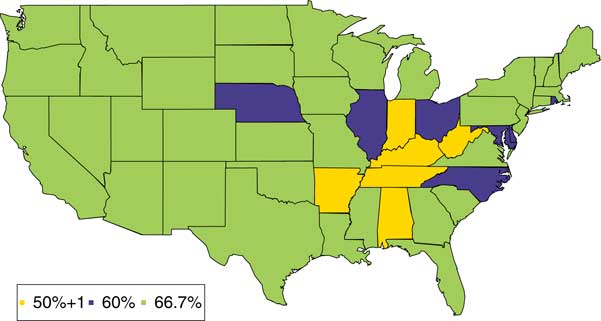
We address both of these challenges by conducting a comparative study of executive success in the American states. We focus specifically on governors’ success in bargaining with legislatures over the size of the state budget. States exhibit the same kind of variation in the number of legislators required to override a veto found in presidential systems more generally, as Figure 1 shows. Seven states require a three-fifths vote of members to override a veto, six states require a simple majority coalition, while the remaining 37 states impose a two-thirds override requirement.Footnote 3 This variation allows us to examine how institutional arrangements affect political power by comparing levels of executive influence in states with higher override thresholds to executives in states with lower override thresholds.
Veto override requirements by state Note: North Carolina did not provide for a gubernatorial veto until 1997. Alaska and Hawaii both have two-thirds override requirements.

The budgetary process in the American states conforms quite well with the bilateral veto game that characterizes executive–legislative relations in Latin America (Cox and Morgenstern Reference Cox and Morgenstern2001). In every US state, just like in virtually every presidential system, governors are required to submit a budget proposal to the legislature. The legislature passes a budget of its own, relying heavily on the governor’s proposal, and then sends it back to the governor for approval. If the governor approves of the budget, he signs it; if not, he can veto it and send it back to the legislature, who can then attempt to override the veto.Footnote 4 Lacking the votes to override, then, the state is without a budget.
Just as importantly, because governors propose budgets and legislatures enact budgets, the differences between these quantities provides a clear and continuous measure of executive success. Smaller differences between proposed and enacted budgets imply that governors are more successful at achieving their desired budgetary outcome. By converting these quantities into per capita budgetary figures, differences in gubernatorial success can be easily compared across states.
Finally, budget data ameliorate several other measurement concerns in the study of executive influence. Because governors do not express preferences on all matters before their legislature, but instead are likely to strategically announce preferences on those items on which they are likely to be successful, roll call “box scores” are likely to be biased measures of executive influence (King Reference King1993; Howell, Jackman and Rogowski Reference Howell, Jackman and Rogowski2013). Second, legislatures delegate significant and varying amounts of discretion to executives across policy areas (Huber and Shipan Reference Huber and Shipan2002), and thus roll call analyses are likely to mask delegations of power from legislative to executive institutions (Canes-Wrone, Howell and Lewis Reference Canes-Wrone, Howell and Lewis2008).
In addition to examining how veto powers advantage executives in bargaining with legislatures, we contribute to literatures on Latin American budgetary institutions and the study of gubernatorial power in the United States. First, though scholars have identified a range of factors that contribute to budgetary outcomes in Latin America, including the centralization of the budget process (Alesina et al. Reference Alesina, Hausmann, Hommes and Stein1999; Baldez and Carey Reference Baldez and Carey1999; Hallerberg and Marier Reference Hallerberg and Marier2004), electoral systems and budgetary procedures (Stein, Talvi and Grisanti Reference Stein, Talvi and Grisanti1999), party strength (Neto and Borsani Reference Neto and Borsani2004), and the distribution of budgetary influence across national and sub-national governments (Garman, Haggard and Willis Reference Garman, Haggard and Willis2001), existing research generally does not address the ways in which the formal division of power between the executive and legislative branches affects budgetary decisionmaking.
Second, the formal institutional bases of gubernatorial power in the United States remain largely unexplored. Though state politics scholars have long been attuned to how institutional differences across states may contribute to varying degrees of gubernatorial influence, this literature generally examines how legislative characteristics, rather than institutional sources of gubernatorial powers, affect influence over policy. For example, Kousser and Phillips (Kousser and Phillips Reference Kousser and Phillips2009; Kousser and Phillips Reference Kousser and Phillips2012) examine gubernatorial influence as a function of the nature of the policy over which the branches bargain and the professionalism of the legislature (see also Squire Reference Squire1997; Kousser Reference Kousser2005; Mooney Reference Mooney2009). Professionalism increases the legislature’s capacity to bargain; some legislatures meet for longer periods of time and thus can be more patient in bargaining with the governor, making them relatively more successful in achieving their policy preferences. Moreover, while scholars have developed empirical measures of institutional gubernatorial powers using factors such as appointment powers, partisan support in the legislature, and line-item veto authority (e.g., Schlesinger Reference Schlesinger1965; Beyle Reference Beyle1968; Dometrius Reference Dometrius1979; Krupnikov and Shipan Reference Krupnikov and Shipan2012), these measures do not distinguish the effects of institutional arrangements separately from other factors.
Budgetary Bargaining and Interbranch Conflict
Budgetary politics is an excellent setting in which to examine how veto institutions affect executive influence over policy outcomes. Budgets are among the most important responsibilities of legislatures, as the failure to pass a budget, unlike other legislation, results in an extreme (and undesirable) reversion point (Kousser and Phillips Reference Kousser and Phillips2012).Footnote 5 Executives and legislators across governments must agree on funding levels for national, state, and local programs, and the actors in each branch and the bureaucracy often have substantially different interests and competing incentives (Sharkansky Reference Sharkansky1968). As a result, statehouses are frequently roiled by controversy over spending priorities, especially in tight fiscal climates.
Previous scholarship on budgetary outcomes tends to focus on how executive influence is shaped by information asymmetries between the branches, line-item veto powers, agenda-setting capacities, and the role of political context. A sizable literature emphasizes the advantages of information in interbranch bargaining, in which executives wield greater influence when informational asymmetries work in their favor (e.g., Howell, Jackman, and Rogowski 2013).Footnote 6 Beyle (Reference Beyle1968) writes that informational asymmetries are even greater in states than they are at the federal level, and concludes that governors are more successful in bargaining with state legislatures than presidents are in setting the size of the budget.Footnote 7 The empirical findings with respect to the line-item veto are mixed at best, with Kousser and Phillips (Reference Kousser and Phillips2012, 206) and Carter and Schap (Reference Carter and Schap1990), among others, concluding that it provides limited advantages if any.Footnote 8 In studying presidents’ influence in Latin America, by contrast, scholars have tended to focus on the presidents’ agenda-setting powers (Baldez and Carey Reference Baldez and Carey1999; Tsebelis and Alemán Reference Tsebelis and Alemán2005), which provide a built-in institutional advantage that is largely separate from veto authority. Finally, research on outcomes other than budgets in the United States tend to find that executive success increases with public approval ratings (e.g., Edwards Reference Edwards1976; Rivers and Rose Reference Rivers and Rose1985) and when the executive’s copartisans have a greater share of legislative seats (Erikson, Wright and McIver Reference Erikson, Wright and McIver1993; Wright and Schaffner Reference Wright and Schaffner2002).
Developing an Argument About Veto Institutions and Executive Influence
We argue that the nature of veto power is an important source of executive influence, and specifically that the requirements to override a veto play a significant role in shaping budgetary outcomes across the states. In particular, as the number of legislators required to override a veto increases, the legislature must assemble a larger coalition in order to pass its preferred policy into law. Thus, the executive is more empowered relative to the legislature when the override requirement is higher.
We illustrate this argument using pivot-based models of lawmaking (e.g., Krehbiel Reference Krehbiel1998). We assume that the executive’s and legislature’s preferences can be arrayed along a single ideological dimension, and that each institution’s pivotal actors, or those whose consent is necessary for a proposal to become law, must prefer the proposal in order defeat the status quo. As Krehbiel (Reference Krehbiel1998) points out, because lawmaking power in the American system is separated between the chambers and the president, any successful law requires not only agreement from the median legislator, but also from the executive or the veto override pivot in both chambers.Footnote 9 When the legislature and the executive have conflicting preferences about a particular policy proposal, the legislature’s preferred proposal can become law only if the legislature has the requisite number of votes to override a veto. As this requirement increases, the executive gains leverage in extracting policy concessions from the legislature.
In all states, like the federal government, the executive sets the agenda by proposing a budget. The legislature responds to this initial offer by accepting the budget, or by changing it via increases or decreases in spending. The legislature’s budgetary demand is determined by the median legislator, whose support is necessary to pass the budget. The median legislator may have strategic incentives to support a budget that differs from her own ideal point, depending on the governor’s budgetary preferences and the preferences of the legislator whose support is necessary to override a potential veto (Kiewiet and McCubbins Reference Kiewiet and McCubbins1988).Footnote 10
Once the median approves a budget, the governor may choose to sign it, resulting in enactment, or may veto the proposal. In the event of a veto, the legislature may either re-pass its budget through a successful override vote, or may acquiesce to the governor’s demands if it is unable to muster enough votes for a successful override. Because budgets are mandatory legislation and have a reversion point of 0 in most states (Adler and Wilkerson Reference Adler and Wilkerson2012; Klarner, Phillips and Muckler Reference Klarner, Phillips and Muckler2012; Kousser and Phillips Reference Kousser and Phillips2012), the failure to pass a budget results in a government shutdown, making the status quo always less attractive than any non-zero proposal.
A gubernatorial veto can be overridden only when the legislature’s override pivot prefers the median legislator’s proposed budget to the governor’s preferred budget. In the event of a veto, the median legislator must either accept policy closer to the governor’s preference or risk a shutdown if there are insufficient votes to override. Importantly, the location of the veto pivot corresponds to the institutional rule required to override; in states with a majority override requirement, the median and veto override pivot are the same actor, implying that the median’s budgetary preferences will always be enacted (Black Reference Black1948), regardless of the preferences of the governor.Footnote 11 In states that require three-fifths of the legislature to override a veto, however, the median and veto override pivot have different ideal points, and given most distributions of legislators across an ideological spectrum, the three-fifths override legislator’s ideal point is relatively distant from the median, making it less likely that the override pivot prefers the median’s budget. This situation empowers the governor to veto budgetary bills, forcing the legislature to re-pass a vetoed budget closer to the governor’s ideal point. And in states with a two-thirds veto override requirement, the veto pivot is even further from the median, making the governor’s veto an even more powerful tool with which to extract budgetary concessions from the legislature.
Furthermore, based upon the pivotal politics theory, supermajoritarian override requirements advantage governors when gubernatorial preferences fall outside of the gridlock interval bounded by the median legislator and the relevant override pivot. If the governor’s preferences are relatively moderate with respect to the preferences of the legislature, such that the governor’s ideological position is in between the preference of the median legislator and the override pivot, the governor can propose her ideal budget and the legislature will pass it because the median and the override pivot cannot modify the budget to better accommodate both their preferences. But if the governor’s preferences are relatively extreme compared with the median legislator and the override pivot, veto bargaining will ensue and the override requirement will affect the degree to which the legislature accommodates the governor’s preferences.
Thus, given that the key institutional actors must all agree to enact policy, we expect that governors are less successful in influencing budget outcomes in majority override states where the median legislator has the power to unilaterally pass her ideal budget over the objections of a relatively toothless governor. Increasing the veto override threshold, however, increases a governor’s leverage relative to the legislature. Consider the case of a governor with relatively extreme policy preferences. Legislatures in majority override states can effectively ignore the governor; regardless of the dollar amount the governor proposes for a particular policy, the median legislator can move expenditures to exactly her ideal point. Legislatures in three-fifths and two-thirds states, however, are relatively weaker compared with the governor because of the difficulty in assembling a coalition large enough to override a veto. When legislators cannot assemble a large supermajority coalition, they must agree to a policy closer to the governor’s preference (technically, at the override pivot’s ideal budget). Based on this logic, we expect that as the override threshold increases, governors will be more successful in achieving their budgetary preferences.
Veto Override Power Conditional on Executive Preferences
In related research, Kiewiet and McCubbins (Reference Kiewiet and McCubbins1988) use a distributive model to argue that veto power allows the president to exert greater influence over appropriations only when the executive prefers a lower level of spending. Using a one-dimensional spatial model where spending equals 0 on the far left and increases as one moves to the right, it is easy to understand why this is the case. If the pivotal legislative actor prefers lower spending, the legislature can simply pass a budget at its ideal point. The executive, faced with a choice between the reversion point (at the far left) and the median’s preference, will choose not to veto as the legislature’s ideal point is closer to the executive’s than the reversion point, at or near 0. However, if the executive prefers a lower spending amount than the legislature, a veto may occur if the executive also prefers the reversion point to the legislature’s offer.Footnote 12 In turn, once a veto becomes necessary, the majority coalition must consider the location of the veto pivot, and supermajority rules are likely to empower the governor, as the override pivot location moves toward the reversion point.
In this distributive model, the location of the reversion point becomes crucial. As Klarner, Phillips and Muckler (Reference Klarner, Phillips and Muckler2012, 994) detail, failing to pass a budget by the start of the fiscal year results in a partial government shutdown in 22 states. During a shutdown, public employees are temporarily laid off, government contractors are not paid, state facilities are closed, and many government services are suspended. In these states, it is unlikely a governor would prefer a government shutdown to a higher level of budgetary spending unless the governor was particularly anti-spending and the legislature passed an extremely large budget. In other states in which a partial government shutdown does not result, or in states which allow for continuing resolutions, identifying the reversion point becomes more difficult. Moreover, while continuing resolutions can be (and often are) used for financing the US government when no budgetary agreement has been reached, they are only used in nine states and “are not common or important considerations in state budget negotiations” (Kousser and Phillips Reference Kousser and Phillips2009, 57). The ambiguous reversion point in many states raises the possibility that governors may be able to influence policy even when they prefer more spending than the legislature. Nonetheless, to empirically address this problem, we supplement our main analyses by examining only the subset of states in which governors proposed a smaller budget than was passed by the legislature. In these cases, we expect supermajority veto power to produce budgets closer to the governor’s preference consistent with the claims made above.
Endogeneity Concerns
Our empirical approach below requires that state-level veto requirements be exogenous to gubernatorial success in budget bargaining. In particular, we hold that structural veto rules are not the consequence of, nor always covariant with, some other budgetary procedure that increases or decreases gubernatorial success. Although simple majority override states seem to be geographically clustered (see Figure 1), these states do not distinctly share many other rules that distinguish them from supermajority states. The simple majority override states are about average on most important observable covariates such as legislative professionalism, population, and other budgetary rules, nor is it the case that governors in these states have a unique history of legislative success or failure.
In addition, as veto rules are constitutional in nature, states do not regularly change their veto override provisions to ephemerally provide more or less gubernatorial power in conjunction with budget-specific reforms. Although states have changed their veto override rules, these changes were driven by the desire to change the institutional balance of power in states, rather than simply reflecting the pre-existing power structure (see e.g., McGrath, Rogowski and Ryan Reference McGrath, Rogowski and Ryan2015a; McGrath, Rogowski and Ryan Reference McGrath, Rogowski and Ryan2015b). While some southern states tend to have weaker governors due to historical distrust of the executive arising from military governors after the Civil War, this is not the case for Illinois, Indiana, Ohio, West Virginia, Kentucky, Maryland, or Delaware. Further, many of the states with non-supermajority requirements became states at a similar time, in the early to mid-1800s, but this is not likely to be correlated with modern day budgetary success, especially since the modern budget process did not take root until the middle of the 19th century. Importantly, we also find significant differences in gubernatorial bargaining success within the supermajority states (i.e., between the three-fifths and two-thirds override states), which are far more heterogeneous with respect to observable characteristics. This further assuages endogeneity concerns in the present study.
State Budgetary Proposals and Enactment Data
To assess the extent to which larger veto override requirements empower governors, we collected data on gubernatorial budgetary proposals and legislative enactments from the Fiscal Survey of the States (FSS) for the fiscal years 1987 through 2011 (National Association of State Budget Officers 1987–2011).Footnote 13 These reports are published twice each year—in the spring (March/April) and in the fall (September/October). The spring report records the aggregate general fund budget requested by each governor and the fall report notes the actual budget enacted by the state legislature for each fiscal year. The unit of analysis is the state-year. We follow previous research (Kousser and Phillips Reference Kousser and Phillips2012) and omit Alaska, Nebraska, and Wyoming from all analyses.Footnote 14 In addition, there are a number of instances of missing data within the FSS reports, with governors proposing or legislatures enacting budgets after each year’s date of publication. Accounting for the missing data, there are a total of 1162 observations in our full data set.Footnote 15
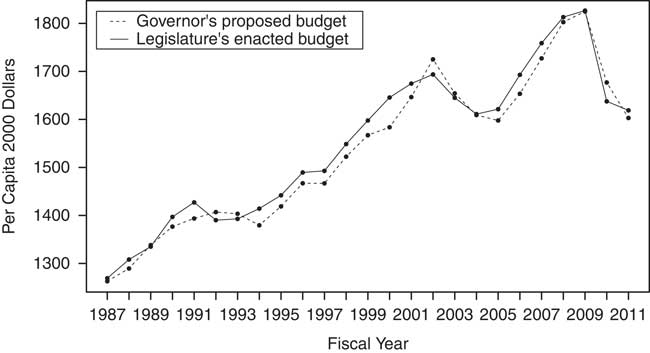
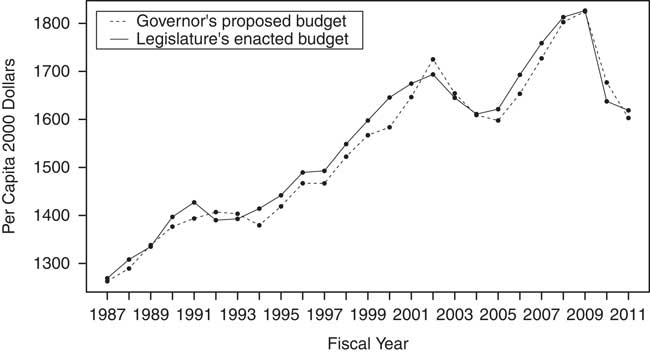
Across the data, the mean budget request by governors (standardized to year 2000 dollars using the consumer price index) is $9.1 billion (SD: $11.0 billion; range: $531.3 million–$82.5 billion) and the mean general fund enacted budget is $9.2 billion (SD: $11.1 billion; range: $531.3 million–$84.1 billion), indicating that governors often get very close to what they propose on the whole. Of course, state population is an important determinant of total budgetary spending, so we transform these data into per capita measures. Figure 2 displays the averages of governors’ proposed budgets per capita (dashed line) and the legislatures’ enacted budgets per capita (solid line) for each fiscal year. Strikingly, state budgets, both proposed and enacted, have increased considerably—around 50 percent—over the past quarter century. Though the two lines closely track each other, the figure also reveals a good amount of variation in the differences between proposed and enacted budgets. In some years, such as 2002 and 2008, governors and legislatures appear very far apart when it comes to budgeting. But in others, such as 2004 and 2009, the average differences between proposed and enacted budgets nearly vanish. This temporal variation, combined with state-level variation in political and institutional conditions, provides an excellent opportunity to examine how veto override requirements across states affect gubernatorial success in budget bargaining.
Proposed and enacted state budgets Note: Alaska, Nebraska, and Wyoming are omitted from the calculations.
Dependent Variables
For each state-year, we use the FSS data to construct a commonly employed measure of executive success in budgetary bargaining (Kiewiet and McCubbins Reference Kiewiet and McCubbins1988; Canes-Wrone, Howell and Lewis Reference Canes-Wrone, Howell and Lewis2008; Howell and Jackman Reference Howell and Jackman2013), equal to the difference between the governor’s budget request and the enacted budget. To allow for comparisons across states, we adjust these figures by state population:
 $$\left| {\left( {{{Gov.\,Proposed\,Budget_{{it}} } \over {population_{{it}} }}} \right){\minus}\left( {{{Enacted\,Budget_{{it}} } \over {population_{{it}} }}} \right)} \right|.$$
When this variable takes a value of 0, governors received exactly what they asked for from the state legislature. Gubernatorial success, however, decreases as the value of this variable increases. Thus, in the resulting regressions, positive coefficients on covariates indicate a negative relationship with gubernatorial success, and negative coefficients indicate that the covariate has a positive influence on success. This characterization of the dependent variable is especially useful in that it is consistent with the spatial framework of the pivotal politics model; governors propose their ideal points, and prefer smaller deviations from these locations to larger deviations.Footnote 16
We also considered two alternative characterizations of the dependent variable that accounts for the oftentimes incremental nature of state budgets. Research at the federal level (e.g., Wildavsky Reference Wildavsky1964; Fenno Reference Fenno1966) shows that relevant actors, including requesting agencies, think of budgets in terms of previous budgets and do not consider significant increases or decreases as feasible outcomes. Thus, it may be appropriate to model gubernatorial preferences and legislative enactments as a function of the previous budget. We follow Canes-Wrone, Howell and Lewis (Reference Canes-Wrone, Howell and Lewis2008) in doing just this and measure gubernatorial preferences by the percentage change the governor’s request would represent relative to the previous enacted budget. We similarly measure the percentage change in the legislature’s budget enactment compared with what they enacted the previous year. As above, we take the absolute difference between these two as measure of gubernatorial success:
 $$\left| {\left( {{{Gov.\,\,Proposed\,Budget_{{it}} } \over {Enacted\,Budget_{{it{\minus}1}} }}} \right){\minus}\left( {{{Enacted\,Budget_{{it}} } \over {Enacted\,Budget_{{it{\minus}1}} }}} \right)} \right|{\times}100.$$
We also estimated models in which the dependent variable is the absolute value of the difference between the governor’s proposal and the enacted budget, divided by the size of the enacted budget.Footnote 17 Using these alternative characterizations of the dependent variables produces estimates that are substantively identical to those shown in the main text, providing evidence that governors are more successful in states with supermajority override requirements. The estimates from these models are shown in Tables A.1 and A.2, respectively, in the Supplementary Appendix.
Empirical Strategy
Our empirical strategy proceeds in two parts. According to our theory, a supermajoritarian veto override requirement promotes gubernatorial success, so we first develop a set of empirical tests meant to test this relationship. In the second set of tests, we parse the effects of three-fifths and two-thirds override requirements. By comparing the two thresholds, we attempt to determine whether governors in two-thirds override states are significantly more successful than those in three-fifths states, an additional prediction from the theory.
Our key independent variables are, first, an indicator for whether each state had a simple majority override threshold or a supermajority override requirement, and second, an indicator for the type of override requirement (majority, three-fifths, or two-thirds).Footnote 18 In the first set of models, we expect the indicator for a supermajority override requirement to be negatively signed, indicating greater gubernatorial success. In the second set of models, we expect both indicators to be negative, with the indicator for states with two-thirds override requirements larger in magnitude than the indicator for states with three-fifths requirements. We account for additional factors that may influence a governor’s success in setting the size of the budget. Because success may depend on what the governor requests, we include the logged value of the governor’s proposed budget (in 2000 dollars), following the intuition that legislatures might be more likely to accept small budget proposals than very large ones. We also include an indicator for whether the governor possesses a line-item veto, as governors do in 43 states; after all, governors may be better able to realize their budgetary objectives if they can strike individual line-item appropriations from the budget passed by the legislature.Footnote 19 Gubernatorial success may also depend upon the level of political support in the statehouse, which we assess in two ways. First, we include an indicator for divided government, which indicates conditions when at least one chamber of the legislature is controlled by a party opposite the governor’s, as divided government has important constraining effects on budgetary bargaining between the branches (Alt and Lowry Reference Alt and Lowry1994). We also include a measure of the proportion of lower chamber seats held by the governor’s party in a given year (Klarner Reference Klarner2003).Footnote 20
Research on budget bargaining in the states points to the particular importance of legislative bargaining capacity (e.g., Kousser and Phillips Reference Kousser and Phillips2012) in affecting gubernatorial success. Thus, we account for legislative professionalism using each state’s “Squire Index” (Squire Reference Squire1992; Squire Reference Squire2007).Footnote 21 We include two variables, the per capita gross state product (GSP) and a logged measure of the state unemployment rate, to capture the influence of state-level economic health on budget bargaining. These economic variables are meant to describe the extent to which governors may benefit from propitious economic conditions or be harmed by poorly performing economies (Ferguson Reference Ferguson2003).
Beyond these core controls, our most-preferred models account for additional features of state government that may constrain gubernatorial influence over the budget. These include indicators for various sources of gubernatorial budgetary power identified in Krupnikov and Shipan (Reference Krupnikov and Shipan2012), which account for the governor’s ability to spend funds without legislative approval, the governor’s power to reorganize budget-related departments without legislative approval, the governor’s power to unilaterally reduce the budget, and whether the governor has the authority for budget preparation. We also include indicators for whether the state has the initiative process, and whether the state has a tax and expenditure limit in place, as both have been shown to have important effects on state policymaking and may reduce the governor’s budgetary discretion (Matsusaka Reference Matsusaka2004; New Reference New2010).
We include a lagged dependent variable to help address concerns about potential unobservables. By including this lagged dependent variable, we condition on previous outcomes (the difference between the governor’s proposed and enacted budget in the prior year), which themselves are a combination of observed and unobserved state-level factors. However, we acknowledge that there may be unobservable differences between states with norms or cultures of “strong” and “weak” governors, and the lagged dependent variable approach may not allow us to fully account for these potential differences. We also include year fixed effects to account for any unmeasured year-specific factors that may also affect gubernatorial success. We cluster the standard errors on governors to account for governor-specific correlations in the error terms.
Results
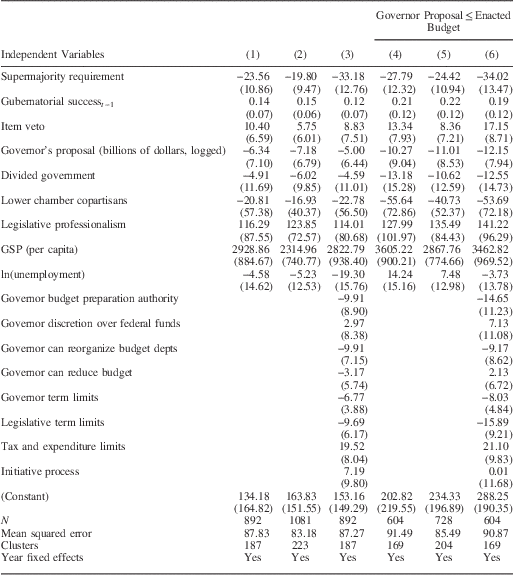
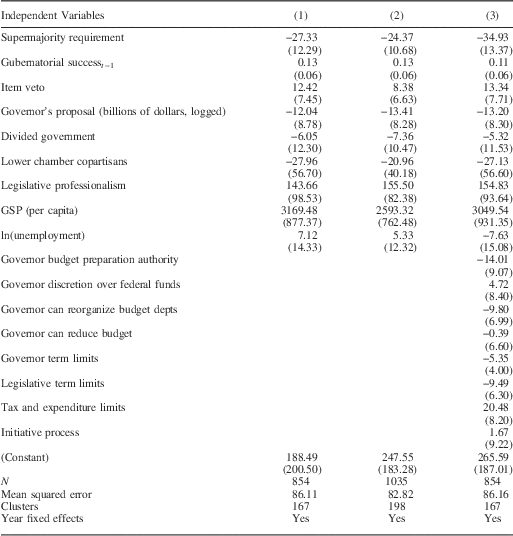
Table 1 displays the results for our first set of models. Recall that a negative coefficient indicates that an increase in the independent variable resulted in more gubernatorial success.
Supermajoritarian Override Requirements and Gubernatorial Success

Note: Entries are linear regression coefficient estimates and standard errors, clustered by governor. The dependent variable is the absolute value of the difference between the governor’s proposed budget (per capita) and the legislature’s enacted budget (per capita). The supermajority variable in models (1) and (3) indicates states with a veto override threshold of three-fifths or two-thirds, excluding states with supermajority budgetary passage requirements. In model (2), the supermajority variable indicates states with three-fifths or two-thirds veto override requirements or states that require legislative supermajorities to approve the state budget. Year fixed effects are included in all models but not reported. Alaska, Nebraska, Maryland, and Wyoming are excluded from all models.
The models in columns (1) and (2) include our core covariates which may intervene in the relationship between a supermajority override requirement and a governor’s budgetary success. In the first model, we exclude states that require a legislative supermajority to pass a budget, while they are included in the second model but coded as supermajority states. Several states with supermajority budgetary requirements also have either a three-fifths or majority veto override (Arkansas, Illinois, and Rhode Island) and by excluding them we lose variation on our key independent variable, though as the models show, the coefficients are virtually identical across the two models. In the third model (column (3)), we exclude states with supermajority budget requirements, and we include a larger set of covariates as described above.
As expected, the lagged gubernatorial success variable is positive, <1, and significant in each of the three models. This indicates that gubernatorial success in a previous year predicts success in the following year, and can account for a significant amount of the variation in year-to-year success. This variable reflects the fact that budgetary negotiations between legislatures and governors are not independent events, but reflect long-term relationships between the two institutions.
Across all three models, the coefficient for states with a supermajority override requirement is negative, large in magnitude, and statistically significant. In models with a lagged dependent variable, we can interpret the coefficients on these indicators (and on all other variables) as the short-term effect of an increase in the veto override requirement from a simple majority to a higher threshold (either three-fifths or two-thirds). Thus, states that require a legislative supermajority to override a gubernatorial veto pass budgets that are significantly closer to the governor’s preferences than states with simple majority override requirements. As the results show, this relationship is robust to the specification of the supermajority variable and the inclusion of a wide range of covariates, and suggests that governors are more successful, in the short term, realizing their budgetary preferences in states with supermajority override requirements by between $20 and $33 per capita.
The long-term effect of adding a supermajority override requirement can be found by dividing the supermajority coefficient by 1−Gubernatorial success t−1. This increases the effect in all models by slightly more than the short-term effect, such that in column (1) of Table 1, the long-term effect is −27.40. Similarly, the long-term effects in columns (2) and (3) are −23.29 and −37.70, respectively. However, we should note that these effects are not statistically distinguishable, and that the long-term effects over a four-year period (the typical length of term for a governor) do not differ significantly from the short-term effect.Footnote 22
Interestingly, the evidence for the importance of the override requirement is stronger than for most of the other factors included in the model. The coefficient for the availability of the item veto is positive, the opposite direction from expectations, suggesting that governors have less budgetary influence when they are able to strike line-item appropriations, but this coefficient falls short of conventional levels of statistical significance. Moreover, the signs for the coefficients for the degree of political support within the legislature are inconsistent; divided government and increased shares of copartisans within the lower chamber both appear to be associated with decreased gubernatorial success, but neither coefficient is statistically distinguishable from a null effect. Consistent with the results found in Kousser and Phillips (Kousser and Phillips Reference Kousser and Phillips2009; Kousser and Phillips Reference Kousser and Phillips2012), the coefficient for legislative professionalism is also positive (though relatively imprecisely estimated), indicating that governors are less successful when bargaining with more professionalized legislatures.Footnote 23 Interestingly, the coefficients for gross state product are all positive and statistically significant, suggesting that governors are less able to dictate budgetary terms in prosperous times.
In the third model, which includes additional covariates for gubernatorial constraints, we find that state tax and expenditure limits promote legislative independence, resulting in decreased gubernatorial success, while, surprisingly, the restrictiveness of the governor’s term limits appears to increase their success (though this coefficient falls just short of statistical significance). None of the other coefficients reach statistical significance.
Columns (4) through (6) replicate the previous three models’ specifications, but are limited to the sub-sample in which the governor’s proposal was less than that enacted by the legislature. According to the Kiewiet and McCubbins (Reference Kiewiet and McCubbins1988) distributive politics model, the veto will be effective only when the governor prefers less spending than the legislature and when the veto is a credible threat because the governor also prefers the reversion point to the legislature’s budget. The estimated effect of a supermajority veto override requirement is remarkably similar to the three previous models, and the point estimates are greater for each specification, though the differences are not statistically significant. This robustness check confirms our theoretical claims regarding supermajority veto power while suggesting that the observed effects of the distributive model proposed by Kiewiet and McCubbins are similar to those derived from a preference-based spatial model.
The substantive effects of the override requirements in each of the six models are quite large. Legislative professionalism has long been cited as an antidote to egregious displays of power from governors (Rosenthal Reference Rosenthal1990), and our coefficient estimates (though they are not all statistically significant with respect to professionalism) suggest that professionalism and the override requirement may have countervailing implications for executive power. For instance, Squire (Reference Squire2007) shows that Wisconsin’s level of legislative professionalism increased from 0.27 to 0.46 between 1986 and 1996. Based on the coefficient estimates shown in model (3) above, we would expect that this would decrease gubernatorial success by about $22 per capita.Footnote 24 Similarly, the results for override requirement indicate that increasing the number of votes to override a veto from a simple majority to a supermajority increase gubernatorial success by between $20 and $33 per capita. Thus, if Alabama, which currently has a simple majority override requirement (and a 2012 population of 4.8 million), were to rewrite its constitution and provide for a supermajority override requirement, our estimates suggest that Alabama governors would be more successful in achieving their budgetary requests by between $96 and $158 million.
As a final examination of our six empirical models, we use the lagged success variable to predict long-term gubernatorial success under different conditions of legislative professionalism and divided government. Perhaps surprisingly, the estimated long-term effect of a supermajority veto override requirement does not change in any meaningful way based on party control of the lawmaking institutions; the predicted value is virtually identical under both situations and remains unchanged across the four years for which we simulated. Increasing legislative professionalism from its mean to maximum value results in a fairly substantive decrease in long-term gubernatorial success, producing a predicted value twice as large during both periods of unified and divided government, and making governors slightly less successful across each successive year.Footnote 25 Yet, because of the rather large standard errors for the legislative professionalism variable, this effect is not statistically significant at the 0.05 level, nor are the differences across each of the years significantly different. Thus, though the substantive result is quite strong, we cannot say with confidence that legislative professionalism produces a dynamic negative effect over time on gubernatorial success.
Different Supermajority Veto Override Veto Thresholds
After finding that, consistent with our expectations, supermajoritarian veto override requirements increase gubernatorial success in budgetary negotiations with the legislature, we now look for evidence that governors are more successful in states with two-thirds override requirements than they are in states with three-fifths override requirements. For each override dummy variable, we expect there to be a significant negative coefficient, demonstrating that each override indicator is statistically different from a majority override, the excluded category. We further expect the two-thirds override indicator to be larger and statistically distinguishable from the three-fifths override indicator. To assess these hypotheses, we estimate the same three models shown in Table 1, but include separate indicators for states with three-fifths and two-thirds override requirements.
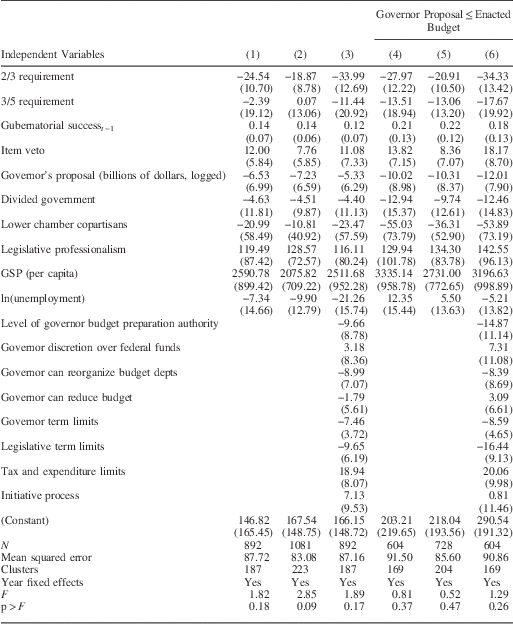
The results are shown in Table 2. As the table shows, the coefficients for states with two-thirds override requirements are negative and statistically significant across all three models, indicating that governors are substantially more successful in states with two-thirds requirement than in states with simple majority override requirements. The coefficients for states with three-fifths requirements are negative (the expected direction) in two of the three models; however, they do not reach standard levels of statistical significance. Moreover, the results of the Wald test (shown in the bottom panel of the table) show that the coefficients for two-thirds and three-fifths states are statistically distinguishable at varying levels. Again, we replicate our models in columns (4), (5), and (6) for those instances in which the governor proposed a smaller budget than that enacted by the legislature. Here, the point estimates for the three-fifths override are much larger, though like those in columns (1) through (3), they do not reach the standard level of significance. However, the variable for two-thirds override is negative and statistically significant, consistent with the theory and the results from Table 1.
Budgetary Success by Override Requirement in States

Note: Entries are linear regression coefficient estimates and standard errors, clustered by governor. The dependent variable is the absolute value of the difference between the governor’s proposed budget (per capita) and the legislature’s enacted budget (per capita). The supermajority variable in models (1) and (3) indicates states with a veto override threshold of three-fifths or two-thirds, excluding states with supermajority budgetary passage requirements. In model (2), the supermajority variable indicates states with three-fifths or two-thirds veto override requirements or states that require legislative supermajorities to approve the state budget. Year fixed effects are included in all models but not reported. Alaska, Nebraska, Maryland, and Wyoming are excluded.
On the whole, the results in this table provide suggestive, though not dispositive, evidence that governors in states with two-thirds override requirements are more successful than governors in states with either simple majority or three-fifths override requirements, and, more tentatively, that governors in states with three-fifths override requirements are more successful than governors in states with simple majority override requirements.
As the results in Table 2 highlight, we are presented with a number of empirical difficulties in identifying the effect of the three-fifths override requirement. First, as indicated above, considerably more states have two-thirds override requirements than three-fifths requirements; and furthermore, many of the states with three-fifths override requirements do in fact require two-thirds or even three-quarters support to pass a budget. Thus, the small sample size makes it difficult to obtain precise standard errors.
Second, the theory suggests that the override requirement empowers the governor only when the governor’s ideal point is external to the gridlock interval, bounded by the chamber median and the chamber override pivot. If the governor is inside the gridlock interval, she will receive her ideal point and any effects of the override requirement will be attenuated. Thus, though the results in Table 2 provide suggestive support for our expectations, it is likely that the recovered coefficients for the indicators for override requirements suffer from attenuation bias. That is, because the sample combines scenarios in which the governor’s budgetary preferences are internal and external to the gridlock interval, and the theory leads us to expect that the override requirement should have no effect when the governor’s preferences fall within the gridlock interval, the coefficients for the indicators for override requirements are likely biased toward 0. If we were able to recover the true parameter estimates, then, the results may support stronger statistical inferences.
Unfortunately, identifying those situations in which governors’ preferences are exterior to the gridlock interval is not straightforward. To date, there are no gubernatorial analogues to DW-NOMINATE scores that can be compared across states, years, and legislatures.Footnote 26 Instead, we rely on an indirect approach. We use data from Shor and McCarty (Reference Shor and McCarty2011) on state legislative ideology to estimate the size of the gridlock intervals in each year and chamber.Footnote 27 The gridlock interval is calculated as the absolute ideological distance between the chamber median and the veto override pivot. Because the relevant constraint is the larger of the two chambers’ distance, for each state we code the larger of the two gridlock intervals as the state’s gridlock interval. The gridlock size for majority override state is coded as 0.
We replicate the analyses found in Table 2 by focusing on those subsets of states with arbitrarily small gridlock intervals. We test two expectations that are consistent with our argument about attenuation bias. First, for state legislatures where the gridlock interval is small, we should obtain stronger evidence in support of the relationship between gubernatorial success and override requirements. Second, as we limit our focus to states with increasingly small gridlock intervals, the magnitudes of the coefficients for the indicators of override requirements should increase.
The median size of the gridlock interval across all years and states is approximately 0.35. Thus, we focus only on those subsets of states where the gridlock interval falls below this threshold. We then re-estimate these models for states where the gridlock interval is even smaller: 0.25 and 0.15. For each of these models, the coefficients for states with two-thirds requirements is negative and statistically significant. Moreover, the magnitude of the coefficient increases monotonically in size for states with smaller gridlock intervals. We find the same trend for states with three-fifths gridlock intervals. The coefficient is negative for states with gridlock intervals of 0.25 units or smaller, and is negative, larger in magnitude, and statistically significant when re-estimating the model for states with gridlock intervals of 0.15 units or smaller.
Examined differently, among states with three-fifths override requirements, we compared the differences between proposed and enacted budgets for states whose gridlock interval sizes were in the upper and lower terciles. The average difference in states where the gridlock intervals were larger than 0.20 units (the upper tercile) was 83.02 per capita dollars, whereas the average difference in states where the gridlock intervals were smaller than 0.11 units (the lower tercile) was 47.62 per capita dollars. The difference between these two figures is statistically significant at p<0.08, providing additional evidence in support of our claim that the results in Table 2 underestimate the true magnitude of the relationship between override requirements and gubernatorial success.
Strategic Requests and Gubernatorial Success
The findings above indicate that there are smaller differences between proposed and enacted budgets in states with higher veto override requirements. While the results are consistent with this interpretation, they are also consistent with an alternative interpretation of the relationship between what governors request and legislatures enact. Namely, governors may be strategic about their budgetary proposals based upon the bargaining environment shaped by the nature of the override rule.
Consider the following example. Suppose a governor prefers a smaller budget than the legislature. Though proposal power confers first-mover advantages to governors, they may anticipate that the legislature will revise the budgetary request to reflect its own preferences. According to our argument, the scope of these revisions depends upon the nature of the override requirement. When only a simple majority is required to override a veto, the legislature can substantially increase the governor’s proposed budget because the same simple majority that passes a budget can override the governor’s veto. In contrast, when a supermajority is required to override a veto, the legislature can only undertake modest revisions to a gubernatorial budget in the absence of a supermajority-sized coalition. In the former case, then, the governor may decide to submit a budget request that is considerably lower than his sincere preferences, expecting that the legislature will adjust it upwards. In the latter case, a governor with the same sincere budgetary preferences may submit a budget with a larger funding request, knowing that the legislature will not be able to significantly increase the budget above what he requested.Footnote 28 Thus, the possibility of strategic gamesmanship, in which the override requirement leads governors to strategically propose budgets, based upon their expectations of how the legislature will adjust the submitted budgets, could explain the pattern of results shown above.
Before proceeding, though, it is worth recognizing that existing literature generally fails to find evidence of strategic proposalmaking. For instance, Kousser and Phillips (Reference Kousser and Phillips2012) specifically parameterize a bonus to governors who make proposals that reflect their sincere policy preferences, and argue that governors are incentivized to offer budgets that reflect their sincere preferences because otherwise legislators will refuse to engage in bargaining (Kousser and Phillips Reference Kousser and Phillips2012, 90). In their study of presidential success in congressional appropriations, Kiewiet and McCubbins (Reference Kiewiet and McCubbins1988, 722) argue that budgets send signals to the electorate (rather than to legislators), and thus electoral considerations lead them to expect that a “president’s requests to Congress truthfully reveal his preferences.” More generally, Kiewiet and McCubbins (Reference Kiewiet and McCubbins1991) suggest that partisan differences in what presidents request imply that presidential budget requests are sincere reflections of underlying preferences. In addition, agencies are unlikely to strategically misstate their budgetary needs due to reputational concerns in their interactions with Congress (e.g., Fenno Reference Fenno1966; Padgett Reference Padgett1980, Reference Padgett1981; Wilson Reference Wilson1989). Thus, to the extent that agency requests are the most important source of information for executives as they prepare budget proposals, a governor is unlikely to submit figures to the legislature that attempt to game the system (Forsythe and Boyd Reference Forsythe and Boyd2012).
Nevertheless, to investigate the possibility of strategic proposalmaking, we directly model this potential endogeneity using instrumental variables and two-stage least squares. In the first stage, we estimate a model that explains gubernatorial budget requests as a function of “instruments” that are unrelated to gubernatorial success. Using the coefficients from this model, we generate predicted values for the size of the governor’s budget request, and then use these predicted values in a model that explains gubernatorial budget success. To the extent that our instruments are uncorrelated with gubernatorial budget success except through the size of the governor’s proposal (known as the “exclusion” restriction), and that our instruments are reasonably strong predictors of the governor’s proposal, instrumental variables allows us to account for strategic proposalmaking and recover consistent and unbiased estimates of the association between veto override requirements and gubernatorial success (see Sovey and Green (Reference Sovey and Green2011) for further discussion of the use of instrumental variables in political science).
Following the strategy of Kiewiet and McCubbins (Reference Kiewiet and McCubbins1985) and Howell and Jackman (Reference Howell and Jackman2013) for presidential budgetary requests, we instrument for the governor’s budget proposal on indicators for first-term governors and the year of the governor’s term in office. We expect these instruments to satisfy the exclusion restriction because governors are likely to reduce spending in their first terms in office because agencies are comprised of employees they did not select and enforce policies that are not of the governor’s choosing. As governors have time to select their own agency staff and reorient agency agendas, however, governors increase their proposed budgets.Footnote 29 That is, the length of time a governor has been in office is correlated with the size of the budgetary request, but does not have a causal effect on budgetary success through some other omitted variable.
In addition, we use a third instrument, state population, which also seems likely to satisfy the exclusion restriction because it should influence the total dollar amount requested by governors but would not seem to have any relationship with a governor’s success in budgetary politics.Footnote 30 Logged population is a valid instrument as long as population size of the state has no effect on governor success independent of the governor’s budgetary proposal (i.e., governors in smaller or larger population states are not more or less likely to be successful in negotiating with the legislature). We log population to adjust for its skewed distribution and use all three instruments jointly to re-estimate the models shown in Table 1.
Though we cannot test the exclusion restriction directly, we can test the strength of the instruments as recommended by Angrist and Pischke (Reference Angrist and Pischke2009).Footnote 31 As indicated by the partial R 2 and a joint F-test of all three instruments, they are quite strong, yielding an F-statistic of ~240 in the first model, and thus ameliorating concerns about weak instruments. Interestingly, however, neither of the instruments used by Kiewiet and McCubbins (Reference Kiewiet and McCubbins1985) or Howell and Jackman (Reference Howell and Jackman2013) is statistically significant in the first-stage regression.Footnote 32 The coefficients associated with these indicators are all very close to 0, suggesting the absence of any systematic or substantive relationship with the size of a governor’s proposal. However, the coefficient for the population variable is positive and statistically significant, indicating that, as expected, governors in more populous states request larger budgets. Governors also appear to submit larger budget requests in states with an item veto, more professionalized legislatures, an absence of tax and expenditure limits, a larger GSP, and when governors have greater authority for preparing the budget and spending federal funds. These results are consistent with expectations, and give us additional confidence that our first-stage models are producing substantively meaningful results.
The second stage results are displayed in Table 3. The patterns closely mirror those from our previous analyses. Even if governors are strategic when submitting their budgetary requests, governors in states with supermajority override requirements are considerably more successful in achieving their budgetary goals. In fact, the override requirement is the only institutional factor for which we obtain consistently significant results. Though the item veto and tax and expenditure limits are again associated with decreased gubernatorial success, while gubernatorial authority over budget preparations and ability to reorganize budgetary departments are associated with increased gubernatorial success, these coefficients all fall short of standard levels of statistical significance. We do not instrument for the sub-sample in which governors propose budgets smaller than those enacted. The results from the regressions suggest there is little substantive difference between the two, and instrumenting for strategically low budgets is not substantively different than instrumenting for all proposed types. An examination of proposed budgets by override threshold for the sub-sample (where the legislature enacted budgets greater than the governor’s proposal) demonstrates that there is no difference based on override threshold—proposed sub-sample budgets are nearly identical to those proposed in the full sample. If strategic behavior were to explain the results, governors with higher override requirements would have to submit larger budgets when they prefer less than their legislatures. The lack of differences strongly suggests that the results are not explained by governors’ attempts to strategically game the system in ways that correlate with the override requirement.
Accounting for Strategic Proposalmaking

Note: Entries are second stage coefficients and standard errors, clustered by governor, from instrumental variables estimation. The dependent variable is the absolute value of the difference between the governor’s proposed budget (per capita) and the legislature’s enacted budget (per capita). The supermajority variable in models (1) and (3) indicates states with a veto override threshold of three-fifths or two-thirds, excluding states with supermajority budgetary passage requirements. In model (2), the supermajority variable indicates states with three-fifths or two-thirds veto override requirements or states that require legislative supermajorities to approve the state budget. Year fixed effects are included in all models but not reported. Alaska, Nebraska, Maryland, and Wyoming are excluded from all models.
In summary, we find strong and consistent evidence that the nature of the veto override requirement has important implications for executive influence over policy, as reflected by success in budget bargaining. As the number of votes required to override a veto increases, governors can drive harder bargains with the legislature because it is more difficult for the legislature to assemble coalitions large enough to enact its will over the governor’s objections. As a result, even though no vetoes may actually occur, the nature of the override requirement affects legislatures’ willingness to pass budgets that are palatable enough for the governor’s signature, thereby augmenting gubernatorial power with respect to the legislature. Further, governors who are external to gridlock interval, or relatively extreme to the legislature, are the ones most empowered by high override requirements.
Conclusion
Presidential systems are characterized by separated executives with few legislative powers. In most of these systems, the veto is in fact the only formal power possessed by an executive hoping to influence policy. Previously, little work has explored the importance of veto rules on executive influence, despite its obvious importance in presidential systems around the world. We used one context, the American states, to generalize about the effect of vetoes on budgetary policymaking, an issue area that is among the most important to lawmakers and citizens. The states provide a setting through which we can understand how veto override requirements are likely to empower executives in similar systems, and help policymakers understand how different veto rules affect the relationship between the executive and the legislature when designing or reforming government institutions.
When the Framers designed the American Constitution, one of the gravest fears of the Anti-Federalists was the creation of an executive branch headed by a single individual. In Letter V of the Anti-Federalist Papers, Cato writes that the “great powers of the President … would lead to oppression and ruin.” Cato further warns that, should the states ratify the US Constitution, “[they] will incline to an arbitrary and odious aristocracy or monarchy; [and] that the president possessed of the power, given him by this frame of government differs but very immaterially from the establishment of monarchy in Great Britain.” The provision of veto power was central to these concerns. The British monarch had the power of the absolute veto, and was able to unilaterally strike down measures passed by Parliament. The Federalists, however, pointed to the qualified nature of the president’s veto as a shield against the legislature’s propensity to enact improper laws—and the ability of Congress to overcome a veto should it assemble a supermajoritarian coalition.
The framers’ basic concern about the executive’s power relative to the legislature mirrors scholars’ interest in evaluating the extent to which executive preferences are reflected in policy outcomes. Our analyses indicate that gubernatorial influence over the budget increases as the requirement to override a veto increases. Governors in states with supermajority override requirements are more successful at getting the legislature to agree to their budgetary requests than governors in states with either simple majority override requirements. In other words, when institutional rules require the legislature to take the preferences of the governor more seriously, the governor’s preferences are more likely to become enacted.
The results shown in this paper extend and refine research on the comparative study of political institutions and policy outcomes. For instance, while the number of veto players affects the degree of policy change (Tsebelis 1995), the findings reported here indicate that the nature of key players’ veto powers influences which actors’ preferences are reflected in new policies. More generally, our results call attention to the ways in which key institutional arrangements—including the requirements for a legislature to override an executive veto—structure the underlying bargaining terms between the branches. Importantly, we show that relatively extreme executives are especially advantaged by high override requirements when both branches prefer to avoid gridlock, suggesting conditions under which executives can be relatively successful in achieving their desired policies even when their preferences conflict with the legislature’s.
While the specifics of the budgetary process vary across both the American states and presidential systems more generally, the central finding from this paper sheds light on the importance of how fundamental structural arrangements affect budgetary outcomes. Governors are generally thought to be more empowered formally than the president, due to bureaucratic information advantages and the ability of most governors to use line-item vetoes. In terms of informal power, presidents may be more advantaged in that they have greater access to media attention and a greater ability to go public. Though these differences are no doubt important, our focus here has been on the veto as the most basic shared power possessed by all executives in presidential systems.
In the case of the United States, our results suggest that US presidents are more advantaged vis-à-vis Congress than they would be if the American Founders had instituted a lower requirement for overriding a veto.Footnote 33 In Latin American presidential systems, executives submit budgets to legislatures for approval, and the power of presidents to veto legislative budgets varies widely, as do the legislatures’ ability to override a veto. Though Latin American presidents are reported to be the dominant players in the budgetary process (Stapenhurst 2008), our results suggest that the specific provisions by which presidents and legislatures bargain over the budget play important roles in structuring each branch’s influence over the outcome.
Our findings also highlight the advantages of using institutional differences across sub-national governments to study questions about how institutions affect political outcomes. Even political variables that promote agreement or disagreement between the chambers, such as divided or unified party control, may be less important than the institutional rules which govern the interbranch bargaining process. Elected officials themselves appear to recognize the importance of provisions such as the override requirement for how power is distributed across the branches of government. For instance, in 2013, while Alabama Governor Bob Bentley argued that the simple majority override requirement created one of the weakest governors in the nation, state legislators argued that the relative facility of overriding a gubernatorial veto was important for them to safeguard the interests of their constituents. Even more intriguingly, in 2014, Illinois Republican gubernatorial candidate (and eventual governor) Bruce Rauner helped fund a ballot initiative to increase the number of votes required to override a gubernatorial veto from three-fifths to two-thirds.Footnote 34 And, to the extent that budgetary politics is representative of the legislative process as a whole, our results shed new light on how even relatively small nuances of constitutional provisions have important implications for the distribution of power across branches of government.