Introduction
Discretion, which is an inescapable feature of most administrative decisions, may be performed in ways that discriminate against specific categories of claimants. Two social policy trends make the risk of ethnic discrimination particularly salient. The first trend, known as activation turn, imposes activation requirements on welfare recipients and sanctions on those who fail to comply (Watts et al., Reference Watts, Fitzpatrick, Bramley and Watkins2014). Activation increases the discretionary power of front-line workers (Brodkin, Reference Brodkin, Brodkin and Marston2013). The second trend is increased net migration into affluent democracies. Migration increases ethnic heterogeneity and changes the composition of welfare recipients; hence, front-line workers are increasingly in a position where they may discriminate against or in favour of ethnic minorities. Discrimination occurs when two similar applicants are treated differently because of characteristics that should not be relevant, such as ethnicity. The aim of this study is to examine whether front-line workers discriminate when they impose sanctions on participants in an activation programme.
Despite its importance, few studies have investigated discrimination in the implementation of social policies. A reason may be the methodological challenges involved in studying discrimination. In a recent study, Campbell (Reference Campbell2015) found that teachers in England systematically evaluated the abilities of ethnic minority pupils below their actual scores on standardised tests of reading and maths compared with other pupils in the sample. Campbell interpreted the findings as indicating negative stereotyping of such pupils by teachers. Comparing the actual abilities of a group of people with how others evaluate their abilities is an effective way to detect negative stereotyping. This method requires independent assessments of actual abilities and a measure of the evaluations that others make about their abilities (be they teachers, employers or other individuals). When such information is unavailable, an alternative strategy involves using an experimental design. An experimental design measures discrimination directly by investigating whether the assessment or treatment of a person varies with the identity markers (e.g. ethnicity and gender) of that individual. To investigate ethnic discrimination, researchers must choose a research design that aims to hold everything constant, apart from the ethnicity of the applicant.
In this study, we use a vignette experiment to investigate whether front-line workersFootnote 1 make different decisions regarding how to treat clients depending on the clients’ ethnicity and gender. In a survey sent to front-line workers in the Norwegian Labour and Welfare Administration (NAV), we included a vignette of a claimant who did not comply with the mandatory activation requirements for the Qualification Programme, a Norwegian welfare programme. Front-line workers who affirmed that they had experience with the programme read the vignette and were asked to decide whether to sanction the claimant. To investigate whether their decision varied with the ethnicity of the claimant, we randomly varied the name of the claimant in four equal samples.
Experimental studies of discrimination
Numerous studies have used experimental designs to study discrimination in labour and housing markets but almost none have been undertaken with regard to discrimination in social welfare programmes. We identified only two earlier studies that used an experimental design to study discrimination in welfare programmes. Before we discuss these studies, we will review the findings with regard to discrimination in markets.
Discrimination in markets
According to Becker (Reference Becker1957), discrimination in labour markets occurs if employers treat workers (or job applicants), with identical individual productivity characteristics, differently (less favourably) because they belong to a specific group (such as ethnicity).
Economists differentiate between taste-based discrimination and so-called statistical discrimination, initially described by Phelps (Reference Phelps1972) and Arrow (Reference Arrow, Ashenfelter and Rees1973).Footnote 2 First, employers may simply dislike members of a certain group; if so, discrimination is based on taste. Second, employers with no bias against a group may nevertheless find it ‘rational’ – in a profit-maximising sense – to discriminate against members of the group if (1) they have limited information about the skills of the individual job applicants in the group and (2) the group indicator carries information about the value of the unobserved productivity parameters. In the latter case, employers use observable group characteristics such as ethnicity to infer an expected (in a statistical sense) value of the productivity parameters in situations where they lack individual information.
Two types of experiments are used to study discrimination: audit experiments and correspondence experiments. In audit experiments, the experimenter instructs real persons (actors) with different ethnicities to present the same information and behave in the same manner towards an employer. In correspondence experiments, written résumés that are identical except for the ethnicity of the jobseekers are sent to employers.
Several audit and correspondence experiments have examined discrimination in labour markets and housing markets.Footnote 3 Most have been conducted in the US, but an increasing number are being conducted in Europe, including Scandinavia. Norwegian and Swedish studies have shown that an ethnic minority name reduces the likelihood that a landlord contacts a prospective tenant who has responded to a rent advertisement. The negative effect is greater for men than for women (Andersson et al., Reference Andersson, Jakobsson and Kotsadam2012; Bursell, Reference Bursell2014). An ethnic minority name similarly reduces the likelihood of a job applicant being granted a job interview. Here the negative effect is also greater for men than for women (Midtbøen and Rogstad, Reference Midtbøen and Rogstad2012). The pattern is the same in US studies (Bertrand and Mullainathan, Reference Bertrand and Mullainathan2004).
The discovery of greater negative effects for ethnic minority men than for ethnic minority women suggests that social categories such as gender and ethnicity should not be studied in isolation. The study of English teachers, referred to in the Introduction, found that identity markers such as ethnicity and gender intersected in creating stereotypes (Campbell, Reference Campbell2015). Stereotypes appear to be intersectional, implying that identity markers should be studied in different combinations (see Bursell, Reference Bursell2014). Consequently, we differentiated not only between native and ethnic minority names in our experiment but also between male and female names.
Discrimination in social programmes
Few previous studies have used vignette experiments to study possible discrimination in the implementation of social programmes. One study used a survey experiment to investigate gender bias in the allocation of public long-term care for elderly persons in Norway (Jakobsson et al., Reference Jakobsson, Kotsadam, Syse and Øien2015). It found that a female applicant with an adult daughter was offered less help than a female applicant with an adult son. Apparently, Norwegian front-line workers who allocate long-term care expect female applicants to receive more help from a daughter than from a son. Hence, they allocate less public care to female applicants with daughters, although they are not formally allowed to consider the gender of adult children. This can be interpreted as a form of statistical discrimination.
Another study used a vignette experiment to investigate sanctions in a welfare programme targeting low-income mothers among 137 caseworkers in Florida (Schram et al., Reference Schram, Soss, Fording and Houser2009). It found that a claimant with a Spanish or African-American name was sanctioned more often than a claimant with a Caucasian name if the claimant violated the activation requirements in the programme. Discrimination was more evident if ethnicity (name) was coupled with stereotypical information aimed at identifying the ethnic minority to which the participant belonged.
Assumptions and social policy context
Unlike the US, Norway has no large African-American or Spanish-speaking minority. However, minorities are over-represented in welfare programmes. North Africans (particularly Somalis) constitute the largest minority group on social assistance. Norwegian ethnographic studies indicate that front-line workers experience Somalian men to be particularly demanding (Engebrigtsen, Reference Engebrigtsen, Nes, Skoug and Strømstad2005; Fangen, Reference Fangen2008). Somalian recipients have also reported being treated arbitrarily and disrespectfully and experiencing personally invasive behaviour by front-line workers (Friberg and Elgvin, Reference Friberg and Elgvin2014). This suggests that we should find similar discrimination in Norway towards claimants with North African names, as Schram et al. (Reference Schram, Soss, Fording and Houser2009) found with regard to Spanish and (in particular) African-American names in the US.
However, substantial institutional and cultural differences exist between the welfare systems of the US and Norway, which may dampen or reduce an eventual similar tendency in Norway. First, Norway redistributes income on a larger scale, and social programmes are more generous and reach a larger proportion of citizens. Norwegian ‘active’ welfare programmes are to a lesser extent workfare strategies directed mainly towards ethnic minorities (Alesina and Glaeser, Reference Alesina and Glaeser2004; Scruggs, Reference Scruggs, Beramendi and Anderson2008; Scruggs and Allan, Reference Scruggs and Allan2006). Our initial expectation was that ethnic discrimination could also be identified in Norway but to a lesser extent than in the US. We further assumed that Norwegian front-line workers would treat North African male claimants more harshly than they would treat North African female claimants because previous research on ethnic discrimination in the Norwegian housing and labour markets had revealed greater discrimination towards ethnic minority men than towards ethnic minority women.
The Qualification Programme
With the aforementioned hypotheses in mind, we believe the Qualification Programme (QP) in Norway to be very well suited for studying the enforcement of sanctions. The QP was established in 2007 as the main policy instrument to fight poverty and social exclusion (Gubrium et al., Reference Gubrium, Harsløf, Lødemel, Lødemel and Moreira2014; Norwegian Ministry of Labour and Inclusion, 2006). The aim of the programme is to improve the labour market attachment of claimants who have complex problems and cannot immediately be integrated into the labour market but, nonetheless, are deemed capable of working. The programme targets individuals who are long-term recipients of social assistance. Unlike social assistance, the QP is not only a benefit scheme but also a full-time activation programme, where claimants are referred to as participants. Each participant in the programme has a right to an individually designed weekly plan that involves 37.5 hours of extensive training, counselling and related activities geared towards increasing their opportunities of finding ordinary work. Whilst they are in the programme, which usually lasts for two years, they are entitled to a special Qualification Allowance (QA). Unlike social assistance, the QA is not a means-tested benefit. Instead, it provides a regular income equal to the minimum state pension. In addition to the QA, participants may be entitled to child allowances and supplementary social assistance benefits on a means-tested basis.
The QP is administered by the NAV. The NAV administers all types of social security benefits in Norway, with recipients comprising approximately 20 per cent of the working-age population. A majority of front-line workers in the NAV have higher education, and more than 40 per cent are trained as social workers (Hagelund and Terum, Reference Hagelund, Terum, Bay, Hagelund and Hatland2015). The QP has the highest caseworker/client ratio of all programmes in the NAV.
In principle, signing up for the QP is voluntary. However, in practice, turning down an offer from the NAV to join the programme can be difficult. To be eligible, recipients must have a permanent address in Norway and undergo a work capability assessment (Gjersøe, Reference Gjersøe2016). The average age of participants is 34 years, 44 per cent are women, and just over half are non-native Norwegians. The largest group comprises immigrants from Somalia (Lima and Naper, Reference Lima and Naper2013).
In the QP, participants are placed in a typical ‘throffer’ situation, where a threat is accompanied by an offer (Goodin, Reference Goodin, Schmidtz and Goodin1998; Molander and Torsvik, Reference Molander and Torsvik2015). The assumption is that participants perceive the QA to be more attractive than social assistance, owing to the predictability of income and the lack of a means test. In addition, participants receive a great deal of extra follow-up and help that are not offered to those on social assistance. This is crucial for the construction of sanctions. In the carrot and stick approach for motivation, the greater generosity and predictability of the scheme represent ‘carrots’ for those who sign up for the programme. The scheme is also the basis for the threat of sanctions (‘stick’). Participants who do not comply with the activation requirements can lose part or all of the benefit. Weak sanctions imply a reduction in the QA. Strong sanctions imply being ejected from the programme and losing the QA. Claimants who are ejected may still be eligible for regular social assistance.
Data and methods
As part of a larger survey sent to front-line workers in the NAV, we included an experimental vignette. Front-line workers read nearly identical versions of a summary of a person who had violated the rules in the QP. One group of front-line workers received a vignette with a typical Norwegian male name, a second with a typical Norwegian female name, a third with a North African male name and a fourth with a North African female name. They were then asked whether the violations should lead to ejection from the programme.
The vignette
The participant was married, and the name of the partner was chosen to indicate the same ethnic group as the QP participant. The name of the participant was mentioned nine times in the vignette, and the name of the partner was mentioned once. We repeated the name to make the gender and ethnicity of the participant salient. This is the vignette (translated from Norwegian):
X [Anja, Jens, Amina, Jamir] is a 37-year-old [man/woman] who has received various social assistance benefits during the last four years, primarily economic support. [He/she] applied to attend the Qualification Programme (QP) after some pressure from the social assistance office and initially received the right to an eight-month stay in the programme. There are now four months left.
At the first meeting with [his/her] caseworker after having entered the programme, [he/she] seemed active and motivated to obtain paid work. During the following weeks, this changed. The caseworker detected several signs that X did not much care about adhering to the programme rules. X sometimes did not respond to text messages and did not always show up for scheduled talks. [He/she] is signed up for a course that includes on-the-job training, but the organiser of the course has reported that [he/she] has not turned up at the workplace. The course organiser has therefore cut part of the QA money, because of the participant's failure to show up.
The caseworker has informed X several times that the programme can be stopped if [he/she] does not follow the agreed plan. X has then given varying and diffuse reasons for not showing up at the workplace. In the contact with X, it has been revealed that the [husband/wife], X, feels depressed. [He/she] works in the canteen at a hospital and is often on short-term sickness leave. The couple have a two-year-old boy and a four-year-old girl. Both children attend kindergarten. X says [he/she] feels torn between the expectations of the family and the QP (NAV).
A while ago, a letter was sent to X, informing [him/her] that the programme will be stopped if [he/she] does not follow up according to plan. Since then, NAV has not heard anything from [him/her]. Nor has X replied to a text message from the caseworker.
After reading this summary, the front-line workers were asked two questions (translated from Norwegian): (1) ‘Given this information, do you think a decision should be made to cease participation in the QP? Yes or No’. (2) ‘Does X [Anja, Jens, Amina, Jamir] resemble cases you often encounter? Yes or No’
We developed the vignette in consultation with experienced NAV front-line workers and conducted a pilot test with staff who had experience with the QP.
The Survey
The survey was distributed online to 2,747 front-line workers working in 108 municipalities. The municipalities were a random sample of Norway's 428 municipalities. The response rate was 63 per cent (1,735 front-line workers). Only those NAV front-line workers who confirmed they had experience working with the QP received the vignette, and 470 responded to the vignette.
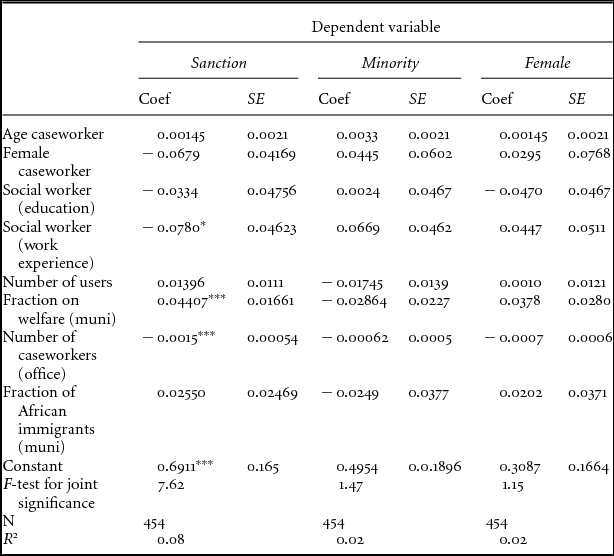
We used a random number generator to allocate the participant identity (gender and ethnicity) to the vignettes the front-line workers received. The randomisation procedure was successful. None of the variables influencing the decision to sanction is correlated with the identity of the person in the vignette. This implies a balanced sample in each of the ‘treatments’ (i.e. identities of the vignette person).Footnote 4
Results
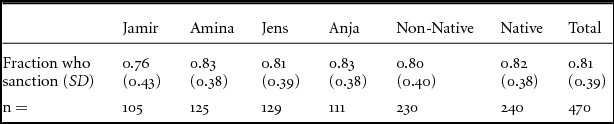
Because the identity of the vignette participant was randomly allocated to the front-line workers, we can identify discrimination simply by comparing mean sanction rates across the types of participants. Table 1 reports the fraction of front-line workers sanctioning each participant.
Fraction of caseworkers who decided to sanction the participant

Table 1 shows that most front-line workers (on average, 81 per cent) would remove the participant from the programme. No discrimination based on the gender or ethnicity of the participant was detected. The fraction of front-line workers who would sanction the non-native vignette participants (Jamir and Amina) is slightly lower than the fraction that would sanction the native vignette participants (Jens and Anja), but the difference is not statistically significant.
We also performed a regression analysis where we controlled for several caseworker and workplace characteristics (gender, age and number of participants; education of the caseworker; size of the office; and fraction of the workforce receiving health-related social benefits in the municipality where the office is located). We constructed an indicator variable based on whether the caseworker agreed with the following statement: ‘The generous social security benefits in Norway encourage migrants to come to the country’Footnote 5 . The regression analysis confirms the finding in Table 1; that is, front-line workers do not discriminate based on the ethnicity and gender of the participant, not even those front-line workers who believe generous social security benefits attract migrants.
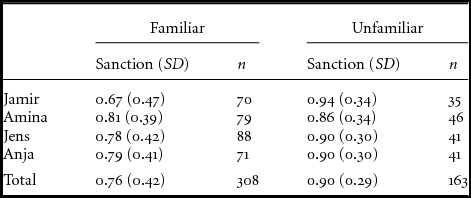
All NAV front-line workers who received the vignette had experience with the QP but not everyone agreed that the vignette represented a familiar case. On average, 66 per cent of the front-line workers found the vignette to be familiar. The degree of familiarity did not vary across the gender and ethnicity of the vignette client. Next, we examined whether caseworkers, who were acquainted with participants who violate activation requirements, sanction differently from those who were not familiar with this type of behaviour. Here we find differences between the front-line workers. Those who were familiar with the case described in the vignette sanctioned far less often than those who did not recognise this as a familiar case. Table 2 (last row) shows that 90 per cent of the caseworkers who were unfamiliar with such participants decided to eject the participant from the programme compared with only 76 per cent of those who were familiar with such participants. The difference (14 percentage points) in the overall propensity to sanction is statistically significant. (The Fisher exact test statistic for equality in the propensity to sanction across these groups gives a p value of .0019.)
Fraction of caseworkers who decided to sanction, in terms of familiarity with the vignette

This finding corresponds with a finding reported by Schram et al. (Reference Schram, Soss, Fording and Houser2009), who found that experienced caseworkers sanction participants less often than inexperienced caseworkers do. Schram et al. offered two explanations from a US context. First, caseworkers with greater experience may have witnessed the negative effects of sanctioning on the future lives of participants – they have a stronger premonition that ejecting a participant will result in a difficult or hopeless life situation. Second, caseworkers with greater experience may be more motivated to support participants. Although our question concerns whether the caseworkers were familiar with participants who violate activation requirements, rather than whether the caseworkers were more ‘experienced’, these hypotheses may also explain our findings. Caseworkers who are familiar with participants who violate activation requirements may also be more aware that sanctioning involves conflicts with clients and extra paperwork. In addition, a selection effect is possible: front-line workers who continue to work with participants who break the rules (rather than apply for other work in NAV or leave NAV altogether) may be a select group of front-line workers who find working with ‘difficult’ participants to be rewarding.
Schram et al. (Reference Schram, Soss, Fording and Houser2009) found that experienced caseworkers discriminated against Spanish and African-American participants compared with Caucasian participants.Footnote 6 We, however, find no such pattern. Table 2 shows that among caseworkers who were not acquainted with participants similar to those described in the vignette, there is no statistical difference in sanctioning. A large majority (between 86 and 94 per cent) want to eject the participant, regardless of gender or ethnicity. The only exception concerns front-line workers who are acquainted with such cases. They are actually less inclined to sanction Jamir (the North African male) than the other participants. If we aggregate Amina, Jens and Anja and compare them with Jamir, the difference in the propensity to sanction between ‘familiar and unfamiliar’ is 13 percentage points, with a p value of .035 (Fisher exact test). Thus, contrary to our initial hypothesis – that is, the North African male is sanctioned more often – we find either no discrimination (among caseworkers unfamiliar with such cases) or a tendency to be less strict towards North African male claimants (among caseworkers familiar with such cases).Footnote 7
In summary, ethnic minority participants are not sanctioned more harshly in Norway if they do not comply with the activation requirements in the QP; nor are men sanctioned more than women. Front-line workers are strict regardless of the gender or ethnicity of the participant. However, front-line workers who are unfamiliar with participants who violate activation requirements are much harsher than front-line workers who have previous experience with such participants. Front-line workers who are familiar with such participants are less likely to sanction, and they are likely to treat a male participant with a non-native name more leniently than other participants. The latter can be perceived as reverse discrimination. Individuals who do not meet the requirements of the programme are less likely to be sanctioned if they are males from an ethnic minority group, provided that their caseworker has previous experience with rule-breaking participants.Footnote 8
Discussion
Our findings raise several questions. Why do vignette experiments reveal discrimination in the labour and housing markets in Norway but not in social programmes? Why did the surveyed Norwegian front-line workers who reported familiarity with rule-breaking participants sanction Jamir less often than they did Jens, Anja and Amina? Finally, why does Norway differ from the US, where Schram et al. (Reference Schram, Soss, Fording and Houser2009) found negative discrimination against ethnic minorities, in particular African-Americans? In the following subsections, we suggest some answers to these questions.
Why does discrimination differ between markets and public welfare?
As aforementioned, vignette experiments – in Norway and elsewhere – have revealed that landlords and employers discriminate against tenants or jobseekers with a non-native name, and that such discrimination is particularly prevalent if the person is a male. Why do we find no such pattern in the QP?
First, perhaps the risk-reward calculus is different for a front-line worker than for an employer or a landlord. By risk-reward calculus, we mean the balance between the perceived risks and rewards associated with making a decision. If it differs between actors, they are likely to choose different courses of action. Front-line workers who administer welfare programmes have fewer incentives to discriminate, because they are not at risk of incurring any type of loss by selecting the ‘wrong’ recipient for sanctioning. Landlords, by contrast, risk something if they rent an apartment to someone who later turns out to be a troublesome tenant, because a tenant – once chosen – can be difficult to evict. Similarly, employers risk something if they employ a jobseeker who subsequently turns out to be an inefficient worker, because it can be costly and difficult to lay off an employee later. Therefore, landlords and employers have greater reasons to discriminate, in the form of statistical discrimination, compared with front-line workers. In addition, front-line workers may be punished harder than landlords or employers if they are found to discriminate based on ethnicity and/or gender. Front-line workers who exhibit such behaviour may destroy their career prospects, and even risk being fired. Landlords and employers may also face negative reactions if they discriminate against a minority but these reactions are less likely to result in loss of work or livelihood.
Why some reverse discrimination?
If Norwegian caseworkers believe that accusations of discrimination may jeopardise their career prospects, they may be sensitive to a mere suspicion that they discriminate against ethnic minorities. Working within the Norwegian welfare system, they may ‘overcompensate’ by being especially lenient towards ethnic minority claimants – in particular male claimants, since male immigrants receiving welfare benefits are arguably the group most widely suspected by the media of being subjected to public discrimination. This hypothesis turns the initial suspicion of discrimination on its head: the judgement of caseworkers is possibly coloured by general stereotypes regarding which groups are discriminated against, but this colouration may work in a way that reduces sanctioning of such claimants.
In addition, Norwegian social workers, who constituted the majority of caseworkers, are sensitised to the plight of ethnic minorities during their training. They are taught a cognitive frame that more often portrays welfare claimants as victims of circumstances beyond their control, rather than as strategic ‘takers’ who cannot be trusted and must be disciplined (Halvorsen et al., Reference Halvorsen, Stjernø and Øverbye2013). In short: Norwegian caseworkers are possibly concerned with avoiding accusations of ethnic discrimination, and with preventing exclusion of ethnic minorities, to such an extent that some degree of reverse discrimination may even take place.
Why does discrimination in public welfare systems differ from the US?
The aforementioned study by Schram et al. (Reference Schram, Soss, Fording and Houser2009) found negative discrimination of ethnic minority claimants in the US welfare system. Why do results in Norway differ?
We do not have the data to do a comparative analysis of the diverging results between the US and the Norwegian experimental studies. However, we can offer some hypotheses as suggestions for further research.
First, the research design is not strictly the same. The Schram et al. study included two vignettes depicting single mothers: one Latina/Caucasian single mother and one African American/Caucasian single mother. Both were contrasted to a Caucasian (white) single mother. Schram et al. detected discrimination against the African-American claimant in particular (relative to the Caucasian claimant), and discrimination was more pronounced when the vignette contained information that the claimant had previously violated activation requirements. Based on the findings, Schram et al. (Reference Schram, Soss, Fording and Houser2009: 398) claimed the following: ‘Overall, our study clarifies how racial minorities, especially African Americans, are more likely to be punished for deviant behaviour in the new world of disciplinary welfare provision’.
In contrast to this study, we did not present the respondents with different versions of the vignette; we did not vary the extent to which the claimant had previously violated activation requirements. However, our vignette depicts a case where the claimant has previously violated the activation requirements several times. Hence, our vignette corresponds to the worst-case vignette described by Schram et al. In addition, the sample in our study is larger (N = 470) than the sample used by Schram et al. (N = 137), thereby allowing us to obtain a more precise estimate of discrimination. Thus, although the research designs differ somewhat, we find it unlikely that this is the main reason why the results differ.
Alternative explanations must necessarily be speculative. One possibility concerns how ethnic minority welfare claimants are cognitively ‘framed’ by mass media and in the public discourse. In the US, ‘welfare’ is strongly associated with ethnic/racial characteristics (Alesina and Glaeser, Reference Alesina and Glaeser2004; Schram et al., Reference Schram, Soss and Fording2003). Most recipients of Temporary Assistance for Needy Families are poor single mothers and a large proportion are Hispanics and African Americans. Mass media, and the public discourse, often portray claimants as ‘strategic takers’. There can be an ethnic component to this portrayal, in particular with regard to African-Americans (Schneider and Ingram, Reference Schneider and Ingram1993; Gilens, Reference Gilens1999; Schram et al., Reference Schram, Soss, Fording and Houser2009). Norwegian media, on the other hand, tend to portray claimants more as victims of circumstances beyond their control, and the public debate focuses on the desirability of social integration of ethnic minorities (Bay and Stang, Reference Bay, Stang, Bay, Pedersen and Saglie2009). If such general stereotyping processes influence caseworkers, this may explain the diverging results. In this context, it can be noted that a larger percentage (>80 per cent) of Norwegian front-line workers have tertiary education, compared with approximately 60 per cent of US caseworkers in the study by Schram et al. (Reference Schram, Soss, Fording and Houser2009).Footnote 9 Previous studies indicate that people with higher education tend to be less ethnocentric – although these studies have not looked specifically at caseworkers (Van Der Waal et al., Reference Van Der Waal, Achterberg, Houtman and de Koster2010). However, and drawing in the opposite direction, concerns about civil rights and non-discrimination has a longer history, and therefore probably a stronger and more salient role, in the US than Norway.
Another possible explanation could be the different design of the welfare system itself, rather than the broader social culture. Decisions made by front-line workers are likely to depend on the historical and administrative contexts of the particular street-level organisation they work within (Watkins-Hayes, Reference Watkins-Hayes, Brodkin and Marston2013). US welfare schemes are separated from social security programmes serving the majority. This is less the case in Norway. QP participants in Norway are served by the same welfare agency and have the same caseworkers as the majority. The QP is administered by NAV, which is responsible for all social security benefits and most social services. Everyone older than 66 years and approximately 20 per cent of the working-age population (16–66 years) are served by the same NAV caseworkers (Terum and Hatland, Reference Terum and Hatland2014). Different institutional contexts may impact on the selection of caseworkers, as well as on how they perceive their clients. Perhaps the broader client base in the Norwegian system somehow reduces the ‘otherness’ of ethnic minority claimants.
A third set of possible explanations concerns how work is organised within welfare agencies. Despite the similar role as programmes of ‘last resort’, the role caseworkers play in administering such welfare programmes, through tailoring support to the actual needs of recipients, varies considerably cross-nationally (Jewell, Reference Jewell2007, 181). In the US, welfare programmes represent bureaucratic organisations, staffed by non-professionals who make eligibility assessments based on extensive regulations from above. Jerwell (op.cit.) contrasts the US with Sweden, where social assistance resembles a professional organisation, staffed by social workers with a large amount of discretionary power. Norway is similar to Sweden in this regard. US caseworkers may have less autonomy and be held to a stricter targets-and-performance system than Norwegian caseworkers (Brodkin, Reference Brodkin1997, Reference Brodkin, Brodkin and Marston2013). Following Lipsky (Reference Lipsky1980), larger professional discretion on behalf of Norwegian caseworkers may imply they are more autonomous in reducing the ‘hassle’ of sanctioning, including the risk of exposing themselves to complaints and criticism from clients that are sanctioned. Perhaps they are particularly sensitive about not exposing themselves to complaints from ethnic minority claimants in this regard. If so, the larger degree of autonomy among Norwegian caseworkers compared to US caseworkers may contribute to an explanation of the different empirical findings.
As already mentioned, we do not have sufficient empirical material to test these (partly competing) hypotheses; they are suggested avenues for further cross-national research with regard to how caseworkers treat ethnic minority claimants.
Concluding comment
Schram et al. (Reference Schram, Soss, Fording and Houser2009) used their findings to develop the so-called Racial Classification Model (RCM), as a theoretical tool to understand caseworker behaviour related to ethnic minorities. The RCM model is based on an underlying premise that salient social classifications and group representations are necessary for individuals (here: caseworkers), in order to avoid information overload and bring coherence to the complexities of daily decision making. According to Schram et al. (Reference Schram, Soss, Fording and Houser2009), the likelihood that such cognitive classifications will be ethnically charged is a function of the prevailing cultural stereotypes of ethnic groups, the extent to which policy actors (caseworkers in the present study) hold relevant group stereotypes, and the presence or absence of stereotype-consistent cues.
The Racial Classification Model (RCM) may be a fruitful tool in further cross-national studies of possible ethnic discrimination by caseworkers. The different Norwegian findings may also be investigated within the framework of this model. We have argued that three factors may influence the decisions caseworkers make: (1) differences in cultural stereotypes of ethnic groups, (2) the extent to which caseworkers (for organisational or other reasons) hold relevant group stereotypes, and (3) the presence or absence of stereotype-consistent cues (as caseworkers, with varying degree of autonomy, decide what to do).
It would be an exciting prospect for future research to investigate the following more exactly and in a larger number of countries: how ethnic discrimination is influenced by differences in cultural stereotypes, the extent to which caseworkers hold relevant group stereotypes, and the presence or absence of stereotype-consistent cues. For this future research, experimental designs will be of great value.
Acknowledgements
This study was made possible by grants from the Research Council of Norway's Welfare, Working Life and Migration (VAM) programme. We gratefully acknowledge the following individuals for their insightful feedback on an earlier version of this article: Jonathan Bradshaw, University of York; Mike Adler, University of Edinburgh; Flemming Larsen, Aalborg University; and Silje B. Fekjær and Anders Molander, Oslo and Akershus University College. We also thank the anonymous referees at the Journal of Social Policy for their helpful comments.
Appendix
Testing for random assignment of the identity of the vignette client