I. INTRODUCTION
It is well known that small crystalline particles and rods produced from materials with face-centered cubic (FCC) crystal lattice, such as Cu, Ag, Au, often demonstrate axes of 5-fold symmetry, e.g., see Refs. Reference Ino1–Reference Seo, Yoo, Chung, Park, Ryu and Hyunjoon8. During FCC crystal growth low-energy {111}-type twin boundaries (TBs) can be formed in the particle body. These TBs divide a particle or a rod into mutually misoriented crystalline regions, i.e., twins. The presence of twins is crucial for the emergence of pentagonal particles (PPs) and pentagonal rods (PRs) with unusual “noncrystallographic” axes of rotational symmetry. Typically, for experimentally observed PPs and PRs diameter varies from 10 nm to 10 μm.Reference Gryaznov, Heydenreich, Kaprelov, Nepijko, Romanov and Urban3, Reference Vikarchuk and Volenko6, Reference Tang and Kotov9 In an ideal case, low-energy TBs are the only defects in PPs and PRs. Nanoscale PPs and PRs can be defect free providing particular physical and mechanical properties, e.g., strong anisotropy, high mechanical strength and hardness similar to those observed for monocrystalline whiskers.Reference Yacaman, Ascencio, Liu and Gardea-Torresday4 Another important feature of PPs and PRs is their enhanced catalytic activity,Reference Gryaznov, Heydenreich, Kaprelov, Nepijko, Romanov and Urban3, Reference Tang and Kotov9 which is dictated by the crystallography of their surface. PPs of icosahedral and decahedral shapes are bounded by {111}-type facets, and PRs have {100}-type planes as side facets and {111}-type planes as cap facets. This specific crystallography of cap ends was also shown to be responsible for the interactions and assembling of PRs.Reference Tang and Kotov9
The structure and elastic distortion of PPs and PRs crystal lattice can be characterized in the framework of the disclination approach as it was first proposed in Ref. Reference De Wit10 and then developed in full details in Refs. Reference Gryaznov, Heydenreich, Kaprelov, Nepijko, Romanov and Urban3, Reference De Wit10–Reference Gryaznov, Kaprelov, Romanov and Polonsky12.
The relaxation of elastic stresses due to disclinations is the cause of the transformations of PRs and PPs that occur as they grow.Reference Gryaznov, Heydenreich, Kaprelov, Nepijko, Romanov and Urban3, Reference Marks13 The aim of our article is to demonstrate the possibility of various relaxation processes in PRs and PPs and to provide disclination models for the observed phenomena.
II. EXPERIMENTAL BACKGROUND
In this section, we consider some results of experimental studies of nano- and microscale PRs and PPs received by electrodeposition of copper in Togliatti State University, Russia (Figs. 1 and 2).
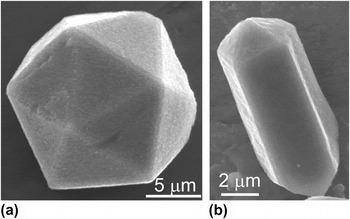
(a) Icosahedral copper particle and (b) pentagonal prismatic copper rod with perfect exterior shapes.

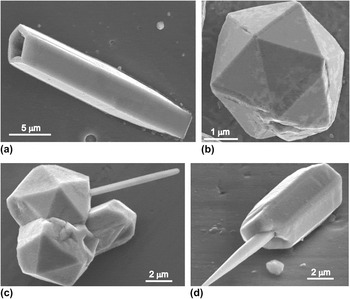
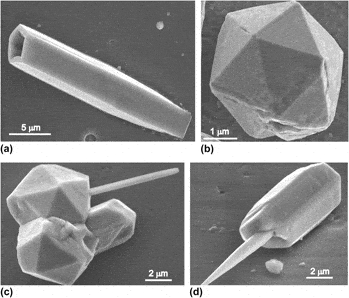
(a, b) Pentagonal microrods (PRs) and pentagonal microparticles (PPs) with cavities and (c, d) whiskers obtained by electrodeposition of Cu.

In Fig. 1, pentagonal Cu microrods and microparticles are presented. These particles have perfect shape, but this does not mean that they do not contain numerous internal defects. Figure 2 shows the microparticles with a defective external shape with a hole inside the PR or PP and the nanowhisker (NW) growing from the particle. These imperfections form during electrodeposition. Electrodeposition of the particles with subsequent heating to 400 °C and above in air leads to the formation of cavities, channels, and the growth of numerous whiskers on the outside of the initially outwardly perfect particles.
The following observations should be noted:
(i) During the electrodeposition NWs are often formed in places, where TBs junctions emerge from the surface. These NWs have mainly pentagonal symmetry, i.e., NWs are nanoPRs.
(ii) The holes and empty channels are formed during the PP and PR growth. The growth and formation of the NW from the particle is accompanied by the formation of internal cavities within the particle.
(iii) After annealing in air or in vacuum, all the microparticles tend to lose faceting. Icosahedra annealed in air become overgrown by numerous NWs, but pentagonal rods do not. NWs growing from the places of TBs junctions, emerging to the surface, are often pentagonal.
III. THEORETICAL BACKGROUND
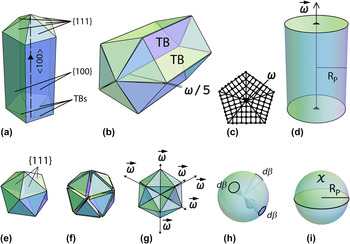
The origin of pentagonal symmetry in PRs and PPs follows from the schematics given in Fig. 3. As shown in Fig. 3(a), PR is a polycrystal consisting of five FCC monocrystalline regions divided by five TBs. Lateral faces of this multiple-twinned PR are crystallographic planes of {100}-type, whereas cup faces are of {111}-type. The axis of 5-fold symmetry is parallel to <100>-type direction. The internal structure of PRs can be understood from the schematics of Figs. 3(b) and 3(c).Reference De Wit10 In the top-view of Fig. 3(b), five undistorted parts of the PR are aligned along four TBs, which in FCC crystals are {111}-type planes, e.g., see Ref. Reference Gryaznov, Heydenreich, Kaprelov, Nepijko, Romanov and Urban3. Because of FCC crystal geometry, there is a small angular gap ω preventing the formation of a completely connected and undistorted PR. This angular gap however can be eliminated by mutual rotation of the gap faces with the formation of the fifth TB. The closing of the gap is equivalent to the introduction of the positive wedge disclination of the strength ω along the PR axis.Reference De Wit10, Reference Romanov, Vladimirov and Nabarro14 The resulting configuration of the crystal lattice in the PR cross-section (which is the plane of the {110}-type) is shown in Fig. 3(c), where a triangle designates a wedge disclination. In the case of PPs, the standard morphology is an icosahedra with {111}-type crystallographic facets only.Reference Howie and Marks11, Reference Gryaznov, Kaprelov, Romanov and Polonsky12 An icosahedra possesses six disclinations shown in Fig. 3(e). It has been provenReference Gryaznov, Kaprelov, Romanov and Polonsky12 that each 5-fold axis, which appears at the junction of five TBs in a PR or a PP, contains a positive wedge disclination of the strength  .
Disclination models for PRs and PPs: (a) PR with internal twin boundaries, (b) angular gap ω in a PR, (c) twinned crystal lattice of PR, (d) PR modeled as cylinder of radius R P having positive wedge disclination of strength ω, (e) icosahedral PP, (f) PP with solid angle deficiency, (g) PP with six wedge disclinations of strength ω, (h) PP with infinitesimal solid cones dβ, and (i) PP modeled as spheroid with Marks–Yoffe disclination.

The introduction of a disclination leads to an elastic distortion of the crystal lattice in the bulk of the PR and PP. In the continuum mechanics model, which is suitable for the calculation of elastic fields and energies, a PR can be described as an elastic cylinder with a coaxial positive wedge disclination [Fig. 3(d)] and icosahedral PP can be described as an elastic spheroid with six positive wedge disclinations [Fig. 3(g)] or with one specific Marks–Yoffe disclination [Fig. 3(i)].Reference Howie and Marks11
Summarizing all of the above, one can conclude that to describe the elastic properties of the pentagonal faceted particles it is convenient to use a disclinated cylinder or disclinated spheroid.
The characteristics and properties of disclinations, which distinguish them from the dislocations, are important in our theoretical constructions. Namely, the elastic strain and stress of a single straight disclination have a divergence away from the disclination line. Disclination energy increases quadratically with an increasing characteristic screening parameter, such as crystallite size (more details on disclinations in crystals are given in the book chapterReference Romanov, Vladimirov and Nabarro14). In this regard, straight-line disclinations can only exist in crystals of small size or in the presence of other defects that can reduce (screen) their elastic fields.
Such properties of disclinations in finite size bodies are the cause for the manifestation of various mechanical stress relaxation mechanisms in PRs and PPs.
There exists a number of stress relaxation models for disclinated crystals. In the following section, we briefly describe the developed models for stress relaxation related to the pentagonal crystalsReference Romanov and Kolesnikova15, Reference Dorogin, Vlassov, Kolesnikova, Kink, Lohmus and Romanov16 and present a new model for stress relaxation, which explains a simultaneous formation of whiskers on the surface and a cavity inside a disclinated crystal.
IV. STRUCTURAL TRANSFORMATIONS IN DISCLINATED MEDIA
A. Stress relaxation mechanisms of PRs and PPs
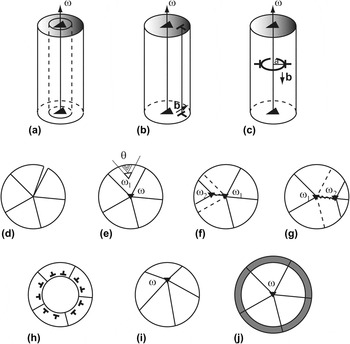
Over the past two decades, stress relaxation models for PRs and PPs have been developed and designed. Figure 4 presents schematics for these models. In the analysis of the models, the energy criterion for starting the relaxation process is used:

The channels of stress relaxation in PRs and PPs: (a) appearance of a hollow center; (b) formation of the straight-line dislocation; (c) formation of the vacancy-type dislocation loop; (d) opening of a gap; (e) origination of a negative disclination of power ω1 with a system of stacking faults; (f, g) different ways of decomposing the disclination of power ω into two others linked by a “disclinational” stacking fault; (h) formation of a region without a disclination; (i) shifting of the pentagonal axis towards the periphery; and (j) the formation of a surface misfit layer having a different parameter of the crystal lattice than in the original crystal. For simplicity, the channels of relaxation are depicted for the case of PRs.

where E initial, E final are the energies of PP or PR before relaxation and after relaxation.
It has been shown that the following processes contribute to diminishing elastic energy of PRs and PPs: appearance of an empty channel [Fig. 4(a)]Reference Romanov, Vladimirov and Nabarro14, Reference Romanov, Polonsky, Gryaznov, Nepijko, Junghanns and Vitrykhovski17; formation of a straight-line dislocation [Fig. 4(b)]Reference Gryaznov, Heydenreich, Kaprelov, Nepijko, Romanov and Urban3, Reference Romanov and Kolesnikova15 or vacancy-type dislocation loop [Fig. 4(c)]Reference Kolesnikova and Romanov18; opening of a gap [Fig. 4(d)]Reference Gryaznov, Heydenreich, Kaprelov, Nepijko, Romanov and Urban3; appearance of a negative disclination of power ω1 with a system of stacking faults [Fig. 4(e)]Reference Gryaznov, Heydenreich, Kaprelov, Nepijko, Romanov and Urban3; different ways of decomposing the disclination with power ω into two others linked by a “disclinational” stacking fault [Figs. 4(f) and 4(g)]Reference Gryaznov, Heydenreich, Kaprelov, Nepijko, Romanov and Urban3; formation of a region without a disclination [Fig. 4(h)]Reference Gryaznov, Heydenreich, Kaprelov, Nepijko, Romanov and Urban3; shifting of the pentagonal axis towards the periphery [Fig. 4(i)]Reference Gryaznov, Heydenreich, Kaprelov, Nepijko, Romanov and Urban3; and the formation of a surface misfit layer having a different parameter of the crystal lattice than in the original crystal [Fig. 4(j)].Reference Dorogin, Vlassov, Kolesnikova, Kink, Lohmus and Romanov16 In addition, molecular dynamics simulation showed that the core of a disclination in a crystal has a “loose” structure, leading to the formation of an empty channel.Reference Mikhailin and Romanov19
For several models, critical size of pentagonal particles was evaluated (e.g., see Refs. Reference Romanov and Kolesnikova15, Reference Dorogin, Vlassov, Kolesnikova, Kink, Lohmus and Romanov16, Reference Kolesnikova and Romanov18). Starting from the critical size, the relaxation processes in PRs and PPs are triggered by disclinations.
Consistency of the proposed relaxation models with experimental observations was discussed in detail in Ref. Reference Gryaznov, Heydenreich, Kaprelov, Nepijko, Romanov and Urban3.
B. NW growth at disclination
The model of NW growth proposed below is suitable for pentagonal crystals and bulk polycrystalline materials with micrograins and nanograins, junctions of which are known to form disclination-type structures.Reference Romanov and Kolesnikova15 Grain boundary junctions in polycrystals possess elastic fields characteristic of disclinations.Reference Romanov, Vladimirov and Nabarro14, Reference Rybin20 These fields become a source for such structural transformations associated with defect formation and defect motion. Formation of metallic NWs on the surface of polycrystals is often referred to as a relaxation of mechanical stresses stored in the material.
Various theoretical models of metallic one-dimension NW growth have been proposed.Reference Peach21–Reference Smetana26 However, in only one of those works, namely in Ref. Reference Eshelby22, were prismatic dislocation loops taken into consideration. One should note that namely prismatic dislocation loops (on the contrary to the case of shear dislocation loops) are related to the condensation of point defects, e.g., in the form of vacancy or interstitial disks. In a new model proposed below, we combine this idea with the advantages of a disclination approach.
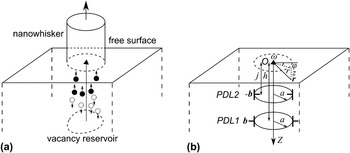
Our model of NW formation operates with prismatic dislocation loops that condensate on the disclination in the TB junction or in the grain boundaries of a polycrystal. Due to the formation of vacancy-type dislocation loops or pores in the bulk, the excess material is then extruded at the surface in the form of NWs [Fig. 5(a)].
Schematics of the nanowhisker (NW) growth model. (a) Sketch of the atom’s flow motion to NW formation in the grain boundary junction. (b) Half-space body with a disclination and two prismatic dislocation loops PDL1 and PDL2 coaxial with a disclination.

Let us consider a half-space body with two wedge disclinations of powers ω and −ω (i.e., disclination dipole) placed at a large distance from each other and perpendicular to the surface. The first disclination ω (shown in Fig. 5) serves as a source of compressive stresses and is located coaxial to the growing NW, while the other is placed enough far, i.e., at a distance much greater than any size parameters used in the problem and used for “screening”. The elastic fields of a disclination dipole in this body are well known.Reference Kolesnikova and Romanov27 A prismatic dislocation loop PDL1 with Burgers vector b and radius a coaxial with the disclination line OZ is then introduced [see Fig. 5(b)]. PDL1 is a vacancy-type dislocation loop and corresponds to collective motion of vacancies [Fig. 5(a)]. Another prismatic dislocation loop PDL2 of radius a, with Burgers vector −b, is coaxial with the former dislocation loop and situated at the distance j from the surface [Fig. 5(b)]. PDL2 is of interstitial type and represents the collective flow of excess atoms towards the surface [Fig. 5(a)].
Total elastic energy E total of the body containing a disclination dipole and dislocation loops, PDL1 and PDL2, can be expressed as the sum:

where E dcl is the elastic energy of disclination dipole, E L1 and E L2 are the elastic energy of PDL1 and PDL2 correspondingly, interaction energy between the disclination dipole and PDL1 (PDL2) is denoted as E d−L1 (E d−L2), and E L1−L2 is interaction energy between PDL1 and PDL2.
The energy release, E rel, is defined as a difference between the initial elastic energy of a bare disclination dipole and the total elastic energy of the system after the formation of the dislocation loops PDL1 and PDL2:

E L1 and E L2 can be found in analytical form in Ref. Reference Kolesnikova and Romanov27. The interaction energies E d−L1 and E d−L2 are calculated as a work done by the elastic forces of the disclination dipole for removing or inserting a disk of radius a and thickness b at the position of PDL1 or PDL2. The term E L1−L2 is determined as a work done by elastic forces of PDL1 for inserting the same disk (or vice versa) at the position of PDL2. The expressions for the stress field of PDL1 (PDL2) are given, for example, in Ref. Reference Kolesnikova and Romanov28.
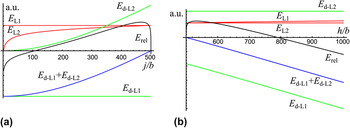
In Figs. 6(a) and 6(b), the diagrams demonstrate general behavior of the system with certain sample set of parameters. Both PDL1 and PDL2 are attracted to the free surface (see E L1 and E L2), although PDL1 is also attracted deep into the body by the compressive stresses of the disclination and PDL2 is extruded by them. Attraction between PDL1 and PDL2 follows from their opposite Burgers vectors. Interplay of these forces is described by the energy release E rel as functions of j and h (Fig. 6). The diagrams clearly show a range of parameters where E rel < 0, which means that formation of PDL1 and PDL2 is energetically favorable versus the initial state of the body without them. However in other cases, their formation requires overcoming of an energy barrier. Rearrangement of the separated dislocation loops is followed by gliding of PDL1 downward to a vacancy reservoir (e.g., pore), and PDL2 toward the surface contributing to the growth of the NW.
Diagrams of the energy of the dislocation loops E L1 and E L2, the interaction energies E d−L1 and E d–L2 and their sum, and the energy release E rel (a) as a functions of distance j in units of b with fixed h = 500·b, (b) as function of distance h in units of b with fixed j=500·b. The energy is given in arbitrary units, calculated for the case b = 0.5 nm, ω = 0.1, a = 500 nm, r core = 0.4 nm and typical values of the materials elastic properties.

V. CONCLUSIONS
The structure of PRs and PPs and the elastic distortion of their crystal lattice can be characterized in the framework of the disclination approach. It is the disclination-induced stresses relaxation that causes structural transformations in PRs and PPs.
It has been demonstrated both theoretically and experimentally that there are multiple channels of stress relaxation and reduction of the elastic energy in PRs and PPs. One of the stress relaxation mechanisms is considered in particular, namely, the appearance of the internal cavity in PRs and PPs, accompanied by the formation of NWs on the surface of the PRs and PPs.
We have described a possible mechanism addressing the simultaneous emergence of pentagonal NWs and internal cavities in PRs and PPs based on the nucleation of two dislocation loops of opposite sign near the surface of a crystal with a disclination. As a result, vacancy-type dislocation loop remains in the material and is a nucleus for pores, while the interstitial loop comes to the free surface, contributing to NW growth. Demonstrated calculations provide a qualitative evidence for the formation of NW-pore pair in a material with disclinations, in particular in PRs and PPs. We therefore propose a conduction of an additional experimental study to verify this hypothesis. Moreover, in the development of the given model, it would be desirable to elaborate a theoretical explanation and estimation of the critical size of PR and PP as well as the NW radius.
ACKNOWLEDGMENTS
The support of EU IIF PIIF-GA-2008-220419 from Marie Curie program is acknowledged. The work was also partly supported by Estonian Science Foundation Grant 8420 and Estonian Nanotechnology Competence Centre (EU29996).