Introduction
Suicide is a leading cause of death in many regions of the world, with prevalence estimates ranging from 10 to 20 deaths per 100 000 people (Kessler et al. Reference Kessler, Borges and Walters1999; Nock et al. Reference Nock, Hwang, Sampson and Kessler2010). Suicidality is a complex behavior and is probably determined by the interaction of a multitude of different factors. Among these, the role of biological factors in increasing individual predisposition has been established (Ernst et al. Reference Ernst, Mechawar and Turecki2009; Turecki et al. Reference Turecki, Ernst, Jollant, Labonte and Mechawar2012). In addition, a history of childhood adversity, and in particular sexual and physical abuse, has often been associated with increased suicide risk (Bensley et al. Reference Bensley, Van Eenwyk, Spieker and Schoder1999; Molnar et al. Reference Molnar, Berkman and Buka2001; Dube et al. Reference Dube, Anda, Whitfield, Brown, Felitti, Dong and Giles2005). For example, a history of childhood sexual abuse increases the odds of suicide attempts (SA) by up to 12 times (Bensley et al. Reference Bensley, Van Eenwyk, Spieker and Schoder1999; Molnar et al. Reference Molnar, Berkman and Buka2001).
Emotional dysregulation (e.g. high levels of personality traits such as anxiousness) and behavioral dysregulation (e.g. high levels of personality traits such as impulsive aggression or disruptiveness) are also frequently reported in individuals with a history of childhood adversity (Brezo et al. Reference Brezo, Paris, Vitaro, Hebert, Tremblay and Turecki2008c ; Cicchetti et al. Reference Cicchetti, Rogosch, Gunnar and Toth2010). Likewise, emotional dysregulation and behavioral dysregulation are strong predictors of SA (Beautrais et al. Reference Beautrais, Joyce and Mulder1999; Brezo et al. Reference Brezo, Barker, Paris, Hebert, Vitaro, Tremblay and Turecki2008a , Reference Brezo, Paris, Vitaro, Hebert, Tremblay and Turecki c ). Furthermore, studies have consistently suggested that levels of impulsive-aggressive behaviors are related to increased suicide risk among patients with the same psychiatric diagnosis, such as major depression (Brodsky et al. Reference Brodsky, Oquendo, Ellis, Haas, Malone and Mann2001), and markers of stress dysregulation have been frequently associated with increased suicide risk (Beautrais et al. Reference Beautrais, Joyce and Mulder1999; Brezo et al. Reference Brezo, Barker, Paris, Hebert, Vitaro, Tremblay and Turecki2008a , Reference Brezo, Paris, Vitaro, Hebert, Tremblay and Turecki c ).
Both internalizing and externalizing disorders have been associated with childhood adversity (Horwitz et al. Reference Horwitz, Widom, McLaughlin and White2001; Levitan et al. Reference Levitan, Rector, Sheldon and Goering2003), and also with suicidality (Oquendo et al. Reference Oquendo, Lizardi, Greenwald, Weissman and Mann2004; Brezo et al. Reference Brezo, Paris and Turecki2006, Reference Brezo, Paris, Vitaro, Hebert, Tremblay and Turecki2008c ). Although useful, the associations between childhood adversity, personality traits and psychopathology, and also those with suicidal behavior, are for the most part based on empirical evidence derived from cross-sectional observations that rely on one-point snapshots rather than developmental trajectories. As such, previous studies have been limited in their ability to elucidate temporal and predictive relationships between these factors. In particular, questions regarding whether and how personality traits and mental disorders explain the increased suicide risk observed in individuals who were exposed to childhood adversity remain unanswered.
Mental disorders may modify the association between childhood adversity and suicidality transmitted through personality trait trajectories in four possible ways. First, mental disorders may enhance the likelihood of membership of abused children in high trajectories of anxiousness and/or aggressive-disruptive behaviors. Second, mental disorders may enhance the association between high personality trait trajectories and suicidality. Third, mental disorders may both increase the likelihood of membership of abused children in high personality trait trajectories and enhance their association with suicidality. Fourth, mental disorders may enhance the likelihood of suicidality by abused children with and without personality trajectories as intermediaries.
Such moderating influences of internalizing and externalizing disorders are suspected but, to our knowledge, have not yet been formally tested. Questions of particular preventive and therapeutic relevance are (a) whether emotional and behavioral dysregulation account for the association between childhood adversity and suicidal behavior; and if this is the case, (b) whether internalizing and externalizing disorders modify the effect of emotional and behavioral dysregulation on the risk of suicidal behavior.
Method
Study population
In 1986–1988, families of children attending nursery school in public francophone schools in Quebec were recruited using a multistage sampling procedure. From 4488 participating children, two subsamples were selected for follow-up. First, the representative subsample (R) was a randomly selected group of 1001 boys and 999 girls. Second, the disruptive subsample (D) was an additional group of 593 boys and 424 girls oversampled for children exhibiting disruptive behaviors. In both groups, the majority (88%) were of non-Hispanic White ethnicity.
The assessment schedule had three stages: (a) childhood, yearly assessments at age 6–12 years; R=2000, D=1017; (b) mid-adolescence, average age 15.7 years (range 15–18); R=1233, D=482; (c) adulthood, average age 21.4 years (range 19–24); R=1149, D=627.
Individuals who had died, refused participation or could not be contacted accounted for an overall adulthood attrition rate of 41% (R=43%, D=39%). To adjust for this, multivariate analyses were conducted with and without weights representing individual probabilities of remaining in the study conditional on variables related to attrition; specifically, mean early socio-economic adversity and sex. Among non-responders, mean adversity was higher (R=0.32 v. 0.25, t 1,1893.5=77.410, p=0.0005; D=0.39 v. 0.32, t 1,1893.5=72.161, p=0.031) and males were over-represented [R=50% v. 35%, χ2(1)=46.05, p<0.05; D=55% v. 36%, χ2(1)=36.30, p<0.05].
This study was approved by the research ethics boards of the University of Montreal and McGill University and signed informed consent was obtained from all participants.
Measures
Childhood risk factors
In young adulthood, contact childhood sexual abuse and childhood physical abuse were measured as indicators of childhood adversity. Self-reported contact childhood sexual abuse experienced before the age of 18 was assessed with the Adverse Childhood Experiences Study Questionnaire (Felitti et al. Reference Felitti, Anda, Nordenberg, Williamson, Spitz, Edwards, Koss and Marks1998). Self-reported childhood incidence of severe or very severe physical abuse perpetrated by either parent was assessed with a subset of 14 items derived from the Revised Conflict Tactics Scales (Straus et al. Reference Straus, Hamby, Boney-McCoy and Sugarman1996).
Mediators
The Social Behavior Questionnaire (Masse & Tremblay, Reference Masse and Tremblay1997) assesses several childhood traits. The resulting scores of disruptiveness and anxiousness were used to identify behavioral trajectories. Disruptiveness was based on 13 items (Cronbach's α=0.90), including hyperactive, aggressive, antisocial and oppositional traits. Anxiousness (Cronbach's α=0.74) was assessed with six items.
Moderators
We tested the collective moderating effects of adolescent externalizing Axis I disorders (attention-deficit/hyperactivity, oppositional–defiant and conduct disorders) on the one hand and of internalizing Axis I disorders on the other (mood and anxiety disorders). The disorders were assessed with the Diagnostic Interview Schedule for Children (DISC; Breton et al. Reference Breton, Bergeron, Valla, Berthiaume and St-Georges1998) using DSM-III-R (APA, 1987) criteria.
Covariate and outcome measures
Family history of SA
In the mid-adolescent assessment, both parents were administered the Diagnostic Interview Schedule for DSM-IV (DIS-IV; Robins et al. Reference Robins, Cottler, Bucholtz and Compton1995). If either parent indicated SA, family history was scored 1, otherwise 0.
SA status
SA status was based on adolescent and adult assessments. Adolescent history was obtained from parental/adolescent responses to a question (‘Have you/your child already attempted suicide?’) from the DISC (Breton et al. Reference Breton, Bergeron, Valla, Berthiaume and St-Georges1998). The number of attempted suicides was nine (5.0%) at age <12 years, 37 (20.3%) for ages 12–14 years, 93 (51.1%) for ages 15–17 years, 39 (21.3%) for ages 18–20 years, and four (2.3%) for ages 21–23 years. Adult history was assessed with questions from the Suicidal Intent Scale (Beck et al. Reference Beck, Morris and Beck1974) asking whether and when (year) suicides were attempted. If either assessment indicated an attempt, attempt status was scored 1, otherwise 0.
Statistical analysis
Step 1: Identifying disruptiveness and anxiousness trajectories
Trajectories of disruptiveness and anxiousness were assessed only for the subjects who also participated in the adult assessment. We identified developmental trajectories (clusters of individuals following similar progressions of behavior over time) using semi-parametric group-based modeling (SAS 9.1; Nagin & Tremblay, Reference Nagin and Tremblay1999; Jones et al. Reference Jones, Nagin and Roeder2001), a type of growth-mixture modeling. The Bayesian information criterion (BIC; Raftery, Reference Raftery1995) was used to select the optimal model from a series of models involving different numbers of trajectory groups. The semi-parametric group-based modeling approach offers several advantages: it is fairly robust regarding outlier data (i.e. it can accommodate non-normal distributions); and it can handle missing data through maximum likelihood estimation without losing information, as would be the case with listwise deletion. Moreover, each individual's posterior probability estimate for each trajectory group (the probability of following trajectory subgroups) is computed and can thus be used for further analyses.
Step 2: Testing mediating effects of trajectories on the association between childhood adversity and SA and moderating effects of mental disorders and sex
Disruptiveness and anxiousness trajectories were tested as mediators of the association between childhood adversity and SA (Baron & Kenny, Reference Baron and Kenny1986). Mediators are variables that account for a portion or all of the association between a predictor (P) and an outcome (O). Mediation is also operationalized as a mechanism through which P influences O. Mediation testing consists of three regression steps needed to demonstrate associations between: (1) P (childhood adversity) and O (SA); (2) P and mediator Me (disruptiveness or anxiousness trajectories as mediators of the effect of adversity on SA); (3) Me and O; and (4) P and O while controlling for Me. Where there is a decrease in the total effect when the mediator is controlled for, the existence of an indirect, mediating effect is suggested. Mediating effects were tested for the high disruptiveness and high anxiousness trajectory group in comparison to the respective low group. To test the statistical significance of mediation, we used the Sobel test (Kenny, Reference Kenny2009), adjusted for binary outcomes.
Moderating effects of internalizing and externalizing disorders and sex were tested separately by entering each as an additional predictor (moderator) together with an appropriate interaction term (Jaccard, Reference Jaccard2001) into the regression models used to assess mediating associations (Muller et al. Reference Muller, Judd and Yzerbyt2005; Edwards & Lambert, Reference Edwards and Lambert2007) (see Supplementary Table S1).
Results
Identifying trajectories
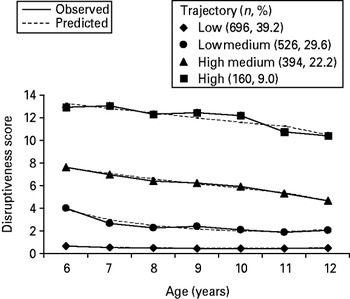
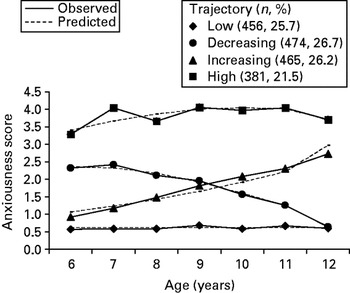
A total of 1776 individuals were included in the trajectory analyses conducted in this study. These analyses indicated four trajectories that provided the optimal fit of the data (Supplementary Table S2) for both disruptiveness (Fig. 1) and anxiousness (Fig. 2). Of the four trajectories of disruptiveness, the most frequent was the low trajectory, representing 39% of the sample, in contrast to the high trajectory, representing only 9% (Fig. 1). High medium (22%) and low medium (30%) disruptiveness trajectories had a more stable character than the intermediate anxiousness trajectories, both representing 26% of the sample (Fig. 2). The latter trajectories included individuals whose anxiousness either declined from moderate to low levels or increased from low to moderate levels. A similar percentage of individuals (26%) followed a low anxiousness trajectory, which remained stable over time. The least commonly followed trajectory of anxiousness was the high trajectory (22%), comprising individuals whose high anxiousness levels remained stable over time (Fig. 2).
Disruptiveness trajectories.

Anxiousness trajectories.

Univariate statistics
Disruptiveness trajectories
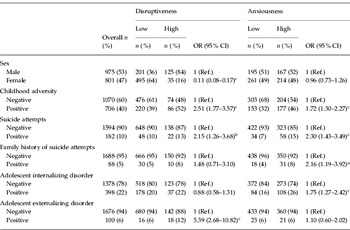
As shown in Table 1, boys were over-represented in the high disruptiveness trajectory compared to the low trajectory. Moreover, childhood adversity and SA were more prevalent in the high disruptiveness trajectory relative to the reference trajectory. As expected, externalizing disorders were more prevalent in the high trajectory group when compared to the low disruptiveness trajectory group. By contrast, no such relationship was found with regard to internalizing disorders. In other words, there was no excess frequency of internalizing disorders among individuals with high disruptiveness trajectories, suggesting independence of this putative modifier (internalizing disorders) from the mediator (high disruptiveness trajectory).
Univariate differences between high and very low trajectory groups for disruptiveness and anxiousness

OR, odds ratio; CI, confidence interval; Ref., reference; n, unweighted counts of individuals in cell; %, weighted percentages; Overall, overall sample.
a 0.01<p<0.05.
b 0.001<p<0.01.
c p<0.001.
Anxiousness trajectories
High and low anxiousness trajectories had balanced sex compositions (Table 1). When compared to the low trajectory, childhood adversity and SA were more prevalent in the high anxiousness trajectory. As expected, internalizing disorders were significantly more prevalent in the high anxiousness trajectory group than in the low trajectory group. By contrast, no such relationship was found with regard to externalizing disorders, suggesting independence of this putative modifier (externalizing disorders) from the mediator (high anxiousness trajectory).
Multivariate effects
Logistic regression analyses were conducted to investigate the relationships between childhood adversity, developmental trajectories of disruptiveness behaviors and anxiousness, and SA. In each of the regressions, the effects of sex and family history of SA were considered as relevant control variables. With respect to sex, moderating effects were also tested by including interaction terms as described above. The moderating effects of mental disorders were also tested. As required (Muller et al. Reference Muller, Judd and Yzerbyt2005), we only considered disorders that are not associated with the trajectories when testing possible moderating effects of internalizing and externalizing disorders on the relationships between the developmental trajectories and SA. As such, we only tested the moderating effect of internalizing disorders on the relationship between disruptiveness trajectories and SA and the moderating effect of externalizing disorders on the relationship between anxiousness trajectories and SA.
Disruptiveness trajectories
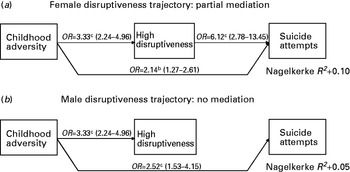
Logistic regressions testing moderating effects of internalizing disorders on the associations between adversity, high disruptiveness trajectory and SA yielded non-significant results. By contrast, as shown in Fig. 3, sex had a moderating effect on one of those associations. More specifically, sex significantly interacted with the high disruptiveness trajectory in the prediction of SA [odds ratio (OR) 5.90, 95% confidence interval (CI) 1.76–19.76, p=0.004]. Probing this significant interaction term showed that the association between high disruptiveness trajectories and SA was only significant among females (OR 6.12, p<0.001). In addition, the association between childhood adversity and SA was partially explained by the disruptiveness trajectory (OR 2.14, p=0.004) among females (Fig. 3 a). The Sobel test further supported the significance of this partial mediating effect (Sobel statistic: z=3.59, p=0.0003). By contrast, the disruptiveness trajectory did not attenuate the strength of this path for males (OR 2.52, p<0.001). However, sex did not significantly interact with childhood adversity in the prediction of SA. Moreover, sex did not significantly modify the regression path (OR 3.33, p<0.001) from childhood adversity to the disruptiveness trajectory. The previous associations were found after controlling for the significant effect of family history of suicide attempts on SA (OR 2.58, 95% CI 1.06–6.27, p=0.04).
Mediating effect of the high disruptiveness trajectory on the association between childhood adversity and suicide attempts moderated by sex (a 0.01<p<0.05, b 0.001⩽p⩽0.01, c p<0.001).

Anxiousness trajectories
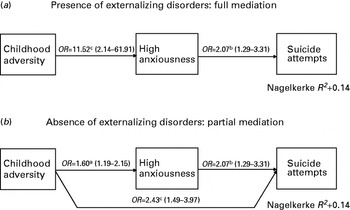
Similarly to the disruptiveness trajectory analyses, we ran logistic regressions for the anxiousness trajectories while controlling for the significant effects of family history of SA (OR 2.21, 95% CI 1.01–4.44, p=0.04) and sex (OR 2.82, 95% CI 1.70–4.70, p<0.001) on SA. Although no significant moderating effects of sex were noted, externalizing disorders did have a significant moderating effect (OR 7.22, 95% CI 1.31–39.78, p=0.02). Specifically, the trajectory of high anxiousness fully explains the relationship between childhood adversity and SA only among individuals with externalizing disorders (Sobel statistic: z=2.07, p=0.0380), whereas among individuals without externalizing disorders, only a partial account of the relationship between childhood adversity and SA was observed (Sobel statistic: z=2.16, p=0.0307).
As shown in Fig. 4 a, probing the interaction revealed that (a) for individuals diagnosed with externalizing disorders, childhood adversity increased the odds to follow the high anxiousness trajectory by more than 11 times (p<0.001), and (b) for individuals without externalizing disorders (Fig. 4 b), childhood adversity increased the odds of being in this trajectory only by 1.6 times (p=0.002). Further probing of this interaction (adversity×externalizing disorders) indicated a significant path from adversity to SA for individuals not diagnosed with externalizing disorders (Fig. 4 b; OR 2.43, 95% CI 1.48–3.97, p<0.001), whereas this path remained non-significant for individuals diagnosed with externalizing disorders (Fig. 4 a; OR 1.60, 95% CI 0.28–9.21, p=0.60). Thus, the ORs of both paths were significantly lower than OR 2.82 (95% CI 1.78–4.49, p<0.001) before controlling for the mediating effects of the high anxiousness trajectory.
Mediating effect of the high anxiousness trajectory on the association between childhood adversity and suicide attempts moderated by externalizing disorders (a 0.01<p<0.05, b 0.001⩽p⩽0.01, c p<0.001).

Externalizing disorders did not, however, modify the relationship between the high anxiousness trajectory and SA. Thus, the path from the high disruptiveness trajectory to SA was invariant according to the presence or absence of externalizing disorders (OR 2.07, p=0.003) (Fig. 4 a, b). Moreover, externalizing disorders did not significantly interact with adversity in the prediction of SA.
Finally, analyses using attrition weights and/or posterior probabilities of high disruptiveness and high anxiousness trajectories (instead of dummy variables) yielded very similar results to those reported above.
Discussion
Using a developmental, person-centered approach, we examined the effects of childhood trajectories of anxiousness and disruptiveness on the relationship between childhood adversity and lifetime SA as assessed in young adulthood. Moreover, we tested whether adolescent internalizing and externalizing diagnoses modify the relationships involving disruptiveness and anxiousness trajectories. To our knowledge, this is the first study to formally evaluate these relationships.
Replicating previous findings (Nagin & Tremblay, Reference Nagin and Tremblay1999; Brezo et al. Reference Brezo, Barker, Paris, Hebert, Vitaro, Tremblay and Turecki2008a ), we identified four distinct developmental profiles of anxiousness and disruptiveness across ages 6–12 years. Also in line with previous research, the prevalence rate of a high trajectory of disruptiveness was about half the size of the prevalence rate of a high trajectory of anxiousness and both prevalence rates were smaller than the rates of moderate, low and very low trajectories.
Although a relationship between childhood adversity, such as early-life sexual and physical abuse, and suicidal behavior in adulthood is consistently reported (Bensley et al. Reference Bensley, Van Eenwyk, Spieker and Schoder1999; Molnar et al. Reference Molnar, Berkman and Buka2001; Dube et al. Reference Dube, Anda, Whitfield, Brown, Felitti, Dong and Giles2005), behavioral mechanisms accounting for this relationship remain unclear. The most striking finding of our study was that the extreme trajectories of behavioral and emotional dysregulation explained the association between childhood adversity and suicidal behavior. This finding is in line with past studies that consistently indicate that impulsive-aggressive traits and anxiety traits/disorders are associated with increased risk of suicide and suicidal behaviors (Beautrais et al. Reference Beautrais, Joyce and Mulder1999; Brezo et al. Reference Brezo, Barker, Paris, Hebert, Vitaro, Tremblay and Turecki2008a , Reference Brezo, Paris, Vitaro, Hebert, Tremblay and Turecki c ; Cicchetti et al. Reference Cicchetti, Rogosch, Gunnar and Toth2010). It is also consistent with work indicating that childhood adversity influences psychological development by directly influencing cognitive processing of threatening stimuli (Lara & Klein, Reference Lara and Klein1999), and also stress reactivity (Heim et al. Reference Heim, Bradley, Mletzko, Deveau, Musselman, Nemeroff, Ressler and Binder2009; Lupien et al. Reference Lupien, McEwen, Gunnar and Heim2009). In turn, cognitive distortions and increased stress reactivity may increase the risk of suicidal behavior by increasing the propensity to quickly display negative affect to daily life stressors (Wichers et al. Reference Wichers, Myin-Germeys, Jacobs, Peeters, Kenis, Derom, Vlietinck, Delespaul and van Os2007).
Disruptiveness trajectories
In addition to important additive associations with each of our target variables, sex showed moderating effects in the relationship between a high disruptiveness trajectory and SA. Specifically, a high trajectory of disruptiveness accounted for the association between adversity and SA only among females. Thus, the majority of females who experienced childhood adversity and who, in turn, followed a trajectory of high disruptiveness subsequently attempted suicide. In this context, it is important to consider that a high disruptiveness trajectory is much less frequent for females than for males. In general, the unbalanced sex composition of the disruptiveness trajectories supports the notion that disruptive behaviors are more common among males than females. Among males, however, there was no excess frequency of SA associated with the extreme disruptiveness trajectory. A possible explanation for this finding lies in both the lower odds of male SA and the preferential attrition, including suicide completion, of males with membership in this trajectory. Nevertheless, our finding remained robust when applying attrition weights that corrected for the effects of sex and socio-economic adversity, as both of these variables are related to disruptiveness. Future research using larger samples and suicide records is required to systematically examine the validity of this tentative explanation. The findings suggest that early impulsive-disruptive behaviors already merit serious consideration in both clinical and research contexts despite sex-related differences in suicidal behaviors and outcomes.
Anxiousness trajectories
The high anxiousness trajectory fully explained the association between childhood adversity and lifetime SA assessed in young adulthood. An important finding is that the potency of the mediating effect of the high anxiousness trajectory was influenced by externalizing disorders. Externalizing disorders exacerbated the probability of abused individuals to follow a high anxiousness trajectory. For abused individuals without externalizing disorders, the probability of being extremely anxious was significantly lower, although still elevated when compared to non-abused individuals. For individuals without externalizing disorders, a trajectory of high anxiety seems to be an important link between childhood adversity and SA, but other variables are also of marked influence. By contrast, for individuals with externalizing diagnoses, a trajectory of high anxiety throughout childhood seems to be the main factor that explains the association between childhood adversity and SA. Hence, childhood adversity, when experienced by individuals vulnerable to externalizing disorders, seems often to be related to stable and extreme dispositions of anxiety and, in turn, to suicidal behavior. This moderating effect supports the accumulating evidence of gene–environment interactions explaining predisposition to suicidal behavior (Brezo et al. Reference Brezo, Klempan and Turecki2008b ; Labonte & Turecki, Reference Labonte and Turecki2010), including data suggesting that early-life adversity increases risk of suicide by changing the methylation patterns of regulatory sequences of the glucocorticoid receptor in the hippocampus, a gene and structure important in the regulation of stress responses (McGowan et al. Reference McGowan, Sasaki, D'Alessio, Dymov, Labonte, Szyf, Turecki and Meaney2009). An important conclusion for research, and for clinical practice, is that the presence of two of these three predictors of suicidality (i.e. childhood adversity, externalizing disorders or extreme and persistent anxiousness throughout childhood) should be of concern because our analyses suggest they are highly predictive of future suicidality.
Considered alongside the pervasive mediating effects of behavioral dysregulation on the association of adversity and SA, the finding that externalizing disorders exacerbate the mediating effects of high anxiousness trajectories further supports the notion that impulse control dysregulation plays a central role in predisposition to SA. Impulse control dysregulation is a feature common to substance abuse and disruptive disorders and may explain both suicidal behaviors and psychiatric co-morbidity of internalizing and externalizing disorders (Turecki, Reference Turecki2001; Verona et al. Reference Verona, Sachs-Ericsson and Joiner2004). This suggests that early disruptive behaviors and adolescent externalizing disorders may be more useful markers of the risk for suicidality than their internalizing counterparts. Each of our findings persisted in the presence of important covariates including socio-economic conditions and family history of suicide, an observation that is consistent with previous evidence from our group indicating that impulsive-aggressive behaviors mediate familial aggregation of suicidal behavior (McGirr et al. Reference McGirr, Alda, Seguin, Cabot, Lesage and Turecki2009).
Our findings need to be considered in light of several methodological limitations. First, given our culturally homogeneous community sample, preset conclusions may have limited generalizability to other populations. Second, attrition may have affected our internal validity, although we repeated the analyses using weights to test for its effect. We also replicated the trajectories that were previously found in less selected samples (Nagin & Tremblay, Reference Nagin and Tremblay1999; Brezo et al. Reference Brezo, Barker, Paris, Hebert, Vitaro, Tremblay and Turecki2008a ). Third, our estimates of ORs are probably larger than their risk ratio counterparts, given that they are not equivalent for an outcome whose frequency is more than 10% (Viera, Reference Viera2008). Fourth, tests of moderated mediation require, in addition to temporal ordering of the predictor, mediator, moderator and outcome, that the moderator be independent from each of the previous variables (Muller et al. Reference Muller, Judd and Yzerbyt2005; Edwards & Lambert, Reference Edwards and Lambert2007). Replicating previous findings, however, both mental disorders were associated with childhood adversity (Horwitz et al. Reference Horwitz, Widom, McLaughlin and White2001; Levitan et al. Reference Levitan, Rector, Sheldon and Goering2003) and suicidality (Oquendo et al. Reference Oquendo, Lizardi, Greenwald, Weissman and Mann2004; Brezo et al. Reference Brezo, Paris and Turecki2006, Reference Brezo, Paris, Vitaro, Hebert, Tremblay and Turecki2008c ). To reduce any problems this may cause, we selected as moderators only disorders that were independent from the respective personality trajectory.
Although our trajectories co-vary with and precede SA and their associations are theoretically plausible, and suggested in the literature, our design was not experimental. We may have failed to rule out other variables responsible for their relationship. These limitations were balanced by the methodological strengths: namely, the use of a comprehensive, hypothesis-driven approach, relying on multipoint assessments by independent raters and tested for attrition effects. In addition, in establishing the optimal number of trajectories, we used statistical criteria rather than arbitrary cut-offs.
In conclusion, we have demonstrated that elevated disruptiveness trajectories explain the association between childhood adversity and SA, and that sex plays an important moderating role in this regard. Specifically, persistent disruptiveness in females partly explains the association of adversity and SA, whereas the corresponding male trajectories are not explained in this regard. Moreover, we found that high anxiousness trajectories also account for this association, and this process is further exacerbated by externalizing disorders. Pending further research, preventive programs may benefit from considering externalizing personality and psychiatric markers assessed in early childhood.
Supplementary material
For supplementary material accompanying this paper, visit http://dx.doi.org/10.1017/S0033291712000438.
Acknowledgments
This study was supported by grant MOP 151060 from the Canadian Institutes of Health Research and by the National Consortium on Violence Research, Carnegie Mellon University. Support was also received from the Programme National de recherche et de développement en matière de santé, the Conseil Québécois de la recherche sociale, and the Fonds Québécois de la recherche sur la société et la culture. G. Turecki is a Chercheur Boursier from the Fonds de la recherche en santé du Québec (FRSQ).
Declaration of Interest
None.