States provide social welfare services in order to help meet the needs of their citizenry. Social spending is the result of the state's efforts to lessen predictable conditions that threaten income and economic security, including unemployment, poor health, disability, and old age (Amenta Reference Amenta1993). States invest in public spending to attain a range of policy objectives such as fostering economic development, reducing poverty, and helping improve their citizens’ physical quality of life (Anyanwu and Erhijakpor Reference Anyanwu and Erhijakpor2009; Flora and Heidenheimer Reference Flora and Heidenheimer1987). There has been much policy debate over whether social spending on welfare really helps to achieve positive outcomes for society. Some recent examples include fierce political debates over the effectiveness of federal and state-level poverty reduction or education programs in the United States and the heated dialogue surrounding Parliamentary votes over welfare spending caps in the United Kingdom (Inman Reference Inman2014; Kasperkevic Reference Kasperkevic2014).
The growing policy-relevant debate on the use and effectiveness of social welfare spending has also prompted significant scholarly work on various socioeconomic and political outcomes of welfare efforts. Some studies focus on whether public spending policies on health, childcare, and education meet their goals (Gupta and Verhoeven Reference Gupta and Verhoeven2001; Gupta, Verhoeven, and Tiongson Reference Gupta, Verhoeven and Tiongson2002; Kimmel Reference Kimmel1995). Other analyses focus on the effect that public spending might have on economic growth (Baldacci et al. Reference Baldacci, Clements, Gupta and Cui2008; Rayp and van de Sijpe Reference Rayp and van de Sijpe2007), poverty reduction (Berg-Schlosser and Kersting Reference Berg-Schlosser and Kersting2003; Brady Reference Brady2005; Granato, Inglehart, and Leblang Reference Granato, Inglehart and Leblang1996; Heltberg, Simler, and Tarp Reference Heltberg, Simler and Tarp2001; Keefer and Khemani Reference Keefer and Khemani2003), human development (Gebregziabher and Niño-Zarazúa Reference Gebregziabher and Niño-Zarazúa2014), and civil peace (Taydas and Peksen Reference Taydas and Peksen2012). Despite considerable research on a wide range of outcomes of social spending, little is known about the possible gender-specific effects of welfare policies. The purpose of this study is to assess the extent to which public spending is significantly related to the economic and political wellbeing of a historically disadvantaged group—women.
Women tend to be heavily represented among the marginalized segments of society, and have long been portrayed as one of the major beneficiaries of welfare services. As such, scholars frequently designate most public welfare policies as “women friendly” (Bock and Thane Reference Bock and Thane1991; Borchorst Reference Borchorst1994; Fraser Reference Fraser1987; Hernes Reference Hernes1987; Kolberg Reference Kolberg1991; Sainsbury Reference Sainsbury1994; Wilson Reference Wilson1977). Existing research even suggests that women themselves in key economic and political positions tend to strongly advocate for social spending as a path to women's empowerment, as well as that of other disadvantaged groups (Bolzendahl Reference Bolzendahl2009; Bolzendahl and Brooks Reference Bolzendahl and Brooks2007; Bratton and Ray Reference Bratton and Ray2002; Caiazza Reference Caiazza2004; Misra Reference Misra2003; O'Regan Reference O'Regan2000). Despite this, little cross-national research has systematically tested the widely-held assumption of the potential benefits of welfare efforts for women, especially in the economic and political spheres. To this end, we analyze whether the fiscal commitment of governments to social services in three key areas –education, health, and social services– affects women's share of seats in national legislatures and female participation in the total labor force.
There are gender-focused studies that investigate whether welfare expenditures might improve various education and health outcomes for women along with other groups such as children and elderly (Anyanwu and Erhijakpor Reference Anyanwu and Erhijakpor2009; Baldacci, Guin-Sui, and de Mello Reference Baldacci, Clements, Gupta and Cui2003; Farag et al. Reference Farag, Nandakumar, Wallack, Hodgkin, Gaumer and Erbil2013; Frankenberg and Thomas Reference Frankenberg and Thomas2001; Summers Reference Summers1994). Other studies explore the influence of particular forms of social spending on women's employment (Gornick, Meyers, and Ross Reference Gornick, Meyers and Ross1997; Korpi Reference Korpi2000; Lewis Reference Lewis1992; Orloff Reference Orloff2002; Sainsbury Reference Sainsbury1994) and the impact of welfare policies on gendered divisions of labor in employment and households (Crompton Reference Crompton2006; Hobson Reference Hobson1990; Lewis Reference Lewis and Lewis1993). These studies, however, are mostly historical examinations of the various kinds of social policies that have been enacted, and they examine predominately Western European and the North American experiences.
We further extend the current knowledge of the possible gender-specific effects of social spending by offering a cross-national analysis of the degree to which social spending affects women's participation in the labor force and politics. Analyzing data for 97 countries for the years spanning 1990 to 2010, we are better able to assess the possible relationship between welfare expenditures and women's status outside of specific cases and unique social settings. Our study therefore builds on the earlier country- or region-specific research on the gender-specific effects of social welfare policies to be able to draw more generalizable inferences.
The remainder of the study is as follows. First, we present the theoretical framework detailing the nexus between welfare spending and women's involvement in the labor force and politics. In the subsequent section, we discuss the data and model specifications and report the findings from the data analysis. We conclude with a discussion of the implications of our findings for policymaking and academic research.
SOCIAL WELFARE POLICIES AND WOMEN‘S ECONOMIC AND POLITICAL STATUS
Public services and social safety nets are intended to prevent disadvantaged members of society from falling below a certain level of poverty and experiencing severe levels of desperation (Flora and Heidenheimer Reference Flora and Heidenheimer1987; Huber and Stephens Reference Huber and Stephens2001). States also anticipate that social welfare services such as child care, education, and job training would assist marginalized groups to find employment, and thus reduce their dependence on welfare policies in the long term. Women are frequent beneficiaries of welfare spending, as they tend to face marginalization in nearly every society across the world. While gendered marginalization intersects with class, race, ethnicity, and other aspects of discrimination, traditional assumptions about acceptable or appropriate gender roles have long affected women's access to education, economic power, and active involvement in key economic and political decision-making (UNDP 2015; UN Women 2015).
When states invest in social spending, the expectation is that welfare policies would partially correct some of these gendered patterns of power and participation in public life.Footnote 1 Social welfare spending might help women gain the skills and independence to participate more fully in the economy, politics, and other aspects of society. Thus, government spending on social programs might partially break down some of the barriers to women's economic independence, personal autonomy, and political empowerment. In the remainder of this section, we offer a detailed discussion of how the fiscal commitment of governments to social policies might contribute to the improvements of women's participation in the total labor force and national politics.
Welfare Spending and Female Labor Force Participation
Labor force participation is essential for economic security, yet women around the world continue to face challenges to active employment. On average, women are more likely to engage in unpaid work, earn less than men, be underrepresented in senior decision-making positions within companies, encounter uneven barriers to entrepreneurship, and find themselves in vulnerable employment in most countries (Iversen and Rosenbluth Reference Iversen and Rosenbluth2006; UNDP 2015). Some of the challenges to women's equal participation in the labor force stem from gendered assumptions about care. Cultural norms and expectations about who should provide care for children and other household members result in women more frequently providing care within families (Abramovitz Reference Abramovitz1996; Fraser Reference Fraser1987; Rosenbluth, Salmond, and Thies Reference Rosenbluth, Salmond and Thies2006).
These gendered assumptions result in women on average performing three times more unpaid work than men, encompassing a range of care activities (UNDP 2015). This uneven care burden means that women spend a disproportionate amount of time providing care as compared to men, a trend which holds across both wealthy and poorer countries (Bittman et al. Reference Bittman, England, Folbre, Sayer and Matheson2003).Footnote 2 This results in mothers having some of the lowest rates of participation in the labor force, even in states in the global North (Daly Reference Daly2000; Marino, Romanelli, and Tasso Reference Marino, Romanelli and Tasso2013). When childcare or elder care is supported by the state, women will have more time to participate in the labor force (Orloff Reference Orloff2002). Thus, one direct impact of the allocation of more funds to social programs could be an increase in the extent of women's paid employment in the total labor force. For instance, previous research suggests that social spending on childcare and family-related support in Scandinavian countries during the 1980s and 1990s was instrumental for many women to reconcile family obligations and have more paid employment outside of the home (Kolberg Reference Kolberg1991).
Similarly, public spending on healthcare both allows people to be healthy enough to work as well as relieves some of the care burden that many women face. Several studies have found that spending on health initiatives is associated with better health outcomes (Anyanwu and Erhijakpor Reference Anyanwu and Erhijakpor2009; Baldacci, Guin-Siu, and de Mello Reference Baldacci, Guin-Siu and de Mello2003; Farag et al. Reference Farag, Nandakumar, Wallack, Hodgkin, Gaumer and Erbil2013). For example, a study of 47 African countries found that higher amounts of health spending reduce infant and under-five mortality rates (Anyanwu and Erhijakpor Reference Anyanwu and Erhijakpor2009). Farag et al. (Reference Farag, Nandakumar, Wallack, Hodgkin, Gaumer and Erbil2013) had similar findings regarding improvements to infant and child health in their examination of public expenditures in 133 low- and middle-income countries. Specifically related to women's health, Frankenberg and Thomas (Reference Frankenberg and Thomas2001) illustrate that public financing of a midwife program in Indonesia between 1993 and 1997 was related to a significant increase in body mass index for women of reproductive age. Additionally, the presence of a village midwife during pregnancy was associated with increased infant birthweight. Both of these outcomes are regarded as beneficial for the mothers and children in the study.Footnote 3
Overall, the existing research indicates that public expenditures on health are positively associated with improvements to public health, particularly for children and pregnant women. Women's improved health conditions would enable them to become more active participants in the economy. Further, since women tend to disproportionately be central caregivers for children, healthier children would mean less demand on their time, which might be filled with paid employment in the labor force. Therefore, health spending likely contributes to healthier women and healthier children, both of which would enable women's labor force participation.
Better health also enables the sustained and effective use of the knowledge and skills that individuals acquire through education (Schultz Reference Schultz1999). Education is essential for gaining the skills necessary for individuals to be competitive in most job markets. Gupta, Verhoeven, and Tiongson (Reference Gupta, Verhoeven and Tiongson2002) show that both the level and the composition of spending on education are important determinants of enrollment rates, persistence rates through grade 4, and primary school dropout rates. Likewise, Baldacci et al. (Reference Baldacci, Clements, Gupta and Cui2008) find that an increase in education spending of just one percentage point of GDP is associated with three more years of schooling on average and raises the annual growth of GDP per capita by 1.4 percentage points in 15 years.
Female deprivation in many parts of the world has been likened to a “vicious cycle” wherein girls are not educated because they are not expected to contribute financially to a family (Summers Reference Summers1994, 1). Family resources are not dedicated to girls’ education, as they are not regarded as being a good investment for the economic prospects of the family. However, it is likely because they are uneducated that they cannot gain the skills necessary to access many jobs. This results in a self-fulfilling prophesy and the vicious cycle continues (Sabarwal, Sinha, and Buvinic Reference Sabarwal, Sinha and Buvinic2010; Summers Reference Summers1994). Public funding for education takes some of the burden off of families in paying for the education of both sons and daughters. More women may therefore be able to gain an education and the benefits that go along with it, including being more competitive for paid jobs. The skills that accompany education are a vital factor in whether or not many women will be able to enter the formal labor market (Edin and Lein Reference Edin and Lein1997).
In sum, we argue that public funding for welfare programs reduces some of the barriers to women's participation in the labor force. Social programs that lessen some of the care burden that many women face improve their ability to seek and hold jobs.Footnote 4 Additionally, spending on health and education help many women to be healthy enough to work and have skills that make them more competitive in the labor market. For the reasons outlined above, we offer the following hypothesis:
H1:
Public welfare spending is positively associated with women's labor force participation.
Welfare Spending and Women's Involvement in Politics
Women also tend to be underrepresented in politics, on average holding many fewer elected national positions than men. While globally there is a good deal of variation in women's presence in legislatures, states overwhelmingly fail to achieve gender equity in these bodies. According to the World Bank (2016), the global percentage of parliamentary seats in a single or lower chamber held by women has increased from 17% in 2006 to 22.9% in 2015, which is still a relatively low figure. Indeed, the United Nations General Assembly passed a resolution on women's political participation in 2011, which noted that “women in every part of the world continue to be largely marginalized from the political sphere, often as a result of discriminatory laws, practices, attitudes and gender stereotypes, low levels of education, lack of access to healthcare and the disproportionate effect of poverty on women” (UN General Assembly 2011, 2).
The last three factors in the UN's list—lack of education, access to healthcare, and economic security—are three of the areas in which welfare spending is often targeted. As discussed above, social spending aids women by removing barriers to their participation in public life. For instance, education spending enables women to gain skills and have expanded opportunities (Edin and Lein Reference Edin and Lein1997; Sabarwal, Sinha, and Buvinic Reference Sabarwal, Sinha and Buvinic2010; Summers Reference Summers1994). A basic example of this is the role of education in providing simple literacy skills necessary to stand for public office (Shvedova Reference Shvedova, Ballington and Karam2005). Existing work also shows that education is specifically connected to increases in political participation (Burns, Schlozman, and Verba Reference Burns, Schlozman and Verba2001). Education allows for training in the analysis of and participation in political debates. It also potentially includes engagement in voluntary opportunities like school organizations that may foster leadership experience, bureaucratic or organization skills, as well as cooperation and negotiation skills, each of which is useful for participation in national elections.
Additionally, education can provide networking channels that can manifest in political recruitment for national elections. There is some evidence that women's participation in education initiatives in particular can result in more active political engagement. Examples from Venezuela, Nicaragua, Uganda, and India illustrate that state-funded public education campaigns resulted in a sharp increase in the number of women participating in local and national elections, along with engaging in protests and participating in associations and organizations within civil society (Goetz Reference Goetz2003).Footnote 5 Hence, state spending on education initiatives increases the likelihood that women who participate in them might gain skills, confidence, or networks that can be translated into more active presence in national politics, including national parliaments (Shvedova Reference Shvedova, Ballington and Karam2005).
Likewise, spending that results in increased labor force participation and increased economic security is another important component of political participation. Poverty results in strains on resources to actively participate in politics. It is more challenging for people struggling with economic insecurity to participate actively in political processes (Berg-Schlosser and Kersting Reference Berg-Schlosser and Kersting2003; Holzner Reference Holzner2007). Studies find that, in particular, social security transfers and public health spending significantly reduce poverty (Brady Reference Brady2005). This means that women who face poverty may have some of their economic burden lessened through social spending, thus enabling them to assume more active roles in national-level politics. According to Razia Faiz, a former member of Parliament in Bangladesh,
The two most overwhelming obstacles for women in entering parliament are lack of constituents and lack of financial resources. Women […] have no base from which to develop contacts with the people or to build knowledge and experience about the issues. Furthermore, they have no money of their own; the money belongs to their fathers, their husbands or their in-laws. Given the rising cost of running an effective campaign, this poses another serious hurdle for women in the developing world (Shvedova Reference Shvedova, Ballington and Karam2005, 41).
While this does not apply to all women equally, it does indicate that the economic marginalization that many women face is a challenge to participation in national parliaments. Social spending that removes some of this economic marginalization, while also potentially facilitating network connections and other education benefits through education spending, can thus remove some of the significant barriers that women face to running for and holding seats at the national level.
Finally, public spending removes obstacles to women's involvement in the formal job sector by providing skills, healthcare, and care-supporting services. As public spending allows more women to participate in the labor force, particularly in well-organized public sectors, this increases the level of organization of women and their potential for political mobilization (Huber and Stephens Reference Huber and Stephens2001). For example, women who are employed by the state may be more involved in political networks, prompting their more active engagement in politics (Rosenbluth, Salmond, and Thies Reference Rosenbluth, Salmond and Thies2006). At the same time, the increased access to skills and time provided by improved education and care services enables women to translate political awareness into political engagement.
While it is true that some women who choose to run for public office might already be wealthy enough to not necessarily benefit directly from means-tested assistance programs (Shvedova Reference Shvedova, Ballington and Karam2005), state spending on social security, health, and education are often publicly available regardless of socioeconomic status. This means that even women who would not necessarily enroll in programs due to being economically marginalized might still gain some benefits from them in the form of having healthier children and reduced burdens on their time, which could have a positive impact on their ability to run for office. For economically marginalized women these benefits would likely be even greater. Additionally, there is evidence to suggest that women in key economic and political positions tend to strongly advocate for social spending once in office (Bolzendahl Reference Bolzendahl2009; Bolzendahl and Brooks Reference Bolzendahl and Brooks2007; Bratton and Ray Reference Bratton and Ray2002; Caiazza Reference Caiazza2004; Misra Reference Misra2003; O'Regan Reference O'Regan2000). Therefore, it is likely that social spending increases the chances for women to participate in politics, where they are likely to support social spending, which results in even more women getting involved in politics. This parallels Andrea Campbell's (Reference Campbell2005) findings in her influential work on the relationship between increases in benefits from Social Security and Medicare, and heightened civic participation among senior citizens in the United States.
To summarize, we assert that social spending enables women to participate in the political sphere by offering more women the opportunities to gain the skill sets and economic stability necessary to be competitive in national elections. It also relieves the care burden of those women who are tasked with caring for children or older relatives, which enables them become more active in politics. Based on the above discussion, we offer the following hypothesis:
H2:
Public welfare spending is positively associated with women's share of seats in national legislatures.
RESEARCH DESIGN
To evaluate the empirical merits of the theoretical claims discussed above, we gathered time-series, cross-sectional data for the years spanning 1990 to 2010. Country-year is the unit of analysis, and the analysis includes 97 countries. However, because the data are unbalanced, the number of countries varies by the variables included in each model. Descriptive statistics for all the variables and the list of countries included in the analysis appear in the supplementary material (Tables A1 and A2, respectively).
Outcome Variables
The first outcome variable, Female labor force participation, is the percentage of women in the total labor force. It is a widely used proxy that captures women's overall labor force participation among the economically active population. The labor force data are from the World Development Indicators (World Bank 2015). The second outcome variable, Women's participation in national parliaments, is the proportion of seats held by women in national parliaments. The variable specifically accounts for female participation in the single chamber unicameral parliaments and the lower chamber in bicameral parliaments. The data for female parliamentarians are from the World Development Indicators (World Bank 2015) and Women in National Parliaments (Inter-Parliamentary Union 2015) datasets.
Explanatory Variables
To examine the impact of welfare spending on women's economic and political status, the model includes the welfare spending variable. It captures governments’ overall fiscal commitments to various social needs in three major areas, including education, health, and social security. The variable is measured as a percentage of total public spending.Footnote 6 Education expenditures include all government investments and expenditures in public education. Health expenditures include all the basic and hospital health care spending. Social security spending refers to such social protection expenses as family and children, unemployment, and housing. There is no guarantee that devoting money to certain social welfare areas will automatically result in improvements on those areas. Yet the share of welfare spending in total public expenditures is an indication of priorities set by governments. Further, there is already evidence indicating that allocation of more money and other resources is positively associated with advancements in social services, thus spending serves as a good proxy for whether people have access to public goods (Brown and Hunter Reference Brown and Hunter2004). The spending data come from the Relative Political Capacity (RPC) dataset (Kugler and Tammen Reference Kugler and Tammen2012). The RPC dataset originally gathered the spending data from the United Nations Statistics Division and the International Monetary Fund's Government Finance Statistics database.Footnote 7
The model also includes a battery of control variables to account for all the major covariates of women's economic and political empowerment. The natural log of gross domestic product (GDP) per capita income controls for the possible positive impact of economic wealth on women's wellbeing. Economic prosperity might help women improve their economic and political status by helping them gain more economic freedom, personal autonomy, and socioeconomic empowerment (Detraz and Peksen Reference Detraz and Peksen2016; Duflo Reference Duflo2012; Peksen Reference Peksen2011; Richards and Gelleny Reference Richards and Gelleny2007).
The CEDAW ratification variable controls for the expectation that countries that ratified the Convention on the Elimination of All Forms of Discrimination against Women (CEDAW) are less likely to tolerate gendered discrimination in politics and the marketplace (Cole Reference Cole2012; Murdie and Peksen Reference Murdie and Peksen2015). It is coded one for all the years since the ratification of the CEDAW convention, and zero otherwise. We also control for the percentage of women in total population (female population) since the higher proportion of women in total population might be positively associated women's involvement in the economy and politics.
The democracy variable controls for the possible positive relationship between democracy and women's wellbeing. The variable ranges from −10 (most authoritarian) to + 10 (most democratic) and comes from the Polity IV dataset (Marshall, Jaggers, and Gurr Reference Marshall, Jaggers and Gurr2012). Because democratic governments are more constrained by systems of checks and balances as well as the possibility of losing office through elections, they have more incentives to prevent systematic gendered, and other forms of discrimination against their citizens (Beer Reference Beer2009; Norris and Inglehart Reference Norris and Inglehart2001; Poe, Tate, and Keith Reference Poe, Tate and Keith1999). Women might therefore have a stronger presence in the economy and politics in democracies than nondemocratic regimes.
Earlier research suggests that more economic globalization is positively associated with women's economic and political status (Gray, Kittilson, and Shandholtz Reference Gray, Kittilson and Sandholtz2006; Neumayer and De Soysa Reference Neumayer and Soysa2007). As economic globalization promotes better living conditions through increased economic growth and prosperity, women might have more economic opportunities that they can use for economic independence and self-empowerment. To take this argument into account, the model includes economic openness, which is the natural log of total trade flows (exports plus imports) as a percentage of GDP. The data for economic development, economic openness, and female population are from the World Development Indicators dataset (World Bank 2015)
Methodological Concerns
To correct for autocorrelation (i.e., temporal dependence in the outcome variables), we lag both outcome variables by one year and then include them—Female Legislatort-1 and Female Labort-1—on the right-hand side of the equation. We first report models with random effects. We also run models with country-fixed effects to ensure that the results are not biased by any unobserved country-specific, time-invariant factors. Earlier research suggests that the extent of female participation in politics and the economy might affect the level of welfare spending by the government (Bolzendahl Reference Bolzendahl2009; Bolzendahl and Brooks Reference Bolzendahl and Brooks2007). Thus, there might be a mutual interdependence (i.e., endogeneity) between the extent of welfare spending and women's involvement in the economy and politics.
To account for this possible endogenous process, we adopt two strategies. First, we lag the welfare spending variable one year in the models to make sure that they temporally precede the outcome measures. While this is not a perfect solution to address the question of reciprocal causation, it at least temporally allows the main explanatory variables to come first. Second, we estimate two-stage least squares (2SLS) models with an instrumental variable (IV) to account for the possibility of endogeneity. It is a challenging task to find instrumental variables, as it requires finding strong predictors of welfare spending that are theoretically and statistically exogenous to women's participation in national parliaments and the labor force. We use the following indicators in the 2SLS models: ethnic tensions, population size, the share of agriculture in GDP, and past welfare spending.Footnote 8
Ethnic tensions are also likely to decrease the extent of public services as rival ethnic groups might see general public services as less beneficial to their own groups and thus ethnic groups who have significant influence in the state might be less inclined to invest in social services (Alesina, Baqir, and Easterly Reference Alesina, Baqir and Easterly1999; Alesina and Spolaore Reference Alesina and Spolaore1997; Easterly and Levine Reference Easterly and Levine1997). The ethnicity data are from the International Country Risk Group (ICRG) dataset (Knack and Keefer Reference Knack and Keefer1998). The population size of a country also appears to have a significant negative impact on the amount of public spending (Easterly and Rebelo Reference Easterly and Rebelo1993). This is in part because it becomes more challenging for the state to provide social services for a large populace. Countries that heavily depend on agriculture as one of their main sources of income tend to have higher public spending, as those are also the countries with less liberalized economies and therefore face less pressure to limit public spending (Easterly and Rebelo Reference Easterly and Rebelo1993; Tanzi Reference Tanzi, Goldin and Alan Winters1992). The data for population size and the GDP indicator come from the World Development Indicators dataset (World Bank 2015). The extent of welfare spending in the recent history of a country is another key predictor of the current welfare spending trends. However, the spending in the immediate past might still be endogenous to women's well-being. We thus use a three-year lagged welfare spending variable to estimate the instrumental variable.Footnote 9
FINDINGS
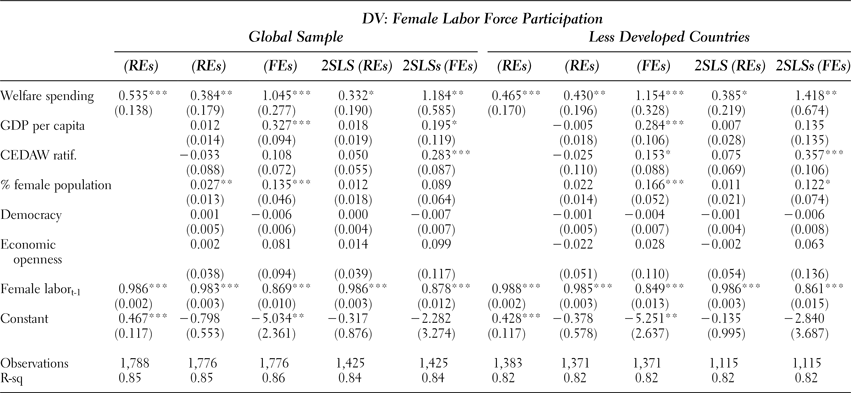
Table 1 reports the models that evaluate the impact of social welfare policies on the extent of women's participation in the total labor force. The first two models are the random effects models, and the third model is the fixed effects model. The fourth and fifth models are the 2SLS models estimated with the random effects and fixed effects indicators, respectively. To check the sensitivity of the findings to sample specification, we report additional models in Table 1 with a sample that excludes all the major developed countries including Australia, Canada, Japan, the United States, New Zealand, and Western European countries.
Welfare spending and female labor force participation

Notes: Standard errors appear in parenthesis. ***p ≤ 0.01, **p ≤ 0.05, *p ≤ 0.1
The results in Table 1 suggest that welfare spending has a statistically significant positive effect on the level of female labor force participation. The results are similar across the models for both the global and less developed countries samples that confirm the robustness of the significant relationship between social welfare policies and women's labor force participation. Hence, the findings in Table 1 lend statistical support for the hypothesis that more fiscal commitment by governments in key social areas are positively associated with women's economic status.
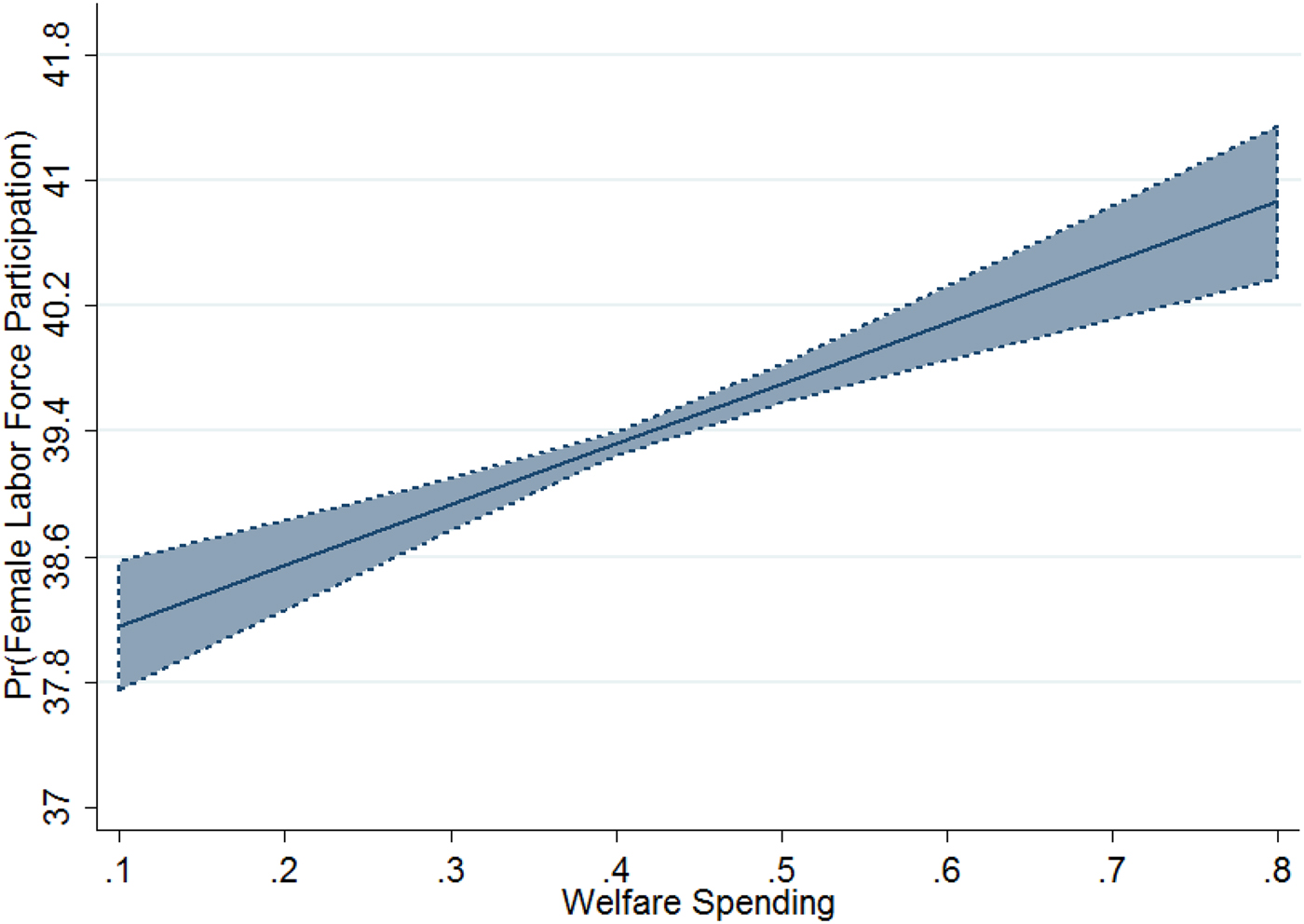
How substantial is the effect of welfare spending on female labor force participation? To examine the marginal effect of welfare spending, Figure 1 reports the change in the predicted value of the female labor force variable, as the welfare spending variable moves from lower to higher values while the other significant independent variables in the third model in Table 1 are kept in their mean scores. When the spending variable is altered from its minimum (0.1) to maximum value (0.8) in the figure, the predicted value of female labor force participation goes up by 7% (from 38.2 to 40.9). When there is a one standard deviation increase in the average value of the spending variable (from 0.42 to 0.55) based on the descriptive statistics in Table 4, the predicted value of the female labor force variable increases by about 1.3% (from 39.4 to 39.9). In all, based on the results in Table 1 and Figure 1, we find that welfare policies are likely to have a substantively significant influence on women's economic status.
Marginal effect of welfare spending on female labor force participation with 95% confidence interval (global sample)

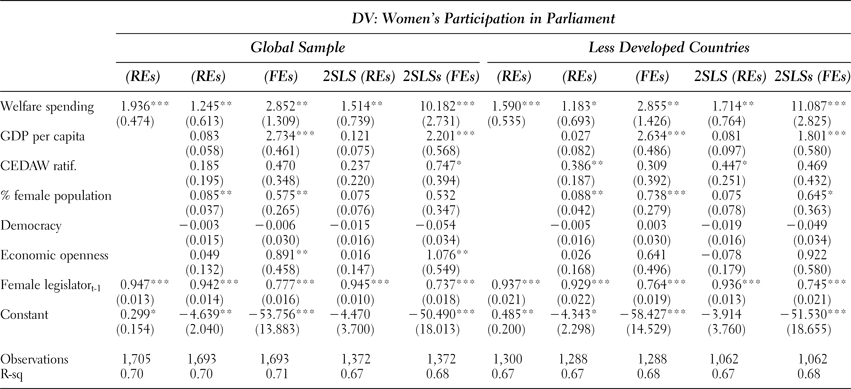
Table 2 reports the models that assess the effect of welfare spending on women's share of seats in parliament. The results across the models indicate that welfare spending is positively related to women's political status. That is, women's are more likely to hold key political positions in countries with relatively high levels of welfare spending. The results are robust to the two different model specifications (random effects and fixed-effects) and the use of instrumental variables. We therefore find robust statistical evidence denoting that more fiscal commitments to key social welfare areas positively covary with the extent of women's participation in national politics.
Welfare spending and women's participation in parliament

Notes: Standard errors appear in parenthesis; ***p ≤ 0.01, **p ≤ 0.05, *p ≤ 0.1
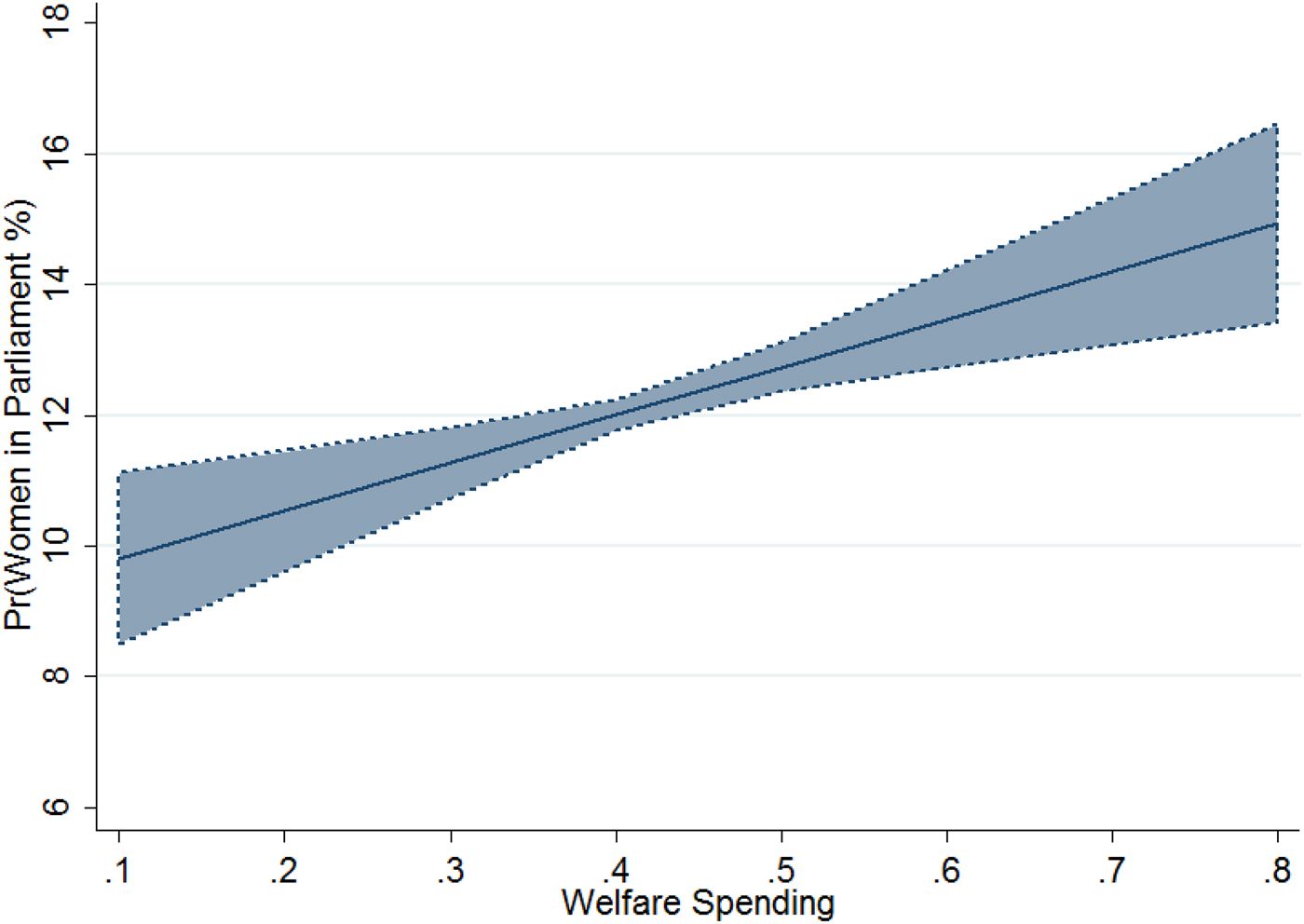
Figure 2 reports the substantive effect of the welfare spending variable on women's presence in national parliaments based on the third model in Table 2. According to the figure, when the spending variable is altered from its minimum (0.1) to maximum (0.8), the predicted value of the outcome variable goes up 52% (from 9.8 to 14.9). When we increase the average score of the welfare spending variable by one standard deviation (from 0.42 to 0.55) based on the descriptive statistics in Table 4, we find that the predicted value of the outcome variable goes up 7% (from 12.2 to 13.1). These results clearly indicate that the hypothesized impact of welfare spending is both statistically and substantively significant in estimating the share of female parliamentarians in national parliaments.
Marginal effect of welfare spending on women's participation in parliament with 95% confidence interval (global sample).

Among the control variables across the models in the tables, economic development shows a positive impact on women's economic and political status in most models. This suggests that women are more likely to be actively involved in the labor force and national politics in wealthier countries. In some models, we also find that the ratification of the CEDAW and the proportion of female population are statistically significant in the expected direction. That is, the ratification of the CEDAW and higher proportion of female population are likely to contribute to the improvement of women's presence in the economy and politics. Economic openness is another variable that is statistically significant in some models. This indicates that global economic integration might help improve women's economic and political status.
The democracy variable, on the other hand, is not statistically significant in the models. Thus, we find no statistically significant evidence that political regime type affects women's economic and political wellbeing when controlling for the other major covariates of women's economic and political empowerment. This suggests that more political openness does not necessarily translate into more female participation in economic and political spheres. Given that both politics and economics have long been male-dominated sectors, even democracies might struggle with creating necessary conditions for women to play more active roles within them.
Additional Analyses and Robustness Checks
To make sure that our results are robust to the operationalization of the welfare spending measure, we used an alternative operationalization of the spending variable, welfare spending as a percentage of GDP. We find no major change in the main findings in the models estimated with the alternative spending variable. This finding should not be very surprising, as the correlation score between the two spending measures is considerably high, 0.82. The results from the models with the alternative spending variable appear in the supplementary material (Table A3). In addition to the fixed-effects models reported in the main analysis that account for any unobserved country-specific effects, we estimated models controlling for the dominant religion as well as the extent of ethnic or religious fractionalization. Our main findings remain unaltered in these additional models. This further confirms our theoretical claims that government's fiscal commitments to welfare policies might have a positive effect on women's involvement in the total labor force and national legislatures
CONCLUSIONS
This paper has examined the possible effect of social welfare spending on women's economic and political status. We specifically tested the impact of government's fiscal commitments to social policies on women's involvement in the total labor force and national legislatures. Results from a sample of 97 countries for the years from 1990 to 2010 confirmed the theoretical expectations that welfare spending is positively associated with the extent of women's presence in the total labor force and national parliaments. Our analysis expands the current literature on the possible effects of social welfare policies. Whereas existing scholarship mostly focused on the extent to which welfare spending might affect female educational attainment and health outcomes, we offer robust evidence that welfare spending is positively related to women's political and economic status. While there is likely some variation with exactly how the relationship between social spending and political and economic participation plays out in an individual context, our findings offer important insight on global trends. This study also acts as a bridge between the existing work on the outcomes of social spending and the gender-focused work that tends to focus most heavily on Europe and North America.
Our findings have significant implications for policymaking. Neoliberal economic logic often encourages states to shrink the size of public spending as a possible way to stimulate more economic competitiveness and efficiency. However, less social spending could mean that women and other marginalized groups might lose out on the benefits that they gain through spending on social security, health, and education. Our study contributes to answering the question of whether welfare spending actually helps those it is intended to help. A next step would be to ensure that health, education, and childcare/eldercare initiatives are specifically designed to aid in removing those obstacles to women's full participation in economics and politics. While we are not claiming that women's participation in politics and paid labor necessarily results in gender equity in society, we argue that these could be viewed as desirable outcomes in that they achieve some of the overall goals of social spending by states, namely improving the position of some marginalized citizens. Governments should reflect on the specific benefits that women receive from public spending and target resources into further encouraging women's participation in politics and the economy by facilitating skill building, poverty reduction, and reductions to care burdens. It is crucial that social spending goes to policies that actively promote women's full participation in both the economic and political spheres. Advocacy in support of health and education initiatives by women's rights groups and other nonstate organizations could be instrumental in amplifying such initiatives.
Our focus on the gender-specific economic and political effects of welfare spending offers a better understanding of some of the potential paths for increasing women's participation in political and economic life. This is important from the perspective of procedural justice (i.e., the justice of equal participation). While we acknowledge that increased involvement of women in different public spheres does not completely remove their marginalization, it might be considered as a first step in larger societal shifts that allow women the option of greater levels of political or economic participation.
SUPPLEMENTARY MATERIAL
To view supplementary material for this article, please visit https://doi.org/10.1017/S1743923X17000253