Numerous studies have shown that awareness of inflectional morphology develops prior to formal literacy instruction (Bowers, Kirby, & Deacon Reference Bowers, Kirby and Deacon2010; Carlisle, Reference Carlisle2010; Goodwin & Ahn, Reference Goodwin and Ahn2010; Nagy, Carlisle, & Goodwin, Reference Nagy, Carlisle and Goodwin2013). For that reason, children who learn to read and write in an alphabetic language mostly understand the functional aspect of inflectional morphology (Berman, Reference Berman1981; Kuo & Anderson, Reference Kuo and Anderson2006). One domain of inflection is numerus (e.g., house – houses). As the written inflection markers in most alphabetic writing systems are also audible in speech, few studies have focused on the effects of morphological instruction on the spelling of inflectional markers in detail. However, the French writing system strongly represents lexical–morphological differences and morphosyntactic relations, such as plural agreement, that are often not perceptible in speech (Catach, Reference Catach1986). Developmental studies on French monolingual children show that morphosyntactic knowledge and processing skills are especially difficult to acquire (Cogis, Reference Cogis2007; Elalouf, Cogis, & Gourdet, Reference Elalouf, Cogis and Gourdet2011; Totereau, Brissaud, Reilhac, & Bosse, Reference Totereau, Brissaud, Reilhac and Bosse2013). Our study is situated in Luxembourg, where children learn to read and write in German (WL1), from Grade 1 onward and start to learn French as a second written language (WL2) from Grade 3 onward. We aim to determine whether children who learn to spell French as a WL2 encounter similar difficulties and to what extent an intervention study training morphosyntactic knowledge and processing skills improves multilingual pupils’ French spelling.
In French, the syntactic phenomenon of number agreement is strongly marked in written but not in spoken language (Dubois, Reference Dubois1965; Catach, Reference Catach1986). In spoken French, the distinction between singular and plural is mostly marked only by the determinant. For example, in speech only the words le /lə/ versus les /le/ mark the distinction between singular and plural: Le petit chat noir saute. /lə pəti ʃa nwaʁ sot/ “The little black cat jumps” versus Les petits chats noirs sautent. /le pəti ʃa nwaʁ sot/ “The little black cats jump.” All other words are pronounced identically in singular and plural, apart from certain words that have an audible plural (un œil/des yeux “eye/eyes”) and apart from the context of a liaison (Encrevé, Reference Encrevé1988). In this specific case, the presence of a following word beginning with a vowel makes the plural marker audible: de bons amis / də bɔ̃zami/ “good friends.” The reader thus uses the visual information to extract the structure of a sentence. Orthographic markers reduce the risks of semantic ambiguity as they orient the prereading attention of the eyes to the spatial grammatical organization of a sentence. While the visual structure thus facilitates the reading process, the writing process is more difficult as the writer has to mark the inaudible signs, which requires an analysis of the grammatical structure of the sentence (Berninger, Abbott, Abbott, Graham, & Richards, Reference Berninger, Abbott, Abbott, Graham and Richards2002).
In written French, several plural markers are used to show the plurality of syntactic constituents: –s endings mark the plural on determinants (le – les, “the – the”) and regularly on nouns (chat – chats, “cat – cats”) and adjectives (noir – noirs “black – black”). In few cases, the marker –x is used to show the plural of nouns (bateau – bateaux “boat – boats”) and adjectives (beau – beaux “beautiful – beautiful”). The plural of verbs in the third-person plural is marked with the –nt ending. In addition, in some verbs an affix is included between the root and the inflectional ending (as in il finit – ils finissent “he stops – they stop”), or the consonant in the stem is doubled (as in il comprend – ils comprennent “he understands – they understand”). Two very frequent verbs that have clearly audible plural forms are to be (il est – ils sont “he is – they are”) and to have (il a – ils ont “he has – they have”).
Children discover the inaudible plural markers while learning to read. To decode and encode them correctly, they need to apply morphosyntactic knowledge that goes beyond phoneme–grapheme correspondences (Jaffré & Fayol, Reference Jaffré and Fayol2005). Morphosyntactic knowledge designates the awareness and understanding that a language is a system in which all elements are related (Hjelmslev, Reference Hjelmslev1947). Many studies focusing on French spelling as a first language (L1) have shown that, even by the end of primary school, pupils still have difficulties with coding morphosyntactic information in their writing (Manesse & Cogis, Reference Manesse and Cogis2007; Totereau et al., Reference Totereau, Brissaud, Reilhac and Bosse2013).
THE ACQUISITION OF FRENCH PLURAL MARKERS FROM A DEVELOPMENTAL PERSPECTIVE
In the last two decades, many studies were carried out to determine the acquisition phases of the French written plural markers. Totereau, Thévenin, and Fayol (Reference Totereau, Thevenin and Fayol1997) reported that this acquisition follows a specific developmental pattern (see also Fayol, Hupet, & Largy, Reference Fayol, Hupet and Largy1999). At the very beginning of the writing experience, children do not seem to know that some markers indicate the plural of nouns, adjectives, or verbs. When writing, they make use of a phonographic procedure: they spell words the way they are pronounced, hence in the singular form without any inflection markers. However, French-speaking children rapidly acquire some declarative knowledge about plural markers, mainly related to the syntactic category of nouns. Thus, French-speaking second and third graders correctly mark noun plurals and tend to generalize the use of the marker –s correctly on adjectives (e.g., les petits chats “the little cats”) and sometimes erroneously on verbs (e.g., les chats *sautes “the cats *jumps”; Totereau, Barrouillet, & Fayol, Reference Totereau, Barrouillet and Fayol1998). In this phase, children do not yet take into account grammatical categories. They seem to apply a general procedural rule (Anderson, Reference Anderson1993, Reference Anderson1995): if plural, then add –s at the end of (all) words by copying the grammatical feature of the subject number from the determinant (the agreement controller) to the number-carrying part of the adjective and the verb (Fayol et al., Reference Fayol, Hupet and Largy1999, Fayol, Tottereau, & Barrouillet, Reference Fayol, Tottereau and Barrouillet2006). From fourth grade onward, most French-speaking children are able to distinguish between nouns, adjectives, and verbs, and can thus deal with restrictions on the procedural rule they previously applied: Rule 1—if plural and noun or adjective, then add –s; Rule 2—if plural and verb, then add –nt to the verb. Consequently, pupils at the end of the fifth grade succeed most of the time in marking the agreement of nouns, adjectives, and verbs in simple sentences where the serial and syntactic structures converge.
FACTORS THAT INFLUENCE THE ASSIGNMENT OF PLURAL AND SPELLING PATTERNS IN L1 AND L2 CONTEXTS
Several factors have been found to influence the plural assignment in children acquiring French as a WL1: semantics, serial and syntactic dimensions of the grammatical categories, reliability of the plural markers –s and –nt, and word frequency. As shown by Totereau et al. (Reference Totereau, Barrouillet and Fayol1998), Fayol (Reference Fayol2003), and Fayol et al. (Reference Fayol, Tottereau and Barrouillet2006), the agreement assignment largely relies on semantics. Nouns often refer to countable entities, and –s occurs at the end of nouns when they are many, a principle which is easily understood by children (“one cat – two cats”). Verb and adjective plurals are not semantically grounded. They formally ensure cohesion within the noun phrase (NP) and between the subject and the verb (Dubois, Reference Dubois1965). Noun plurals are, in addition, more salient than adjective or verb plurals as their default position within the NP is mostly immediately behind the determinant, that is, the word that makes the plural audible (in the absence of the liaison). The correct spelling of plural markers is also highly influenced by the serial position within a sentence (Feigenbaum & Simon, Reference Feigenbaum and Simon1962; Jamieson & Mewhort, Reference Jamieson and Mewhort2009). The position of adjectives (pre- vs. postnominal) in a NP influences the writer’s spelling, for example, in les belles maisons (prenominal), “the pretty houses” versus les maisons rouges (postnominal), “the red houses.” The position of the adjective directly after the determinant reduces the number of agreement errors, while postnominal adjectives tend to be left uninflected more often (Fayol et al., Reference Fayol, Tottereau and Barrouillet2006). The reliability of the marker –s compared to the marker –nt further influences children’s spelling (MacWhinney, Reference MacWhinney1997). In French, word-final –s is generally more frequent than word-final –nt. Moreover, as a linguistic cue, the –s marker is more reliable than –nt: encountering –s almost always ensures the reader that s/he is dealing with plurality, which is less often the case with –nt endings. As a result, in the beginning, pupils tend to correctly inflect nouns and adjectives more often than verbs. The acquisition and use of plural markers also depends on word frequency. Compared to frequent words, rare words (or pseudowords) are semantically less accessible and therefore require a higher degree of morphosyntactic processing. This is especially important in second language and multilingual contexts where learners might have less lexical–semantic knowledge of the target language (Netten, Droop, & Verhoeven, Reference Netten, Droop and Verhoeven2011).
Based on the above-mentioned factors, it can be concluded that learners of French grasp the plural of nouns earlier than the plural of verbs and adjectives. Correctly applying the plural of verbs and adjectives seems to depend on the acquisitional stage. Initially, adjectives seem to be pluralized more accurately than verbs, probably due to the overgeneralisation of the nominal marker –s (Thévenin, Totereau, Fayol, & Jarousse, Reference Thévenin, Totereau, Fayol and Jarousse1999). However, at a more advanced stage, pupils’ performance on verbal plural markings progresses faster compared to adjectival plural markings (Fayol, Reference Fayol2003).
Few studies have examined grammatical spelling skills such as plural markings in a second language (L2). One study on English college-level learners of French as a L2 investigated the subject–verb agreement in sentences with intervening clauses (Garrott, Reference Garrott1998). The study reports that, for L2 learners, the manipulation of subject–verb agreement becomes more difficult with increasing linear distance between the noun and the verb. The error rate might, however, be related not only to the linear distance but also to a limited understanding of semantic and syntactic relations within the sentences. In a longitudinal study, Ågren (Reference Ågren2008) observed the development of plural markings among Swedish pupils of different levels (beginners vs. advanced) learning French in high school. The study reported that the production of morphological spelling markers is limited to nouns, pronouns, and determinants at the beginning of language acquisition. The plural of verbs was rarely marked in the beginning but reached a high performance at later stages. In contrast, adjectives were never marked with plural in the initial stage, and even the most advanced learners did not fully master the agreement on (pre- or postnominal) adjectives. As for the position of the adjectives, it was found to have a clear impact on the spelling development of French as L1 (Fayol et al., Reference Fayol, Tottereau and Barrouillet2006) but not on French as L2 (Ågren, Reference Ågren2008). Ågren (Reference Ågren2008) could not report clear pluralizing tendencies related to the position of the adjectives. Nevertheless, it should be kept in mind that the author provides evidence based on data from high school students learning French as a foreign language, and her results cannot be directly generalized to primary school children. To our knowledge, there is no study on grammatical spelling with primary school children acquiring French as WL2.
EFFECTS OF MORPHOSYNTACTIC TRAINING ON SPELLING
We will now consider the didactic approaches to the spelling of plural morphology in a L1 context (France) and in a multilingual language context with French WL2 (Luxembourg). In France, the plural is taught by means of grammatical rules, and its systematic application is realized by means of exercises, without encouraging pupils’ metalinguistic reflexion or fostering their explicit thinking about the language structures (Cogis, Reference Cogis2004). In Luxembourg, French is first taught (in the second grade) with the communicative approach, based on a global teaching method via immersion and not on the progressive and explicit acquisition of the languages structures (MENJE, 2011). In the following grades, pupils are taught, similarly to French pupils, by means of rules and exercises. A key difference is that they have already learned to read and write in German, so they acquire French as WL2. The effectiveness of the traditional drill-like approach, consisting of teaching, repeating, and exercising a rule, when applied to morphosyntax, is questioned by many researchers, as a decrease in the spelling competence of French pupils has been registered in France (Manesse & Cogis, Reference Manesse and Cogis2007; ELINET, 2016). Totereau et al. (Reference Totereau, Brissaud, Reilhac and Bosse2013) point out the necessity of an explicit approach to the teaching of plural morphology that would stimulate pupils’ explicit knowledge of and reflection on the language structures.
Explicit training of morphological spelling rules seems to have a major effect on spelling and other literacy skills (Bowers et al., Reference Bowers, Kirby and Deacon2010; Bryant & Nunes, Reference Bryant and Nunes2003; Carlisle, Reference Carlisle2010; Carlisle, McBride-Chang, Nagy, & Nunes, Reference Carlisle, McBride-Chang, Nagy and Nunes2010; Goodwin & Ahn, Reference Goodwin and Ahn2010; McCutchen, Stull, Logan, Lotas, & Evans, Reference McCutchen, Stull, Logan, Lotas and Evans2014): it makes learners think explicitly about the language system and its functionality and leads to the elaboration of orthographic representations. However, only a few intervention studies aiming to explicitly train morphosyntactic awareness in French have been carried out. Thévenin et al. (Reference Thévenin, Totereau, Fayol and Jarousse1999) performed an intervention study with 360 French monolingual children in Grades 1 to 3. During the training, pupils were taught about the functionality of plural markers of different grammatical categories (nouns, verbs, and adjectives). The aim of the training was to develop a grammatical metalanguage that would allow pupils to establish links between grammatical categories and plural markers as a first step and to choose the right plural marker for the corresponding category as a second step. The authors reported that the spelling performance of the second graders (and of a few first graders) increased significantly, and that they reached the level of third graders after 3 weeks of training. The results of this study suggest that a morphosyntactic didactical approach to teaching the French plural markers can have positive effects on pupils’ spelling. A broad range of qualitative studies confirmed this result and provide insights into the development of syntactic awareness and spelling performance (Boivin, Reference Boivin2014; Cogis, Reference Cogis2004; Fisher & Nadeau, Reference Fisher and Nadeau2014). Cogis (Reference Cogis2004) performed four short sequences of explicit training with monolingual fifth graders. The aim of the training was to foster explicit thinking about the adjectival plural agreement by stimulating structured verbal interactions between the pupils based on a previously dictated sentence. Similarly, Fisher and Nadeau (Reference Fisher and Nadeau2014) implemented a training that encouraged primary school pupils to analyze and discuss orthographic doubts and to mobilize their grammatical and orthographic knowledge on the phrase and clause levels. Both studies reported positive effects of the training on children’s spelling. Geoffre (Reference Geoffre2014) included two tools proposed by Brissaud and Cogis (Reference Brissaud and Cogis2011) in his classroom to train grammatical agreement and observed the orthographic improvement of eight pupils from Grades 3 to 5. These tools were designed to visualize the morphosyntactic structure of the noun phrase and the subject–verb agreement and thereby foster morphosyntactic processing. In our study, we used similar training materials in an experimental design set in a multilingual context.
THE CURRENT STUDY
The fifth graders in our study have a multilingual background. They had been learning oral Luxembourgish, a Germanic-based language, for at least 7 years at the time of the study. These pupils started to learn to read and write in German (WL1) in Grade 1 and began to learn French as a second written language (WL2) in Grade 3. In both German and French, the plural is marked with a suffix on determinants, adjectives, and nouns within a NP as well as on verbs. In German, however, the suffix contains information of the numerus, genus, and case, whereas the suffix in French clearly indicates plural only. The written plural marker is therefore well identifiable in French but not in German.
Two hypotheses guided our study. First, we hypothesized that the spelling patterns linked to the plural marking established for L1 French pupils would be similar to pupils who acquire French as a WL2. The multilingual learners had been acquiring reading and spelling skills in German since Grade 1. Therefore, they should have been able to differentiate grammatical categories (noun, verb, and adjective) in German and to a certain extent in French. Based on the acquisition model of Thévenin et al. (Reference Thévenin, Totereau, Fayol and Jarousse1999) and Fayol (Reference Fayol2003), two alternative predictions concerning the spelling patterns were made. For pluralizations of real words, performance would be better with nouns, followed by adjectives and then verbs (Hypothesis 1a); or performance would be better with nouns, followed by verbs and then adjectives (Hypothesis 1b). Furthermore, we differentiated between the two adjective positions (pre- and postnominal) to determine whether the distance to the determinant influenced our L2 learners and to learn whether they behaved like French monolinguals or like the L2 learners from Ågren’s (Reference Ågren2008) study. We included pseudowords in our study to determine whether pupils apply morphosyntactic rules independent of semantics. For pseudowords, we expected a generally lower performance due to a higher processing cost during encoding and a lack of semantic familiarity. However, we expected similar spelling patterns as for real words.
Second, and more important, we hypothesized that explicit training of French morphosyntactic structures would lead multilingual pupils with French as a WL2 to focus more on the morphosyntactic regularities while marking plurals and would thus improve their performance on plural spellings. We expected that, after the training, the spelling pattern of the intervention group would be less influenced by factors such as semantics and word frequency.
METHOD
Participants
In total, 228 fifth graders (123 girls and 105 boys, mean age=132 months) recruited from 22 classes across Luxembourg participated in our study. Due to the linguistic situation in Luxembourg, participants were growing up in a multilingual context. In the school system, spoken Luxembourgish is used in kindergarten; then, from the first grade onward, pupils acquire literacy in their WL1 German. German is also used as the language of instruction throughout the primary school. From the third grade on, pupils also learn written French, their WL2. As for the language spoken at home, 38% (87 pupils) of them used mainly Luxembourgish; 16% (36 pupils) used mainly Portuguese, 7.3% (17 pupils) used mainly French, and 38.7% (88 pupils) were bilingual (using a different language with their mother and father). The children using French at home, who might have received more oral input in this language than their peers, were not excluded from the sample, because all pupils can be assumed to have discovered the plural markers that are only present in written French at the same time. In addition, further analysis with the variable language (French vs. non-French) revealed no significant differences between the pre- and posttest performances of children with French as a home language and the other children. To ensure that all other pupils had a sufficient command of French syntax, they were administered a standardized test for reception of grammar. Only the data of pupils scoring over 50% correct on this test and who attended both the pre- and the posttest were considered for further analyses. To ensure that all participants were exposed to the same amount of written language, those who had entered the Luxembourgish school system later than the first grade were excluded from the analysis.
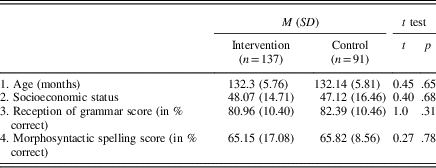
Based on the results of the pretest, a morphosyntactic spelling test, we randomly assigned these pupils to an intervention (n=137) and a control group (n=91). This was done by creating three performance groups of weak, medium, and strong spellers based on pupils’ scores on the spelling test. In a second step, they were randomly placed in the intervention or control group. Both groups were matched in age and socioeconomic status based on average International Socio-Economic Index of Occupational Status (Ganzeboom, Reference Ganzeboom2010). Table 1 summarizes these characteristics for each group.
Means, standard deviations, t test, and p values of age, socioeconomic status, and the pretest scores for reception of grammar and morphosyntactic spelling tasks of the intervention and the control group

Home language was equally distributed across the two groups. Forty percent of the pupils from the intervention and 35% from the control group spoke Luxembourgish with both parents. Thirty-eight percent of the pupils from the intervention and 40% from the control group spoke two different languages with their parents at home. Fifteen percent of the pupils from the intervention and 14% from the control group spoke Portuguese with both parents. Seven percent of the pupils from the intervention and 9% from the control group spoke French with both parents. Chi-square tests showed that there was no statistically significant difference in the language distribution across the groups (p >.05). Parental permission to participate in the study was obtained and the National Research Ethics Committee was informed.
Materials and procedure of the pre- and posttest
The pretest consisted of two tests: a test for reception of grammar and a morphosyntactic spelling test. The pretest was administered in the middle of the school year and was followed by a 3-week training. The posttest consisted of another morphosyntactic spelling test and was administered 6 weeks after the last intervention session.
Reception of grammar
Reception of grammar was assessed with an adapted version of the French standardized test L'É.co.s.se (Lecocq, Reference Lecocq2013). The test was administered as a group test following Lüke, Ritterfeld, and Tröster (Reference Lüke, Ritterfeld and Tröster2016). The original version contains 20 exercise blocks testing 20 grammatical structures, and each block contains 4 items (80 sentences in total). The adapted version contained all 20 original blocks; however, we only used 2 of the 4 items. Thus, our test consisted of 40 orally presented sentences represented as multiple-choice items. Each item contained four possible responses represented as pictures. The children were asked to choose the picture representing the sentence. The test was administrated to the entire class by means of an audio CD recorded by a female native speaker. Every sentence was repeated twice, and the time between the repetitions increased as a function of the complexity of the items. The maximum score was 40 (1 point for each correct response). All instructions were given orally in French.
Morphosyntactic spelling
Morphosyntactic spelling was assessed with a task that included 48 target and 23 filler items in the pretest and 47 target and 24 filler items in the posttest. One filler item was removed from the pretest and 1 target item was removed from the posttest because they were wrongly interpreted by many pupils. After the error analysis, 1 more target item was removed from the category of postnominal adjectives. The pseudoadjective agors in the sentence Les chiens agors (“The agors dogs”) triggered considerably more substitution errors than other items of the same category because of its similarity with the French verb adorer “love.”
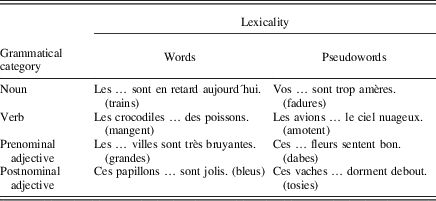
In total, three variables were manipulated for this test: the grammatical category (nouns, verbs, and adjectives), the lexicality (words vs. pseudowords), and the syntactic position of the adjectives only (prenominal vs. postnominal), resulting in eight different test conditions. The pseudowords were constructed following French graphotactic regularities. Word frequency was controlled using the French lexical database MANULEX (Lété, Sprenger-Charolles, & Colé Reference Lété, Sprenger-Charolles and Colé2004). Only highly frequent words with a Standard Frequency Index bigger than 50 were used as test items. All plurals of nouns and adjectives were regular, ending with –s. The adjectives were all simple qualifying adjectives. All verbs were regular first group verbs, ending in –er in the infinitive form. All words started with a consonant to avoid the phenomenon of liaison, which would make the plural audible. Length and frequency of the target words were controlled for across grammatical categories and tests (pre- vs. posttest). Verbs and nouns were placed in their canonical position (following the determinant and the noun). Every test condition consisted of six items in total (in the posttest there were only five items in the pseudoword section of postnominal adjectives). Table 2 illustrates the complete test design with one example for every test condition.
Conditions of the morphosyntactic spelling test for words and pseudowords

Note: Target spellings in brackets.
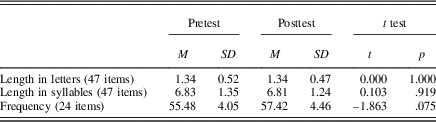
The children were asked to complete words in a cloze test consisting of independent sentences and presented in two parts (words and pseudowords). Within each part, the grammatical category of the targets was randomly mixed. The complete sentences were recorded by a female native speaker and administrated to the entire class by means of an audio CD. Each sentence was played twice with a 5-s interval between the first and the second repetition. Children were presented with the written sentences containing gaps and asked to spell the missing words. Only the plural endings of the words were scored. The pre- and the posttest were designed identically, but the items were different. The Cronbach α coefficient was 0.927 for the pretest items and 0.924 for the posttest items. T tests performed on all pre- and posttest items showed that there was no significant difference in the length or frequency of the chosen words (see Table 3).
Mean lengths, standard deviations, t test, and p values of the length and the frequency of all word and pseudoword target items in the pre- and posttest

Error analysis
An additional error analysis was performed on the pre- and posttest data. Children’s errors were classified as (a) omission errors (the absence of the plural marker: mange instead of mangent or cuisine instead of cuisines); (b) substitution errors (the –nt ending used for a noun/adjective: jolient or the –s ending used with verbs: ils manges); and (c) other errors that were not considered for further analysis. The addition of an incorrect, but generally possible nominal/adjectival marker to a noun/adjective, for instance, of –x instead of –s, was coded as correct.
Materials and procedure of the morphosyntactic training
The intervention was conducted in the pupils’ own schools by trained instructors. To ensure identical standardized administration of the intervention program and high treatment fidelity, all instructors participated themselves, before the intervention, in the morphosyntactic training they were going to give and were provided with a script that included all interaction scenarios that they had to strictly follow. In addition, they received support and feedback throughout the intervention. They were asked to only use French as the language of interaction with the children. Moreover, further tests with the variable “instructor” did not reveal any significant differences in the performance of the groups instructed by different persons.
For the training, the children were taken out of the classroom during their regular classes. They worked in small groups of 4–5 participants in quiet, isolated rooms. The intervention and control groups both attended six training sessions in total, two per week over 3 weeks. Each session lasted approximately 20 min.
The intervention group followed a morphosyntactic training designed based on the same didactic concept and using similar teaching tools as prior studies with French monolinguals (Cogis, Reference Cogis2004; Fisher & Nadeau, Reference Fisher and Nadeau2014). The aim of the training was to foster morphosyntactic processing and improve the spelling of French plurals. The training explicitly focussed on the orthographic plural markers –s and –nt and explored their function to reveal the morphosyntactic structure of the NP and the subject verb agreement. The aim of the program was to trigger explicit thinking about the nominal, adjectival, and verbal plural agreement and to teach the pupils strategies that would help to control their output while writing.
In the intervention script, the agreement chain was visualized by means of a ball game. It consisted of a sentence, in which words were represented as players throwing the “agreement ball” between themselves. The ball had to be moved by the performing person from the determinant to the other parts of the NP and to the verb, representing the spread of the plural markers that are mandatory in French for determinants, nouns, adjectives, and verbs. The very first ball game was explained and demonstrated by the instructor in the first intervention session. All the other games were executed by the pupils themselves under the instructor’s guidance when necessary. In the first two sessions, the training items included noun phrases only. Later on, the agreement chain was extended to include the verb. Reflecting on the necessity of the agreement was explicitly trained by dictating sentences containing categories with silent plural markers (Step 1), by collecting all the children’s answers (Step 2), and letting them decide which forms were appropriate or not in the given context (Step 3). The decision was taken and discussed collectively; the children were encouraged to use the terminology from the ball game for their argumentation when explaining why a specific word form does not fit the context. The training also included several tasks with pseudowords to encourage the pupils to base their orthographic decisions on morphosyntactic criteria rather than on lexical knowledge.
The control group actively performed listening comprehension exercises. They listened to six short French texts (of about 5–6 min) and afterward discussed the stories. All discussions were in French; the duration of exposure to French was the same for both groups.
RESULTS
Two hypotheses guided our study. First, we hypothesized that the spelling patterns linked to the plural marking established for L1 French pupils would be similar for pupils who acquire French as a WL2. Second, we hypothesized that an explicit training of French morphosyntactic structures would improve their performance on plural spellings.
The data analysis was organized as follows: to identify the general spelling pattern of plurals, we first analyzed the results of the spelling pretest for all pupils (Hypothesis 1). To examine the training effects, we compared the spelling results on the pre- and posttest of the intervention and control group in general and then separately for each grammatical category (Hypothesis 2). To better understand the effects of the training, we further performed complementary error analyses when appropriate. Partial eta squared is reported as a measure of effect size (0.01=small, 0.06=medium, 0.14=large effect) for all significant results.
General spelling patterns in multilingual fifth graders
The first research hypothesis was that pupils with French as WL2 would show similar spelling patterns as L1 pupils. To test this hypothesis, we looked at the pretest spelling results of the total sample. A 4×2 analysis of variance (ANOVA) with grammatical category (noun, verb, prenominal adjective, or postnominal adjective) and lexicality (word vs. pseudoword) as within-subjects factors was performed on the target spellings. As Mauchly’s test of sphericity was significant for grammatical category and for the interaction Grammatical Category × Lexicality, we report the Greenhouse–Geisser correction for these variables.
There was a main effect of grammatical category, F(3, 555.003)=102.01, p<.001, ηp 2=.310. Overall, test scores were highest for nouns (M=62.54), lower for verbs (M=55.30), and lowest for adjectives. On the latter, performance was better for prenominal (M=48.14) than for postnominal adjectives (M=37.28). There was also a strong main effect of lexicality, F(1, 227)=371.56, p<.001, ηp 2=.621. Children’s performance on words (M=62.52) was significantly higher than on pseudowords (M=39.11). The interaction Grammatical Category × Lexicality was significant, F (3, 644.67)=81.92, p<.001, ηp 2=.265. The effect of lexicality was different across the grammatical categories.
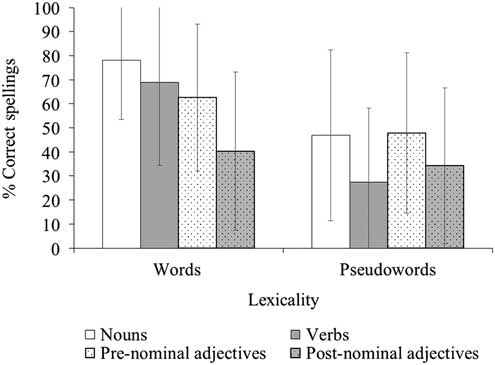
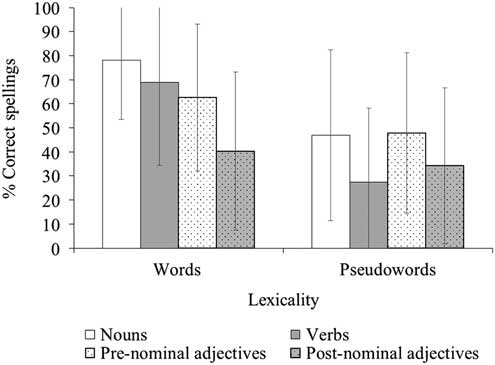
The performance pattern for words was different from that for pseudowords. Pairwise comparisons of a further separate ANOVA showed that for words pupils spelled nouns (M=78.14) significantly more accurately than verbs (M=68.86), p<.001. Performance for adjectives was significantly lower than for nouns and verbs (p<.001 in both cases). Within the latter, performance was significantly better for prenominal (M=62.72) than for postnominal adjectives (M=40.35), p<.001. Pairwise comparisons for pseudowords showed that there was no significant difference between children’s performance on nouns (M=46.93) and prenominal adjectives (M=47.88), p=1.000. In general, performance was significantly higher on nouns and prenominal adjectives than on postnominal adjectives (M=34.21), p<.001. Performance was significantly lower for verbs (M=27.41) than the other categories, p<.001 when compared to nouns and prenominal adjectives and p=.015 when compared to postnominal adjectives. Figure 1 illustrates the general spelling pattern across grammatical categories for words and pseudowords.
Means of correct spellings (in percent) of the entire sample (n=228) for words and pseudowords in the spelling test (pre-test).
The general effect of the morphosyntactic training
To assess the general effect of the training, a repeated 2×2×4 ANOVA with test session (pretest vs. posttest), lexicality (word vs. pseudoword), and grammatical category (nouns, verbs, prenominal adjectives, or postnominal adjectives) as within-subjects factors and with group (intervention vs. control) as between-subjects factor was performed on the spelling test scores (Hypothesis 2). For this analysis we only report the significant interactions with group.
There was a main effect of test session, F (1, 226)=83.91, p<.001, ηp 2=.271, indicating that pupils’ performance was higher in the posttest (M=71.23) than in the pretest (M=63.79). There was also a strong main effect of lexicality, F (1, 226)=402.40, p<.001, ηp 2=.640, with significantly more correct spellings for words (M=73.28) than for pseudowords (M=61.74). The interaction Lexicality × Test Session was significant, F (1, 226)=17.38, p<.001, ηp 2=.071: the performance difference between words and pseudowords was higher in the pretest than in the posttest. The interaction Test Session × Group was significant, F (1, 226)=47.85, p<.001, ηp 2=.175. Although both groups obtained higher spelling scores in the posttest, the intervention group’s performance in the posttest has improved significantly better compared to the control group.
There was a main effect of grammatical category, F (3, 678)=197.47, p<.001, ηp 2=.466, but the interaction Grammatical Category × Group and the triple interaction Test Session × Grammatical Category × Group were not significant. However, the interaction Grammatical Category × Test Session was significant, F (3, 678)=15.97, p<.001, ηp 2=.071, suggesting that the overall spelling pattern was different in the pre- and posttest for both groups.
Furthermore, the interaction Lexicality × Grammatical Category, F (3, 678)=159.80, p<.001, ηp 2=.414, and the triple interaction Lexicality × Grammatical Category × Test Session, F (3, 678)=3.90, p=.009, ηp 2=.017, were also significant, but as there were no interactions with group these results are not interpreted here. This suggests that the spelling patterns were different for words and pseudowords in the pre- and posttest. Pairwise comparisons of further separate ANOVAs for words and pseudowords confirmed that the spelling patterns in the posttest were different. For words, both groups performed significantly better on nouns than on prenominal adjectives and verbs (p<.001 in both cases). There was no significant difference between the performances on prenominal adjectives and on verbs (p=1.000). Performance on the latter was significantly better than on postnominal adjectives (p<.001). For pseudowords, both groups performed significantly higher on prenominal adjectives than on nouns, followed by postnominal adjectives (p<.001 in both cases). Performance on verbs was significantly lower than on the other categories (p<.001 in all cases). The precise effects of the training on performance related to grammatical categories for both groups are described in the following section.
The effect of the training on performance related to grammatical categories
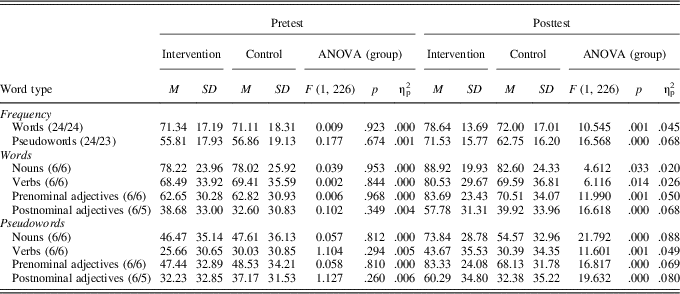
To analyze the effects of the morphosyntactic training more closely, separate repeated-measures ANOVAs with group (intervention vs. control) as between-subjects factor were performed on the scores of each grammatical category (noun, verb, prenominal, and postnominal adjectives). The within-subject factors were lexicality (word vs. pseudoword) and test session (pretest vs. posttest). For adjectives, an additional analysis was performed for the syntactic position (prenominal vs. postnominal). Table 4 summarizes the descriptive statistics of the pre- and posttest for each of the controlled variables per group (control vs. intervention).
Means and standard deviations (in %) of the correct responses for the intervention (n=137) and the control group (n=91) in the pre- and posttest for each word type in the French spelling task

Note: The number of items for each word type is indicated in brackets. Results from one-way analyses of variance (ANOVAs) represent the main effect of test.
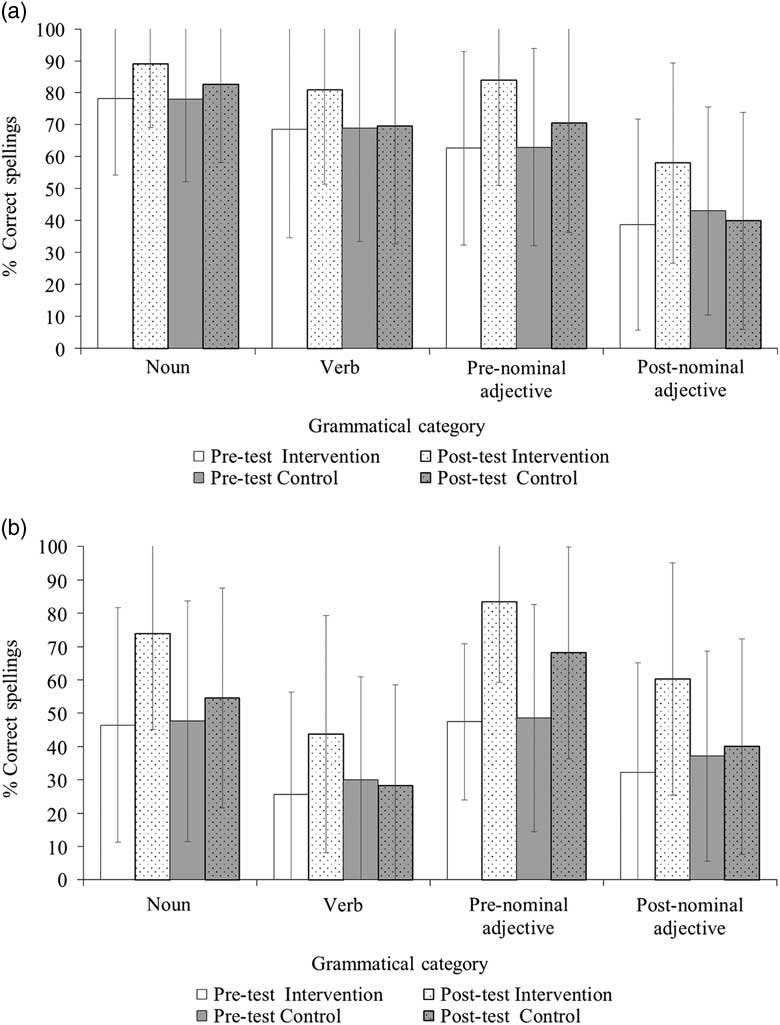
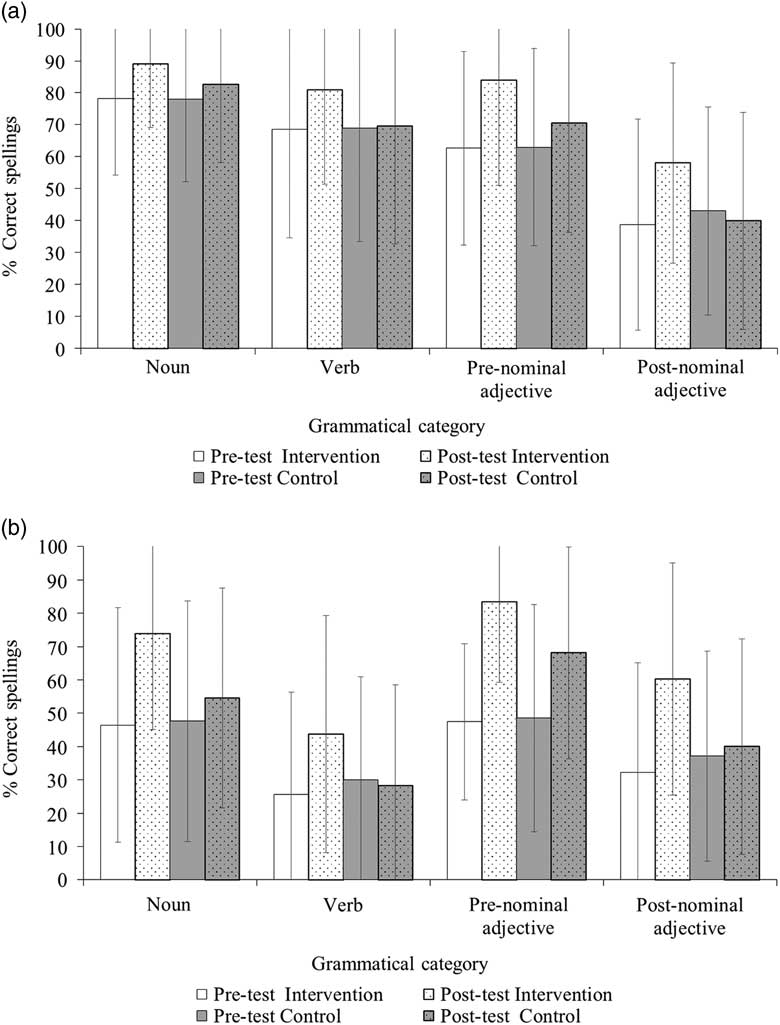
Figure 2 illustrates the initial (pretest) scores of both groups and the improvement after the training (posttest scores) for all grammatical categories in relation to word (Figure 2a) and pseudoword (Figure 2b).
(a) Test scores (in percent) for the intervention (n=137) and the control group (n=91) in the pre- and post-test for all grammatical categories (words). (b) Test scores (in percent) for the intervention (n=137) and the control group (n=391) in the pre- and post-test for all grammatical categories (pseudowords).
Nouns
There was a main effect of test session, F (1, 226)=58.77, p<.001, ηp 2=.206, with a higher performance of correct plural noun spellings in the posttest (M=74.98) than in the pretest (M=62.58). There was also a main effect of lexicality, F (1, 226)=305.44, p<.001, ηp 2=.575, with higher performance on nouns (M=81.94) than on pseudonouns (M=55.63). There was a significant interaction Lexicality × Test Session, F (1, 226)=15.4, p<.001, ηp 2=.064, indicating that the effect of lexicality was stronger in the pretest than in the posttest. The interaction Test Session × Group, F (1, 226)=16.82, p<.001, ηp 2=.069, was also significant. In the posttest, the scores of the intervention group (M=81.39) were significantly higher than the scores of the control group (M=68.59). The triple interaction Lexicality × Test Session × Group was significant, F (1, 226)=8.70, p=.037, ηp 2=.037, suggesting that the effect of lexicality was different in the pre- and posttest depending on the group: the intervention group obtained significantly higher scores on pseudonouns in the posttest compared to the control group.
Verbs
There was an effect of test session, F (1, 226)=18.91, p<.001, ηp 2=.077, and a strong effect of lexicality, F (1, 226)=605.58, p<.001, ηp 2=.728. The children’s spelling performance on plural verbs was significantly higher in the posttest (M=55.50) than in the pretest (M=48.40), and real verbs (M=72.01) were spelled correctly more often than pseudoverbs (M=31.90). The interaction Test Session × Group was significant, F (1, 226)=23.55, p<.001, ηp 2=.094. The performance of the intervention group after the training was significantly higher (M=62.10 in posttest vs. M=47.08 in pretest), while the control group remained at similar levels (M=49.72 in pretest vs. M=48.90 in posttest). The interactions Test Session × Lexicality, F (1, 226)<1, and Lexicality × Test Session × Group were not significant, F (1, 226)=2.18, p=.141, ηp 2=.002. For plural verb markings, the effect of lexicality was similar across both test sessions and similar for both groups.
Prenominal and postnominal adjectives
The effect of test session was significant for prenominal adjectives, F (1, 226)=178.06, p.<001, ηp 2=.441, and postnominal adjectives, F (1, 226)=39.77, p<.001, ηp 2=.150. The plural spellings of adjectives in both positions improved significantly in the posttest (prenominal: M=55.36 in pretest vs. M=76.42 in posttest; postnominal: M=37.74 in pretest vs. M=49.50 in posttest). The effect of lexicality was significant for prenominal adjectives, F (1, 226)=37.63; p<.001, ηp 2=.143, but not for postnominal adjectives (p=.114). For prenominal adjectives, performance was higher than for prenominal pseudoadjectives. However, the interaction Lexicality × Test Session was significant for both prenominal adjectives, F (1, 226)=31.95, p<.001, ηp 2=.124, and postnominal adjectives, F (1, 226)=6.75, p=.010, ηp 2=.029. Performance increased significantly more for pseudoadjectives than for real adjectives, and this is true for both prenominal and postnominal positions. The interaction Test Session × Group was significant for both prenominal adjectives, F (1, 226)=22.06, p<.001, ηp 2=.089, and postnominal adjectives, F (1, 226)=40.15, p<.001, ηp 2=.151. The intervention group’s spelling of prenominal and postnominal adjectives improved significantly in the posttest in comparison to the control group.
To analyze the effects of the adjectives’ position, another 2×2×2 repeated-measures ANOVA with lexicality (word vs. pseudoword), test session (pretest vs. posttest) and position (prenominal vs. postnominal) as within-subjects factor and with group as between-subject factor was performed. Only the significant interactions with position are reported. There was a strong effect of the syntactic position of adjectives, F (1, 226)=433.40, p<.001, ηp 2=.657, with more correct spellings when the adjectives precede the nouns (M=65.89) than when they follow the nouns (M=43.62). The significant interaction Lexicality × Position, F (1, 226)=13.34, p<.001, ηp 2=.056, indicates that the effect of lexicality was different depending on the position: in the prenominal position, performance on real adjectives was better than on pseudoadjectives, whereas in the postnominal position lexicality had little impact on performance. The interaction Test Session × Position was also significant, F (1, 226)=30.79, p<.001, ηp 2=.120, showing that both groups improved their performance on prenominal adjectives more than for postnominal adjectives in the posttest compared to the pretest. The Test Session × Position × Group interaction was also significant, but its effect was weak, F (1, 226)=6.91, p=.009, ηp 2=.030. Only the intervention group improved their performance on postnominal adjectives after the training.
Error analysis
To go beyond the analyses of the children’s correct spelling and to better understand their difficulties, we performed complementary error analyses for each grammatical category. We performed separate 2×2 repeated-measures ANOVA with error type (omission vs. substitution) and test session (pretest vs. posttest) as within-subjects factors and with group as between-factor for each grammatical category. The analysis revealed significant effects of the test session (overall, children produced significantly fewer errors in the posttest) as well as of the error type (children produced significantly more omission than substitution errors) for every grammatical category. The interaction Test Session × Error type was also significant in all analyses, indicating that in the posttest significantly fewer omission errors were produced overall compared to the pretest. The interaction Error Type × Group was not significant for any of the conditions, suggesting that the intervention and control groups both showed similar error patterns.
DISCUSSION
The current study investigated the effectiveness of a training fostering morphosyntactic processing in multilingual children with French as a WL2. More specifically, we focused on the processing of French number agreement. We hypothesized, first, that multilingual children who acquire French as a WL2 would show similar spelling patterns for plural markers as has been established for French monolingual pupils, but we did not predict their exact stage of acquisition. Our second hypothesis was that our training would improve the children’s spelling of plurals based on morphosyntactic regularities.
General spelling patterns in multilingual fifth graders
The results of the pretest confirm our first hypothesis and support the findings of previous studies (Fayol, Reference Fayol2003; Fayol et al., Reference Fayol, Tottereau and Barrouillet2006; Thévenin et al., Reference Thévenin, Totereau, Fayol and Jarousse1999; Totereau et al., Reference Totereau, Brissaud, Reilhac and Bosse2013). Pupils encountered fewer difficulties when marking the plural of nouns (79% correct spellings) than the plural of verbs (70% correct spellings) or of prenominal adjectives (63% correct spellings). Postnominal adjectives were correctly pluralized the least often (39% correct spellings). Regarding plural markers, the spelling pattern of the multilingual children of this study is thus similar to monolingual children after more years of written language learning (Hypothesis 1b). Fayol et al. (Reference Fayol, Tottereau and Barrouillet2006) found similar patterns for monolingual French fourth and fifth graders despite the longer learning experience. Based on the evidence provided by the results of the pretest, one can assume that the factors that have an effect on the plural assignment we reported above (semantics, syntactic position, reliability of the markers, and word frequency) influence L1 and L2 learners in a similar way.
Based on the mean group performance of our participants, it seems that that after 2 years of French lessons, most participants of the present study can correctly pluralize nouns, prenominal adjectives, and verbs, but not yet postnominal adjectives. However, to elucidate more precisely the individual learning development regarding the plural of grammatical categories, a longitudinal study is needed. Ågren (Reference Ågren2008)’s study on the development of plural markers in French as a foreign language showed, however, that learners have more difficulties with correctly spelling adjectives than other word categories independently of their position. The analysis of the test scores in the present study, however, indicates that children’s performance with prenominal adjectives was significantly higher than with postnominal adjectives, a result that is in line with L1 pupils. The different outcomes of our study and Ågren’s (Reference Ågren2008) could possibly be explained by some methodological differences. Our data comes from a cloze test that strictly controlled the number of adjectives used and their positions. Ågren (Reference Ågren2008), on the contrary, examined free writings, where the use of adjectives and their position was not controlled. As the author indicates herself, the texts produced by the participants contained a highly variable number of adjectives depending on the position. Alternatively, our study looked at learners at a specific developmental phase (after 2.5 years of written input), while Ågren (Reference Ågren2008) observed learners’ performance with adjectives at different developmental phases, making it difficult to define a general spelling tendency.
In the case of pseudowords, when no lexical information was available, the pupils could only rely on the syntactic information provided by the sentence. As expected, their performance was significantly poorer than that for real words in each of the four grammatical categories. It is very probable that the children relied on semantic information while spelling and that the lack thereof may have caused disorientation in the sentence structure and led to omission of the plural marking. The spelling pattern of plural markings for pseudowords was slightly different compared to words: pseudonouns and prenominal pseudoadjectives were most often correctly inflected (48% correct spellings for both grammatical categories), followed by postnominal pseudoadjectives (35% correct spellings), and pseudoverbs were least correctly inflected (30% correct spellings). It seems that, for pseudowords, the spelling pattern of the multilingual pupils is less advanced and corresponds to earlier stages of acquisition (as predicted by Hypothesis 1a).
The general effect of the morphosyntactic training
The results of the posttest confirm our second hypothesis, which predicted positive effects of the morphosyntactic training on children’s spelling performance. Thus, our study adds to the few existing studies providing evidence for a significant improvement of monolingual pupils’ spelling due to a greater focus on morphosyntactic structures (Cogis, Reference Cogis2004; Geoffre, Reference Geoffre2014; Thévenin et al., Reference Thévenin, Totereau, Fayol and Jarousse1999) and extends to multilingual learners with French as a WL2. After only six training sessions, the intervention group significantly improved its spelling performance on all grammatical categories independent of the word frequency (lexicality).
Although the overall spelling performance of the intervention group improved after the training, the change of the spelling pattern cannot be explained by the training itself, as the resulting pattern was the same for both groups. In the posttest performance was still best with nouns, but scores on prenominal adjectives and verbs were similar, and postnominal adjectives were most difficult to pluralize for both groups; in contrast, in the pretest performance was better with verbs than with prenominal adjectives.
The effect of the training on performance related to grammatical categories
Nouns were, as expected, the best candidates to be correctly inflected in most cases, for three reasons: their plurality is semantically grounded, they often occupy the position right after the determinant, and they receive the most frequent plural marker, –s. Already in the pretest, the number of omission errors was the lowest with nouns. Substitution errors were practically nonexistent. For pseudonouns, pupils obtained similar results in the pretest as for prenominal pseudoadjectives (in the pretest), as both categories share the same syntactic position and require the same plural marker. However, only about half of all pseudonouns (just below 50%) were pluralized correctly; the other half were prone to omission errors. After the training, the performance with both nouns and pseudonouns increased significantly, especially for the intervention group, and the omission errors decreased accordingly.
The performance for verbs in the pretest was significantly lower than for nouns in both groups, with more omission and substitution errors. This is probably due to the increased distance from the determinant and to the less salient verbal ending as well as the absence of the semantically grounded plural. In the pretest, performance for pseudoverbs was lowest compared to the other three grammatical categories: only 27% of all pseudoverbs were correctly pluralized. It seems that lexical knowledge plays an especially important role for verbs; if the word was not recognized as a verb, the performance decreased notably. Besides the high number of omission errors (affecting more than half of all items), pseudoverbs also triggered a substantial number of substitution errors. After the training, the score of the intervention group improved significantly by 28% for verbs and by 18% for pseudoverbs. Correspondingly, children also produced 20% fewer omission errors. However, the number of substitution errors increased significantly, especially in the intervention group (by 15%). The results of the error analysis underpin this observation: the interaction between test session, error type, and group was only significant in the case of the pseudoverbs. The increase in substitution errors for the intervention group in the posttest could be interpreted as an effect of the training: the children were more sensitive to the plurality, but they still failed to assign the correct verbal marker. Instead, they chose the more reliable and frequent marker –s.
French adjectives are, from a semantic perspective, similar to verbs, because their plural is purely formal. They are, at the same time, similar to nouns, because both categories share the same plural marker –s. In addition, the syntactic position of adjectives can be pre- or postnominal and this impacts the pluralization. For instance, prenominal adjectives occupy the default position of the noun, postnominal adjectives the default position of the verb.
Although prenominal adjectives are at the default position of nouns and share the same plural marker, they were pluralized significantly less often than nouns. The performance on prenominal adjectives was also significantly lower than on verbs, even if the plural of both verbs and adjectives lack semantic foundation. However, prenominal pseudoadjectives were pluralized significantly more often than pseudoverbs. The syntactic position of pseudo-prenominal adjectives and the fact that they have the same plural marker as nouns was probably favorable. In the posttest, the performance of the intervention group on prenominal adjectives increased significantly and reached the same level as the performance on verbs. The performance on pseudo-prenominal adjectives improved even more than the performance on both pseudonouns and pseudoverbs and reached the same level of correct spellings as the real adjectives.
Postnominal adjectives were the least likely candidates to receive a plural marker, possibly because their plural is purely formal. In addition, they occupy a position further away from the determinant than prenominal adjectives do. Although they share the syntactic position of the verb and have a more salient plural marker, they were still pluralized significantly less often than verbs. It seems that children had fewer difficulties with identifying verbs as a grammatical category to be pluralized and assigning the correct plural marker than with identifying postnominal adjectives. This result is in line with observations of learners of French as a L1 (Fayol et al., Reference Fayol, Tottereau and Barrouillet2006). Postnominal adjectives also triggered the largest number of omission errors with only few substitution errors. Overall performance was better on postnominal pseudoadjectives than on pseudoverbs, probably because the plural marker –s, correct in the case of postnominal pseudoadjectives, is the most frequent plural marker in French. Postnominal pseudoadjectives, however, triggered as many substitution errors as pseudoverbs. Without semantic information, children do not seem to distinguish postnominal pseudoadjectives from pseudoverbs and thus do not correctly apply morphosyntactic knowledge when both share the same syntactic position.
After the training, the number of correct plural spellings of postnominal adjectives increased significantly for the intervention group. However, both groups obtained similar scores for real and postnominal pseudoadjectives (no main effect of lexicality for postnominal adjectives). Real or pseudoadjectives in postnominal position are far away from the determinant and might not be recognized as part of the NP and are thus not inflected.
Conclusions
In summary, our data show that for real words the grammatical category of nouns causes the fewest agreement difficulties in multilingual fifth graders, followed by verbs and prenominal adjectives. Postnominal adjectives are by far the most difficult category causing the most omission errors even after the training. The major finding of our study is that a greater focus on morphosyntactic structures can lead to the improvement of the spelling performance of primary school children who acquire French as a WL2. Despite the very short period of training, the children in the intervention group significantly improved their spelling of plural in all grammatical categories compared to the control group. As the posttest was administered 6 weeks after the training, one can assume that the training had a sustainable effect.
Although the overall spelling patterns for real and pseudowords are not identical, the general performance of the intervention group increased for pseudowords, suggesting that the pupils in this group became more sensitive to syntactic regularities. The participants learned to use the syntactic information provided by the sentence, even when they could not rely on semantics. Thus, considering that syntactic information could be a great support, especially for children who acquire French as a WL2 and generally have less developed vocabulary in that language. As also shown by other studies with pupils acquiring literacy in L2s, the learning processes and the phases of acquisition are similar for first and for L2 learners. Moreover, in this study, no interference from the WL1 of the participants was possible, as the silent plural markers that are present only in written French are not characteristic of their WL1, German.
Limitations, future directions, and implications
These findings have theoretical and practical implications. On the one hand, our study underpins the link between morphosyntactic awareness and spelling performance. It represents an essential theoretical contribution to the current discussion about the hierarchical and serial morphosyntactic knowledge that is crucial for the development of good spelling competence in languages with a deep orthography such as French. Multilingual pupils with less language input in particular seem to profit from an approach that explicitly focuses on morphosyntactic structures. Children can apply the acquired metalinguistic knowledge about phrase structures and flection markers in written French when lacking vocabulary. The practical implications of our findings relate to the positive impact of our training on children’s spelling, highlighting the importance of a didactic approach that takes into account morphosyntactic phrase structures and that explicates the function of orthographic markers in revealing the morphosyntactic phrase structure. Our approach to the silent plural markers and the materials we used during the training confirms that didactic approaches used in the context of French as a first school language can be added to the didactic practices used with multilingual children acquiring French as a WL2.
The present study has some limitations. First, we varied the position of the adjectives (pre- and postnominal), but not the position of nouns and verbs. It would be interesting to address this aspect in a separate study, looking exclusively at the effects of the word position on pupils spelling performance. Second, the tests in this study were limited to cloze tests on the word level and did not engage with the spelling of plurals within complete sentences or texts. From a cognitive perspective, the integration of the sentence level would require a higher cognitive load while writing; from a pedagogical point of view, writing sentences is closer to real writing tasks and gives a better insight into the manipulation of plural within the sentence structure. A third limitation is the fact that there was no follow-up test proving the long-term sustainability of the training effects. The above-mentioned issues limit the scope of our empirical findings to (a) the spelling competences of multilingual learners with French as a second writing system and (b) the manipulation of plural markers on the word level in specific positions to a specific moment after a morphosyntactic training. It does not, however, give much insight into the extent to which the children assimilated the strategies acquired during the training and whether they continued to use them during their French classes. A fourth and final limitation concerns the training of the control group. This group was administered a listening comprehension training. This training did not aim to improve their spelling competence. It merely served to exclude the potential impact of a Hawthorne effect on the test scores of the intervention group. As the present study is the first to address the question of morphosyntactic-based teaching in French in L2 contexts, our primary intention was to test its general efficacy. Further research should consider all of the above-mentioned limitations.