Literature on tribes in Iraq is scant and often falls prey to simplistic binary approaches to state-society relations. Scholars of legal pluralism provide tools to conceptualize interrelations between adjacent normative fields. Several legal specialists have talked about “a thin form of cooperation” between tribal “private orders” and the Iraqi state.Footnote 1 By the same token, many scholars presuppose that the capacity of the tribes and the state to mediate and settle feuds covary in opposite directions and are correlated with the strength of state institutions (tribes step in to fill a vacuum during times of state weakness). However, careful examination of Iraqi penal legislation and its implementation in tribal areas invalidates this stereotypical paradigm. Already in her seminal 1973 article, Sally Moore drew the attention of scholars of legal pluralism to the idea that legal orders should be approached as partially discrete, overlapping social fields. The various arenas intersect and create meaning for each other.Footnote 2
This paper takes Moore's warning a step further and suggests that the relationship between tribes and state judicial institutions in Iraq is in fact best understood as deeply embedded cooperation.Footnote 3 At the intersection of customary practices and state law lies a vast legal field that requires study in its own right. Iraqi legislation contains carefully crafted windows enabling tribal justice to happen outside of the court system. When a tribal conciliation is attained, Iraqi laws provide for accommodation, sentence reduction, or outright termination of all proceedings. The reason legal scholarship on Iraq has missed this very peculiar dimension of state-tribal relations has to do with the coded language of Iraqi legislation. Owing to a diffuse taboo surrounding tribal affairs in Iraq, legislators have carefully avoided all semantic references to tribalism. The main two pieces of current Iraqi legislation are Iraqi Penal Code number 111 of 1969 and Criminal Procedure Code number 23 of 1971. There is no occurrence of the words “tribe” or “tribal” in any these two texts. These were elaborated in a context of state-sponsored development schemes and discourse of modernization professedly hostile to tribalism and its associated customary practices—referred to as “a cornerstone of feudalism.”Footnote 4
Tribal Ṣulḥ, Tanāzul, and the Iraqi Judge
The Tribal Criminal and Civil Dispute Regulation (TCCDR) introduced by the British in 1916 was repealed by decree 56 of 27 July 1958, upon the overthrow of the Iraqi monarchy. State-tribal relations in the judicial sphere nonetheless continue to operate along the same lines today.Footnote 5 Contemporary arrangements mirror earlier legal configurations. An essential aspect of the TCCDR was that these regulations were not substituted for the 1918 Iraqi Penal Code, which remained fully applicable. The TCCDR framework articulated the relationship between tribal justice mechanisms, primarily focused on compensations to the aggrieved party, and state justice characterized by its more punitive function. At the center of both the TCCDR and the current legislation lies the classic separation between two sets of rights, al-ḥaqq al-shakhṣī (the personal right) and al-ḥaqq al-ʻāmm (the public right). In both laws, although collective responsibility is a guiding precept during tribal settlements, the victim's demand for redress falls into the personal right. By contrast, the public right is understood as state offenses to which both the penal code and several provisions of the TCCDR applied. Prior to 1958, tribal settlement councils (majālis al-taḥkīm) were convened by Iraqi authorities, the proceedings of which were painstakingly transcribed by the clerks of the qā’im-maqām's administration (district level). If a conciliation deal (ṣulḥ) was reached during the majlis, in most cases state authorities would accept the recommendations of the tribal judges (as provided by article 8:10 of the TCCDR). Ṣulḥ has strong legal foundations in Hanafi and Ottoman traditions. It is “a form of contract (ʿaḳd), legally binding on both the individual and community levels.”Footnote 6 Furthermore, state officials took ṣulḥ deals into account as mitigating circumstances in the application of al-ḥaqq al-ʻāmm, in particular when the complainant decided to waive his or her personal right by abandoning the claim (al-tanāzul ʻan al-shakwā).
Today, in the 1969 and the 1971 codes, ṣulḥ (conciliation) and tanāzul (withdrawal of the complaint) remain the two pivotal foundations of state-tribal relations. They are, however, not reserved to tribal litigants, and the two words do not belong to the lexical field of tribalism. Articles 194 and 195 (Code 23) specify the conditions for ṣulḥ to be validated by a judge, whereas 9.C of the same code introduces the possibility of tanāzul. Investigative judges are happy to terminate all cases of misdemeanors (junḥa) listed in article 3.A (Code 23), which are offenses punishable by detention for a period of between three months and five years, and/or a fine (article 26, Code 111). Article 130.A (Code 23) provides for the termination of a case (īqāf al-tanfīdh). Article 9.G (Code 23) does, however, provide that in cases where a felony (jināya) was committed, the withdrawal of a complaint does not affect the case of public justice. This means that the daʻwā al-ḥaqq al-ʻāmm (judicial prosecution engaged by the state) remains. Article 25 (Code 111) indicates that a felony is punishable either by death, life imprisonment, or a detention for a period of between five and fifteen years. Although there exists no legal provision recognizing ṣulḥ in jināya cases, articles 132 and 133 (Code 111) provide that “if the court considers that the circumstances of a felony or of the offender call for leniency, it may substitute a lesser penalty for the penalty prescribed for the offence.”Footnote 7 In practice, a death penalty may be commuted to a life sentence, a term of between five and fifteen years may be substituted for a life sentence, and a period of detention of between six months and five years may be substituted for imprisonment for a term of five to fifteen years. Similar judicial configurations are described in Jordan and in the Palestinian territories.Footnote 8
Concurrently, negotiations during tribal sessions (pl: fuṣūl, sing: faṣl) reflect these legal arrangements, although regional variations can be observed. Tribes of the Gharbiyya
(Sunni provinces) and the mid-Euphrates are more inclined to take their cases to court than tribes of southern provinces (Basra, Dhi Qar, Maysan, and Wasit, as well as some predominantly Shi‘a neighborhoods in Baghdad).Footnote 9 In the case of homicide, the vast majority of Iraqi tribesmen do, however, consider it necessary to lodge a complaint, as long as no interference by armed para-state actors disrupts state-tribal relations. When death was caused accidentally (qaḍā' wa qadar), prompt tanāzul (withdrawal of the complaint) is anticipated once a settlement involving blood money (diyya) is reached. By contrast, premeditated murder cases are less likely to result in tanāzul. Southern tribes sometimes negotiate what they call a fidiyya (lit. ransom), an additional diyya, to obtain tanāzul.
State-Tribal Relations as Deeply Embedded Cooperation
In Iraq, the exercise of adjudicative power is best represented as deeply embedded cooperation between partially overlapping and interpenetrating legal orders. Each normative system retains a degree of functional autonomy in the areas where there is no overlap. State law does not incorporate substantial customary elements, as in South Africa, for example.Footnote 10 In that sense, there is relative normative closure, little movement across boundaries, and a mutual understanding that each jurisdiction retains complementary yet distinct prerogatives. In particular, tribes consider that the punitive component of a settlement lies exclusively within the purview of the state. Even jelwa (coll. exile), whereby the perpetrator of a grave offense and his relatives must go into exile, should be understood as a step taken by the community to restore public order and forestall revenge attacks (thār). The exiled tribesman is expected to surrender to the police to be incarcerated. The fugitive can seek protection of a powerful shaykh as a dakhīl (tribal protégé) and demand to be escorted to the police station to avoid immediate retaliation by the aggrieved party. In the case of homicide, a faṣl is unlikely to happen as long as the incriminated tribesman remains at large. To issue death certificates, unless they are under armed groups’ control, hospitals routinely request a police report so an investigation can be opened. For jināya-related offenses, the Iraqi legal configuration does not involve redundant parallel jurisdictions (“forum shopping”). Significantly, shuyūkh (sing: shaykh) and tribesmen never complain about Iraqi law as such. Quite the contrary, they deplore that the state is often too weak to enforce state legislation equally among all citizens.Footnote 11
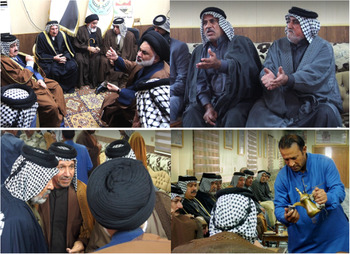
State-tribal linkages should in fact be conceptualized as integrated. A vast autonomous legal arena emerges at the intersection of state law and customary practices, in which tribal affairs can no longer be isolated for analytical purposes from functions pertaining to the state. Tribes enjoy representation in state institutions, and they take an active role in the legislative sphere. The Directorate of Tribal Affairs (Mudīriyyat Shu'ūn al-ʻAshā'ir), an old institution founded by the British in 1923, exemplifies this overlap (Fig. 1). It is part of the Ministry of Interior and has branches in each Iraqi province that report back to the administration of the governorate. The directorate includes a Committee for Tribal Conflict Resolution (Lajnat Faḍḍ Nizāʻāt al-ʻAshā'iriyya), which holds regular fuṣūl at its muḍīf (tribal reception hall). Its directors all have both the status of tribal shuyūkh and higher officers in the Iraqi police or the Iraqi army.Footnote 12 In Iraq more broadly, many shuyūkh are (often retired) senior officers, or they have had a career in state civil institutions.
Tribal fuṣūl at the Directorate of Tribal Affairs in Baghdad, December 2020. Photos by the author.

One outcome of this intertwined configuration is the fine balance that exists between state strength and tribal ability to preserve social order—which can only be attained when the state is sufficiently robust and if the country is not crippled by civil war. By all accounts, the protracted absence of state structures after 2003 and the subsequent ‘ṭā'ifiyya’ (the sectarian civil war of 2004–8) translated into a loss in capacity of tribal elites to mediate or, at the very least, contain conflicts between communities. This was particularly true in predominantly Sunni provinces. In Tel ʻAfar, for instance, Sunni shuyūkh retained little control over members of their own tribes and could no longer organize cross-sectarian fuṣūl for fear of reprisals by al-Qaeda.Footnote 13 More recently, armed-group proliferation along with Shi‘a dominance over depleted state institutions in the town is resulting in a similar withdrawal of Sunni tribal authorities who are perceived as too weak to weigh in on negotiations. To give a second example, with the return of relatives of Islamic State (ISIS) members to their areas of origin after several years of displacement, Sunni tribal authorities have expressed a strong sense of confusion. The scale of the crisis caused by ISIS, along with prolonged state paralysis, have led to an enduring stalemate. Relatives of ISIS members do not face state prosecution, but they are confronted with complex barriers to return, such as community perceptions that they have one (or more) relative with a real or rumored ISIS affiliation. Tribes do not believe that national reconciliation falls within the scope of tribal affairs, although the state does not de facto assume the responsibility for reintegration of ISIS relatives into their communities of origin. At the same time, tribes are grappling with the implications of the customary principle of collective responsibility, and they are forced to devise new mechanisms to lessen prospects of revenge acts.Footnote 14
Amending the ‘Urf: The Tribe-State-Marjaʻiyya Triangle
There are of course instances in which the ‘urf (tribal customary law) stands in contradiction with Iraqi law (legal dissonance).Footnote 15 In recent years, the Baghdad Directorate of Tribal Affairs has worked on several legislative proposals designed, in the words of its director Nasir al-Nuri, to discipline, or rectify (tahdhīb), the ‘urf in a stated attempt to reduce violence and provide the Iraqi state with improved tools to prosecute threats to public order.Footnote 16 The most conspicuous example is degge ‘ashairiyye (lit. dakka ‘asha'iriyya), the spraying of bullets on houses of wanted tribesmen during a tribal feud with the aim of forcing the entire enemy clan to leave the area (jelwa). The principle of individual liability is enshrined in Iraqi law, and “punishment should be personal,” whereas collective responsibility is a core precept of tribal law.Footnote 17 Therefore, degge was recently criminalized under article 2 of the 2005 Anti-Terrorism Law (in November 2018).Footnote 18 That the demand to suppress this tribal practice emanated from the tribes themselves does, however, preclude any interpretation of it as a top-down state attempt to crack down on tribes. Many tribal authorities are expressing the desire to unify the ‘urf at the country level and address problematic interactions within tribal affairs. Degge is a practice characteristic of southern Iraqi tribes, although it also is found in some predominantly Shi‘a neighborhoods in Baghdad. It creates recurring tensions with other tribes. Iraqi tribal ‘urf is fraught with such contradictions and bitter dissensions, particularly with regard to financial settlements. Speaking of legal order does not presuppose inherent consistency, although a body of laws is often “represented as a bounded symbolic universe.”Footnote 19 Southern tribes tend to ask for “unreasonable” diyya compensations (blood money). When an incident involves tribes from different regions, this difference complicates the work of mediators. Tribes of the Gharbiyya and the mid-Euphrates routinely agree on an average amount of 10 million Iraqi dinars (about $8000) in the case of unpremeditated murder, and it usually does not exceed 25 million dinars. Southern tribes can request diyya compensations of over a hundred million dinars. Smaller tribes find it difficult to bear the burden of a pricy diyya, since payment is generally supported by the entire clan of the perpetrator.
Speaking of tribalism, among other phenomena, Sally Mores noted that although a social field defines its own norms and procedural framework, “it is simultaneously set in a larger social matrix which can, and does, affect and invade it, sometimes at the invitation of persons inside it, sometimes at its own instance.”Footnote 20 Since 2003, the combination of state disintegration with relative Shi‘a political dominance has led Iraqi tribes to turn to religious institutions to confer legitimacy to and buttress state-tribal cooperation. Most notably, on 23 May 2017, a nationwide tribal agreement was presented to and endorsed by the Marjaʻiyya—the Shi‘a religious authorities in Karbala and Najaf at the head of whom stands Grand Ayatollah Sistani. The document recommends avoiding “exaggerated and arbitrary compensation settlements incompatible with religious instructions.” In a previous declaration, Shi‘a Marjaʻiyya had already set the recommended price for the diyya at 5250 grams of silver (about 12.6 million Iraqi dinars in 2017). They also reiterated the Qur'anic guidance that relatives of a criminal should not be held accountable: “and no bearer of burdens will bear the burden of another,” thus prohibiting jelwa (exile) beyond first-degree relatives in support of a demand frequently expressed by the tribes themselves.Footnote 21 The 2017 agreement also condemns degge, the firing of celebratory gun shots, assaults of state employees by tribes, and explicitly stands against forced marriage entailed by some tribal customs (in particular, the giving of a faṣliyya, a woman ceded as a part of a tribal settlement). Although they emanate from Shi‘a institutions, these recommendations are widely accepted among all ethno-religious groups in Iraq, and the document was subsequently circulated across the country. Tribal authorities were convened to sign the manuscript of the pledge at provincial branches of the Directorate of Tribal Affairs. This religious sanctioning was reportedly instrumental in the criminalizing of the degge as an act of terrorism a year later.
Conclusion
In light of the preceding remarks, the statement that “as an ideal-type, the tribe seems to be all that the modern state is not” does not withstand scrutiny. Put bluntly, in the legal arena at least, there are times when the tribe is the state and the state is the tribe. Further extensive field research is however needed in areas where para-state actors interfere in state-tribal relations—in the southern provinces in particular, as well as in regions with simmering sectarian tensions.Footnote 22