INTRODUCTION
Hydroids belonging to the family Stylasteridae are important components of deep coral communities (Heifetz, Reference Heifetz2002). Due to their branched calcareous skeleton, these organisms are considered habitat forming species (Etnoyer & Morgan, Reference Etnoyer, Morgan, Freiwald and Roberts2006) producing structurally complex habitats and supporting a high taxonomic diversity of associated fauna (Brooke & Stone, Reference Brooke and Stone2007).
Stylasterid corals are worldwide distributed from shallow to deep water, nevertheless Errina aspera (Linnaeus, 1767) is the sole species known from the Mediterranean Sea (Cairns, Reference Cairns1983; Zibrowius & Cairns, Reference Zibrowius and Cairns1992; Schuchert, Reference Schuchert2008). As accurately reported by Zibrowius & Cairns (Reference Zibrowius and Cairns1992), E. aspera has been a subject of considerable confusion owing to numerous misidentifications. Currently, the occurrence of E. aspera is confirmed only for the Strait of Messina, the Strait of Gibraltar and its Atlantic approaches, and a locality further south of the Atlantic coast of Morocco (Zibrowius & Cairns, Reference Zibrowius and Cairns1992; Álvarez-Pérez et al., Reference Álvarez-Pérez, Busquets, De Mol, Sandoval, Canals, Casamor, Freiwald and Roberts2005). Moreover, some branches were collected from the Cape Verde Islands, but they slightly differ from the typical Mediterranean form and this record requires further confirmations (Zibrowius & Cairns, Reference Zibrowius and Cairns1992).
Fredj & Giermann (Reference Fredj and Giermann1982) firstly documented, through submersible dives, the abundant population of E. aspera located in the Messina Strait on the rocky bottoms exposed to strong currents around 110–130 m depth between Ganzirri (Sicily) and Punta Pezzo (Calabria). The bathymetric range of this species in this area was later extended to 230 m depth on the basis of dredgings and a video-record made from a submarine off Capo Annunciata, south of Messina (Sicily) (Di Natale & Mangano, Reference Di Natale and Mangano1985).
Errina aspera has been frequently recorded in association with the giant barnacle Pachylasma giganteum (Philippi, 1836) (Darwin, Reference Darwin1854; Fredj & Giermann, Reference Fredj and Giermann1982; Zibrowius & Cairns, Reference Zibrowius and Cairns1992) and is always associated with the mollusc Pedicularia sicula Swainson, 1840 (Aradas & Benoit, Reference Aradas and Benoit1876; Arnaud & Zibrowius, Reference Arnaud and Zibrowius1979; Selli et al., Reference Selli, Colantoni, Fabbri, Rossi, Borsetti and Gallignani1980; Zibrowius & Cairns, Reference Zibrowius and Cairns1992). This symbiosis was observed also in several samples collected by grab between 61 and 443 m depth along the Spanish coast of the Gibraltar Strait, where E. aspera was found particularly abundant between 150 and 330 m (Álvarez-Pérez et al., Reference Álvarez-Pérez, Busquets, De Mol, Sandoval, Canals, Casamor, Freiwald and Roberts2005).
Although the presence of this species in the Messina Strait has been known for a long time (Gualtieri, Reference Gualtieri1742), the ecology of E. aspera was until now largely underexplored. The aim of this paper is to enlarge the knowledge about the sole stylasterid known for the Mediterranean Sea through ROV imaging. Using this non-destructive method the benthic community dominated by E. aspera on the bottom of the Messina Strait was described and the morphometric parameters of the colonies, their density and the population structure were recorded.
MATERIALS AND METHODS
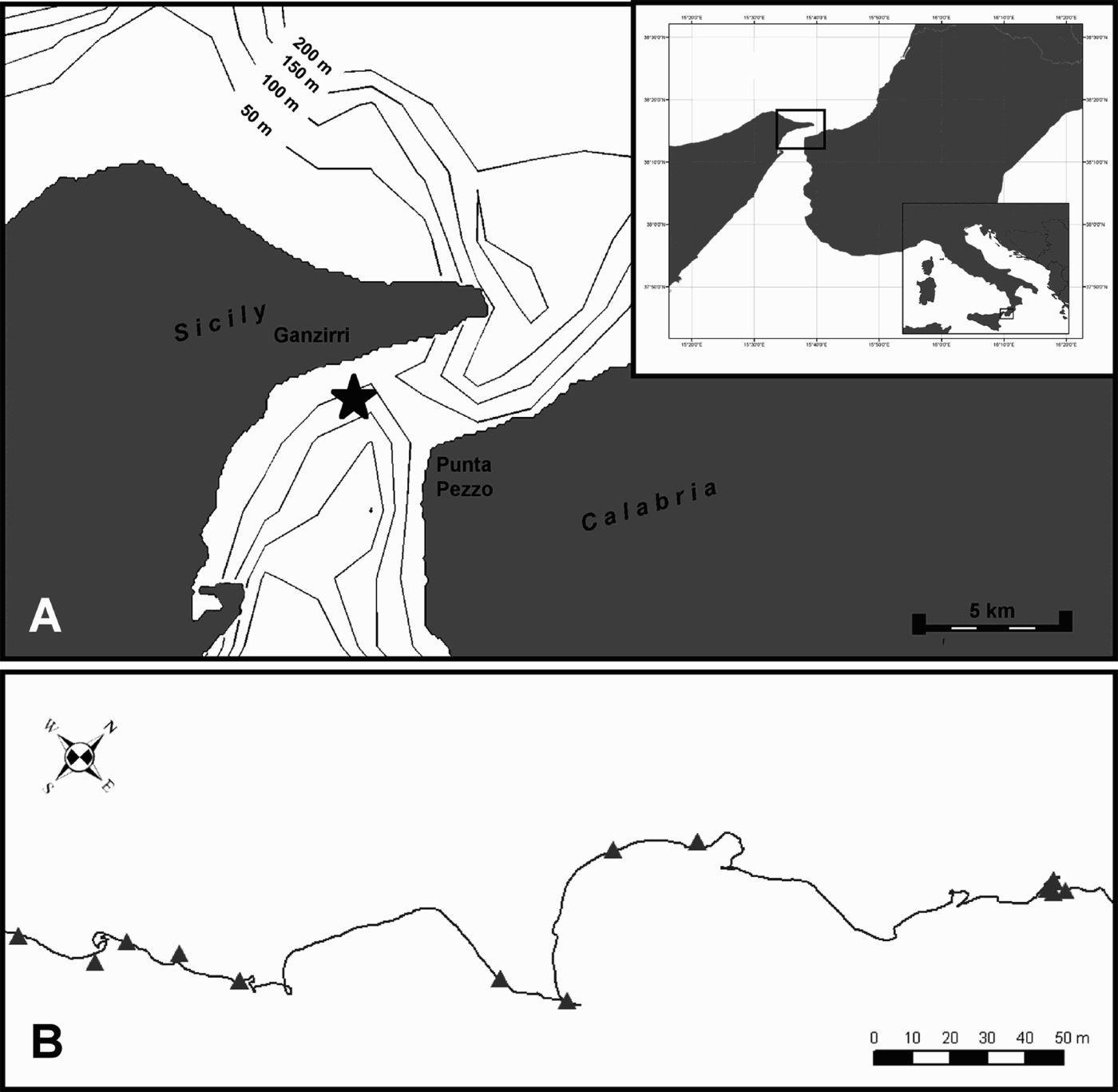
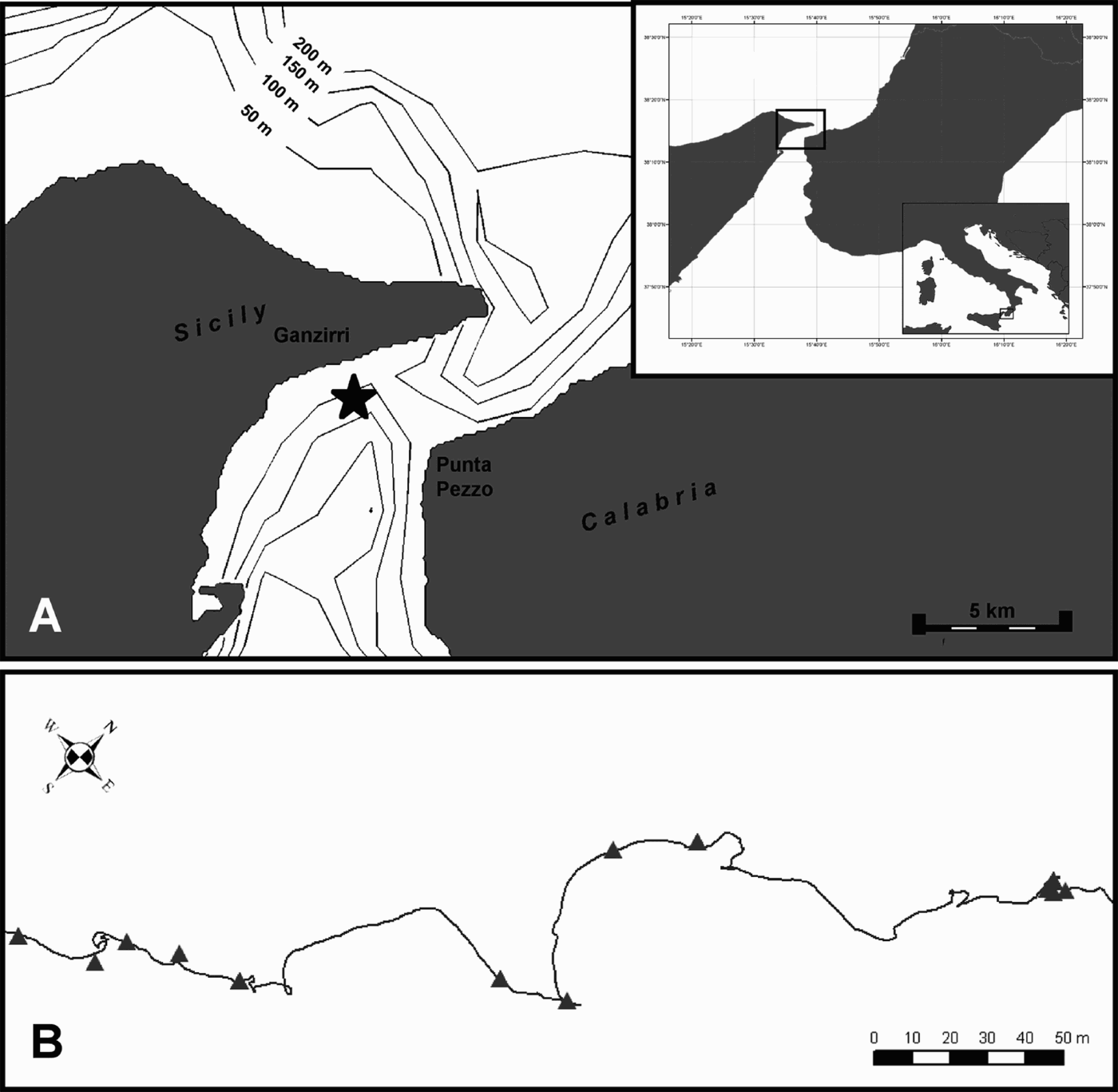
The population of Errina aspera was studied in the site known as La Sella, in front of Sicily just south of the ridge of the Messina Strait (38.24599°N–15.61988°E). This area is the narrowest portion of the Strait reaching 3.15 km from Ganzirri on the Sicilian coast to Punta Pezzo on the Calabrian side (Figure 1A, inset). In this central part of the Strait the ridge reaches its minimum depth (80–120 m), separating the western side, shallower, from the eastern side, deeper and more plane. The Strait of Messina, and especially this area, because of its topographic characteristics, is dominated by a dynamic instability due to stationary currents, tidal currents and other peculiar oceanographic features (Vercelli, Reference Vercelli1925; Mosetti, Reference Mosetti1988). The bottom is lashed by very strong currents, up to a maximum of 200 cm s−1 as measured along the Ganzirri–Punta Pezzo section (Tomasino, Reference Tomasino, Guglielmo, Manganaro and De Domenico1995). The continuous moving and mixing of Tyrrhenian and Ionian waters enhance the nutrient enrichment of the area (Cortese & De Domenico, Reference Cortese and De Domenico1990).
Sampling area. (A) Bathymetric structure of the Messina Strait indicating the area where the ROV survey was conducted (black star). Inset, localization of the Messina Strait; (B) ROV track with the position of the recorded images (some results overlapped because of the small image size).
The population was studied through a remotely operated vehicle survey (ROV ‘Pollux) conducted on August 2007 on board of the RV ‘Astrea’ of ISPRA between 83 and 105 m depth. The ROV was equipped with an underwater acoustic tracking position system (Tracklink 1500 MA, LinkQuest Inc.) providing detailed records of the track along the seabed, a digital camera (Nikon D80, 10 megapixel with a strobe Nikon SB 400), and a high definition video camera (Sony HDR-HC7). Additionally it had a depth sensor, a compass, and two parallel laser beams providing a 10 cm scale for measuring the sampling areas on the substratum and the height and width of the colonies.
A 350 m long transect (covering an area of about 1200 m2, with the ROV visual field width of 3–4 m) was carried out along the South-west–North-east direction of the Strait within the area occupied by the hydrocoral population (Figure 1B) and data analysis was performed on 33 high resolution photographs randomly taken along the ROV track.
Image analysis allowed the estimation of density (colonies m−2 ± SE) and the size of the colonies (height and width) of E. aspera. Close up images were used to study their branching pattern (apices number) in order to give an interpretation of the growth strategy of the corals. The population structure was studied through the size–frequency distribution of the counted specimens divided into 1 cm size-classes.
A characterization of the species associated to the E. aspera community was also made both for what concern the epibiontic species living on the colonies and the organisms sharing the habitat with the stylasterid. In particular CPC software (version 5.1) available from the National Coral Reef Institute, NOVA University (Kohler & Gill, Reference Kohler and Gill2006) was used to estimate the average cover percentage (±SE) of the most abundant species of benthic fauna and flora.
RESULTS
The assemblage
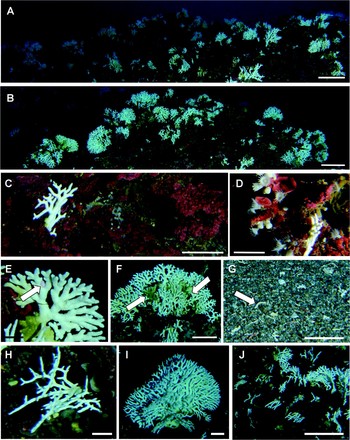
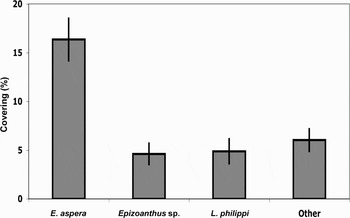
The twilight zone of the Messina Strait is characterized by a rocky substrate lashed by strong currents that completely prevent the deposition of fine sediments. The images collected along the ROV track indicated that on average 68.1 ± 2.4% of the substratum was constituted by naked rocks or coarse sediments. The most important component of the benthic community was Errina aspera with a covering ranging from 1.3 to 56% (16.4 ± 2.2% on average) (Figures 2A, B & 3). Other important species were the coralline alga Lithothamnion philippii Foslie, 1909 (average covering 4.9 ± 1.2%) (Figures 2C & 3) and an unidentified species of zoanthid probably belonging to the genus Epizoanthus (average covering 4.6 ± 1.1%) (Figures 2D & 3). Other benthic organisms like unidentified sponges, hydrozoans (Sertularella sp.), bryozoans (Sertella and Myriapora) and various algae were occasionally observed (Figure 3). On the colonies of E. aspera, the gastropod Pedicularia sicula (1–2 specimens per colony) was frequently observed (Figure 2E). Several colonies of the stylasterid were partially overgrown by a filamentous green alga (Figure 2F).
Errina aspera assemblage. (A, B) The population of E. aspera of the Messina Strait. The rocky bottom is covered by the coralline alga Lithothamnion philippii and the white zoanthid Epizoanthus sp.; (C) colony of E. aspera settled on the organogenic substratum built by the red coralline alga Lithothamnion philippii; (D) close-up view of the white zoanthid Epizoanthus sp.; (E) the pink gastropod Pedicularia sicula (arrow) associated to E. aspera; (F) several colonies of E. aspera showing parts of the colonies covered by a green alga (arrows); (G) coarse sediment with white broken pieces (arrow) of E. aspera; (H, I) different growth forms of E. aspera: three-dimensional not densely branched, stag antler-shaped (H); three-dimensional densely branched (I); (J) numerous juveniles occurring on the rocky bottom close to the major colonies. Scale bars: A, B, G, J, 10 cm; C, F, 5 cm; D, E, H, I, 1 cm.

Average per cent covering (± SE) of the main benthic components of the studied assemblage obtained by CPC software.

On the detritic bottom at the base of the rocks colonized by E. aspera numerous broken portions of the colonies were observed (Figure 2G).
The Errina aspera population
A total of 4348 colonies of Errina aspera were counted in the photographs with a density ranging from 18 to 445 colonies m−2, 101.4 ± 13.3 colonies m−2 on average.
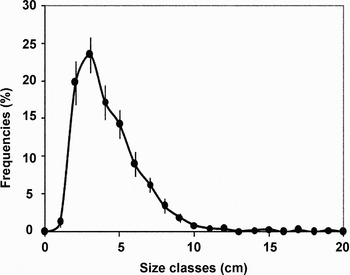
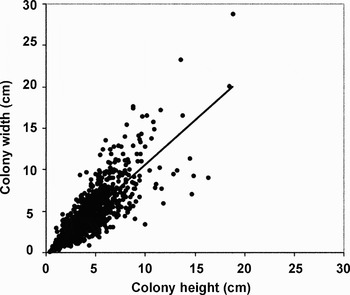
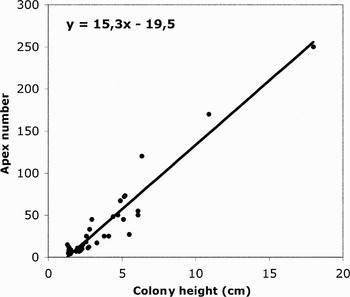
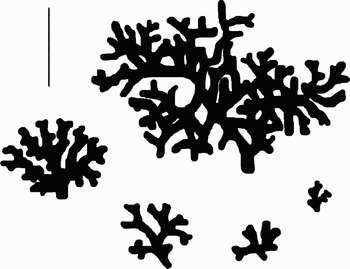
The colony size was very variable. ROV images were not suitable to record colonies smaller than 1 cm, while the tallest measured colony was 18.8 cm high. The average size (height × width) of the observed colonies was 4.1 ± 0.1 × 4.3 ± 0.1 cm. The size–frequency distribution of the colony height was unimodal with a mode in the classes 3–5 cm and a long tail of rare large colonies (Figure 4). In the observed colonies the height/width ratio was very close to 1 within all size-classes (Figure 5). Colonies of different size-classes, corresponding to different growth stages, increased rapidly the complexity of their ramification pattern (evaluated as number of branch apices) (Figure 6). The number of apices for colonies with a height comprised between 1 and 2 cm was on average 8.5 ± 1.5, for those between 4 and 5 cm high was 51.4 ± 7.7, while the highest colonies (>10 cm high) had an average of 210 ± 40 apices (Figure 7).
Average (± SE) size–frequency distribution of the colony height of Errina aspera in the studied population.

Relationship between height and width of the observed colonies of Errina aspera (r = 0.81, N = 4348).

Relationship between height of colonies and number of apices showing the increasing complexity of Errina aspera along with its growth (r = 0.96, N = 50).

Schematic representation, obtained from photographs, of Errina aspera colonies of different size showing the three-dimensional complexity increasing in the branching pattern. Scale bar: 5 cm.

Different growth forms of E. aspera were recorded. The most common colonies were bi-dimensional, fan-shaped (Figure 2E, F), but three-dimensional, bushy forms were occasionally recorded. Some specimens were not densely branched and showed a peculiar stag antler shape (Figure 2H), while other large specimens were multi-planar, densely branched (Figure 2I).
DISCUSSION
Stylasterid corals are mainly known from a taxonomic point of view but few data are available concerning their ecology and population structure due to the scarcity of field studies. Information about their abundance and biodiversity mainly derive from studies of cold-water coral communities including stylasterids, such as the Alaskan deep coral assemblages, where hydrocorals represent 5.9% of the total coral abundance (Heifetz, Reference Heifetz2002).
Remotely operated vehicle exploration has represented a turning point in the observation of deep benthic fauna allowing detailed studies on the structure of deep benthic assemblages. With this method several studies about Mediterranean deep coral communities were recently conducted considering both scleractinian corals (Mastrototaro et al., Reference Mastrototaro, D'Onghia, Corriero, Matarrese, Maiorano, Panetta, Gherardi, Longo, Rosso, Sciuto, Sanfilippo, Gravili, Boero, Taviani and Tursi2010; Vertino et al., Reference Vertino, Savini, Rosso, Di Geronimo, Mastrototaro, Sanfilippo, Gay and Etiope2010) and black corals (Bo et al., Reference Bo, Bavestrello, Canese, Giusti, Salvati, Angiolillo and Greco2009, Reference Bo, Bavestrello, Canese, Giusti, Angiolillo, Cerrano, Salvati and Greco2010).
This is the first ROV study describing the habitat and the population structure of Errina aspera in the Mediterranean Sea. In the Messina Strait this species dominates a very peculiar community settled in an area characterized by extremely strong currents and our data of density (18–445 colonies m−2) are higher than those reported by Fredj & Giermann (Reference Fredj and Giermann1982) (from 5–6 to some tens of colonies m−2).
Errina species may represent conspicuous features of deep rocky environments. Errina dabneyi (De Pourtalès, 1871), for example, is an important element of the upper bathyal slope of the southern Faial Channel in the Azores Archipelago from 350 m to 500 m depth (Wisshak et al., Reference Wisshak, López Correa, Zibrowius, Jakobsen and Freiwald2009). The flabellate colonies have been documented mainly on rocks exposed to currents, with the concave sides of the fans facing the water movement. The colonies of E. dabneyi are colonized by scleractinians, sponges and much more frequently by the gastropod Pedicularia sicula (Braga-Henriques et al., Reference Braga-Henriques, Carreiro-Silva, Porteiro, Matos, Sampaio, Ocaña and Ávila2009; Wisshak et al., Reference Wisshak, López Correa, Zibrowius, Jakobsen and Freiwald2009). Very dense populations of Errina species have been reported in different zones of the austral hemisphere. In the New Zealand's fjords, the deep-water emergent Errina novaezelandiae Hickson, 1912 is one of the most conspicuous components of the community settled at 20–30 m depth or more (Miller et al., Reference Miller, Mundy and Chadderton2004). Häussermann & Försterra (Reference Häussermann and Försterra2007) investigated the stylasterid population of the Patagonian fjord region observing an extraordinary high density of Errina antarctica (Gray, 1872), occurring on primary and secondary hard substrata below 10 m depth. In the Archipelago Madre de Dios (Chile) large colonies of this species are spread over an area of more than 10,000 m2 with a coverage exceeding 80%. In the studied area of the Messina Strait we have calculated a maximal covering of 56%. These data suggest that the formation of dense, almost monospecific coral assemblages, is a common characteristic of the species belonging to the genus Errina.
Errina novaezelandiae populations are dominated by small colonies with few large individuals (Miller et al., Reference Miller, Mundy and Chadderton2004) and a similar situation is observed for E. aspera in the Messina Strait (Figure 2J). For this population however, it is possible to hypothesize that the structure is strongly constrained by the hydrodynamic conditions of the habitat. The colony growth in fact increases the friction of the flowing water. Once the colonies reach a size of 10 cm, they are no longer able to withstand the force of the current and their apicol branches break. This idea is confirmed by the observation of a high number of broken pieces of E. aspera accumulated on the detritic bottom of the studied area as already observed by Fredj & Giermann (Reference Fredj and Giermann1982). Larger colonies may probably survive only in relatively sheltered micro-habitats. Mortality of colonies, especially the large ones, may also be affected by the epibiosis of filamentous green algae which have been observed growing on the stalks and major branches of these specimens.
Also the recorded different growth forms of the colonies are probably due to the influence of current direction. While small colonies are generally planar to maximize the surface facing the current, large colonies, viz. those from sites with weaker currents, are bush-shaped. The relationship between the growth form and different ecological conditions was also recorded for E. antarctica in the Patagonian fjords (Häussermann & Försterra, Reference Häussermann and Försterra2007). Here, fan-like two-dimensional colonies perpendicular to the current direction were recorded on steep walls, while three-dimensional bushy colonies were found on gentle slopes and horizontal portions of channels characterized by moderate to strong current, closer to the Pacific open areas where sedimentation stress was apparently low.
We do not have direct growth measures of E. aspera, but some data are available for closely related species. The average net growth rate of E. novaezelandiae, estimated through calcein tagging and stereo photography, ranged from 0.7 mm yr−1 (Miller et al., Reference Miller, Mundy and Chadderton2004) to 2.7 ± 1.1 mm y−1 (Chong & Stratford, Reference Chong and Stratford2002). Errina dabneyi instead showed a faster growth rate (4–6 mm y−1), estimated through photographic imaging (Wisshak et al., Reference Wisshak, López Correa, Zibrowius, Jakobsen and Freiwald2009). For our estimation we have chosen an average growth rate of 5 mm y−1 according to E. dabneyi data since the two species share a more similar habitat and depth range. It is therefore possible to estimate that 50% of the colonies of the Messina Strait have less than 7 years and about 90% less than 14 years while the largest colonies may reach 40 years old.
This research adds a significant contribution to the poor knowledge concerning calcareous deep corals of the Mediterranean Sea, since studies are mainly focused on the deep banks of scleractinian corals Madrepora oculata Linnaeus, 1758 and Lophelia pertusa (Linnaeus, 1758) and their associated fauna (Mastrototaro et al., Reference Mastrototaro, D'Onghia, Corriero, Matarrese, Maiorano, Panetta, Gherardi, Longo, Rosso, Sciuto, Sanfilippo, Gravili, Boero, Taviani and Tursi2010; Vertino et al., Reference Vertino, Savini, Rosso, Di Geronimo, Mastrototaro, Sanfilippo, Gay and Etiope2010).
ACKNOWLEDGEMENTS
We would like to thank Dr Francesco Falcieri for consultancy on oceanographic data. We would like to thank also the crew members of RV ‘Astrea’ for their precious help during field work. This study has been conducted by ISPRA (ex ICRAM), within the project No. 327 MoBioMarCal, and financed by the Calabrian Regional Council for Environment. This work undertaken through MoBioMarCal is affiliated to the European Census of Marine Life.