Introduction
In the past few decades, scholars have paid considerable attention to the institutional determinants of cross-border venture capital (VC) investment (e.g., Aizenman & Kendall, Reference Aizenman and Kendall2012; Guler & Guillen, Reference Guler and Guillen2010a; Vedula & Matusik, Reference Vedula and Matusik2017). Extant research has predominantly focused on the characteristics of formal institutions of host countries as country-level institutional determinants of cross-border VC investment. While this research stream has significantly advanced our understanding of how formal institutions affect cross-border practices, particularly in cross-border VC investments where investors often hold significant influences and play a paramount role in shaping investment decisions (Zhang, Zhang, & Schwab, Reference Zhang, Zhang and Schwab2024), scholars have increasingly begun to realize the importance of informal institutions that incorporate affective and moral elements which represent social approval and legitimacy granted by the government (Murtinu, Reference Murtinu2021) and the public (Tian, Reference Tian2022), such as informal country-level sentiments (Arikan & Shenkar, Reference Arikan and Shenkar2013; Bertrand, Betschinger, & Settles, Reference Bertrand, Betschinger and Settles2016; Siganos & Tabner, Reference Siganos and Tabner2020), military conflicts (Li, Arikan, Shenkar, & Arikan, Reference Li, Arikan, Shenkar and Arikan2020), intercountry relations (Bilgili, Allen, Loncarich, Kedia, & Johnson, Reference Bilgili, Bilgili, Allen, Loncarich, Kedia and Johnson2023), and diplomatic relations (Li, Meyer, Zhang, & Ding, Reference Li, Meyer, Zhang and Ding2018). The rising significance of informal institutions is also evident in the ever-evolving and complex geopolitical landscape, as well as in various international events such as Brexit, the Sino–US trade war, and the Russia–Ukraine conflict.
Surprisingly, the literature on cross-border VC investment has paid relatively little attention to the influence of informal institutions such as sentiment. It is a significant omission, especially given that investors are embedded in a sentiment-infused national environment (Yiu, Wan, Chen, & Tian, Reference Yiu, Wan, Chen and Tian2024), and their investment decisions are ineluctably influenced by home country sentiments due to the cascading effects of environmental conditions (Petricevic & Teece, Reference Petricevic and Teece2019). This article thus aims to fill this research gap by incorporating home country political sentiment, which is an aspect of informal institutions and defined as the degree of home country government’s attitudes and emotional states – such as friendly, favorable, cooperative, or hostile (Myrick, Reference Myrick2020; Myrick & Wang, Reference Myrick and Wang2024; Tian, Reference Tian2022) – toward the counterpart country, into VC investment as an extension to the well-established influencing mechanisms. Our primary research question is: How does the investor’s home country political sentiment toward the investee’s country influence investors’ cross-border VC investment?
Building on the trust literature, this article develops a theoretical framework to explore the underlying mechanism of home country political sentiment on cross-border VC investment and the contingency factors that strengthen or weaken this relationship. Extant research suggested that trust could be regarded as an important theoretical mechanism that links the relationship between country-level sentiment and firm cross-border activities (Arikan & Shenkar, Reference Arikan and Shenkar2013; Hasija, Liou, & Ellstrand, Reference Hasija, Liou and Ellstrand2020). In this article, we concentrate on affect-based trust, which is an important type of trust that refers to trust ‘from the heart’ (Chua, Ingram, & Morris, Reference Chua, Ingram and Morris2008: 436) and manifests the emotional bonds among individuals, and propose that a higher level of home country political sentiment can lead to a higher level of investors’ affect-based trust, which results in a larger amount of VC investment. We further propose two groups of investor-side contingent factors that affect such a relationship. One group represents sentiment transmission, including GVC (transmission through equity ownership) and connected VC (transmission through interpersonal relationships), while another group reflects sentiment suppression, including investor managerial team education (suppression through endogenous rationality) and investor host country experience (suppression through exogenous rationality). Specifically, we suggest that GVC and connected VC will strengthen the positive relationship between home country political sentiment and cross-border VC investment, and that the moderating effect of GVC is stronger than that of connected VC. In addition, investor managerial team education and investor host country experience will weaken the positive relationship between home country political sentiment and cross-border VC investment. Empirically, we focus on China’s home country political sentiment toward other countries and study Chinese VC firms’ cross-border investment decisions. Findings from a unique dataset consisting of 1,234 Chinese VCs’ overseas investments from 2000 to 2021 provide strong support for our hypotheses.
This study aims to make several theoretical contributions. First, prior studies have shed considerable light on how international relations and sentiments can influence cross-border strategic decisions such as M&A, alliance, and new subsidiary location choice (Arikan & Shenkar, Reference Arikan and Shenkar2013; Bertrand, Betschinger & Settles, Reference Bertrand, Betschinger and Settles2016; Li, Meyer, Zhang & Ding, Reference Li, Meyer, Zhang and Ding2018). Yet we know little about how and through which mechanisms home country sentiment can exert influence on cross-border VC investment, which differs from other cross-border activities in that it involves companies from different countries, with one company (the investors) holding a dominant position with absolute power in terms of influence and negotiation (Chemmanur, Hull & Krishnan, Reference Chemmanur, Hull and Krishnan2016; Guler & Guillen, Reference Guler and Guillen2010b). In our study, we propose that home country political sentiment can increase cross-border VC investment through fostering the investor’s affect-based trust and leading to less rational decision-making. We further identify two types of moderating variables that can transmit or suppress this effect, this paper contributes to our understanding of how macro-level country sentiment cascades down to micro-level firm activities and bridges the macro-micro divide in this field.
Second, this study contributes to cross-border VC investment by theorizing and empirically demonstrating that country-level sentiments, an important dimension of informal institutions, can substantially shape the flow of VC investments (Devigne, Manigart, & Wright, Reference Devigne, Manigart and Wright2016). While previous research has mainly focused on formal institutions – such as those supporting innovation, investor rights, and regulatory stability – as key determinants of cross-border VC activity (Aizenman & Kendall, Reference Aizenman and Kendall2012; Balcarcel, Hertzel, & Lindsey, Reference Balcarcel, Hertzel and Lindsey2010; Guler & Guillen, Reference Guler and Guillen2010a), this study introduces home country political sentiment as a critical antecedent. It highlights how investor perceptions of the political climate can influence affect-based trust, risk assessments, and decisions, adding to the understanding of how informal institutions shape cross-border VC investment. The findings thus offer new insights into how geopolitical narratives and public opinion impact investment behavior.
Third, this study contributes to the trust literature by examining trust within the context of geopolitical tensions. Prior research has predominantly conceptualized trust as a reflection of intrinsic preferences and characteristics (Tenzer, Pudelko, & Harzing, Reference Tenzer, Pudelko and Harzing2014; Zaheer, Hernandez, & Banerjee, Reference Zaheer, Hernandez and Banerjee2010), while limited attention has been paid to how trust may vary across different contexts. This study addresses this gap by investigating how external factors may complicate conventional trust-building mechanisms under conditions of geopolitical uncertainty. In doing so, this article extends the boundary conditions of VC’s political resources and other managerial attributes, thereby advancing the understanding of trust dynamics in complex environments and contributing to the broader development of trust theory.
Theoretical Background and Hypotheses
Affect-Based Trust
Trust is defined as ‘a psychological state comprising the intention to accept vulnerability based upon positive expectations of the intentions or behavior of another’ (Rousseau, Sitkin, Burt, & Camerer, Reference Rousseau, Sitkin, Burt and Camerer1998: 395). Scholars identify the feature of trust as that the acceptance of vulnerability is not subject to the uncertainty related to intentions, motives, and prospective actions (Kramer, Reference Kramer1999; Mayer, Davis, & Schoorman, Reference Mayer, Davis and Schoorman1995), and have regarded trust as the foundational determinant of inter-firm or interpersonal relationships, as well as subsequent outcomes such as economic exchange (Zaheer & Venkatraman, Reference Zaheer and Venkatraman1995), acquisitions (Graebner, Reference Graebner2009), and supplier performance (Poppo, Zhou, & Li, Reference Poppo, Zhou and Li2016).
Affect-based trust is one important component of trust, which is featured by affective foundations (Bigley & Pearce, Reference Bigley and Pearce1998; Lewis & Weigert, Reference Lewis and Weigert1985) and manifests the emotional bonds among individuals and attaches importance to intrinsic virtue (Pennings & Woiceshyn, Reference Pennings, Woiceshyn, Bacharach and Ditomaso1989). The parties characterized by affect-based trust are connected by emotional investments and ties and have the tendency to reciprocate care and concern (Rempel, Holmes, & Zanna, Reference Rempel, Holmes and Zanna1985). It will place a large emphasis on empathy, affiliation, and rapport on the basis of shared regard for the other person (Schaubroeck, Lam, & Peng, Reference Schaubroeck, Lam and Peng2011). Chua, Morris, and Ingram (Reference Chua, Morris and Ingram2009) further revealed that the sources of affect-based trust vary with countries and found that the presence of economic dependence (friendship) ties has more (less) influence on the affect-based trust for Chinese managers than for American managers.
The presence of affect-based trust will also result in several important outcomes related to organizations and individuals. Scholars suggest that leaders with affect-based trust are more likely to have a social exchange mindset which is necessary for the development of team psychological safety (Schaubroeck et al., Reference Schaubroeck, Lam and Peng2011). Affect-based trust is especially important for such development because psychological safety is not related to rational expectation and is not calculative (Edmondson, Reference Edmondson2004). It will also shape the tendency of cooperation and help the formation of team cohesion and a comfortable workplace atmosphere (De Jong, Dirks, & Gillespie, Reference De Jong, Dirks and Gillespie2016). Chua, Morris, and Mor (Reference Chua, Morris and Mor2012) suggested that individuals with high affect-based trust are more likely to listen attentively and comprehend differing viewpoints rather than dismiss them outright; by recognizing and valuing perspectives that differ from their own, they can more effectively navigate related tensions, participate in constructive discussions, and leverage these differences to create innovative solutions to challenges.
Cross-Border VC Investment
VC financing is an important driving force of entrepreneurship throughout the world, and it is fundamental for the development of high-potential innovative entrepreneurial ventures and general economic growth (e.g., Gompers & Lerner, Reference Gompers and Lerner2001; Samila & Sorenson, Reference Samila and Sorenson2011). Traditionally, VC investing was a local business. The geographic proximity to investment targets was deemed necessary to identify investment opportunities (Sorenson & Stuart, Reference Sorenson and Stuart2001) and to effectively provide post-investment monitoring and value-adding (Devigne, Manigart, Vanacker, & Mulier, Reference Devigne, Manigart, Vanacker and Mulier2018; Makela & Maula, Reference Makela and Maula2006). Consequently, investing in domestic companies can facilitate interactions between investors and potential investee firms, whereby both parties can more easily build mutual trust and expedite reaching an investment decision (Bottazzi, Da Rin, & Hellmann, Reference Bottazzi, Da Rin and Hellmann2016). More recently, however, the VC industry has experienced international growth at growing rates (Goodhart & Schoenmaker, Reference Goodhart and Schoenmaker2016). This has led to a dramatic increase in the number and amount of cross-border investments. Yet this does not come without challenges caused by the distance between VC firms and distant portfolio companies (Devigne et al., Reference Devigne, Manigart, Vanacker and Mulier2018). An unfamiliar environment and lack of awareness of local cultural and social practices amplify the already substantial agency problems VCs face due to information asymmetries and potential moral hazard issues with entrepreneurs. Thus, why VCs invest in nondomestic companies is a research question that has attracted the attention of numerous researchers.
Extant scholars have highlighted country-level determinants that significantly impact VCs’ cross-border investments (e.g., Aizenman & Kendall, Reference Aizenman and Kendall2012; Guler & Guillen, Reference Guler and Guillen2010a; Schertler & Tykvova, Reference Schertler and Tykvova2011). They have suggested that an important determinant driving the flow of cross-border VC investments is the institutional development of the host country. Scholars have argued that cross-border VCs prefer to invest in institutionally developed countries characterized by technological, legal, financial, and political institutions that create a more investor-friendly climate with more transparency and fewer information asymmetries between VCs and their portfolio companies (Guler & Guillen, Reference Guler and Guillen2010a). In a similar vein, some research has investigated the impact of different characteristics between the home and host countries to explain VC flows across borders. For instance, expected economic growth differences between countries are positively related to the flow of VCs from the low growth to the high growth country (Schertler & Tykvova, Reference Schertler and Tykvova2011). Moreover, geographical distance (Colombo, D’Adda, Malighetti, Quas, & Vismara, Reference Colombo, D’Adda, Malighetti, Quas and Vismara2017), transnational technical communities (Madhavan & Iriyama, Reference Madhavan and Iriyama2009), common language, and colonial ties (Aizenman & Kendall, Reference Aizenman and Kendall2012) can also influence the flow of cross-border VC investments.
While important advancements have been made in investigating country-level determinants, much of this progress focuses on the formal institutions of the host country or the differences in terms of formal institutions between the home country and host country. The role of informal institutional environments influencing VC activities remains underexplored (Gu & Lu, Reference Gu and Lu2014). In this study, we thus anchor on an important dimension of informal institutions – i.e., home country political sentiment – to identify how home country political sentiment affects cross-border VC investments from developing markets.
Home Country Political Sentiment and Cross-Border VC Investment
Country-level relations indicate the nature of interactions between home and host country institutions and will impinge on international investments (Bertrand et al., Reference Bertrand, Betschinger and Settles2016; Li, Newenham‐Kahindi, Shapiro, & Chen, Reference Li, Newenham‐Kahindi, Shapiro and Chen2013). Scholars have unveiled several types of country-level relations and how these relations shape the tendency of international investments. For instance, Li et al. (Reference Li, Meyer, Zhang and Ding2018) suggested that diplomatic relations between countries will affect foreign investment location choice, and further documented the roles of political connections. Li, Arikan, Shenkar, and Arikan (Reference Li, Arikan, Shenkar and Arikan2020) examined how country-dyadic military conflicts affect investors’ reactions to cross-border acquisitions. Besides these cross-national relations, scholars and practitioners begin to look at the role of national sentiment in one country toward another country. National sentiment matters a lot for MNEs to gain legitimacy or justify international investments. Thus, an emerging body of research has begun to explore the influences of country-level sentiments on cross-border business activities (Bertrand et al., Reference Bertrand, Betschinger and Settles2016; Fieberg, Lopatta, Tammen, & Tideman, Reference Fieberg, Lopatta, Tammen and Tideman2021; Hasija et al., Reference Hasija, Liou and Ellstrand2020; Liou, Brown, & Hasija, Reference Liou, Brown and Hasija2021).
Previous studies have conducted pioneering studies on how host country sentiment affects cross-border activities such as FDI and M&A (Arikan & Shenkar, Reference Arikan and Shenkar2013; Bertrand, Betschinger & Settles, Reference Bertrand, Betschinger and Settles2016; Li, Makino, & Jiang, Reference Li, Makino and Jiang2019; Li, Meyer, Zhang & Ding, Reference Li, Meyer, Zhang and Ding2018; Tian, Reference Tian2022), but the role of home country sentiment, particularly in cross-border VC investments, has been less explored. In the cross-border VC context, investors often hold significant power, influencing not just the provision of capital but also the strategic direction of ventures. This power asymmetry makes VC investments especially sensitive to the political sentiment of the investor’s home country. Given the active involvement of VC investors in shaping their portfolio companies, home country sentiment can play a crucial role in their cross-border decision-making. Examining home country sentiment in this context thus offers valuable insights into how informal institutions, such as political sentiment, guide investors’ actions across borders.
Home country political sentiment fosters a sentiment-infused atmosphere in which firms are embedded. Companies operating within this environment are influenced and mobilized by the government’s sentiment, which cascades down and spills over into inter-firm relationships (Li et al., Reference Li, Arikan, Shenkar and Arikan2020), leading to corresponding sentiment toward entities in the counterpart country. The sentiment toward entities in the counterpart country affects investors’ perceptions of host country investees, resulting in a high level of affect-based trust from investors toward the target firm. This affect-based trust manifests emotional attachment and expectations of inter-party care and concern (Barsade & Gibson, Reference Barsade and Gibson2007; Bigley & Pearce, Reference Bigley and Pearce1998; Legood, Van der Werff, Lee, den Hartog, & van Knippenberg, Reference Legood, Van der Werff, Lee, den Hartog and van Knippenberg2023). With such attachment, VC investors will be more likely to develop psychological safety and maintain favorable beliefs toward the investee (Batjargal, Reference Batjargal2007; Bottazzi et al., Reference Bottazzi, Da Rin and Hellmann2016; Edmondson, Reference Edmondson2004). In addition, because affect-based trust is intuitive and rooted in emotional connections, decisions based on this type of trust are less influenced by calculative, analytical, and judgmental cues, which are crucial for rational decision-making (Eisenhardt & Zbaracki, Reference Eisenhardt and Zbaracki1992; Simon, Reference Simon1979). This can lead VC investors to make investment choices that may appear relatively irrational, as they may decide to invest even if the opportunity is not a fundamentally sound one.
Meanwhile, when investors have a strong emotional connection, they are more likely to adopt a future-oriented perspective and tend to focus on abstract and broad information related to distal goals (Mount, Baer, & Lupoli, Reference Mount, Baer and Lupoli2021; Steinbach, Gamache, & Johnson, Reference Steinbach, Gamache and Johnson2019). Therefore, they are more likely to engage in venture projects and support the company through ups and downs, fostering resilience and long-term growth. According to a news article by the Global Times, Chinese VC firms shifted their focus to Indonesia after the Sino-India border conflict in 2020.Footnote 1 On June 24, a spokesperson for the Chinese Foreign Ministry stated that the China–India border conflict was a deliberate provocation by the Indian side, which had repeatedly violated agreements and crossed the boundary, leading to clashes between the two countries.Footnote 2 Two months later, the Chinese Foreign Minister met with the Indonesian Foreign Minister, expressing China’s willingness to continue fostering positive exchanges and to advance bilateral relations toward even greater achievements.Footnote 3 As a result, Chinese VCs felt disappointed with the Indian market and were more interested in the Indonesian market. For instance, Shunwei Capital and BAce Capital intended to focus more on Indonesia than India. The Financial Times reported that the co-founder of Shunwei Capital stated they do ‘not make new investments in India for now’ and plan to seal more deals in Indonesia.Footnote 4 As of 2023, Chinese investors remain enthusiastic about investing in Indonesia. A popular saying encapsulates this sentiment: ‘Who wins Indonesia, wins Southeast Asia (market)’.Footnote 5 Chinese VC firms’ intention to invest in Indonesian startups is influenced by home country government sentiment and affect-based trust that fosters firms to increase investment amount and nurture long-term relationships.
Based on the above reasons, we predict that affect-based trust would be more likely to result in a hot-headed decision and a higher amount of investment. We propose:
Hypothesis 1 (H1): Home country political sentiment has a positive influence on the amount of cross-border VC investment.
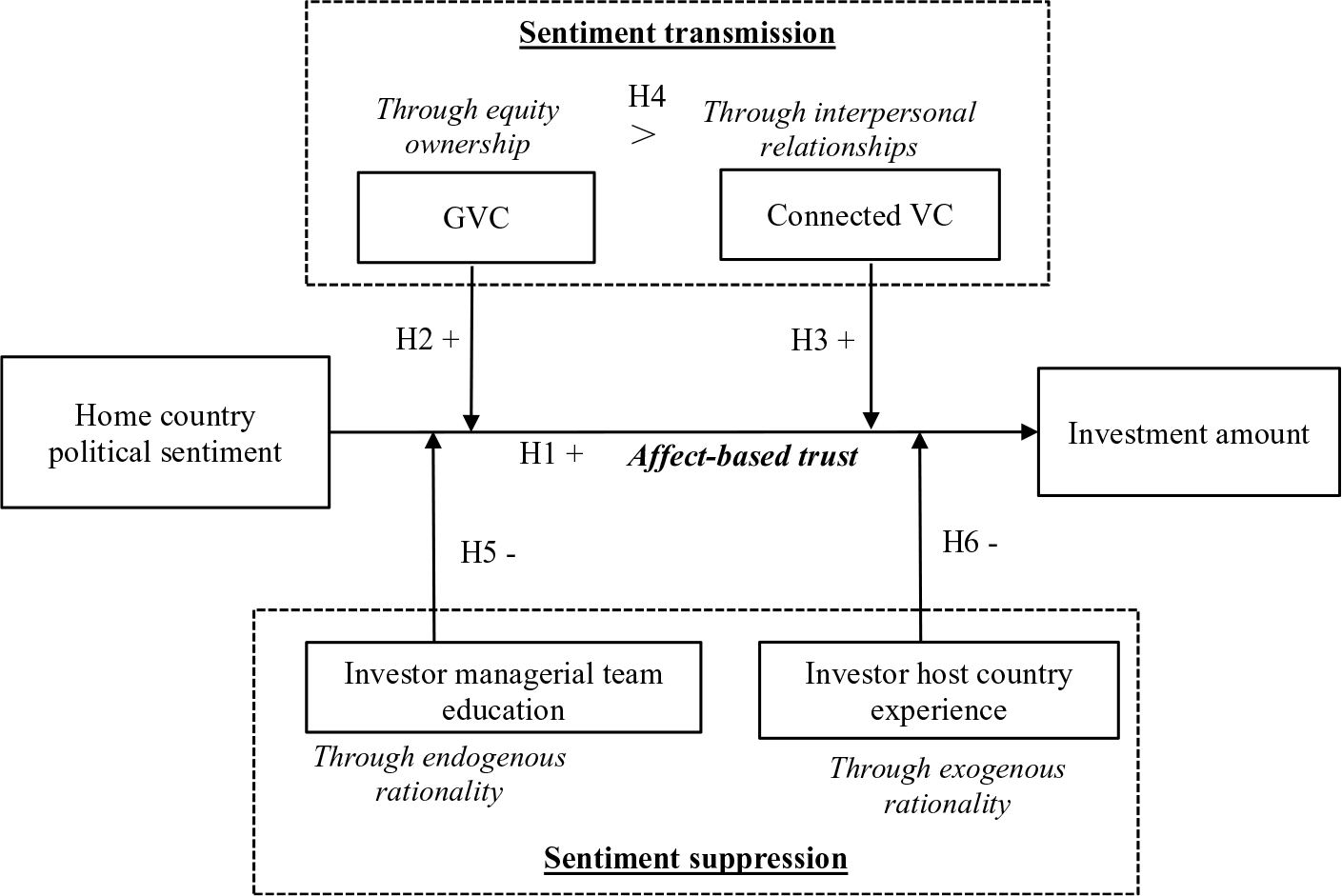
To deepen our understanding of the cascading effect of home country political sentiment on firm-level strategies, we further study the moderating effect of sentiment transmission and sentiment suppression, and focus on four investor-side factors. We suggest that the influence of home country political sentiment on investment amount is different for investors that have heterogeneous types of ties to the government, including GVC (sentiment transmission through equity ownership) and connected VC (sentiment transmission through interpersonal relationships). In addition, the influence is different for investors that have distinct sources of rationality, including investor managerial team education (sentiment suppression through endogenous rationality) and investor host country experience (sentiment suppression through exogenous rationality). Figure 1 presents our theoretical model.
Theoretical framework
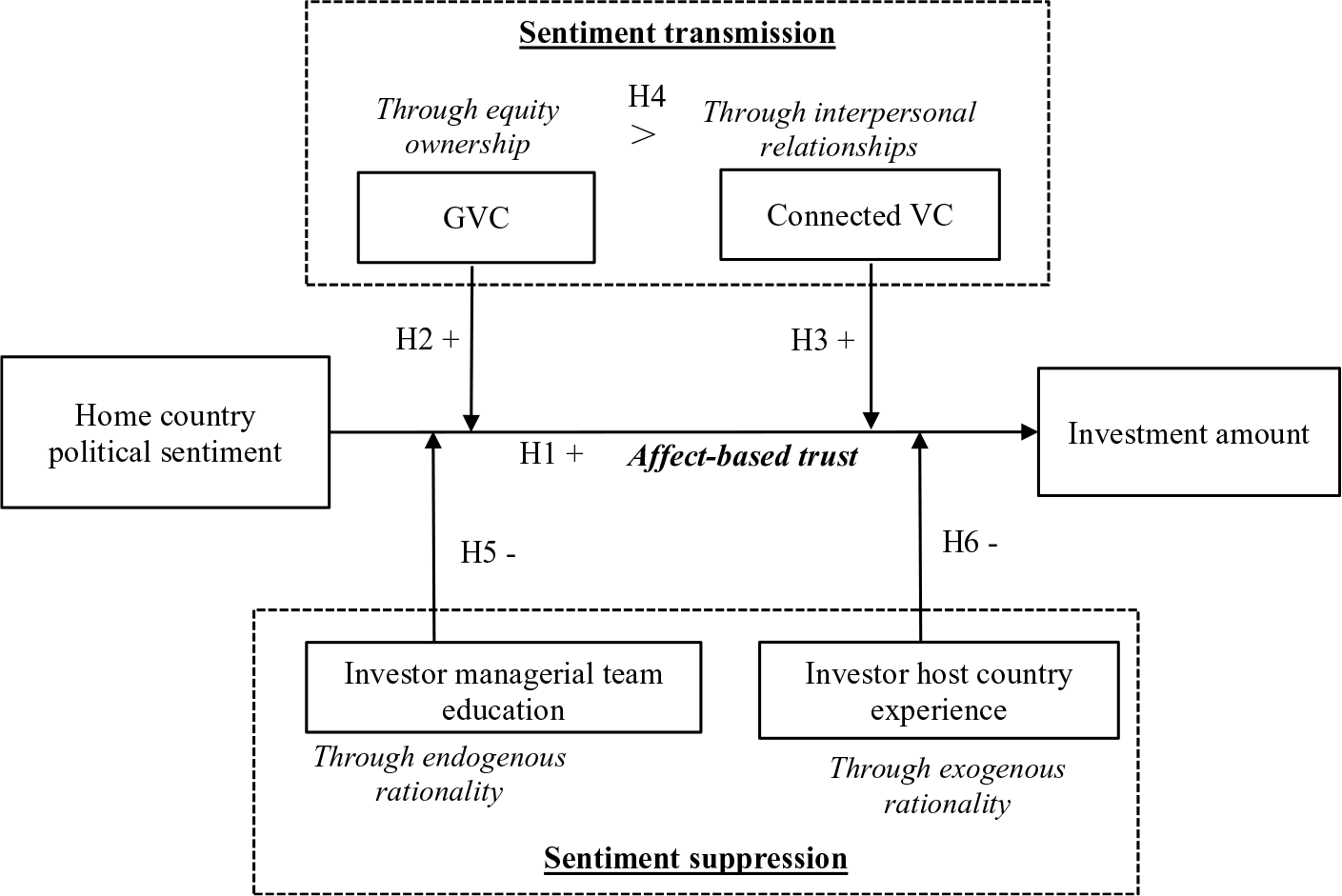
Figure 1 Long description
The influence of home country political sentiment on investment amount occurs through affect-based trust. Sentiment transmission occurs through equity ownership (GVC) and interpersonal relationships (Connected VC), with hypotheses H2 and H3 indicating positive effects. Sentiment suppression involves investor managerial team education (through endogenous rationality) and investor host country experience (through exogenous rationality), with hypotheses H5 and H6 indicating negative effects. Hypothesis H1 suggests a positive effect of affect-based trust on investment amount, while H4 indicates a greater influence through interpersonal relationships than equity ownership.
Sentiment Transmission: GVC and Connected VC
VC investors exhibit heterogeneity in their involvement with the government. Two types of VCs are particularly affiliated with the government: GVCs and Connected VCs. GVCs are governed through government ownership, whereas connected VCs are linked with the government through personal political ties. Extant studies have demonstrated that both GVC and connected VC possess advantages in navigating institutional constraints and market imperfections, allowing them to generate economic rents in portfolio investments (Brander, Du & Hellmann, Reference Brander, Du and Hellmann2015; Wang & Wu, Reference Wang and Wu2020; Zhang & Gu, Reference Zhang and Gu2024). We expect both GVC and connected VC can strengthen the relationship between home country political sentiment and investment amount through different sentiment transmission channels, and that the influence of GVC is stronger than that of connected VC.
In particular, because GVCs are owned or controlled by the government, national interests are a greater consideration when they make cross-border investments decisions, as these companies carry the mission of supporting national strategies such as economic development, technological advancement, and national security (Li, Li, & Wang, Reference Li, Li and Wang2019; Li, Xia, & Lin, Reference Li, Xia and Lin2017; Tan & Tan, Reference Tan and Tan2005). These firms are more likely to be attuned to and follow the political sentiment of home country government, and thus more inclined to align their practices with government stances. Furthermore, GVC firms are established with the primary aim of advancing both economic and political objectives. This form of government ownership and dual social function enables them to access scarce resources controlled by the government (Gao & Yang, Reference Gao and Yang2021), which are more likely to be allocated to projects that align with the government’s sentiment and ideology. Therefore, when the government expresses sentiments toward other countries, GVC firms will internalize these sentiments and their political ideology (Cuervo-Cazurra, Inkpen, Musacchio, & Ramaswamy, Reference Cuervo-Cazurra, Inkpen, Musacchio and Ramaswamy2014). The government’s sentiments are transmitted to firms through equity ownership, influencing the affect-based trust of GVCs. This trust leads firms to be more supportive of investees and focus on projects that align with national interests. Therefore, we predict that compared to non-GVCs, home country political sentiment is more likely to be internalized by GVCs, thereby shaping their strategic direction and decision-making processes in cross-border VC investment. We propose:
Hypothesis 2 (H2): The positive relationship between home country political sentiment and cross-border VC investment amount is stronger for GVC firms than for non-GVC firms.
As for connected VCs, which are linked with the government through interpersonal relationships, political factors need to be considered more critically in decision-making compared to their less connected counterparts. On one hand, highly connected VCs have numerous interpersonal political connections, allowing them to engage with more government officials and political affairs (Li, Wei, Cao, & Chen, Reference Li, Wei, Cao and Chen2022; Yan & Chang, Reference Yan and Chang2018), thereby gaining access to more political information and understand the government’s sentiments and positions (Ridge, Ingram, & Hill, Reference Ridge, Ingram and Hill2017) through various formal and informal channels. This relationship enables companies to better grasp the expectations and needs of the government. On the other hand, connected VCs are motivated to align their positions with the government, demonstrating allegiance, loyalty, and support to maintain and strengthen their political connections. By fostering connections with the government, they not only enhance their standing within political circles but also position themselves to access valuable resources and benefits from the government. Therefore, when the government expresses sentiments toward other countries, highly connected VCs pay closer attention to these sentiments and are more likely to align with the government’s sentiments. The government’s sentiments are transmitted to connected VC firms through interpersonal connections, fostering greater affect-based trust toward their investees and ultimately influencing their investment decisions. We thus predict that the influence of home country political sentiment on investment is stronger for highly connected VC than for less connected VC. We propose:
Hypothesis 3 (H3): The positive relationship between home country political sentiment and cross-border VC investment amount is stronger for highly connected VC firms.
To take a further step, we compare the relative strength of the sentiment transmission through equity ownership and interpersonal relationships. Ownership-based government involvement is generally more powerful and stable in securing benefits for firms compared with interpersonal connection-based government involvement (Huang, Tsui-Auch, Dieleman, & Gomulya, Reference Huang, Tsui-Auch, Dieleman and Gomulya2024). When transmission occurs through equity ownership, the government’s sentiment is directly and internally conveyed to VC firms (Cuervo-Cazurra et al., Reference Cuervo-Cazurra, Inkpen, Musacchio and Ramaswamy2014; Huang et al., Reference Huang, Tsui-Auch, Dieleman and Gomulya2024). The strategic direction and decision-making of GVCs are often more stable because they are directly regulated and supported by the government. As the ultimate shareholder, the government can directly participate in and control firm decisions, allowing its sentiments and policy inclinations to more easily permeate the strategic direction of these firms. Additionally, the presence of government ownership leads firms to prioritize national interests and policy objectives over economic ones (Genin, Tan, & Song, Reference Genin, Tan and Song2021), actively responding to government sentiments and directives. In contrast, the transmission of interpersonal political connections is indirect and external, facilitated through personal ties with government officials outside the firm. These political connections are not as stable as government ownership and their influence varies with personal characteristics and external institution characteristics such as government officials’ term limits and shifting political landscapes (Wang & Luo, Reference Wang and Luo2019; Zhong, Lin, Gao, & Yang, Reference Zhong, Lin, Gao and Yang2019). In addition, while firms with interpersonal political connections also take political sentiments into account, they are more likely to prioritize shareholder interests over political sentiments compared to those controlled by the government (Zhang & Gu, Reference Zhang and Gu2024). We thus expect that the strengthening effect of government VC, which represents transmission through equity ownership, will be stronger than that of connected VC, which represents transmission through interpersonal relationships. We propose:
Hypothesis 4 (H4): The moderating effect of GVC is stronger than that of connected VC.
Sentiment Suppression: Investor Managerial Team Education and Host Country Experience
Education is instrumental in fostering individuals’ rationality by significantly enhancing their ability to process information and make informed decisions (Helfat & Peteraf, Reference Helfat and Peteraf2015; Wiersema & Bantel, Reference Wiersema and Bantel1992). Empirical evidence demonstrates that educational attainment is closely linked to the development of critical cognitive skills such as analytical thinking and complex problem-solving, both of which are essential for effective rational decision-making (Morgeson, DeRue, & Karam, Reference Morgeson, DeRue and Karam2010). Furthermore, individuals with educational qualifications tend to employ systematic, evidence-based approaches in their decision-making processes, leading to better organizational outcomes (Ployhart & Moliterno, Reference Ployhart and Moliterno2011). This enhanced capacity for rationality allows educated individuals to navigate uncertainty more effectively and make sound judgments in complex environments, equipping them with the tools to critically evaluate risks and opportunities. As such, the managerial team’s education experience is a vital determinant of rationality in decision-making across diverse contexts (Johnson, Schnatterly, & Hill, Reference Johnson, Schnatterly and Hill2013).
In our context, since well-educated managerial teams rely more on analytical skills and rational thinking to evaluate investment (Ghanizadeh, Reference Ghanizadeh2017; Inbar, Cone, & Gilovich, Reference Inbar, Cone and Gilovich2010; Menon, Saiti, & Socratous, Reference Menon, Saiti and Socratous2007; Mumby & Putnam, Reference Mumby and Putnam1992), we expect that the positive relationship between home country political sentiment and cross-border VC investment amount will be weakened. This is because the influence of the home country political sentiment is more closely related to emotional links and trust, which well-educated managerial teams are less susceptible to. In contrast, less-educated managerial teams are often more likely to conflate facts with sentiments to a larger extent, making the relationship between home country political sentiment and VC investment amount stronger for firms with less-educated teams. Synthesizing the above arguments, we propose:
Hypothesis 5 (H5): Investor managerial team education weakens the relationship between home country political sentiment and cross-border VC investment amount.
During the process of overseas investment and organizational learning, investors gradually accumulate a range of experiences and knowledge about the policies, cultures, and norms of the host countries (Li, Vertinsky, & Li, Reference Li, Vertinsky and Li2014). Such experience and knowledge can help investors to adapt to the local environment (Mata & Alves, Reference Mata and Alves2018) and improve the capability of understanding, evaluation, and judgment of both the dynamics of the local environment and the capabilities of indigenous firms in the host country (Slangen & Hennart, Reference Slangen and Hennart2008). Investors can also develop local networks, social resources and reputation, which renders them higher legitimacy, stronger bargaining power, and greater information acquisition ability (Mohr, Wang, & Fastoso, Reference Mohr, Wang and Fastoso2016).
An investor with extensive experience in a specific country is more inclined to make well-informed and rational investment decisions. The rationale for this argument is that such an investor possesses a more comprehensive understanding of the external environment of the investee. The investor is more likely to possess an extensive network within the host country, which facilitates access to a broader range of information about the investee, and advances the capacity to absorb and process pertinent information. The possession and processing of local information acquired from exposure to local institutional environments are essential for logical and statistical analysis in decision-making (Conlon & Parks, Reference Conlon and Parks1987; Gigerenzer & Gaissmaier, Reference Gigerenzer and Gaissmaier2011). As investors’ investor host country experience grows, they become more competent in screening their business plans in the host country, which effectively inhibits bounded rational or irrational decision-making stemming from affect-based trust. In 2015, Didi, along with investment firms like Tencent and SoftBank, made its first investment in the Indian market. However, it underestimated the complexities of the Indian landscape, including consumers’ high price sensitivity, underdeveloped payment systems, and limited transportation infrastructure. Driven by a desire to replicate its success in China, Didi invested heavily in the Indian ride-hailing platform Ola without conducting thorough due diligence.Footnote 6 In contrast, another VC firm, KIP, has closely monitored emerging markets such as India and Southeast Asia, investing in over 10 local companies to date. Its Vice President pointed out that many common mistakes made by VCs result from insufficient information. He emphasized the importance of thoroughly understanding these markets, gathering comprehensive data to truly grasp market dynamics, and learning from the investment experiences of predecessors in host countries to avoid common pitfalls.Footnote 7 These examples illustrate how the host country experience can significantly influence rational thinking in investment decisions.
Therefore, the capability of acquiring and processing information obtained from investor host country experience prompts investors to make decisions without reliance on affect-based trust. The influence of home country political sentiment on cross-border VC investment will be diminished by the rationality accumulated from the external environment, as the underlying mechanism – affect-based trust – is inhibited when making investment decisions. We thus propose:
Hypothesis 6 (H6): Investor host country experience weakens the positive relationship between home country political sentiment and cross-border VC investment amount.
Methods
Data and Sample
This study focused on China’s home country political sentiment toward other countries for several reasons. First, cross-border investment in China has risen dramatically in recent decades, and China plays an increasingly important role in the cross-border VC market. Second, scholars from Tsinghua University have developed a unique dataset about Chinese government’s sentiment toward 12 major countries, including Australia, France, Germany, India, Indonesia, Japan, Pakistan, Russia, South Korea, the United Kingdom, the United States, and Vietnam. These countries have relatively large bilateral economic transactions or conspicuous international relations with China. We focused on deals with investors from China and investees from these 12 major countries that have political relations index data. We collected VC investment data from Zero2IPO, which is one of the leading VC information providers (Zheng & Xia, Reference Zheng and Xia2018) and covers key information such as investment date, investment amount, and firm location. The moderators and control variables were lagged by one year. After deleting observations with missing values, our final sample contains 1,234 cross-border investments from 2000 to 2021.
Measurements
Cross-border investment amount
Following prior literature (Conti, Dass, Di Lorenzo, & Graham, Reference Conti, Dass, Di Lorenzo and Graham2019; Pan, Li, Chen, & Chen, Reference Pan, Li, Chen and Chen2020), we measured cross-border investment amount using the natural logarithm transformation of the total amount of investment in 1,000 RMB for each deal between focal investor and investee.
Home country political sentiment
We measure home country political sentiment using the political relations index developed by researchers at Tsinghua University (Yan, Reference Yan2010), which provides precise Chinese government authorities’ monthly attitude toward 12 major countries and has begun to be increasingly used in management research (Tian, Reference Tian2022; Zhou, Li, & Wang, Reference Zhou, Li and Wang2024). The researchers identified bilateral political events such as military conflicts and diplomatic events based on information from the Ministry of Foreign Affairs of the People’s Republic of China and the People’s Daily, and converted these events into a uniform index. The developers of this index took five elaborate steps to convert political events into a uniform index (Du, Ju, Ramirez, & Yao, Reference Du, Ju, Ramirez and Yao2017). After obtaining the scores, the developers also conducted a series of tests to ensure the accuracy of the index, including the validity of the method for calculating the initial value, consistency with experiential facts, and sensitivity tests on minor changes in relations. The political relations index is similar to the widely used Goldstein scale in the political science literature (Goldstein, Reference Goldstein1992) and is at the monthly level and ranges from – 9 to 9. Because VC decisions usually take several months (Mason & Harrison, Reference Mason and Harrison1996; Mohamed & Schwienbacher, Reference Mohamed and Schwienbacher2016), we used the mean value of the political relations index toward a specific host country within three months prior to the investment date to measure home country political sentiment. We also changed the time window to 1, 2, 4, 5, 6, and 12 months to measure home country political sentiment as a robustness test.
GVC
To measure GVC, we first searched each VC firm’s ownership from the TianYanCha database (https://www.tianyancha.com/), which is a premier online platform that offers comprehensive background information of firms in China and is widely used in academic research (Colonnelli, Li, & Liu, Reference Colonnelli, Li and Liu2024; Li, Chi, Lan, & Wang, Reference Li, Chi, Lan and Wang2025), and then identified whether each investor is ultimately owned or controlled by the government (Devarakonda & Liu, Reference Devarakonda and Liu2024). In this respect, we measured GVC as a categorical variable that is coded as 1 if it is fully owned by the government or if it has any limited partners or large investors wholly owned by the government and 0 otherwise (Bertoni, Colombo, & Quas, Reference Bertoni, Colombo and Quas2019; Grilli & Murtinu, Reference Grilli and Murtinu2014).
Connected VC
Following Zhang and Gu (Reference Zhang and Gu2024), we evaluated the extent of government involvement in VC firms through the personal political ties of their managerial team members. We collected biographical information on managerial team members from a broad range of public sources. First, we obtained the managerial team member list of each VC firm based on information from the firms’ websites, the National Enterprise Credit Information Publicity System (NECIPS), and additional sources such as CVSource and Zero2IPO. We gathered detailed career histories for these managerial team members from platforms including CVSource, Zero2IPO, as well as the Asset Management Association of China (AMAC).
Next, we analyzed the biographies to identify any prior work experience in government agencies. Following prior research (Zheng et al., Reference Zheng, Singh and Mitchell2015), we classified political connections into four levels: county-level, city-level, provincial-level, and national-level. For each managerial team member, we assign a value of 0 if he or she had no political ties, and 1, 2, 3, and 4 if he or she had county, city, provincial, and national levels, respectively. Then, we calculated connected VC as the total value of all members within each VC firm (divided by 10 for ease of interpretation), to provide a comprehensive measure of the degree of political connections for each VC firm. The results remain largely consistent if we use alternative measurements, such as the number of members with political connections, the ratio of members with political connections, a dummy variable indicating whether any key member has political connections, and the highest level of political connections among key members.
Investor managerial team education
Based on the biographies of managerial team members we collected, we identified each team member’s educational background. Investor managerial team education is measured as the ratio of members who have obtained a bachelor’s degree to the total number of managerial team members in the VC firm. The results remain consistent if we use the ratio of members with master’s degrees or doctoral degrees.
Investor host country experience
Following Boellis, Mariotti, Minichilli, and Piscitello (Reference Boellis, Mariotti, Minichilli and Piscitello2016), we measured investors’ investor host country experience using the total number of historical investments initiated by the investor in a certain host country.
Control variables
Other factors that may influence cross-border investment amount were controlled in this article. For investor-level variables, prior research has demonstrated that larger investors have more capital and are more likely to invest a large amount (Wang, Mahmood, Sismeiro, & Vulkan, Reference Wang, Mahmood, Sismeiro and Vulkan2019). We thus controlled for investor size and measured it using the natural logarithm transformation of capital managed by the VC investor (in million RMB, missing values were replaced with the sample mean). Older and more experienced investors may have different amounts of investment (Bailey, Kumar, & Ng, Reference Bailey, Kumar and Ng2008; Huang & Pearce, Reference Huang and Pearce2015). Thus, we controlled investor age, measured using the specific investment year minus the founding year, and investor investment history, measured using the natural logarithm transformation of the total number of investments an investor initiated in all countries in the past (including investments in China). In addition, although the investors in our sample are located in China, some of them received foreign investment that may influence firms’ cross-border investments. We thus controlled investor foreign involvement and assigned it the value of 1 if the investor has foreign capital involvement. We also controlled for investor location dummies to capture the regional-level effects, including seven regions of China: northern, eastern, southern, central, southwest, northwest, and northeast.
Because the investees are small startup companies in different countries, we cannot obtain much information about the investees to control for investee-level variables. Still, we took a further step and searched investees’ names in Wikipedia and manually collected its founding year. We were able to control investee age, which is measured using the investment year minus the founding year. In addition, we controlled for investee maturity. Following prior literature (Antretter, Sirén, Grichnik, & Wincent, Reference Antretter, Sirén, Grichnik and Wincent2020; Zhang & Gu, Reference Zhang and Gu2021), we measured investee maturity on the basis of the four life stages (startup stage, early stage, expansion stage, and mature stage) of an investee at the time it receives VC investment. We assigned investee maturity the value of 1 if the investee is at the startup stage, the value of 2 if the investee is at the early stage, the value of 3 if the investee is at the expansion stage, and the value of 4 if the investee is at the mature stage.
For variables that reflect the relationship between investors and their investees, studies have found that investors are more likely to invest in startups that are in one of the development stages they desire to invest in (Giot & Schwienbacher, Reference Giot and Schwienbacher2007). We controlled for stage match, which is a dummy variable with a value of 1 indicating the investee’s development stage is one of the investor’s desired investment stages. Furthermore, investors have different strategies if they have invested in a firm before (Khanin, Ogilvie, & Leibsohn, Reference Khanin, Ogilvie and Leibsohn2012), so we controlled for investment history in the investee and measured it using the total number of investments initiated by the investor to the specific investee in the past.
We also included some province-level variables. Investors located in provinces that have more VC firms are more likely to have similar investment patterns with other firms due to imitation and learning effects (Li, Qian, & Yao, Reference Li, Qian and Yao2015), we collected data from pedaily.cn and controlled for province VC popularity, measured using the natural logarithm transformation of the number of VC firms operating in a certain province. Provinces with higher levels of marketization have more developed formal institutions and firms in these provinces have different cross-border strategies and performance (Yi, Wang, & Kafouros, Reference Yi, Wang and Kafouros2013; Yiu, Wan, Chen, & Tian, Reference Yiu, Wan, Chen and Tian2022). We thus controlled for marketization and measured it using the annual province marketization index developed by the National Economic Research Institute. Because the marketization index has not been updated after 2019, we interpolated the following years using the ipolate command in Stata.
Since our data only covers 12 host countries, many country-level variables such as cultural distance and GDP per capita are highly correlated.Footnote 8 To avoid multicollinearity, we only included variables that have relatively low correlation coefficients with home country political sentiment and other country-level variables, in our models. It has been well established that VC firms are more likely to invest in countries that have similar cultures to their home countries (Dai & Nahata, Reference Dai and Nahata2016), so we controlled cultural distance and measured it using the data and method described in Berry, Guillen, and Zhou (Reference Berry, Guillen and Zhou2010). In addition, we also included trade dependence as a control variable to consider the influence of economic-related factors. This variable was measured as the sum of export and import flows between China and the host country divided by the GDP of the host country (Bertrand et al., Reference Bertrand, Betschinger and Settles2016).
Estimation Model
Because the independent and dependent variables in this study cross multiple levels and the dependent variable is continuous, we use a multilevel mixed-effects regression (the Stata command is mixed) to test our hypotheses. Multilevel mixed-effects models contain both fixed effects and random effects. It is a generalization of linear regression and allows for the inclusion of random deviations other than those associated with the overall error term (Hofmann, Reference Hofmann1997). As the investees are nested within different countries, we fitted mixed models with random intercepts at the country level. We report robust standard errors to account for potential heteroskedasticity (Deb, David, & O’Brien, Reference Deb, David and O’Brien2017; Srinivasan, Choo, Narayanan, Sarkar, & Tenhiälä, Reference Srinivasan, Choo, Narayanan, Sarkar and Tenhiälä2021). We also used OLS with investor location and year-fixed effects as a robustness test, and the results are largely consistent with our main results.
Results
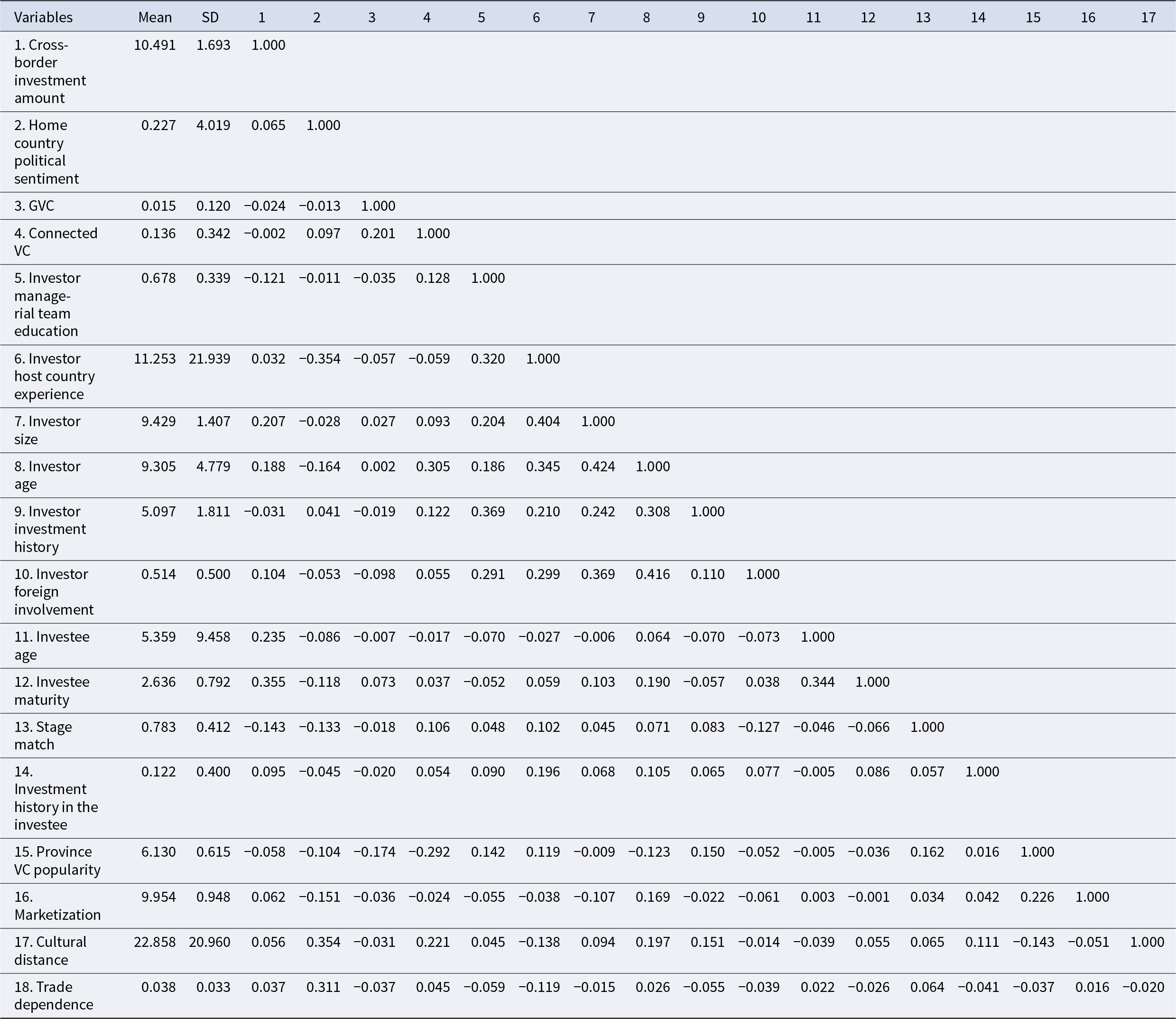
In Table 1, we report the mean value and standard deviation of each variable, as well as the correlation coefficients of different variables. Most of the correlation coefficients are less than 0.4. To further check whether multicollinearity is a concern, we calculated the VIF values of each variable. The VIF values range from 1.08 to 2.07, and the mean VIF is 1.38. The values are much less than the threshold of 10 (Shi, Gao, & Aguilera, Reference Shi, Gao and Aguilera2021), indicating that multicollinearity is not a significant problem in this study.
Descriptive statistics
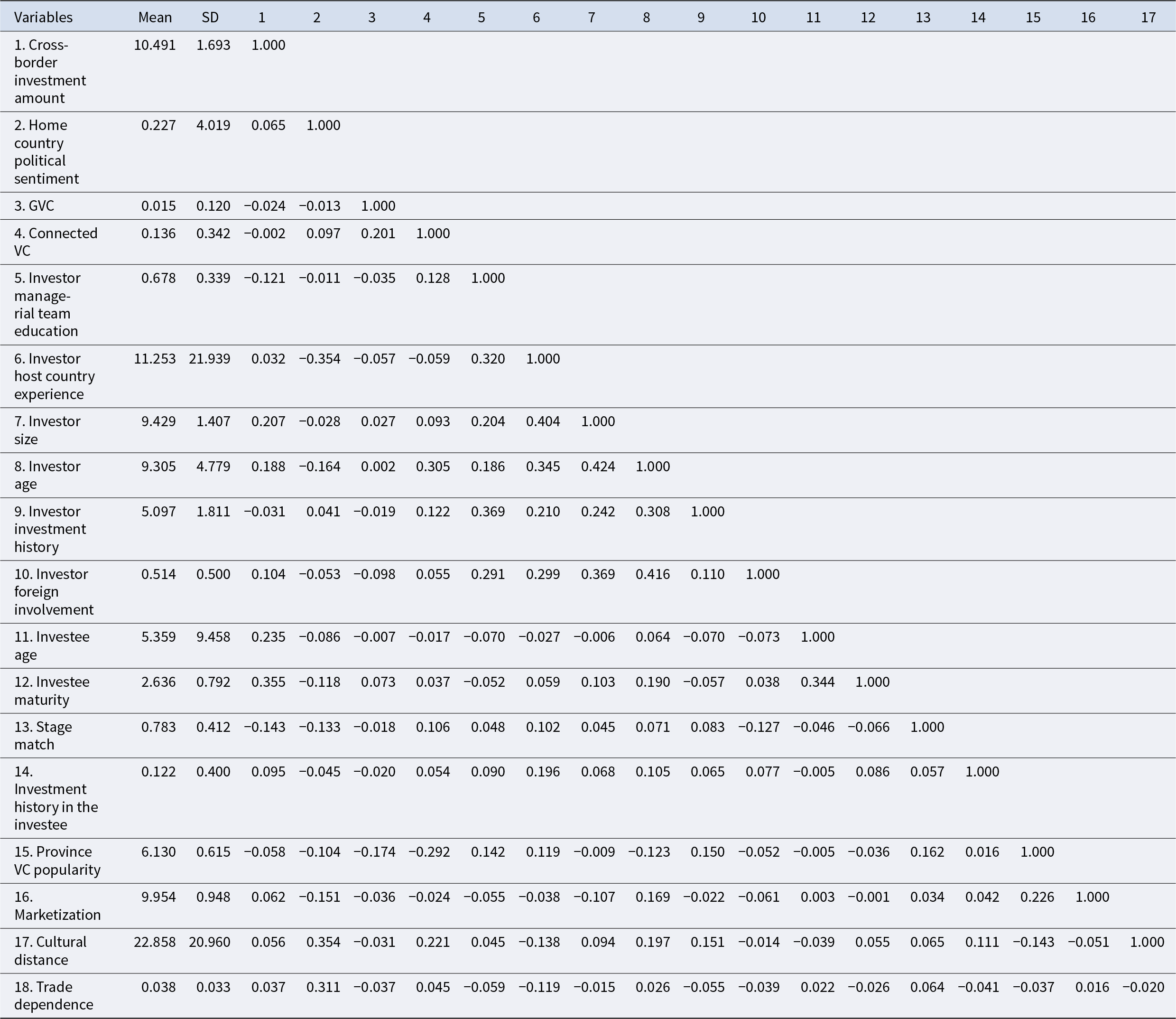
Table 1 Long description
Descriptive statistics list 18 variables with columns for Mean, SD, and a correlation matrix labeled 1 through 17. Variable 1, Cross border investment amount, has mean 10.491 and SD 1.693; its correlations include 0.065 with Home country political sentiment, minus 0.024 with GVC, minus 0.002 with Connected VC, minus 0.121 with Investor managerial team education, 0.032 with Investor host country experience, 0.207 with Investor size, 0.188 with Investor age, minus 0.031 with Investor investment history, 0.104 with Investor foreign involvement, 0.235 with Investee age, 0.355 with Investee maturity, minus 0.143 with Stage match, 0.095 with Investment history in the investee, minus 0.058 with Province VC popularity, 0.062 with Marketization, and 0.056 with Cultural distance. Home country political sentiment has mean 0.227 and SD 4.019, and correlates minus 0.354 with Investor host country experience, 0.354 with Cultural distance, and 0.311 with Trade dependence. Investor host country experience has mean 11.253 and SD 21.939, and correlates 0.404 with Investor size, 0.345 with Investor age, 0.320 with Investor managerial team education, and minus 0.138 with Cultural distance. Investor size has mean 9.429 and SD 1.407, and correlates 0.424 with Investor age and 0.369 with Investor foreign involvement. Investee age has mean 5.359 and SD 9.458, and correlates 0.344 with Investee maturity, which has mean 2.636 and SD 0.792. Cultural distance has mean 22.858 and SD 20.960; Trade dependence has mean 0.038 and SD 0.033, with correlations shown only against variables 1 through 17.
Notes: N = 1,234. Absolute values greater than or equal to 0.057 in correlation are significant at the 0.05 level.
The influence of home country political sentiment on cross-border investment amount
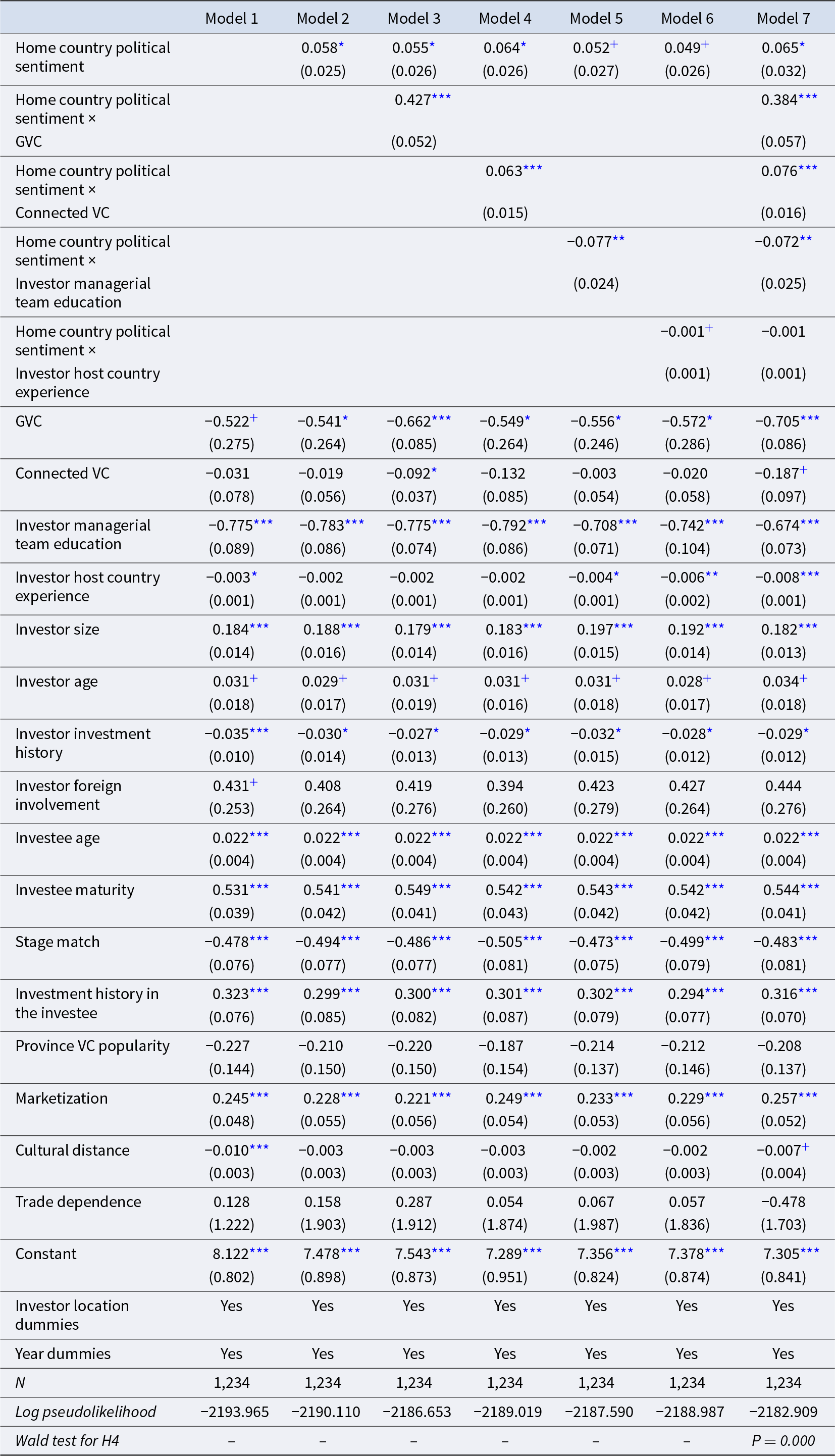
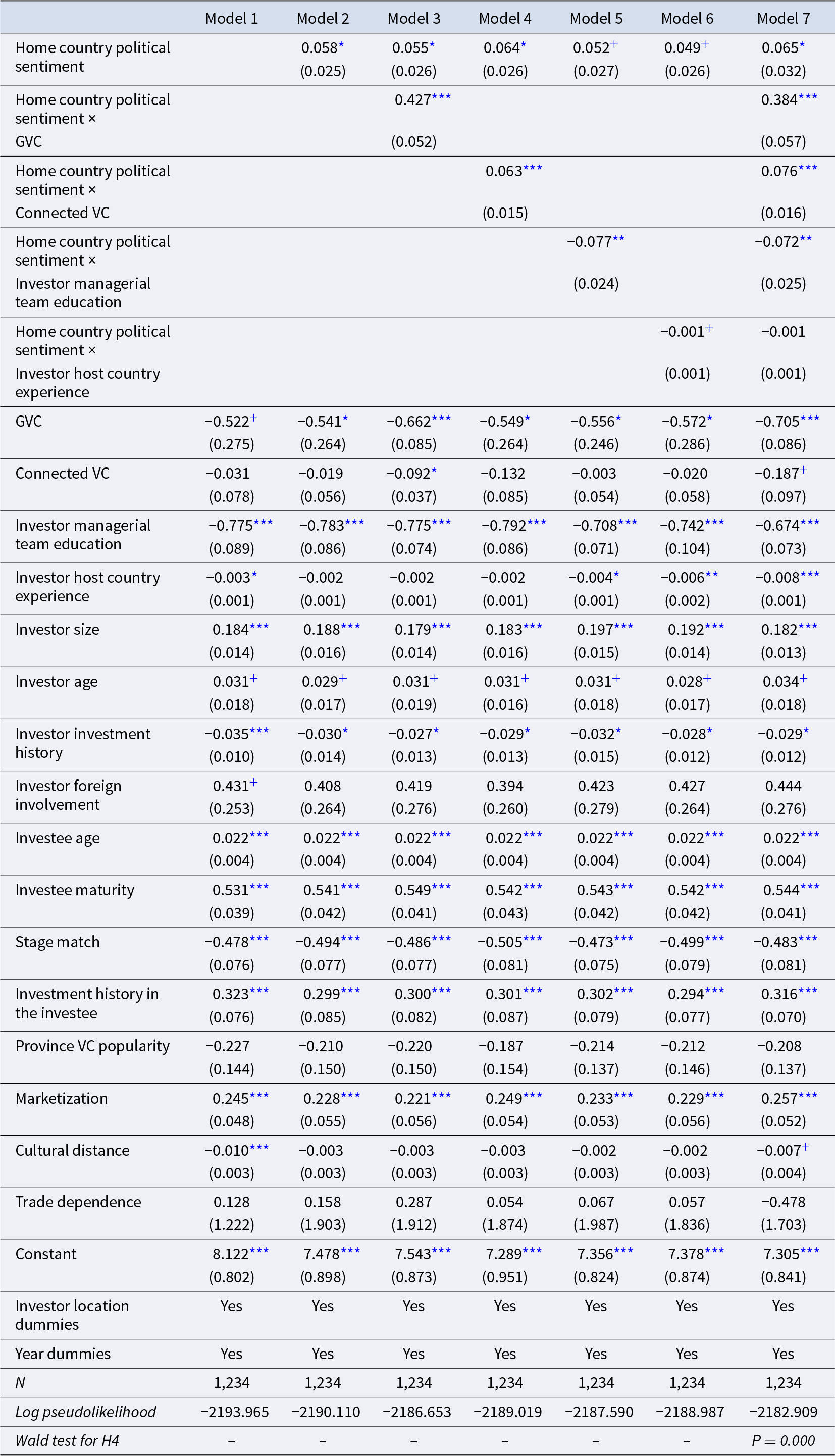
Table 2 Long description
Seven regression models labeled Model 1 through Model 7 report coefficients with robust standard errors in parentheses for cross border investment amount. Home country political sentiment is not reported in Model 1, and is 0.058* with standard error 0.025 in Model 2, 0.055* with 0.026 in Model 3, 0.064* with 0.026 in Model 4, 0.052+ with 0.027 in Model 5, 0.049+ with 0.026 in Model 6, and 0.065* with 0.032 in Model 7. Interaction terms appear in selected models: home country political sentiment with GVC is 0.427*** with 0.052 in Model 3 and 0.384*** with 0.057 in Model 7; home country political sentiment with Connected VC is 0.063*** with 0.015 in Model 4 and 0.076*** with 0.016 in Model 7; home country political sentiment with Investor managerial team education is minus 0.077** with 0.024 in Model 5 and minus 0.072** with 0.025 in Model 7; home country political sentiment with Investor host country experience is minus 0.001+ with 0.001 in Model 6 and minus 0.001 with 0.001 in Model 7. Main effects include GVC from minus 0.522+ with 0.275 in Model 1 to minus 0.705*** with 0.086 in Model 7, Connected VC from minus 0.031 with 0.078 in Model 1 to minus 0.187+ with 0.097 in Model 7, Investor managerial team education from minus 0.775*** with 0.089 in Model 1 to minus 0.674*** with 0.073 in Model 7, and Investor host country experience from minus 0.003* with 0.001 in Model 1 to minus 0.008*** with 0.001 in Model 7. Investor size is 0.179*** to 0.197*** across models, Investor age is 0.028+ to 0.034+, Investor investment history is minus 0.027* to minus 0.035***, and Investor foreign involvement is 0.394 to 0.444 with no significance markers shown. Investee age is 0.022*** in all models, Investee maturity is 0.531*** to 0.549***, Stage match is minus 0.473*** to minus 0.505***, Investment history in the investee is 0.294*** to 0.323***, Province VC popularity is minus 0.187 to minus 0.227, Marketization is 0.221*** to 0.257***, Cultural distance is minus 0.010*** in Model 1 and ranges from minus 0.002 to minus 0.007+ in Models 2 to 7, and Trade dependence ranges from minus 0.478 in Model 7 to 0.287 in Model 3. Constants range from 7.289*** with 0.951 in Model 4 to 8.122*** with 0.802 in Model 1; investor location dummies and year dummies are Yes in all models; N is 1,234 in all models; log pseudolikelihood ranges from minus 2193.965 in Model 1 to minus 2182.909 in Model 7; Wald test for H4 is reported only in Model 7 as P 0.000.
+ Notes: Robust standard errors in parentheses. P < 0.10, * P < 0.05, ** P < 0.01, *** P < 0.001.
Main Results
The regression results are shown in Table 2. Model 1 includes all the control variables. Based on Model 1, Model 2 adds home country political sentiment, and Models 3 and 4 further add the interaction of home country political sentiment with GVC and connected VC, respectively. Models 5 and 6 include the interaction of home country political sentiment with investor managerial team education and investor host country experience, respectively. Model 7 includes all the interaction terms.
In H1, we propose that home country political sentiment is positively related to VC investment amount. From the result in Model 2 of Table 2, we can see the coefficient of home country political sentiment is 0.058 (P = 0.022), with the 95% confidence interval between 0.008 and 0.108. For the economic significance, when home country political sentiment increases by one unit, VC investment amount (untransformed value) increases by 6%. Therefore, a higher level of home country political sentiment can lead to a higher amount of VC investment amount, and H1 is supported.
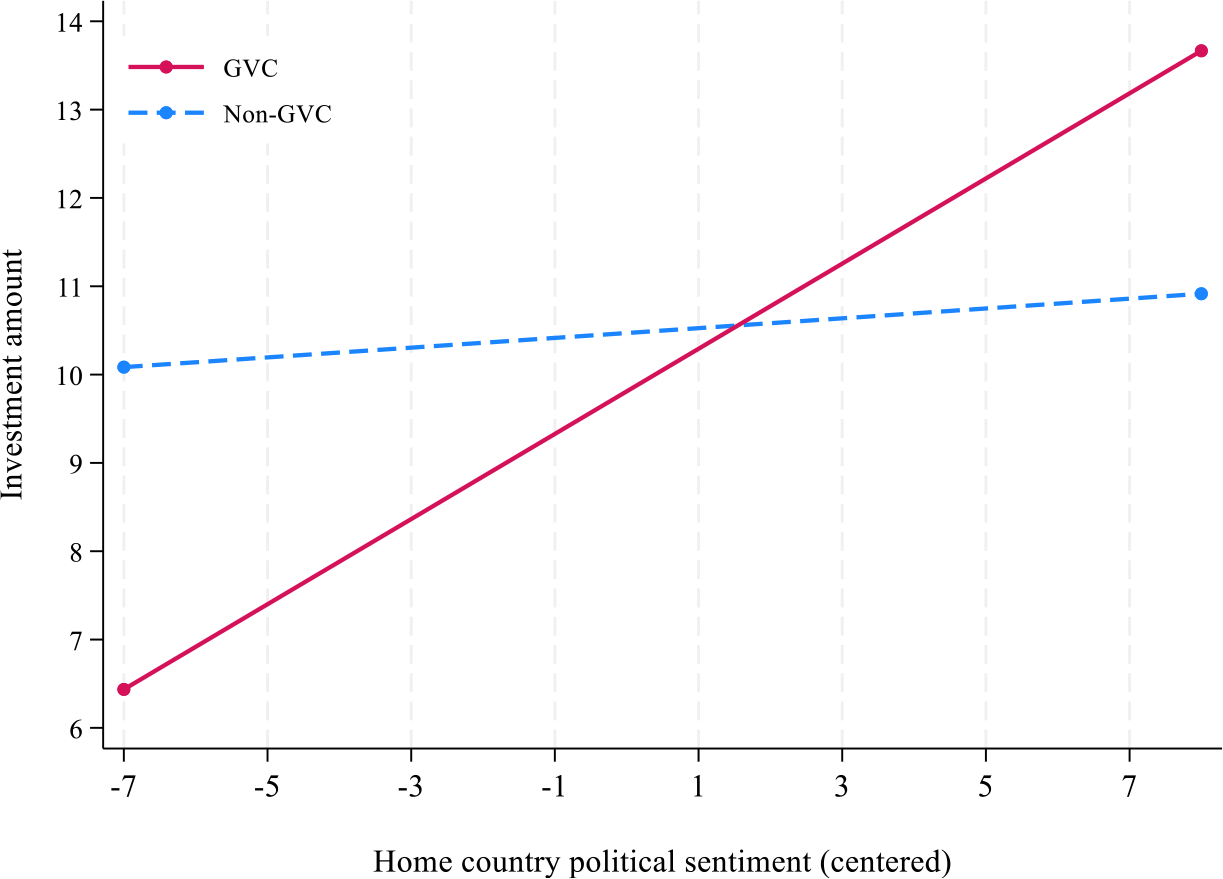
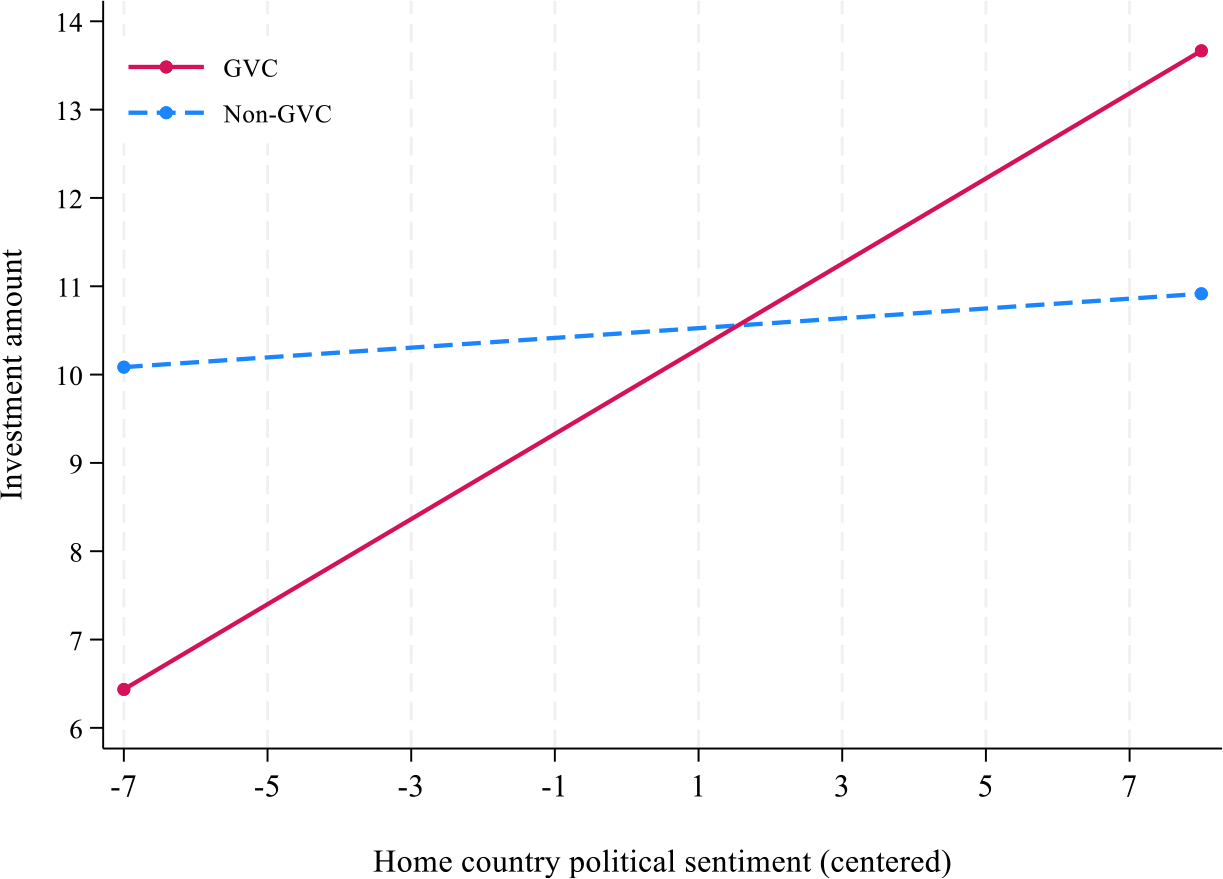
H2 proposes that GVC moderates the relationship between home country political sentiment and VC investment amount. From the result in Model 3, the coefficient of the interaction term of home country political sentiment and GVC is 0.427 (P = 0.000), with the 95% confidence interval between 0.325 and 0.528. This indicates that home country political sentiment has a stronger influence on VC investment amount for GVC firms, which is consistent with our H2. Therefore, H2 is supported. Figure 2 shows the interaction plot of the influence of home country political sentiment on investment amount for GVC firms and non-GVC firms, and we can see that the relationship between home country political sentiment and VC investment amount is stronger for GVC firms. For the economic significance, when home country political sentiment increases by one unit, VC investment amount (untransformed value) increases by 61.9% for GVC firms, as compared to a 5.7% increase for non-GVC firms.
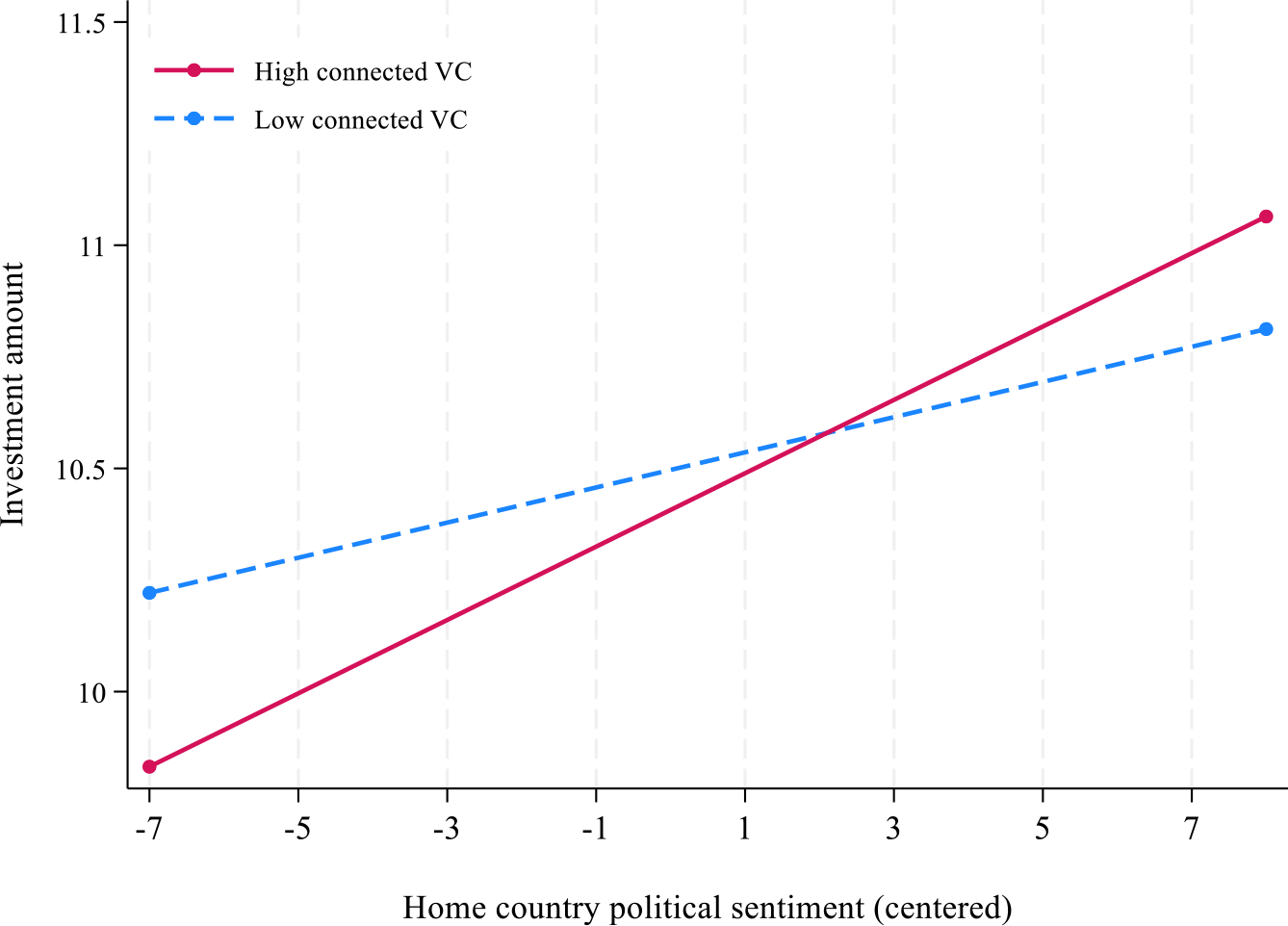
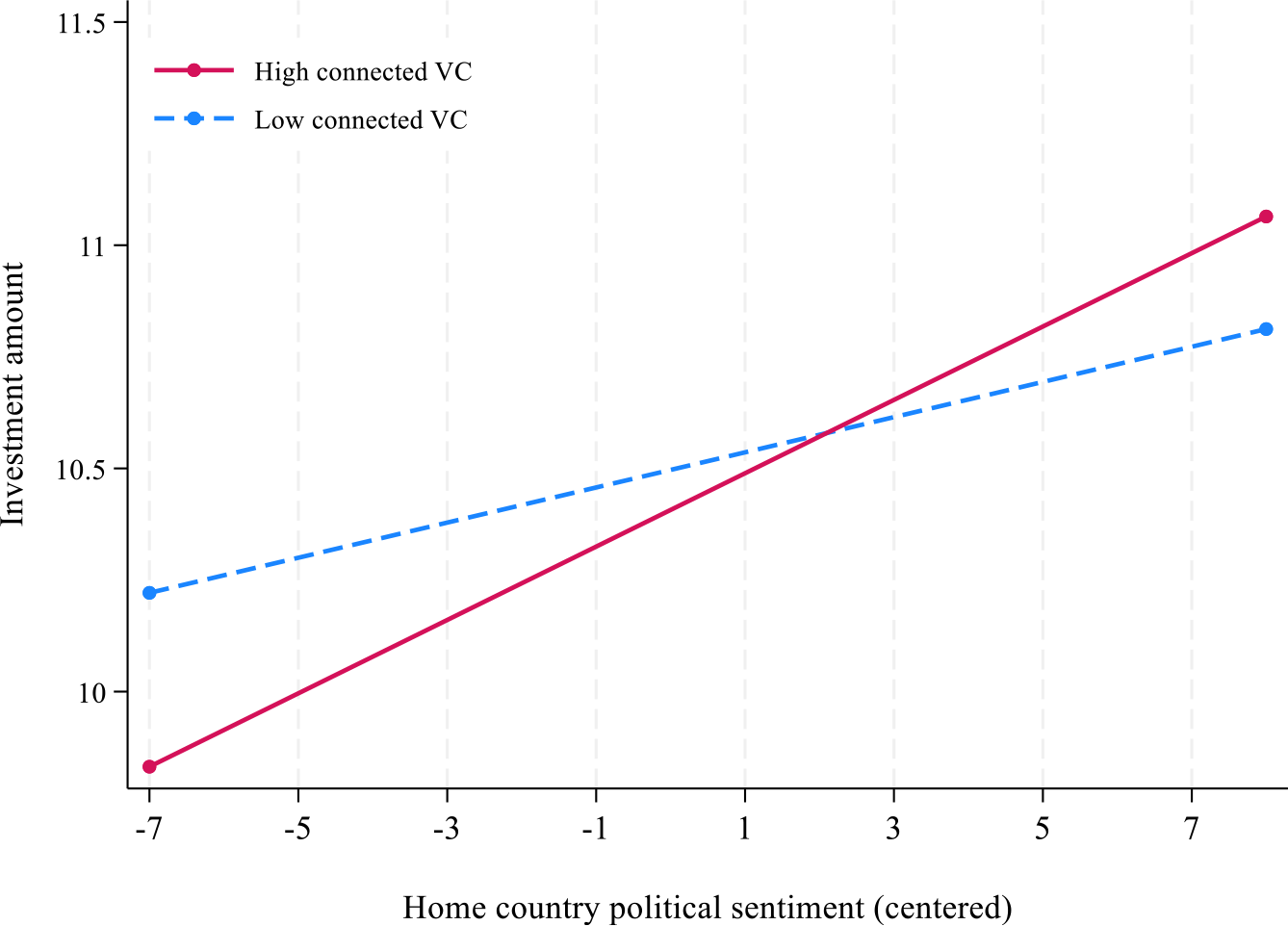
H3 proposes that connected VC moderates the relationship between home country political sentiment and VC investment amount. From the result in Model 4, the coefficient of the interaction term of home country political sentiment and connected VC is 0.063 (P = 0.000), with the 95% confidence interval between 0.033 and 0.092. This indicates that home country political sentiment has a stronger influence on VC investment amount when the investor has more interpersonal political connections, which is consistent with our H3. Therefore, H3 is supported. Figure 3 shows the interaction plot of the influence of home country political sentiment on VC investment amount at a low level (one standard deviation below mean) and a high level (one standard deviation above mean) of connected VC, and we can see that the relationship between home country political sentiment and VC investment amount is stronger for highly connected VC firms. For the economic significance, at the low level of connected VC, when home country political sentiment increases by one standard deviation, VC investment amount (untransformed value) increases by 4%, compared to an 8.6% increase at the high level of connected VC.
Interaction plot for the moderating effect of GVC
Interaction plot for the moderating effect of connected VC
H4 proposes that the moderating effect of GVC is stronger than that of connected VC. We conducted a Wald test to examine the null hypothesis that the coefficient of the interaction term of home country political sentiment and GVC is not significantly different from the coefficient of the interaction term of home country political sentiment and connected VC (Agarwal, Ganco & Ziedonis, Reference Agarwal, Ganco and Ziedonis2009; Li, Hernandez & Gwon, Reference Li, Hernandez and Gwon2019; Rhee & Fiss, Reference Rhee and Fiss2014) in Model 7. Consistent with the hypothesis, the regression coefficient for the interaction term of home country political sentiment and GVC (b = 0.384, P = 0.000) is different from the regression coefficient for the interaction term of home country political sentiment and connected VC (b = 0.076, P = 0.000). The resulting Wald statistic indicates that the moderating effect of GVC is significantly greater (P = 0.000), supporting our H4. We further ran OLS regression and conducted seemingly unrelated estimation (the Stata command is suest) as a robustness test, since this estimation can only be applied after OLS regression. Consistent with the hypothesis, the regression coefficient for the interaction term of home country political sentiment and GVC is significantly different from the regression coefficient for the interaction term of home country political sentiment and connected VC (P = 0.004), also supporting our H4.
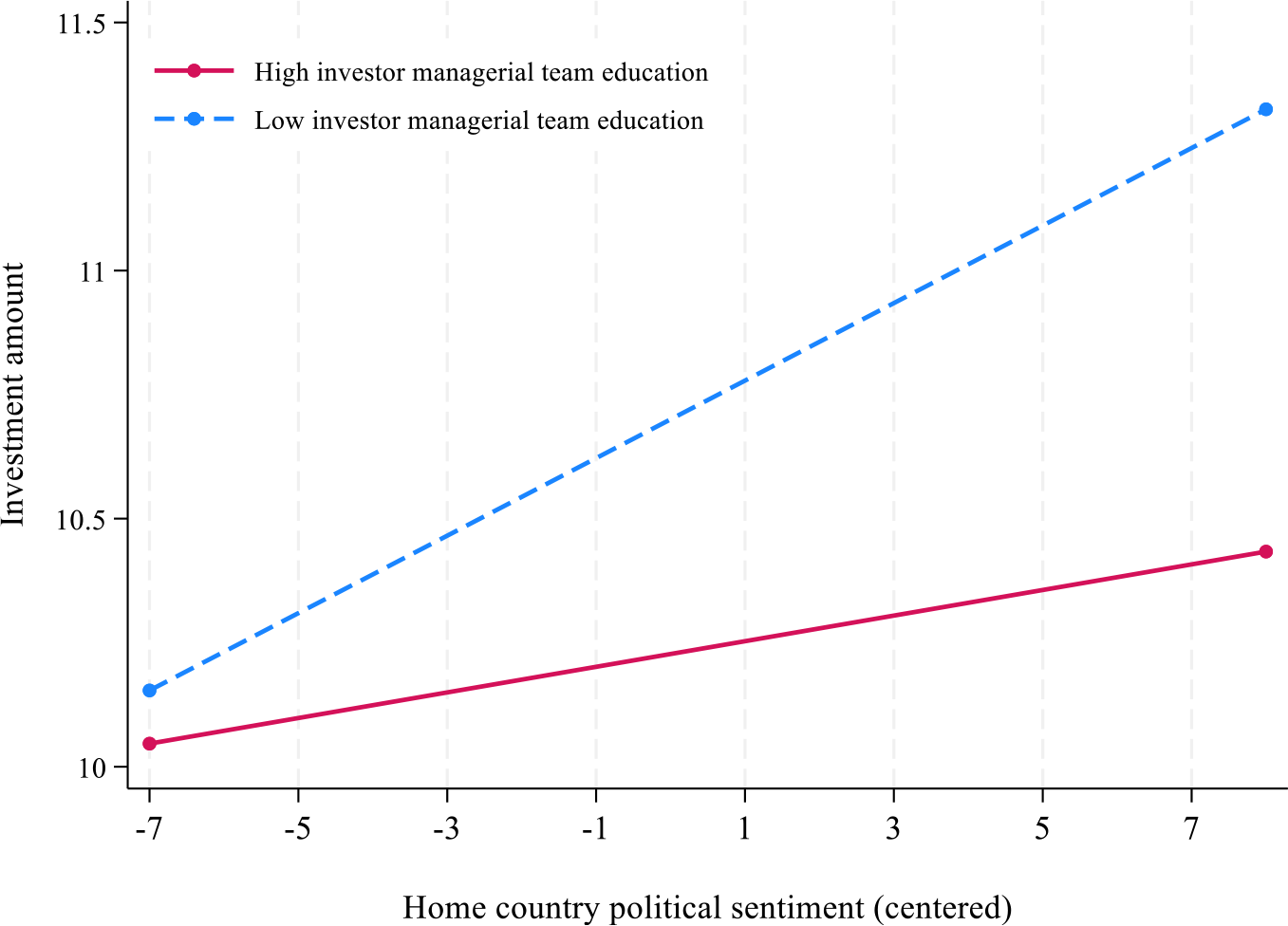
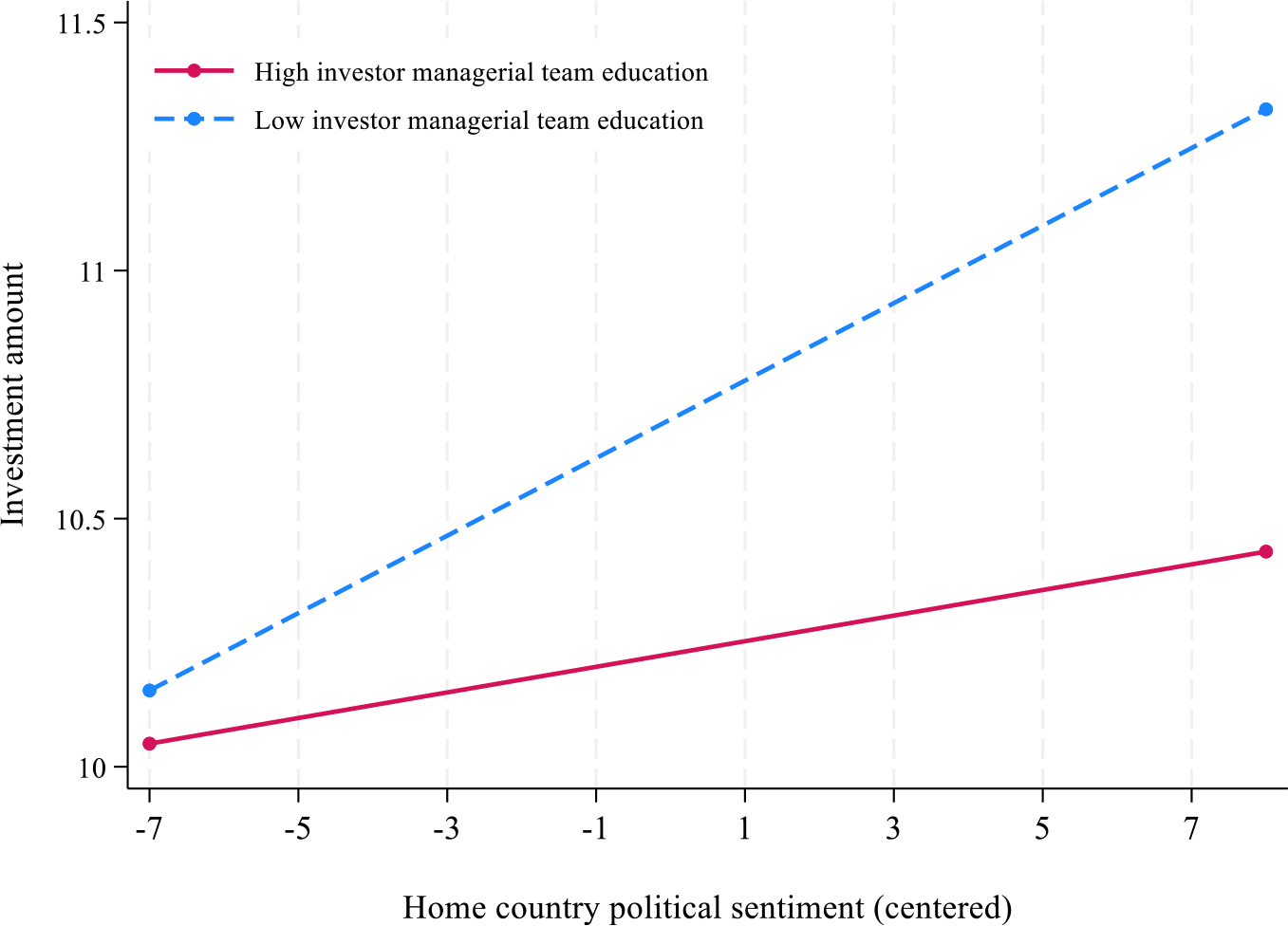
H5 proposes that investor managerial team education moderates the relationship between home country political sentiment and VC investment amount. From the result in Model 5, the coefficient of the interaction term of home country political sentiment and investor managerial team education is −0.077 (P = 0.001), with the 95% confidence interval between −0.125 and −0.030. This indicates that home country political sentiment has a weaker influence on VC investment amount when a larger proportion of top managers have education experience, which is consistent with our H5. Figure 4 shows the interaction plot of the influence of home country political sentiment on VC investment amount at a low level (one standard deviation below mean) and a high level (one standard deviation above mean) of investor managerial team education, and we can see that the relationship between home country political sentiment and VC investment amount is weaker for VC firms that have larger proportions of top managers with education experience. For the economic significance, at the low level of investor managerial team education, when home country political sentiment increases by one standard deviation, VC investment amount (untransformed value) increases by 8.1%, compared to a 2.6% increase at the high level of investor managerial team education.
Interaction plot for the moderating effect of investor managerial team education
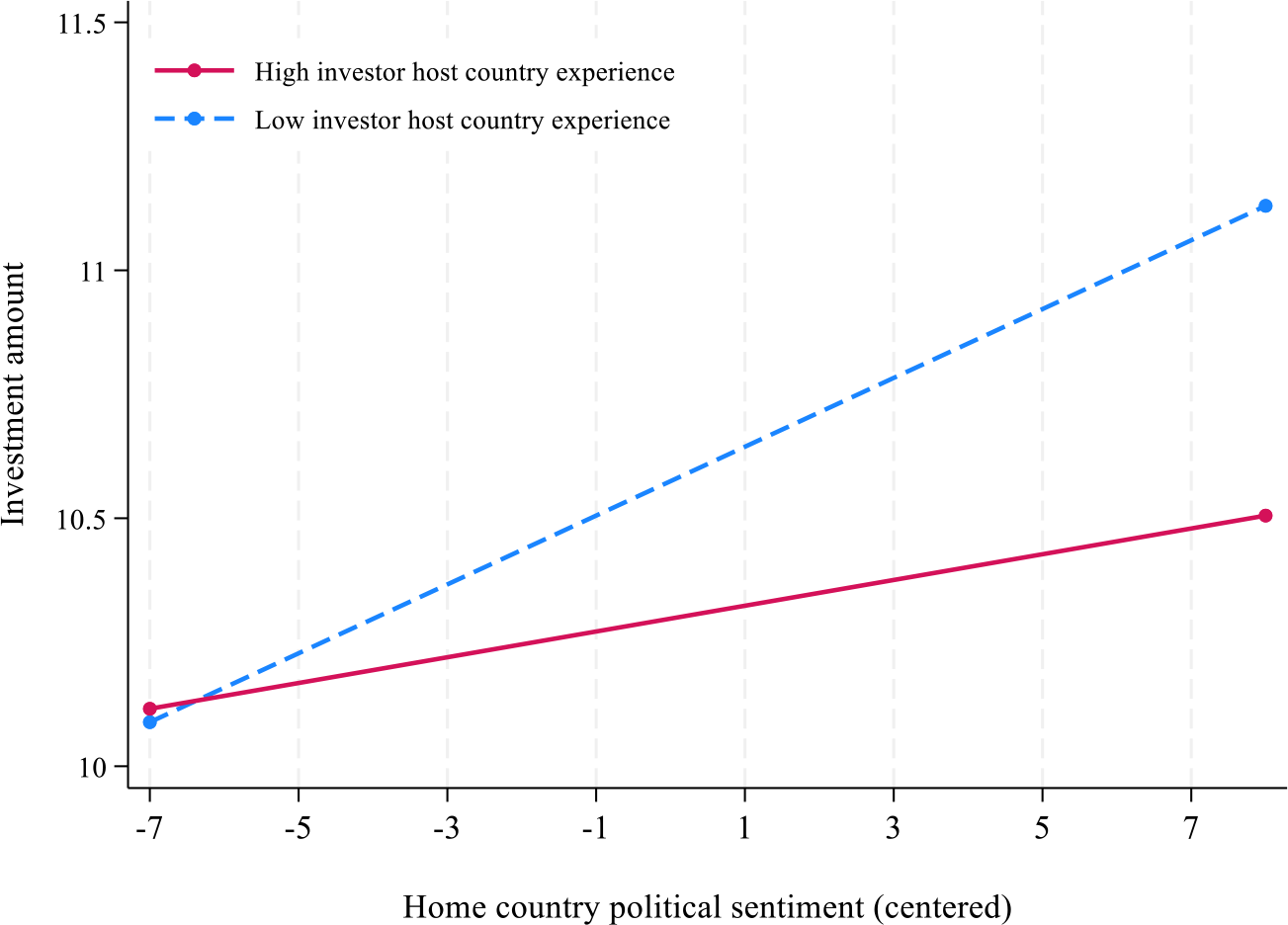
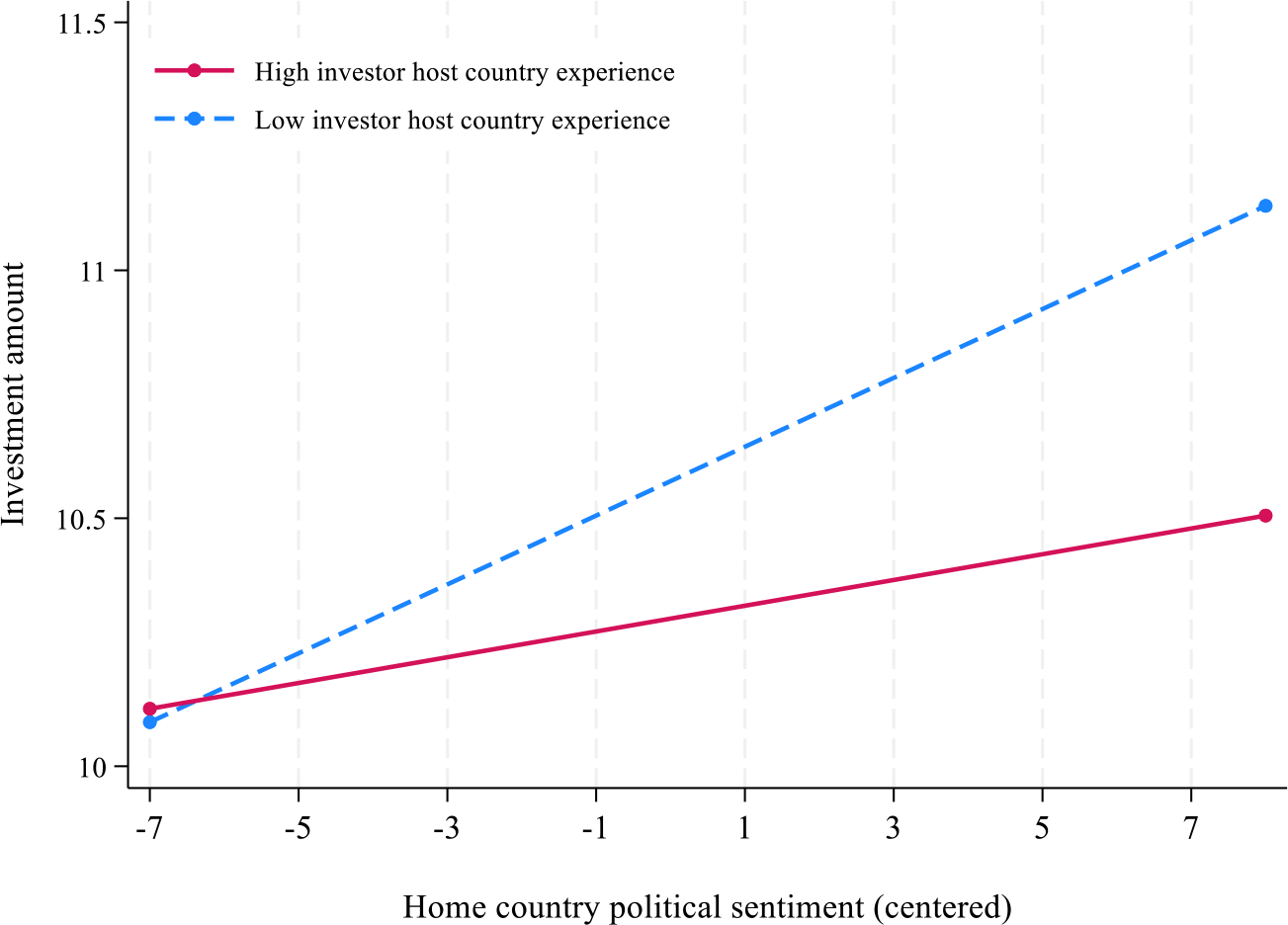
H6 proposes that investor host country experience moderates the relationship between home country political sentiment and VC investment amount. From the result in Model 6, the coefficient of the interaction term of home country political sentiment and investor host country experience is –0.001 (P = 0.069), with the 95% confidence interval between –0.002 and 0.000. This indicates that home country political sentiment has a weaker influence on VC investment amount when the investor has more investor host country experience, which is consistent with our H6. Figure 5 shows the interaction plot of the influence of home country political sentiment on VC investment amount at a low level (one standard deviation below mean) and a high level (one standard deviation above mean) of investor host country experience, and we can see that the relationship between home country political sentiment and VC investment amount is weaker for VC firms with more investor host country experience. For the economic significance, at the low level of investor host country experience, when home country political sentiment increases by one standard deviation, VC investment amount (untransformed value) increases by 7.2%, compared to a 2.6% increase at the high level of investor host country experience.
Interaction plot for the moderating effect of investor host country experience
For the results of the control variables, we found that GVC, investor managerial team education, and investor host country experience, investor investment history, and stage match are negatively related to the amount of cross-border VC investment. The results indicate that GVCs and VCs whose managerial teams are well-educated and who have more investment knowledge will be more cautious when making decisions concerning cross-border investments. One possible reason for the negative influence of investor host country experience might be that as investors gain experience in a particular country, they may become more knowledgeable about what types of investments are more likely to succeed. This learning effect could lead them to be more selective (Killen, Hunt, & Kleinschmidt, Reference Killen, Hunt and Kleinschmidt2008; Nicolosi, Peng, & Zhu, Reference Nicolosi, Peng and Zhu2009), thereby reducing the amount of investment in certain projects. They may also become less blindly optimistic and adopt a more cautious investment strategy (Korniotis & Kumar, Reference Korniotis and Kumar2011), such as reducing the investment amount in individual projects to diversify risks. In addition, consistent with expectation, investor size, investee age, investee maturity, and investment history in the investee, and province marketization level have significantly positive influence on the amount of cross-border VC investment.
Endogeneity
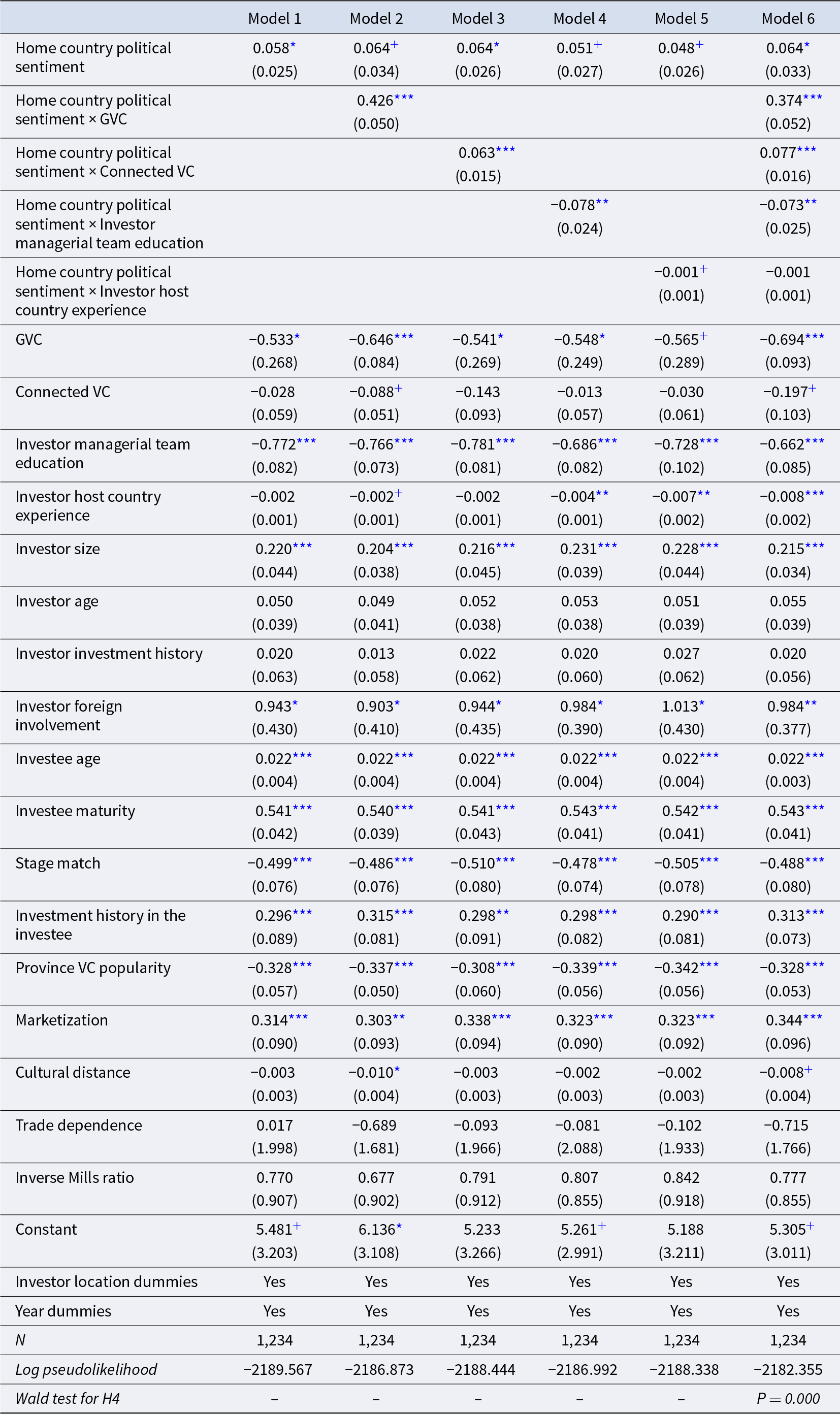
As VC firms need to first decide whether to invest in a foreign country and then decide the amount of cross-border investment, sample selection bias is a potential problem since those that did not have foreign investments are not included in the sample. To deal with such an endogeneity issue, we used a Heckman two-stage model and created a dummy variable, foreign investment, with a value of 1 if the investment is cross-border and 0 otherwise. In the first stage, we used a probit model to run a regression of foreign investment on investor-level control variables. Province average foreign investment, measured as the average times of foreign investments in the province where a VC firm is located (the focal firm is excluded), is included as an exclusion restriction since it should be correlated with whether a firm chooses to invest in a foreign country but should not be correlated with the investment amount in a specific foreign firm. As shown in Table 3, the second-stage models then included the inverse Mills ratio obtained from the first stage as an additional control variable. In Model 1 to Model 6 of Table 3, the coefficients of the inverse Mills ratio are all insignificant, indicating that sample selection bias may not be a major concern in our data. The results of hypothesized variables are consistent with the main results.
Additional analysis to check sample selection bias
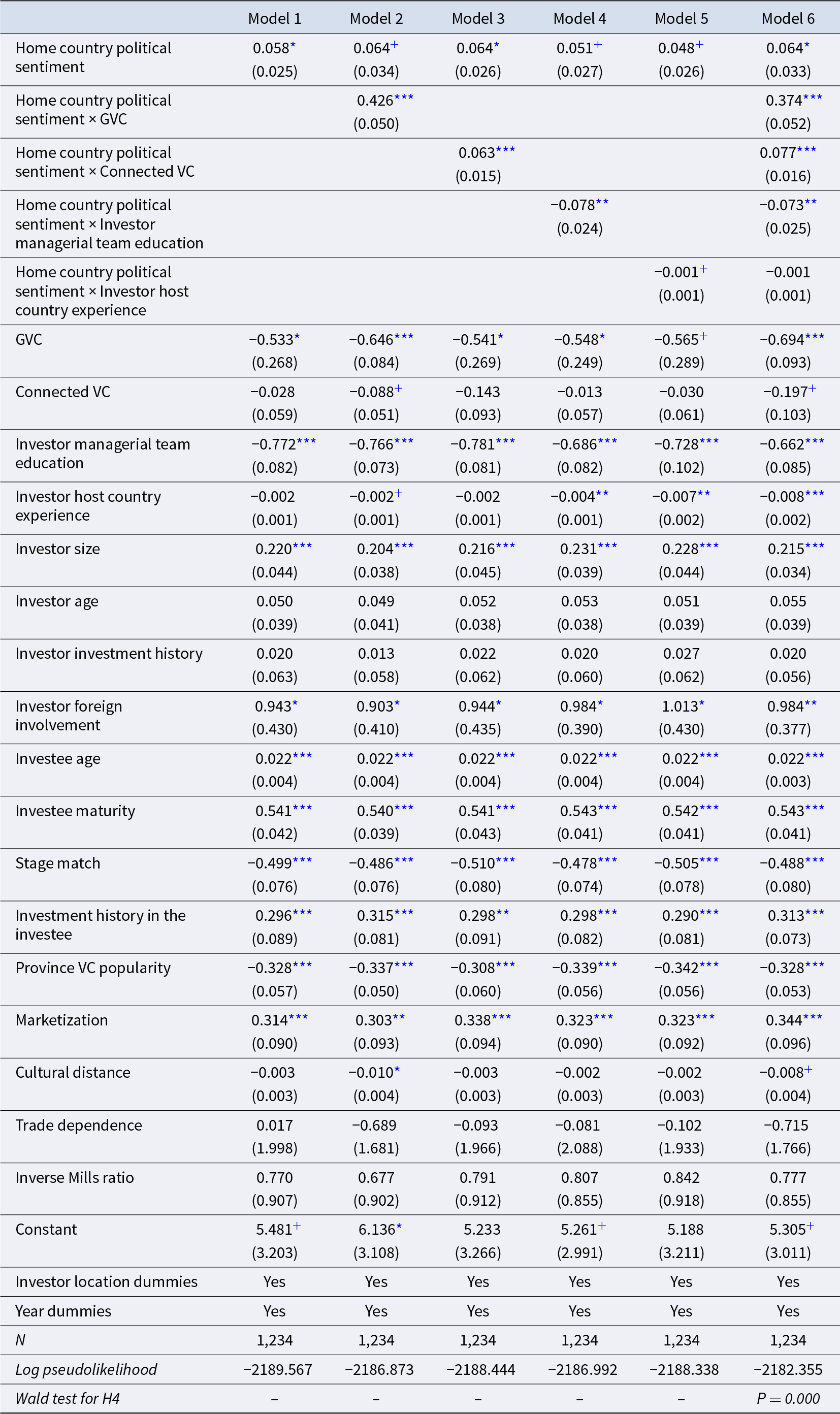
Table 3 Long description
Six regression models labeled Model 1 through Model 6 report coefficients with robust standard errors in parentheses for home country political sentiment and related interaction terms, plus multiple investor, investee, and context controls. Home country political sentiment is 0.058 with a star in Model 1, 0.064 with a plus in Model 2, 0.064 with a star in Model 3, 0.051 with a plus in Model 4, 0.048 with a plus in Model 5, and 0.064 with a star in Model 6. Interaction terms appear in selected models: home country political sentiment times GVC is 0.426 with three stars in Model 2 and 0.374 with three stars in Model 6; home country political sentiment times connected VC is 0.063 with three stars in Model 3 and 0.077 with three stars in Model 6; home country political sentiment times investor managerial team education is minus 0.078 with two stars in Model 4 and minus 0.073 with two stars in Model 6; home country political sentiment times investor host country experience is minus 0.001 with a plus in Model 5 and minus 0.001 with no marker in Model 6. Across models, GVC ranges from minus 0.533 with a star in Model 1 to minus 0.694 with three stars in Model 6, and connected VC ranges from minus 0.028 in Model 1 to minus 0.197 with a plus in Model 6. Investor managerial team education is negative in all models, from minus 0.662 with three stars in Model 6 to minus 0.781 with three stars in Model 3, and investor host country experience ranges from minus 0.002 to minus 0.008 with three stars in Model 6. Investor size is positive in all models, from 0.204 with three stars in Model 2 to 0.231 with three stars in Model 4, while investor age and investor investment history have small positive coefficients without markers across models. Investor foreign involvement is positive in all models, from 0.903 with a star in Model 2 to 1.013 with a star in Model 5; investee age and investee maturity are positive with three stars in all models; stage match is negative with three stars in all models; investment history in the investee is positive with stars in all models; province VC popularity is negative with three stars in all models; marketization is positive with two or three stars in all models; cultural distance is near zero with a star only in Model 2 and a plus in Model 6; trade dependence and inverse Mills ratio have no markers in any model. Investor location dummies and year dummies are Yes in all models; N is 1,234 in all models; log pseudolikelihood ranges from minus 2189.567 in Model 1 to minus 2182.355 in Model 6; the Wald test for H4 is reported only for Model 6 as P equals 0.000.
+ Notes: Robust standard errors in parentheses. P < 0.10, * P < 0.05, ** P < 0.01, *** P < 0.001.
In addition, because our sample only covers 12 countries, many country-level variables are highly correlated with each other or the country-level variables we controlled, and thus cannot be controlled in the main analyses due to multicollinearity, resulting in the possibility of omitted variable bias. We tried to add country-level variables, including institutional distance, cumulative conflicts, and GDP per capital, one by one in the regression models, and the results are largely consistent with our main results. Taking a further step, we conducted the impact threshold of a confounding variable (ITCV) test (Busenbark, Yoon, Gamache, & Withers, Reference Busenbark, Yoon, Gamache and Withers2022), which determines the minimum correlations with an omitted variable required to overturn the results from significant to insignificant (Frank, Reference Frank2000). Our result shows that, to invalidate the inference, 48.33% (596) observations would have to be replaced with cases for which there is an effect of 0. In addition, to invalidate the significant effects of the independent variables, the absolute value of the impact of possible confounding omitted variables must be greater than the absolute value of the ITCV. The impact values of the control variables we include in our regressions are all lower than the absolute value of ITCV (0.0465). This suggests that it is unlikely that there is an omitted variable that would invalidate our findings (Harrison, Boivie, Sharp, & Gentry, Reference Harrison, Boivie, Sharp and Gentry2018; Hubbard, Christensen, & Graffin, Reference Hubbard, Christensen and Graffin2017).
Robustness Tests
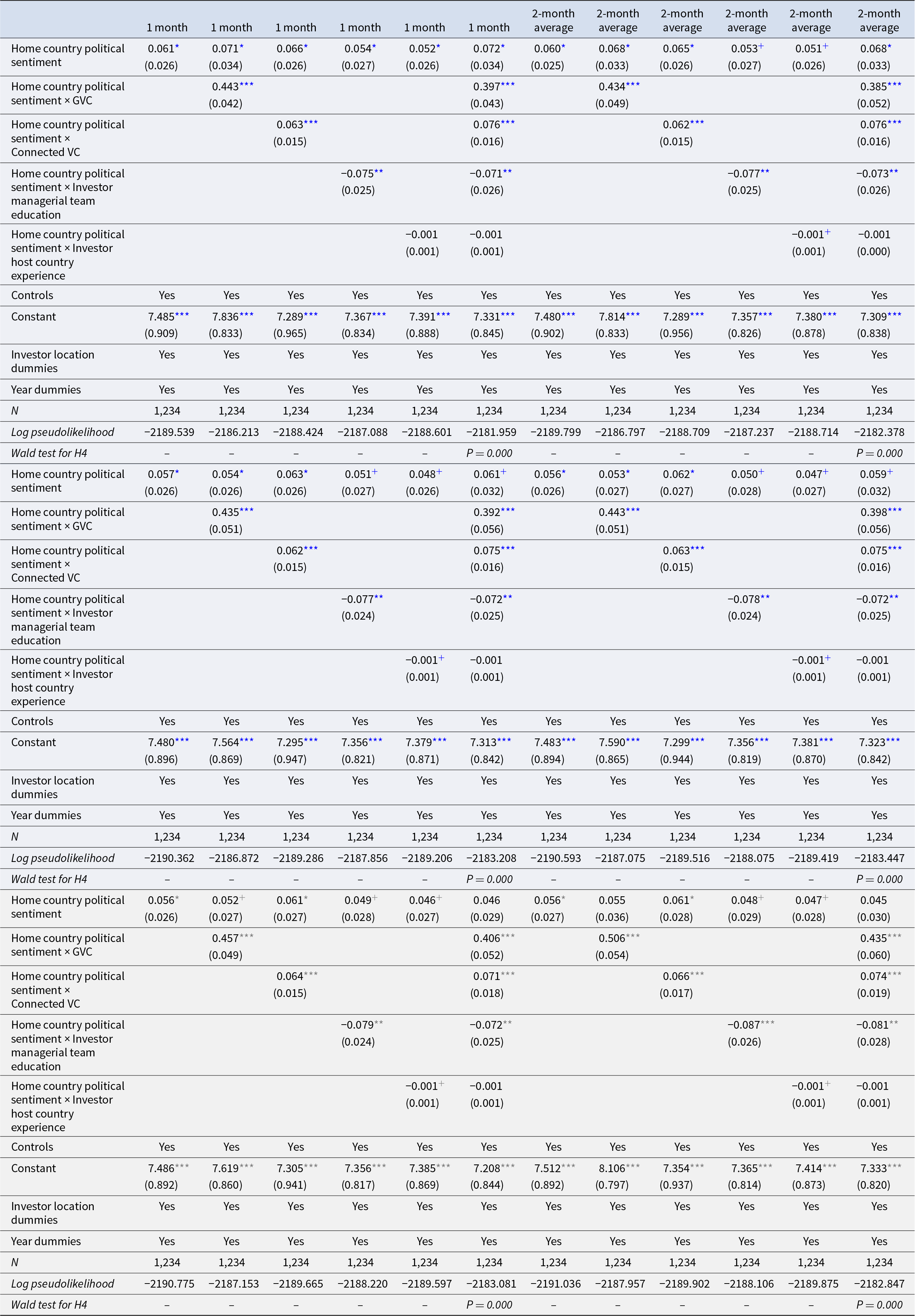
We conducted several additional analyses to check the robustness of our results. First, in the main analysis, we used the average value of political relations index within the prior 3 months to measure home country political sentiment. As a robustness test, we recalculate the variable using different time windows, i.e., the average value of political relations index in prior 1, 2, 4, 5, 6, and 12 months, respectively, and reran the regression models. The results are largely consistent with our main results, providing further support for our hypotheses. Table 4 shows the regression results.
Alternative measure of home country political sentiment using different time windows
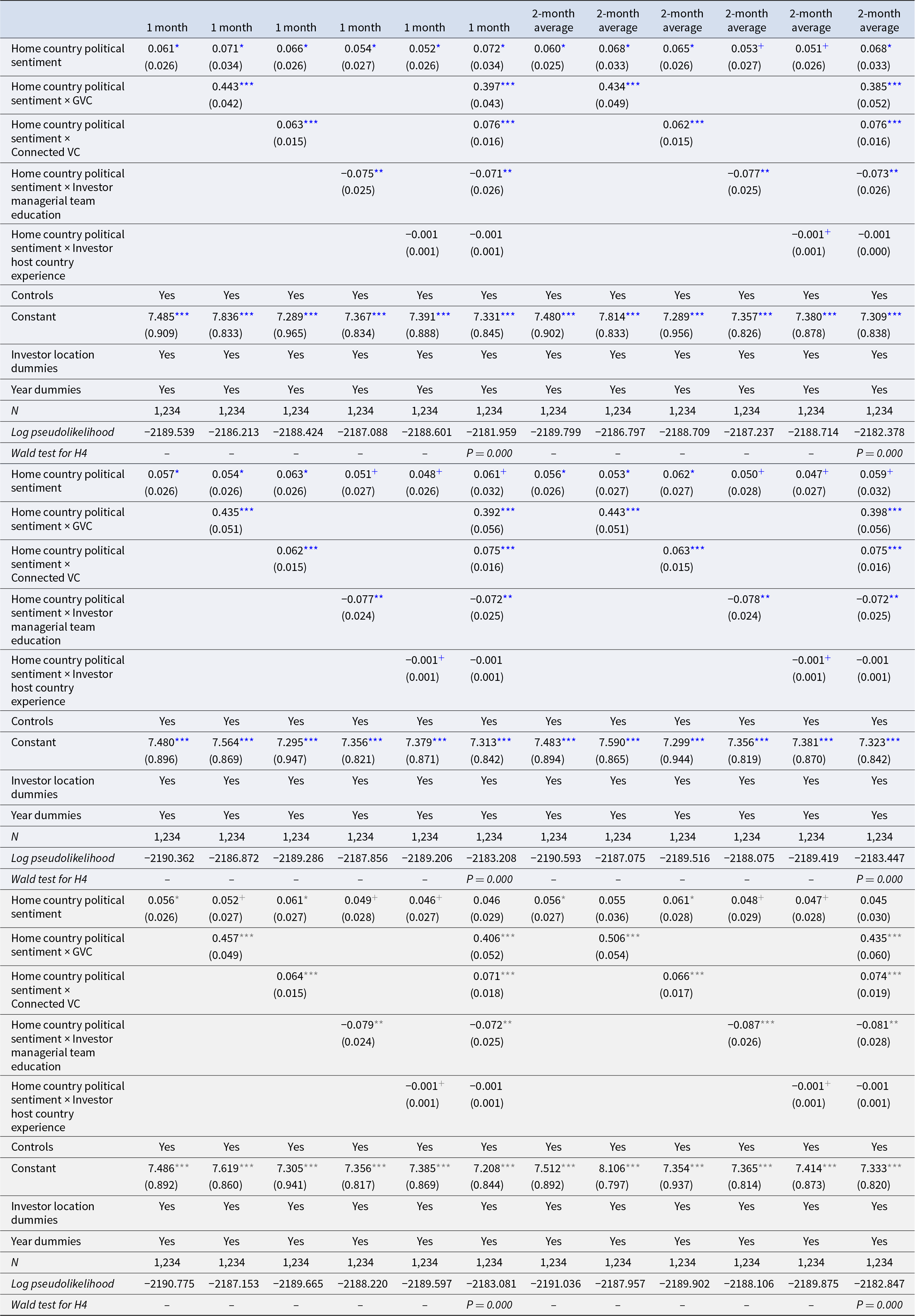
Table 4 Long description
Twelve regression model columns are grouped into six labeled, 1 month, and six labeled, 2 month average. The row, Home country political sentiment, reports coefficients of 0.061 star, 0.071 star, 0.066 star, 0.054 star, 0.052 star, and 0.072 star for the six 1 month columns, with standard errors 0.026, 0.034, 0.026, 0.027, 0.026, and 0.034. For the six 2 month average columns, the same row reports 0.060 star, 0.068 star, 0.065 star, 0.053 plus, 0.051 plus, and 0.068 star, with standard errors 0.025, 0.033, 0.026, 0.027, 0.026, and 0.033. Interaction rows appear only in selected columns: Home country political sentiment times GVC is 0.443 three stars and 0.397 three stars in the 1 month group and 0.434 three stars and 0.385 three stars in the 2 month average group, with standard errors 0.042, 0.043, 0.049, and 0.052. Home country political sentiment times Connected VC is 0.063 three stars and 0.076 three stars in the 1 month group and 0.062 three stars and 0.076 three stars in the 2 month average group, with standard errors 0.015, 0.016, 0.015, and 0.016. Home country political sentiment times Investor managerial team education is negative where reported, at minus 0.075 two stars and minus 0.071 two stars in the 1 month group and minus 0.077 two stars and minus 0.073 two stars in the 2 month average group, with standard errors 0.025, 0.026, 0.025, and 0.026. Home country political sentiment times Investor host country experience is minus 0.001 and minus 0.001 in the 1 month group and minus 0.001 plus and minus 0.001 in the 2 month average group, with standard errors shown as 0.001, 0.001, 0.001, and 0.000. Controls, investor location dummies, and year dummies are marked Yes in every column; N is 1,234 in every column; constants range from 7.289 three stars to 7.836 three stars with standard errors between 0.826 and 0.965; log pseudolikelihood values range from minus 2189.799 to minus 2181.959. Wald test for H4 is shown only in the sixth column of each group, reported as P equals 0.000.
+ Notes: Robust standard errors in parentheses. P < 0.10, * P < 0.05, ** P < 0.01, *** P < 0.001. The detailed coefficient and robust standard errors of control variables are not reported due to space limit.
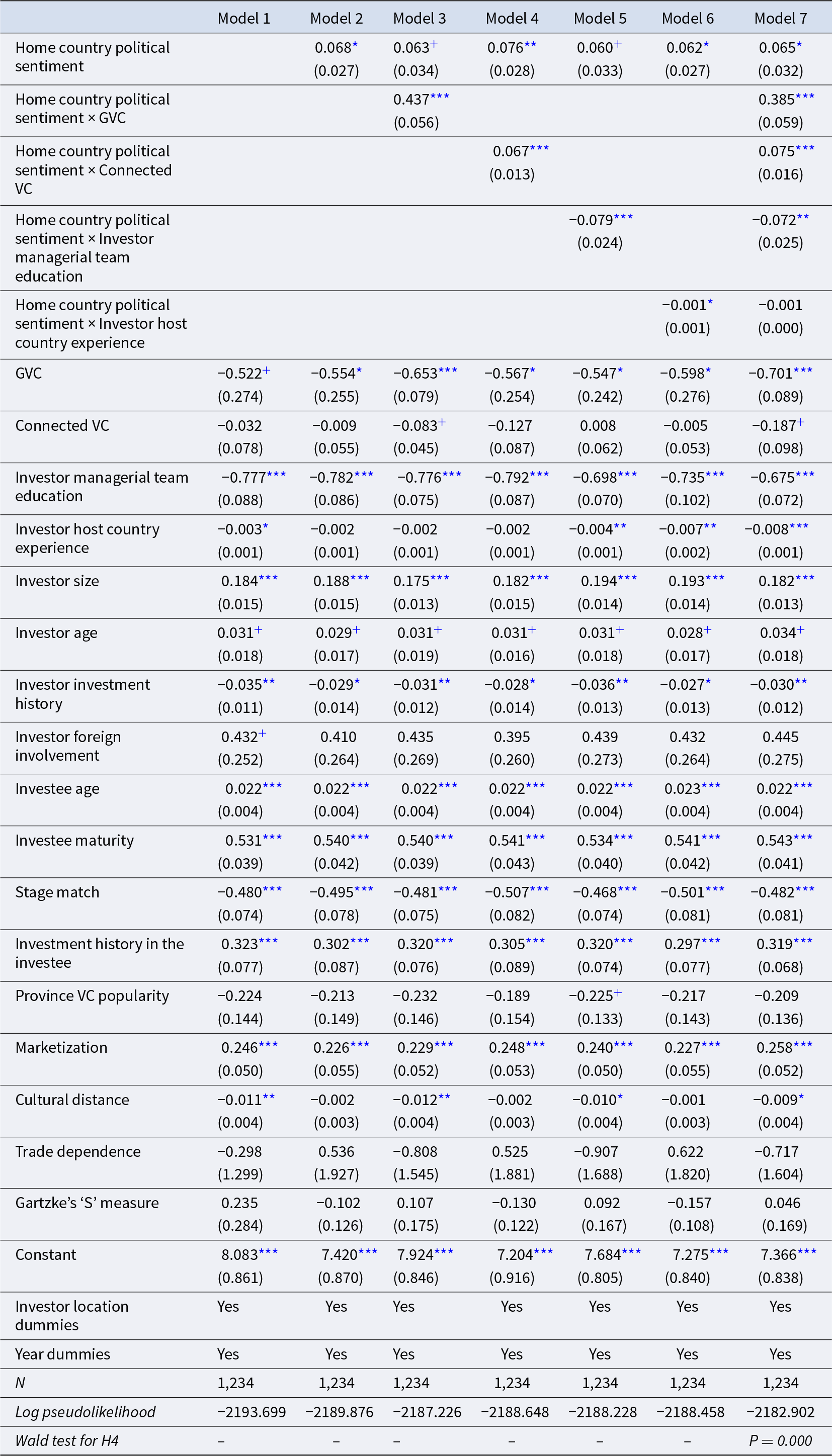
Second, one widely used measure of home country political sentiment in prior studies is Gartzke’s ‘S’ measure calculated using voting records in the United Nations General Assembly (Bertrand et al., Reference Bertrand, Betschinger and Settles2016; Hasija et al., Reference Hasija, Liou and Ellstrand2020). However, this measure is symmetric and mainly reflects objective inter-state interest relations, it cannot well capture subjective national sentiments and researchers cannot differentiate the degrees of home country political sentiment in home and host countries. Moreover, it is calculated on a yearly basis and cannot fully capture the short-term investment decision (Tian, Reference Tian2022). To exclude the possible influence of bilateral relations, we included this measure as an additional control variable. The regression results shown in Table 5 are consistent with our main results.
Including Gartzke’s ‘S’ measure as an additional control variable
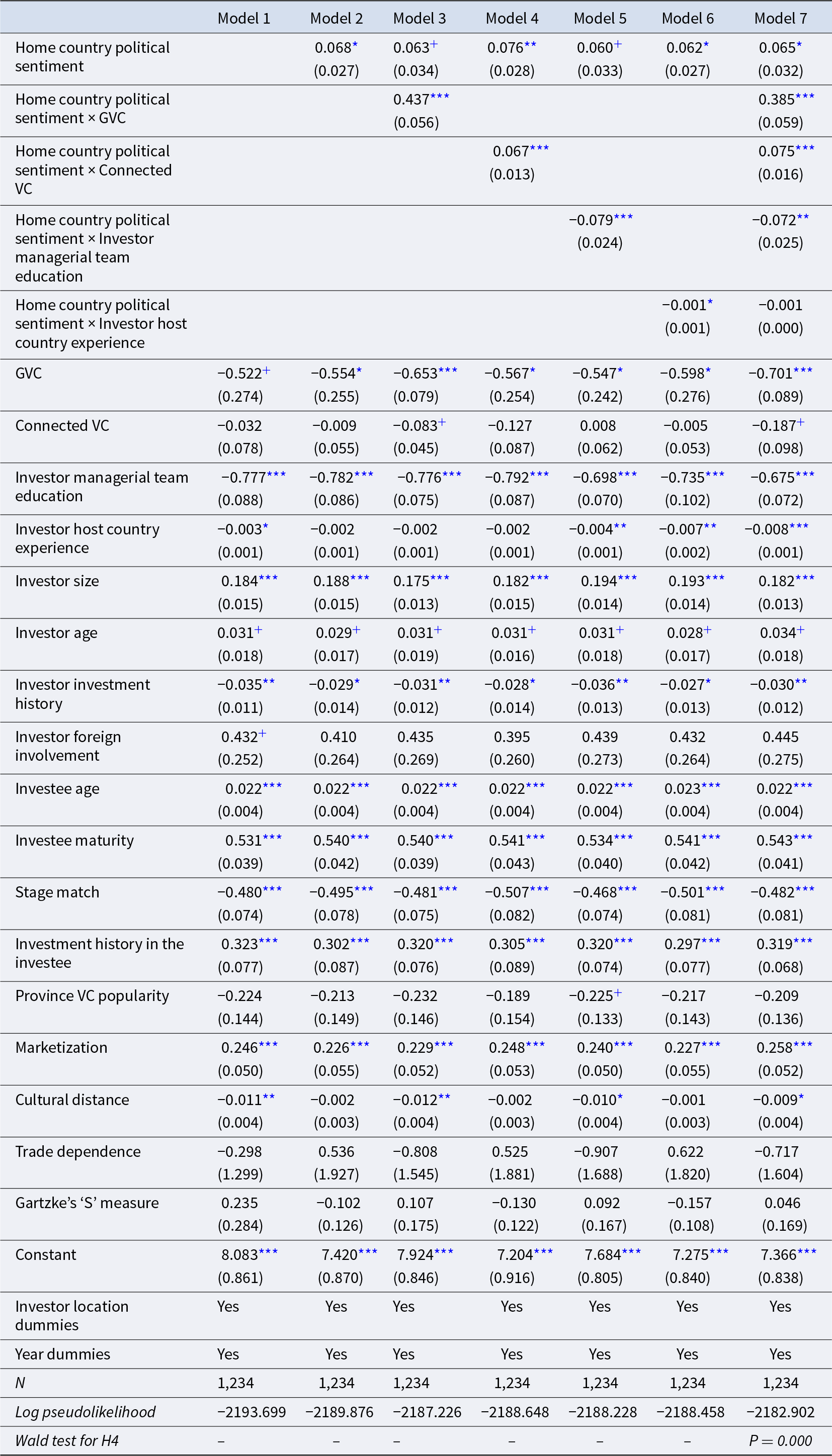
Table 5 Long description
Seven regression models labeled Model 1 through Model 7 report coefficients with robust standard errors in parentheses for investor, investee, and country level variables. Home country political sentiment appears from Model 2 onward with coefficients 0.068* in Model 2, 0.063+ in Model 3, 0.076** in Model 4, 0.060+ in Model 5, 0.062* in Model 6, and 0.065* in Model 7, with standard errors 0.027, 0.034, 0.028, 0.033, 0.027, and 0.032. Interaction terms are included selectively: Home country political sentiment with GVC is 0.437*** in Model 3 and 0.385*** in Model 7, with standard errors 0.056 and 0.059; Home country political sentiment with Connected VC is 0.067*** in Model 4 and 0.075*** in Model 7, with standard errors 0.013 and 0.016; Home country political sentiment with Investor managerial team education is minus 0.079*** in Model 5 and minus 0.072** in Model 7, with standard errors 0.024 and 0.025; Home country political sentiment with Investor host country experience is minus 0.001* in Model 6 and minus 0.001 in Model 7, with standard errors 0.001 and 0.000. Main effects include GVC, negative in all models from minus 0.522+ in Model 1 to minus 0.701*** in Model 7; Connected VC ranges from minus 0.032 to minus 0.187+; Investor managerial team education is negative and marked in all models from minus 0.792*** to minus 0.675***; Investor host country experience is negative from minus 0.003* to minus 0.008***. Investor size is positive and marked in all models from 0.175*** to 0.194***, and Investor age is 0.028+ to 0.034+; Investor investment history is negative and marked from minus 0.027* to minus 0.036**. Investee age and Investee maturity are positive and marked in all models, while Stage match is negative and marked in all models; Investment history in the investee is positive and marked in all models. Province VC popularity is negative in all models with one marked value, minus 0.225+ in Model 5; Marketization is positive and marked in all models; Cultural distance is negative and marked in Models 1, 3, 5, and 7; Trade dependence varies in sign and is unmarked in all models; Gartzkes S measure is unmarked in all models. Investor location dummies and Year dummies are Yes in every model; N is 1,234 for all models; Log pseudolikelihood ranges from minus 2193.699 in Model 1 to minus 2182.902 in Model 7; Wald test for H4 is reported only in Model 7 as P 0.000.
+ Notes: Robust standard errors in parentheses. P < 0.10, * P < 0.05, ** P < 0.01, *** P < 0.001.
Discussion
Although many studies have investigated the influence of country-level relations sentiments on cross-border deals such as acquisition, alliance, and joint venture (e.g., Arikan & Shenkar, Reference Arikan and Shenkar2013; Bilgili et al., Reference Bilgili, Bilgili, Allen, Loncarich, Kedia and Johnson2023; Li et al., Reference Li, Arikan, Shenkar and Arikan2020), few have focused on the role of home country sentiments in VC cross-border investment which is unique in that investors not only provide capital but also play an active role in shaping the strategic direction of the ventures they support. Using a sample of Chinese VC firms’ overseas investment, this study examines how home country political sentiment influences cross-border investment amount in the host country. The results show that home country political sentiment is positively associated with cross-border investment amount. Furthermore, this article investigates the contingency factors of two groups of investor-side contingency factors that represent sentiment transmission and sentiment suppression respectively. We find that GVC and connected VC strengthen the relationship between home country political sentiment and cross-border investment amount, while investor managerial team education and investor host country experience weaken the relationship between home country political sentiment and cross-border investment amount. Furthermore, we found that the strengthening effect of GVC is stronger than that of connected VC.
Theoretical Implications
This study provides several important theoretical implications. First, this paper zooms in on home country political sentiment to examine the impact of country-level sentiments on VC cross-border investment, a promising research area that has been largely overlooked thus far. Due to the cascading effects of global systems and environmental change, country-level sentiments have a considerable impact on firm strategic decisions and performance (Petricevic & Teece, Reference Petricevic and Teece2019). Prior scholars have shed considerable light on how country-level relations and sentiments can exert influence on country-level FDI flow as well as firm-level strategies such as cross-border alliance, M&A, and location choice (e.g., Li et al., Reference Li, Meyer, Zhang and Ding2018). However, our knowledge of the association of informal institutions such as generalized social sentiments with VC firms’ perception, evaluation, and subsequent behavioral preference regarding small foreign startups remains limited. By introducing home country political sentiment, which is an essential environmental cue and consideration (Stockmann & Gallagher, Reference Stockmann and Gallagher2011; Tian, Reference Tian2022), and studying its influence on VC investment, this article enriches our understanding of the consequences of home country political sentiment and contributes to the literature on country-level relations and sentiments.
Second, this study contributes to the burgeoning literature on cross-border VC investments. Departing from most studies in this research area which underscore the formal institutions as determinants of cross-border VC investments (e.g., Aizenman & Kendall, Reference Aizenman and Kendall2012; Guler & Guillen, Reference Guler and Guillen2010a), we focused on one informal dimension of institutions between home and host countries (Devigne et al., Reference Devigne, Manigart, Vanacker and Mulier2018). We extend prior work that emphasized the formal institutions which create innovative opportunities, protect investors’ rights, and guarantee regulatory stability (Balcarcel et al., Reference Balcarcel, Hertzel and Lindsey2010), by investigating the salient role of country-level sentiments in the flow of VCs across borders. In particular, our findings about the importance of informal institutions can help advance extant research on cross-border differences in VC behavior. Prior research has predominantly focused on how VCs calibrate their decision processes and evaluation criteria when making cross-border investments by examining the features of the institutional environment (Cumming, Filatotchev, Knill, Reeb, & Senbet, Reference Cumming, Filatotchev, Knill, Reeb and Senbet2017; Guler & Guillen, Reference Guler and Guillen2010a). These studies, however, do not take into account the socialized perspective that may represent when VCs systematically avoid funding potentially attractive ventures just because they are located in a country with a poor relationship with their home country, thus resulting in an insufficient emphasis on the impact of informal institutions. While prior research has highlighted the role of informal institutions such as cultural differences (e.g., Dai & Nahata, Reference Dai and Nahata2016) in shaping local VCs’ cross-border investments, the underlying mechanism primarily operates through rational, calculative-based trust driven by coordination and communication costs. In contrast, our study focuses on how political sentiment influences VCs’ cross-border investments through irrational, affect-based trust. Our theoretical argument and empirical results provide evidence that VCs may avoid investing large amounts in countries with poor relationships with their home countries in the first place, and those country relations may influence the attractiveness of a country for VCs and their confidence. As such, it can be readily used to calculate the extent that a cross-border VC will fund a venture in a country with a close or distant relationship with the focal VC’s home country.
In addition, although our context is specific to China, our findings have the potential to be generalized in other countries, due to the fact that our theoretical contentions are predominantly derived from the logic grounded in the trust literature which is a universally present concept across countries. One of the distinctive aspects of our research lies in the exploration of the GVC and connected VC which may be more closely tied to our Chinese VC context. But the theoretical underpinnings, i.e., sentiment transmission and suppression can be utilized to comprehend diverse types of VCs in other countries. For instance, the US–China trade war triggers the increasing state-backed VC funds to boost technology development, and these state-backed VC funds have a direct influence on how US VCs should be operated. By applying this framework, scholars can gain deeper insights into the dynamics of VC operations, not only in the context of trade-related pressures but also in other country-specific scenarios where sentiment-related factors play a role in shaping VC strategies and outcomes.
Third, despite the extensive literature on trust, which serves as a crucial lens for understanding both individual and organizational behaviors (Legood et al., Reference Legood, Van der Werff, Lee, den Hartog and van Knippenberg2023), prior research has predominantly examined trust as a reflection of intrinsic preferences and characteristics (Tenzer et al., Reference Tenzer, Pudelko and Harzing2014; Zaheer et al., Reference Zaheer, Hernandez and Banerjee2010). This perspective has led to studies that explore trust-related differences between countries, such as comparisons between Chinese and American managers (Chua et al., Reference Chua, Morris and Ingram2009), as well as the outcomes of employees’ trust in team leaders (Costigan, Insinga, Berman, Kranas, & Kureshov, Reference Costigan, Insinga, Berman, Kranas and Kureshov2011). Those works have looked at trust from a more static view, often treating it as an enduring trait rather than a responsive construct to external forces and environmental changes. However, trust is not inherently stable and can vary with context. To deepen our understanding, this study investigates how trust influences cross-border investment decisions in contexts of heightened geopolitical tension. We also examine how this relationship varies depending on the characteristics of VCs and managers. By addressing these questions, we aim to provide a more nuanced understanding of how trust operates within international business frameworks, particularly when external factors complicate traditional trust-building mechanisms.
Practical Implications
This study yields several implications for practice. First, VCs should pay close attention not only to the deal information specific to their cross-border investments, but also to country-level relational dynamics. Our research highlights that country relations between home and host countries play an important role in cross-border VCs’ investment decision-making and evaluation criteria. When a foreign VC undergoes a cross-border investment, country relations can actively shape the investment activities by affecting the focal VC’s perception of uncertainty and risk and the functioning and structure of the focal investment. In this sense, VCs should pay much attention to the influence of country-level relational dynamics and be prepared for the potential evolution of such relations to better manage their cross-border VC investment activities.
Second, as for policy implications, our research indicates that attempts by governments to develop and sustain a good relationship with foreign countries can be a key component of their overall strategies aimed at innovating their entrepreneurial ecosystem. The increased tendency of VC investors from developing markets (e.g., China) to invest in other developing markets and more developed countries merits further attention from policymakers in their attempt to upgrade their formal and informal institutions. Other countries may emulate this attempt by designing and implementing policy initiatives aimed at attracting foreign investors.
Limitations and Future Directions
This study has some limitations that could be addressed by further studies. First, the role of home country political sentiment may vary across different institutional contexts, yet this article only empirically tested China’s political sentiment toward other countries. Future scholars can incorporate the national sentiment of multiple countries and study the distinctions of the role of home country political sentiment in heterogeneous institutional contexts. In addition, due to data limitations, our sample only covers 12 host countries. Utilizing textual data to develop a more comprehensive measure of China’s political sentiment and studying its influence on cross-border investment is also a promising research direction. Moreover, this article focuses on home country sentiment without taking host country sentiment into consideration. Future research can measure political sentiment in each country to incorporate both home and host country sentiments.
Second, this article only investigates the influence of government’ sentiment on cross-border VC investment, and does not directly measure investors’ own sentiments. We also do not consider the sentiment of other home country stakeholders. Will the influence of investors’ own sentiment be different from that of government’s sentiment? How does the sentiment of other stakeholders, such as interest groups, employees, and the local community, influence VC investment decisions? These questions are also worthy of exploration.
In addition, due to limitations in data availability, this article employs archival data and cannot measure the influencing mechanism directly. Future studies can employ different research methods, such as case studies, experiments, and survey studies, to capture affect-based trust and empirically test the underlying mechanism.
Conclusion
This study conceptualizes home country political sentiment as an important dimension of informal institutions that matter for cross-border VC investments. We investigate how sentiment plays a role in influencing VC cross-border investment process. In particular, we show that home country political sentiment can significantly influence investors’ affect-based trust and perception toward the investees, and thus influence the amount of VC cross-border investment. Furthermore, our study suggests that the role of home country political sentiment is contingent on factors that represent sentiment transmission and sentiment suppression. Our study offers an attempt to disentangle the influences of informal institutional factors on VC foreign market entry decisions, and serves as a touchstone for further theoretical refinement on the linkage between country-level sentiment and firm-level strategic decisions.
Data availability
The data that support the findings of this study are available from the corresponding author upon reasonable request.
Acknowledgements
This study was partially supported by grants from the National Natural Science Foundation of China (Grants No. 72202157; 72091311; 72102127; 72102003; 72102184), and the Humanities and Social Science Project of the Ministry of Education of China (Grant No. 21YJC630128).
Chenjing Wang (chenjingwxy@stu.pku.edu.cn & 2101111023@gsm.pku.edu.cn) is a PhD candidate in strategic management at Guanghua School of Management, Peking University, China. Her research interests include international business, corporate social responsibility, and corporate governance.
Xiaocong Tian (tian.xiaocong@sdu.edu.cn) is an associate professor in the School of Management at Shandong University. She received her PhD from the Chinese University of Hong Kong. Her current research focuses on nationalist sentiment, rhetorical strategies, and corporate governance. She is exploring these issues in the context of emerging markets, particularly in China
Li Tong (litong2020@gsm.pku.edu.cn) is an assistant professor of management at the Guanghua School of Management, Peking University, China. His research interests include corporate social responsibility and corporate M&A strategy. He has published in the Academy of Management Journal, Strategic Management Journal, and Journal of Business Ethics.
Yingzhao Xiao (yingzhao@tju.edu.cn) is an associate professor in the College of Management and Economics at Tianjin University. He received his PhD from the Chinese University of Hong Kong. His research interests relate primarily to entrepreneurship, organization theory, and macro-organizational behavior.
Ying Zhang (zhangyingmgt@nwpu.edu.cn) is an associate professor of management at Northwestern Polytechnical University, China. She received her PhD from Hong Kong Baptist University. Her current research focuses on ESG and corporate internationalization.