Introduction
Anhedonia, a key feature of major depressive disorder (MDD), is a multi-faceted symptom comprised of various constructs with distinct neurobiological mechanisms. Anhedonic adults may experience reduced motivation to work for rewards (i.e. motivational anhedonia), derive weaker pleasure when imagining or looking forward to a reward (i.e. anticipatory anhedonia), and/or enjoy rewarding activities less than before (i.e. consummatory anhedonia) (Treadway & Zald, Reference Treadway and Zald2011). Of these, motivational anhedonia is the least understood.
Operationally, motivation can be defined as one's willingness to overcome the effortful costs in pursuit of rewards (Husain & Roiser, Reference Husain and Roiser2018). This definition emerged from a rich literature in non-human animals, which measured how much physical effort an animal is willing to allocate to obtain a reward (Chong, Bonnelle, & Husain, Reference Chong, Bonnelle and Husain2016; Salamone & Correa, Reference Salamone and Correa2012). For example, in the classic T-maze paradigm, rodents are trained to decide between one arm that provides more food pellets but require high-effort to climb over a tall barrier v. another arm that has fewer food pellets but is unobstructed (Salamone, Correa, Yang, Rotolo, & Presby, Reference Salamone, Correa, Yang, Rotolo and Presby2018). Based on the ‘effort-discounting’ principle, animals generally find effort aversive and devalue rewards available by the effort costs required to obtain them (Walton, Kennerley, Bannerman, Phillips, & Rushworth, Reference Walton, Kennerley, Bannerman, Phillips and Rushworth2006). Therefore, choices could be used as a proxy for motivation, such that a more motivated animal would choose to invest more effort than a less motivated animal for the same amount of reward. Inspired by the wealth of preclinical studies, advances in our understanding of human motivation have also been made within the framework of effort-based decision-making. Unsurprisingly, these studies have largely concentrated on the willingness to exert physical effort for rewards (e.g. Treadway, Buckholtz, Schwartzman, Lambert, & Zald, Reference Treadway, Buckholtz, Schwartzman, Lambert and Zald2009). However, effort can be experienced not only in the physical domain (Chong et al., Reference Chong, Bonnelle and Husain2016; Husain & Roiser, Reference Husain and Roiser2018).
Motivation to invest cognitive effort is fundamental to everyday life as well. For example, students have to decide how much cognitive effort to put into studying in order to achieve their desired grades in an upcoming exam. Clinically, substantial evidence has implicated a lack of cognitive effort in depression and associated it with serious functional consequences (Cohen, Lohr, Paul, & Boland, Reference Cohen, Lohr, Paul and Boland2001; Ellis & Ashbrook, Reference Ellis and Ashbrook1988; Hammar & Ardal, Reference Hammar and Ardal2009; Hartlage, Alloy, Vázquez, & Dykman, Reference Hartlage, Alloy, Vázquez and Dykman1993; Hasher & Zacks, Reference Hasher and Zacks1979; Zakzanis et al., Reference Zakzanis, Leach and Kaplan1998). Moreover, impairments in cognitive effort motivation could significantly hamper treatment in depression, e.g. psychotherapy requires the frequent use of significant cognitive effort to re-orient distorted negative thoughts. Despite its significance, research on the motivation to invest cognitive effort for rewards is in its infancy (Husain & Roiser, Reference Husain and Roiser2018). Crucially, previous studies exploring the relationship between depression and willingness to expend cognitive effort have yielded mixed findings. Some investigators have reported that depression was associated with reduced cognitive effort for reward, but others have found no relationship between them (see review by Horne, Topp, & Quigley, Reference Horne, Topp and Quigley2021).
A few laboratory-based tests are currently available to probe cognitive effort-based decision-making (e.g. Chong et al., Reference Chong, Apps, Giehl, Sillence, Grima and Husain2017; Massar, Libedinsky, Weiyan, Huettel, & Chee, Reference Massar, Libedinsky, Weiyan, Huettel and Chee2015; Soutschek, Kang, Ruff, Hare, & Tobler, Reference Soutschek, Kang, Ruff, Hare and Tobler2018; Westbrook, Kester, & Braver, Reference Westbrook, Kester and Braver2013). However, these existing tasks are associated with important interpretive challenges. For example, Westbrook et al. (Reference Westbrook, Kester and Braver2013) adopted the N-back working memory task, where participants monitored the identity of a series of visual stimuli and responded when the current presented stimulus matched the one in the previous N trials. Cognitive effort was manipulated by varying N from 1 to 6, and subjects made a series of choices between performing a lower-effort option for lower-reward or a higher-effort option for higher-reward. However, the task becomes difficult to perform beyond N = 2 due to the rapid encoding, retrieval, updating, and discarding processes demanded of working memory (Callicott, Reference Callicott1999; Owen, McMillan, Laird, & Bullmore, Reference Owen, McMillan, Laird and Bullmore2005). Indeed, these investigators reported that the success rate in patients with schizophrenia and healthy controls decreased sharply, and their perceived likelihood of failing increased greatly, from N = 2 onwards (Culbreth, Westbrook, & Barch, Reference Culbreth, Westbrook and Barch2016; Westbrook et al., Reference Westbrook, Kester and Braver2013).
Another example is the letter cancellation task, where subjects had to cross out all the letters ‘e’ in a text of random letters, provided the two letters before and after an ‘e’ were not vowels (Soutschek et al., Reference Soutschek, Kang, Ruff, Hare and Tobler2018). The different effort levels were to cancel 8, 16, 24, 32, or 40 lines of random text. However, even though crossing out more lines required more cognitive effort, it also expected larger physical effort. Moreover, more time is needed to cancel more lines, thus resulting in greater delay in reward delivery. Hence, participants may choose not to exert greater effort during certain trials not because of the cognitive demand, but because they think it is not worth spending more physical effort and/or it is not worth spending longer time for the reward. Put differently, cognitive effort discounting is potentially confounded by physical effort and temporal discounting.
To address these challenges, we developed the Cognitive Effort Motivation Task (CEMT), a new paradigm that assessed willingness to exert cognitive effort for rewards without the confounds of probability, physical effort, and temporal discounting. Cognitive effort was manipulated by varying the number of items kept in spatial working memory, and participants had to make a series of choices between performing a fixed low-effort option for low-reward or a variable option that required higher-effort in exchange for higher-reward. Importantly, before administering the CEMT, we conducted an extensive learning session whereby subjects experienced each possible effort level 10 times and were allowed to proceed to the main task only if they could perform each effort level with at least 80% accuracy. This ensured that participants selected between options based on cognitive effort, and not the probability of succeeding, during the CEMT. Moreover, the amount of time required to execute each effort level was the same, thus ensuring that choices were not influenced by temporal delay. Finally, participants were required to exert the same amount of physical effort regardless of which option they chose, thus minimizing the influence of physical effort discounting. Unlike most previous tasks, computational modelling was also used to capture each individual's decision pattern and objectively index their motivation to invest cognitive effort with a single parameter (see Methods for details). Our main goals in this study were to (1) investigate the utility and validity of the CEMT, and (2) examine cognitive effort motivation in MDD patients without putative interpretative confounds.
Methods
Participants
Forty-four healthy volunteers and 26 depressed patients took part in this study (see Table 1 for participant characteristics). All healthy subjects were recruited from the Boston metropolitan area and underwent the Structured Clinical Interview for DSM-IV-TR (SCID) (First, Williams, Karg, & Spitzer, Reference First, Williams, Karg and Spitzer2015) to confirm the absence of any current or past psychiatric disorders. For the depressed group, 20 participants were recruited from the Boston metropolitan area and fulfilled the SCID criteria for MDD; six were inpatients at McLean Hospital who had a primary diagnosis of MDD. The exclusion criteria for MDD subjects were history of psychosis or bipolar disorder, substance-related disorders, active suicidality, lifetime history of electroconvulsive therapy, or unstable medical conditions. Ethical approval for the study was obtained from the Partners Human Research Committee. After providing written informed consent, participants completed the CEMT and a battery of questionnaires in a quiet testing room.
Participant characteristics

HC, healthy control; MDD, major depressive disorder; BDI, Beck Depression Inventory; SHAPS, Snaith Hamilton Pleasure Scale; AMI, Apathy Motivation Index; BA, behavioral activation; SM, social motivation; ES, emotional sensitivity.
a Nine patients were on SSRIs (selective-serotonin reuptake inhibitors), two patients were on SNRIs (serotonin-norepinephrine reuptake inhibitors), and one patient was on SNRI and SARI (serotonin receptor antagonists and reuptake inhibitors).
Cognitive Effort Motivation Task (CEMT)
The CEMT was programmed using PsychToolBox on MATLAB (MathWorks) and administered on a Microsoft Surface Laptop. This task manipulated cognitive effort by systematically varying the number of items kept in working memory and comprised of three main phases (Fig. 1):
(1) Decision phase: Participants were first asked to select, without any time limit, between a fixed low-effort-low-reward (LE/LR) option, which required them to remember 1 item for 1 point, and a variable higher-effort-higher-reward (HE/HR) option that could reward them 2, 4, 6, or 8 points in return for remembering 2, 3, 4, or 5 items. There were three blocks of 32 trials (i.e. total of 96 trials) in the experiment. Every block presented two samples of each HE/HR effort-reward combination in a pseudorandomized sequence. Positions of both options were pseudorandomized with half the trials presenting LE/LR on the left (i.e. HE/HR on right) and the remaining trials showing LE/LR on the right (i.e. HE/HR on left).
(2) Remembering phase: After making a decision, the options disappeared and participants saw the words ‘Remember the red squares’ for 1000 ms. A 6-by-6 square grid was then presented. The chosen number of squares within the grid were highlighted in red while the remaining squares were black. Subjects were given 2500 ms to remember the locations of the red squares within the grid. The red squares then turned to black (so all squares in the square grid looked the same) and was followed after a 1000 ms interval by the testing phase.
(3) Testing phase: Subjects were tested on their memory of the red squares five times. For each test, a target ‘T’ appeared for 2000 ms at a random square on the square grid. They had to indicate via keypress (‘m’ or ‘n’, counterbalanced) whether or not the target was presented in a red square during the remembering phase. This was followed by a 200 ms interval before the next test occurred. The number of points from their chosen option (i.e. LE/LR or HE/HR) was rewarded if at least four tests were correct, and zero points otherwise. Participants were told that the total number of points earned from five randomly selected trials would be converted into a monetary bonus of up to US$5.
Schematic of the cognitive effort motivation task. This task manipulated cognitive effort by systematically varying the number of items kept in working memory. On every trial, participants had to first decide between a fixed low-effort-low-reward option, which awarded 1 point for remembering 1 item, and a variable higher-effort-higher-reward option that gave either 2, 4, 6, or 8 points in return for remembering 2, 3, 4, or 5 items, respectively (decision phase). After selecting an option, a square grid was presented in which the chosen number of squares within the grid were highlighted in red while the remaining squares were colored in black. Subjects had 2.5 s to remember the locations of the red grids (remembering phase). Next, participants were tested on their memory of the red squares five times (testing phase). For each test, a target ‘T’ appeared for 2000 ms at a random square on the square grid. They had to indicate via keypress whether or not the target was presented in a previously red square. Finally, the number of points from their chosen option was rewarded if at least four tests were correct, and zero points otherwise (feedback phase).

A learning session was administered before the CEMT. Subjects performed the remembering phase and testing phase for each effort level (i.e. 1, 2, 3, 4, 5 items) 10 times and proceeded to the CEMT only if they achieved 80% accuracy for each level. When a participant had trouble reaching this criterion, the task difficulty was reduced and re-administered with smaller 5-by-5 or 4-by-4 grids. Importantly, they completed the CEMT with the corresponding grid size. Forty-two HCs as well as 22 MDD patients completed the 6-by-6 grid successfully. The remaining two HCs and four MDD patients could not meet the criterion for the 6-by-6 grid, but successfully performed the 5-by-5 grid. After completing this learning session (but before starting the CEMT), subjects were also asked to rate how cognitively and physical demanding each effort level was on a visual analogue scale from 0 to 10 (higher score indicating greater demand).
Computational modelling
Every subject's choices during the decision phase was modeled with a series of utility discounting functions using the softmax equation. The probability of choosing option i from a set of options {i, j} is $P( i) = e^{\beta \cdot SV_i}/( e^{\beta \cdot SV_j} + e^{\beta \cdot SV_i})$ , where β refers to the softmax parameter. SV represents the subjective value on trial t and took on the following forms:
• Linear: SV(t) = R(t) − kE(t),
• Hyperbolic: $SV( t ) = {{R( t ) } \over {1 + kE( t ) }}, \;$

• Parabolic: SV(t) = R(t) − kE(t)2,
• Exponential: SV(t) = R(t)e −kE(t),
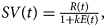
where R stands for the reward magnitude (1, 2, 4, 6, or 8), E refers to the effort level (1, 2, 3, 4, or 5), and k is the parameter of interest denoting how steeply reward is discounted as a function of cognitive effort (higher k indicates greater discounting).
The models were computed by using expectation-maximization to derive group priors and Laplace approximation of posterior distributions for parameter estimation for each participant (Huys et al., Reference Huys, Eshel, O'Nions, Sheridan, Dayan and Roiser2012; Suthaharan, Corlett, & Ang, Reference Suthaharan, Corlett and Ang2021). To avoid issues with non-Gaussianity, parameters were represented as logarithmic transformed variables (i.e. logβ, logk) with support on the real line and normally distributed group priors. The best-fitting model was determined with integrated group-level Bayesian Information Criterion factors (iBIC), which captures the trade-off between model fit and complexity (Huys et al., Reference Huys, Eshel, O'Nions, Sheridan, Dayan and Roiser2012). The difference between any two models' iBIC values (i.e. ΔiBIC) approximates their relative log Bayes factor and a ΔiBIC > 10 represents strong evidence for the model with the lower score. As a form of additional validation, 100 sets of surrogate data were simulated from the best-fitting model to examine whether qualitatively similar patterns to the real data can be reproduced based on the computed parameter estimates. The maximum a posteriori parameters for each subject were computed and used together with the original sequence of options to generate a novel sequence of choices for comparison with the raw data.
Clinical measures
Apathy Motivation Index (AMI) (Ang, Lockwood, Apps, Muhammed, & Husain, Reference Ang, Lockwood, Apps, Muhammed and Husain2017): This is an 18-item self-report measure of motivation in the behavioral, social, and emotional domains. Each item was rated on a five-point Likert scale, with a higher total score in each subscale indicating greater apathy (i.e. lower motivation). One MDD subject did not complete this measure.
Snaith Hamilton Pleasure Scale (SHAPS) (Snaith et al., Reference Snaith, Hamilton, Morley, Humayan, Hargreaves and Trigwell1995): This is a 14-item self-report measure of consummatory anhedonia. Each item was scored on a four-point Likert scale, with a higher total score indicating lower ability to experience pleasure. One MDD subject did not complete this scale.
Beck Depression Inventory (BDI-II) (Beck, Steer, & Brown, Reference Beck, Steer and Brown1996): This is a 21-item self-report measure of depressive symptom severity. Each item was scored on a four-point Likert scale, with a higher total score indicating more severe levels of depression.
Statistical analyses
A linear mixed model was estimated with the restricted maximum likelihood method to examine participants' subjective ratings of cognitive and physical demand of each effort level. This model contained fixed effects of group (MDD, HC), domain (cognitive, physical), effort level (1, 2, 3, 4, 5 squares), group × domain, group × effort level, domain × effort level, and group × domain × effort level, as well as random intercepts for each subject. Pairwise comparisons with Bonferroni corrections were carried out for significant effects.
Mixed ANOVA was used to examine potential group differences in how reward magnitude (regardless of effort level) influenced the proportion of HE/HR option chosen. The between-subject factor was group (MDD, HC) and within-subject factor was reward (2, 4, 6, 8 points). To investigate the effect of effort level (regardless of reward magnitude), a similar approach was taken but using a within-subject factor of effort level (2, 3, 4, 5 squares) instead. Greenhouse–Geiser corrections were used to adjust the degrees of freedom when the assumption of sphericity was violated. Bonferroni-corrected pairwise comparisons were conducted on significant factors.
Pearson correlations were used to probe the associations between the clinical measures and computational parameter k. All variables were approximately normally distributed with no significant outliers.
Finally, a linear mixed model was estimated with the restricted maximum likelihood method to investigate participants' accuracy of execution at each effort level. This model contained fixed effects of group (MDD, HC), effort level (1, 2, 3, 4, 5 squares), and group × effort level, as well as random intercepts for each subject. Pairwise comparisons with Bonferroni corrections were carried out for significant effects.
Results
Subjective ratings of cognitive and physical demand as effort levels increased
There was a significant interaction effect of domain × effort level [F (4,612) = 75.7, p < 0.001], indicating that subjects experienced a greater increase in cognitive demand compared to physical demand as the effort levels increased (Fig. 2). The group × domain interaction was significant as well [F (1,612) = 21.2, p < 0.001]. MDD patients reported greater mean cognitive demand than HCs [t(90.0) = 2.53, p < 0.05] across all effort levels, but there was no difference in mean physical demand between both groups [t(90.0) = 0.82, p = 0.42]. There were also significant main effects of effort level [F (4,612) = 217.2, p < 0.001] and domain [F (1,612) = 713.1, p < 0.001]. All other terms in the model did not reach statistical significance (p's > 0.05).
Subjective ratings of cognitive and physical demands associated with each effort level in healthy controls (HC) and patients with major depressive disorder (MDD). The rating of cognitive demand in both groups increased more steeply than physical demand as effort levels increased. MDD subjects also reported greater mean cognitive demand than healthy controls across all effort levels, but there was no group difference in self-rated physical demands.

Proportion of HE/HR option chosen as reward magnitude increased
The main effect of reward was statistically significant [F (1.4,94.7) = 68.1, p < 0.001], indicating that subjects chose the HE/HR option more often as the reward magnitude increased (regardless of effort level) (Fig. 3a). We also observed a significant main effect of group [F (1,68) = 13.2, p < 0.001], with MDD patients choosing fewer HE/HR options on average across all reward levels compared to HCs, but the group × reward interaction was not statistically significant [F (1.4,94.7) = 1.25, p = 0.28].
(a) Proportion of higher-effort-higher-reward (HE/HR) option chosen as reward magnitude increased. Subjects chose the HE/HR option more often as the reward magnitude increased (regardless of effort level). MDD patients also selected fewer HE/HR options on average across all reward levels compared to HCs, but there was no group × reward interaction. (b) Proportion of HE/HR option chosen as effort level increased. Subjects made fewer selections of the HE/HR option as the effort level increased (regardless of reward magnitude). Relative to HC, MDD patients also chose the HE/HR option less frequently across all effort levels, but there was no group × effort interaction.

Proportion of HE/HR option chosen as effort level increased
There was a significant main effect of effort level [F (1.6,108.6) = 87.4, p < 0.001], with subjects making fewer selections of the HE/HR option as the effort level increased (regardless of reward magnitude) (Fig. 3b). We also found a significant main effect of group [F (1,68) = 13.2, p < 0.001], indicating that MDD patients chose the HE/HR option less frequently across all effort levels compared to HCs. There was no group × effort interaction [F (1.6,108.6) = 1.06, p = 0.34].
Parabolic model best explains participants' choice data
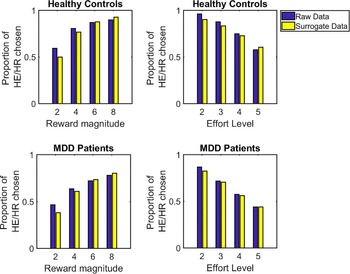
The parabolic discounting model provided the most parsimonious account of participants' choices during the decision phase, with a ΔiBIC = 49 (overwhelming evidence) over the second-best exponential model (linear: iBIC = 4338.7; hyperbolic: iBIC = 5000.4; parabolic = 4141.8; exponential: iBIC = 4190.7). Hence, changes in effort at higher levels had a greater impact on discounting reward than changes at lower levels. Surrogate data simulated from the parabolic model also reproduced qualitatively similar patterns in the MDD and HCs raw data to a reasonably good extent (Fig. 4).
Comparison between surrogate and actual data. Surrogate data simulated from the winning computational model reproduced qualitatively similar patterns in the raw data for healthy controls and individuals with major depressive disorder (MDD) to a reasonably good extent.

On a group level, patients with MDD [mean(s.d.) = −1.46(1.27)] had significantly larger logk than HCs [mean(s.d.) = −2.28(0.99)] [t(68) = 3.02, p < 0.005]. This suggests that depressed individuals exhibited lower willingness to exert cognitive effort for reward compared to healthy people. There was no group differences in the softmax parameter [MDD: mean(s.d.) = 0.001(1.199); HC: mean(s.d.) = 0.338(1.077); t(68) = 1.22, p = 0.23].
Associations of logk with self-reported motivation, anhedonia and depressive symptom severity in MDD patients and healthy individuals
There was a trending correlation between logk and the AMI behavioral activation subscale [r(23) = 0.39, p = 0.053, online Supplementary Fig. S1a] in the MDD group, suggesting that depressed patients who reported lower motivation in the behavioral domain were less willing to invest cognitive effort for reward on the CEMT. On the other hand, logk was not associated with the social motivation [r(23) = 0.25, p = 0.22] or emotional sensitivity [r(23) = 0.07, p = 0.76] subscales of the AMI. Correlational analyses also revealed that, among the MDD group, logk was not related to total score on the SHAPS [r(23) = 0.05, p = 0.83] and BDI [r(24) = 0.13, p = 0.54], suggesting that the willingness to exert cognitive effort for reward on the task was not associated with self-reported levels of consummatory anhedonia or severity of depressive symptoms.
Within HCs, it was observed that logk was significantly correlated with AMI behavioral activation subscale [r(42) = 0.346, p = 0.02, online Supplementary Fig. S1b] as well as SHAPS [r(42) = 0.351, p = 0.02, online Supplementary Fig. s1c]. This suggests that healthy individuals who had lower behavioral motivation and consummatory anhedonia exhibited lower willingness to exert cognitive effort for reward on the CEMT. In contrast, there was no association between logk and social motivation [r(42) = 0.09, p = 0.55], emotional sensitivity [r(42) = 0.28, p = 0.07] in the HC group.
No group difference in average decision time
There was no difference between MDD patients [mean(s.d.) = 1.75(0.46)s] and HCs [mean(s.d.) = 1.96(0.79)s] in the average time taken to choose an option during the decision phase [t(68) = 1.24, p = 0.22]. This suggests that both groups were equally quick at deciding between the options.
No group difference in the overall accuracy of execution
Patients with MDD [mean = 95.6(4.1)%] did not differ from HCs [mean = 95.8(4.0)%] in the overall percentage of trials successfully executed during the testing phase [t(68) = 0.24, p = 0.81].
Association of execution accuracy with effort levels
There was a significant effect of effort level [F (4,330) = 14.2, p < 0.001]. Pairwise comparison analyses found that participants had significantly lower execution accuracy when they had to remember five squares compared to other effort levels, but there were no significant differences in execution accuracy when remembering between 1 and 4 squares (online Supplementary Fig. S2). Nevertheless, the mean accuracy at the effort level of five squares was still high at ~87% [1 square: mean(s.d.) = 97.6(7.2)%, two squares: mean(s.d.) = 97.1(4.9)%, three squares: mean(s.d.) = 96.7(4.9)%, four squares: mean(s.d.) = 94.6(7.1)%, five squares: mean(s.d.) = 87.1(19.8)%]. All other terms in the model did not reach statistical significance (p's > 0.05).
Discussion
Here, we have introduced the CEMT – a novel behavioral paradigm that assesses one's willingness to exert cognitive effort in order to obtain rewards. This task offers significant advantages over previous tasks. First, a learning session was administered to make sure that subjects could achieve at least 80% accuracy for each effort level before proceeding to the CEMT. This extensive learning ensured that during the decision phase, subjects were selecting between options based on cognitive effort and not probability of succeeding on the trial. The impact of self-handicapping, which is the process by which people avoid putting in effort in order to prevent potential failure from hurting self-esteem, is also minimized. Second, all trials lasted the same duration, thereby ensuring that choices were not influenced by temporal delay. Third, participants always had to make five button presses regardless of which option they chose, thus equalizing the physical effort required. The goals of this study were to investigate the feasibility and validity of the CEMT, as well as compare cognitive effort motivation between MDD patients and the healthy population. Several key findings emerged.
After completing the training, in both groups, rating of cognitive demand increased more steeply than physical demand as effort levels increased. MDD subjects also reported greater mean cognitive demand than healthy controls across all effort levels, but there was no group difference in self-rated physical demands. Hence, the paradigm was working as expected – participants perceived the task to be more cognitively (but not physically) effortful when the spatial working memory load increased, yet they were still able to achieve ⩾80% accuracy on each effort level during the training and >95% overall accuracy during the actual task. On the other hand, a previous study utilizing the N-back paradigm reported that even though subjects' self-rated cognitive demand increased as N got higher, their perceived likelihood of failure also elevated along with a decrease in actual success rate (Westbrook et al., Reference Westbrook, Kester and Braver2013).
During the decision phase of the CEMT, both MDD patients and healthy people selected the HE/HR option more frequently as the reward on offer increased, and less often as the effort level increased. However, depressed patients made significantly fewer HE/HR choices across all reward and effort levels, suggesting that they were less motivated to invest cognitive effort for reward compared to controls. Interestingly, these findings are similar to earlier studies observing that MDD patients were significantly less willing to exert physical effort for reward relative to healthy individuals (Treadway, Bossaller, Shelton, & Zald, Reference Treadway, Bossaller, Shelton and Zald2012), which suggests that poorer effort motivation in depression might be consistent across domains. However, our results stand in contrast to findings from a recent study, which also varied cognitive effort in terms of working memory load but surprisingly reported no difference between MDD patients and healthy individuals in the amount of HE/HR choices (Tran, Hagen, Hollenstein, & Bowie, Reference Tran, Hagen, Hollenstein and Bowie2021). This discrepancy might have occurred due to a combination of reasons. First, these investigators used the N-back paradigm, which measured working memory for a sequence of letters whereas our task measured spatial working memory instead. Second, their task included an additional manipulation whereby even if the participant successfully completed the trial, there was only a 12, 50, or 88% chance of reward delivery. This complicates the decision process because besides the cognitive demand associated with both options, participants also had to consider that reward was not guaranteed regardless of each option they choose. Second, their task contained only two different effort levels, but had 11 different reward magnitudes. Hence, it is likely to be tapping more into reward, rather than effort, sensitivity. On the other hand, the CEMT examines an equal number of effort and reward levels.
Design of the CEMT also allowed us to model participants' trial-by-trial choice data and derive a subject-specific k parameter that denotes how steeply the reward on offer was discounted by the required effort level. Thus, k served as a proxy of cognitive motivation level as a higher k reflected lower willingness to invest cognitive effort for rewards (and vice versa). A parabolic model provided the most parsimonious account of subjects' data and indicated that higher effort levels had a greater impact on devaluing rewards than lower effort levels. Moreover, surrogate datasets generated by using the derived parameters to simulate the experiment reproduced the raw data and general pattern of behavior to a good degree, thus providing an additional form of model validation. MDD patients also exhibited significantly higher k values than healthy participants, which is consistent with the group-level choice data analyses. Together, these findings suggest that computational modeling could serve as a reliable way to objectively quantify individual levels of cognitive motivation.
Finally, depressed patients and healthy individuals who were more motivated to exert cognitive effort for reward (based on the computational parameter k) also self-reported greater levels of behavioral motivation (albeit at a trend level of significance for patients). However, k was not associated with self-report measures of social and emotional motivation and depressive symptom severity. Interestingly, there was a significant correlation between k and consummatory anhedonia (based on the SHAPS) among the healthy controls, but not MDD patients. This might be due to the relatively small patient sample size, which results in reduced statistical power to detect significant effects. Future studies could evaluate these relationships in a larger group of patients. It is also worth noting that the SHAPS is a global assessment of hedonic tone and future investigations could adopt more modern scales such as the Positive Valence Systems Scale (Khazanov, Ruscio, & Forbes, Reference Khazanov, Ruscio and Forbes2020), which was developed based on the NIMH RDoC framework and measures different positive valence systems subdomains.
In clinical outcome research, the CEMT could provide more objective and sensitive measures of motivational disturbances in anhedonia. This will supplement conventional clinical and interview-based measures, which might suffer from influences that can complicate assessment such as lack of willingness in disclosure and absence of insight. Future directions include using the task to investigate the neural mechanisms underlying cognitive effort motivation in depression, which could lead to greater diagnostic precision of anhedonia within the clinic and contribute toward personalized treatment for anhedonic patients with MDD.
Several limitations should be acknowledged. First, although participants in the current study were all able to achieve at least 80% accuracy, it is possible that patients with more severe illness might not be able to meet this cutoff and have to be excluded, thus reducing the generalizability of our findings. Second, independent measures of baseline cognitive functioning were not obtained. Hence, it is unclear whether HCs and MDD patients were matched on cognitive abilities. Third, although we ensured that all participants were able to obtain at least 80% accuracy for each of the effort levels during training, it was still observed that the actual task execution accuracy when having to remember five squares (~87%) was significantly lower than the other effort levels (~95–98%). Hence, while potential effects of probability discounting have been significantly lessened with our task design, they might not have been completely eliminated.
Conclusion
Motivation to invest cognitive effort for rewards is fundamental to everyday life, but its association with MDD remains unclear. Here, we have introduced the CEMT – a novel behavioral paradigm that assessed willingness to exert cognitive effort for rewards without the confounds of probability, physical effort, and temporal discounting – and combined it with computational modeling to provide empirical evidence that patients with MDD were impaired on cognitive effort motivation compared to the general population.
Supplementary material
The supplementary material for this article can be found at https://doi.org/10.1017/S0033291722000964.
Author contributions
Y.A. and D.A.P. developed the study concept. All authors contributed to the study design. Testing and data collection were performed by Y.A. and S.G. Data analysis and interpretation were performed by Y.A. under the supervision of D.A.P. The paper was drafted by Y.A., and S.G. and D.A.P. provided critical reviews. All authors approved the final version of the paper for submission.
Financial support
This project was supported by the Harvard Medical School Kaplen Fellowship in Depression and Livingston Award, as well as the Dorris Family Pilot Translational Award and A*STAR National Science Scholarship (all to Y.A.). D.A.P. was partially supported by R37 MH068376. The content is solely the responsibility of the authors and does not necessarily represent the official views of the National Institutes of Health. The funding organization had no role in the design and conduct of the study; collection, management, analysis, and interpretation of the data; preparation, review, or approval of the manuscript; and decision to submit the manuscript for publication.
Conflict of interest
Over the past 3 years, Dr Pizzagalli has received consulting fees from Albright Stonebridge Group, Neumora Therapeutics (former BlackThorn Therapeutics), Boehringer Ingelheim, Compass Pathways, Concert Pharmaceuticals, Engrail Therapeutics, Neurocrine Biosciences, Neuroscience Software, Otsuka Pharmaceuticals, and Takeda Pharmaceuticals; honoraria from the Psychonomic Society (for editorial work) and Alkermes, and research funding from NIMH, Dana Foundation, Brain and Behavior Research Foundation, and Millennium Pharmaceuticals. In addition, he has received stock options from Neumora Therapeutics (former BlackThorn Therapeutics), Compass Pathways, and Neuroscience Software. There are no conflicts of interest with the work conducted in this study. No funding from these entities was used to support the current work, and all views expressed are solely those of the authors. The other authors have no financial disclosures.