INTRODUCTION
The community composition of near-shore environments is strongly determined by the physical and biological topography of the substrate. In sandy shore environments, above-ground structures are transient (i.e. loose-lying algal mats), and/or intermittent (i.e. shell beds). As a result, sandy shore communities are dependent on terrestrial nutrient runoffs (Mandeel, Reference Mandeel2002; Fabricius, Reference Fabricius2005) and/or offshore primary production inputs (Griffiths et al., Reference Griffiths, Stenton-Dozey, Koop, McLachlan and Erasmus1983; Brown & McLachlan, Reference Brown and McLachlan1990), which may be unpredictable and sporadic. One of the most important sources of primary food supplies to sandy beaches is through loose-lying algae that accumulate in coastal environments, especially in the tropics (Stoner & Greening, Reference Stoner and Greening1984; Colombini et al., Reference Colombini, Aloia, Fallaci, Pezzoli and Chelazzi2000). Besides directly delivering an important food source to many grazers (Robertson & Mann, Reference Robertson and Mann1982; Inglis, Reference Inglis1989; Salovius & Bonsdorff, Reference Salovius and Bonsdorff2004), drifting algal clumps also provide habitats for fish (Kingsford & Choat, Reference Kingsford and Choat1985; Kingsford, Reference Kingsford1992; Davenport & Rees, Reference Davenport and Rees1993), and a dispersal mechanism for many invertebrate species (Highsmith, Reference Highsmith1985; Locke & Corey, Reference Locke and Corey1989; Alfaro et al., Reference Alfaro, Jeffs and Creese2004). Furthermore, many researchers have investigated the succession, energy flow and consumption rates for standing algal stocks (Griffiths & Stenton-Dozey, Reference Griffiths and Stenton-Dozey1981; Koop et al., Reference Koop, Newell and Lucas1982; Griffiths et al., Reference Griffiths, Stenton-Dozey, Koop, McLachlan and Erasmus1983; Stenton-Dozey & Griffiths, Reference Stenton-Dozey, Griffiths, McLachlan and Erasmus1983).
An associated outcome of drifting algae is the accumulation of stranded seaweeds on beaches with high public amenity value. Tropical beaches are susceptible to algal beach-cast accumulation and degradation, because of increased fishing of grazers and high nutrient inputs from land activities that enhance algal production (Jackson, Reference Jackson1997; Bellwood et al., Reference Bellwood, Hughes, Folke and Nystrom2004; McManus & Polsenberg, Reference McManus and Polsenberg2004). High algal biomass may accumulate and decompose in the surf zone over short periods of time (Robertson & Hansen, Reference Robertson and Hansen1982; Zemke-White et al., Reference Zemke-White, Speed and McClary2005), thus presenting a significant problem to commercial operations in the tourism sector (i.e. resorts and water sport operators). As a consequence, many coastal operations actively remove seaweed from sandy beaches, thus altering the ecological dynamics of associated fauna. At Likuri Island, Fiji Islands, large amounts of Gracilaria maramae accumulate and are removed regularly from the Robinson Crusoe resort beach front. These activities have resulted in a call for management strategies that take into account the ecological value of these transient communities. As a first step to evaluate their importance to algal mat microcosms, this study aims to identify the faunal composition of detached algal mats (bottom drifting on sandflats) and attached algae (on a nearby seagrass bed) at Likuri Island, Fiji Islands.
MATERIALS AND METHODS
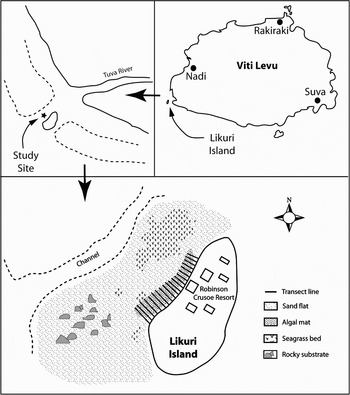
The study site is located at Likuri Island, southern Viti Levu, Fiji Islands (18° 03′15.64S and 177° 17′18.83E) (Figure 1). The island is about 1 km long and 400 m wide, and is about 2 km from the mainland. A reef and mudflats are located to the south-east, and a channel to the north. Sample collections were undertaken on the western side of the island, where algal mats accumulate on sandflats and adjacent seagrass beds (Figure 1). Gracilaria maramae is the predominant alga at the study site, and it is found loose-lying and attached to seagrasses and offshore rocks (Figure 1).
Map of the study site at Likuri Island, southern Viti Levu, Fiji Islands. The three sampling habitats were algal mat, seagrass bed and rocky substrate.

Quantification of the size of the contiguous mat along the beach was undertaken by selecting 20 stations 10 m apart along the shore where the mat was lying (Figure 1). From these stations, transect lines were laid perpendicular to the shore. The thickness (vertical distance from the bottom to the top of the mat) of the loose-lying algal aggregation was measured every 2 m along the transect line. While some material was stranded out of the water on the beach, only the submerged, fresh material was mapped and sampled.
In order to determine the strength of Gracilaria maramae attachment to their primary substrates (seagrass blades and rocks), pulling experiments were conducted with a spring scale (OBA Instrument Works Ltd, Tokyo, Japan) (Friedland & Denny, Reference Friedland and Denny1995). Twenty seagrass plants and small rocks (~15 cm in diameter) with attached G. maramae were collected and taken to shore. Immediately after collection, a cable tie (5 mm width) was secured to the holdfast or point of attachment to the respective substrate. The cable tie was then connected to the scale with a nylon monofilament. The scale was pulled horizontally (parallel to the substratum) to simulate drag and acceleration forces until the alga was detached (sensu Friedland & Denny, Reference Friedland and Denny1995). The force required to detach each alga was recorded and compared between substrate types.
Characterization of algal aggregations was undertaken within three habitats—bottom-drifting algal mats, algal canopies attached to seagrass beds, and algae attached to rocky substrates. Fifteen replicate quadrats (0.25 m2) were randomly placed within each habitat to sample all above-ground biomass during April 2006. All samples were sorted and weighed immediately after collection. The algal and plant material was classified within the following categories: detached Gracilaria maramae (DG), attached G. maramae (AG), seagrass blades (SB) and other algae (OA). The fauna found within each quadrat were identified to the lowest possible taxonomic level. The density of macro-fauna and biodiversity indices for each habitat were calculated and compared between habitats.
Analysis of variance was used to analyse the data, after checking for any violations of all parametric requirements. None of the data sets required transformations, except for macro-faunal densities, which were log (X+1) transformed. Shannon–Weiner indices were calculated to compare biodiversity among habitats.
RESULTS
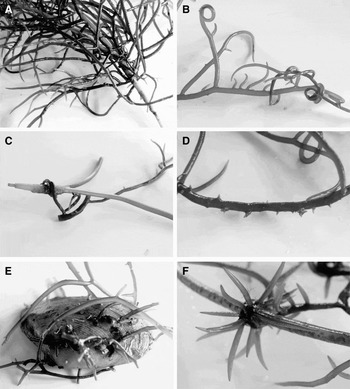
Field observations indicate that Gracilaria maramae appears to have two distinctive morphologies. Attached G. maramae tend to have long and straight branches stemming from a single holdfast (Figure 2A). Detached G. maramae develop curled tendrils (Figure 2B), presumably to re-attach to any adjacent substrate, such as seagrass blades (Figure 2C) and other algal thalli. As a consequence, loose-lying algae are intimately intertwined within the mat, at some points attached to underlying shell and coral cobbles or seagrasses, providing a relatively protective and stable environment for macro-invertebrates. The algae continue to grow while detached, and may have considerably more sprouting buds (Figure 2D) than attached individuals. In addition, G. maramae may have two attachment modes—through direct settlement of spores on a hard substrate (Figure 2E), and through curling and re-attachment around a seagrass blade or similar structure (Figure 2F) (Jones, Reference Jones1962).
Photographs of (A) Gracilaria maramae attached to seagrass blade; (B) detached curling Gracilaria maramae; (C) holdfast re-attachment to seagrass; (D) sprouting buds in Gracilaria maramae thallus; (E) attachment to hard substrate (shell); and (F) re-attachment around seagrass.

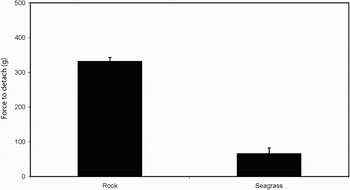
Results from the pulling experiments indicate that Gracilaria maramae is more strongly attached to rocky substrates compared to seagrass blades (Figure 3). The force (±SE) required to detach G. maramae from the rocks was 331±50 g, while detachment from seagrass blades required 65±33 g. A one-way ANOVA test indicated that these differences were highly significant (ANOVA; F(1,38)=392.3; P < 0.001). A general survey of the region points to the rocky substrate and seagrass bed as the likely sources of G. maramae that contribute to beach-cast accumulation. These algae may detach after strong hydrodynamic conditions, and then accumulate in the surf zone, where they continue to grow and entangle. Measurements of the loose-lying algal mat area indicate that the mat extended 180 m along the shore with an average width of 9.8 m and an average depth (±SE) of 0.22±0.76 m, giving an approximate volume of 447 m3 and covering an area of 2015 m2.
Mean force (±SE) required to dislodge Gracilaria maramae from rocky and seagrass blade substrates at Likuri Island, Fiji Islands.

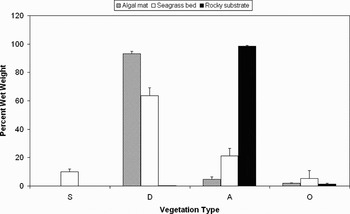
As expected, the majority of the algae in the mat were detached, although a small percentage (~5%) was attached to shell and coral rubble found on the sandy substrate (Figure 4). All the Gracilaria maramae found in the rocky substrate habitat was attached to the rocks (single upright holdfast attachment), while a mixture of detached (~64%) and attached (~21%) algae was found in the seagrass bed habitat. Most of the attached algae in the seagrass bed was associated with seagrass blades, apparently re-attached after curling. The greatest mean wet weight of algal/plant material (±SE) collected within the 0.25 m2 quadrats was found in the algal mat with 1171±499 g, followed by the rocky substrate with 913±260 g, and the seagrass bed with 343±128 g. A one-way ANOVA resulted in significant differences among habitats (ANOVA; F(2,42) = 24.9; P < 0.001), although a Tukey test showed no significant difference between algal mat and rocky substrate habitats only.
Mean per cent (±SE) algal and plant material (S, seagrass; D, detached Gracilaria maramae; A, attached Gracilaria maramae; O, other algae) found within three subtidal habitats (algal mat, seagrass bed, and rocky substrate) at Likuri Island, Fiji Islands.

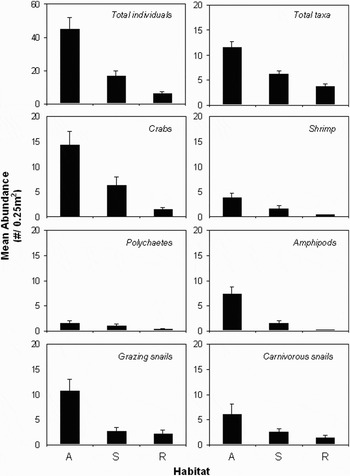
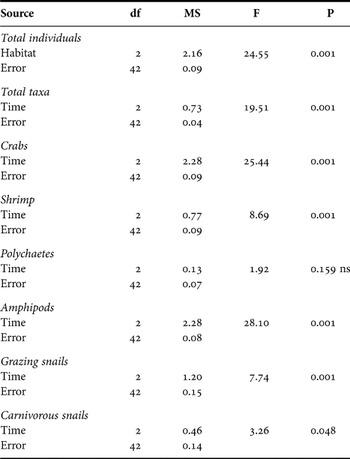
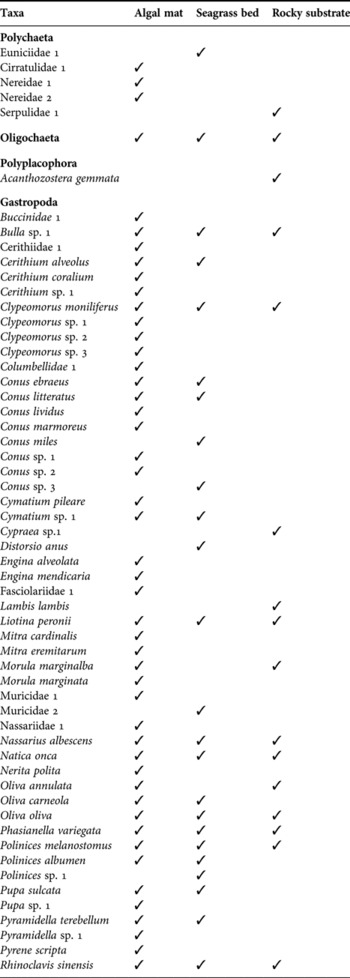
Results from the macro-faunal samples indicate that the algal mat habitat had the highest total number (±SE) of individuals and taxa (44.9±7.2 and 11.6±1.1 individuals/0.25 m2, respectively) among the three habitats, and that the rocky substrate had the lowest total number (±SE) of individuals and taxa (6.4±1.1 and 3.8±1.5 individuals/0.25 m2, respectively). This density pattern also is persistent for each of the major macro-faunal groups encountered, including crabs, shrimp, polychaetes, amphipods, grazing snails, and carnivorous snails (Figure 5). One-way ANOVA tests for the total number of individuals and taxa and for each of the major faunal groups all resulted in significant differences among habitats, except for polychaete worms (Table 1). Non-significant Tukey tests were found for shrimp, amphipods, and grazing and carnivorous snails between seagrass beds and rocky substrates, and for grazing snails between algal mat and seagrass bed habitats. Crabs (7.4±1.3 individuals/0.25 m2) and grazing snails (5.2±1.0 individuals/0.25 m2) were the most abundant organisms encountered in all habitats, while polychaete worms (0.9±0.2 individuals/0.25 m2) were the least abundant of the groups investigated (Figure 5). The taxa found within the three habitats are listed in Table 2.
Mean density (±SE) of total individuals, total taxa, crabs, shrimp, polychaetes, amphipods, grazing snails and carnivorous snails within three habitats (A, algal mat; S, seagrass bed; R, rocky substrate) at Likuri Island, Fiji Islands. Note different scales.

One-way ANOVA testing mean macro-faunal density among habitats (Algal mat, Seagrass bed, and Rocky substrate) at Likuri Island, Fiji Islands. Non-significant test is indicated with “ns”.

List of taxa within three habitats (algal mat, seagrass bed and rocky substrate) at Likuri Island, Fiji Islands.

The Shannon–Weiner index calculations resulted in higher species diversity for the algal mat habitat (5.8), followed by seagrass bed (5.1), and rocky substrate habitat (4.8).
DISCUSSION
Macro-algal communities provide habitats and food sources for a variety of marine organisms. The transient and sporadic nature of algal mats results in a dynamic microcosm, where organisms come and go, and populations increase and decrease in density over short periods of time. At Likuri Island, there is a unique opportunity to compare mono-specific algal stands within floating mats, attached to seagrass blades, and attached to rocks. Gracilaria maramae was found to be the most abundant alga within all three habitats (algal mat, seagrass bed and rocky substrate), with two distinctive morphologies depending on whether it was attached or free-floating. It appears that G. maramae can attach to suitable substrates through direct settlement of spores and/or development of attachment points after curling around a substrate. Re-attachment of fragments is not uncommon in this genus (Jones, Reference Jones1962) and other red algae (Santelices & Varela, Reference Santelices and Varela1994). The versatility of this species allows it to continue to grow, even after detachment by storms and other hydrodynamic processes, and may be the reason for its dominance at the study site. Biomass estimates during April 2006 indicated that the algal mat may contain 447 m3 of mostly G. maramae. While only one sampling event was conducted in this investigation, similar algal biomasses are commonly found at the study site, although densities may increase after storm events (Wayne Latter, Robinson Crusoe resort, personal communication). Future studies of community composition throughout the year may provide further information regarding seasonal variability.
Based on the pulling experiments, it is apparent that the attachment of Gracilaria maramae to rocky substrates is 5 times stronger than the attachment to seagrass blades. These results suggest that re-attachment to seagrass blades and entanglement through curling of tendrils in the algal mat may be secondary strategies to remain in shallow water environments (higher sunlight and growth rates) and avoid offshore transport. While pelagic algal species, such as Macrocystis pyrifera and Sargassum spp., can maintain their surface position with air bladders through their long-distance dispersal (Kingsford, Reference Kingsford1995; Woodcock, Reference Woodcock1995), G. maramae is more negatively buoyant (no air bladders), and tumbles on the bottom. Thus, the ability of G. maramae to curl and re-attach, together with its fast growth rates, allow for the unusual formation of semi-stable micro-habitats on near-shore sandy shores, where transient and stationary organisms may reside. Although not measured in this study, it is likely that this algal biomass also contributes a significant amount of nutrients to infauna living in these sandy environments.
Results from the faunal composition analyses indicate that the algal mat habitat had the highest density and biodiversity among the three Gracilaria maramae habitats studied at Likuri Island. Conversely, the rocky substrate had the lowest number of individuals and taxa. Many mobile organisms, such as shrimp and carnivorous snails, were present in all three habitats, although they appeared to be attracted in higher densities to food resources in the algal mat. A range of grazing snails and crabs, especially juveniles, were common in the algal mat, which suggests that this habitat may favour young grazers and scavengers. In addition, a high density of amphipods and isopods also was found associated with the drifting algal material, which is in agreement with previous work (Koop & Field, Reference Koop and Field1980; Robertson & Lucas, Reference Robertson and Lucas1983; Ingólfsson, Reference Ingólfsson1995; Salovius & Bonsdorff, Reference Salovius and Bonsdorff2004). Seagrass beds had a higher density of bivalves, which were found at the surface of the sediment when the quadrats were sampled. This group of organisms may represent an important link between epifaunal and infaunal communities, which was not strongly represented in the other two habitats.
Seagrass beds have been known to support a high diversity and abundance of organisms, especially juveniles, which use this habitat as nursery or feeding grounds (Edgar, Reference Edgar1990; Connolly, Reference Connolly1997; Sheridan, Reference Sheridan1997; Duarte, Reference Duarte1999). In this study, the density and biodiversity within the algal mat habitat were higher than those in the seagrass bed. Comprehensive comparisons between seagrass beds and algal drifting habitats are lacking. However, while there is strong evidence for high associated biomass and diversity within seagrass beds (Sheridan, Reference Sheridan1997; Duarte, Reference Duarte1999; Alfaro, Reference Alfaro2006), the level of secondary production within algal mats is less clear (Holmquist, Reference Holmquist1994; Tzetlin et al., Reference Tzetlin, Mokievsky, Melnikov, Saphonov, Simdyanov and Ivanov1997; Norkko et al., Reference Norkko, Bonsdorff and Norkko2000; Alfaro et al., Reference Alfaro, Jeffs and Creese2004). Previous studies have reported on the ephemeral nature of non-pelagic drift algae (Hily et al., Reference Hily, Potin and Floc'h1992; Alfaro et al., Reference Alfaro, Jeffs and Creese2004), which may deter long-term residents. Contrary to floating algal rafts, bottom drifting algae tend to undergo rapid fragmentation and decomposition after being detached (Smith & Foreman, Reference Smith and Foreman1984; Salovius & Bonsdorff, Reference Salovius and Bonsdorff2004). Degradation may be accelerated when algae reach the surf zone and are exposed to the air or buried in the sand (Robertson & Hansen, Reference Robertson and Hansen1982; Talbot & Bate, Reference Talbot and Bate1988). The unusual life strategies of Gracilaria maramae (rapid growth and entanglement) may provide a unique opportunity for the development of highly abundant and diverse faunal assemblages, which in turn may sustain adjacent near-shore communities. Active removal of this primary production source and habitat may have significant effects on the food web dynamics of coastal ecosystems adjacent to managed beaches. Further investigations on the trophic links and nutrient cycling between algal mat and adjacent habitats would need to be conducted before undertaking management strategies.
ACKNOWLEDGEMENTS
We are thankful to the Robinson Crusoe resort for their logistical support during field activities. Staff from the School of General Studies, Fiji Institute of Technology (Litiana Vudikaria and Salanieta Matai) provided invaluable assistance in the collection and sorting of samples. We are grateful to the Naveihabahaba Village for hosting us through the sampling period. Editorial assistance was provided by Kathy Campbell. This project was made possible with the support of the School of Applied Sciences, and a grant from the Faculty of Health and Environmental Sciences, Auckland University of Technology.