Introduction
Cystic echinococcosis (CE) is highly endemic in Kazakhstan and there is considerable evidence that the incidence of human CE has increased dramatically since independence from the Soviet Union (Abdybekova et al., Reference Abdybekova, Sultanov, Karatayev, Zhumabayeva, Shapiyeva, Yeshmuratov, Toksanbayev, Shalkeev and Torgerson2015). There have been a number of studies documenting the prevalence of CE in intermediate hosts and of Echinococcus granulosus in definitive hosts. Prevalences of 34–48% have been reported in sheep (Torgerson et al., Reference Torgerson, Shaikenov, Rysmukhambetova, Ussenbayev, Abdybekova and Burtisurnov2003a), with up to 23% prevalence in farm dogs (Torgerson et al., Reference Torgerson, Burtisurnov, Shaikenov, Rysmukhambetova, Abdybekova and Ussenbayev2003b). In Kazakhstan, CE is a notifiable disease, and in recent years close to 1000 cases have been reported each year, giving an annual incidence of approximately 5.8 cases per 100,000 (Abdybeokova et al., Reference Abdybekova, Sultanov, Karatayev, Zhumabayeva, Shapiyeva, Yeshmuratov, Toksanbayev, Shalkeev and Torgerson2015).
Based on recent molecular and phylogenetic evidence, the E. granulosus sensu lato may comprise five valid species, including E. granulosus sensu stricto (s.s.) (genotypes G1–G3), E. equinus (G4), E. ortleppi (G5), E. canadensis (G6–G10) and E. felidis (Alvarez Rojas et al., Reference Alvarez Rojas, Romig and Lightowlers2014). Most human cases of CE appear to be caused by E. granulosus s.s.; however, E. ortleppi and E. canadensis are also known to be zoonotic. Different genotypes may also have different preferred intermediate hosts and transmission pathways.
There are few reports on the genotypes of E. granulosus (sensu lato) circulating in Kazakhstan. However, E. granulosus G1 strain and G6/G7 strain (E. canadensis) have been isolated from dogs in south-eastern Kazakhstan (Stefanić et al., Reference Stefanić, Shaikenov, Deplazes, Dinkel, Torgerson and Mathis2004; Trachsel et al., Reference Trachsel, Deplazes and Mathis2007) and in neighbouring Kyrgyzstan (Ziadinov et al., Reference Ziadinov, Mathis, Trachsel, Rysmukhambetova, Abdyjaparov, Kuttubaev, Deplazes and Torgerson2008). Therefore, the aims of this study were to identify the genotypes of Echinococcus circulating in various species of livestock in Kazakhstan.
Materials and methods
From 2015 to 2016, Echinococcus cysts were collected from sheep and cattle from all 14 oblasts (regions) of Kazakhstan. Cysts were stored in ethanol until analysis.
For DNA extraction and amplification from E. granulosus, kits produced by Genekam Biotechnology AG (Germany) were used. Isolation and purification of DNA were achieved using a standard phenol-chloroform method with proteinase K and subsequent ethanol precipitation (Butler, Reference Bowles, Blair and McManus2012).
The amplification reaction was performed according to standard procedures in a volume of 25 µl containing 60 mM Tris-HCL, 10 mm (NH4)2SO4, 0.1% Tween 20, 1 µm primer, 25 ng genomic DNA and 0.5 units Taq-polymerase. As a control, a sample containing the complete amplification mixture, but without added DNA, was used.
The polymerase chain reaction (PCR) reaction was performed using two primers. For cox1, the forward primer was 5′-ATGTGTTGATTTTGCCTGGA-3′, whilst the reverse was 5′GAGCTACTACAAACCAAGGTATC-3′. For the nadh1, the forward primer was 5′-AGGTTATTCTCAGTCTCGTAAGG-3′, whilst the reverse was 5′-CGATTAGTCTCACACACAGCAC-3′. Cox1-F/R-specific primers were designed by primer 5 based on the cox1 gene sequence (GenBank: AB271910.1) of E. canadensis reported in GenBank. The nadh1-F/R-specific primers were designed by primer 5 based on the nadh1 gene sequence (GenBank: EF558357.1) of Echinococcus reported in GenBank. Because of the high homology of Echinococcus, a primer was designed to target one of the sequences; nadh1-R and cox1-R are reciprocal complementary sequences with EF558357.1 and AB271910.1. For cox1, the size of the PCR product was 400 base pairs; for nadh1, the PCR product comprised 495 base pairs.
Amplification conditions were 3 min at 94°C (denaturation) followed by 1 min at 50°C (annealing) and 1 min at 72°C (synthesis); 50 μl of chloroform was added to the tube with the amplified sample. The tube was then stirred and centrifuged in a microcentrifuge for 30 s. The aqueous phase containing the amplified DNA was collected, which gave directly the PCR products without further purification. The amplification product was analysed using 1.5–2% agarose gel with the addition of ethidium bromide. Stained gels were photographed under ultraviolet light.
Results and discussion
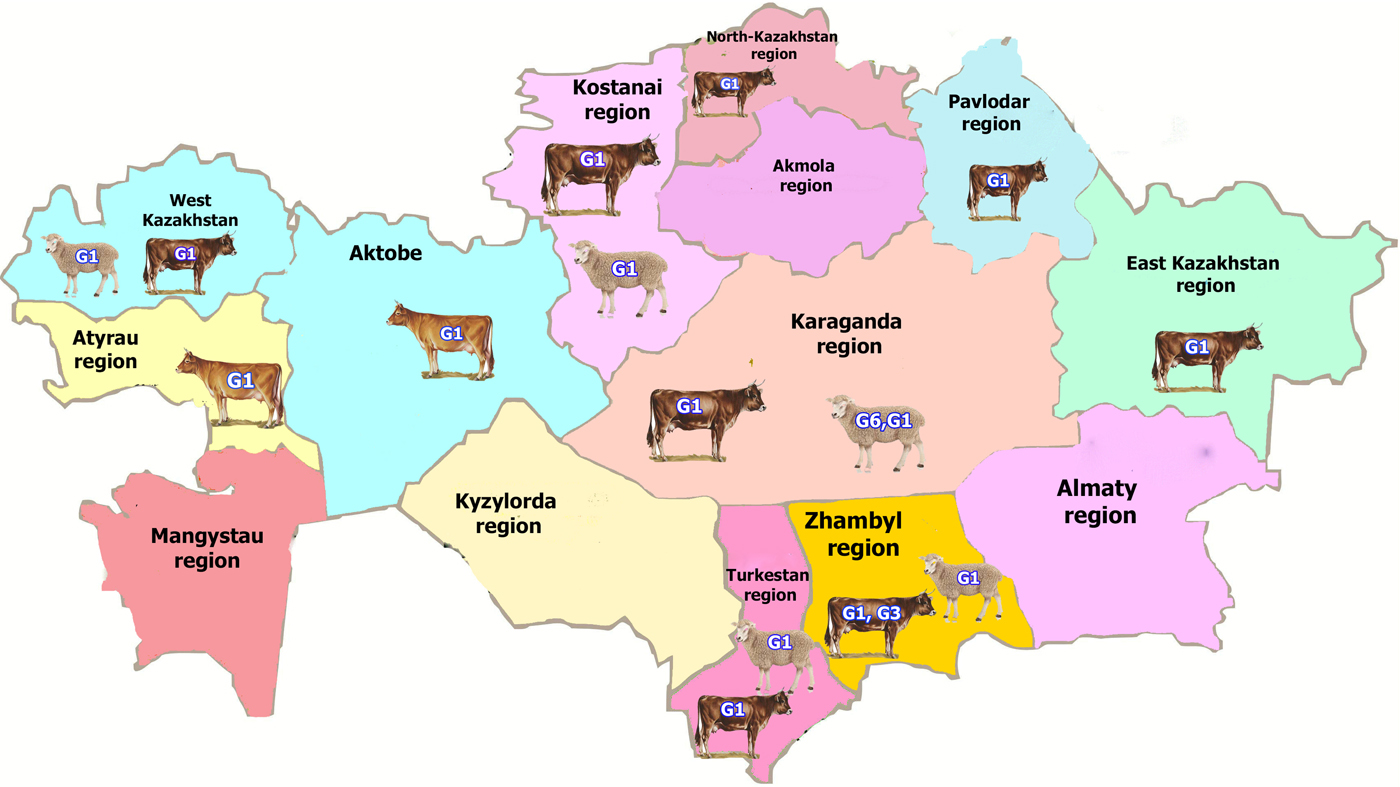
A total of 34 cysts were sequenced and identified to strain level. Phylogenetic analysis showed that 30 isolates were identified as the genotype G1 (GenBank accession number: DQ062857). Of these, ten were isolated from the lungs of cattle, five from the livers of cattle, 12 were from the lungs of sheep and three from the livers of sheep. The E. granulosus s.s. G1 genotype was found in all regions of Kazakhstan. The E. granulosus s.s. G3 genotype (accession number GenBank: M84663) was identified in two isolates – both were cysts from the lungs of cattle from the Zhambyl region. A further two isolates were identified as E. canadensis (G6), which were both isolated from the lungs of sheep from the Karkarala district of the Karaganda region. Figure 1 presents a map indicating the regions and intermediate hosts from which the various genotypes were isolated.
Geographic and host origin of the various isolates of E. granulosus found in this study.

Bowles et al. (Reference Butler and Butler1992) originally suggested that there were seven genotypes of the E. granulosus complex. More recent classification of E. granulosus has suggested genotypes 1–10, although some of these genotypes are now regarded as species. Genotypes G6, G7, G8 and G10 may be one, two or three separate species (Lymbery et al., Reference Lymbery, Jenkins, Schurer and Thompson2015). In which case, G6/7 is E. intermedius, G8 is E. borealis and G10 is E. canadensis. Genotypes G1 and G3 are part of E. granulosus s.s. and usually regarded as a single species (Kinkar et al., Reference Kinkar, Laurimäe and Sharbatkhori2017) – it is the most common species that infects humans. The other generally recognized species within this complex include genotypes G4 (E. equinus), which is not generally considered zoonotic, and G5 (E. ortleppi) (Alvarez Rojas et al., Reference Alvarez Rojas, Romig and Lightowlers2014).
The results showed that in Kazakhstan the dominant circulating E. granulosus genotype is the G1 genotype. This is consistent with many other studies. Echinococcus granulosus s.s. (G1–G3) is thought to cause approximately 88% of all human cases of CE and is thus likely to be the most important source of human echinococcosis in Kazakhstan. The G6 genotype has been detected previously in dogs in Kazakhstan and this study indicates that it is also present in sheep, which may be a source of infection to dogs. In other studies, G6 has not only been isolated from goats, but it has been suggested that goats are an important reservoir for this genotype (Soriano et al., Reference Soriano, Debiaggi, Pierangeli, Pianciola, Bergagna, Lazzarini, Mazzeo and Basualdo2016) and goats make up a significant proportion of the small ruminants in Kazakhstan (Iñiguez, Reference Iñiguez2004). Camels and pigs may also serve as intermediate hosts of the G6 strain (Umhang et al., Reference Umhang, Richomme, Hormaz, Boucher and Boué2014; Ebrahimipour et al., Reference Ebrahimipour, Sadjjadi, Yousofi Darani and Najjari2017). The camel population stands at about 160,000 in Kazakhstan (Ryskaliyeva et al., Reference Ryskaliyeva, Henry, Miranda, Faye, Konuspayeva and Martin2018) and pigs at 887,000 (FAOSTAT, 2018). Both of the G3 isolates found in the present study were from the lungs of cattle.
The geographical distribution of the various genotypes of Echinococcus has been reviewed in Deplazes et al. (Reference Deplazes, Rinaldi and Rojas2017). The genotypes and frequencies of Echinococcus isolated in the present study are somewhat similar to that found in Iran where a systematic review found that 92.3% of isolates from livestock are G1 strain, 2.4% G3 and 4.7% G6/G7 (Khademvatan et al., Reference Khademvatan, Majidiani, Foroutan, Tappeh, Aryamand and Khalkhali2018). Similarly in Turkey and Iraq, the G1 strain predominates, but G3 has been found in a small proportion of livestock (Vural et al., Reference Vural, Baca, Gauci, Bagci, Gicik and Lightowlers2008; Hammad et al., Reference Hammad, Cavallero, Milardi, Gabrielli, D'Amelio and Al-Nasiri2018). The Middle East has been suggested as being the origin of the G1 and G3 genotypes (Kinkar et al., Reference Kinkar, Laurimae and Balkaya2018). To the east, in China, G1 also predominates, with a few isolates of G6/7 or G3 reported (Zhong et al., Reference Zhong, Wang, Hu, Wang, Liu, Gu, Wang, Peng and Yang2014; Ma et al., Reference Ma, Wang and Lin2015; Wang et al., Reference Wang, Wang and Hu2015). To the north, in Russia, E. granulosus s.s. (presumably G1) has been isolated from sheep, whilst G6 has been found in reindeer and wolves (Konyaev et al., Reference Konyaev, Yanagida and Nakao2013).
In conclusion, this study confirms the widespread nature of echinococcosis in livestock in Kazakhstan. The Echinococcus genotypes identified in this study – G1, G3 and G6 – are known human pathogens. The G1 genotype, in particular, is highly pathogenic to humans and is the dominant genotype found in this study; thus, both cattle and sheep are important reservoirs for this parasite. The G3 and G6 genotypes may be of less importance as they were isolated less frequently, but parallel studies of parasite material recovered from human cases would be needed to gain a complete picture.
Financial support
None
Conflicts of interest
None.