Introduction
Socioeconomic status (SES) has been studied extensively in the medical literature. Previous published studies have demonstrated that low SES may be associated with a number of adverse health outcomes, including increased medical comorbidity and increased mortality (Cox et al., Reference Cox, McKevitt, Rudd and Wolfe2006). Part of this may stem from the fact that patients with low SES, particularly in the developing world, may have less access to subsidized health care (Alter et al., Reference Alter2006). Furthermore, patients with low SES, even if living in a country with subsidized health care, may be less likely to access health care and may be more likely to engage in habits that are bad for them such as drinking and smoking (Kapral et al., Reference Kapral, Wang, Mamdani and Tu2002).
St. Michael's Hospital serves a large inner city population in a major urban setting (Metropolitan Toronto). Health care services for this population are fully funded by the provincial government through the Ontario Health Insurance Program (OHIP). While a broad cross-section of the population would be classified as low SES, the region also encompasses highly affluent areas, resulting in a mixed SES population. The St. Michael's Hospital Memory Disorders Clinic accepts referrals from patients in the area referred by their family physicians. It should be noted that only patients with a physician referral can be seen, which would effectively eliminate any patients who do not have a family doctor. There is no age restriction on referrals and data on patients have been accumulated since 2004. When seen at the clinic, patients typically receive a standardized history as well as a standardized cognitive assessment consisting of the Behavioural Neurology Assessment (BNA; Darvesh et al., Reference Darvesh, Leach, Black, Kaplan and Freedman1994), the Mini-mental State Examination (MMSE; Folstein et al., Reference Folstein, Folstein and McHugh1975) and the Clock Drawing Test (CDT; Freedman et al., Reference Freedman, Leach and Kaplan1994).
Many large population-based studies have looked at the impact of SES on the prevalence of dementia (Evans et al., Reference Evans1997; Karp et al., 2000; Turrell et al., Reference Turrell2002; Koster et al., Reference Koster2005; Zhao et al., Reference Zhao2005; Goldbourt et al., Reference Goldbourt, Schnaider-Beeri and Davidson2007; Lang et al., Reference Lang2008; Scazufuca et al., Reference Scazufca2008). The majority of these studies have shown a clear relationship between the prevalence of dementia and low SES. Many methods have been used in these studies to measure SES, including annual income, educational level, occupation and residential SES (i.e. neighborhood income levels). Lang et al. (Reference Lang2008), for example, found that living in an economically deprived neighborhood resulted in a high prevalence of dementia, independent of other measures of SES, such as annual income and education. Other studies have shown a clear relationship between SES and the rate of cognitive decline using the modified MMSE (Koster et al., Reference Koster2005). Some studies have attempted to determine what mediates the decline in cognitive function in low SES populations. Medical factors such as baseline heart disease, cerebrovascular disease and diabetes (Koster et al., Reference Koster2005), Apolipoprotein E (APOE) status (Zhao et al., Reference Zhao2005) and occupational status (Melzer et al., 2000) have all been investigated and none of these factors, while all somewhat associated with worse cognitive functioning, was found to explain adequately the discrepancies associated with SES. Evans et al. (Reference Evans1997) looked at three separate SES factors – education, occupation, and income –and their impact on the subsequent development of Alzheimer's disease (AD). Only educational attainment appeared to have a persistent effect on the development of AD, with patients who had a lower educational attainment having a higher risk of developing dementia. Similarly, Golbourt et al. (Reference Goldbourt, Schnaider-Beeri and Davidson2007) looked at the impact of SES using occupation and education in a large sample of patients living in a Jewish community and discovered a three- to six-fold increase in the prevalence of dementia among patients with low SES versus those with high SES.
Few studies have actually looked at these correlations in autopsy proven AD. Munoz et al. (Reference Munoz, Ganapathy, Eliasziw and Hachinski2000) compared 115 patients with autopsy proven AD who died while in hospital to 145 patients without autopsy proven AD. There was no difference in educational attainment between the two groups. In terms of explaining this finding, it is possible that the patients in the sample did have advanced AD and furthermore were hospitalized as opposed to living in the community. Some investigators have been careful to distinguish early-life from late-life SES, realizing that SES is not a static entity and that it can vary over the lifecourse. Turrell et al. (Reference Turrell2002) examined SES across the life span and found that SES at each phase of the life span could have an independent impact on subsequent cognitive functioning. Studies have also looked at the incidence of dementia, showing a strong correlation between SES and the subsequent development of dementia in cognitively normal adults. Wilson et al. (Reference Wilson2005) looked at early childhood SES in a large cohort of priests and discovered an association between low SES and poor baseline cognitive functioning. There was no association, however, between the rate of cognitive decline and the subsequent development of dementia. Some studies have looked at whether certain types of dementia may be more prevalent in low SES populations. Nitrini et al. (Reference Nitrini1995) looked at the development of different forms of dementia in low vs. high SES populations and found that it did not affect the prevalence of particular dementia subtypes. Specifically, vascular dementia and other reversible causes of dementia were no more common in low SES patients than AD.
This paper examines the impact of SES on the prevalence of dementia and poor cognitive functioning in an Inner City Memory Disorders Clinic. To our knowledge, this is the first time such a detailed analysis of SES and clinical outcome has been applied to a unique inner city clinical population. Based on the existing literature, it is predicted that the overall prevalence of dementia will be high when compared to other non-inner city memory clinic populations and that a diagnosis of dementia will correlate positively with increased age, medical comorbidity, low education and low SES.
Methods
Data collected from the St. Michael's Hospital Memory Disorders Clinic over the period 2004 to 2008 was examined retrospectively. Patients were asked to sign a consent form that allowed their data to be entered into an electronic database following their assessment. This study has received full ethics approval from the University of Toronto Research Ethics Board. Data captured in this database included detailed sociodemographic data, such as age, gender, living situation, whether or not the patient was accompanied, educational attainment, annual income, drug premiums (in the province of Ontario, drug premiums are linked to income status), patient's mode of transportation and whether or not they had a family physician. The database also captured important medical information such as the patient's baseline cognitive status (as measured by the MMSE, BNA and CDT), dementia diagnosis, risk factors for the development of dementia, current medications and medical comorbidity (Cumulative Illness Rating Scale (CIRS); Rochon et al., Reference Rochon1996).
A diagnosis of dementia was based on DSM-IV criteria. In order for patients to be classified as having dementia, they had to have a history of progressive cognitive decline, cognitive impairment in multiple domains and functional impairment. All patients seen in the clinic were interviewed by a clinician who took a comprehensive history, physical exam and administered a number of cognitive tests including MMSE, BNA and CDT. More comprehensive neuropsychological testing was not conducted as the BNA covers multiple cognitive domains and was thought to be sufficient. The BNA (Darvesh et al., Reference Darvesh, Leach, Black, Kaplan and Freedman2005) measures language, attention, visuospatial function, naming and executive function. We decided to use the BNA in preference to other cognitive scales as it can be administered by any clinician, provides a good overview of the affected cognitive domains and is used by most memory clinics throughout the Greater Toronto Area. Furthermore, it has been scientifically validated and shown to be superior to the MMSE in detecting dementia (Darvesh et al., Reference Darvesh, Leach, Black, Kaplan and Freedman2005). In addition to cognitive testing, all patients had routine blood work to rule out reversible causes of cognitive impairment (TSH, B12, RBC folate) as well as structural brain imaging using computerized tomography (CT) or magnetic resonance imaging (MRI). The diagnosis of different dementia subtypes – e.g. AD, dementia with Lewy bodies (DLB) – was based on expert clinical guidelines. All patients were seen if possible by a minimum of two specialists (geriatrician, geriatric psychiatrist, neurologist) to confirm the diagnosis. Patients not diagnosed with dementia could potentially suffer from a number of conditions that could affect cognitive ability, including depression, age associated memory impairment and mild cognitive impairment to name a few.
Data analysis
Data from 217 patients were analyzed retrospectively using SPSS software. Descriptive statistics looking at the distribution of demographic, socioeconomic and neurocognitive factors in the sample were examined. Socioeconomic status was defined in two ways: (i) according to annual income, with patients having a household income less than $35,000 being defined as low SES, and (ii) according to neighborhood income quintiles. Neighborhood income quintiles were computed using existing census data and divided the region of Toronto into five quintiles. For the purposes of analysis, low (1, 2) and high (3, 4, 5) income quintiles were pooled. Patients with low and high SES based on annual income and neighborhood quintiles were compared using non-parametric statistics. Patients with and without dementia were also compared to determine the association between SES and a diagnosis of dementia.
Statistical procedures used in the analysis included ANOVA for the descriptive statistics, χ2 and Mann-Whitney for multiple comparisons between SES subgroups, and multivariate logistic regression for evaluating the impact of individual SES factors on cognitive status and dementia.
Results
In terms of demographics, it was noted from the one-way ANOVA of data from the 217 patients that slightly over half of the sample was female (55.3%), over a third of the sample was married (39.2%) and the majority of patients spoke English fluently (93.1%). Over half the patients seen in the clinic attended their appointment alone (55.3%), over half were born in Canada (56.2%), and over half had 12 years of education or more (53.9%). In terms of SES status, 46% had a low annual income and 41% lived in low residential SES neighborhoods. In terms of factors that might potentially be associated with a diagnosis of dementia, tobacco and street drug use were relatively low (17.1% and 7.8%, respectively) while a moderate proportion admitted to drinking regularly (44.2%). Just over one third (36.4%) were diagnosed with dementia of one type or another. AD was the most common dementia diagnosed (14.7%), followed by mixed dementia (9.2%), vascular dementia (6%), frontal-temporal dementia (1.4%) and DLB (0.5%). A fairly significant percentage of the patients seen were also diagnosed with mild cognitive impairment (MCI) (12%). Approximately one third of patients had psychiatric comorbidity (36.9%), with the majority of affected patients having major depression (33.2%). A relatively large percentage of patients were already on antidepressant treatment (28.1%) while a much smaller percentage were on other psychotropic medications, including cognitive enhancers (12.9%).
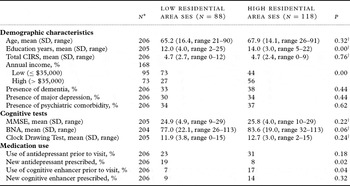
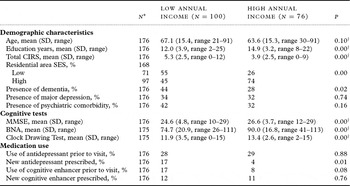
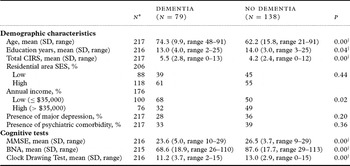
In terms of comparative statistics (Table 1), low residential SES was associated strongly with low education (p < 0.001), low annual income (p < 0.001), and initiation of an antidepressant (p < 0.05). Surprisingly, baseline cognitive status as measured by the MMSE, BNA and CDT did not associate significantly. Conversely, high SES was strongly associated with prior use of a cognitive enhancer (p < 0.05). Low SES based on annual income (Table 2) was significantly associated with increased age, low education (p < 0.001), increased medical comorbidity (p < 0.001), poor baseline cognitive functioning as measured by the MMSE (p < 0.001), BNA (p < 0.001) and CDT (p < 0.001), and increased rates of prescription of new antidepressants (p < 0.05). As a number of patients in the sample (n = 41) were unwilling to provide information regarding their annual income, we ran an analysis comparing those who provided such information with those who did not and detected no significant differences. A diagnosis of dementia (Table 3) was strongly associated with increased age (p < 0.001), low education (p < 0.05), increased medical comorbidity (p < 0.001), poor performance on all cognitive tests (p < 0.001), and low annual income (p < 0.05). There was conversely no relationship with residential SES (p = 0.44) or psychiatric comorbidity (p = 0.36), specifically major depression (p = 0.20).
Results of χ2 and Mann-Whitney tests comparing patients residing in low residential SES areas vs. patients residing in high residential SES areas on demographic characteristics and cognitive tests

*Total numbers vary due to missing data.
†Mann-Whitney.
CIRS = Cumulative Illness Rating Scale; MMSE = Mini-mental State Examination; BNA = Behavioral Neurology Assessment
Results of χ2 and Mann-Whitney tests comparing patients with low annual income with patients with high annual income on demographic characteristics and cognitive tests

*Total numbers vary due to missing data.
†Mann-Whitney.
CIRS = Cumulative Illness Rating Scale; MMSE = Mini-mental State Examination; BNA = Behavioral Neurology Assessment
Results of χ2 and Mann-Whitney tests comparing patients with dementia vs. patients without dementia on demographic characteristics and cognitive tests

*Total numbers vary due to missing data.
†Mann-Whitney.
CIRS = Cumulative Illness Rating Scale; MMSE = Mini-mental State Examination; BNA = Behavioral Neurology Assessment
Using a multivariate logistic regression model we sought to estimate the adjusted effects of demographics and cognitive test results on a dementia diagnosis. Because of the differential levels of missing data, we examined four different models (N = 217, N = 215, N = 214, N = 176). We found that age and medical comorbidity (e.g. arthritis, diabetes) were consistently associated with dementia, but the effects of all other variables, including annual income, became non-significant once the BNA was included in the model. Specifically, for every increase of one year of age in our sample, the likelihood of a diagnosis of dementia increased 1.06 times. Similarly, an increase in medical comorbidity (CIRS score of one point) conferred a 16% per year increased risk of dementia in our sample. On the other hand, every unit of increase in BNA scores was associated with a 4% reduction in the likelihood of a dementia diagnosis.
Finally, we compared participants with and without dementia with low and high annual income to see if there were any baseline cognitive differences. Among patients with dementia there were no significant differences on two of the measures (p = 0.4 for MMSE and 0.168 for CDT) but significant differences on one of the measures (p < 0.05 for the BNA). However, among subjects with no dementia, those with high annual income had comparatively higher cognitive scores (p = 0.004 for MMSE, 0.000 for BNA and 0.012 for CDT).
Discussion
This study examined data obtained from 217 patients attending an outpatient Memory Disorders Clinic located in the inner city of Toronto. A high percentage of patients attending the clinic spoke English fluently (93.1%) and over 50% had a minimum of a high school education. In spite of a relatively high level of education and the prevalence of English, over a third of the sample earned less than $20,000.000 per year. It is hard to know how much this reflects low SES, however, as income is known to be a relatively poor marker of SES in an older population compared to other variables such as education and occupation. The sample in general was characterized by variability in traditional markers of SES, including annual income, education, residential SES and medical comorbidity. In general, educational levels were higher than anticipated and psychiatric comorbidity, specifically major depression, was quite high. One third of the sample had some form of dementia, with AD being the most prevalent subtype followed by mixed dementia, vascular dementia, frontal-temporal dementia and DLB.
Compared to published data from other memory clinics, our patient population was considerably younger and remarkably cognitively intact. The mean baseline MMSE was very high (25.4) compared to previous published studies, the mean age was substantially lower (66.6) and the prevalence of dementia was quite low (36%). A review of data from previously published studies suggests a much higher prevalence of dementia (between 50% and 60%), higher age at presentation (70 years) and a lower mean MMSE score (20) (Almeida et al., Reference Almeida, Hill, Howard, O'Brien and Levy1993; Barker et al., Reference Barker, Carter and Jones1994; Thompson et al., Reference Thompson, Inglis, Findlay, Gilchrist and McMurdo1997; Luce et al., Reference Luce, McKeith, Swann, Daniel and O'Brien2001; LoGuidice et al., Reference LoGiudice, Hassett, Cook, Flicker and Ames2001; Hejl et al., Reference Hejl, Hording, Hasselbalch, Dam, Hemmingsen and Waldemar2003; Stratford et al., Reference Stratford, LoGiudice, Flicker, Cook, Waltrowicz and Ames2003). This finding is somewhat puzzling, given that the clinic is located in an inner city neighborhood where the prevalence of dementia would be expected to be quite high. Part of this discrepancy may stem from the fact that although all patients were referred by a specialist or family physician, a large number of the referrals were initiated by patients concerned about their memory. Barker et al. (Reference Barker, Carter and Jones1994) compared self-referrers to physician-referred patients in a memory clinic and found that self-referrers were younger, had more psychiatric comorbidity, lower levels of dementia and a higher baseline MMSE score. This finding has broad policy implications and does suggest to some extent that patients referred by physicians may be more “appropriate” and in need of assistance when compared with patients not referred by their physicians. As patients with low SES may not have access to a family doctor, this may lead to the need for adopting other approaches to assessment such as outreach programs.
Similar to the data from other clinics, a large percentage of patients had some form of psychiatric comorbidity (37%), most commonly major depression (33%). This is not that surprising given that major depression is commonly associated with increased cognitive complaints (Harwood et al., Reference Harwood1999; Stewart et al., Reference Stewart2001; Fischer et al., Reference Fischer2008) and the majority of patients were referred to the clinic because of a complaint of memory loss. Studies done on previous memory clinics have also suggested a high prevalence of psychiatric comorbidity (Barker et al., Reference Barker, Carter and Jones1994; LoGiudice et al., Reference LoGiudice, Hassett, Cook, Flicker and Ames2001; Luce et al., Reference Luce, McKeith, Swann, Daniel and O'Brien2001; Hejl et al., Reference Hejl, Hording, Hasselbalch, Dam, Hemmingsen and Waldemar2003; Stratford et al., Reference Stratford, LoGiudice, Flicker, Cook, Waltrowicz and Ames2003). LoGiudice et al. (Reference LoGiudice, Hassett, Cook, Flicker and Ames2001) compared psychiatric comorbidity in English and non-English speaking patients and found a much higher prevalence of psychiatric comorbidity among patients who did not speak English.
We had predicted that markers of SES, both residential and non-residential, would be strongly associated with both decreased baseline cognitive functioning and a diagnosis of dementia. While both low education and decreased annual income were strongly associated with both dementia and decreased baseline cognitive functioning, residential SES and psychiatric comorbidity were not strongly associated. There may be many potential reasons for this. First, residential SES may be a poor predictor of SES in this population given its varied nature and smaller sample size. High-income residents may be located in relatively marginalized neighborhoods and vice versa. The absence of a relationship with psychiatric comorbidity is harder to explain. It may be that having psychiatric comorbidity, even in affluent individuals, may lead to a greater awareness of cognitive impairment, prompting more visits to memory clinics. This enhanced awareness may be present irrespective of SES status, particularly with depression, which has been documented to cause increased cognitive complaints (Fischer et al., Reference Fischer2008). Notably, a large percentage of our patients were depressed and on some form of antidepressant treatment.
While it is clear from our study that low annual income, increased age, increased medical comorbidity and limited education appear to be strongly associated with poor baseline cognitive functioning and dementia, the relative contribution of each factor is less clear. According to our regression analysis, age and medical comorbidity played a much larger role than annual income in predicting a diagnosis of dementia. This again suggests that it is not perhaps low SES itself that predisposes to dementia, but rather other factors such as age and overall medical health. It may be that general physical health offers a window into how the brain is functioning, with poor physical health being highly correlated to impaired cognitive function. Because increased age may be associated with high SES, while increased medical comorbidity is associated with low SES, this canceling out may explain the lack of a strong relationship between a diagnosis of dementia and low annual income. Psychiatric comorbidity in our sample was strongly associated with low education but poorly associated with dementia and decreased baseline cognitive functioning. As decreased education in our sample was noted to be independently associated with poor baseline cognitive functioning and high rates of dementia, this suggests that perhaps the presence of psychiatric comorbidity may be less likely to be associated with dementia or decreased cognitive functioning. It is possible, for example, that being depressed or having psychiatric medical comorbidity leads to increased memory complaints, prompting earlier referrals to memory clinics. Psychiatric comorbidity may also lead to improved medical surveillance overall, resulting in lower rates of dementia and better baseline cognitive status among those with low education.
Low SES, as measured both residentially and by annual income, seemed to correlate with increased prescriptions of new antidepressants when compared to high SES. Yet there was no significant difference in the prevalence of major depression between the two groups, suggesting that one group (i.e. the low SES group) may be more likely to be offered antidepressant treatment or more likely to accept it. Part of this may stem from the fact that people with high SES may have other means at their disposal to improve their mood, such as therapy, while low SES patients may not be as fortunate. Another potential explanation is that there may be a difference in depression severity, with low SES individuals having more severe depressive symptoms and high SES individuals having milder symptoms. There may also be a stronger desire on the part of the physician to try to assist the low SES patient as they may be perceived to be more vulnerable. Another interesting finding was that patients with high residential SES were more likely to be on cognitive enhancers prior to coming to the clinic whereas there was no association between rates of cognitive enhancer use and annual income. It does suggest that patients who live in more affluent neighborhoods are more likely to take cognitive enhancing medications.
Previous studies have suggested that patients with low SES may present to memory clinics with more advanced disease (Almeida et al., Reference Almeida, Hill, Howard, O'Brien and Levy1993). We explored severity of cognitive impairment at clinical presentation in subjects with and without dementia and found that there was no difference in baseline cognitive status among subjects with dementia in terms of annual income (whether high or low), while significant differences existed in subjects with no dementia. Specifically, those latter subjects with high annual incomes performed significantly better cognitively than their low annual income counterparts. While we would have predicted that the discrepancy in cognitive performance between low and high SES individuals would have been more marked in the demented subgroup, the discrepancy in the non-dementia subgroup may be due to the fact that patients with low annual income, while not being diagnosed with dementia, may have many more risk factors for cognitive impairment, including poor education, substance abuse and increased medical comorbidity. This, however, does not explain why, among subjects with dementia, there was no difference in severity at presentation. If anything, this is an encouraging finding, suggesting that patients with both low and high annual income may present to memory clinics at a similar stage in their disease, thus deriving equal benefit from treatment.
A number of limitations may have impacted on the validity of this study. First, as we were principally interested in looking at the correlates of dementia, we did not subclassify the non-dementia subgroup. Thus, this group was composed of a heterogeneous mix of patients with varying levels of cognitive impairment due to MCI, depression, brain injury and other factors. Second, as the data were collected from surveys completed by the participants, and as not all participants were able or willing to provide data, there are some omissions which may have influenced the results. In spite of this difficulty, we were able to collect a significant amount of data from participants. Finally, data were only available on patients who came to the clinic, more than likely because they were concerned about their memory. Thus, the findings cannot be generalized beyond this patient sample.
In conclusion, this study looked at the impact of residential and non-residential SES on the prevalence of dementia in an inner city Canadian Memory Disorders Clinic. While the sample was quite variable in terms of traditional markers of SES, compared to previous published studies the mean age of patients seen was lower, the prevalence of dementia was lower and the mean MMSE score was higher. As the clinic is situated in an inner city neighborhood with high baseline rates of dementia, this suggests that persons most in need of treatment may not be seen, possibly because of lack of access to a family doctor or for other reasons. Furthermore, a diagnosis of dementia and poor baseline cognitive functioning appeared to be strongly associated with increased age and increased medical comorbidity, while the impact of other demographic factors such as low education and low annual income seemed to be less significant. Future studies should explore why patients most in need of assessment are not being referred, what alternative programs can be developed to address this gap (such as outreach programs) and what the relative contribution of each sociodemographic factor is to a diagnosis of dementia. Such research may help to inform public policy, ultimately leading to improved patient outcomes.
Conflict of interest
None.
Description of authors' roles
C. Fischer was responsible for the study design and the coordination of data collection. T. Schweizer was responsible for coordinating the analysis and scientific methodology. T. Hansen and S. Gibbons were involved in updating the databases and assisting with the analyses. E. Yeung was responsible for the statistical analysis. L. Ringer and L. Fornazzari were involved in the clinical assessment of the patients included in the database.
Acknowledgments
The authors would like to acknowledge the contributions of Dr. Rick Glazier, who assisted with the methodology of the paper and aided with the analysis of neighborhood income quintiles, and Dr. Rosane Nisenbaum, who assisted with the statistical analyses.