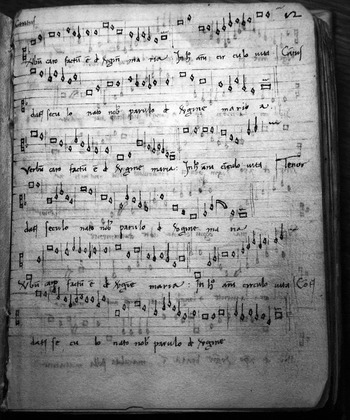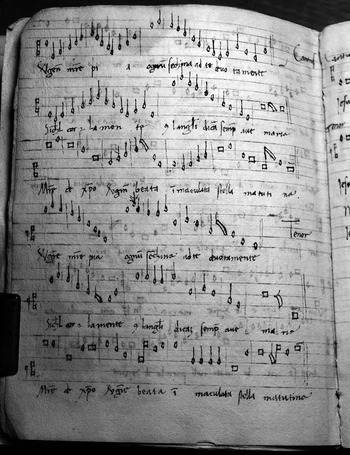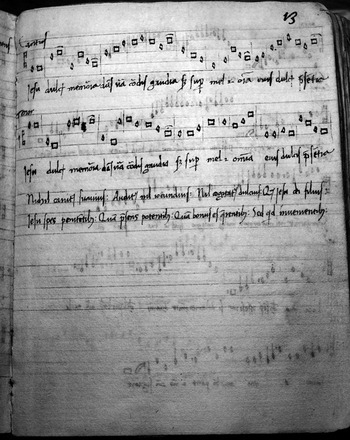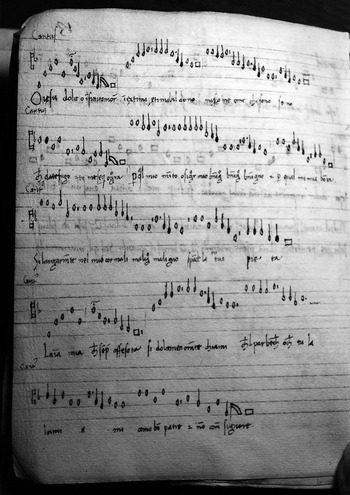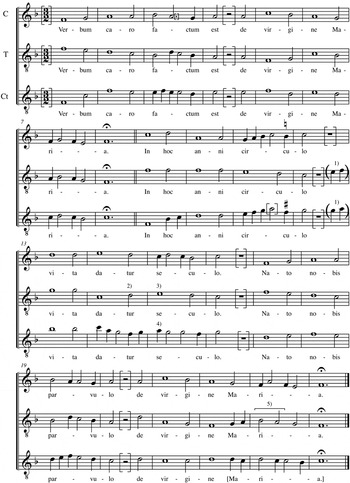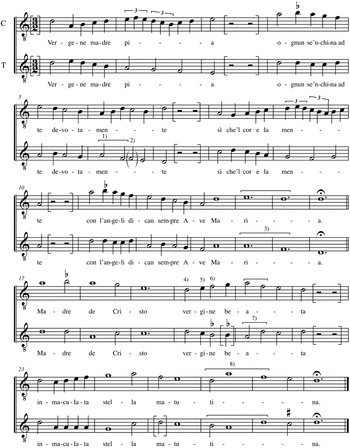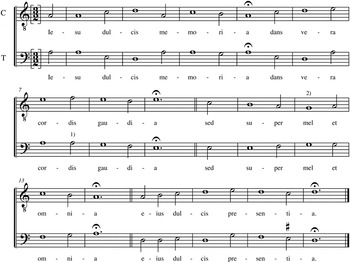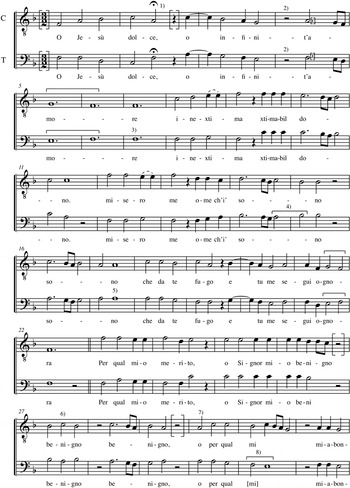


Manuscript 1/88 from the Library of St Isidore's College in Rome, of the Irish Franciscan Friars (hereinafter Rsi 88),Footnote 1 temporarily in the keeping of the Archive at the Order's Mother House in Rome, is of special interest to musicologists. This miscellaneous manuscript of small format (128×99 mm) comprises 268 folios (253 numbered and written and 15 blank, unnumbered); it was compiled in the second half of the fifteenth century, with works, or parts of works, in Latin or Italian, transcribed by various hands, but with many common graphic traits.Footnote 2 After a letter of St Bonaventure (fols. 1v–4r), a first set of vernacular laude and Latin hymns occupies fols. 4v–16r, some also provided with polyphonic music: Verbum caro, for three voices; Vergene madre pia; Iesu dulcis memoria; O Jesu dolce, o infinit'amore, all for two voices; a three-voice Veni creator spiritus; a two-voice Christe redemptor omnium/ex Patre patris unice; a three-voice Lauda Syon Salvatorem; and lastly a monophonicVerbum caro.Footnote 3 There follows, up to fol. 156v, another set of laude (texts only), many of which are clearly ‘pseudo-Jacoponian’, albeit attributed to the Franciscan poet, and Latin hymns and prose passages of a hagiographic and moral character (treatises, sermons, epistles, excerpta and exempla, etc.). On fol. 44r is the two-voice hymn Hic est Christus verus filius Dei, apparently an unicum. At fol. 157r begins the treatise De imitatione Christi et de contemptu omnium vanitatum mundi by Jean Gerson, which ends on fol. 205r with the date of transcription ‘mcccclxxxv’ and the names of the copyists Dionisius and Peregrinus, both ‘bononienses’, from Bologna.Footnote 4 From fol. 206r to fol. 248r, the manuscript contains other vernacular laude and a further set of prose passages wholly similar in content to the previous set. The codex ends with a fascicle (fols. 250–68) of which the first three folios (250v–253v) are scholastic exercises, probably written down by a sixteenth-century novice, translating sentences from the vernacular into Latin. The last fifteen sheets are unused. (For the inventory, see Appendix I below.)
The musical notation, in various hands and inks, is white mensural, without any mensuration sign (see Appendix III). It should be noted, however, that the single musical pieces are separated (except for O Jesù dolce, o infinit'amore) by bars drawn vertically on the stave from top to bottom, mostly coinciding with single words or portions of text. The staves are drawn accurately, except in the case of the monophonic Verbum caro and Hic est Christus, where they have clearly been drawn free-hand. The musical notation is not always correct from a mensural point of view, particularly with regard to ligatures and pauses, giving the impression that these pieces were transcribed almost extempore with a highly summary and approximate notation, reflecting perhaps the authentic features of the chant imprinted in the memory of the copyist or transcribed from performance. The vertical bars also seem to indicate that the copyist, rather than adhering to proper mensural notation, was trying to reproduce the free and pliable delivery of the single verbal images.Footnote 5 In conclusion, the notation seems to be purely indicative and functional with regard to the substantially declamatory rhythmic-musical progression of the poetic text, or of portions of it, almost like an outline to aid memorisation.
As for its provenance, the manuscript may have been compiled in a Franciscan convent in northern Italy, although it could equally be assumed that only some parts were transcribed by copyists from central-north Italy, as may be deduced by an abbreviation on fol. 154v that is typical of Milanese scribes of the fifteenth century,Footnote 6 and the presence on fol. 24r–v of the capitolo ternario on death Hora giamai se appropinqua l'aurora, found in as many as three Milanese prints.Footnote 7 Northern Italy is also suggested by the fact that, as compared to the ‘Tuscan’ anthologies, Rsi 88 presents a large number of ‘pseudo-Jacoponian’ laude as in the ‘Venetian’ books of laude or laudari.Footnote 8 This also involves the adoption of linguistic features that are typically northern – or, rather, of the Veneto – albeit alternating with central features, such as the possessives ‘to’, ‘toa’, ‘toi’, ‘soi’ and the pronouns ‘mi’, ‘ti’.Footnote 9 Furthermore, again by way of example, Anima dolce also includes the first person singular of the verb andare as ‘vagio’ and the present infinitive of the verb baciare as ‘basar(te)’. Lastly, a northern origin may also be indicated by the underlining on fol. 240v of the Florentine origin of Belcari, even in the rubric ‘Laude di Feo Belcari fiorentino’ and, on fol. 205r, at the end of the treatise by Gerson, the reference to two copyists as being ‘bononienses’.
At the same time, however, the presence of twenty strophes added to the moral ‘pseudo-Jacoponian’ Proverbia (fol. 29r–v),Footnote 10 transmitted only by Mad (fols. 87v–94v), drafted perhaps at Orvieto between the end of the fourteenth and the first quarter of the fifteenth century,Footnote 11 brings us back to a central Italian context, since ‘it appears that these verses can be more or less assigned to Umbrian culture at the end of the Duecento, early Trecento’.Footnote 12Mad also contains a rubric in which the proverbs are explicitly attributed to ‘frate Jacovone’: in view of the relationship between the two manuscripts, there are good reasons for suggesting that the mutilated Rsi 88 might have had a similar rubric.Footnote 13 Further confirmation is provided by the language of the texts, which, thanks also to their considerably later chronological setting (last quarter of the fifteenth century), seem generally and generically to retain, or go back to, even in the case of the ‘Giustinian’ laude, the central-Italian linguistic koine, testified by the use of numerous Jacopone-style terms – or at least Tuscan-Umbrian – such as ‘dificii’, ‘alliso/a’, ‘smesuranza, ‘involuppato’.Footnote 14 Even the six octaves that begin the poem O Augustino Aurelio doctore hark back to a central culture and could be the opening of a ‘song’ of a popular kind, a cantare, as shown by its characteristic narrative tone: indeed, the author, St Cyril, invites St Augustine, in direct and almost colloquial language, to narrate St Jerome's life.Footnote 15
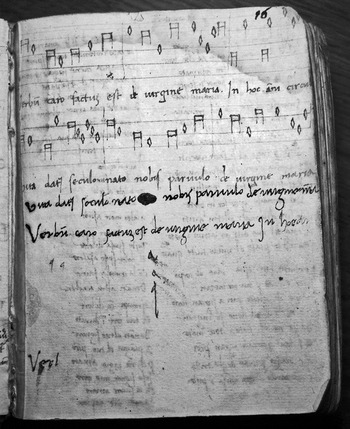
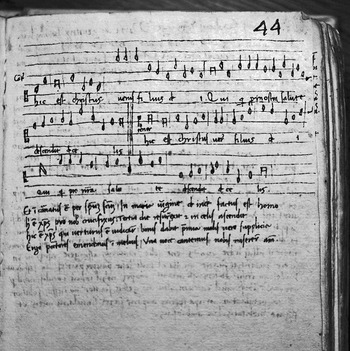
To return to the history of the codex, we cannot exclude the possibility that it is a collection of single fascicles of varying provenance and content, brought together in the first half of the seventeenth century, as shown by its title, Libro de diverse cose, affixed in the middle of fol. 1r by a contemporary hand.Footnote 16 This is confirmed by other aspects: (a) the different size of the fascicles; (b) the differing weight of the leaves;Footnote 17 (c) the trimming of the leaves with lacunae in the margins, especially top and bottom; (d) the variety of capitals, whether or not illuminated, titles, inscriptions, rubrics and paragraph marks; (e) the likeness – which can be observed in many cases – of the single fascicles, or groups of them, and the completeness of the works; (f) the inclusion (fols. 12v–15v) of a small fascicle of compositions with musical settings, placed immediately after the first booklet, containing mostly laude (fols. 4v–11v).Footnote 18 A further demonstration of the existence of pre-existing homogeneous booklets may be indicated by the fact that the monophonic Verbum caro factum est was added by a different hand from the one that copied the second fascicle (fols. 12v–15v) on the recto of fol. 16, with which the third fascicle begins, which is usually blank. At the same time, the hymn Hic est Christus was also written – both text and music – most probably by yet another copyist,Footnote 19 on the recto of the last page, also blank, of the fifth fascicle (fol. 44r).
Beside the many treatises and single texts in Latin in Rsi 88, indeed sandwiched among them, are forty-six poems, nine of which – as we have seen – have music. Of the poems, eleven are in Latin (hymns, sequences and other paraliturgical texts) and thirty-five in the vernacular (laude, Proverbia and a capitolo ternario). As far as we know, we can say that, of the unpublished vernacular poems (i.e. laude), two are unica: Verbum caro factum est/de virgine Maria/in quest'anno glorioso and O Augustino Aurelio doctore, and three have been transmitted only by one other source: Dè, va’, cor mio (also in Mad, fol. 200v),Footnote 20Leva la mente in alto (also in Pal 99, fol. 21v), Quanto fu dura Signore (also in Vat 7714, fol. 102v).Footnote 21Amor, amor Iesù, che m'ài ferito, although corresponding to three of the last six strophes (31, 33, 36) of Jacopone's Amor de caritate, is transmitted as a separate poem.Footnote 22 Of the Latin texts, only the hymn Hic est Christus appears to be an unicum in Rsi 88.
The capitolo ternario on death Hora giammai se appropinqua l'aurora deserves separate consideration. As far as we know, it is transmitted by two other codices, Rsi 83 and AqP, and by the incunabulum compiled by Bernardino de’ Busti, an Observant Friar Minor of the Province of Milan, with the title Incomencia la corona de la beatissima Vergine Maria (Milan: Leonardo Pachel, 1490) with the caption on fol. 53v: ‘Exultatione la quale fa el bono religioso <quan>do passa de questa miserabil vita’.Footnote 23
Since Rsi 88 is a Franciscan manuscript, it will certainly not come as a surprise that about half of the Italian laude are attributed to Jacopone da Todi: Altissima luce; Amor, amor Iesù;Footnote 24Amor de caritate; Amor Iesù dilecto; Anima mea da Cristo si’ smarrita; Che fai (Que fai), anima predata; Chi vole trovare amore; Facciam facti; Iesù faccio lamento; Non se tenga amatore; O anima fidele/che voi de Dio sentire; Signor mio io vò languendo; Troppo ben perde tempo. Other attributions stated in the captions concern Udite macta pazzia, assigned to Feo Belcari (although in other sources Jacopone is also indicated as the author), and the two Latin hymns Dulcis Ihesu memoria and Plange fidelis anima, both attributed to St Bernard. Of the laude in Rsi 88 assigned to Jacopone, two, Amor de caritate (plus Amor, amor, Iesù) and Che fai anima predata, are almost certainly – at least according to Franco Mancini – by the poet from Todi.Footnote 25Altissima luce, an ancient lauda in the Cortona tradition, is ‘signed’ at the final stanza by ‘Garçone’ (‘Garço’), a figure still not identified with any certainty, as we shall see below. Of the others, Iesù faccio lamento and Signor mio io vò languendo are attributed in the other sources to Ugo Panziera;Footnote 26Non se tenga amatore in BU 2650, fol. 99v to Francesco d'Albizo;Footnote 27Anima mea da Cristo si’ smarrita in Chig, Ross 651 and in Marc 182 and 244 to Bianco da Siena Gesuato; and Amor Iesù dilecto to Leonardo Giustinian. With regard to Facciam fatti in Ricc 2929, fol. 197v, the caption reads ‘Lalde fatte per Santo Bernardino da Siena dell'Ordine de’ frati minori di Sancto Francescho’,Footnote 28 whereas in Fe it is doubtfully assigned to Bianco da Siena.Footnote 29 Among the anonymous laude, according to the authoritative Giustinian Codex Vgr 1, the following texts should be attributed to Leonardo Giustinian: Vergene madre pia, O Jesù dolce, Anima pellegrina, Laudiam l'amor divino,Footnote 30Ave Maria (verçene) gloriosa and O Maria diana stella (in other sources also assigned to Clemente Pandolfini). Again with regard to anonymous laude in Rsi 88, we note that O povertà gloriosa and Udite nova pazzia in some sources are attributed to Jacopone and that Feo Belcari is given as the author of Tanta pietà mi tira.Footnote 31 A further element of interest is the presence of two laude belonging to the more ancient repertory, known as ‘cortonese’: Altissima luce and Troppo ben perde tempo. This peculiarity had already been highlighted in the case of a Faenza codex dated 1426, now Vat 11251, which, with as many as eleven ‘cortonese’ laude, provides ‘a further demonstration of the popularisation after the thirteenth and fourteenth centuries and in various regions of Italy of the Tuscan-Umbrian lauda tradition (laude from the “cortonese” repertory are even found in late manuscripts such as the Patetta by Finalmarina dated 1537)’.Footnote 32 The survival of these laude is easily explained if we consider that many of the more recent manuscripts, especially those belonging to the Franciscan tradition, transmit laude by Jacopone or attributed to him: many of the ‘cortonese’ laude belong to the same context. Examples, among many, are Ave, Vergene gaudente, Oimè, lasso e freddo lo mio core, Ogn'om si sforzi d'ordinare, Sia laudato san Francesco and Troppo ben perde tempo. The Franciscan codex Rsi 88 thus provides fresh evidence of this long lauda tradition.
In such a context, of particular interest is the example provided by Altissima luce, which, in Rsi 88, consists of ten strophes exactly as in Cort, the oldest and most authoritative source.Footnote 33 The sole significant difference is found in line 41, where Cort has ‘Garço doctore di voi, donna, canta’,Footnote 34 whereas Rsi 88 reads ‘El tuo garzon de te parlla e canta’, which coincides exactly with the Orvietan Mad ‘el tuo Garçone di te parla e canta’.Footnote 35 This agreement of the two sources might lend greater weight to the reading ‘Garçone’, until now attested solely by Mad. We do not, however, wish to discuss the basic – and still unsolved – problem of the identification of the character ‘Garço/Garçone/Garzon’, whether he was the great-grandfather of Petrarch (‘Garço doctore’ by Cort) or the musician cited under the name of ‘Garçone’ in line 8 of the sonnet by Nicolò de’ Rossi Io vidi ombre e vuy al paragone.Footnote 36 We merely observe that the reading ‘Garçone/Garzon’ appears only in Mad and in Rsi 88, the captions of which attribute the composition to Jacopone: therefore, in such a case, it is more likely to be a simple corruption of the common noun ‘garzone’, i.e. servant (without any reference to the musician cited by Niccolò de’ Rossi). In this respect, it is interesting to note that in Mad and in Rsi 88 this elusive ‘Garço’/‘Garçone’, even when addressing Jesus Christ or the Virgin Mary, uses a familiar and colloquial tone: ‘el tuo Garçone di te parla e canta’, completely unlike the ‘Garço doctore di voi, donna, canta’ of the Cortona tradition.Footnote 37
Turning to Troppo ben perde tempo, we note that it is transmitted by Mad Footnote 38 with an almost identical incipit (Troppo ben perde ’l tempo). Also very similar is the caption: Rsi 88: ‘Jacobone dell'amor de Dio’; Mad: ‘Lauda di Frate Iacovone. Dell'amore e dilection di Dio’;Footnote 39 the reading in line 51, second hemistich, ‘dello tuo singniore’ vs. ‘del tuo salvatore’ (Cort and others), and the number of strophes: seven in Rsi 88, thirty in Mad (albeit in two inverted groups).Footnote 40
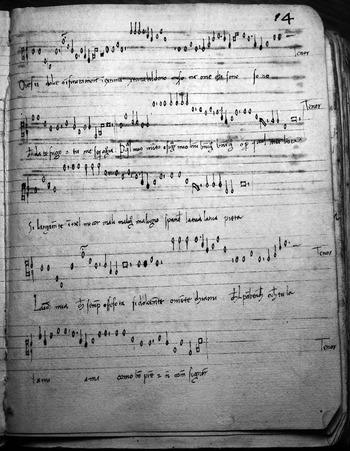
As stated earlier, nine pieces in Rsi 88 are also provided with musical notation: of these, seven are given on fols. 12r–15v, one on fol. 16r, the first of a new fascicle, and the last on fol. 44r. The two bifolia comprising fols. 12–15 constitute a separate booklet that belonged – presumably right from the beginning – to a larger one, and is still bound to the quintern/sextern that precedes it (fols. 1–10+1), containing – starting at fol. 4v – the poetic texts of an initial set of laude, two of which (Verbum caro and Vergine madre et pia) we find again below (fol. 12v: Vergene madre pia), also with their related musical notation. The inclusion of these two laude, both in the section devoted to poetic texts and in the one set aside for the related music, seems to strengthen the hypothesis of the original union of the two booklets. Vice versa, in the case of O Jesù dolce, the version set to music is found on fols. 13v–14r but the complete text much later on (fols. 237v–238r), as is the famous ‘jubilus’, the hymn attributed to St Bernard, Jesu dulcis memoria, the text of which is copied at fols. 103v–104r, whereas its two-voice setting had already been transcribed at fol. 13r. It is interesting to note, however, that many other laude, of which Rsi 88 transmits only the text, are also provided with musical settings in other sources. These include:
• O Maria diana stella, attributed to Leonardo Giustinian, transmitted in a two-voice version in Berlin (no. 6) and Western 84 (fols. 63v–64), and in a four-voice version in Razzi;
• Ave Maria gloriosa, also attributed to Giustinian, transmitted in a two-voice version in Marc 145, fols. 170v–171r;
• Altissima luce, transmitted monophonically in Cort, fols. 17r–19v and in BR 18, fols. 43r–44v;
• Troppo ben perde tempo chi non t'ama, present in monodic form in Cort, fols. 72r–82v (with the incipit Troppo perde ’l tempo/ki ben non t'ama);
• Amor Jesù dilecto, in many manuscripts attributed to Jacopone, is found in a two-voice version in Marc 145, fols. 134r–135v;
• Iesù faccio lamento, attributed to Ugo Panziera, is transmitted in a three-voice version in Grey, fols. 70v–71r;
• Anima pellegrina, for three voices, in Grey, fols. 65v–66r, in Aldini, fol. 11v, Bergamo, pp. 152–3 (music) and 158–9 (text only),Footnote 41 and in Petrucci 1508, fol. 54v (incipit: Anima benedicta; music by Innocentius Dammonis);
• Laudiam l'Amor divino, set to music in a four-voice version by Innocentius Dammonis, and published in Petrucci 1508, fol. 15v.
Among the laude, Rsi 88 also includes the Latin text of the sequence Gaude Virgo mater Christi, found as a hymn in Marc 145, fols. 127r–128r (3 voices); Panc, fols. 29v–30v (4 voices);Footnote 42Feininger, fols. 230–1 (3 voices);Footnote 43 and Western 84, fol. 63r (2 voices). Furthermore, immediately after the section containing the polyphonic settings, ending on fol. 16r, on fols. 16v–17r is found the text of the lauda attributed to Giustinian Anima pellegrina, of which four musical versions are known, two for two voices in Aldini, fol. 11v and Bergamo, pp. 152–3 (in black notation), and the other in a three-voice version in Grey, fols. 65v–66r and in the version printed by Ottaviano Petrucci, Laude Libro Primo (1508), with music by Innocentius Dammonis. The inclusion of so many laude without music in Rsi 88, but with music in other sources, means that we cannot exclude the hypothesis that the persons who transcribed and/or used this Franciscan codex were also capable of singing some of the laude not provided with musical notation, known from the oral tradition, also perhaps through the very widespread ‘cantasi come’ [sing as] (henceforth ‘c.c.’) tradition. Examples of this are the following laude:
• Facciam facti, c.c. Udite matta pazzia (Maruc, fol. 130r)
• Udite una pazzia, c.c. Senno mi pare e cortesia (Chig, fol. 40v and Ross 424, fol. 179v)
• O Maria diana stella, c.c. Uscirò di tanti affanni (Pal E. 6. 5. 2, fol. 137v) or Galantina morosina (Mgl 30, p. 68)
• Tanta pietà mi tira, c.c. O lasso me tapino sventurato (Gall 1, p. 1) or Al monte santo Gesù apparia (Chig, fol. 44r; Fn II VII4, fol. 10v; Mgl 367, fol. 31r; Mgl 690, fol. 2r; Cors 43 D 3, p. 3).
In turn, however, the tunes required in the captions to sing these poems often refer to other musical settings – secular or sacred – again with the function of ‘cantasi come’, creating a network of cross-references that is often highly intricate and complex.
Of the two-voice lauda for the Annunciation Vergene madre pia (fol. 12v), in ballata form, Rsi 88 provides as a rule only the music for the refrain and the first piede.Three other musical settings, substantially similar to the one in Rsi 88, are found, two of them, in Marc 145, fols. 27v–28r, no. 14 and fols. 171v–173r, no. 95 respectively, and the third in Aldini, fol. 5r–v.Footnote 44 The text alone is found, besides in Rsi 88, fol. 5v (Vergine madre et pia), also in Ham, fols. 142v–143 (the only source to attribute it to Giustinian),Footnote 45 in Marc 145, fols. 53r–v and 193v–194r, Marc 182, fol. 211v, Vgr 2, fol. 93r–v, Cap, fol. 10v.Footnote 46 The last-mentioned (Vergine madre et pia, in Rsi 88, fol. 5v), in lines shared with the musical version (ripresa and first piede), also presents, besides the incipit, other significant variants such as those in ll. 3 and 4: ‘collo core e colla mente/coll'Angel dican sempre Ave Maria’ vs. ‘sì che ’l core e la mente/coll'angeli dican sempre Ave Maria’, the latter reading being the one on which all the musical and some of the literary sources agree. The reading ‘coll'angeli’ vs. ‘coll'Angel’ is also confirmed by the music, which adds a note above the syllable ‘li’ of ‘angeli’. The variant might thus be not only metrical and/or grammatical, but also semantic.
Giampiero Scardin, collating the three Veneto versions with that of Capestrano (Cap), observed not only a great difference in the number of strophes, from a minimum of three to a maximum of seven, but also numerous shifts in their order and the inclusion of new strophes. He therefore concluded that it was a ‘rather rare phenomenon in the field of lyric poems transmitted by the various codices, and clear proof of the great popularity achieved – in the fifteenth century – by this lauda, of which not even the author is known’.Footnote 47 Scardin's reasoning could also find confirmation in Madre de Christo, vergene beata found in Ud (fols. 15v–16r), set to music presumably by Pietro Capretto (Petrus Hedus).Footnote 48 Indeed, the text of the first quatrain matches that of the first stanza of Vergine madre et pia (on fol. 5v), whereas the second and the third, from a metrical point of view, correspond precisely to the refrain. In substance, we could possibly be dealing with a composition borrowed from the lauda-ballata Vergine madre et pia, of which it took part of the text of the first stanza (the first two piedi) in the first quatrain and the rhyme scheme of the refrain in the second. The two texts are as follows:

Besides the music, what changes totally is also the musical scheme, which in Madre de Christo (abab cdcd) seems undoubtedly closer to that of a frottola than to that of a ballata. Such a structure leads to the conclusion that the Ud version is an adaptation of an earlier text (Marc 145) rather than the contrary.Footnote 50
With regard to the musical differences among the four versions of Vergene matre pia that have come down to us, Rsi 88 (see Appendix IV, no. 2) agrees substantially with the other sources, except for a few minor details that we shall now seek to illustrate. We should first note the sequence of four minims in the Cantus at bar 20 on ‘vergene be-’, where the other sources indicate alternating semibreve, minim, semibreve, minim.Footnote 51 This is strange precisely because at another point, at ‘(di)can sempre A(ve)’ (b. 12 of the Cantus), Rsi 88 transmits this rhythmic reading after a succession of descending minims. A further unique variant is found in the Tenor at bars 6–7: after the ligatura cum opposita proprietate a–f, the f is repeated, as a semibreve, but should perhaps be expunged. On several occasions, Rsi 88 agrees only with Aldini against the two versions of Marc 145, as for example in bar 4 of the Tenor, at ‘ognun se ’nchina’, in the sequence d′–d′–c′–c′–d′ against the d′–d′–d′–c′–d′ of the two Marc 145 versions. In other cases, Rsi 88 agrees only with two sources, Aldini and Marc 145 (first version), or Aldini and Marc 145 (second version), but this is not the right place to discuss all the variants of the four sources in detail. What has been said so far, however, already allows us to conclude that in the case of even the polyphonic laude, most of the variants could have been generated in the context of an oral tradition, precisely because the genre had always enjoyed wide circulation and popularity. It is also true, however, that some variants may depend on copyist errors, simplifications, omissions, misunderstandings of the melodic and mensural reading, the lack of attention to pauses and to the position of single notes and clefs. For this reason, it is not always feasible to employ strictly philological and textual criteria, which are too restrictive and one-sided for a genre of musical production the written documents of which very often mirror real-life performance. The Rsi 88 version is thus just one of many possibilities, naturally with its own specificity, but also with a series of melodic, rhythmic and harmonic readings that have become stratified in the course of the oral and written traditions.
Vergene madre pia is particularly interesting in various ways also on a musical level. First we should note, at bars 6–7, the presence of the so-called ‘Landini’ cadence, which might on the one hand be an archaism, but on the other could also be a sign of the actual antiquity of the piece. The overall musical structure of the refrain substantially follows the poetic text, which comprises alternating seven-syllable lines and hendecasyllables (xYyX), and then alternating melodic repetitions corresponding to the metric scheme (except for bb. 8–9, which in Rsi 88, Aldini and Marc 145 (fols. 27v–28) are one tone lower with respect to the corresponding bb. 1–2). This results in an ABA′B′-type musical structure not very different, however, from that of Madre de Christo, seen above, set to music by Petrus Hedus in a more ‘frottolistic’ manner and borrowing from the ‘original’ version only the first part of the stanza (i.e. the two piedi). The complete musical schema (like a ballata) of Vergene madre pia is then, perhaps, as follows: ABA′B′|CD[CD|ABA′B′]. Also of interest is the fact that at the end of the refrain, with the beginning of the two piedi, the musical progression of the piece changes radically, since the use of longer values, such as the breve and semibreve, gives greater importance to the triple rhythm. Significant too is the emphasising of the acclamation ‘Ave Maria’ at the end of the refrain by utilising ligatures in long notes.Footnote 52 Lastly, of interest is the way in which the text–music relationship is treated in the second and fourth lines of the refrain, both hendecasyllabic (although in actual fact the fourth, since the synaloepha is not followed in any of the sources, is dodecasyllabic). In the case of the second line, the melody follows the poetic text syllabically up to the tenth syllable (the penultimate), after which comes a brief but articulated melisma (‘ognun se ’nchina ad te devotamen – [te]’). In the fourth line, following Rsi 88, the situation is entirely different: to emphasise still further the name ‘Maria’ that comes at the end of the line, the copyist detaches it from the rest of the line, doing so in such a way that the melody used to intone the first ten syllables of the second line can also be employed to sing the fourth, curtailing the three syllables of the name ‘Maria’. This has involved increasing from eight to ten the number of syllables composing this initial portion of line, not including the synaloepha between ‘sempre’ and ‘Ave’, and modifying ‘l'Angel’ to ‘l'angeli’. By means of this operation, the original hendecasyllable becomes a line of thirteen syllables and the portion of text corresponding to the words ‘con l'an-ge-li di-can sem-pre A-ve’, now being ten syllables, can easily be sung to the melodic section used to sing ‘o-gnun se ’nchi-ni ad te de-vo-ta-men-[te]’.
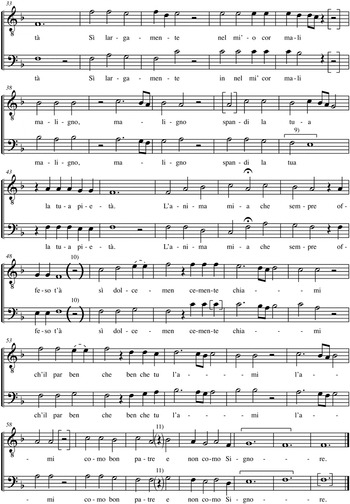
O Jesù dolce (see Appendix IV, no. 4), attributed to Leonardo Giustinian, has been transmitted by a great number of literary witnesses, but only seven musical versions have reached us: Wash, fol. 110v, monophonic;Footnote 53Rsi 88, fols. 13v–14r, Grey, fols. 67v–68r,Footnote 54Razzi, fols. 60v–61r,Footnote 55Western 84, fols. 71v–72 for 2 voices; Panc, fol. 50v, for 3 voices;Footnote 56Petrucci 1508, fols. 59v–60r (music by Innocentius Dammonis)Footnote 57 and Petrucci 1507, fol. 24v (music by Baldasar), for 4 voices.Footnote 58 With the exception of Rsi 88, all the musical sources are incomplete for they have the music of the refrain and of the first piede only.Footnote 59 In Rsi 88, instead, the first stanza of this lauda has been transcribed, text and music, in its entirety, i.e. in all its parts, refrain, first and second piede and volta, presumably to embrace the numerous musical differences even between symmetrical sections (refrain/volta and piede i/piede ii). This circumstance makes the Rsi 88 version particularly interesting from a performance point of view, since it shows that the variants are mostly linked to the poetic text and its metric peculiarities. First of all, the fact that in some sources (Panc, Rsi 88, Petrucci, Razzi) the first truncated line (‘amor’) of the presumably ‘original’ text (see Wash, Western 84 and Grey) is set to music as paroxytone (‘amore’) means that the final line of the refrain and of the stanza become paroxytone in turn (respectively ‘ognora’ [but also in Grey and Western 84] vs. ‘ognor’ of Wash and ‘signore’ [also in Grey and Western 84] vs. [‘signor’?] of Wash); but if ‘amor’/ ‘ognor’/[‘signor’] (in Wash) do make rhyme correctly, the words ‘amore’/‘amor’ (Grey and Western 84) vs. ‘ognora’/ ‘signore’ (in the other sources) do not match perfectly. The two texts are as follows:Footnote 60

Moreover, the shift from the truncated line to the paroxytone cannot occur for the first line of the volta – usually sung to the music associated with the first line of the refrain – since the rhyme, normally linked to that of the previous line (‘spandi la tua pietà’), in this case is necessarily truncated (‘l'anima mia che sempre offeso t'à’). This causes a modification to the musical setting of the line, which, as already mentioned, as a rule should coincide with the first line of the refrain (in this case, paroxytone). It is also interesting that the hendecasyllables, on a musical level, have been split into two hemistichs without the synaloepha, the first of five syllables and the second of seven (5+7). In this respect, however, the final cadence shows other variants (beside those caused by the paroxytone ending) since the copyist has considered the second hemistich of the last line of the refrain also without the synaloepha, as some kind of eight-syllable line (‘e tu me se-gui o-gno-ra’), whereas the corresponding line at the end of the stanza is normally of seven syllables (‘e non co-me Si-gno-re’). This simple discarding of one syllable has given rise to a rather significant variation between the two musical settings.
With the premise that in many cases the synaloepha is not observed in musical settings, it is interesting to note, however, what the copyist of Rsi 88 does with the first line of the second piede, which, although it should be a hendecasyllable, has been subdivided into two hemistichs (5+7), the first of five syllables (‘sì lar-ga-men-te’) and the second of seven (‘nel mi-o cor ma-li-gno’). The fact that the second hemistich was considered heptasyllabic can also be inferred from a comparison with the matching line in the first piede (‘o Si-gnor mio be-ni-gno’). In the latter, however, ‘mio’ is deemed a monosyllable, whereas in the second piede, to make the accounts balance, it has to be treated as a bisyllable. It is also interesting to note that in the Cantus, ‘mio’ is counted as a bisyllable, while in the Tenor it figures as ‘mi’, which has obliged the copyist to add a syllable at the start of the hemistich in order to complete the heptasyllable (‘in nel mi’ cor ma-li-gno’). In the poetic version set to music, the first hemistich of lines 1 and 3 of the stanza also shows a considerable syllabic difference: the first piede is hypermetrical (seven syllables: ‘Per qual mi-o me-ri-to’)Footnote 61 while the second is correctly pentasyllabic (‘sì lar-ga-men-te’). The most significant example of syllabic difference, however, occurs in the second and fourth lines of the stanza – which as a rule (but not, of course, in Rsi 88!) should be two truncated seven-syllable lines – with their related musical and rhythmic differences (‘o per qual mi-a bon-tà’, for the second, and ‘span-de la tu-a pi-e-tà’, for the fourth). As we can see, the person who transcribed this lauda, in copying it in its entirety, was being careful, owing to the many metric and thus musical differences between the matching parts of the ballata structure: the first/second piede, refrain/volta. In general, these musical versions are all different from each other; it should be noted, however, that the melody transmitted by Wash as the Tenor, and albeit with many variants, is also in Panc, Rsi 88, Grey and Razzi. In Western 84 the melody of the Tenor partially agrees, obviously with many exceptions, with the Cantus of the other sources. Note too that in Rsi 88 this lauda lies a third higher than the other versions, which poses various problems of musica ficta, and that the fermata in the other sources placed on the last syllable of the hemistich ‘O Jesù dolce’ in Rsi 88 is oddly situated above the first note of the following hemistich (‘o infinito’/‘che sempre’).
The links between Rsi 88 and the other versions (especially Panc, Wash, Grey and Razzi) go well beyond the same Tenor being used by all five sources, albeit with numerous differences. They even share the same way of conceiving the text–music relationship, presenting a considerable number of common rhythmic, stylistic and harmonic practices, first and foremost the repetition of several sections of text, or single words, whether whole or in part, as can already be seen in Wash (‘che sono’, bb. 13–17), a trend that is significantly more articulated in Panc (‘misero mi|misero mi|che sono|che sono’), in Grey (‘inextima|xtimabil dono|misero mi|o mi|che sono|sono’) and in Razzi (‘inestimabil don|o inestimabil don|dono|misera me ch'i’ sono|ch'io sono’). In Rsi 88, however, it is even more accentuated: ‘inextima|xtimabil dono|misero me|omé ch'i’ sono|sono’; ‘o Signor mio benigno [‘beni’ in the Tenor]|benigno|benigno’; ‘mali|maligno|maligno’; ‘sì dolcemen|cemente chiami|ch'il par ben che|ben che tu l'ami|l'ami’.Footnote 62 This technique of repeating various phrases, words, or even just syllables, also the opposite of breaking them or interrupting them in a manner that is not always logical, recalls very similar practices in Ars nova musicFootnote 63 and may well confirm the antiquity of the piece. Common to all sources is also the tendency to declamation, frequent recourse to pauses to isolate parts or portions of text and, lastly, the employment of extremely simple harmonic processes.
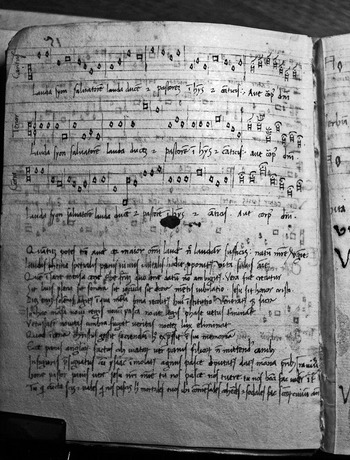
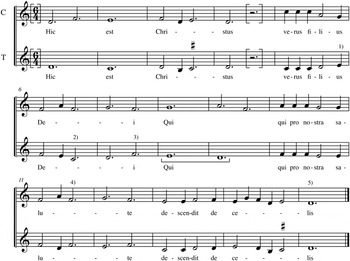
As far as the liturgical pieces in Latin are concerned, we should first note that some are in cantus fractus.Footnote 64 These include the three-voice Lauda Syon, the monophonic Verbum caro, the three polyphonic hymns Veni creator spiritus, Christe redemptor omnium, and Iesu dulcis memoria and lastly, the two-voice hymn, apparently an unicum, Hic est Christus. The text is as follows:

Apart from using cantus fractus, it seems possible to affirm that many pieces in Rsi 88 were composed in the style and with the technique now known as ‘simple polyphony’,Footnote 65 featuring a rather elementary movement of the voices and very simple harmonic structures based mainly on thirds, fourths, fifths, octaves and unisons, with frequent homorhythmic and homophonic movement, especially when associated with cantus fractus.
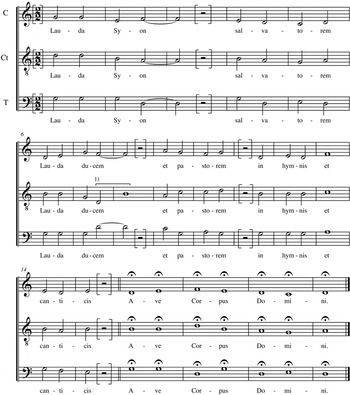
The sequence Lauda Syon, inserted in the liturgy for the feast of Corpus Christi, has been transmitted in many manuscripts. In some of them, however, including Rsi 88, it is presented in the form of a hymn. This means that, whereas in the sequence the twelve pairs of strophes are each sung to different music, in the hymn all the stanzas are sung to the same music. Furthermore, the hymn version suggests that in this form it was also utilised during eucharistic adoration. The rigorously isostrophic sequence Gaude Virgo too, also in Rsi 88, albeit without music, may also have been sung as a hymn, precisely as it is in, among others, Panc,Footnote 66Marc 145, Western 84 and Feininger, in which a musical setting is provided for the first strophe. This may have come about thanks to its isostrophic form. The shift in form from sequence to hymn with its related liturgical-functional change, is not infrequent in the fifteenth and sixteenth centuries. One particularly interesting case is that of the Stabat mater (in many sources attributed to Jacopone), which was also originally an isostrophic sequence, but very early on transformed into a hymn or lauda.Footnote 67
In the case of Gaude Virgo we may also note that the Rsi 88 version, as compared to the texts known from other sources, comprises nine strophes, two of which are presumably unica: the third and seventh. The text is as follows:

To illustrate the various changes over the centuries, let us start with the text of the sequence published in Analecta Hymnica Medii Aevi (hereinafter AH), vol. 42, no. 73, from a missal printed at Rouen in 1506, comprising eight pairs of strophes (each of three lines), of which the odd ones, 1a, 2a, 5a, 6a, 7a, and the even one of the final pair, 8b, according to the editors of the AH ‘form the original sequence (perhaps at first a rhymed prayer), which here, as so often, has undergone an expansion’.Footnote 68 These six ‘oldest’ strophes, in the same order, are found in Tr 87, in this case a true sequence attributed to H. Battre, in which, according to alternatim practice, the matching even strophes do not appear in the manuscript. But they are found normally, also in different order, position, number (from 6 to 24 stanzas) and musical settings, in hymn form as well. In Rsi 88 they match stanzas 1–2, 5–6 and 8–9. The shift from sequence to hymn is easily realised since the text is in an isostrophic form, i.e. with the same metrical and rhyme structure (mostly: aax, bbx, and so on, in the hymn form).
The sequence/hymn Gaude virgo mater Christi, in celebration of the Joys of the Blessed Virgin, is one of the most widespread and best known of all rhymed Latin prayers. It has been transmitted, in different textual and musical versions, in various kinds of manuscripts and prints: liturgical books, laudari, books of hours, motet collections and miscellaneous volumes containing devotional texts, prayers, sermons, sentences, laudi, precepts and so on.Footnote 69 In many sources Gaude virgo is labelled ‘sequence’, but in the musical sources, because of its isostrophic form, it appears mostly as a hymn in which the first stanza only is set to music. As already said, as hymn it is found in an anonymous musical version transmitted by Marc 145,Footnote 70Panc,Footnote 71Feininger Footnote 72 and Western 84. Moreover, as a contrafactum, this version was also sung to the text Gaude flore virginali, as transmitted by Q 15, fol. 280, no. 285 (3 voices);Footnote 73 Bologna, Biblioteca Universitaria, MS 2216, fol. 22r (3 voices);Footnote 74 Milan, Biblioteca Nazionale Braidense, MS AD.XIV.49, fol. 84v (2 voices);Footnote 75 and Western 84, fol. 68r (2 voices, same Tenor but different Cantus). Moreover, this ‘sequence’ is found in motet form in three through-composed four-voice versions, by Du Fay (in Q 15, fols. 206r/8v–210v, no. 193Footnote 76 and Munich, Bayerische Staatsbibliothek, MS clm 14274, formerly Mus. MS 3232a, fols. 5v–7r, but presumably a true sequence according to alternatim practice, as in Tr 87), and Innocentius Dammonis (in Petrucci 1508, fols. 22v–23r),Footnote 77 and in a through-composed three-voice version by Innocentius Dammonis (Petrucci 1508, fol. 22r).Footnote 78 Moreover, with the text Gaude flore virginali and in motet form it was also set to music in a four-voice through-composed version by Innocentius Dammonis (Petrucci 1508, fols. 23v–24r),Footnote 79 and anonymously in Petrucci 1507, fols. 20v–21r.Footnote 80 The tradition continues into the sixteenth century.
The different arrangements of strophes in the transmission of a text can be ascribed to its popularity and widespread circulation, having been deliberately reworked by copyists and/or singers to satisfy the expectations of users and the public. This phenomenon affects all late-medieval compositions of popular origin, whether Latin or – more especially – vernacular. As a result, each version should now be considered an unicum and should be published as such according to the version provided by each separate source. Indeed, each variant is ‘authentic’, since it belongs to the category of rewriting or readapting an older poem that has become part of ‘popular’ tradition. Such rewriting not only affected the texts and related musical settings, but was responsible for introducing new strophes, eliminating others and rearranging their order.Footnote 81
To return to Lauda Syon (see Appendix IV, no. 7), the following is a list of musical manuscripts – certainly not exhaustiveFootnote 82 – in which the sequence appears in hymn form: Rsi 88 (Franciscan), fol. 15v; Feininger (of Franciscan origin), pp. 236–7;Footnote 83Pal 472 (probably also Franciscan), fol. 15v;Footnote 84Panc, fol. 20v,Footnote 85 all for three voices; Western 84, fol. 63, and BA, fols. 183v–184 (of Dominican origin), for two voices (the first strophe only).Footnote 86 The Cantus and Tenor parts are substantially the same in the five sources, and even the Contratenor agrees, except for a few variants, with the other versions, although not with Panc, which gives a rather different melodic reading.Footnote 87 In the hymn version, at the end of each of the first six strophes (all three-line), marked by a solidus (single or double bar), a proparoxytone fourth line appears like the previous one (except for the last two, which are paroxytones), sung almost like an acclamation to a melodic phrase with long notes and even with fermatas. The six additional lines are as follows: Ave Corpus Domini – Natum matre virgine – Vita salus anime – Vera fide creditur – Ihesu sit honor Christo – Veneratur quia sacrum. Starting from the sixth strophe, the hymn proceeds regularly up to the ninth, following the order of the original sequence. All these strophes are also three-line and can thus be easily sung to the melody accompanying the first, which ends with a small cadence prior to the single/double bar. In the hymn version, after strophe 9 it continues with strophes 10 and 11 (ex 21 and 22), quatrains, followed in turn by the two final strophes 12 and 13 (ex 23 and 24), both with five lines:

How would the strophes with a greater number of lines than the first, a tercet, have been sung? Stanzas 10 and 11, being quatrains, might easily have been sung by repeating the melody associated with the second line of the tercet, while the last two, strophes 12 and 13, having five lines, might have been sung by repeating the music of the two first lines, with the following musical structure: ABCX, for a tercet; ABBCX, for a quatrain; and ABABCX, for the five-line strophes. Little assistance is given by Feininger, the only source, it appears, with only five strophes, all quatrains, i.e. a tercet plus the ‘additional line’, the acclamation. However, the fact that they end with ‘Ave, Corpus Domini’ for the first, second and fourth, and with ‘Ave, Mater Domini’ for the third and fifth respectively seems to show that, as far as the ‘additional line’ is concerned, the tradition is not uniform. This is also confirmed by the fact that the acclamation ‘Ave, Mater Domini’ is not found in Rsi 88. As we can see, in the musical tradition, the shift from sequence to hymn form occurs in different ways, both with regard to the textual reading of the ‘additional line’, and with the number of lines in each stanza.
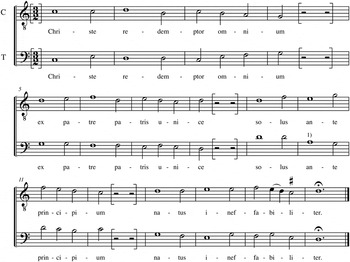
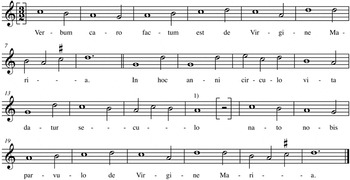
Of the Christmas poem Verbum caro factum est (see Appendix IV, no. 1) a great number of sources and witnesses exist,Footnote 88 but the versions closest to Rsi 88 (fol. 12r), as far as the Cantus and the Tenor are concerned, appear in Feininger (pp. 234–5, no. 4),Footnote 89 in Berlin, transposed a fourth below,Footnote 90Western 84 (fol. 65v, for two voices), and in Rocca di Botte.Footnote 91 The only real difference lies in the fact that the Feininger, Western 84 and Rocca di Botte versions are for two voices, whereas the Berlin and Rsi 88 versions are for three, with an added Contratenor part (although Berlin is different). This Verbum caro also seems to be in cantus fractus, as is the one copied by another hand on fol. 16r in a monophonic version. Of the famous hymn (also known as ‘jubilus’), attributed to St Bernard, Jesu dulcis memoria (or Dulcis Jesu memoria) (see Appendix IV, no. 3), the repertories provide only one three-voice version in Aldini,Footnote 92 on fol. 13r, and two versions, one for two voices (pp. 228–9, no. 1) and one for three (pp. 246–47, no. 10) in Feininger. The Rsi 88 version is for two voices and in cantus fractus, like the one – again for two voices – in Feininger. The melody, as also in the other two sources, is independent of the Gregorian melody, at least according to the version in Liber Usualis.Footnote 93Rsi 88 is distinguished, however, by the fact that on the word ‘memoria’ we note the same melodic phrase (albeit a fifth higher) found in LU. The Feininger and Aldini versions are different, the former being more elaborate and the latter being rigidly syllabic. Also in cantus fractus is the three-voice version of the hymn Veni creator spiritus,Footnote 94 with frequent passages and progressions in homorhythmic style, whose melody does not seem to be linked to any known setting (see Appendix IV, no. 5). Totally homorhythmic and homophonic is the two-voice hymn Christe redemptor omnium, which is also in cantus fractus (see Appendix IV, no. 6). The last piece set to music in Rsi 88 is the short and simple eucharistic hymn Hic est Christus, for two voices, which we note here only because it is an unicum (see Appendix IV, no. 9).
In conclusion, we may affirm that the musical interest of Rsi 88 does not consist merely in having transmitted a set of polyphonic Italian laude and Latin hymns, some of which are unica, but also lies in its confirmation of a ‘simple’ polyphonic tradition in Italy still during the fifteenth century that flowered parallel to the refined, artistic and sophisticated traditions and that was practised in monastic environments, particularly those belonging to the Friars Minor. One of the many interesting aspects of this tradition is its transmission, not in official liturgical books, but in miscellaneous kinds of manuscripts mostly of small format and for personal use, containing treatises, lectures, sermons, prayers, excerpta, alternating with a rich and varied poetic production, especially of Italian laude, Latin hymns and sequences, with and without music, of a popularising taste and tradition. A further interesting aspect of Rsi 88 is the fact that O Jesù dolce, o infinit'amore has been written out – both text and music – in its entirety, i.e. including all its parts: ripresa, piedi and volta. Such circumstance helps us to understand how the same music could be adapted to a different text (ripresa/volta and 1st piede/2nd piede), particularly in the case in which a different syllabic – and consequently metrical – subdivision required variations at the musical level as well, whether between one section and another of the lauda, or even between one voice and another (Cantus and Tenor). In this sense, O Jesù dolce is a highly interesting and instructive case. Partially similar problems of text–music relations also concern Vergene madre pia. Rsi 88, in short, thus can be deemed a source of considerable importance, also because it provides, together with other manuscripts, a suggestive example of the ways in which a sequence can be transformed into a hymn, especially in the case of Lauda Syon Salvatorem.
APPENDIX I Inventory of Rsi 88
The heading ‘Remarks’ indicates all attributions which are found in the sources listed by Tenneroni, Frati and modern editors. Also indicated are the number of strophes (‘str.’) and lines (‘ll.’); in indicating the latter, the first number refers to the refrain and the latter to the total number of lines in the poem.
The heading ‘Repertories' refers only to the Latin or Italian poems, providing only the main liturgical and paraliturgical (RH and AH), literary (IUPI) and musical (RISM) repertories, as well as all catalogues, books and articles on single sources or authors provided with inventories, concordance tables and bibliographic apparatus (for the abbreviations, see Appendix II). The concordances listed under the repertories refer only to the poetic text and known musical settings composed in the fourteenth and fifteenth centuries.
The incipit and desinit (‘des.’), expressed in roman type together with the rubrics, printed in italics, are presented in a semi-diplomatic edition with just the separation of the words. Boldface has been adopted only for poetic incipits for easier and more rapid indentification.
The sign ♫ indicates the presence of musical notation.
Textual deletions are due to the copyist, while underlining is editorial and highlights an error.
In the bibliographical apparatus, round brackets contain explanatory or additional information on whatever immediately precedes them.
The classification ‘IMBF II’ from p. 171 to p. 179 contains the comparative tables of codices 559, 606, 607, 1037 and 1537 of the Bibliothèque nationale de France.
Gathering structure: i, fols. 1–10+1; ii, fols. 12–15; iii, fols. 16–28; iv, fols. <28a–d?> 29–32; v, fols. 33–44; vi, fols. <44a>–59; vii, fols. 60–3; viii, fols. 64–9; ix, fols. 70–84; x, fols. 85–104; xi, 105–20; xii, 121–36; xiii, 137–56; xiv, 157–70; xv, 171–7; xvi, 178–205; xvii, 206–20; xviii, 221–34; xix, fols. 235–52 <250–1 cut out>; xx, fols. 253–<258 n.n.>; xxi, fols. <259–68 blank n.n.>.Footnote 95
fol. <Ir> <Two prescriptions>. ‘Ad purificare la voce’ and ‘Per la voce perduta e per la infratione del corpo’ (15th c.); previous call number for codex: ‘N·139’ (17th c.); part of a vernacular text on a religious subject (14th c.).
fol. <Iv> Initial ‘P’ in light blue with plant motif decorations in red and part of a fourteenth-century vernacular text (as above).
fol. 1r Final rules of the Franciscan ‘nove costitutioni’ (15th c.); title of volume: ‘Libro de diverse cose’ (17th c.).
fols. 1v–3r <Letter>. In nomine summe trinitatis et sancte unitatis, des.: et in eternum dominus sit vobiscum. amen.
fols. 3r–4v <Letter>. Epistola fratri Bonaventure quam direxit predicatorum ordinem sui ministri … In Christo sancto carissimis Ministris et custodibus universis frater Bonaventura … des.: Valete. Data parisis anno domini Mcclvij …
fols. 4v–5r <Lauda-Ballata>. Verbum caro factum est/De Vergine Maria/In hoc anni circulo, des.: Cum Vergine Maria amen. finis.
remarks: Attributed to Jacopone; 23 str.=2+92 ll.
repertories: RH, nos. 8614–16, 21347; MBF, pp. 178, 196; Mazza, p. xvi; IUPI, p. 1829; IUPI 3, p. 261; Luisi I, pp. 194, 200, 245, 247; RISM B IV1, p. 72, no. 98; p. 231, no. 99; p. 349, no. 267; p. 413, no. 1; p. 791, no. 2; RISM B IV3, p. 329, no. 5; p. 390, no. 4; RISM B IV4, p. 833, no. 2; p. 1032, no. 9; p. 1125, no. 10; RISM B IV5, p. 31, no. 283; p. 65, no. 3; p. 80, no. 26; p. 91, no. 28; p. 146, no. 86; p. 148, no. 142; p. 149, no. 144; p. 157, no. 35; p. 158, nos. 49, 50, 51; p. 218, no. 7; p. 222, no. 72; p. 329, no. 13; p. 335, no. 113; p. 455, no. 62; p. 456, no. 85; p. 518, nos. 103, 104; p. 524, no. 10; p. 548, nos. 3, 4; p. 551, no. 1; p. 553, nos. 40, 45; Damilano Fonti, pp. 87–8 nos. lxxvi–lxxxv; Cattin Il manoscritto, pp. 30–1, no. 1; pp. 48, 49, no. 71; Cattin Nuova fonte, p. 199, no. 30; Cattin Italian, p. 21, no. 16; Carboni–Ziino Un elenco, p. 461, no. 36; Jaenecke, pp. 128–31; Zimei, pp. 27–9; Filocamo, pp. 484–6, no. 86; pp. 726–9, no. 142; pp. 732–4, no. 144; Western 84, fols. 65v–66, 68v–69 and 72v–73 (two voices).Footnote 96
musical editions: AH, i, p. 198, no. xxiii; Jeppesen, pp. lxxxi and 106–7, no. 62 (Petrucci 1508, fols. 14v–15, music by Innocentius Dammonis); PMFC xii, pp. 158, 159, 206, nos. 45 and 46; Luisi II, pp. cxxvii–cxxxi, 194–221, nos. 42*–58*; Feininger, p. 60, no. 3; p. 61, no. 4; Jaenecke, pp. 136–42, nos. 1–5; Luisi II: Table II: photo of Pal 472; Luisi II: Table XVI: photo of Berlin; Luisi II: Table XXVII: photo of Magl 112 b, fol. 60r (ed. pp. 210–11, no. 56*); Cattin Italian, p. 18, no. 16; Zimei, p. 45; Filocamo, p. 486, no. 86; p. 729, no. 142; p. 734, no. 144; I più antichi, Table CXXVI (photo of Torino, fol. 334r, monophonic); Damilano Laudi, p. 46 (Table 1: photo); Gozzi, pp. 45–6, 63–70, 85, 113–14, 283–6 (nos. 62 and 63); Diederichs, pp. 330–4, 348–9, 355–7; see also Appendix IV, no. 1.
literary editions: Mone, ii, p. 80, no. 387; Gall2, p. 110, no. 253; Damilano Laudi, pp. 23–5; Mazza, pp. 171–2, no. cxxxiv; Banfi, pp. 321–6, no. 84; Zimei, p. 46.
fol. 5r <Lauda quatrains>. O Maria diana stella/che reluci piu che l sole, des.: Tucti i celi a te se nchina. finis.
remarks: Attributed to Leonardo Giustinian/Clemente Pandolfini; 6 str.=24 ll.; variants: O Maria stella diana.
repertories: IUPI, p. 1164; IMBI 26, p. 76 (Faenza 195); Tenneroni, p. 186; Luisi I, Table 37; pp. 31, 71, 79, 95, 108, 110, 132, 134, 140, 141, 144, 151, 160, 165, 168, 212, 215, 218, 224, 234, 248, 403, 535; Carboni–Ziino Laudi, p. 278; Jaenecke, pp. 128–31; Carboni Angelica: p. 344, no. 6806; Carboni Chigi, p. 554, nos. 916, 917; Carboni L'Aquila, p. 161, nos. 2687, 2688; Western 84, fols. 63v–64 (two voices).
musical editions: Carboni–Ziino Laudi, p. 327, no. 21; Jaenecke, p. 143, no. 6; Luisi II, Table xvi: photo of Berlin; Luisi II, pp. lxiv and 94, no. 63 (Berlin); pp. lxv and 95, no. 64 (Razzi).
literary editions: IUPI 3: p. 165; Gall3, p. 122, no. 249; Luisi I, p. 259 no. 7; Luisi II, p. cxv, no. 63.
fol. 5r <Sequence-Hymn>. Gaude Virgo mater christi/quem per arem aurem concepisti/gabriello nuntio/Gaude quia deo plena, des.: In peremni gaudio. amen. finis.
remarks: 9 str.=27 ll.
repertories: RH, no. 7017 (see also nos. 7012–24, 27204–8, 37592); IUPI, p. 636; IUPI 4, p. 186; RISM B IV2, p. 44, no. 5; RISM B IV3, p. 161, no. 73; p. 358, no. 16bis a.; RISM B IV5, p. 26, no. 193 (Du Fay); p. 472, no. 192 (Battre); p. 548, no. 2; p. 553, no. 47; Damilano Fonti, p. 8. nos. xxxi–xxxiii; Cattin Il manoscritto, pp. 50–1, no. 76 (Petrucci 1508); Luisi I, pp. 133, 144; Carboni–Ziino Un elenco, p. 461, no. 37; Western 84, fol. 63 (two voices).
musical editions: Feininger, p. 60, no. 2; Luisi II, pp. xcvii and 292, no. ii.A.3 (Marc 145); pp. cii and 332, no. ii.C.7; p. 333, no. ii.c.8 (Innocentius Dammonis); Filocamo, pp. 332–4, no. 48; Gozzi, pp. 44, 46, 79, 280–3, no. 61; Diederichs, pp. 316–19.
literary editions: AH, xv, p. 96, no. 68; xlii, p. 83, no. 74; xlvi, p. 134, no. 90; Mone ii, p. 162; IUPI 3, p. 83; Gall3, p. 145, no. 301; Luisi II, pp. cxl, cxliii.
fol. 5v <Lauda-Ballata>. Laus beate marie Virginis. Vergine madre et pia/ognun se nchieni ad ti devotamente, des.: Nel regno mio con meco in compagnia. finis.
remarks: Attributed to Leonardo Giustinian; 5 str.=4+39 <40> ll.
repertories: IUPI, p. 1833; Tenneroni, p. 260; Luisi I, Table 37; pp. 50, 70, 79, 113, 115, 116, 141, 158, 165, 410; RISM B IV5, p. 325, no. 5; p. 552, no. 14; p. 554, no. 58; Damilano Fonti, p. 89, no. xci; Cattin Il manoscritto, pp. 32–3, no. 14; pp. 56–7, no. 95.
musical editions: Cattin Contributi, p. 66, no. 11; Cattin Aldini, p. 4, no. 5; Luisi II, pp. lxix, 140, no. 91; pp. lxix, 141, no. 92; Diederichs, pp. 170–4 and 358–61; see also Appendix IV, no. 2.
literary editions: Mone ii, p. 422 (refrain and first stanza); De Bartholomaeis, pp. 114–15; IUPI 4, p. 261; Luisi I, p. 391, no. 86; Luisi II, p. cxix, no. 91; p. cxli, no. ii.b.2 (Madre de Christo, vergene beata – Ud)
fols. 5v–6v <Lauda-Ballata>. Ave Maria gloriosa/Matre nostra advocata, des.: mente sia piatosa. finis.
remarks: Ave Maria esposta attributed to Leonardo Giustinian; 10 str.=4+80 ll.; variants: Ave Maria Maria gloriosa (=IUPI, p. 144; Luisi I, pp. 39, 133, 173, 175; Carboni Chigi, p. 61, no. 1015); Ave Maria verçene gloriosa (=IUPI, p. 144; Luisi I, Table 37; p. 96).
repertories:IUPI, p. 144; Tenneroni, p. 66; Carboni Chigi, p. 61, no. 1015; RISM B IV5, p. 554, no. 57; Damilano Fonti, p. 77, no. x; Cattin Il manoscritto, pp. 56–7, no. 94; Luisi I, Table 37; pp. 39, 46, 48, 96, 114, 116, 133, 144, 173, 175.
musical editions: Luisi II, pp. lv and 17, no. 12.
literary editions:IUPI 3, p. 20; Luisi I, pp. 380–1, no. 26; Luisi II, p. cviii, no. 12.
fol. 6v <Lauda-Ballata>. Laude della nativita de christo. Verbum caro factum est/De Virgine Maria/In quest anno glorioso/per darce vita et riposo, des.: Cola Vergine Maria. finis
remarks: Unicum; 24 str.=2+96 ll. There is another vernacular lauda with the same refrain but different in following stanzas: In questo anno gratioso (see IUPI, pp. 757 and 1829).
fol. 7r–v <Lauda-Ballata>. Della Vergine maria Iacobone. Altissima luce con grande splendore, des.: virgine sancta con tucta honoranza. finis.
remarks: Attributed to Jacopone/Garço; 10 str.=2+40 ll.
repertories: IUPI, p. 62; Tenneroni, p. 52; Ceruti Burgio Tavola, pp. 150–1; Luisi I, p. 136; Giunta, p. 4, no. 54.
musical editions: Liuzzi, i, pp. 284–7, no. vii; Liuzzi, ii, pp. 120–3, no. xxvii; Terni, pp. 17–21, no. 8; Ziino Strutture, p. 46; Lucchi, pp. 116–18, no. vii; Karp, p. 82; Wilson, pp. xxiii and 36, no. 30; Dürrer, ii, p. 13, no. 7 and p. 97, no. 27.
literary editions:IUPI 3, p. 7; IUPI 4, p. 153; Varanini, pp. 118–21, no. 8; Del Popolo i*, pp. 262–3, no. 41; Banfi, p. 86, no. 17; Cerruti Burgio, pp. 158–9, no. 36; Cappelletti, pp. 97–9, no. 5; Wilson, pp. xliii, lxvii.
fol. 7v <Lauda-Ballata>. Frate Iacobone dell amore de Iesu christo. Amor amor Iesu che m ai ferito/Altro c amore non posso gridare, des.: Affocame d amore. finis
remarks: Author: Iacopone; 3 str.=18 ll.=str. 31, 33, 36 of the Jacoponian lauda Amor di caritate/perché m'ài ssì feruto?
repertories: IUPI, p. 78.
literary editions: See below, Amor de charita, fols. 235r–237v (p. 119).
fols. 7v–8r <Lauda-Ballata>. Iacobone dell amor de dio. Troppo ben perde tempo chi non t ama / Iesu amore sopr ogn altro amore, des.: Et non hai cura alcuna del tuo signo<re>. finis.
remarks: Attributed to Jacopone; 7 str.=2+49 ll. Variants: Troppo perde il tempo chi ben non t'ama and Troppo se perde el tempo chi non t’ ama (BA).
repertories: IMBF, ii, p.176; IUPI, pp. 1752, 1753; Tenneroni, p. 249; Ceruti Burgio Tavola, pp. 166–7; Mazza, p. xv; Luisi I, p. 70; Giunta, p. 50, no. 136.
musical editions: Liuzzi, i, pp. 394–403, no. xxxii; Terni, pp. 95–105; Lucchi, pp. 207–12, no. xxxii; Ziino Strutture, pp. 37–8; Dürrer, ii, p. 41, no. 32.
literary editions:IMBF, iii, p. 316; Staaff, pp. 142–9; IUPI 3, p. 250; IUPI 4, p. 255; Ferri, pp. 246–52, no. 101; Mazza, pp. 149–53, no. cix; Varanini, pp. 217–34, no. 33; Ceruti Burgio, pp. 89–90, no. 18; Banfi, pp. 133–5, no. 34.
fol. 8r–v <Lauda-Ballata>. Frate Iacobone de l amor de dio. Non se tenga amatore/D esser mai bene amato, des.: Con summo resplendore. finis.
remarks: Attributed to Jacopone/Francesco d'Albizo; 5 str.=4+39 <40> ll.
repertories:IMBF, ii, p. 176; IUPI, pp. 1074, 1076; Tenneroni, p. 162; Luisi I, pp. 132, 158, 191; Carboni, ii, p. 159, no. 1816.
literary editions: Mazza, pp. 113–14, no. lxxx.
fols. 8v–9r <Lauda-Ballata>. Alia. Amor Iesu dilecto/Ven dentro del mio core, des.: fame degno de star nel tuo cospecto. finis.
remarks: Attributed to Jacopone/Giustinian; 6 str.=4+48 ll.
repertories:IUPI, p. 88; Tenneroni, p. 56; Luisi I, Table 37; pp. 32, 33, 51, 73, 79, 107, 114, 116, 134, 141, 162, 181–3, 187, 289, 290, 406, 534; Mazza, p. xv; Giunta, p. 44, no. 59; RISM B IV5, p. 553, no. 50; Damilano Fonti, p. 76, no. iv; Cattin Il manoscritto, pp. 50–1, no. 79.
musical editions: Luisi II, pp. liii, 4–5, no. 2; Diederichs, pp. 404–5.
literary editions:IUPI 3, p. 12; Gall4, p. 236, no. 399; Mazza, pp. 159–60, no. cxviii; Luisi I, pp. 289–90, no. 50; p. 302, no. 69; Luisi II, p. cvii, no. 2.
fol. 9r–v <Lauda-Ballata>. Frate Iacobone della querella de anima che a perduto dio. Signor mio io vo languendo/per te retrovare, des.: ogne mio peccare. finis.
remarks: Attributed to Ugo Panziera/Jacopone; 8 str.=4+64 ll.
repertories:IMBF, ii, pp. 175, 341; IUPI, p. 1623; Di Benedetto Nota, p. 436, no. xix; Luisi I, pp. 203, 234, 246; Giunta, p. 46, no. 80.
literary editions:IMBF, iii: p. 341; Staaff, pp. 169–70, no. 59; IUPI 3, p. 234; Mazza, pp. 59–60, no. xlvi; Del Popolo, i*, pp. 158–61, no. 19 (6 str.).
fols. 9v–10v <Lauda-Ballata>. Laude da contemplare la passione de Iesu christo. De va cor mio con l occhi lacrimosi / De dolce pianto empir llì ad quella fonte, des.: porsi d amor accesi et desiderosi. finis.
remarks: 13 str.=4+91 ll.
repertories: Giunta, p. 47, no. 94.
fols. 10v–11r <Lauda-Ballata>. De contemplare la vita de christo. Leva la mente in alto ad <con>templare / L angello inmaculato, des.: ferito et morto sol per noi salvare.
remarks: 10 str.=4+80 ll.
repertories:IUPI, p. 891; Tenneroni, p. 145.
fol. 11r–v <Lauda Sestine>. <Rubric trimmed and illegible>. Anima dolce or me guarda un poc<o> / Vedime su la croce conficcato, des.: Essi medessimi quello che se fanno. finis.
remarks: 12 str.=72 ll.
repertories: Carboni Angelica, p. 34, no. 511; Carboni Patetta, p. 56, no. 1024; Carboni L'Aquila, p. 24, no. 253.
fol. 12r ♫ <Lauda-Ballata>. Verbum carofactum est, des.: nato nobis parulo de Virgine.
remarks: 1 str.=2+4 ll. See fol. 4v.
fol. 12v ♫ <Lauda-Ballata>. Vergene madre pia, des.: inmaculata stella matutina.
remarks: 1 str.=4+2 ll. See fol. 5v.
fol. 13r ♫ <Hymn>. Iesu dulcis memoria/dans vera cordis gaudia des.: sed quod invenientibus.
remarks: 3 str.=12 ll. See fol. 103v.
fols. 13v–14r ♫ <Lauda-Ballata>. O iesu dolce o infinit amore, des.: et non come signore.
remarks: 1 str.=4+8 ll. See fol. 237v.
fol. 14v <Two staves without notation>.
fol. 15r ♫ <Hymn>. Veni creator spiritus/mentes tuorum visita, des.: tu creasti pectora.
remarks: 1 str.=4 ll.
repertories:RH, no. 21204; IUPI, p. 1824; RISM B IV1, p. 513, no. 2; RISM B IV2, p. 110, no. 20; RISM B IV3, p. 357, no. 14; p. 557, no. 32; RISM B IV4, p. 698, no. 66 (Dunstaple); RISM B IV5, p. 11, no. 140; p. 109, no. 8 (Jachet de Mantua); p. 147, no. 107; p. 303, no. 47 (Du Fay); p. 335, no. 112; p. 423, no. 24 (Du Fay); p. 460, no. 22; p. 471, no. 160 (Battre); p. 481, no. 168; p. 491, no. 108; p. 524, no. 20 (Binchois); p. 545, no. 238 (Du Fay); p. 547, no. 275; Wilson, pp. xxxiii and xlix, no. 98
musical editions:LU, p. 885; Wilson, p. 116; Filocamo, pp. 569–72, no. 107 (Panc [different from Rsi 88]); see also Appendix IV, no. 5.
literary editions:AH, ii, p. 93, no. 132; Mone, i, pp. 241–2, no. 184; Del Popolo, i**, pp. 574–5, no. x; Wilson, p. c.
fol. 15r ♫ <Hymn>. Christe redemptor omnium/ex patre patris unice, des.: natus ineffabiliter.
remarks: 1 str.=4 ll. At the end, a stave without notation or text.
repertories:RH, no. 2960; RISM B IV2, p. 109, no. 17; RISM B IV5, p. 31, no. 294 (Johannes de Lynburgia); p. 303, no. 36; p. 304, no. 50; p. 335, no. 110; p. 426, no. 86 (Du Fay); p. 495, no. 207; p. 530, nos. 128 (Du Fay) and 136; p. 546, no. 247; p. 572, nos. 65 and 83 (Du Fay).
musical editions: See Appendix IV, no. 6.
literary editions:AH, ii, p. 36, no. 22.
fol. 15v ♫ <Sequence-Hymn>. Lauda syon salvatorem/lauda ducem et pastorem / in hymnis et canticis/Ave corpus domini, des.: fac sanctorum civium. amen.
remarks: 13 str.=52 ll.; from str. 2 (Quantum potes), text only.
repertories:RH, no. 10222; IMBF, i, p. 121, no. 628; RISM B IV5, p. 88, no. 1; p. 142, no. 31; p. 217, no. 2; p. 548, no. 5; Gozzi, p. 287, no. 64; Western 84, fol. 63 (two voices).
musical editions:LU, p. 945 (sequence); Feininger, p. 61, no. 5; I più antichi, Table xviii (BA); Filocamo, pp. 262–6, no. 31; see also Appendix IV, no. 7.
literary editions: Mone, i, pp. 276–8, no. 210; AH, i, p. 584, no. 385; Del Popolo, i**, pp. 582–5, no. xiii.
fol. 16r ♫ <Lauda-Ballata>. Verbum caro factum est, des.: parvulo de virgine maria.
remarks: 1 str.=2+4 ll.; ll. 2–4 of str. 1 and ll. 1–2 of the refrain are repeated without notation and by another scribe. See fol. 4v.
musical editions: See Appendix IV, no. 8.
fol. 16v <Lauda Octaves>. Ad crucifixum. Quanto fu dura signore quella croce/La qual portasti per llo mundo ingrato, des.: Pregote mename alla tua sancta gloria. amen. finis.
remarks: 4 str.=32 ll.
repertories:IUPI, p. 1397; Carboni Vaticano, iii, p. 818, no. 15370.
fols. 16v–17r <Lauda-Ballata>. Anima pellegrina/che d amor senti zelo, des.: Che io non senta la spina. finis.
remarks: Attributed to Leonardo Giustinian; 7 str.=4+54 <56> ll.
repertories:IMBF, ii, p. 178; IUPI, pp. 106, 107; Tenneroni, p. 59; Luisi I, Table 37; pp. 37, 57, 60, 61, 76, 88, 89, 96, 107, 110, 132, 134, 140, 142, 146, 148, 152–4, 157, 163, 173, 175, 181, 183, 186, 187, 218, 405, 434, 445, 534; Mazza, p. xv; RISM B IV5, p. 325, no. 12; Cattin Aldini, p. 7, no. 12; Cattin Nuova fonte, p. 200, no. 33; Eynard, pp. 71–7 (Bergamo).
musical editions: Jeppesen, p. 151, no. 87 (Anima benedicta: Petrucci 1508, fol. 54v, music by Innocentius Dammonis); Cattin Contributi, p. 68, no. 13; Cattin Italian, p. 21, no. 19; Luisi II, pp. liv, nos. 6–8; 12, no. 6; 13, no. 7; 14, no. 8; Diederichs, pp. 430–3; Eynard, pp. 84–5 (Bergamo).
literary editions:IUPI 3, p. 16; IUPI 4, p. 158; Jeppesen, pp. xcii–xciii; Mazza, p. 160, no. cxix; Luisi I, pp. 287–8, no. 46; Luisi II, p. cviii, nos. 6 and 7; Eynard, pp. 86–7.
fols. 17v–18v <Homily>. Omelia sancti augustini episcopi. Cum autem venerit filius hominis in maiestate sua, des.: in vita eterna in secula seculorum amen.
fols. 19r–20v <Exemplum>. <Episode of St Francis’ Life>. Orando una volda sancto francesco ecco l angelo de dio, des.: fu consolato lo spiritu de sancto francesco nelle parole de christo.
fols. 20v–21r <Lauda-Ballata>. de fervido amore divino Iacobone. Chi vuole trovare amore/tenga sinceritate/et vera humilitate, des.: trapassa omne virtute. finis.
remarks: Attributed to Iacopone; 14 str.=4+112 ll.
repertories:IMBF, ii, p. 179; IUPI, p. 267; Tenneroni, p. 80; Luisi I, p. 191; Rsi 154, fol. 134v.
literary editions:IUPI 4, p. 166.
fol. 21r–v <Lauda-Ballata>. De amor divino Iacobone. Animamea da christo si smarrita/dolente la mia vita des. si forte m arde l amor de Iesu.
remarks: Attributed to Jacopone/Bianco da Siena Gesuato; 10 str.=4+80 ll.; incomplete.
repertories:IUPI, pp. 106, 848; IMBI 83, pp. 31–2 (Fol 129, fol. 73r); Tenneroni, p. 59; Luisi I, p. 73.
literary editions:IUPI 3, pp. 16, 117; Gall3, pp. 130–2, no. 283.
fols. 22r –23r <Precepts>. Bernardus to, Se tu voi plenamente consequitare quello che tu vai cercando doi cose te sono necessarie, des.: et che pena anno li dannati.
fol. 23v <Excerpta; from St Gregory, St Augustine, St Bernard and St Isidore>. Si ergo fili cupis in dei servitio, des.: et inferno non erit.
fol. 24r–v <Capitolo ternario>. Hora giammai se appropianqua l aurora/Vedo lucifero che gia fiamigia, des.: hor stateve con dio A.M.E.N.
repertories: Luisi I, pp. 211–13; Carboni Addenda (AqP, fols. 280v–281v); Rsi 83, fol. 193r.
fol. 25r–v <Exemplum>. <Episode of frate Leone's Life>. Frater leo insompnis vidit, des.: ut deberent.
fol. 26r–v <Lauda-Ballata>. <Rubric trimmed: […] Iacobone (?)>. Che fai anima predata?/faccio mal ch i so dannata, des.: habi l anima humiliata. finis.
remarks: Author: Jacopone; 23 str.=2+94 ll.
repertories:IMBF, ii: p. 174; IUPI, p. 221; Tenneroni, p. 224; Mancini Il codice, p. 115; Mazza, p. xiii; Luisi I, pp. 158, 191; Giunta, p. 47, no. 97; Rsi 150, fol. 71r.
literary editions:IMBF, iii, p. 352; IUPI 3, p. 30; Staaff, pp. 181–4, no. 65; Ferri, pp. 30–1, no. 16; Mazza, pp. 18–19, no. xiv; Mancini, pp. 102–6, no. 37.
fols. 26v–28v <Lauda-Ballata>. Laude de frate Jacobone de la morte de christo. Iesu faccio lamento/ad te con gran tormento, des.: Al core che t a amato. finis.
remarks: Attributed to Jacopone/Ugo Panziera; 98 str.=392 ll.
repertories:IMBF, ii, p. 177; IUPI, pp. 641, 715; Tenneroni, p. 132; Di Benedetto Nota, p. 441, no. xxix; Bettarini, p. 466 (Add 27428); Luisi I, pp. 63, 71, 168; Cattin Il manoscritto, pp. 52–3, no. 84; Cattin Nuova fonte, pp. 201–2, no. 38; Cattin Italian, p. xxiv. no. 24.
musical editions: Cattin Italian, p. 26, no. 24.
literaryeditions:IUPI 3, p. 111; Mazza, pp. 140–5, no. cvi.
fol. 28v <Lauda-Ballata>. De amor divino. O Iesu dolce signore/inpresoname lo core, des.: co la lancia el cor transfixo.
remarks: 6 str.=2+24 ll.; incomplete.
repertories:IUPI, p. 1159; Rsi 83, fol. 197v.
<4 fols. lacking?>.
fol. 29r–v <‘Pseudo-Iacoponian’ Proverbia>. <L>a nostra vita, e, misera – el mundo, e dubioso, des.: piccol apa trabocca – cera et mel con dolciura. finis.
remarks: 22 str.=str. 44 and 45+20 str. added; beginning incomplete.
repertories: Bigazzi, pp. 5, 6, 63–73.
literaryeditions: Bigazzi, pp. 26–39, 55–9, 102–18.
fol. 30r–v <Lauda-Ballata>. Laus de cristi natali. Con alegro desio/facciam grande allegrezza/Nat e el figliol de dio, des.: tucto pien de dolcezza. finis.
remarks: 13 str.; refrain also at the end=4+104+4 ll.
repertories:IUPI, p. 302; Tenneroni, p. 84; Luisi I, pp. 132, 158, 179.
literary editions: Bini Laudi, pp. 89–92; Bini Rime, pp. 83–5.
fols. 30v–31r <Lauda quatrains>. <Rubric trimmed and illegible>. Laudiam l amor divino/Iesu quel bel fantino, des.: Nella carne velata.
remarks: Attributed to Jacopone/Leonardo Giustinian; 24 str.=3+96 ll.; at the end there is the note: ‘require retro, in illa: o Vergine piu. Finis’; for Christmas.
repertories:IMBF, ii, p. 176; IUPI, pp. 871, 872; Tenneroni, p. 142; Luisi I, Table 37; pp. 16, 33, 51, 63, 77, 82, 87, 108, 110, 114, 116, 133, 134, 141, 145, 148, 152, 153, 173, 175, 181, 183, 219, 406, 534; Carboni Barberini (Barb 3715, fol. 14r); Mazzoli and Mastroianni (Ter, fols. 163v–164r); Cattin Il manoscritto, pp. 54–5, no. 89 (Petrucci 1508).
musical editions: Jeppesen, pp. lxxxi–lxxxii and 108, no. 63 (Petrucci 1508, fol. 15v, music by Innocentius Dammonis); Luisi II, pp. lx, 58, no. 42 (Innocentius Dammonis).
literary editions:IUPI 3, p. 122; Gall3, pp. 123–4, no. 271; Mazza, p. 155, no. cxii; Luisi I, pp. 291, 292; Luisi II, p. cxii, no. 42.
fols. 31r–32r <Lauda-Ballata>. Della evangelica poverta. O poverta gloriosa/De pace e liberta regina et donna/de fede alta colonna, des.: dove de vostri pari se fa vendecta. finis.
remarks: Attributed to Jacopone; 15 str.=4+120+1 ll.; textual variant: O povertà gioiosa.
repertories:IUPI, p. 1180; Tenneroni, p. 193; Luisi I, pp. 67, 144, 194; Giunta, p. 44, no. 66; Carboni–Ziino Tre inni, p. 101 (Fol 128, fol. 103v: O povertà gioiosa).
fol. 32r–v <Lauda-Ballata>. Christo parla al peccatore. Tanta pieta mi tira et tanto amore/de ti vil peccatore, des.: per te morto et piagato. finis.
remarks: Attributed to Feo Belcari; 5 str.=3+45 ll.
repertories:IMBF, i, pp. 120–1, no. 618; IUPI, p. 1718; Tenneroni, p. 248; Luisi I, pp. 123, 160, 177, 190, 193, 200, 240, 246; Carboni Angelica, p. 516, no. 10355; Carboni Corsiniana, p. 637, no. 13158; Carboni Chigi, p. 841, no. 13682 (with c.c.); Carboni Barberini (Barb 3679, fol. 10r; Barb 4047, fol. 123r).
literary editions:IUPI 3, p. 245; Gall1, pp. 1–2, no. 2.
fols. 33r–41v <Account>. Responsio facta sanctissimo domino Clementi pape Vo de statu fratrum collapso minorum, des.: quod ero nisi homo paganus.
fols. 41v–42r <Letter>. De epistola sancti Ieronimi ad paulam et eustochium, Quia impossibile est, des.: flagella resonabat.
fols. 42v–43r <Letter>. Contra affictantes prelatura <rubric in the right-hand margin>, Non quia derectus in platum, des.: de numero reproborum.
fol. 43r <Excerpta>. De applicatione meritorum … Digneus domine, des.: si tibi placet; Bernardus, Si vis deum honorare, des.: valeat possidere.
fol. 43v <blank>.
fol. 44r ♫ <Hymn>. Hic est christus verus filius dei/qui pro nostra salute descendit de celis, des.: cantemus nobis miserere. amen.
remarks: From ‘Et incarnatus est’ (first line of the second strophe): without notation.
musical editions: See Appendix IV, no. 9.
fol. 44v <Excerpta>. Epiphanius familiaris Verginis inquit: Maria dei genitrix, des.: cubiculo cordis oraret; Item Ambrosius in libro de verginitate sic inquit, des.: hec ambrosius.
fol.<44a> lacking
fols. 45r–48r <Explanatio>. Incipit prologus beati bernardi abbatis super Ave maria, Sillabas celestibus sacramentis plenas, des. inchoasti intercedendo perficias. amen.
fols. 48v–54v <Sermon>. Sermo beati Augustini de compassione matris domini in morte filii eius, Omnis qui ad nostrum emmanuel, des.: cum ihesu christo filio tuo. Amen.
fols. 54v–55r <Excerpta>. Augustini in manuali, Vulnera christi yhesu plena sunt misericordia, des.: et deus in eo. Amen.
fol. 55r–v <Excerpta>. Bernardus ad fratres de morte dei de memoria redemptoris nostri, Scit enim quicumque habet sensum christi, des.: et in eius membris computaris.
fol. 55v <Excerpta>. Preceptum beati atanasi de dubietate, Audi nunc novum mandatum, des.: ita crediderint vivent deo in secula seculorum amen.
fol. 56r–v <Excerpta>. Ansermus de voluntate, Omnis actio laudabile, des.: intra mentem admittis.
fols. 56r–58r <Sermon>. Sermo sancti Anselmi episcopi de contemplatione, Renuvata littere vetustate et antiquitate vitiorum, des.: dominum nostrum yhesum christum filium tuum.
fols. 58r–59v <Exortatio>. Quedam exortatio quam fecit abbas provisini (?). Nosci quot diebus personibus, des.: apostolice caritatis perfectio possidetur.
fols. 60r–64v <Sermon>. Postquam autem anima introierit, des.: non est in eo sanitas.
fols. 64v–70v <Treatise>. Incipit tractatus domini bonaventure de corpore et sanguine christi et primo prhohemium et divisio libri <rubric in red ink>. Ad honorem gloriose et individue trinitatis, des.: quod ipse tibi prestare dignetur.
fols. 71r–73r <Letter>. Yhesus christus. Epistola de sancto Ieronimo ad sancta paulina. Como dio ama li soi servi. Dio ce ama per amore perche noi lo amamo per amore, des.: comandarete al mare trasmutate ve obedi<ra>.
fols. 73v–98r <Treatise>. Incipit libellus sancti augustini episcopi de vita heremitica vel solitaria distinctas per sermones quos fecit fratribus suis heremitis <rubric in red ink and initial in blue ink>. Fratres mi, et letitia cordis mi, des.: cupio vos salutare in osculo sancto amen.
fols. 98v–102r <Devota lamentatio>. <Rogerus/Bernardus>. Devota lamentatio Virginis Marie <rubric in red ink>. Cum captus fuisset filius meus deductus est in templum, des.: Dulcissime mulieres valete. Rogerum.
fols. 102v–103v <Meditation>. Bernardus. Omnibus omnia sancta est Virgo beata, des.: prestante domino nostro Iesu christo.
fols. 103v–104r <Hymn>. Bernardus. Dulcis yhesu memoria/dans vera cordis gaudia/sunt fratrum mel et omnia/eius dulcis presentia, des.: frui cum celi civibus. Amen.
remarks: See fol. 13v; St Bernard; textual variant: Jhesus dulcis memoria; 43 str.=172 ll.
repertories:RH, no. 9542; IUPI, pp. 494, 714; IMBI 83, p. 31 (Fol 129, fol. 131r); Mazza, p. xvi; Luisi I, pp. 62, 168; Cattin Il manoscritto, pp. 48–9, no. 74; Carboni Barberini (Barb 3711, fol. 123); RISM B IV1, p. 74, no. 110; p. 790, nos. 4, 5 (=I più antichi, Tables lxxi–lxxii: BR 18); RISM B IV4, p. 1171, no. 2; RISM B IV5, p. 325, no. 15; p. 548, nos. 1, 10; Jaenecke, pp. 129–32; Cattin Nuova fonte, p. 202, no. 39; Cattin Italian, p. xxiv, no. 25; Rsi 79, fols. 46v–49v <44 str.>; Carboni–Ziino Tre inni, pp. 95–6 (Fol 128, fol. 8v, with music) and p. 99 (fols. 80r–81v, text only).
musical editions:LU, p. 452; Jeppesen, pp. lxxxi and 104, no. 60 (Petrucci 1508, fols. 9v–10; music by Innocentius Dammonis); Feininger, p. 60, no. 1; p. 63, no. 10; Cattin Aldini, p. 19, no. 15; PMFC 12, pp. 125–8 and 201–2, no. 36; Jaenecke, p. 144, no. 8; Cattin Italian, p. 27, no. 25; Wilson, pp. xxxiv, 124–5, 126, nos. 105 and 106; Carboni–Ziino Tre inni, p. 109, no. 3 (Fol 128, fol. 8v); Diederichs, p. 428; Gozzi, pp. 277–9, no. 60, and pp. 296–8, no. 69; see also Appendix IV, no. 3.
literary editions: Wilmart, pp. 146–7; Mazza, pp. 170–1, no. cxxxiii; Wilson, pp. l and civ, nos. 105 and 106.
fol. 104r–v <Hymn>. Bernardus. Plange fidelis anima/amica crucis intima, des.: coniugaris celestibus.
remarks: Attributed to St Bernard; 32 str.=128 ll..
repertories:RH, no. 14954; Luisi I, p. 168; Carboni–Ziino Tre inni, p. 98 (Fol 128, fols. 64v–65r).
literary editions:AH, xxxi, pp. 64–6, no. 55.
fols. 105r–154r <Treatise>. Questo libro se chiama Frate Ugo Pansiera contemplativo dell ordine de frati minori. Prologus: Capitulo io <rubric in red ink>. Al suo venerabile in Christo frate etc., Uno laico inutile creatura infra li poveri frati minori indegnamente adnumerato suo divotissimo figliolo si racomanda, des.: in evangelio ut vos christi estis. finis.
fols. 154v–156v <Excerpta>. Bonaventura. In nomine patris et filij et spiritus sancti amen. Sunt aliqua necessaria inter vertutes et mores, des.: quam preparavit deus diligentibus se. Amen.
fol. 156v <Excerpta>. Ambrosius De honestatis moribus <ruric in red ink>. Dilecte fili, dilige lacrimas, des.: Vide quisquis hoc legis ne quod legendo respicis vivendo contempnas. Explicit. Deo gratia amen.
fols. 157r–205r <Treatise>. Yhesus. Incipit liber primus Johannis Gerson cancellarij parisiensis De imitatione christi et de de contemptu omnium vanitatum mundi <rubric in red ink>. Qui sequitur me non ambulat in tenebris, des.: Explicit Johannis gerson Devotum et utile opusculum. finit mcccclxxxv per dionisium et peregrinum bononienses.
fol. 205v <blank>.
fols. 206r–232v <Treatise>. Incipit forma tam novitiorum quam etiam professorum secundum bonaventuram ordinis minorum doctorem eximium quomodo ad triplicem statum sunt incipientibus proficientium et perfectorum. Primo semper debes considerare ad quid veneris propter quid enim venisti non solummodo propter, des.: quando vero ad terrena eas dimictimus hostis roboratis.
fol. 233r <Excerpta>. Crimaco della inse<nsi>bilita. Quell omo che non se dole del periculo de l anima sua e uno philosopho stolto, des.: currevano alla mensa cum grande frecta.
fols. 233v–234v <Excerpta>. ysidori del iudicio. Terret me tota vita mea namque diligenter discussa, des.: Qui cum patre et spiritu sancto gloriaris per interminata secula. Amen.
fols. 235r–237v <Lauda-Ballata>. Amor de charita/perche m hai si ferito, des.: abissame in amore. finis.
remarks: Author: Jacopone da Todi; 36 str.=2+288 ll.; at fol. 236r in the right-hand margin and above the strophes which start with the lines ‘Tucte le cose che ho ordinate’ and ‘Christo lo cor tu m hai furato’ respectively is the following: ‘christo responde’ and ‘Iacovone responde’.
repertories:IMBF, ii, p. 175; IUPI, pp. 82, 83; Tenneroni, p. 54; Luisi I, pp. 41, 127, 159, 161, 191; Giunta, p. 46 no. 83.
literary editions:IUPI 3, p. 11; Ferri, pp. 208–16, no. 90; Mazza, pp. 60–3, no. xlvii; Mancini, pp. 280–9, no. 89.
fols. 237v–238r <Lauda-Ballata>. O yesu dolce o infinito amore/inextimabil dono, fol. 237v, des.: fugira el lupo: et sequira lo pastore. finis.
remarks: Attributed to Leonardo Giustinian; 8 str.=4+64 ll.
repertories:IMBF, i, p. 119, no. 618; iii, p. 36, no. 71; IUPI, pp. 1137, 1159; Tenneroni, p. 184; Luisi I, Table 37, and pp. 11, 31, 49, 65, 70, 77, 79, 82, 87, 95, 105, 106, 108, 110, 122, 123, 126, 128, 130, 131, 133, 134, 140, 141, 145, 148, 149, 152, 154, 156, 157, 163, 168, 169, 171–3, 176–8, 180, 185, 187, 189, 192, 201, 205, 207, 218, 224, 248, 401, 403, 527, 529, 532, 535, 537; Cattin Nuova fonte, pp. 200–1, no. 35; Cattin Italian, p. xxiii, no. 21; Carboni–Ziino Un elenco, pp. 459–61, no. 35; Carboni Barberini (Barb 3679, fol. 22v); Filocamo, pp. 451–5, no. 76.
musical editions: Luisi II, pp. lxiii–lxiv and 88–94, nos. 58–62; Cattin Italian, p. 23, no. 21; Filocamo, pp. 451–5, no. 76; photographic reproductions: Luisi II, Table I (Wash), Table XI (Grey), Table XIII (Petrucci), Table XV (Panc) and pp. 88–94, nos. 58–62; see also Appendix IV, no. 4.
literary editions:IUPI 3, p. 160; Gall2, pp. 48–9, no. 98; Mazza, p. 181 without number; Luisi I, p. 255, no. 1; Luisi II, p. cxiv, nos. 58–62.
fols. 238r–239v <Lauda-Ballata>. Odite una paczia/che me venne in fantasia/e venneme voglia essere morto, des.: ch io dannato o salvo sia. finis.
remarks: Attributed to Iacopone; 50 str.=2+200 ll.
repertories:IMBF, ii, p. 179; IUPI, pp. 1777, 1778; Tenneroni, p. 253; Luisi I, p. 144; Carboni Barberini (Barb 3679, fol. 33v; and 3711, fol. 42r); Rsi 68, fol. 146r.
literary editions: Cipolla, pp. 431–4, no. 2; Mazza, pp. 38–40, no. xxxv.
fol. 239v <Lauda octaves>. O augustino aurelio doctore/tu che ai de cio la sperientia, des.: come chi fugge dalle venenose.
remarks:Unicum; 6 str.=48 ll.; perhaps incomplete, since the word ‘finis’ is lacking.
fols. 240r–242v <Letter>. Incipit qualibet exempla fratris bonaventure ordinis minorum ad fratrem suum <rubric in red ink>. In christo iesu fratri dilecto petro frater eius bonaventura in domino qualicumque veteri homine iam exuto, des.: Vale frater in domino iesu sine quo omnia nihil valent.
fols. 243r–245r <Letter>. Sancto Cirillo vescovo de ierhusalem scrive uno libro in modo de epistula ad sancto Augustino in laude et comendatione de sancto Ieronimo recontando multi miraculi che fece poi la morte sua fra li quali pone li infrascripti doi et dice in questo modo cioe: Da poi la morte del glorioso Ieronimo se levo una setta de eretici, des.: senza la quale ad nullo bon porto se pote venire. Deo gratis.
fols. 245v–247r <Lauda quatrains>. Laude de Feo belchari fiorentino. Udite macta pazzia/della pazza vita mia/I o dell anni quaranta, des.: salvame de tal pazzia. amen.
remarks: Attributed to Iacopone/Feo Belcari; 60 str.=240 ll.
repertories:IUPI, pp. 1777, 1778; Tenneroni, p. 253; Luisi I, pp. 70, 133, 145, 160, 190, 193, 245; Carboni Angelica, p. 538, no. 10793; Carboni Corsini, p. 659, no. 13628; Carboni Barberini (Barb 3679, fol. 33v).
literary editions: Gall3, pp. 146–7, no. 303 (13 str.); Ferraro, pp. 30–8 (60 str.).
fols. 247v–248r <Lauda octaves>. Laude de frate Iacobone. Facciam facti hor facciamo/se in verita christo amamo, des.: che se da sol alli facti. finis.
remarks: Attributed to Jacopone/Bianco da Siena; 26 str.=106 ll.
repertories:IMBF, ii, p. 179; IUPI, p. 574; Tenneroni, p. 110; Luisi I, pp. 156, 159, 173, 194; Rsi 87, fols. 205v–206v; rubric: ‘Laude da fare facti’.
literary editions:IUPI 3, p. 76; Gall3, pp. 154–5, no. 315; Cipolla, pp. 434–5, no. 3; Ferraro, pp. 39–43.
fols. 248r–249v <Lauda quatrains>. Iacobone de tode. O anima fidele/che voi de dio sentire, des.: quanti li nne po fare. amen.
remarks: Attributed to Jacopone; 80 str.=4+320 ll.
repertories:IMBF, i, p. 245, no. 1537; IUPI, p. 1096; Tenneroni, p. 166; Mazza, p. xv; Giunta, p. 43, no. 55; Mancini Il codice, p. 115.
literary editions: Bini Rime, pp. 71–5; Mazza, pp. 146–9, no. cviii (84 str.).
<fols. 249a–b trimmed>.
fol. 250r <blank>.
fols. 250v–253v <Sentences translated from the vernacular into Latin probably by a sixteenth-century novice>.
fols. <254–68> <blank>; <fol. 267 trimmed>.
APPENDIX II Abbreviations
- Add
London, British Library, Additional MS 27428
- Aldini
Pavia, Biblioteca Universitaria, MS Aldini 361
- Aq
L'Aquila, Archivio Diocesano (ex Museo Nazionale, MS 3), MS without call number
- AqP
L'Aquila, Biblioteca Provinciale ‘S. Tommasi’, MS 289
- Aret
Arezzo, Biblioteca Comunale, Fraternita dei Laici, MS 180
- Ars
Paris, Bibliothèque de l'Arsenal, MS 8521
- BA
Bologna, Biblioteca Comunale dell'Archiginnasio, MS A 179
- Barb 3679
Vatican City, Biblioteca Apostolica Vaticana, MS Barb. lat. 3679
- Barb 3715
Vatican City, Biblioteca Apostolica Vaticana, MS Barb. lat. 3715
- Barb 4047
Vatican City, Biblioteca Apostolica Vaticana, MS Barb. lat. 4047
- Bergamo
Bergamo, Biblioteca Civica ‘Angelo Mai’, MS MA 207
- Berlin
Berlin, Staatsbibliothek, N. Mus. ant. theor., MS 30
- BR 18
Florence, Biblioteca Nazionale Centrale, MS Banco Rari 18 (olim Magl. ii i 122)
- BR 19
Florence, Biblioteca Nazionale Centrale, MS Banco Rari 19 (olim Magl. ii i 212)
- BU 2650
Bologna, Biblioteca Universitaria, MS 2650
- Cap
Capestrano, Convento francescano, MS xix
- Chig
Vatican City, Biblioteca Apostolica Vaticana, MS Chig. lat. l. vii. 266
- Cmonf
Casale Monferrato, Archivio Capitolare, MS D (olim F)
- Cors 43 D 3
Rome, Biblioteca dell'Accademia Nazionale dei Lincei e Corsiniana, MS 43 D 3
- Cort
Cortona, Biblioteca Comunale, MS 91
- Faenza 195
Faenza, Biblioteca Comunale, MS 195
- Fe
Ferrara, Biblioteca Comunale Ariostea, MS ii 211
- Feininger
Trento, Castello del Buon Consiglio, Biblioteca Feininger, MS FC 133
- Fn ii vi 63
Florence, Biblioteca Nazionale Centrale, MS Magl. ii vi 63
- Fn ii vii 4
Florence, Biblioteca Nazionale Centrale, MS Magl. ii vii 4
- Fol 128
Foligno, Biblioteca Comunale, MS A x ii 12 (IMBI 83 C. 128)
- Fol 129
Foligno, Biblioteca Comunale, MS A x ii 13 (IMBI 83 C. 129)
- Grey
Cape Town, South African Public Library, MS Grey 3. b. 12
- Ham
Berlin, Deutsche Staatsbibliothek, MS Hamilton 348
- Mad
Madrid, Biblioteca Nacional, MS 10077
- Marc 145
Venice, Biblioteca Nazionale Marciana, MS It. Cl. ix, 145
- Marc 182
Venice, Biblioteca Nazionale Marciana, MS It. Cl. ix, 182
- Marc 244
Venice, Biblioteca Nazionale Marciana, MS It. Cl. ix, 244
- Maruc
Florence, Biblioteca Marucelliana, MS C 262
- Mgl 30
Florence, Biblioteca Nazionale Centrale, MS Magl. vii, 30
- Mgl 112
Florence, Biblioteca Nazionale Centrale, MS Magl. xix, 112b
- Mgl 130
Florence, Biblioteca Nazionale Centrale, MS Magl. Cl. xxxviii, 130 (olim Strozzi)
- Mgl 367
Florence, Biblioteca Nazionale Centrale, MS Magl. vii, 367
- Mgl 690
Florence, Biblioteca Nazionale Centrale, MS Magl. vii, 690
- Pal 99
Florence, Biblioteca Nazionale Centrale, MS Palat. 99
- Pal 170
Florence, Biblioteca Nazionale Centrale, MS Palat. 170
- Pal 472
Florence, Biblioteca Nazionale Centrale, MS Palat. 472
- Pal E 6 5 2
Florence, Biblioteca Nazionale Centrale, Palat. E. 6. 5. 2. (print)
- Panc
Florence, Biblioteca Nazionale Centrale, MS Panc. 27
- Patetta
Vatican City, Biblioteca Apostolica Vaticana, MS Patetta 372
- Petrucci 1507
Laude Libro Secondo, Venice: Ottaviano Petrucci, 1507 (print)
- Petrucci 1508
Laude Libro Primo, Venice: Ottaviano Petrucci, 1508 (print)
- PML
New York, Pierpont Morgan Library, MS M 480
- Q 15
Bologna, Museo Internazionale e Biblioteca della Musica, MS Q 15
- Razzi
Serafino Razzi, Primo Libro delle Laudi Spirituali … In Venetia, ad instantia de’ Giunti di Firenze, 1563 (print)
- Ricc 1294
Florence, Biblioteca Riccardiana, MS 1294
- Ricc 2760
Florence, Biblioteca Riccardiana, MS 2760
- Ricc 2929
Florence, Biblioteca Riccardiana, MS 2929
- Rocca di Botte
Avezzano, Archivio della Diocesi dei Marsi, MS P, Rocca di Botte, 5/25
- Ross 424
Vatican City, Biblioteca Apostolica Vaticana, MS Rossi 424
- Ross 651
Vatican City, Biblioteca Apostolica Vaticana, MS Rossi 651
- Rsi 23
Rome, St Isidore's College, MS 1. 23
- Rsi 29
Rome, St Isidore's College, MS 1. 29
- Rsi 39
Rome, St Isidore's College, MS 1. 39
- Rsi 47
Rome, St Isidore's College, MS 1. 47
- Rsi 68
Rome, St Isidore's College, MS 1. 68
- Rsi 79
Rome, St Isidore's College, MS 1. 79
- Rsi 83
Rome, St Isidore's College, MS 1. 83
- Rsi 87
Rome, St Isidore's College, MS 1. 87
- Rsi 88
Rome, St Isidore's College, MS 1. 88
- Rsi 141
Rome, St Isidore's College, MS 1. 141
- Rsi 150
Rome, St Isidore's College, MS 1. 150
- Rsi 154
Rome, St Isidore's College, MS 1. 154
- Sen
Siena, Biblioteca Comunale degli Intronati, MS i vi 9
- Sep
San Sepolcro, Biblioteca Comunale, MS without shelfmark
- Ter
Terni, Biblioteca Comunale, MS 231
- Torino
Turin, Biblioteca Nazionale, MS F I 4
- Tr 87
Trento, Castello del Buon Consiglio, MS 87
- Triv
Milan, Biblioteca Trivulziana, MS 535
- Ud
Udine, Biblioteca Comunale “Vincenzo Joppi,” MS 165
- Vat 7714
Vatican City, Biblioteca Apostolica Vaticana, MS Vat. lat. 7714
- Vat 11251
Vatican City, Biblioteca Apostolica Vaticana, MS Vat. lat. 11251
- Vat mus
Vatican City, Biblioteca Apostolica Vaticana, MS Vat. mus. 571
- Vgr1
Venice, Biblioteca Giustiniani-Recanati, MS Cl. ii, cxx
- Vgr2
Venice, Biblioteca Giustiniani-Recanati, MS Cl. ii, cxxi
- Wash
Washington, Library of Congress, MS ML 171 J 6
- Western 84
New York, Columbia University, Rare Book and Manuscript Library, MS Western 84
- AH
Analecta Hymnica Medii Aevi, ed. G. H. Dreves, C. Blume and H. M. Bannister, 55 vols (Leipzig, 1886–1922)
- Banfi
Laude cortonesi dal secolo xiii al xv, ed. G. Varanini, L. Banfi and A. Ceruti Burgio; iii: Il codice 535 della Biblioteca Trivulziana di Milano, ed. Varanini and Banfi (Florence, 1985)
- Bettarini
R. Bettarini, Jacopone e il Laudario Urbinate (Florence, 1969)
- Bigazzi
V. Bigazzi, ‘I Proverbia pseudoiacoponici’, Studi di Filologia Italiana, 21 (1963), pp. 5–124.
- Bini Laudi
T. Bini, ‘Laudi spirituali – Codice del secolo XV’, Pragmatologia Cattolica, 24 (1848), Secondo semestre, pp. 87–96 and 183–91; 25 (1849), Primo semestre, pp. 189–92 and 278–86; 26 (1849), Secondo semestre, pp. 185–92; 27 (1850), Primo semestre, pp. 278–86; 28 (1850), Secondo semestre, pp. 91–6 and 186–92; 29 (1851), Primo semestre, pp. 272–86; 30 (1851), Secondo semestre, pp. 95–6 and 284–5
- Bini Rime
T. Bini, Rime e prose del buon secolo della lingua … (Lucca, 1852)
- Cappelletti
Laude di Borgo San Sepolcro, ed. E. Cappelletti (Florence, 1986)
- Carboni I
F. Carboni, Incipitario della lirica italiana dei secoli xiii–xiv, i: Biblioteca Apostolica Vaticana. Fondi: Archivio S. Pietro-Urbinate latino (Vatican City, 1977)
- Carboni II
F. Carboni, Incipitario della lirica italiana dei secoli xiii–xiv, ii: Biblioteca Apostolica Vaticana. Fondo Vaticano latino (Vatican City, 1980)
- Carboni Addenda
F. Carboni, Addenda agli Incipitari della lirica italiana (in preparation).
- Carboni Angelica
F. Carboni, Incipitario della lirica italiana dei secoli xv–xx, iv: Biblioteca Angelica di Roma (Vatican City, 1986)
- Carboni Barberini
F. Carboni, Incipitario della lirica italiana dei secoli xv–xx, xiii–xiv: Biblioteca Apostolica Vaticana, Fondo Barberiniano latino (in preparation)
- Carboni Chigi
F. Carboni, Incipitario della lirica italiana dei secoli xv–xx, x–xii: Biblioteca Apostolica Vaticana, Fondo Chigiano latino (Vatican City, 1994)
- Carboni Corsiniana
F. Carboni, Incipitario della lirica italiana dei secoli xv–xx, viii–ix: Biblioteca dell'Accademia dei Lincei e Corsiniana di Roma (Vatican City, 1992)
- Carboni L'Aquila
F. Carboni, Incipitario della lirica italiana, L'Aquila, biblioteche e archivi pubblici e privati (L'Aquila, 1988)
- Carboni Patetta
F. Carboni, Incipitario della lirica italiana dei secoli xv–xx, vi–vii: Biblioteca Apostolica Vaticana, Fondo Patetta (Vatican City, 1990)
- Carboni Vaticano
F. Carboni, Incipitario della lirica italiana dei secoli xv–xx, i–iii*: Biblioteca Apostolica Vaticana, Fondo Vaticano latino (Vatican City, 1982–8)
- Carboni–Ziino Laudi
F. Carboni and A. Ziino, ‘Laudi musicali del XVI secolo: Il manoscritto Ferrajoli 84 della Biblioteca Apostolica Vaticana’, Cultura neolatina, 33 (1973), pp. 273–329
- Carboni–Ziino Tre inni
F. Carboni and A. Ziino, ‘Tre inni polifonici in un codice umbro del tardo Quattrocento’, in Z. Fabianska, J. Kubienic and P. Wilk (eds.), Muzykolog wobec swiadectw zródlowych i dokumentow: Ksiega pamiatkowa ofiarowana profesorowi Pietrowi Pozniakowi (Krakow, 2009), pp. 87–110
- Carboni–Ziino Un elenco
F. Carboni and A. Ziino, ‘Un elenco di composizioni musicali della seconda metà del Quattrocento’, in I. Alm, A. McLamore and C. Reardon (eds.), Musica Franca: Essays in Honor of Frank A. D'Accone (Stuyvesant, NY, 1996), pp. 425–87
- Cattin Aldini
G. Cattin, ‘Le composizioni musicali del MS Pavia Aldini 361’, in F. A. Gallo (ed.), L'Ars nova italiana del Trecento, 3 (Certaldo, 1968), pp. 1–21
- Cattin Contributi
G. Cattin, ‘Contributi alla storia della lauda spirituale’, Quadrivium, 2 (1958), pp. 45–75
- Cattin Il manoscritto
G. Cattin, ‘Il manoscritto Venet. Marc. Ital. IX 145’, Quadrivium, 4 (1960), pp. 1–57
- Cattin Italian
G. Cattin, Italian Laude and Latin Unica in MS. Cape Town, Grey 3. b. 12 (Corpus Mensurabilis Musicae, 76; [Rome], 1977)
- Cattin Nuova fonte
G. Cattin, ‘Nuova fonte italiana della polifonia intorno al 1500 (MS. Cape Town, Grey, 3. b. 12)’, Acta Musicologica, 45 (1973), pp. 165–221
- Ceruti Burgio
Laude cortonesi dal secolo xiii al xv, ed. G. Varanini, L. Banfi and A. Ceruti Burgio, ii: Il codice 180 della Fraternita dei Laici nella Biblioteca Comunale di Arezzo, ed. Ceruti Burgio (Florence, 1981)
- Ceruti Burgio Tavola
‘Tavola alfabetica delle concordanze del corpus cortonese’, ed. Anna Ceruti Burgio, in Laude cortonesi dal secolo xiii al xv, iv, ed. G. Varanini, L. Banfi and A. Ceruti Burgio (Florence, 1985), pp. 149–69
- Cipolla
C. Cipolla, ‘Laudes Jacoponi Layci in un manoscritto torinese’, Giornale Storico della Letteratura Italiana, 1 (1883), pp. 424–39
- Damilano Fonti
P. Damilano, ‘Fonti musicali della lauda polifonica intorno alla metà del sec. xv’,Collectanea Historiae Musicae, 3 (1963), pp. 59–90
- Damilano Laudi
P. Damilano, ‘Laude latine in un Antifonario bobbiese del Trecento’, Collectanea Historiae Musicae, 3 (1963), pp. 15–57
- De Bartholomaeis
V. De Bartholomaeis, ‘Ricerche abruzzesi’, Bullettino dell'Istituto Storico Italiano, 8 (1889), pp. 75–173
- Del Popolo
Laude fiorentine, I* and I**: Il Laudario della Compagnia di San Gilio, ed. C. Del Popolo, 2 vols (Florence, 1990)
- Di Benedetto Nota
V. Di Benedetto, ‘Nota filologica alla nuova edizione (1962) delle Laudi del B. Ugo Panziera…’, Miscellanea Francescana, 62 (1962), pp. 414–44
- Diederichs
E. Diederichs, Die Anfänge der mehrstimmigen Lauda vom Ende des 14. bis zur Mitte des 15. Jahrhunderts (Tutzing, 1986)
- Dürrer
M. Dürrer, Altitalienische Laudenmelodien: Das einstimmige Repertoire der Handschriften Cortona und Florenz, 2 vols (Kassel, 1996)
- Eynard
M. Eynard, ‘Laude polifoniche in un codice quattrocentesco della Biblioteca Civica’, Bergomum: Bollettino della Civica Biblioteca Angelo Mai di Bergamo, 87/3 (1992), pp. 67–91
- Feininger
L. Feininger, ‘Eine neue Quelle zur Polyphonie des 15. Jahrhunderts’, in E. Fässler (ed.), Festschrift Walter Senn zum 70. Geburtstag (Munich, 1975), pp. 53–63
- Ferraro
G. Ferraro, Poesie popolari e religiose del secolo xiv (Scelta di curiosità letterarie inedite o rare dal secolo xiv al xix, 152; Bologna, 1877)
- Ferri
Iacopone da Todi, Le laude, secondo la stampa fiorentina del 1490, ed. G. Ferri (Bari, 1930: 2nd edn revised by S. Caramella)
- Filocamo
Florence, BNC, Panciatichi 27: Text and Context, ed. G. Filocamo (Monumenta Musica Europea, 2/1; Turnhout, 2010)
- Gall1
Laude di Feo Belcari … [n.d., n.p., but Florence, Bartolomeo de’ Libri, c. 1490]; also in Laude spirituali di Feo Belcari, di Lorenzo de’ Medici, di Francesco d'Albizzo, di Castellano Castellani e di altri, ed. G. C. Galletti (Florence, 1863), pp. 1–43
- Gall2
Laude facte e composte da più persone spirituali (Florence: Francesco Bonaccorsi, 1485) [but 1486]; also in Laude spirituali di Feo Belcari…, ed. Galletti, pp. 44–110
- Gall3
Laude facte composte da più persone spirituali (Florence, Antonio Miscomini, n.d.) [but c. 1495, ‘per Bartolomeo de’ Libri’]; also in Laude spirituali di Feo Belcari…, ed. Galletti, pp. 111–207
- Gall4
Laude vecchie e nuove. (‘A petitione di Ser Piero Pacini da Pescia’, n.d., n.p., n.publ.) [but Florence, c. 1502–3]; also in Laude spirituali di Feo Belcari…, ed. Galletti, pp. 208–87. Repr. as Opera nova di Laude facte et composte da più persone spirituali (Venice: Giorgio de’ Rusconi, a instantia de Nicolò dicto Zopino, 1512)
- Giunta
C. Giunta, ‘Chi era il Fi’ Aldobrandino’, Nuova Rivista di Letteratura Italiana, 2 (1999), pp. 27–151
- Gozzi
Cantus fractus italiano: Un'antologia, ed. M. Gozzi (Musica Mensurabilis, 4; Hildesheim, 2012)
- I più antichi
I più antichi monumenti sacri italiani, ed. F. A. Gallo and G. Vecchi (Bologna, 1968)
- IMBF
G. Mazzatinti, Inventario dei manoscritti italiani delle biblioteche di Francia, 3 vols (Rome, 1886–8)
- IMBI 26
Inventari dei manoscritti delle biblioteche d'Italia, xxvi: Faenza–Castiglione Fiorentino (Florence, 1920)
- IMBI 83
Inventari dei manoscritti delle biblioteche d'Italia, lxxxiii: Foligno–Comunale (Florence, 1959)
- IUPI
Incipitario unificato della poesia italiana, ed. M. Santagata, 2 vols (Modena, 1988)
- IUPI3
Incipitario unificato della poesia italiana, iii: Edizioni di lirica antica, ed. B. Bentivogli and P. Vecchi Galli (Modena, 1990)
- IUPI4
Incipitario unificato della poesia italiana, iv: Bibliografia della lirica italiana nei periodici, ed. S. Bigi and M. G. Miggiani (Modena, 1996)
- Jaenecke
J. Jaenecke, ‘Eine unbekannte Laudensammlung des 15. Jahrhunderts’, in L. Finscher (ed.), Renaissance-Studien Helmuth Osthoff zum 80. Geburtstag (Tutzing, 1989), pp. 127–44
- Jeppesen
K. Jeppesen, Die mehrstimmige italienische Laude um 1500 (Leipzig and Copenhagen, 1935)
- Karp
T. Karp, ‘Editing the Cortona Laudario’, Journal of Musicology, 11 (1993), pp. 73–105
- Liuzzi
F. Liuzzi, La lauda e i primordi della melodia italiana, 2 vols (Rome, 1935)
- LU
Liber Usualis Missae et Officii … (Tournai, 1960)
- Lucchi
Il Laudario di Cortona, ed. L. Lucchi (Vicenza, 1987)
- Luisi
Laudario giustinianeo…, ed. F. Luisi, 2 vols (Venice, 1983)=Luisi I and Luisi II.
- Mancini
Iacopone da Todi, Laude, ed. F. Mancini (Rome and Bari, 1974)
- Mancini Il codice
Il codice Oliveriano 4 e l'antica tradizione manoscritta delle laude iacoponiche, ed. F. Mancini (Pesaro, 1967)
- Mastroianni
F. Mastroianni, ‘Su alcuni testi inediti in quattro “Laudari” della Biblioteca Comunale di Terni’, in P. Pellegrini (ed.), Storia, archeologia e arte nell'Umbria meridionale: Studi in memoria di Cinzia Perissinotto (Perugia, 2009), pp. 155–77
- Mazza
G. Mazza, Il laudario jacoponico Δ vii 15 della Biblioteca Civica “Angelo Mai” di Bergamo (Bergamo, 1960)
- Mazzoli
C. Mazzoli, ‘Due laudi iacoponiche dal manoscritto 231 della Biblioteca Comunale di Terni’, in Mazzoli, ‘I codici della Biblioteca Comunale di Terni: Materiali per lo studio del contesto culturale ternano tardomedievale’, Bollettino della Deputazione di Storia Patria per l'Umbria, 92 (1995), pp. 227–64
- Mazzoni
G. Mazzoni, ‘Ancora su Garzo’, Il Propugnatore, ns 3 (1890), pt. 1, pp. 238–9
- Mone
F. J. Mone, Lateinische Hymnen des Mittelalters, 3 vols (Freiburg im Breisgau, 1853–5)
- PMFC XII
Polyphonic Music of the Fourteenth Century, xii: Italian Sacred Music, ed. K. von Fischer and F. A. Gallo (Monaco, 1976)
- RH
U. Chevalier, Repertorium Hymnologicum…, 5 vols (Louvain, 1921)
- RISM B IV1
G. Reaney, Manuscripts of Polyphonic Music, 11th–Early 14th Century (Répertoire International des Sources Musicales; Munich, 1966)
- RISM B IV2
G. Reaney, Manuscripts of Polyphonic Music (c. 1320–1400) (Répertoire International des Sources Musicales; Munich and Duisburg, 1969)
- RISM B IV3–4
K. von Fischer, Handschriften mit mehrstimmiger Musik des 14., 15. und 16. Jahrhunderts…, 2 vols (Répertoire International des Sources Musicales; Munich and Duisburg, 1972)
- RISM B IV5
N. Bridgman, Manuscrits de musique polyphonique XVe et XVIe siècles: Italie (Répertoire International des Sources Musicales; Munich, 1991)
- Staaff
E. Staaff, Le Laudario de Pise du ms. 8521 de la Bibliothèque de l'Arsenal de Paris: Étude linguistique (Uppsala, 1931)
- Tenneroni
A. Tenneroni, Inizii di antiche poesie italiane religiose e morali (Florence, 1909)
- Terni
Il Laudario di Cortona, ed. C. Terni (Scandicci [Florence], 1988)
- Varanini
Laude cortonesi dal secolo xiii al xv, ed. G. Varanini, L. Banfi and Anna Ceruti Burgio, i*: Il codice 91 della Biblioteca Comunale di Cortona, ed. Varanini, Prima parte (laude 1–45) (Florence, 1981)
- Wilmart
A. Wilmart OSB, Le “Jubilus” dit de Saint Bernard (Rome, 1944)
- Wilson
The Florence Laudario: An Edition of Florence, Biblioteca Nazionale Centrale, Banco Rari 18, ed. Blake Wilson (Recent Researches in the Music of the Middle Ages and Early Renaissance, 29; Madison, Wis., 1995)
- Ziino Strutture
A. Ziino, Strutture strofiche nel Laudario di Cortona, 2 vols (Palermo, 1968)
- Zimei
F. Zimei, ‘Music in Small Italian Villages: A New Source of Fifteenth-Century Polyphony from Rocca di Botte’, Studi Musicali, 26 (2007), pp. 21–63
APPENDIX III Laude and Hymns in MS Rsi 88
Fol. 12r. Verbum caro factum est

Fol. 12v. Vergene madre pia

Fol. 13r. Iesu dulcis memoria

Fols. 13v–14r. O Jesù dolce, o infinit'amore


Fol. 15r. Veni creator spiritus and Christe redemptor omnium

Fol. 15v. Lauda Syon salvatorem

Fol. 16r. Verbum caro factum est

Fol. 44v. Hic est Christus

APPENDIX IV Transcriptions
In the following transcriptions the note values have been halved. For the Critical Apparatus, see pp. 148–9.
Verbum caro factum est, fol. 12r

Vergene madre pia, fol. 12v

Iesu dulcis memoria, fol. 13r

O Jesù dolce, o infinit'amore, fols. 13v–14r


Veni creator spiritus, fol. 15r

Christe redemptor omnium, fol. 15r

Lauda Syon salvatorem, fol. 15v

Verbum caro factum est, fol. 16r

Hic est Christus, fol. 44r

No. 1. Verbum caro factum est
1. The notes in parentheses appear to be superfluous.
2. MS: minim.
3. MS: minim.
4. MS: semibreve.
5. MS: breve, breve.
No. 2. Vergene madre pia
1. MS: b.
2. This note is superfluous.
3. MS: long, breve.
4. MS: minim.
5. MS: minim, but the stem has been deleted.
6. MS: minim.
7. MS: breve, breve.
8. MS: breve, breve, breve.
No. 3. Jesu dulcis memoria
1. MS: g.
2. MS: semibreve.
No. 4. O Jesu dolce, o infinit'amore
1. Here and in b. 47 the fermatas have been written one note too early.
2. It is difficult to tell whether the scribe meant minim or semibreve rests throughout; they have been read as the context suggests.
3. MS: e.
4. MS: breve, breve.
5. MS: semibreve.
6. MS: b.
7. MS: g.
8. MS: breve, breve.
9. MS: breve, breve.
10. Superfluous rest in both voices.
11. Superfluous rest in both voices.
No. 5. Veni creator Spiritus
1. MS: semibreve.
2. MS: breve.
3. MS: semibreve.
4. MS: minim.
5. MS: semibreve.
6. MS: minim.
7. MS: breve.
8. MS: minim.
9. MS: minim.
10. MS: semibreve.
11. MS: minim.
12. MS: minim G.
13. MS: semibreve.
14. MS: A.
No. 6. Christe redemptor omnium
1. MS: semibreve.
No. 7. Lauda Syon Salvatorem
1. MS: breve, breve.
No. 8. Verbum caro factum est
2. MS: semibreve.
No. 9. Hic est Christus
1. MS: semibreve.
2. MS: minim.
3. MS: e′.
4. MS: minim.
5. MS: e′.