Economic historians have explained various organizational forms as different institutional responses to the problems posed by risk and transaction costs. In a hypothetical world without risks or transaction costs, the organization of production and exchange activities would not affect the use of resources, but in reality, various interesting organizations and institutional arrangements emerge to share risks optimally or to minimize transaction costs. Historical examples include economic explanations of sharecropping, the open field system and enclosures, the emergence of the firm, contractual structures observed in slavery, the manorial system, and Southern agriculture.1
See, for example, Alston and Higgs, “Contractual Mix”; Barzel, “Measurement Cost”; Cheung, Theory of Share Tenancy; Coşgel, “Risk Sharing”; Fenoaltea, “Risk”; McCloskey, “English Open Fields”; and Stiglitz, “Incentives.”
Risk and transaction cost explanations can also help to answer one of the fundamental questions of public finance, known as the tax assignment problem. Specifically, in the context of a multi-tiered governmental system, what activities should be taxed and by which level of government?2
If the risk associated with a certain tax base and the transaction costs of measuring it vary significantly, and if possible recipients of the resulting revenue have different capabilities of dealing with these problems, then the assignment of that tax will matter for efficiency. Risk can affect a tax system if some tax revenues are subject to region-specific shocks. Thus, in terms of optimal risk sharing, it may be efficient to assign these revenues to the central government rather than local governments, because the central government can better diversify risky revenues across regions. The opposite conclusion arises with regard to transaction costs because local governments will likely be in a better position to minimize the cost of measuring and collecting variable taxes, owing to their closer proximity to the tax base.
This article will examine how these factors affected tax assignment in the Ottoman Empire during the sixteenth century. By the mid sixteenth century, the Ottomans had built a vast Empire that spanned the area from the Black Sea in the north to Egypt and the Arabian Peninsula in the south, and from the Persian Gulf in the east to central Europe and North Africa in the west. Combining elements from the customs and administrative practices of previously existing states and the basic principles of Islamic taxation, the Ottomans developed a system of government finance that assigned tax revenues to various recipients, including the central treasury, provincial and district governments, military personnel, and various nongovernmental groups such as tribes and pious foundations.
To determine how risk and transaction costs affected this assignment problem, we categorize taxes into two groups based on whether the tax base was fixed or variable during the taxation cycle. We then examine how risks and transaction costs differed between the two groups of taxes. We also examine the differential capabilities of the recipients of these taxes to bear the risks and transaction costs. In this context, we develop two competing hypotheses based on the foregoing reasoning. According to the risk hypothesis, tax revenues with a fixed (safe) base are optimally allocated to local governments, whereas those with a variable (risky) base should go to the central government. In contrast, under the competing transaction cost hypothesis, tax revenues with a fixed (easy to measure) base should be assigned to the central government, whereas those with a variable (difficult to measure) base should go to local governments. Our tests of these hypotheses using data from the Ottoman tax registers of the sixteenth century show that variable taxes tended to be assigned to local governments, providing evidence in favor of the transaction cost hypothesis.
THEORETICAL ANALYSIS OF TAX ASSIGNMENT
Risk and transaction costs are often the focus of competing explanations of historical phenomena. Consider the well-known explanations of land scattering observed in the open field system. In a pioneering contribution that championed economic approaches to such phenomena, D. N. McCloskey argued that this peculiar pattern of land holding was simply a mechanism for peasants to insure against risk.3
McCloskey, “English Open Fields.” For a historical overview of various institutions designed for the management of agricultural risk, see Persson, “Agricultural Risk Management.”
But in another pioneering contribution, Stefano Fenoaltea emphasized transaction costs, rather than risks.
4 Noting that “considerations of risk and transaction costs have altogether different implications for the organization of medieval agriculture,” he found the key to scattering in the transaction costs of purchasing or exchanging labor.
5 As another well-known example, consider explanations of sharecropping, a practice that has been observed throughout history. Although there are several economic approaches to contracts, two of the dominant and competing approaches have been the principal-agent model and transaction cost theories.6
For a historical overview of agricultural contracts, review of the pertinent literature, and quantitative analysis of some of the proposed hypothesis, see Allen, “Cropshare Contracts”; Alston, “Tenant Farming” and Alston and Higgs, “Contractual Mix.”
Principal-agent models typically postulate different risk attitudes between contracting parties and explain differing contractual forms as emerging from the tradeoff between risk and incentives.
7 Cheung, Theory; and Stiglitz, “Incentives.”
Transaction cost theories, on the other hand, avoid making assumptions about risk preferences (or assume universal risk neutrality) and instead focus on differences in the costs of negotiating, supervising, and enforcing contracts.
8 See, for example, Allen and Lueck, Transaction Costs.”
Although theories of risk and transaction costs have generally been employed to explain private organizations and institutions, these ideas can also be used to study the public sector. Some of the recent studies of taxation and government expenditures have relied heavily on these concepts. Thomas Aronsson and Magnus Wikström, for example, examine optimal taxation and risk sharing arrangements in an economic federation.9
Aronsson and Wikström, “Optimal Taxation.”
Similarly, Eric Patashnik studies the implications of transaction cost theory for the design of budgeting institutions.
10 Patashnik, “Contractual Nature.” For examples of other studies of public finance based on theories of risk and transaction costs, see the references cited in Aronsson and Wikström, “Optimal Taxation,” pp. 104–06; and Patashnik, “Contractual Nature,” p. 190. See also contributions in Part 3 of Hoff, Braverman, and Stiglitz, Economics for applications to agricultural taxation.
The effect of risk and transaction costs on the assignment of tax revenues in history, however, has not been systematically examined.
To analyze how risk and transaction costs can affect tax assignment, we consider a two-tiered governmental structure consisting of a central government and multiple local governments. Suppose that aggregate tax revenues will be allocated among these various governments in pre-set proportions. (That is, the spending side of the public budget has already been determined.) To be concrete, assume that aggregate tax revenue, R, will be divided between the central government and local governments (collectively) as follows
Tax revenue is generated from two sources, fixed taxes and variable taxes, which differ both in their predictability and measurability.
11 We do not address the question of which type of tax is optimal in terms of revenue generation, assuming instead that some mix of the two taxes maximizes revenue.
Fixed taxes are those whose bases do not change much during the taxation cycle. This will be the case, for example, if the tax base depends on a fixed asset or a fixed input used in production. Examples include property taxes and taxes that depend on inputs such as the number of trees or the quantity of land, all of which have been observed frequently throughout history. Whereas the tax revenue from fixed taxes is easier to predict and measure because the tax base is stable over time and relatively easy to observe, revenue from variable taxes can change considerably during the taxation cycle. Typical examples include taxes imposed on the revenue or profits from the production or sale of a good or service, which can change over time and by region due to weather, varying fertility of land, and other aspects of the production process. To capture this difference in the simplest manner, we treat total revenue from fixed taxes,
F, as determinate, and total revenue from variable taxes,
V, as random. In any given budgetary period, the total revenue is allocated completely between the two levels of government, or
The problem facing the central government is how to assign the revenues from the two types of taxes between the central and local governments. In a world in which both levels of government are risk-neutral and the transaction costs of raising revenue are zero, the allocation does not matter, so long as equation 2 is satisfied in the aggregate. The two levels of government may differ, however, both in their aversion to risk and their ability to collect revenue. When this is true, there may exist an optimal allocation of fixed and variable taxes between them. We first consider differences in their attitudes toward risk.
The central government, because it receives revenue from all parts of the empire, can diversify away most of the risk from variable taxes, whereas local governments cannot. To capture this, we assume that the central government is risk neutral, while the local government is risk averse. In this case, it is clearly optimal for the central government to fully insure the local government against revenue risk by collecting all of the tax revenue and then redistributing it to the local governments in the form of grants to cover their spending. Such a scheme, however, assumes that it is costless to redistribute revenue between governmental levels, given that all revenue is, in effect, raised locally. If such costs matter, then this scheme can be approximately duplicated by financing as much local spending as possible out of fixed taxes.
Specifically, suppose F≥RL. In this case, all local spending can be financed by fixed taxes, and any remaining fixed tax revenue, plus all variable tax revenue, can be transferred to the central government to finance its spending, where it follows from equation 2 that
Note that this scheme duplicates the first-best outcome, and the local government is fully insured against revenue risk. Alternatively, if F<RL, then all fixed taxes plus some variable taxes must be used to finance local spending, while the remaining variable taxes are transferred to the central government. This represents a second-best outcome because the local government bears some residual revenue risk.
The preceding argument assumed that the local and central governments differed in their abilities to absorb risk, but they will also likely differ in their transaction costs of generating revenue from variable taxes. As we have noted, this cost arises from the need to measure the tax base to prevent tax evasion but also includes agency costs associated with bribery of, or theft by, tax collectors. We assume that these costs are lower for the local government because it is “closer” to the source of the taxation as compared to the central government.
To capture this, let Rv(1−mj) be the “effective revenue” that can be raised from a given variable tax,12
We assume for simplicity that only the variable taxes are subject to this transaction cost. This reflects the greater unpredictability of these taxes, which creates wider scope for evasion or confiscation.
where
mj is the proportion of the gross tax that is dissipated when the tax is collected by government level
j,
j = L,C. Our assumption that the central government has higher transaction costs implies that
mC> mL. To isolate the transaction cost effect, we assume that both governments are risk neutral.
Given this specification, it is clearly optimal for all variable taxes to be collected by agents of the local government in order to minimize transaction costs. (It does not matter how fixed taxes are collected.) If redistribution of revenue is costless, then, given universal risk neutrality, the manner in which the tax revenue is allocated does not matter. However, if redistribution of revenue is costly, then the differential transaction costs of collection would suggest that local spending should be financed as much as possible out of locally raised variable taxes, while the central government should be financed primarily out of fixed taxes. Such a scheme jointly minimizes the transaction costs of raising revenue and of redistributing revenue between government levels.
The preceding analysis has generated opposing predictions regarding the allocation of revenue between the central and local governments. If risk-sharing is the primary consideration, then revenue from variable taxes should be allocated to the central government because of its superior ability to bear revenue risk. In contrast, if the transaction cost associated with revenue collection and distribution is the primary consideration, then variable tax revenue should be assigned to local governments because they are in a better position to minimize revenue dissipation. In the next section, we present evidence on these competing predictions.
OTTOMAN TAX CATEGORIES
To examine the risk and transaction cost hypotheses in the context of the Ottoman Empire, we use information from the Ottoman tax registers, which were assembled periodically by the government to obtain current information about taxable activities and resources.13
These registers were called defter-i hākanī [imperial register], commonly known as the tahrir defterleri (s. defter). For the contents and potential uses of these registers, see Coşgel, “Ottoman Tax Registers.”
These registers were used for a variety of purposes, including serving as official registers to establish legal claims to land, assessing the empire's expected tax revenues, and assigning these revenues to different levels of the government.
At the beginning of each district's register was its tax code, which laid down the basic tax regulations of the district and specified the rates for each type of tax. The tax codes and other information recorded in the registers can be used to classify Ottoman taxes into the general categories of fixed and variable taxes.14
Ottoman taxes have also been classified according to their historical origin, legal foundation, method of payment, and the recipient of the tax revenue. See, for example, İnalcık, “Osmanlılarda Raiyyet Rüsumu”; İnalcık and McGowan, Economic and Social History; Kazıcı, Osmanlılarda Vergi Sistemi; and Darling, Revenue-Raising.
In the fixed category were the personal taxes, which were based on a taxpayer's marital and economic status (e.g., land ownership); input taxes, which were based on one of the inputs used in production (e.g., land, trees, animals); and lump-sum enterprise taxes, which were collected from some of the small, distant villages and from most of the service and manufacturing activities in towns. Variable taxes consisted of trade taxes, which were based on the sale of goods in market towns; and output taxes (primarily on grains, legumes, and fibers), which were assessed as a share of the total output (like the tithe).
15 For a detailed description and economic analysis of Ottoman tax categories, see Coşgel, “Efficiency and Continuity in Public Finance”. The Ottoman central government also received revenues from other sources like tributes from vassal states and profits from government owned enterprises. Because of our focus on tax assignment, such revenues are excluded from this classification. Extraordinary levies to the state called avarız-ı divaniyye are also omitted because of their irregular nature during the classical age. For Ottoman state revenues, see İnalcık with Quataert, Economic and Social History, Vol. 1, pp. 55–76. See also Løkkegaard, Islamic Taxation; and Lambton, “Kharādj,” for Islamic taxation in general.
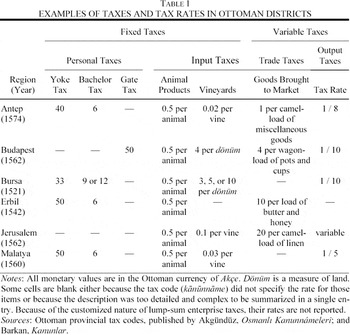
Table 1 shows examples of tax types and rates in some districts of the Ottoman Empire.16
For the complete tax codes of these and other districts, see Akgündüz, Osmanlı Kanunnâmeleri; and Barkan, Kanunlar.
Jerusalem (Kudüs) is in the eastern Mediterranean, Budapest (Budin) is in Europe, Bursa (Hüdavendigār) is in western Anatolia, Erbil is in northern Iraq, and Antep (Ayintab) and Malatya are in eastern Anatolia. The examples of taxes and rates reflect commonalities as well as differences across regions, thus showing how local conditions affected the tax system. The table does not include examples of lump-sum enterprise taxes because the tax codes typically did not codify standardized rates for these activities, except for some rare occasions, as when they specified the tax rates for retail stores as being “per store.”
The risky portion of the Ottoman tax revenues from the recipient's perspective consisted of trade and output taxes. Trade taxes were risky because the amounts of goods brought to the market would fluctuate based on market cycles and various local conditions. Output taxes were also risky because they were subject to various locality-specific shocks such as the weather, climate, and other natural conditions.17
In some regions the output tax rates varied between villages. For an analysis of the determinants and consequences of variable rates in the Fertile Crescent, see Coşgel, “Taxes, Efficiency, and Redistribution.”
The revenue from personal, input, and enterprise taxes, on the other hand, was more certain from the recipient's perspective. The amount that the taxpayers owed for these taxes did not (in principle) depend on business or weather conditions. For example, a married landholding peasant owed the yoke (
çift) tax whether or not his crop failed in a given year. He similarly owed input taxes on his fruit trees even if the fruits were ruined by a storm. The recipient of taxes could thus expect its income from fixed taxes to be relatively steady.
The transaction costs of tax collection would also have differed for fixed and variable Ottoman taxes. In particular, the cost of administering and collecting taxes would have been significantly higher for trade and output taxes, as compared to personal, input, and enterprise taxes. In the case of trade and output taxes, the tax collector would have had to determine the quantity of taxable items brought to the market for sale during each market period because the quantities could not have been predetermined or easily estimated. In contrast, the costs of measuring personal, input, and enterprise taxes would have been relatively low because of their lesser variability.
In sum, the same factors that made variable taxes riskier in terms of the revenue yield would have made them costlier to measure. Thus, in terms of our competing hypotheses, the predictions regarding the optimal assignment of these taxes are exactly opposite.
TAX ASSIGNMENT IN THE OTTOMAN EMPIRE
The Ottoman government consisted of multiple hierarchical levels that divided the empire into provinces, the provinces into districts, and the districts into fiefs. In short, it was a multi-tiered governmental system. Offices at each level received income from taxable sources assigned by the central government. Although a small number of taxes were sometimes assigned exclusively to certain levels of government, tax assignment was generally based, not on the type of taxes, but on the taxpayer. That is, the system did not assign output taxes exclusively to, say, the central government, and all other taxes to other recipients. Instead, revenues were distributed by taxpayer. Whereas everyone in one village paid taxes to the central government, their neighbors in the next village paid to the provincial government, and those in other villages paid to the district government, a local fiefholder (cavalrymen or military commander), or a pious foundation.18
The main revenue recipients were the central government (variously denoted in the registers of different regions as, for example, hāss-ı şāhī or hāss-ı humāyūn), provincial administrators such as the governors of provinces (mīr mīrān, paşa, beylerbeyi) or districts (mīr liwā, sancakbeyi), and holders of small and large fiefs (tīmār and za'āma). There were also pious foundations (vakıfs), private landholders (mülk), and tribal leaders, who somehow possessed the right to collect tax revenues from some villages, based on rights recognized by the legal system or preserved after conquest for political reasons. For the organization and financing of the Ottoman government, see İnalcık, Ottoman Empire; Kunt, Sultan's Servants; and Darling, Revenue-Raising.
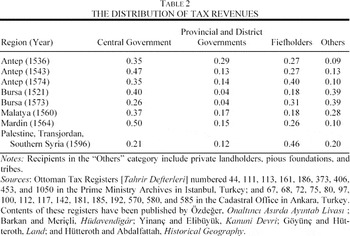
reports the distribution of tax revenue among the main groups of recipients.
19 For examples of the distribution of tax revenues in other districts, see Barkan and Meriçli, Hüdavendigâr, p. 5.
Although fixed and variable taxes were not exclusively assigned to recipients, this did not mean that the assignment of taxes did not reflect differences between fixed and variable taxes, because the proportions of these taxes could vary among taxpayers. To test the implications of the risk and transaction cost hypotheses for tax assignment in the Ottoman Empire, we thus need to examine not only how fixed and variable taxes were allocated to recipients, but also how their proportions affected the assignment. Consider first the risk hypothesis. Suppose the tax revenue of a village consisted mostly, if not exclusively, of output taxes that were subject to location-specific shocks. Because the central government received revenue from all parts of the empire and thus had a well diversified budget portfolio, it would have mattered little to the risk level of the central treasury to add this highly risky income to its portfolio. The same was true for the tax revenues of a provincial government, though to a lesser degree because its revenues were typically restricted to the province and hence less diversified.20
A fiefholder, on the other hand, typically received income from a single village or only a few villages. By receiving this village's tax revenue, the recipient would have been exposed to high risk with little ability to diversify. The risk hypothesis thus implies that this village's tax revenues should have been assigned to the provincial or central governments rather than a local fiefholder.
The transaction cost hypothesis leads to the opposite conclusion. The central government collected taxes through hired agents, who would have lacked sufficient knowledge of local production technologies and units of measurement to accurately calculate the variable tax bases (quantity and quality). Moreover, it was not in their interest to measure the tax bases accurately, because their income was independent of the tax revenue. At the other extreme were the fiefholders who collected taxes from their villages of residence and depended on the tax revenue for their livelihood.21
Unlike the agents of the central government, fiefholders had the knowledge, ability, and high incentives for accurate measurement of variable tax revenues. Between the central government and local fiefholders were intermediate levels of government, which would have had transaction costs that increased with their relative distances to the tax source.
22 The argument also applies to pious foundations that received revenues to support charitable activities. The transaction cost was likely to be lower for pious foundations than for provincial or central governments because of the former's clear beneficiaries and local operations and management The beneficiaries of a foundation were likely to apply strong pressure for higher revenues, changing the nature of the agency problem. Although the manager(s) of a foundation may not have received all tax revenues directly as remunerations for service, they were ultimately responsible for the provision of these services and thus had high incentives to maximize tax revenues in order to fulfill professional obligations and improve service.
The transaction cost hypothesis therefore implies that the tax revenue of a village with a high proportion of output taxes should have been assigned to a fiefholder, rather than to any higher level government.
A QUANTITATIVE ANALYSIS OF THE EFFECT OF RISK AND TRANSACTION COST ON TAX ASSIGNMENT
To conduct a quantitative analysis of the risk and transaction cost hypotheses of tax assignment, we use data from the tax registers of various regions of the Ottoman Empire. We formalize the two hypotheses by constructing a qualitative “distance” variable that represents the relationship between the source and recipient of the revenue from a given tax. We ranked recipients based on their distance to the taxable source in an ascending order, starting with private landholders, then fiefholders, pious foundations, the district government, the provincial government, and finally the central government. We then created an ordinal variable that took the value of the recipient's rank order: the value was one if a village's tax recipient was a private landholder, two if a small fiefholder, and so on.23
Because of the hierarchical nature of the Ottoman system of government, the values for government offices also correspond to their order in the hierarchy. Although some of the recipients, such as private landholders and pious foundations, were not part of the Ottoman government, they received revenues that could have been allocated to the government. We thus kept the information about the allocation of such revenues in the quantitative analysis. Whenever the records separated small and large fiefholders, large fiefholders were given a lower ranking based on the possibility that they might have been receiving revenues from more than one villages and thus were less able to attend each village closely. Sometimes the records did not further distinguish between two or more recipients, for example by lumping together fiefholders and pious foundations in one category, in which case we assigned them an equal ranking.
The distance was therefore the greatest for the central government. This variable served as the dependent variable in an ordered probit model.
The explanatory variable of primary interest is the proportion of variable taxes in total taxes. The sign of this variable will show whether considerations of risk or transaction costs were paramount in the assignment of tax revenues. A positive and significant sign supports the risk hypothesis by indicating that, all else being the same, the riskier tax revenues were more likely to be allocated to distant recipients who could better deal with risks given their more diverse portfolio of revenues. However, if the sign turns out to be negative, it will support the transaction cost hypothesis, indicating that costlier revenues were more likely to be assigned to closer recipients who could better deal with measurement costs.
To isolate the effect of the proportion of output and trade taxes in the regression analysis, we included variables to control for other influences on the determination of tax assignment. One such variable is the size of the tax source. Provincial and central governments may have preferred large sources of revenue in order to benefit from economies of scale in tax collection (for example by reducing the travel and set up costs of their agents).24
For a discussion of the relationship between the size of a tax source and its allocation among recipients, see Kunt, Sultan's Servants, p. 20.
To account for this possibility, we included the number of taxpayers in a village as a proxy variable for its size.
The tax revenues of some villages were divided between two or more recipients. Because the division of revenue required costly coordination, distant recipients may have been reluctant to collect revenues from such villages. To determine whether this had any effect on revenue allocation, we generated a dummy variable based on whether a village's tax revenue was divided (equals one if divided between two or more revenue holders). The productivity of economic activities could also be a factor in determining tax assignment. Because the number of taxpayers was the only input item consistently recorded among provinces, we used information about taxpayers and their taxes to estimate the revenue of economic activities per taxpayer in a village, and then used it as a proxy for the village's productivity. Finally, when the data spanned a geographically wide and diverse area, we used dummy variables to control for the effect of various unobservable (such as political) differences across districts.
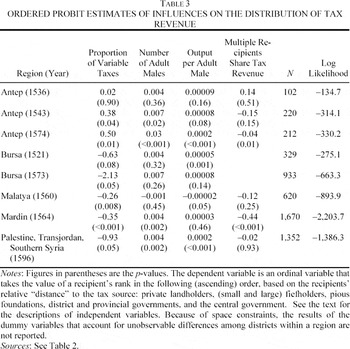
Table 3 shows the results of the ordered probit analysis of influences on tax assignment in five representative regions of the Empire, some at different points in time. The effects of the control variables are generally in the expected directions. The coefficient on the number of taxpayers is generally positive and significant, showing that larger villages were more likely than smaller ones to be assigned to distant recipients. This confirms the expectation about the importance of economies of scale in tax collection. The generally negative (though not always significant) coefficients on the “Revenue Divided” dummy variable are also consistent with the expectations. That divided revenues were less likely to be assigned to distant recipients indicates that the central and provincial governments were less able than others to deal with the requisite costs of division. The coefficients on productivity are also generally positive (in all regions other than Malatya), indicating that more productive tax revenues were more likely to be allocated to central and provincial governments, as compared to pious foundations and fiefholders. (The effect, however, is not very significant in some regions.) Because of space constraints, we do not report the results of the dummy variables that account for unobservable differences among the districts.
Controlling for other influences makes it possible to isolate the individual effect of the focus variable: the proportion of output and trade taxes. The coefficient of the proportion is negative and significant at conventional levels in most regions, providing strong support for the transaction costs hypothesis. The risk hypothesis receives some support only in Antep, where the coefficient is positive and significant in 1543 and 1574. Unfortunately, the data do not include sufficient information about the peculiar circumstances of the region to permit an explanation for this contrary result. The consistently positive coefficient in this region suggests that the importance of the risk and transaction cost approaches may have varied by region, but the negative coefficients in all the other regions indicate that transaction costs were generally the dominant consideration in tax assignment.
The dominance of the transaction cost effect raises the question of why the risk effect was small. Risk considerations may have had an insignificant effect on the assignment of taxes because the recipients had various alternatives to insure against revenue fluctuations. One possibility was the storage of grain or cash income as a means of self insurance. Just as the central government could insure income by diversifying tax revenues across regions, a small fiefholder could diversify over time by storage. Another possibility was for tax recipients to participate in formal or informal institutions of credit.25
For a similar line of reasoning used to criticize risk-based explanations of scattering on open fields, see Fenoaltea, “Risk.”
While these and similar mechanisms allowed tax recipients to insure against revenue risk, there were no feasible alternatives to reduce transaction costs. Various knowledge and incentive constraints as well as agency costs made it infeasible to rely on alternatives like self-reporting to resolve the problem of accurate measurement of the tax base. Other enforcement mechanisms like stiff penalties for underreporting, and mutual or external monitoring, must have been similarly infeasible.
CONCLUSION
A quantitative analysis of the allocation of Ottoman tax revenues shows that the assignment of tax revenue among alternative recipients was influenced more by transaction costs than by risks. The test made use of data from the sixteenth-century tax registers of the Ottoman Empire in five regions. We constructed an ordinal independent variable to represent a recipient's relationship to the source of tax and used an ordered probit model to identify how the proportion of variable (risky, high in transaction cost) taxes affected the outcome of the tax assignment problem. In all but one region the results supported the transaction costs hypothesis. The relative insignificance of risk considerations suggests that tax recipients generally had various feasible alternatives for insuring against risky revenue but no such alternatives for dealing with transaction costs. Consequently, they assigned taxes to those recipients who could bear those costs most efficiently.
We wish to thank the editor of the JOURNAL; two anonymous referees; and the participants and discussants at the 2002 Annual Cliometrics Conference in La Crosse, WI, the 2003 Alumni Workshop in Iowa City, IA, and the 2003 Social Science History Association meetings in Baltimore, MD for helpful comments and suggestions. Ali Özdemir, Sadık Yıldırım, and Hüseyin Yılmaz provided valuable research assistance. Financial support from the University of Connecticut Research Foundation and the National Science Foundation (under Grant No. SES-0433358) is gratefully acknowledged.