INTRODUCTION
Ventromedial prefrontal (VM) brain damage has been repeatedly associated with markedly poor decision-making (Fellows, Reference Fellows2006). Decision-making is a complex behavior that involves the process of choosing between two or more options (Fellows, Reference Fellows2004; Krawczyk, Reference Krawczyk2002; Sugrue, Corrado, & Newsome, Reference Sugrue, Corrado and Newsome2005). Given the complexity of the decision-making process, it has been suggested that difficulties in decision-making among patients with VM could be the result of deficits in one or more domains. For example, it has been reported that difficulties in considering future consequences may account for these patients’ poor decision-making abilities (Bechara, Damasio, Tranel, & Anderson, Reference Bechara, Damasio, Tranel and Anderson1998; Tranel, Bechara, & Denburg, Reference Tranel, Bechara and Denburg2002). Furthermore, it has been suggested that patients with VM lesions involving mainly orbitofrontal damage do not report regret or anticipate the negative consequences of their choices (Camille et al., Reference Camille, Coricelli, Sallet, Pradat-Diehl, Duhamel and Sirigu2004). As such, it appears that these patients have poor counterfactual thinking and fail to assess what was gained as compared to what would have been gained by making a different decision (Larquet, Coricelli, Opolczynski, & Thibaut, Reference Larquet, Coricelli, Opolczynski and Thibaut2010).
Others have highlighted the role that the VM plays in simple value-based decisions (Camille et al., 2011; Fellows & Farah, Reference Fellows and Farah2007). Furthermore, it has been reported that VM damage impairs decision “accuracy” without affecting reaction time, indicating that this region may be critical for linking a particular value to a particular option (Henri-Bhargava, Simioni, & Fellows, Reference Henri-Bhargava, Simioni and Fellows2012).
Yet, one of the most robust clinical findings associated with VM damage is inappropriate behavior manifested mainly in social situations (Anderson, Barrash, Bechara, & Tranel, Reference Anderson, Barrash, Bechara and Tranel2006; Berlin, Rolls, & Kischka, Reference Berlin, Rolls and Kischka2004; Burgess & Wood, 1990; Grafman, Schwab, Warden, & Pridgen, Reference Grafman, Schwab, Warden and Pridgen1996). This suggests that impaired social cognition may potentially account for these patients’ poor decision-making abilities. A key aspect of social cognition is the ability to take the perspective of another person. Perspective-taking relates to consciously adopting the subjective point of view and intentions of the other in relation to oneself. The ability to take the other's perspective is a cognitive form of empathy and requires motivational resources for inhibiting the automatic self-perception mode, while still recognizing the other person as being similar to oneself (Decety & Jackson, Reference Decety and Jackson2004).
Perspective-taking abilities have been shown to be associated with activity in the frontal lobes (Gallagher & Frith, Reference Gallagher and Frith2003; Rankin et al., Reference Rankin, Gorno-Tempini, Allison, Stanley, Glenn, Weiner and Miller2006; Stuss, Gallup, & Alexander, Reference Stuss, Gallup and Alexander2001). Studies of patients with frontal lobe dysfunction have demonstrated that lesions in this region are associated with impaired empathy (Shamay-Tsoory, Tomer, Berger, & Aharon-Peretz, Reference Shamay-Tsoory, Tomer, Berger and Aharon-Peretz2003) and theory of mind (ToM), the ability to make inferences regarding the mental state of others (Gregory et al., Reference Gregory, Lough, Stone, Erzinclioglu, Martin, Baron-Cohen and Hodges2002; Lough et al., Reference Lough, Kipps, Treise, Watson, Blair and Hodges2006; Rowe, Bullock, Polkey, & Morris, Reference Rowe, Bullock, Polkey and Morris2001). In recent years, new models have been proposed to elucidate the confusion in the distinction between empathy and ToM. These models suggest that cognitive ToM, the ability to represent beliefs, is a prerequisite for affective ToM, the ability to represent emotional mental states, which is roughly equivalent to the purely cognitive aspects of empathy and perspective-taking (Sebastian et al., Reference Sebastian, Fontaine, Bird, Blakemore, De Brito, McCrory and Viding2011; Shamay-Tsoory, Harari, Aharon-Peretz, & Levkovitz, Reference Shamay-Tsoory, Harari, Aharon-Peretz and Levkovitz2010). In line with this, VM damage has been reported to mediate perspective-taking and the affective aspects of ToM (Danziger, Faillenot, Peyron, Reference Danziger, Faillenot and Peyron2009; Sebastian et al., Reference Sebastian, Fontaine, Bird, Blakemore, De Brito, McCrory and Viding2011; Shamay-Tsoory, Aharon-Peretz, & Levkovitz, Reference Shamay-Tsoory, Aharon-Peretz and Levkovitz2007; Stone, Baron-Cohen, & Knight, Reference Stone, Baron-Cohen and Knight1998).
Although perspective-taking impairment following VM damage is a robust clinical finding, the potential impact of this phenomenon on distinct domains of decision-making has not been systematically explored in the laboratory.
The Ultimatum Game (UG; Guth, Schmittberger, & Schwarze, Reference Güth, Schmittberger and Schwarze1982) is a widely used laboratory model of economic decision-making, which measures decision-making in a social context and thereby allows the examination of how perspective-taking abilities affect decision-making. In a typical UG experiment, two participants (the proposer and the responder) divide a fixed amount of money (e.g., $10). The proposer is given the role of proposing a division of the money, while the responder is given the role of accepting or rejecting the proposal. If the responder rejects the offer, then neither player receives anything. If the responder accepts the offer, then the money is split according to the division made by the proposer. Research has repeatedly demonstrated that proposers usually offer equal or close to equal divisions (5:5, 4:6) and that responders tend to reject unfair offers (e.g., 2:8), preferring to get zero payoffs rather than accept an unfair distribution of monetary payoffs (Camerer & Thaler, Reference Camerer and Thaler1995).
This “irrational” behavior demonstrates that humans do not act solely to maximize their personal economic gain (Bolton & Zwick, Reference Bolton and Zwick1995; Guth et al., Reference Güth, Schmittberger and Schwarze1982). One of the explanations for the psychological motivation underlying the rejection of unfair offers in the UG points to psychological processes, such as negative emotional reactions (Pillutla & Murnighan, Reference Pillutla and Murnighan1996). Accordingly, functional imaging studies indicate that rejections are associated with activity in the insula, a region associated with negative affect, such as anger and disgust (Sanfey, Rilling, Aronson, Nystrom, & Cohen, Reference Sanfey, Rilling, Aronson, Nystrom and Cohen2003). Moreover, it has been reported that patients with VM lesions tend to reject an abnormally high proportion of unfair offers in the UG, due to their irritable temper and lack of emotion regulation (Koenigs & Tranel, Reference Koenigs and Tranel2007). Further support for the notion that the regulation of emotional reactions may modulate such economic decisions was provided by a study in which a temporary reduction in serotonin levels with acute tryptophan depletion techniques led to impaired emotion regulation and increased rejection rates (Crockett, Clark, Tabibnia, Lieberman, & Robbins, Reference Crockett, Clark, Tabibnia, Lieberman and Robbins2008).
Alternatively, it has been suggested that judgments of fairness intentions and perspective-taking may also account for the rejection rates in economic decisions. Identical offers in the UG have been shown to trigger vastly different rejection rates by the responder, depending on the other offers available to the proposer (Falk, Fehr, & Fischbacher, Reference Falk, Fehr and Fischbacher2003). Responders are much more likely to reject a given offer with an unequal distribution of material payoffs if they know that the proposer could have proposed a more equitable offer. In the study by Falk et al. (Reference Falk, Fehr and Fischbacher2003), subjects played four mini ultimatum games in which the responders had to decide whether to accept or reject offers of 2:8 points (2 for them and 8 for the proposer), which were paired with one of four different possible offers (5:5, 10:0, 2:8, 8:2). Their results demonstrate that the rejection rates of the 2:8 point offers were the highest when the proposer had a fair alternative available (the 5:5 game), as compared to conditions in which the proposer had only unfair alternatives available (the 10:0, 2:8, 8:2 games). The authors conclude that responders’ decisions are influenced by the perceived fairness of the proposers and their intentions, and not only by the distribution consequences (Falk et al., Reference Falk, Fehr and Fischbacher2003). Thus, it appears that economic decision-making in a social context involves emotional processes, as well as the ability to take the perspective of other people and judge their intentions.
Given the “irrational” economic behavior of responders in the UG, it is, therefore, possible that economic decision-making in a social context involves the ability to take the others’ perspective and not merely a rational calculus of distributive consequences. Thus, the impairment of perspective-taking abilities following VM damage may account for the differences in rejection rates in the UG. Indeed, the VM region partially overlaps with the medial of the orbitofrontal cortex. The connections of this region to the amygdala and the limbic system make it anatomically suited for emotion regulation (Diekhof, Geier, Falkai, Gruber, Reference Diekhof, Geier, Falkai and Gruber2011) and integration of the affective and non-affective information required for perspective-taking (Happaney, Zelazo, & Stuss, Reference Happaney, Zelazo and Stuss2004). Collectively, it appears that impaired decision-making in patients with VM lesions may be related to lack of emotion regulation, lack of perspective-taking, or both. While the first possibility has been previously investigated (Koenings & Tranel, Reference Koenigs and Tranel2007), no study to date has investigated the relationship between perspective-taking and decision-making in the UG following VM damage.
The aim of the present study was to investigate whether perspective-taking defects following localized VM brain damage are associated with a different pattern of rejection in the UG. In line with Koenigs and Tranel (Reference Koenigs and Tranel2007), it was predicted that patients with VM lesions would show overall higher rates of rejection. In addition, we tested the prediction that participants with VM damage would exhibit less sensitivity to the intentions of others and, therefore, would not demonstrate different rejection rates depending on the other offers available to the proposer. To test this, a modified UG was used in which the allocation 2:8 remained the same in all trials, while the alternative (5:5, 8:2, 2:8, 4:6) differed from trial to trial. The 4:6 condition in the game replaced the 10:0 condition used in the study by Falk et al. (Reference Falk, Fehr and Fischbacher2003) and was added to create more of an egalitarian alternative that would still give the proposer an advantage. The 4:6 condition represented a situation in which the proposer had to choose between a mildly unfair (4:6) and a highly unfair option (2:8). Thus, choosing 2:8 over 4:6 may trigger the attribution of highly unfair greedy intentions, and, therefore, the rejection rates in this condition were expected to be the highest. Thus, it was expected that rejection rates for the 4:6 offers would be the highest in the control group, as compared to the 5:5, 8:2, 2:8 conditions. On the other hand, it was predicted that responders with VM damage would show a different pattern of rejections due to their perspective-taking deficit and difficulty in attributing intentions to the proposer.
Materials and Methods
Subjects
Participants were eight patients (two women, six men) with acquired localized, well-defined brain lesions of various etiologies, who were referred to the Cognitive Neurology Unit at Rambam Medical Center in Haifa, Israel for cognitive assessment. A neurological examination was conducted before the cognitive assessment, and patients suffering from visual impairment, language deficits, or motor limitations that might interfere with performance of the neuropsychological tasks were excluded. As shown in Table 1, etiologies included head injury and stroke. Testing was conducted at least a year following the injury. The mean time since injury was 4.12 (1.959) years, and the injuries of three patients involved loss of consciousness.
Demographic and cognitive measures for the patients with VM lesions

VM = ventromedial prefrontal; CVA = cerebrovascular accident.
A neurologist who was blind to the study's hypotheses and the neuropsychological data carried out anatomical classification based on early as well as recent computed tomography (CT) (N = 2) or magnetic resonance imaging (MRI) (N = 6) scans. For patients with a head injury, both the acute neuroradiological studies (performed within the first 24–48 hr post-injury) and the more recent MRI scans were examined to rule out the diagnosis of diffuse axonal injury (DAI). The VM lesions included the frontal pole, parts of the inferior frontal gyrus, the middle orbital gyrus, and ventral parts of the medial frontal gyrus [Brodmann areas (BA) 6, medial 8, 9, 10, 24, 32, and orbital Brodmann areas 10, 11, 12, 14, 47]. As shown in Figure 1, the lesions were further transcribed from the CT and MRI images to the appropriate slices of the MRIcro program (Rorden, University of Nottingham, UK), and superimposition of the lesions was carried out. As shown in Figure 1, lesion superimposition for the VM group demonstrated that, although the overlapping region of patients was the VM region, two had a lesion extending to BA 46, and in two patients the lesion reached the temporal lobe.
Lesion overlap of the patients with VM lesions. Areas damaged in one patient are shown in pink; brighter shades denote the degree to which lesions involve the same structures in 2 or more individuals, as indicated by the color strip at the right-hand corner (left hemisphere is displayed on the left side of the figure). As seen in the figure, among the VM patients, two had a lesion extending to BA 46, and in two patients the lesion reached the temporal lobe.

The healthy control group included 20 age-matched healthy volunteers (8 women, 10 men). All participants were fluent in Hebrew, and none had a history of developmental or psychiatric conditions. Subjects with a history of alcohol or drug abuse or previous head trauma with loss of consciousness were excluded. All participants signed an informed consent form. Ethical approval was granted by the Ethics Committee of Rambam Medical Center.
As Table 2 shows, the two groups did not differ in years of education (t[24] = −0.746; p = .463; Cohen's d: 0.294). The groups differed marginally in terms of age (F[24] = −1.985; p = .089; Cohen's d: 0.506) and intellectual abilities (t[24] = 1.656; p = .073; Cohen's d: −0.824), as assessed by the Similarities subscale of the Wechsler Adult Intelligence Scale (WAIS-R, Wechsler, Reference Wechsler1981).
Demographic and cognitive measures of the groups, means and standard deviations

VM = ventromedial prefrontal.
Assessment of Perspective-Taking Abilities
Perspective-taking tendencies were assessed using the Perspective-taking (PT) subscale of the Interpersonal Reactive Index (IRI; Davis, Reference Davis1980). The PT includes 7 items which measures the reported tendency to spontaneously adopt the psychological point of view of others (“I sometimes try to understand my friends better by imagining how things look from their perspective.”). The participants are requested to rate their choices on a 5-point Likert scale, ranging from −2 “does not describe me well” to +2 “describes me very well.” The three other IRI subscales are the Empathic Concern scale, the Personal Distress scale and the Fantasy scale. The IRI scales have previously been adapted to Hebrew and validated with Hebrew speaking Israeli population and were shown to be valid in assessing empathy deficits in patients with frontal lesions (Shamay-Tsoory et al., Reference Shamay-Tsoory, Tomer, Berger and Aharon-Peretz2003). In the present study, the Perspective Taking scale was found to correlate significantly with the Empathic Concern subscale (r = 0.457; p = .019) and with marginal significance with the Fantasy Scale (r = 0.37; p = .063). The PT scale was previously validated with other measures of empathy, sensitivity to others, and intellectual abilities, as well as with interpersonal functioning measures that assess a wide variety of social behaviors (Davis, Reference Davis1980). The IRI has good internal consistency, with alpha coefficients ranging from 0.68 to 0.79 (Davis, Reference Davis1980).
The UG Task
A computerized ultimatum game was used to examine whether identical offers would trigger different rejection rates by the responders, depending on the alternative offers available to the proposer. Participants were seated in one room of a lab and were told that they would be participating in a computerized interactive game involving monetary gain with other participants located in the room next door. The experimenter took a photograph of each participant and then showed them photos of the other participants.
Participants were told that based on a computerized lottery, they would be randomly assigned to either the proposer or the responder's role. They were informed that the proposers would be asked to choose between two different allocations of 10 shekels (NIS; approximately $2.50) for themselves and a responder, who could then either accept or reject the offer. Accepting the offer would lead to a payoff distribution according to the proposer's offer, while a rejection would result in zero payoffs for both players.
The experiment was actually preprogrammed, and all the participants acted as responders. They received four different types of offers in random order, and each type of offer was presented three times, making for a total of 12 offers. Five additional random offers were presented to avoid too much repetition and further ensure that the participants believed they were playing with real proposers. Thus, in total, participants received 17 offers from 17 different proposers.
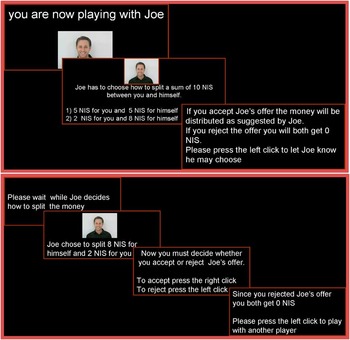
As shown in Figure 2, in each trial the participant was first shown a photograph of the proposer making the offer. Next, the participant was presented with the two alternatives available to the proposer while awaiting the proposer's decision. Then, the responder had to decide whether to accept or reject the proposed offer. Finally, the participant was shown the outcome based on his/her response.
Experimental procedure. In each trial, the participant was first shown a photograph of the proposer making the offer. Next, the participant was presented with the two alternatives available to the proposer while awaiting the proposer's decision. Then, the responder had to decide whether to accept or reject the proposed offer. Finally, the participant was shown the outcome based on his/her response.

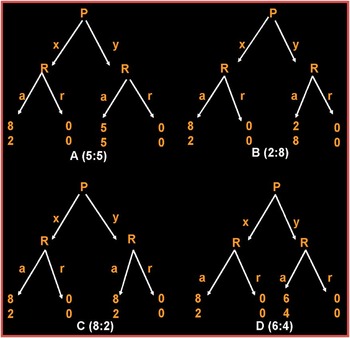
It was explained to the participants that the proposer can choose between two allocations, x and y. As shown in Figure 3, the allocation x of 2:8 remained the same in all trials, while the allocation y (the “alternative” to x) differed from trial to trial. If the proposer chooses x and the responder accepts the offer, then the proposer keeps 8 NIS, while the responder receives only 2 NIS. The four types of alternative y distributions presented to the responders were: (A) 5:5, meaning an equal distribution to both the proposer and the responder; (B) 8:2, meaning that the proposer keeps 2 NIS and gives the responder 8 NIS; (C) 2:8, which is the same as the first offer, meaning that it does not represent a real alternative; and (D) 4:6, meaning that the proposer keeps 6 NIS and gives the responder 4 NIS. The latter condition replaced the 10:0 condition used in the study by Falk et al. (Reference Falk, Fehr and Fischbacher2003) and was added to create more of an egalitarian alternative that would still give the proposer an advantage. Condition D represented a situation in which the proposer had to choose between a mildly unfair (4:6) and a highly unfair option (2:8). Thus, choosing 2:8 over 4:6 may trigger the attribution of highly unfair greedy intentions, and, therefore, the rejection rates in this condition were expected to be the highest. On the other hand, in Condition B, offering 8:2 as an alternative to 2:8 was expected to be perceived as unfair, but probably less so than in Condition A (5:5) and Condition D (4:6), because the only alternative available to 8:2 would give the proposer much less than the responder. Similarly, offering 2:8 without a real alternative in Condition C was not expected to be judged as unfair. Thus, it was expected that rejection rates for the 4:6 (Condition D) offers would be the highest, followed by 5:5 (Condition A), then 8:2 (Condition B), and finally 2:8 (Condition C).
The allocation x (2:8) remains the same in all trials, while the allocation y (the “alternative” to x) differs from trial to trial. If the proposer (P) chooses x and the responder (R) accepts the offer, then the proposer keeps 8 NIS, while the responder receives only 2 NIS. The four types of alternative y distributions presented to the responders were: (A) 5:5, meaning an equal distribution to both the proposer and the responder; (B) 8:2, meaning that the proposer keeps 2 NIS and gives the responder 8 NIS; (C) 2:8, which is the same as the first offer, meaning that the proposer keeps 8 NIS and gives the responder 2 NIS; and (D) 4:6, meaning that the proposer keeps 6 NIS and gives the responder 4 NIS. a = accept; r = reject.

At the end of the experiment, the participants were asked if they believed that the offers were made by real proposers from the photographs, and those who did not believe the manipulation were excluded from the study. As a result of this procedure, two control subjects were excluded from the final analysis, making for a total of 18 controls. Following the experiment, the subjects received a payment of 20 NIS for their participation plus their earnings from the experiment.
Results
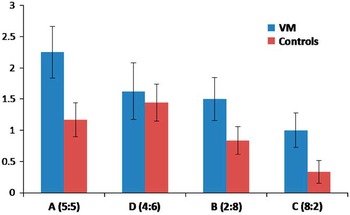
As presented above, the task involved four main conditions: 5:5, 8:2, 2:8, and 4:6. The dependent measure was the number of rejections in each type of condition (A, B, C, D). Since each condition appeared three times, rejections ranged from 0 to 3 (see Table 1). To obtain measures of the trends and interactions over the different conditions, a repeated measures analysis of variance was conducted, with the task condition as the within-subjects factor and group membership (VM, healthy controls) as the between-subjects factor. This analysis revealed a significant condition effect [F(3,72) = 4.514; p = .013; Partial Eta Squared = 0.381] and a group by condition (interaction) effect that approached significance [F(3,72) = 2.487; p = .08, Partial Eta Squared = 0.253]. Furthermore, tests of the between-subject effects indicated a significant group effect [F(1,24) = 4.461; p = .045, Partial Eta Squared = 0.157], suggesting that the rejection rates were overall higher in the VM group (M = 1.5, SE = 0.256) as compared to the healthy controls (M = 0.994, SE = 0.171).
To further explore the difference in rejection rates within each group, separate repeated analyses of variance (ANOVAs) were carried out for each group. In the control group, a significant condition effect [F(3,15) = 3.864; p = .031, Partial Eta Squared = 0.436] indicated that the controls responded differently to the four conditions. As predicted, the rejection rates were the highest for Condition D (M = 1.444; SE = 0.305), followed by Condition A (M = 1.167, SE =.283), then Condition B (M = 0.833; SE = 0.232), and finally Condition C (M = 0.333; SE = 0.162). Specifically, pairwise comparisons indicated significant differences between the rejection rates in Condition C as compared to Condition A (p = .017) and Condition D (p = .003). The rejection rates in the other conditions were not found to differ from each other.
In the VM group, a significant condition effect [F(3,5) = 6.306; p = .038, Partial Eta Squared = 0.791] indicated that the patients also responded differently to the four conditions. Yet, as opposed to the control group, the rejection rates were the highest for Condition A (M = 2.250; SE = 0.313), followed by Condition D (M = 1.625; SE = 0.275), then Condition B (M = 1.500; SE = 0.267), and finally Condition C (M = 1.00; SE = 0.378). Specifically, pairwise comparisons indicated significant differences between the rejection rates in Condition A as compared to Condition B (p = .02), Condition C (p = .019), and Condition D (p = .049). The rejection rates in these three other conditions were not found to differ from each other.
In addition, separate ANOVAs for each condition indicated significant differences between the two groups in the rejection rates in Condition A [F(1,24) = 5.200; p = .032; Partial Eta Squared = 0.178] and marginally significant differences in Condition C [F(1,24) = 3.692; p = .067, Partial Eta Squared = 0.133] (Figure 4). The differences between groups in Condition D [F(1,24) = 0.119; p = .733, Partial Eta Squared = 0.005] and Condition B [F(1,24) = 2.882; p = .103, Partial Eta Squared = 0.107] were not found to be significant.
A 2*4 ANOVA revealed a significant condition effect, a significant group effect, and a group by condition (interaction) effect that approached significance. VM = ventromedial prefrontal.

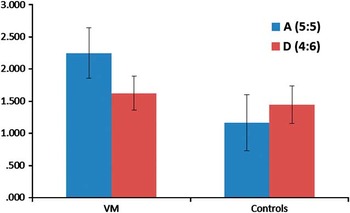
To obtain measures of the trends and interactions over the two fair conditions (A; D), a repeated measures analysis of variance was conducted, with the task condition (A;D) as the within-subjects factor and group membership (VM, healthy controls) as the between-subjects factor. As shown in Figure 5, this analysis revealed a significant group by condition interaction [F(1,24) = 8.033; p = .009, Partial Eta Squared = 0.251], a non-significant condition effect [F(1,24) = 1.188; p = .286, Partial Eta Squared = 0.047] and a non-significant group effect [F(1,24) = 1.782; p = .194, Partial Eta Squared = 0.069]. To examine the relationship between rejections of offers in the four conditions (total rejections) and perspective-taking (PT) abilities of the patients with VM lesions, we carried out a correlation analysis. This analysis indicated a significant negative correlation between the PT scores and the total rejection rates (r = −0.615; p = .05), indicating that diminished PT scores predicted higher rejection rates.
A 2*2 ANOVA of the fair conditions (A, D) revealed a significant group by condition interaction [F(1,24) = 8.033; p = .009; Partial Eta Squared = 0.251], a non-significant condition effect [F(1,24) = 1.188; p = .286, Partial Eta Squared = 0.047] and a non-significant group effect [F(1,24) = 1.782; p = .194, Partial Eta Squared = 0.069]. VM = ventromedial prefrontal.

To confirm that only the PT scale and not other scales predicted the level of rejection in the UG, we examined the correlation between the Similarities scale of the WAIS and the rejection rates. This correlation was not significant (r = 0.338; p = .206). To rule out the possibility that age interacted with the number of rejections in the task, we carried out a correlation analysis between age and total rejection rates. This analysis showed that age was not correlated with rejection rate (r = 0.011; p = .957).
Finally, to examine the contribution of PT and group membership to rejection rates, hierarchical regression analyses were conducted for each of the conditions. In this analysis the PT variable was first entered as predictor, and then the group membership was added to the model. This analysis revealed that for conditions A (model 1, R-square = 0.008; p = .667; model 2, R-square = 0.179; p = .104), B (model 1, R-square = 0.021; p = .482; model 2, R-square = 0.114; p = .261) and D (model 1, R-square =0.031; p = .386; model 2, R-square = 0.032; p = .688), neither the first model (PT) nor the second model (group membership) significantly predicted rates of rejections. Yet, in condition C the first model (PT) significantly predicted rejection rates (model 1, R-square = 0.230; p = .013) while the second model (group membership) did not add to the predicted rates of rejections (model 2, R-square = 0.289; p = .020). For condition C, the R-square change for the second model was 0.059 (p = .182). The latter finding indicates that the PT scores predict the outcome and group does not enhance the model fit after PT has been entered in the model, suggesting that PT deficits may account for difficulties in decision-making.
Discussion
The current study sought to investigate whether rejections of offers in the UG are modulated by attribution of fairness intentions in patients with VM damage. The results of the present study confirm that the attribution of fairness intentions contributes to decision-making. Identical offers of 2:8 generated significantly different rejection rates depending on the other offers which were available to the proposer. In line with Falk et al. (Reference Falk, Fehr and Fischbacher2003), rejection rates of the 2:8 offers were higher when the proposer had a fair alternative available (the 5:5 game), as compared to conditions in which the proposer had only unfair alternatives available (the 2:8 and 8:2 games).
In the present study, an additional 4:6 “greed” condition was presented. This condition represented a situation in which the proposer had to choose between a mildly unfair and a highly unfair option. It was anticipated that the choice of 2:8 over 4:6 might trigger the attribution of highly unfair greedy intentions. Therefore, it was reasoned that this condition would generate the highest rejection rates in healthy individuals. Indeed, as predicted, rejection rates in the healthy controls were the highest in the 4:6 “greed” condition (D), followed by 5:5 (A), 8:2 (B), and then 2:8 (C), indicating that the healthy responders considered the fairness of the proposers and their intentions, and not only the distribution consequences. These results are in line with Pillutla and Murnighan (Reference Pillutla and Murnighan1996), as well as Sanfey et al. (Reference Sanfey, Rilling, Aronson, Nystrom and Cohen2003), who have argued that decision-making in the UG requires ToM and perspective-taking.
The responses of the VM group were somewhat different from those of the controls. On the one hand, their differential responses in the four conditions indicated that they did consider the proposers’ fairness intentions. On the other hand, their pattern of responses indicated that they made different attributions of intentions. The significant differences between the groups were evident in Condition A, indicating that the VM patients tended to show a particular prominent sensitivity to the 5:5 condition. Thus, the VM patients were much more likely to reject the 2:8 offer when the proposer could have proposed an equitable offer (5:5). In contrast to the controls, the patients showed more sensitivity to this condition than to the 4:6 condition. The higher rejection rates of the proposed 5:5 offer and not the 4:6 offer, as observed in the control group, may suggest that the patients did not attribute greed to the proposers as much as the controls did in the 4:6 condition. Furthermore, a significant correlation between the rejection rates and perspective-taking abilities confirmed that decision-making in the VM patients was related to their impaired perspective-taking.
It should be noted that overall, the patients tended to reject more offers than the controls across all conditions. The higher rejection rates of the VM patients replicates the findings of Koenigs and Tranel (Reference Koenigs and Tranel2007), who reported that patients with VM lesions are likely to reject an abnormally high proportion of unfair offers in the UG. As noted above, the authors have interpreted these findings in light of these patients’ impaired emotion regulation. Indeed, neuropsychological reports have repeatedly demonstrated that VM patients tend to exhibit aberrant behavior, high levels of aggression, and a callous disregard for others, which has been associated with impaired emotion regulation and irritability (Anderson, Barrash, Bechara, & Tranel, Reference Anderson, Barrash, Bechara and Tranel2006; Berlin et al., Reference Berlin, Rolls and Kischka2004; Grafman et al., Reference Grafman, Schwab, Warden and Pridgen1996). Koenigs and associates (Reference Koenigs, Young, Adolphs, Tranel, Cushman, Hauser and Damasio2007) have shown that patients with VM damage produce an abnormally “utilitarian” pattern of judgments on moral dilemmas, indicating that the role of the VM in emotion regulation is critical in moral judgments. Thus, the overall higher rejection rates may reflect patients’ difficulties in regulating the anger triggered by the unfair offer.
Yet, it may be argued that impairment in cognitive flexibility may also account for the enhanced sensitivity of patients to the 5:5 condition. An abundance of studies have shown that prefrontal lesions are associated with deficits in cognitive flexibility (Grafman, Jones, & Salazar, Reference Grafman, Jonas and Salazar1990; Robinson, Heaton, Lehman, & Stilson, Reference Robinson, Heaton, Lehman and Stilson1980). It has been demonstrated that prefrontal cortices are essential for flexible decision-making, particularly when it involves response conflicts, effort, and delays (Manes et al., Reference Manes, Sahakian, Clark, Rogers, Antoun, Aitken and Robbins2002; Ragozzino, Detrick, & Kesner, Reference Ragozzino, Detrick and Kesner1999; Rushworth & Behrens, Reference Rushworth and Behrens2008). Of interest, it has been suggested that cognitive flexibility may be essential for the empathic response and for perspective-taking, which requires one to adopt another person's point of view (Grattan & Eslinger, Reference Grattan and Eslinger1989). Decety and Jackson (Reference Decety and Jackson2004) have also emphasized the relationship between empathy and cognitive flexibility, suggesting that the mental flexibility to adopt someone else's point of view is an effortful and controlled process, especially since our default mode of reasoning about others is biased toward self-perspective and egocentricity. Thus, it is possible that lack of cognitive flexibility may have affected the patients’ decisions in the game.
There are several limitations of the present study that need to be acknowledged and addressed. The first limitation concerns the etiology of the patients’ lesions. Most of our sample consisted of patients with traumatic injury. Although patients with MRI evidence of diffuse axonal injury (DAI) were excluded from the study, we could not definitively ascertain that none had diffuse damage that was not observed on the MRI. MRI identifies injury using signs of edema, which may not be present in all cases of diffuse damage. Thus, although structural MRI did not show evidence of diffuse axonal injury, the possibility of such injury cannot be excluded.
Second, the lesion of four patients extended outside the VM and there was no control group of patients with damage outside the frontal lobes. Thus, the current findings should be treated with caution and should be replicated with an appropriate control group.
In sum, although the patients with VM lesions showed some sensitivity to the intentions of others, their responses still differed from those of the control subjects. It appears that their difficulties in emotion regulation may account for their high rate of rejection of offers in the UG. Moreover, an impaired attribution of intentions and cognitive inflexibility may contribute to their aberrant pattern of response in the different conditions.
Acknowledgments
We thank Barak Plazner for assisting in editing the manuscript. The authors acknowledge that the information in this manuscript and the manuscript itself has never been published either electronically or in print. The authors declare no financial or other relationships that could be interpreted as a conflict of interest affecting this manuscript. The authors have no conflicts of interest whatsoever. This work was supported by the Binational Science Foundation (2009251)