



1. Introduction
The standard cosmological model (
 $\Lambda$
CDM model) explains the history of the Universe as a succession of epochs characterized by their expansion rates. The concordance cosmological parameters such as the matter density parameter,
 $\Omega_m$
, the Dark Energy (DE) Equation of State (EoS) parameter,
 $w_0$
, (plus
 $w_a$
in the evolutive case) are obtained by combining the low redshift results (z
 $\lesssim$
2) for Baryon Acoustic Oscillations (BAOs; Jaffe et al. Reference Jaffe, Ade and Balbi2001), type Ia supernovae (SNIa; Riess et al. Reference Riess, Filippenko and Challis1998; Perlmutter et al. Reference Perlmutter, Aldering and Goldhaber1999, among others) and, HII galaxies (HIIG; Melnick et al. Reference Melnick, Moles and Terlevich1987; Chávez et al. Reference Chávez, Terlevich and Terlevich2012; González-Morán et al. Reference González-Morán, Chávez and Terlevich2019; González-Morán et al. Reference González-Morán, Chávez and Terlevich2021; Chávez et al. Reference Chávez, Terlevich and Terlevich2025, and references therein) with extremely high-redshift results (z
 $\sim$
1000) given by Cosmic Microwave Background (CMB) fluctuations (Planck Collaboration et al. 2016a). It is important to note that there are no confident determinations of cosmological parameters at high redshift (2
 $\lt$
z
 $\lt$
13), where the maximum difference in cosmological models that include an evolving DE EoS occurs (Plionis et al. Reference Plionis, Terlevich and Basilakos2011).
2. Using HII galaxies as cosmological probes
HIIGs are metal-poor systems observed in both the local and high-z Universe. These massive systems, experiencing luminous bursts of star formation generated by the formation of young superstellar clusters, have a high luminosity per unit mass (log sSFR
 $\sim$
-7 yr
 $^{-1}$
). These objects have the potential to be used as standard candles due to the correlation between the velocity dispersion and the luminosity of the Balmer emission lines (the L-
 $\sigma$
relation; Melnick et al. 1988; González-Morán et al. Reference González-Morán, Chávez and Terlevich2021, and references therein), locally calibrated using HII-regions in galaxies whose distances have been determined via a primary distance indicator (e.g. Cepheids or TRGB) (Chávez et al. Reference Chávez, Terlevich and Terlevich2012; Fernández-Arenas et al. 2018). A well-studied Equivalent Width (EW) selection threshold (
 $EW({H\alpha})\gt200\unicode{x00C5}$
), guarantees that the burst is very young (age
 $\lt$
5 Myr) and that the contamination by the parent host galaxy is minimal (Leitherer et al. Reference Leitherer, Schaerer and Goldader1999).
The data set used in this study is derived from a comprehensive compilation sourced from multiple previously published works:
-
(1) The anchor sample of 36 nearby objects with independently measured distance moduli was presented and studied in Fernández-Arenas et al. (2018) and references therein.
-
(2) At low z (0.01
 $\lt$
z
$\lt$
0.15), we use 107 HIIG extensively analysed in Chávez et al. (Reference Chávez, Terlevich and Terlevich2014).
-
(3)At intermediate z (0.6
$\lt$
z
$\lt$
4), we included 83 HIIG extensively analysed in González-Morán et al. (Reference González-Morán, Chávez and Terlevich2019); González-Morán et al. (Reference González-Morán, Chávez and Terlevich2021); Chávez et al. (Reference Chávez, Terlevich and Terlevich2025). -
(4) At high z (4
$\lt$
z
$\lt$
13), we include 14 HIIG observed with JWST-NIRSpec as part of the JWST Advanced Deep Extragalactic Survey (JADES; Bunker et al. Reference Bunker, Cameron and Curtis-Lake2024). These were first presented in de Graaff et al. (Reference de Graaff, Rix and Carniani2024) and applied to constraint cosmological parameters in Chávez et al. (Reference Chávez, Terlevich and Terlevich2014). Here we also included the most distant astronomical object (GHz12 at z=12.3) with direct spectroscopic detection of H
$\alpha$
and [O III]
$\lambda$
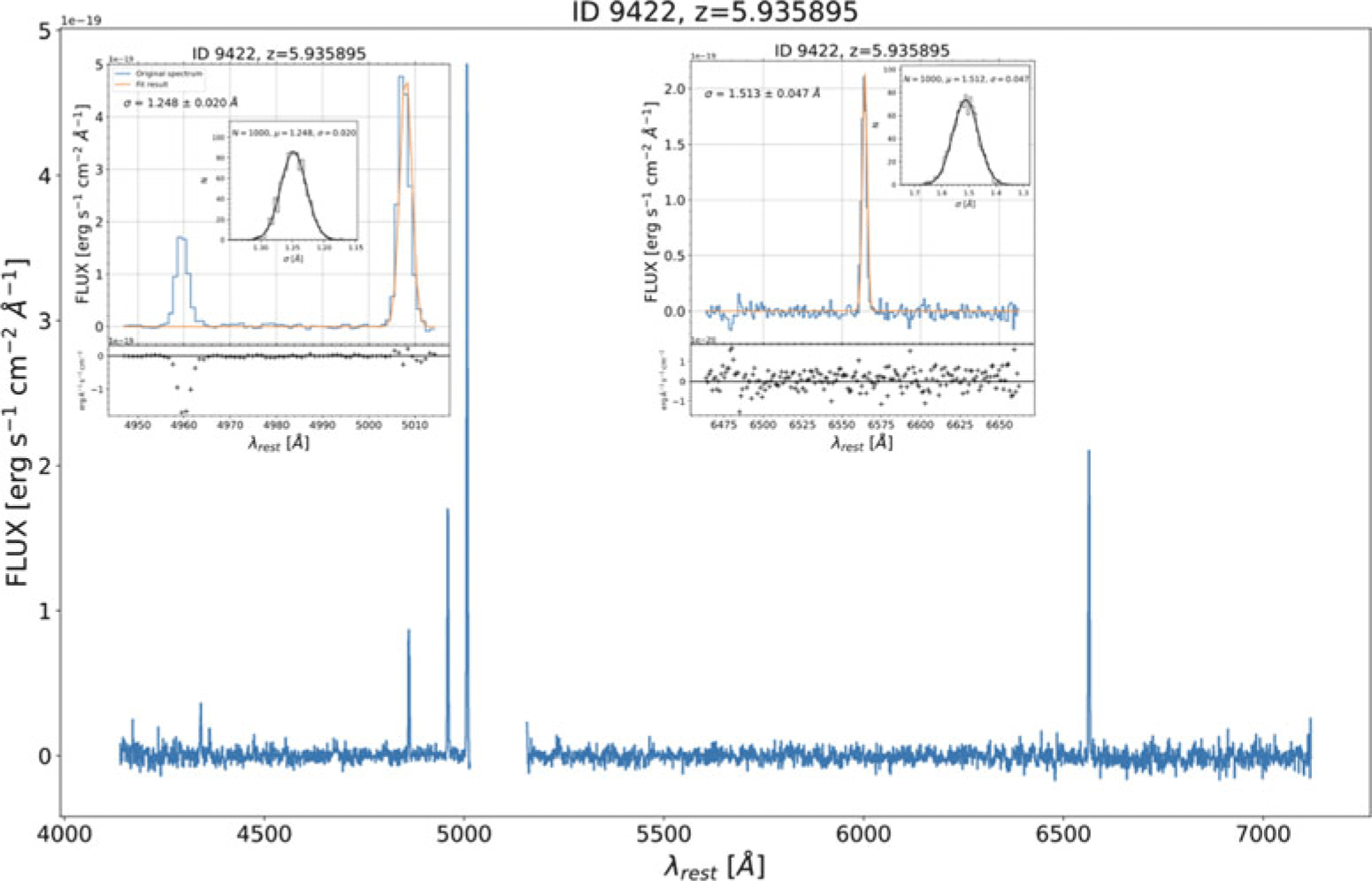
4959,5007Å (Zavala et al. Reference Zavala, Castellano and Akins2025). In Figure 1 we show the 1D spectrum of a HIIG at z
$\sim$
6 observed with the JWST in the G395H grating of NIRSpec.Figure 1.Identification and analysis of a HIIG at redshift 5.935 observed with the JWST in the G395H grating (R
$\sim$
2700) of NIRSpec.


To constrain the cosmological parameters from the distance modulus, we will use a maximum likelihood method,
 $L\propto\exp(-\frac{1}{2}\chi^2_H)$
, where chi-squared
 $\chi^2_H$
is defined by:
 \begin{equation} \chi^2_H = \sum_n\frac{(\mu_0(\log\,f,\log\,\sigma|\alpha,\beta)-\mu_\theta(z|\theta))^2}{\varepsilon^2},\end{equation}
 $\mu_0$
represents the observed distance modulus, derived from the observables via the
 $L-\sigma$
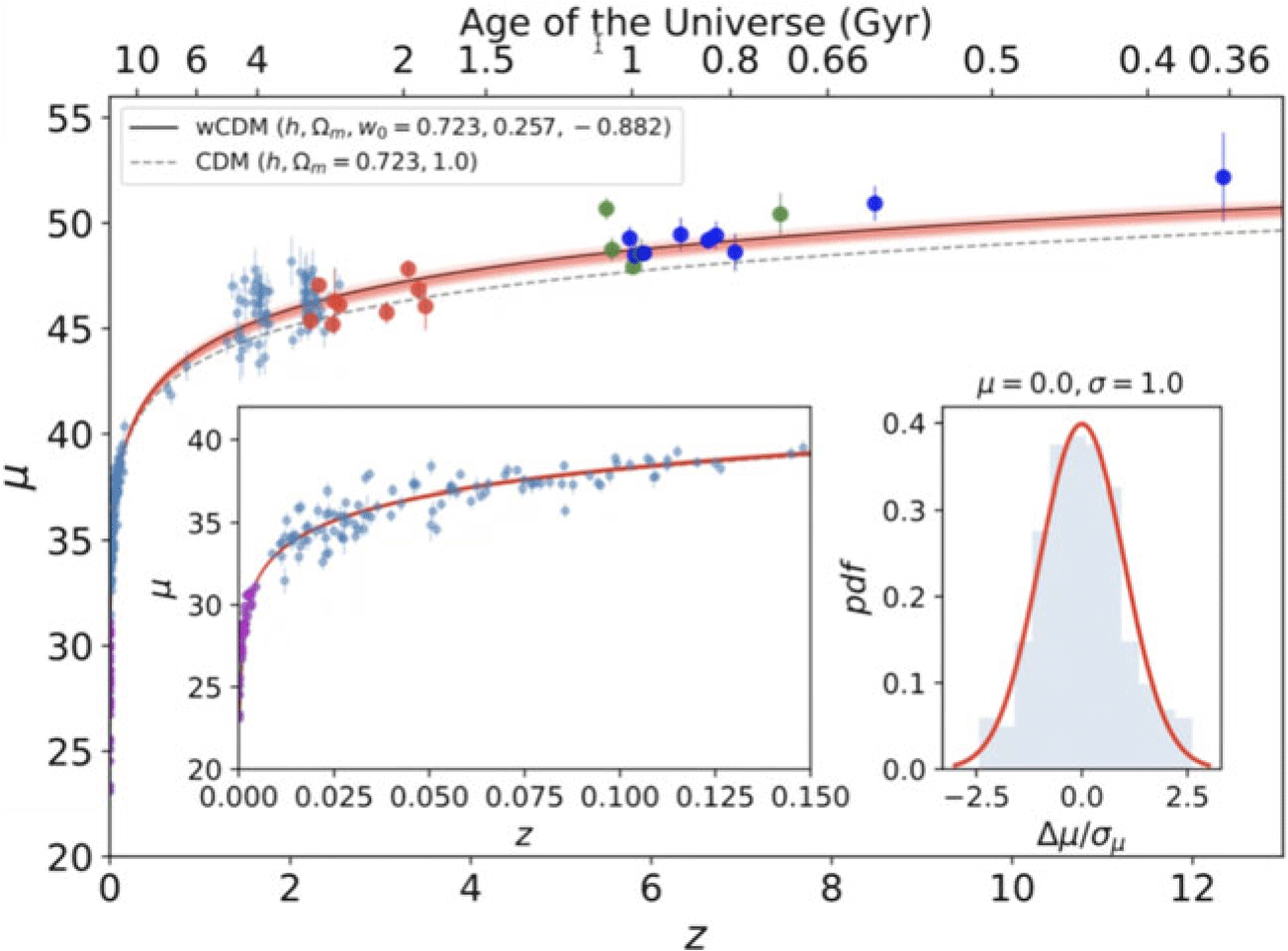
relation (see Figure 2), and
 $\mu_\theta$
denotes the distance modulus derived from a cosmological model with parameters
 $\theta$
and the measured redshift z. The parameters
 $\alpha$
and
 $\beta$
correspond to the intercept and slope of the
 $L-\sigma$
relation, being
 $\sigma$
the Balmer line velocity dispersion and f the line flux (corrected for extinction).
Hubble diagram for HIIG, where
 $\mu$
is the distance modulus. Blue symbols represent the ‘anchor’ sample of local HII-regions and the sample of 181
 $z\lesssim2.5$
HIIG, red symbols are the highest-redshift HIIG observed from the ground, the green and dark blue points represent the HIIG detected by JWST (Chávez et al. in prep). The red line is the best-fit cosmological model, while the grey dashed line is a flat cosmological model without dark energy.

3. Conclusions
The main result of this work is the verification that the
 $L-\sigma$
distance estimator method provides independent estimates of the cosmological parameters, H
 $_0$
,
 $\Omega_m$
,
 $w_0$
and
 $w_a$
, allowing to independently test the
 $\Lambda$
CDM cosmology and to contribute to the H
 $_0$
“tension” discussion.
 ∼
 μ
 z≲2.5


