Introduction
Graphidaceae is the second largest family of lichenized fungi, after Parmeliaceae, comprising approximately 2100 species in the three subfamilies Fissurinoideae, Graphidoideae, and Redonographoideae, not counting subfamily Gomphilloideae (Rivas Plata et al. Reference Rivas Plata, Lücking and Lumbsch2012; Reference LückingLücking et al. Reference Lücking, Aptroot, Boonpragob, Cáceres, Ertz, Harris, Jia, Kalb, Kraichak and Lendemer2014). The family contains two megadiverse genera, Graphis and Ocellularia, both with several hundred species (Reference LückingLücking et al. Reference Lücking, Archer and Aptroot2009; Rivas Plata et al. Reference Rivas Plata, Lücking and Lumbsch2012). Ocellularia has a faster rate of new species discovery, with approximately 75 out of 250 species (32%) described in the past ten years, 60 of these in the past twelve months alone, compared to Graphis with 70 out of approximately 400 species (17·5%), 20 of these in the past twelve months (Reference LückingLücking Reference Lücking2009; Lumbsch et al. Reference Lumbsch, Ahti, Altermann, Amo De Paz, Aptroot, Arup, Bárcenas Peña, Bawingan, Benatti and Betancourt2011; Bárcenas-Peña et al. Reference Bárcenas-Peña, Lücking, Miranda-González and Herrera-Campos2014; Cáceres et al. Reference Cáceres, Aptroot, Parnmen and Lücking2014; Papong et al. Reference Papong, Lücking, Kraichak, Parnmen, Von Konrat and Lumbsch2014). This is largely explained by ecological differences between the two genera: while Graphis is more common in (semi-)exposed microsites and hence its species tend to be more common and have wider distribution ranges, which facilitates discovery, Ocellularia is most diverse in well-conserved rainforest and such places have not been well sampled at a global level (Rivas Plata et al. Reference Rivas Plata, Lücking and Lumbsch2008). Consequently, a large part of the predicted undiscovered species richness in Graphidaceae is expected to represent Ocellularia species (Reference LückingLücking et al. Reference Lücking, Aptroot, Boonpragob, Cáceres, Ertz, Harris, Jia, Kalb, Kraichak and Lendemer2014).
It is therefore not entirely surprising, although unusual, that a small collection of Ocellularia specimens from Cuba, made by the second author in 2006, yielded three species new to science which are formally described here, together with an additional new species based on a historical collection from 1921 by Brother Hioram alias Jean Frange Lagorce. This discovery emphasizes the importance of the Caribbean for diversification and potential endemism of Graphidaceae and other lichens, as pointed out by Lücking (Reference Lücking2015a ). Following the recent publication of a key to the numerous species of the O. papillata, O. perforata, and O. terebrata morphodemes (Reference LückingLücking Reference Lücking2014), here we present a key to thelotremoid Graphidaceae with small, brown, (sub-)muriform ascospores, since three of the four new species described here belong to this ascospore type. Besides the genera Leptotrema, Leucodecton and Wirthiotrema, most of the species with this ascospore type belong in Ocellularia and particularly the O. bahiana group (Rivas Plata et al. Reference Rivas Plata, Lücking and Lumbsch2012). Leucodecton and Wirthiotrema can be keyed out to species elsewhere (Rivas Plata et al. Reference Rivas Plata, Lücking, Sipman, Mangold, Kalb and Lumbsch2010; Medeiros et al. Reference Medeiros, Kraichak, Lücking and Lumbsch2015).
Material and Methods
Specimens were examined with LEICA MS5 and OLYMPUS SZX12 dissecting microscopes and photographed with a JENOPTIC ProgRes C5 microscope digital camera attached to the latter. Sections of apothecia were cut by hand with a razor blade and mounted in tap water for examination with ZEISS Axioscop 2 and VISTA VISION VWR V036 compound microscopes. Secondary chemistry was assessed with standardized methods of thin-layer chromatography (TLC) using solvent system C (Orange et al. Reference Orange, James and White2010) and with spot tests using K and P. Lugol’s iodine solution was flushed through slides with apothecia sections to evaluate amyloidity of ascospores.
Results and Discussion
Ocellularia coronata Lücking & Pérez-Ortega sp. nov.
MycoBank No.: 813491
Differing from Ocellularia bahiana in the ridged to folded thallus, the vertically ridged, mostly sessile apothecia, and the complex, irregular columella forming a layer above the hymenium with narrow pores.
Type: Cuba, Holguín, Yamanigüey, 20°34'24"N, 74°44' 05"W, 22 m, dry forest, on fallen tree trunk, 6 March 2006, Pérez-Ortega 651 (MA—holotype; F—isotype).
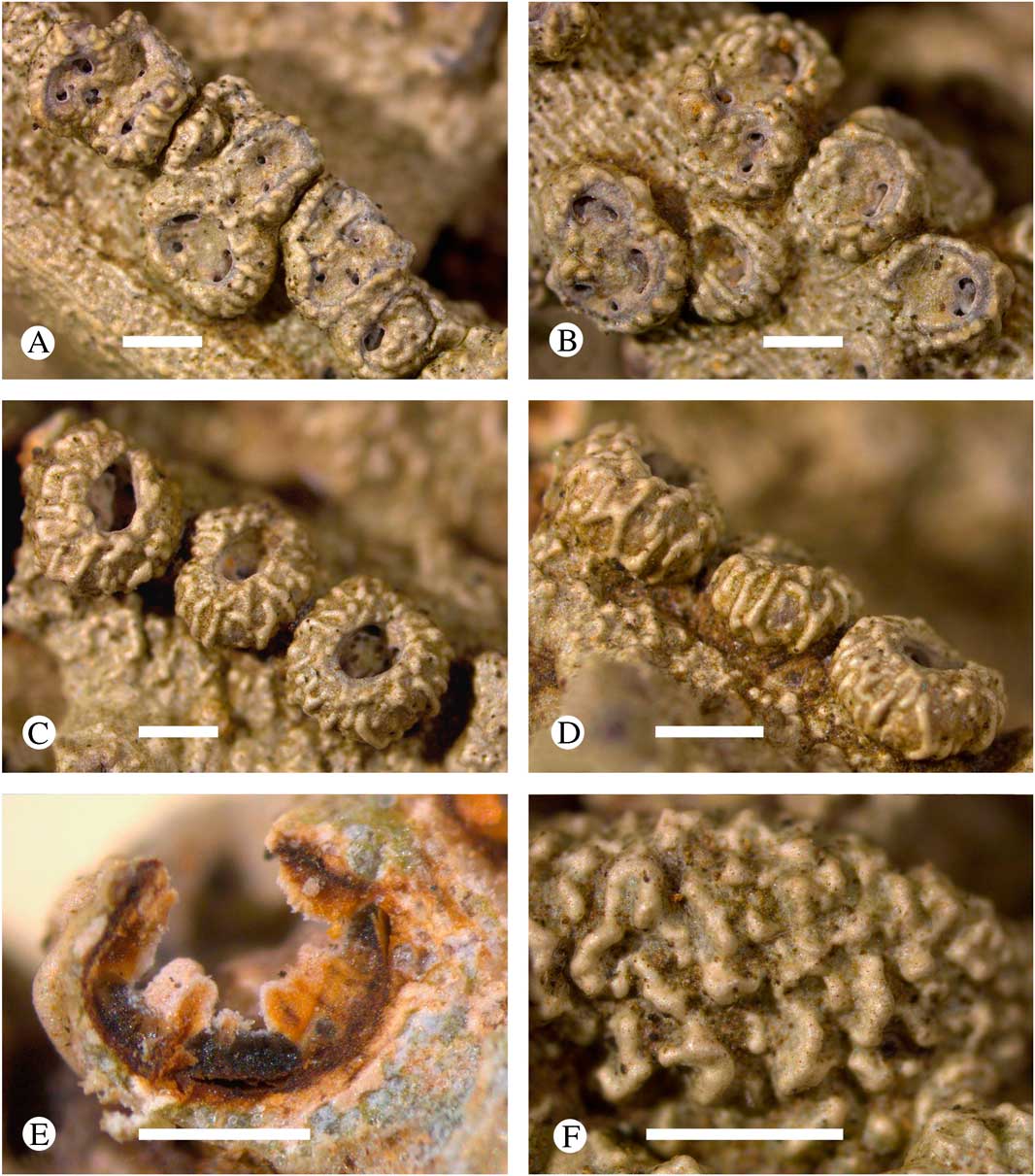
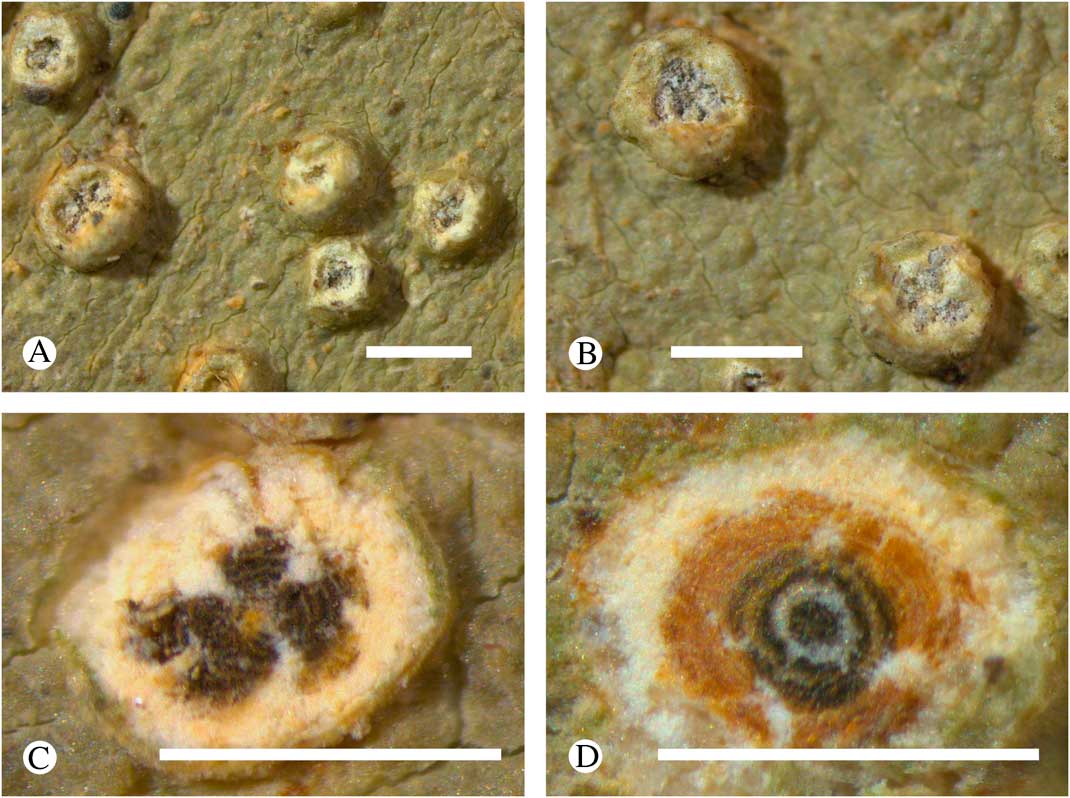
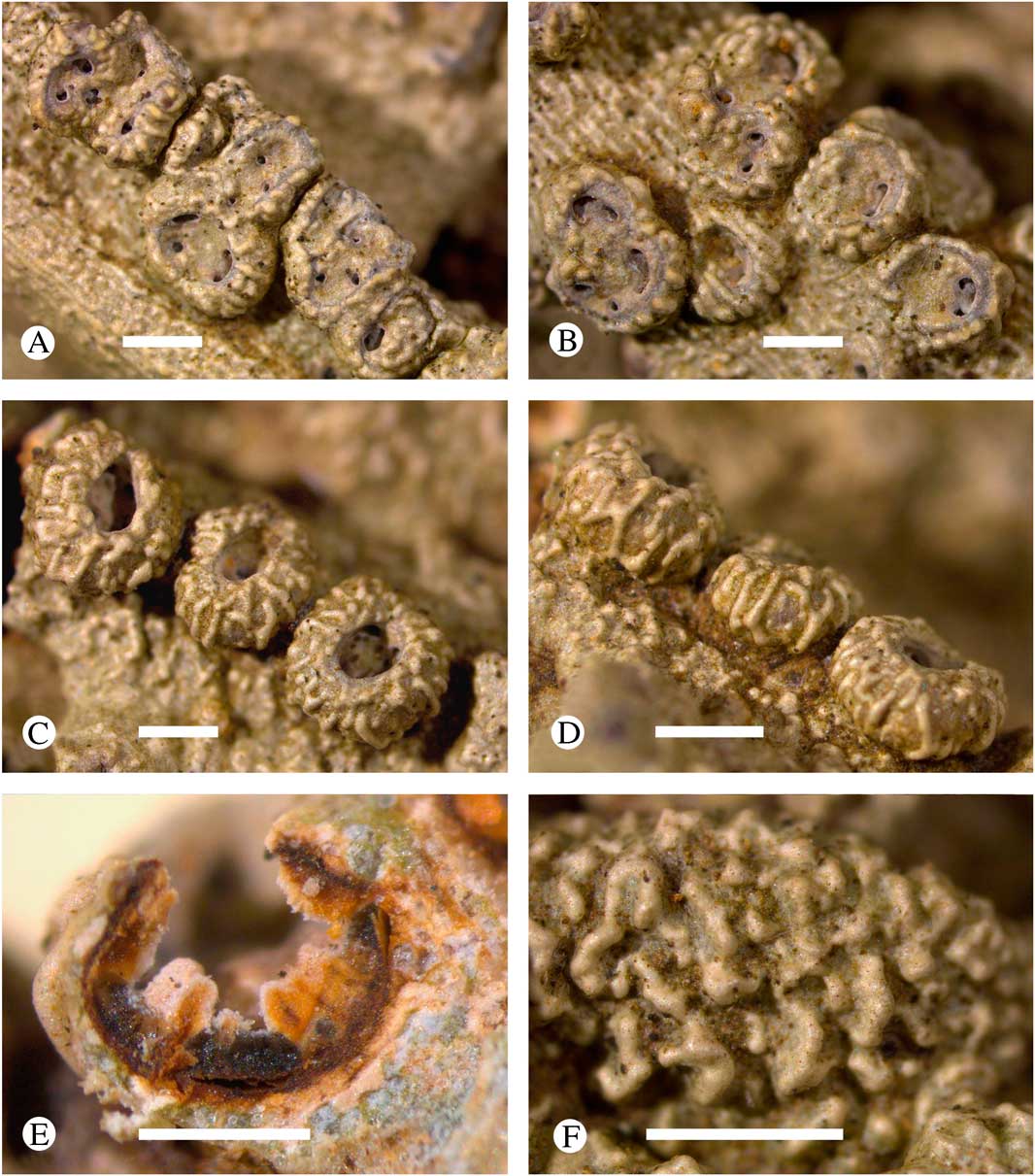
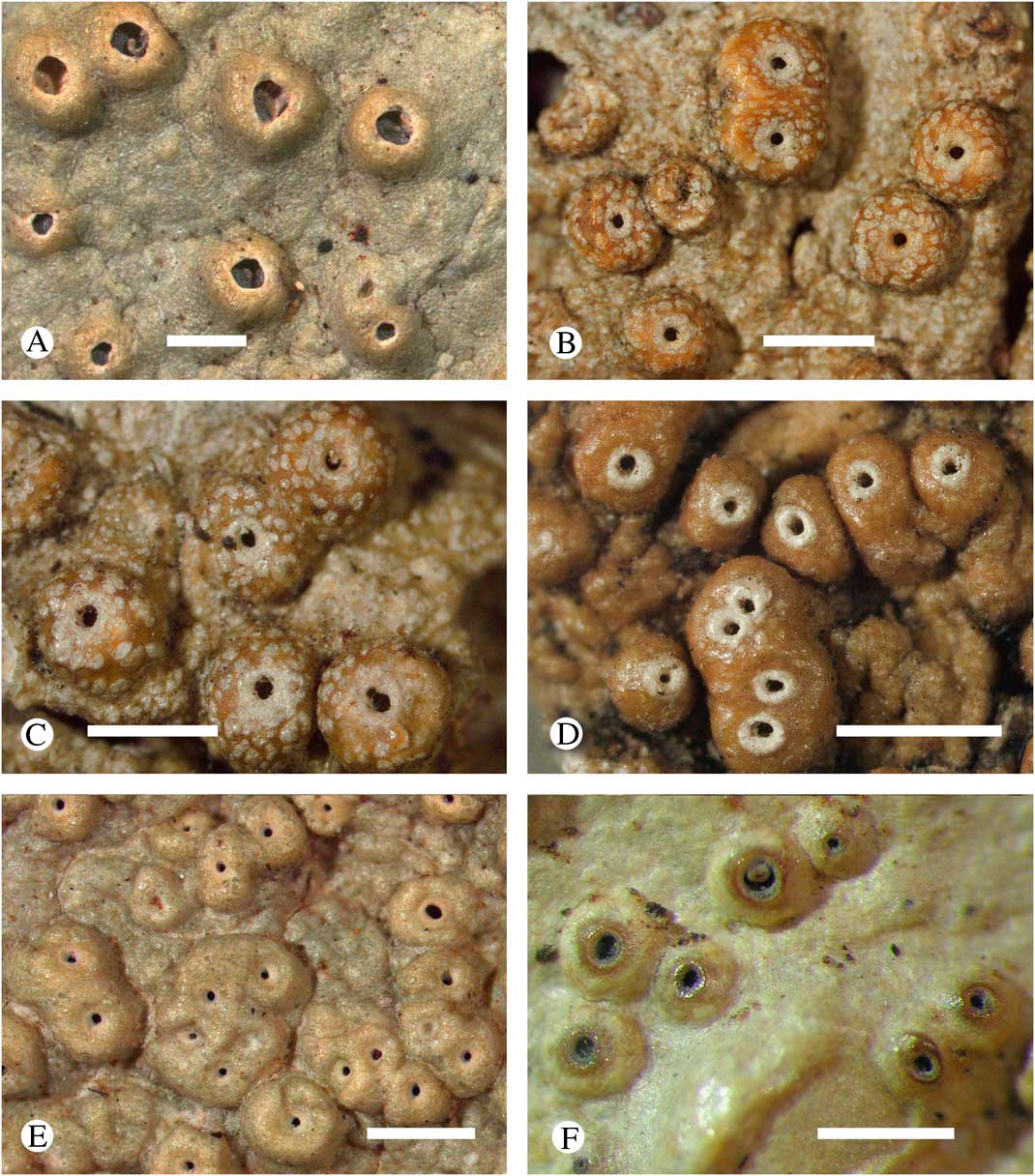
Ocellularia coronata (holotype). A–D, apothecia showing vertical ridges; E, section through apothecium showing excipulum and columella; F, thallus in surface view, enlarged to show ridges. Scales=1 mm. In colour online.
(Fig. 1)
Thallus corticolous, epiperidermal, up to 5 cm diam., continuous; surface distinctly rugose-ridged to finely folded, with short to elongate, often branched ridges 0·1 mm wide, sordid greenish grey; prothallus absent. Thallus in section 100–200 µm thick, with loose, thin cortex, 3–7 µm thick, and massive photobiont layer 90–190 µm thick, strongly encrusted with large (but not columnar) clusters of calcium oxalate crystals and also with numerous small, grey crystals; medulla indistinct. Photobiont Trentepohlia; cells rounded to irregular in outline, in irregular groups, yellowish green, 6–12×6–9 µm.
Apothecia rounded to irregular in outline, solitary or 2–3 aggregate to fused, at first erumpent but soon becoming prominent and then sessile with constricted base, 1–2 mm diam., 0·5–1·0 mm high; disc area partially covered by 0·5–1·0 mm wide primary pore but disc surface additionally covered by columella tissue leaving one or several small, 0·2–0·3 mm wide secondary pores, covering columella tissue, grey; proper margin thin, entire, visible as thin, grey-brown rim around the pore; thalline margin entire, distinctly vertically ridged, with ridges extending from the base of the apothecium to the upper margin, grey. Excipulum entire, externally with an orange layer, 20–30 µm wide, internally dark brown to blackish brown but not fully carbonized, 25–50 µm wide, both layers entire below the hypothecium; laterally covered by algiferous, loosely and thinly corticate thallus containing large clusters of calcium oxalate crystals, 30–50 µm thick; columella present, forming several irregular to radiating strands, individual strands yellowish to dark brown, 30–50 µm wide and 130–150 µm high, above the hymenium encrusted with crystals and forming a continuous layer; hypothecium prosoplectenchymatous, 10–20 µm high, hyaline; hymenium 120–130 µm high, hyaline, clear; proper epithecium indistinct but hymenium instead covered by layer extending from the columella strands, 10–20 µm high, yellowish grey granular. Paraphyses unbranched, apically smooth; periphysoids absent; asci cylindrical, 110–120×8–10 µm. Ascospores 8 per ascus, uniseriate, ellipsoid, muriform with 3–5 transverse and 1–2 longitudinal septa per segment, 18–25×7–8 µm, 2·5–3·5 times as long as wide, olive-brown when mature, distoseptate with lens-shaped lumina, I− even when young and hyaline.
Secondary chemistry
Protocetraric and virensic acids; exposed medulla P+ orange-red, microscopic section K−.
Notes
On account of the small, muriform, olive-brown ascospores, the protocetraric acid chemistry, and the overall morphology, this new species belongs in the Ocellularia bahiana group (Rivas Plata et al. Reference Rivas Plata, Lücking and Lumbsch2012; Kraichak et al. Reference Kraichak, Parnmen, Lücking, Rivas Plata, Aptroot, Cáceres, Ertz, Mangold, Mercado-Díaz and Papong2014). There are currently three other species recognized within this group with protocetraric acid, brown ascospores, and columellate apothecia (see below): O. obturascens forms a finger-like, white-tipped columella partially filling a broad pore, with regularly rounded apothecia (Lücking et al. Reference Lücking, Seavey, Common, Beeching, Breuss, Buck, Crane, Hodges, Hodkinson and Lay2011), whereas O. rudior features a finger-like to partly irregular columella partially filling a broad pore, with edged apothecia (corresponding to O. obturascens sensu Lücking Reference Lücking2015a , Reference Lücking b ); a third species described below, O. radiata, forms radiating, externally visible, whitish columella strands (corresponding to O. rudior sensu Lücking Reference Lücking2015a , Reference Lücking b ). Ocellularia coronata differs from these in the ridged to folded thallus and the irregularly aggregate to fused, sessile, vertically ridged apothecia in which the irregular to radiating columella strands are visible only in cross-section, and in surface view form a continuous layer above the hymenium, leaving small secondary pores within the larger primary pore formed by the proper excipulum. Morphologically similar is O. ornata M. Cáceres et al. recently described from Brazil (Cáceres et al. Reference Cáceres, Aptroot, Parnmen and Lücking2014), which also has its apothecia aggregated in ridged warts with a narrow pore and produces protocetraric acid, but its ascospores are transversely septate and hyaline; this species is possibly related to O. perforata (Leight.) Müll. Arg. in the O. perforata group (Rivas Plata et al. Reference Rivas Plata, Lücking and Lumbsch2012; Reference LückingLücking Reference Lücking2014).
Additional specimen examined
Cuba: Holguín: Yamanigüey, 20°34'24"N, 74°44'05"W, 22 m, dry forest, on fallen tree trunk, 2006, Pérez-Ortega 654 (FR).
Ocellularia fuscospora Lücking & Pérez-Ortega sp. nov.
MycoBank No.: 813493
Differing from Ocellularia urceolaris in the immersed to erumpent apothecia with the pore filled by a white-tipped columella, and from O. laeviuscula in the larger, persistently columellate apothecia and the irregular (not columnar) clusters of crystals in the thallus.
Type: Cuba, Holguín, Yamanigüey, 20°34'24"N, 74°44'05"W, 22 m, dry forest, on fallen tree trunk, 6 March 2006, Pérez-Ortega 650 (MA—holotype; F—isotype).
(Fig 2)
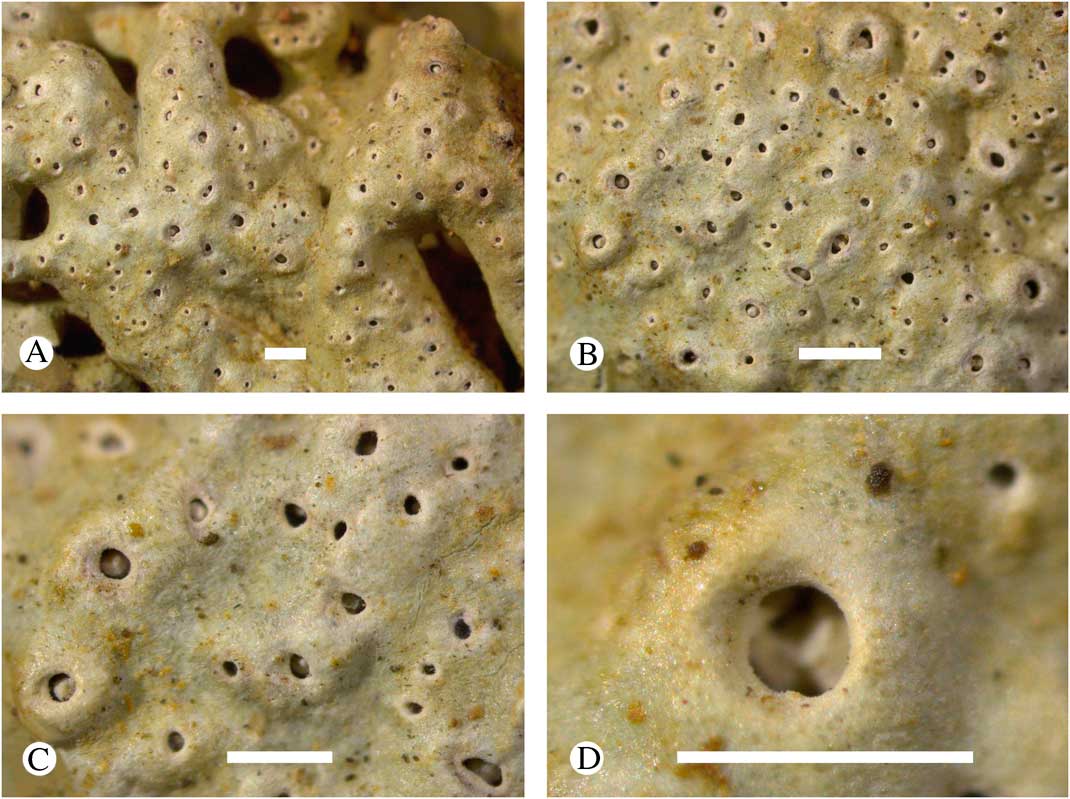
Ocellularia fuscospora (holotype). A–C, thallus with apothecia; D, apothecium enlarged. Scales=1 mm. In colour online.
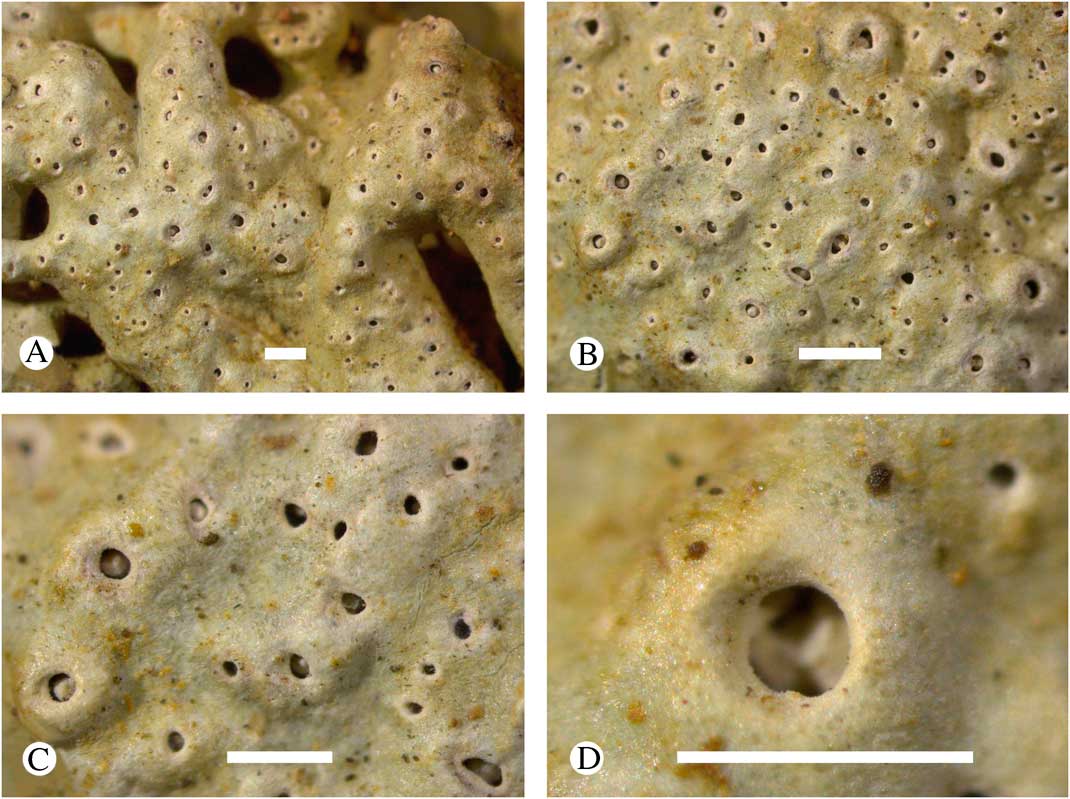
Thallus corticolous, epiperidermal, up to 10 cm diam., continuous, hollow beneath and fragile; surface smooth to uneven but undulate at the macroscale, light yellowish grey; prothallus absent. Thallus in section 150–250 µm thick, with loose cortex, 15–25 µm thick, and massive photobiont layer 130–230 µm thick, strongly encrusted with large (but not columnar) clusters of calcium oxalate crystals; medulla indistinct. Photobiont Trentepohlia; cells rounded to irregular in outline, in irregular groups, yellowish green, 7–11×5–9 µm.
Apothecia rounded, immersed to erumpent, 0·6–1·0 mm diam., 0·3–0·4 mm high; disc covered by 0·2–0·4 mm wide primary pore mostly filled by a white-tipped columella (columella often immersed and not readily visible from above); proper margin thin, entire, indistinct or visible as thin, grey-brown rim around the pore; thalline margin entire, light yellowish grey. Excipulum entire, light to dark yellowish brown, 30–50 µm wide, entire below the hypothecium; laterally covered by an orange-brown, amorphous periderm layer and by a loosely corticate thallus containing large clusters of calcium oxalate crystals; columella present, finger-like to becoming irregular in large apothecia, often developed above the hymenium only, colourless to yellowish, 200–400 µm wide and 100–200 µm high; hypothecium prosoplectenchymatous, 10–15 µm high, hyaline; hymenium 120–130 µm high, hyaline, clear; epithecium thin, 5–10 µm high, grey-brown granular. Paraphyses unbranched, apically smooth; periphysoids absent; asci cylindrical, 120–130×10–15 µm. Ascospores 8 per ascus, more or less uniseriate to irregularly arranged, ellipsoid to oblong and sometimes slightly curved, muriform with 5–7 transverse and 1–2 longitudinal septa per segment, 20–30×8–12 µm, 2–3 times as long as wide, olive-brown when mature, distoseptate with lens-shaped lumina, I− even when young and hyaline.
Secondary chemistry
No substances detected by TLC; exposed medulla P−, microscopic section K−.
Notes
Ocellularia fuscospora resembles a species of the O. papillata aggregate, in particular the palaeotropical O. rongklaensis (Homchant. & Coppins) Lücking (Reference LückingLücking Reference Lücking2014). However, it differs from species in this group by the muriform, olive-brown ascospores which place this new species in the O. bahiana group instead. Most similar within this group is O. urceolaris Ach., which agrees in most features except that it lacks a columella and the apothecia become prominent when mature. Columellate apothecia of Ocellularia laeviuscula (Nyl.) Kraichak et al. might resemble those of O. fuscospora, but the apothecia in O. laeviuscula are small (0·2–0·3 mm) and the thallus is minutely grainy due to the formation of columnar clusters of crystals.
Additional specimen examined
Cuba: Holguín: Cayo Guan, 20°33'57"N, 74°49'33"W, 60 m, near stream, on liana, 2006, Pérez-Ortega 653 (FR).
Ocellularia nigririmis Lücking & Pérez-Ortega sp. nov.
MycoBank No.: 813495
Differing from Ocellularia buckii by the smooth to uneven (not verrucose) thallus and the larger apothecia.
Type: Cuba, Guantánamo, Baracoa, Yunque de Baracoa, 20°20'45"N, 74°34'12"W, 300–572 m, epiphytic, 8 March 2006, Pérez-Ortega 655 (MA—holotype).
(Fig 3)
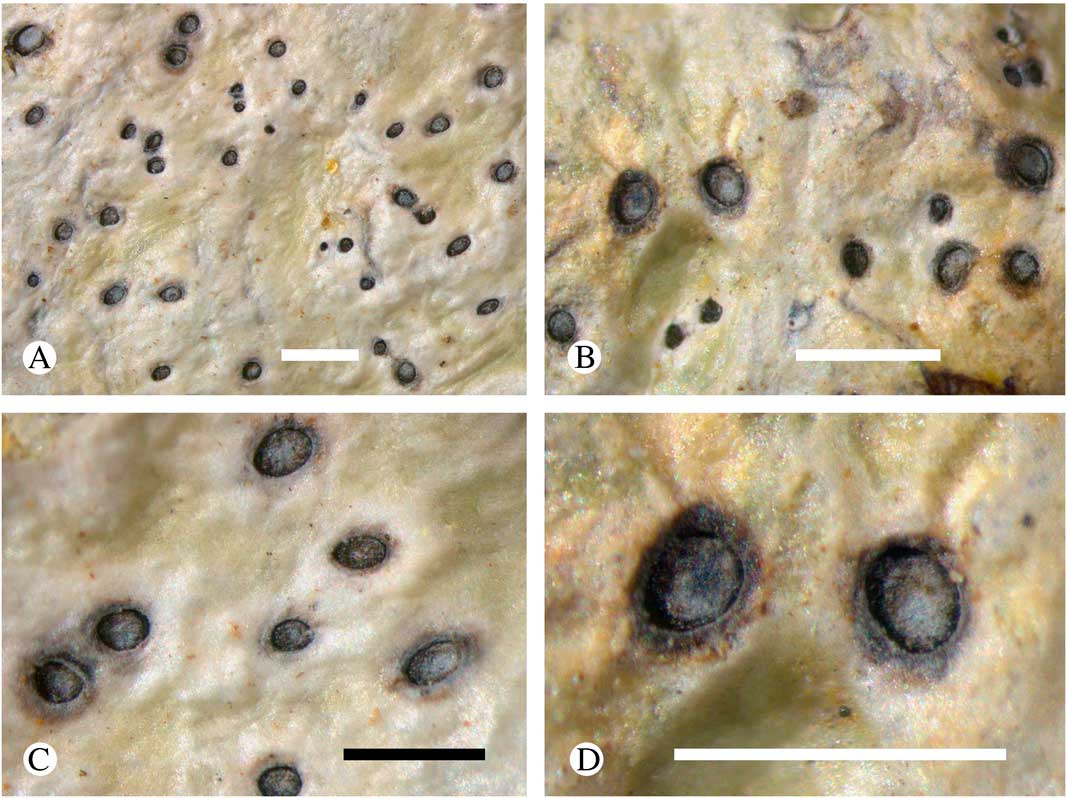
Ocellularia nigririmis (holotype). A–C, thallus with apothecia; D, apothecium enlarged. Scales=1 mm. In colour online.
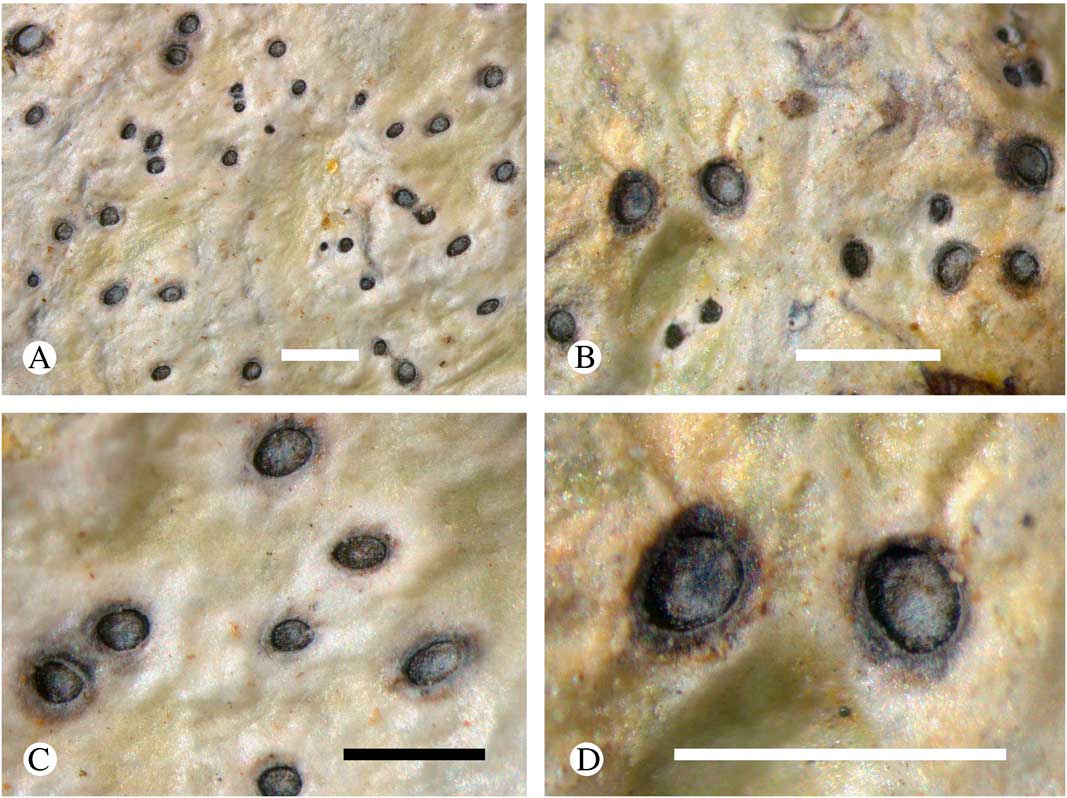
Thallus corticolous, epiperidermal, up to 5 cm diam., continuous; surface smooth to uneven, whitish; prothallus absent. Thallus in section 50–100 µm thick, with dense, prosoplectenchymatous cortex, 15–25 µm thick, and photobiont layer 30–80 µm thick, strongly encrusted with large (but not columnar) clusters of calcium oxalate crystals; medulla indistinct. Photobiont Trentepohlia; cells rounded to irregular in outline, in irregular groups, yellowish green, 6–11×5–10 µm.
Apothecia rounded, immersed, 0·3–0·5 mm diam., 0·18–0·25 mm high; disc covered by 0·15–0·25 mm wide primary pore, completely filled by a black, thinly grey-pruinose columella; proper margin distinct, entire, visible as thin, blackish rim around the pore; thalline margin entire, whitish. Excipulum entire, carbonized in upper half, yellowish to orange-brown below, 30–50 µm wide; laterally covered by an orange-brown periderm layer and by a corticate thallus containing large clusters of calcium oxalate crystals; columella present, finger-like to plug-shaped, fully carbonized, 150–250 µm wide and 150–200 µm high; hypothecium prosoplectenchymatous, 10–15 µm high, hyaline; hymenium 80–90 µm high, hyaline, clear; epithecium indistinct. Paraphyses unbranched, apically smooth; periphysoids absent; asci cylindrical, 80–90×8–10 µm. Ascospores 8 per ascus, more or less uniseriate to irregularly arranged, ellipsoid to fusiform, 5-septate, 16–20×5–6 µm, 3·0–3·5 times as long as wide, hyaline, distoseptate with lens-shaped lumina, I+ amyloid.
Secondary chemistry
No substances detected by TLC; exposed medulla P−, microscopic section K−.
Notes
This is another new species in the species rich O. papillata aggregate, characterized by small, transversely septate ascospores, columellate apothecia, and a lack of secondary substances (Reference LückingLücking Reference Lücking2014). It falls within a group of eight species with carbonized excipulum and columella and, within this group, comes closest to the recently described O. buckii Lücking from Brazil (Reference LückingLücking Reference Lücking2014, Reference Lücking2015a ), with which it shares the whitish thallus and immersed, black-rimmed apothecia with blackish columella. However, the latter has a distinctly verrucose thallus and smaller apothecia with a minute pore. Ocellularia nigririmis also resembles a species of Clandestinotrema with broad columella (Rivas Plata et al. Reference Rivas Plata, Lücking and Lumbsch2012) but differs in the corticate thallus and amyloid ascospores with lens-shaped lumina.
Ocellularia obturascens (Nyl.) Hale
MycoBank No.: MB132231
Hale in Egan, Bryologist 90: 164 (1987); Thelotrema bahianum var. obturascens Nyl., Acta Soc. Sci. Fenn. 7(2): 453 (1863); type: Colombia, Lindig 719 (H-Nyl 3916!— holotype).
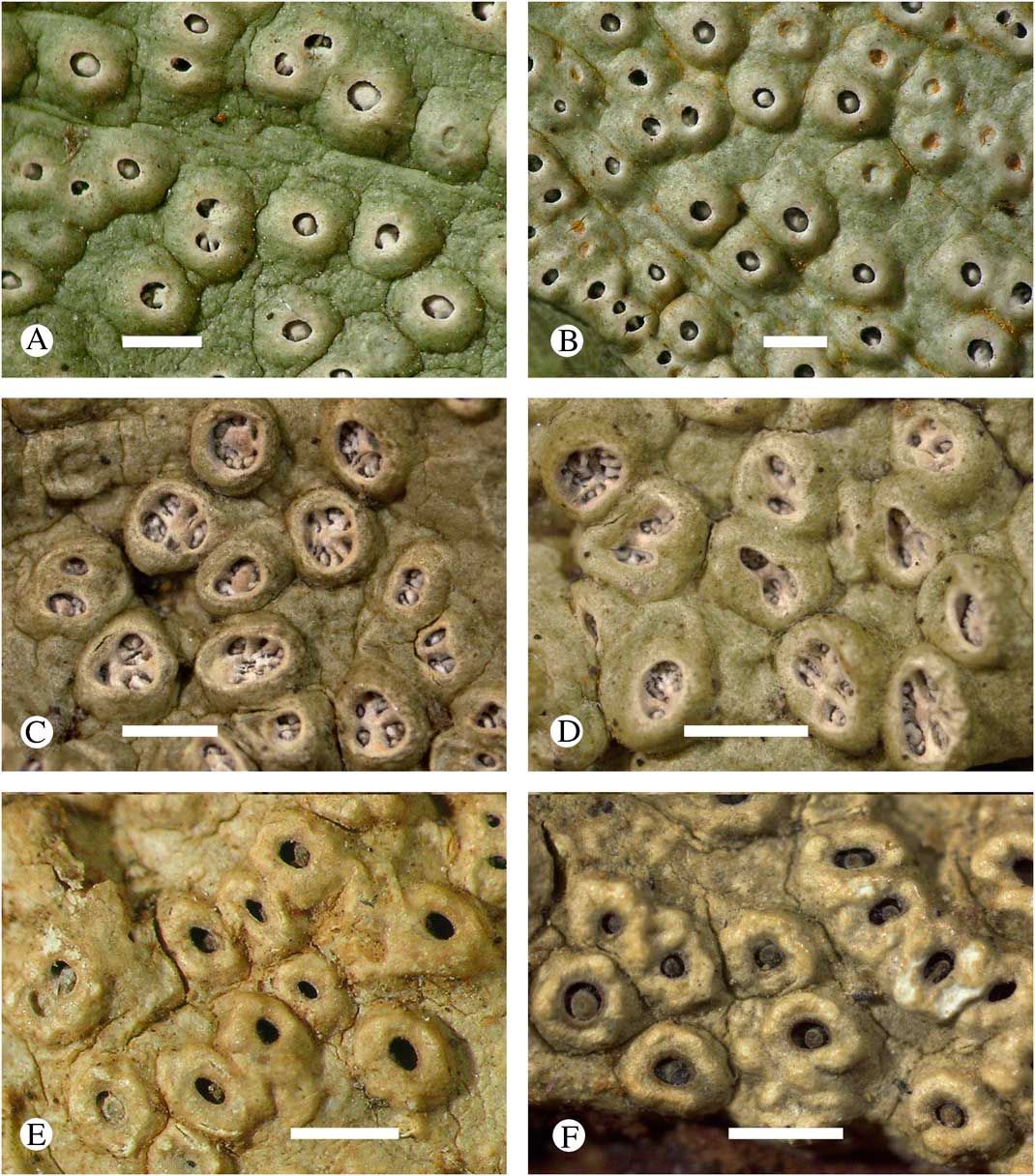
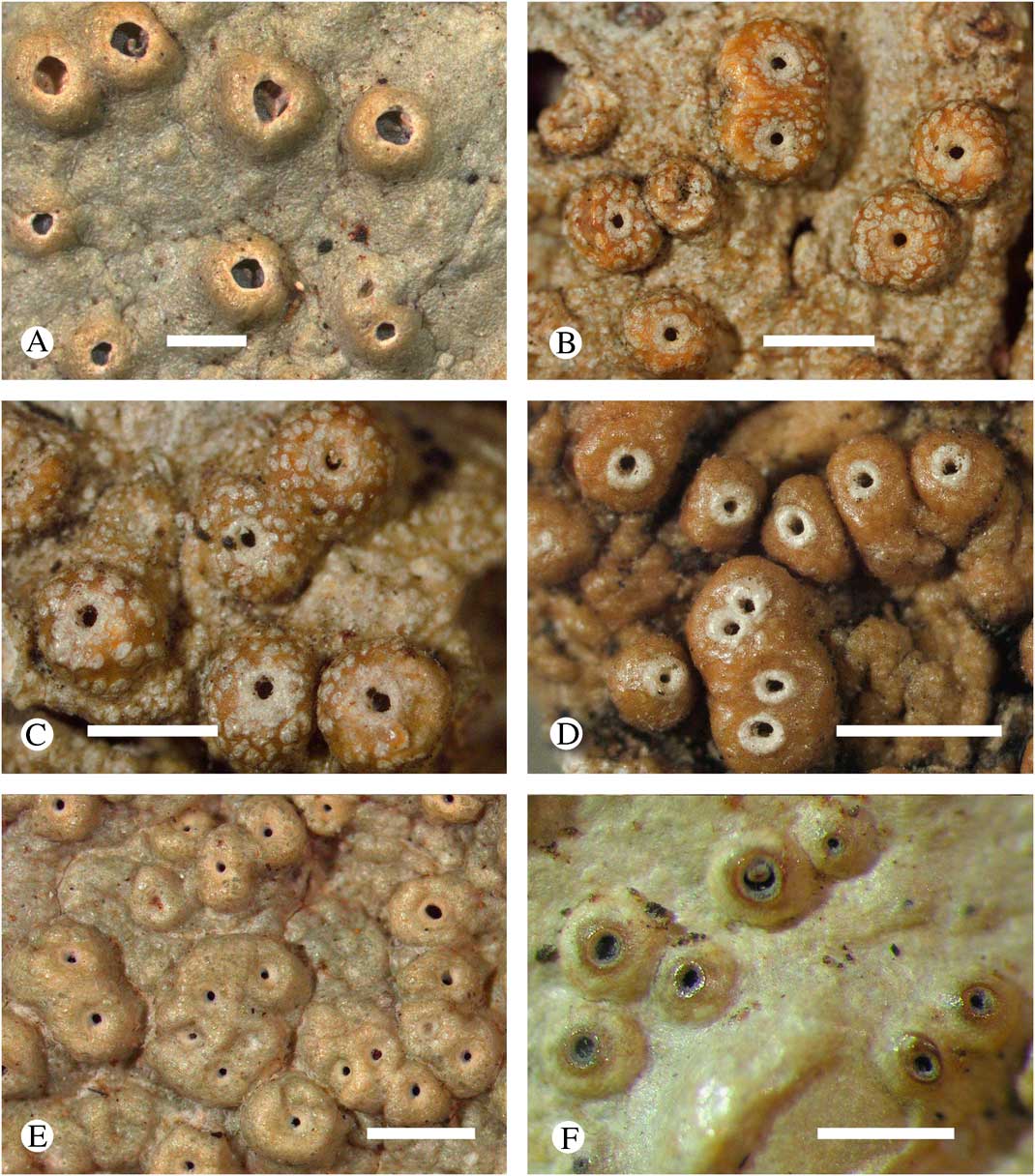
A & B, Ocellularia obturascens (A, USA, Lücking 26554; B, USA, Lücking 26552), thallus with apothecia; C & D, Ocellularia radiata (holotype), thallus with apothecia; E & F, Ocellularia rudior (E, holotype; F, Guadeloupe, Duss 152), thallus with apothecia. Scales=1 mm. In colour online.
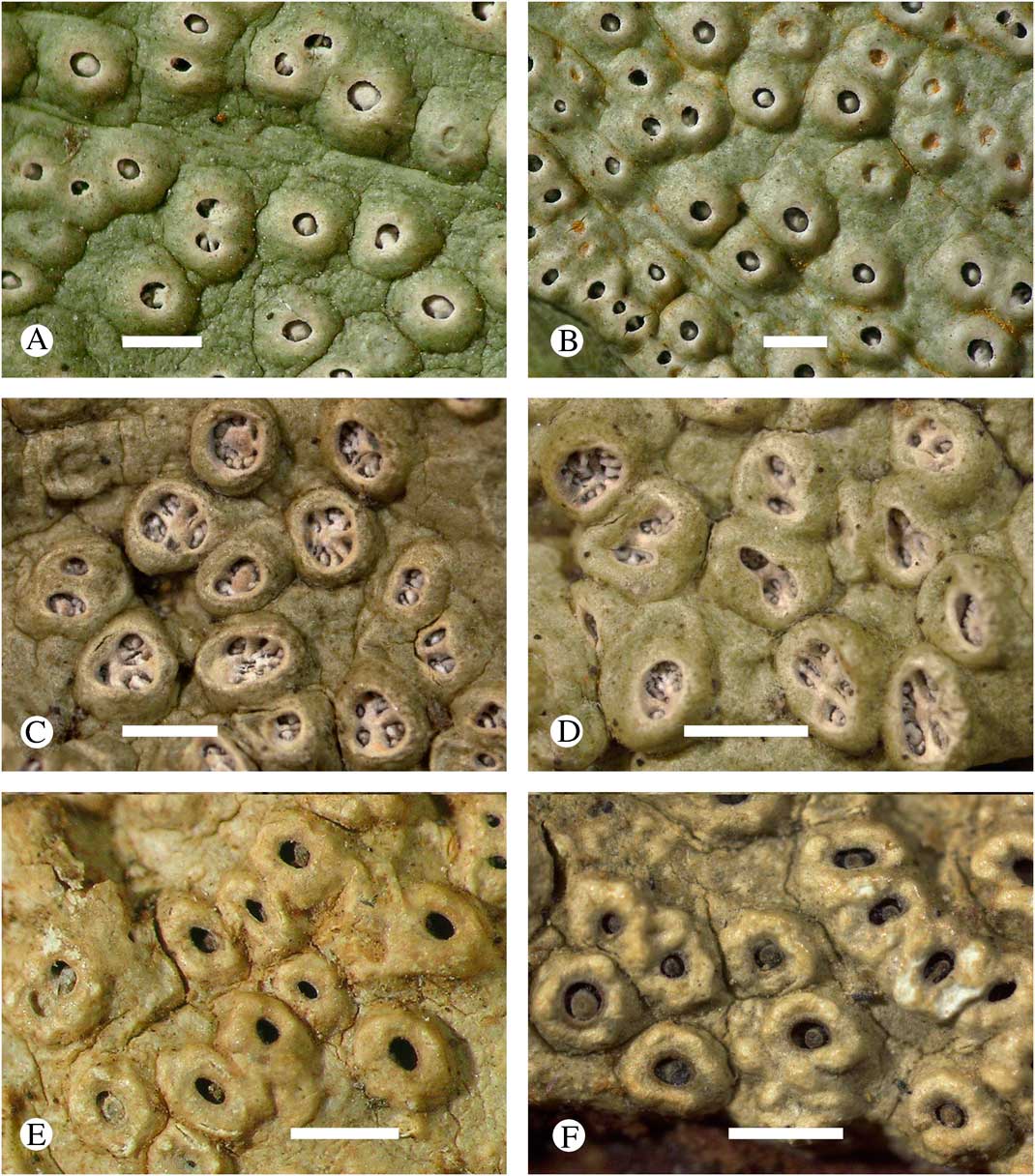
Notes
The correct circumscription of this species was until recently unclear. The protologue characterizes this taxon as similar to Ocellularia bahiana but with white-tipped columella. In previous treatments, variously columellate forms were either considered variations within a broadly defined O. bahiana (Harris Reference Harris1990, Reference Harris1995; Frisch Reference Frisch2006) or subsumed under the name O. obturascens (Hale in Egan Reference Egan1987; Mangold et al. Reference Mangold, Elix and Lumbsch2009; Sipman et al. Reference Sipman, Lücking, Aptroot, Kalb, Chaves and Umaña2012). Lücking (Reference Lücking2015a , Reference Lücking b ) indicated that there might actually be several columellate taxa within this complex and resurrected the name O. rudior for specimens with a radiating columella which, however, appears to be incorrect (see below), since the type material of the latter has a different columella type. Herbarium H-Nyl has two specimens, Lindig 709 and Lindig 719. The first was annotated by Hale as lectotype, but that collection is not cited in the protologue; instead, Lindig 719 is clearly indicated as the type and must be considered a holotype. A third specimen, Lindig 825, is given as the type of var. ruptum, a synonym of O. rudior (see below).
Ocellularia radiata Lücking sp. nov.
MycoBank No.: 813496
Differing from Ocellularia bahiana in the complex columella forming radiating, whitish strands filling the disc, and the often edged apothecia.
Type: Cuba, Oriente, Boca del Jaibo, 29 September 1921, Bro. Hioram 5521 (NY—holotype).
Thallus corticolous, epiperidermal, up to 5 cm diam., continuous; surface smooth to uneven, very minutely grainy, sordid greenish grey; prothallus absent. Thallus in section 100–150 µm thick, with loose, thin cortex, 5–10 µm thick, and massive photobiont layer 100–150 µm thick, encrusted with large, columnar clusters of calcium oxalate crystals and also with numerous small, grey crystals; medulla indistinct. Photobiont Trentepohlia; cells rounded to irregular in outline, in irregular groups, yellowish green, 6–11×6–9 µm.
Apothecia rounded to more or less edged outline, solitary, erumpent to prominent, 0·7–1·3 mm diam., 0·3–0·5 mm high; disc partly covered by 0·3–0·8 mm wide primary pore mostly filled by complex, radiating, whitish columella strands; proper margin thin, entire, visible as thin, whitish rim around the pore; thalline margin entire, smooth and minutely grainy, greenish grey. Excipulum entire, 30–50 µm wide, brown, laterally covered by periderm layer and algiferous, loosely and thinly corticate thallus containing columnar clusters of calcium oxalate crystals; columella present, forming 5–8 radiating strands connected in the centre, individual strands whitish, in section colourless to yellowish, 30–50 µm wide and 130–150 µm high, above the hymenium encrusted with crystals; hypothecium prosoplectenchymatous, 10–20 µm high, hyaline; hymenium 120–130 µm high, hyaline, clear; proper epithecium indistinct but hymenium instead covered by layer extending from the columella strands, 10–20 µm high, yellowish grey granular. Paraphyses unbranched, apically smooth; periphysoids absent; asci cylindrical, 100–120×8–10 µm. Ascospores 8 per ascus, uniseriate, ellipsoid, muriform with 3–5 transverse and 1–2 longitudinal septa per segment, 20–28×7–8 µm, 2·5–3·5 times as long as wide, olive-brown when mature, distoseptate with lens-shaped lumina, I− even when young and hyaline.
Secondary chemistry
Protocetraric and virensic acids; exposed medulla P+ orange-red, microscopic section K−.
Notes
This taxon was provisionally named Ocellularia rudior by Lücking (Reference Lücking2015a , Reference Lücking b ), but re-examination of the type material of the latter showed a finger-like to slightly irregular, grey-brown to rarely whitish columella partly filling a broad pore. Hence, a new species is established for material with radiating, whitish columella. The two species also differ in thallus anatomy, with O. rudior having irregular (not columnar) clusters of crystals and lacking the minutely grainy surface appearance, and in apothecial morphology, with the apothecia of O. rudior typically and distinctly edged.
Additional specimens examined
Jamaica: Trelawny Parish: NW of Troy Nr. Crown Lands Road extension 4·5–5·0 mi, 530–610 m, on bark of Acidocroton, 1975, Proctor 34721 (NY).—Dominican Republic: Altagracia: 5·5 km S of La Romana-Higuey Hwy on road to Bayahibe, 18°24'N, 68°50'W, sea level, dry forest over karst limestone, 1991, Harris 26584 (NY). Distrito Nacional: Sierra Prieta, 18 km NW of Villa Mella on road to Yamasá, 18°39'N, 69°58'W, 250 m, original scrub forest on mesic serpentine hill, 1987, Harris 20192 (NY). Pedernales: 3·5 km SSW of Las Mercedes, 5 km N of intersection of road from Oviedo to Pedernales, 18°02'N, 71°38'W, 240 m, dry forest, 1981, Buck 4506 (NY).
Ocellularia rudior (Vain.) Lücking
MycoBank No.: MB811510
Lücking, Opuscula Philolichenum 14: 58 (2015); Lücking, Opuscula Philolichenum 14: 22 (2015) [comb. inval., ICN Art. 42.1]; Thelotrema rudius Vain., Ann. Acad. Sci. Fenn., Ser. A 6(7): 135 (1915); Leptotrema rudius (Vain.) Zahlbr., Cat. Lich. Univers. 2: 639 (1923); type: Guadeloupe, 1897, Duss 152 (TUR-Vainio 26790!—holotype).
Thelotrema bahianum var. ruptum Nyl., Acta Soc. Sci. Fenn. 7(2): 454 (1863); type: Colombia, Lindig 825 (H-Nyl 3915!—holotype).
Notes
This name was resurrected by Lücking (Reference Lücking2015a , Reference Lücking b ) for specimens with a radiating columella. However, careful re-examination of the type material of all current and past names described within this complex showed that this name has to be applied to a taxon with finger-like to slightly irregular, grey-brown to rarely whitish columella partly filling a broad pore. The specimens with complex, radiating, whitish columella strands are described above as the new species, O. radiata. Both share the often edged apothecial margin, whereas O. bahiana and O. obturascens have regularly rounded apothecia.
Additional specimens examined
Jamaica: St. Ann Parish: 1·4 mi W of Discovery Bay, vicinity of Discovery Bay, Marine Laboratory, 18°28'N, 77°25'W, sea level, dry forest over very rough limestone by seam base of tree, 1981, Buck 6019 (NY).—Cuba: Holguín: Yamanigüey, 20°34'24"N, 74°44'05"W, 22 m, dry forest, on fallen tree trunk, 2006, Pérez-Ortega 652, 666 (FR).
Ocellularia aff. referta Hale
(Fig. 5)
Ocellularia aff. referta (Pérez-Ortega 665). A & B, thallus with apothecia; C & D, apothecia enlarged. Scales=1 mm. In colour online.
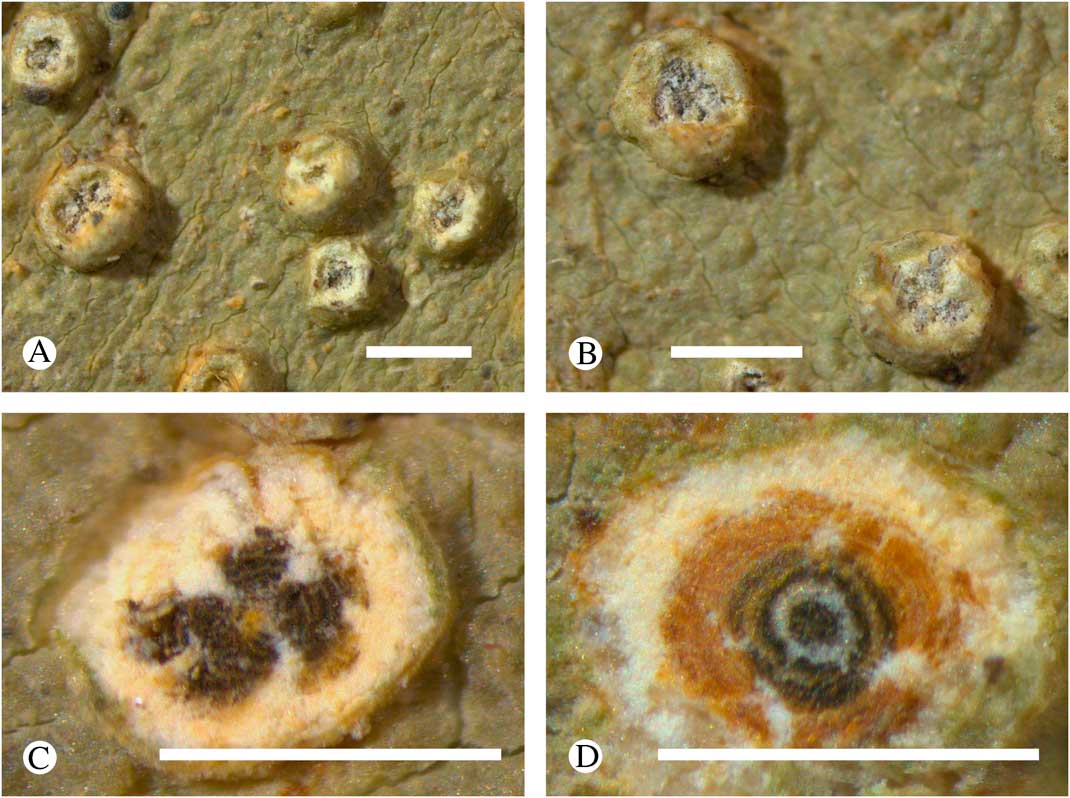
Notes
The present material resembles Ocellularia referta in the excipulum being concentrically layered but differs clearly in other morphological aspects, and probably representing an undescribed taxon. Unfortunately, the apothecia do not contain any fertile hymenia with asci and ascospores, and they are filled with the carbonized remnants of the excipula. In surface view, the apothecia somewhat resemble mazedia.
Specimen examined
Cuba: Holguín: Cayo Guan, Melba trail, entrance to Alexander von Humboldt Park, 20°31'10"N, 74°49'05"W, 345 m, epiphytic, 2006, Pérez-Ortega 665 (F, FR).

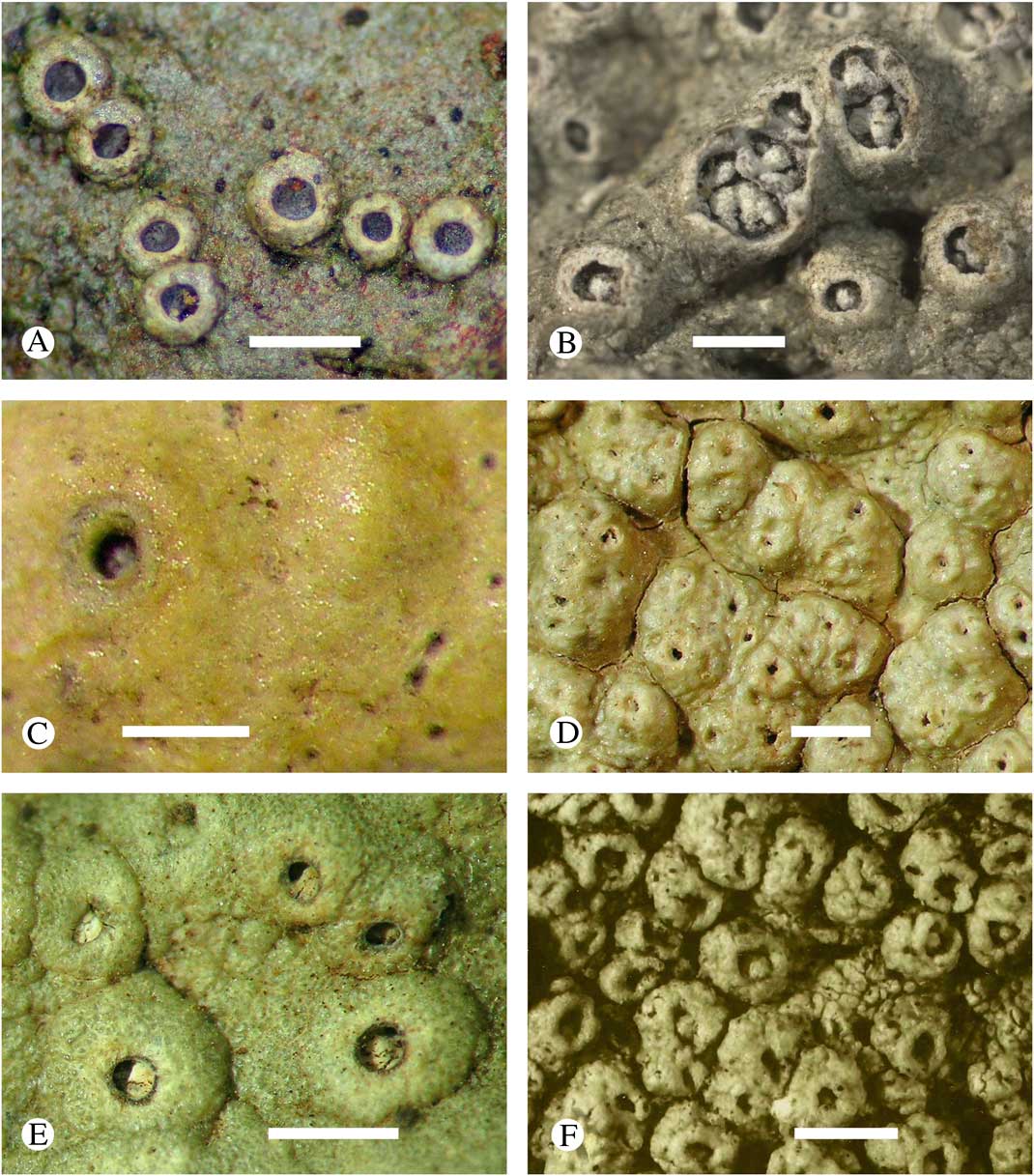
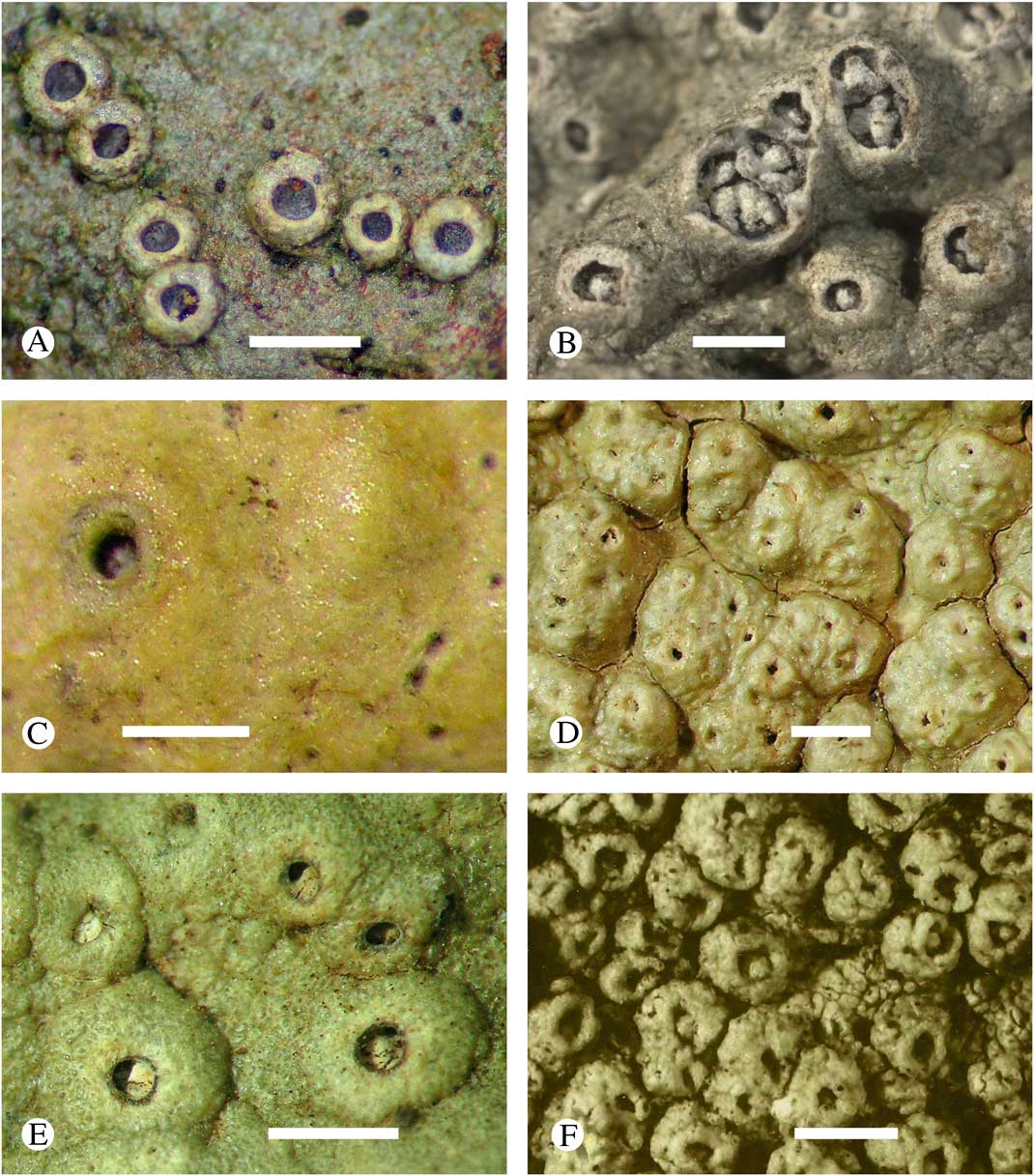
A, Amazonotrema amazonum (Brazil, Cáceres & Aptroot 15774), thallus with apothecia; B, Redingeria microspora (Colombia, Baker 51), thallus with apothecia; C, Ocellularia andamanica (lectotype), thallus with apothecia; D, O. confluens (holotype of Ascidium confluens var. polyporum), thallus with apothecia; E, Rhabdodiscus marivelensis (lectotype), apothecia enlarged; F, R. kinabalensis (holotype), thallus with apothecia. Scales=1 mm. In colour online.
A, Melanotrema columellatum (isotype of Phaeotrema pictetianum), thallus with apothecia; B, Ocellularia albomaculata (holotype), thallus with apothecia; C, Ocellularia laeviuscula (Costa Rica, OTS TS P5), thallus with apothecia; D, Myriotrema thailandicum (Costa Rica, Filson 16379), thallus with apothecia; E & F, Ampliotrema panamense (E, holotype; F, Panama, Hale 43506), thallus with apothecia. Scales=1 mm. In colour online.
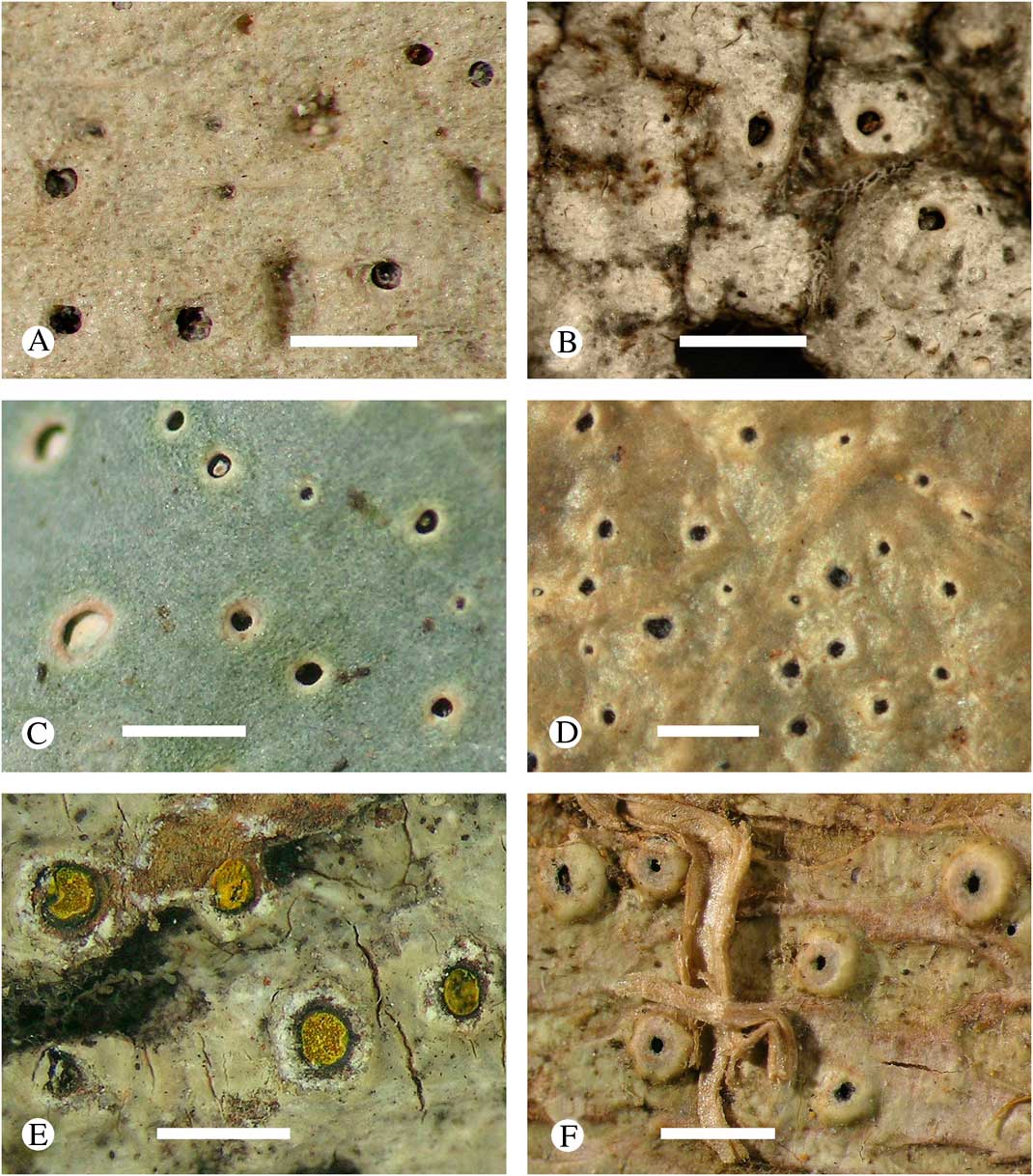
A, Ocellularia bahiana (Brazil, Van den Boom 929), thallus with apothecia; B & C, O. permaculata (holotype), thallus with apothecia; D, O. mammicula (holotype), thallus with apothecia; E, O. petrinensis (Australia, Mangold), thallus with apothecia; F, O. laevigatula (holotype), thallus with apothecia. Scales=1 mm. In colour online.
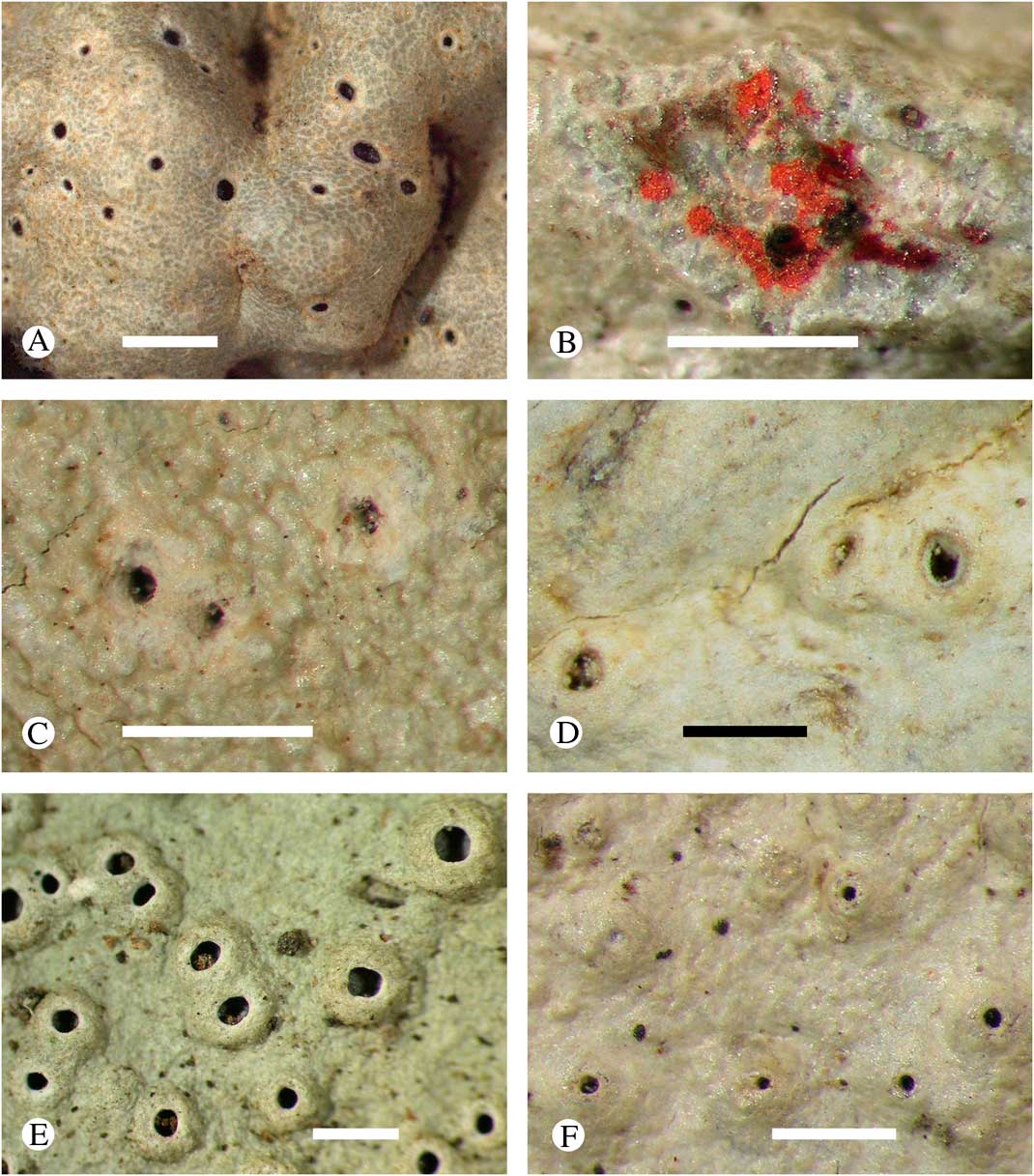
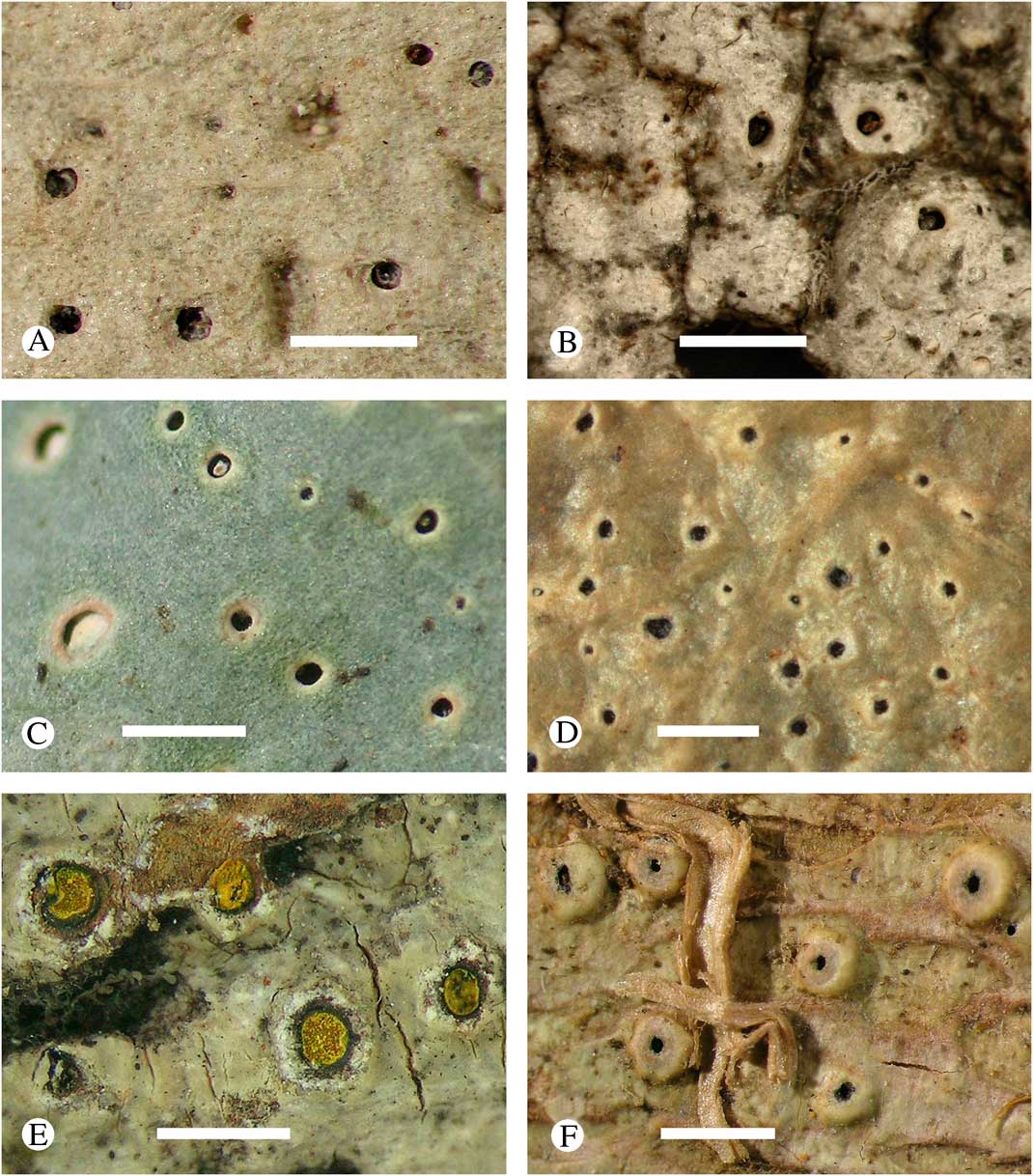
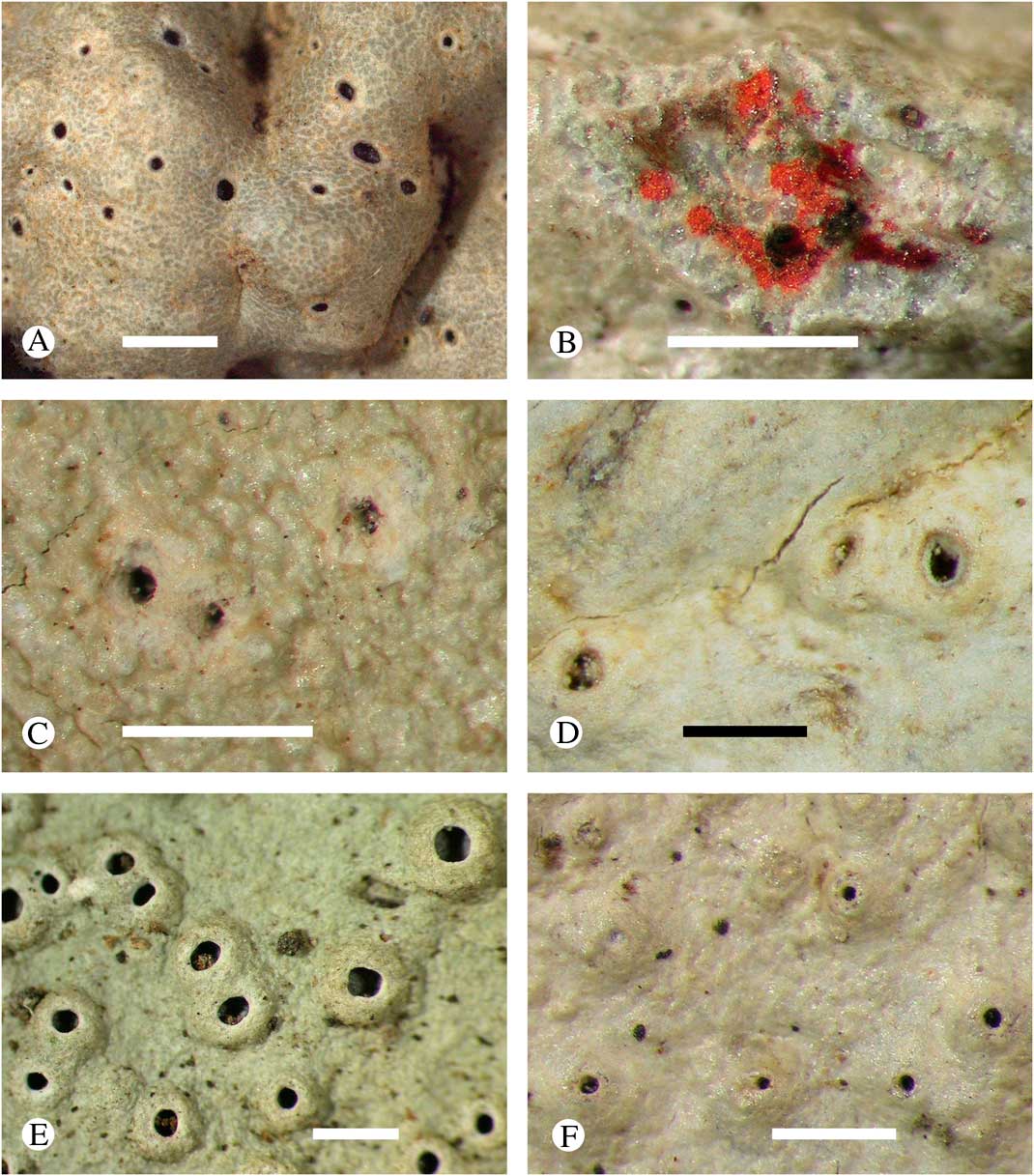
A & B, Leptotrema wightii (A, Australia, Elix 34790; B, isolectotype of Thelotrema subconcretum), thallus with apothecia and medulla showing red crystal clusters; C, L. zollingeri (lectotype), thallus with apothecia; D & E, Ocellularia urceolaris (D, lectotype; E, Costa Rica, Nelsen 2032A), thallus with apothecia; F, O. lunensis (holotype), thallus with apothecia. Scales=1 mm. In colour online.
Data obtained for this study were gathered as part of two projects funded by the National Science Foundation: Phylogeny and Taxonomy of Ostropalean Fungi, with Emphasis on the Lichen-forming Thelotremataceae (DEB 0516116 to The Field Museum; PI H. T. Lumbsch; Co-PI R. Lücking) and ATM – Assembling a Taxonomic Monograph: The Lichen Family Graphidaceae (DEB 1025861 to The Field Museum; PI T. Lumbsch, CoPI R. Lücking). Sergio Pérez-Ortega is supported by the grant CTM2012-38222-C02-02 from the Spanish Ministry of Economy and Competitiveness and is very obliged to Prof. Dr Georg Zizka (Senckenberg Museum, Frankfurt am Main), Dr Stefan Dressler (Senckenberg Museum, Frankfurt am Main), Dra. Prof. Mayra Camino (Jardín Botánico Nacional de Cuba, La Habana), Dr Jorge Gutiérrez (Jardín Botánico Nacional de Cuba, La Habana) and the late Dr Armando Urquiola (Jardín Botánico, Pinar del Río) for the organization of the field trip in Cuba and their kindness throughout its duration. The curators at herbaria from which type specimens and other collections were studied for comparison are thanked for their collaboration, in particular Soili Stenroos and Leena Myllys at H for providing high resolution images of the type material of Thelotrema bahianum var. obturascens and T. bahianum var. ruptum.