1. Introduction
This paper addresses the problem of widespread polysemy of Russian verbal prefixes, particularly when occurring in motion verbs. I argue that seemingly different uses of a prefix share a core lexical meaning, but differ in their syntactic position. When added to a directional motion verb, prefixes behave as lexical, i.e. generated inside VP (see Romanova Reference Romanova2007: Chapter 3). In this case the meaning refers to the spatial domain. When the same prefix is added to a non-directional motion verb, it behaves as a superlexical prefix, i.e. is generated in a syntactically higher position, above Aspect, and its meaning is associated with the temporal domain.
Furthermore, the prefixes in the spatial and temporal domains demonstrate an intriguing parallelism: in the spatial domain, the prefixes may refer to beginning, duration and end of the path (i.e. source, route and goal) while, when applied to the temporal domain, the prefixes are associated with beginning, duration and completion of the event in time. For example, consider the prefixes in (1).
- (1)
(a) pro-jti pjatj kilometrov
PRO-walkdir five kilometers
‘to walk five kilometers’
(b) pro-xoditj pjatj chasov
PRO-walknon-dir five hours
‘to walk for five hours’
(c) pere-plytj rek-u
PERE-swimdir river-acc
‘to swim across the river’
(d) pere-plavatj v bassejne
PERE -swimnon-dir in swimming.pool
‘to swim too much in a swimming pool’
In (1a), pro- refers to the length of the path in space, while in (1b), the same prefix refers to duration of the activity; in (1c), the prefix pere- refers to crossing a boundary across the path in space, while in (1d), it refers to crossing a temporal boundary (e.g. after which swimming is inadvisable).
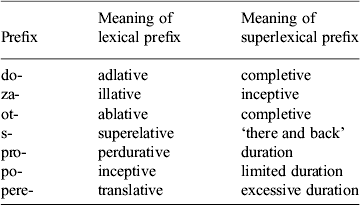
Table 1 lists some of the uses of lexical and superlexical prefixes with motion verbs.Footnote 2 This list is limited to the uses of prefixes compatible with motion verbs. The motion verbs display a directional vs. non-directional distinction, where the directional verbs denote movement to a goal, while non-directional verbs denote sporadic goal-less moving around. The directional verbs combine with lexical prefixes and the non-directional ones combine with superlexical prefixes.
Lexical and superlexical prefixes.

There are several logically possible directions of analysis. The least desirable alternative is homophony, where there are several idiomatic meanings per prefix, and the fact that they sound the same is historically grounded, but synchronically irrelevant. An exhaustive list of all the uses is descriptively adequate, for example, in the classic Ožegov (Reference Ožegov2001) dictionary, as well as in Švedova's (Reference Švedova1980) grammar, the prefixes are listed with at least two meanings. Yet, these meanings are interrelated, and the relations between them are predictable. Treating the polysemy as homophony does not allow one to capture the synchronic generalizations about these relations.
Homophony would also present a problem for language acquisition, as the historical data cannot be available to a language learner. A child encountering two identical morphemes which have some overlap in meaning should initially assume that it is the same lexeme, and try to establish rules for its distribution, rather than freely assume homophony. Thus, the preferable solution would unite the prefixes, so that each prefix would have one meaning, which would vary predictably depending on its function.
I assume that one part of the meaning comes from the lexicon and another part of the meaning comes from the syntactic structure (see Borer Reference Borer2005, Ramchand Reference Ramchand2008). The ‘neo-constructivist’ view taken by Ramchand is that ‘the reason syntactic structures have meaning is that they are systematically constructed as part of a generative system (syntactic form) that has predictable meaning correlates’ Ramchand (Reference Ramchand2008: 11).
The position which I adopt here is that there is a non-structural component of meaning of a prefix which comes from the lexicon, and that each position in a syntactic representation has a specific, independently motivated meaning. For example, the unique meaning of pro- ‘through’ would combine with the meaning contributed by the position either in the path domain or in the time domain, to result in the reading of overcoming a certain distance (if pro- is attached at the path level) or lasting a certain time (if pro- is attached at the time level).
I adopt a ‘neo-constructivist’ viewpoint, in particular ‘the first-phase syntax’ of Ramchand (Reference Ramchand2008) and a cartographic approach to syntax, where syntactic trees are built from individual atomic features. Furthermore, I rely crucially on the lexical/superlexical distinction in the first phase syntax framework (see Svenonius Reference Svenonius and Svenonius2004a).
The lexical prefixes are grouped into three types with contrasting syntactic properties: ‘Route’, ‘Source’ and ‘Goal’ prefixes, referring, respectively, to the trajectory, source and goal of movement (see Zwarts Reference Zwarts2005, Gehrke Reference Gehrke2008, Pantcheva Reference Pantcheva2011).
The contrast between Source and Goal prefixes in Slavic languages has been widely discussed. In Czech, according to Filip (Reference Filip2003) and Součková (Reference Součková2004), the contrast between Source and Goal prefixes is evident from their compatibility with measurement phrases (e.g. ‘a little’, and prefix po- with a similar meaning), where Source prefixes, as open scale predicates, are compatible with measurement phrases, while Goal prefixes, as closed scale predicates, are not.Footnote 3
Furthermore, Pantcheva (Reference Pantcheva, Son, Bašic, Pantcheva and Svenonius2007) considers a tripartite division of Bulgarian prefixes into Source, Path and Goal, based on the compatibility of prefixes with verbs with different subevental structure. Pantcheva (Reference Pantcheva, Son, Bašic, Pantcheva and Svenonius2007) divides the motion verbs into four classes, depending on which subevental heads (init(iation), proc(ess) and res(ult)) they instantiate. It turns out that Source prefixes appear to be available only for motion verbs that do not instantiate init, i.e. lack an external ‘initiator’ argument (e.g. padam ‘I fall’, butam se ‘I push myself’). Similarly, the Goal prefix attaches only to motion verbs that have no res feature, i.e. do not lead to a particular result state (e.g. tancuvam ‘I dance’, butam se ‘I push myself’). Crucially, Pantcheva (Reference Pantcheva2011) further argues for a decomposition of the Path head into Goal, Source, and Route, on the basis of cross-linguistic data showing that different types of paths are of different complexity and only syncretism of adjacent nodes is attested.
I argue for a parallel tripartite division of superlexical prefixes, into inception, completion and result (reminiscent of the homomorphism between an event and a generalized path introduced by Krifka Reference Krifka and Rothstein1998). Once the existence of the lexical and superlexical division, with a tripartite structure on each level, is established, I will show the meaning contribution of the structure, which will allow me to reduce ‘homophonous’ prefixes to a single lexical entry.
2. The framework
2.1 Lexical and superlexical prefixes
In this paper I adopt the division of Russian verbal prefixes into two classes, which correspond to the lexical vs. superlexical distinction (Isačenko Reference Isačenko1960, Schoorlemmer Reference Schoorlemmer1995, Babko-Malaya Reference Babko-Malaya1999, Romanova Reference Romanova and Svenonius2004, Svenonius Reference Svenonius and Svenonius2004a). Lexical prefixes, as potential argument-structure modifiers, are generated in a position inside VP. Superlexical prefixes modify the event itself and do not change argument structure or the core meaning of the base verb and are therefore syntactically higher, above the Aspect head (Pereltsvaig Reference Pereltsvaig2006). According to Romanova (Reference Romanova and Svenonius2004), the lexical prefixes attach mostly to perfective or telic stems (if the verb is supplied with the option), allow the verb to form secondary imperfectives, cannot stack, do not measure over objects, and can change the argument structure of the verb. This behavior corresponds to a low prefix position inside VP (pere- in (2a), vy- in (2b), nad- in (2c) below).
Superlexical prefixes attach to imperfective or atelic stems, do not allow the verb to form secondary imperfectives, can stack (though this is not a frequent phenomenon in Russian), can measure over events or objects, do not change the argument structure of the verb. The examples in (2) illustrate the superlexical prefixes (ot-, pro-, po-) stacking over the lexical prefixes ((2a, b) are adapted from Beliakov & Guiraud-Weber Reference Beliakov and Guiraud-Weber1997):Footnote 4
- (2)
(a) [AspP Ot-[VP pere-biral]] ty bumagi
completive-across-take.2impf you papers-acc
uvoljnjajut tebja.
fire-3pl you-acc
‘You are done with sorting papers. They are firing you.’
(b) [AspP Pro-[VP vy-dergival]] morkovk-u poldnja.
durative-out-pull.2impf carrot-acc half.day
‘He spent half a day pulling out carrots’
(c) A čto ne sjem, to [AspP po-[VP nad-kušu!]]
and what not eat that distributive-slightly-bite
‘And whatever I cannot eat, I will bite slightly one by one!’
In (2a) and (2b) the first, superlexical prefix, attached to the prefixed imperfective stem, refers to the time of the event, without affecting the meaning of the main verb. Ot- in (2a) refers to the permanent completion of the event, while pro- in (2b) refers to duration. Po- in (2c) is an example of the distributive reading. The lexical prefixes are closer to the root and change the lexical meaning of the verbal stem, rather than simply modifying the time. Crucially, the same prefix may act both as lexical and superlexical, with interpretations different enough to provoke a suspicion of homophony, e.g. the superlexical prefixes in (2) (ot-, pro-) may act as lexical prefixes with the same verbs, when adjacent to the root:
- (3)
(a) ot-bira-tj bumagi
away-take-inf papers-acc
‘to take away (from smb., by force)/to select the papers’
(b) pro-dergiva-tj nitku v igolku
through-pull-inf thread-acc in needle-acc
‘to pull the thread through the needle’
While the position of the lexical prefixes in the result projection of the verb, i.e. as the verb complement and its derivation by movement, is relatively clear, both the position and the derivation of the superlexical prefixes is a matter of controversy.
Thus the first question is the position of the superlexical prefixes. Babko-Malaya (Reference Babko-Malaya1999: 98) suggests that the ‘superlexical prefixes are prefixes that are adjoined to Asp[ect] and incorporate into the verb as the result of head movement’. Pereltsveig (Reference Pereltsvaig2006), on the contrary, uses the interplay of the superlexical prefixes with aspect suffixes to show that the superlexical prefixes must attach higher than impf2 (the Aspect head, containing secondary imperfective), which makes it impossible for secondary imperfective to scope outside of a superlexical prefix. Based on the evidence in Pereltsveig (Reference Pereltsvaig2006), I assume that the superlexical prefixes are located between Tense and Aspect.
The second question is whether the superlexical prefixes originate in this position or are derived by movement. Julien (Reference Julien2002: 188) suggests two possibilities of prefix derivation: ‘either the prefix originates in the complement of the lexical element and moves to the left of the lexical element (by head movement or XP movement) or the prefix originates to the left of the lexical element and there is no subsequent movement operation that alters the relative order of the two items'. I suggest that both of these possibilities are used by the Russian verbs: the first involves the lexical prefixes and the latter involves the superlexical prefixes.
The origin of the lexical prefixes inside the verb phrase explains the fact that the lexical prefixes can be idiosyncratic whereas the origin of superlexical prefixes above Aspect explains that the meaning of superlexical prefixes is stable and does not differ from one verb to another. Furthermore, the difference in the syntactic position explains the stress patterns, where the lexical prefixes are capable of changing the stress of the verb, while the superlexical prefixes do not affect the stress on the main verb (as in the contrast between pro-bégatj ‘to run for a certain time’ with a superlexical prefix and regular stress and pro-begátj ‘to run by’, the secondray imperfective with a lexical prefix and changed stress).
To sum up this discussion, I assume that the superlexical prefixes are base-generated in a functional projection between Aspect and Tense, while the lexical prefixes are base generated inside VP, and I will discuss the structure in detail in Section 3 below.
2.2 Directional and non-directional verbs
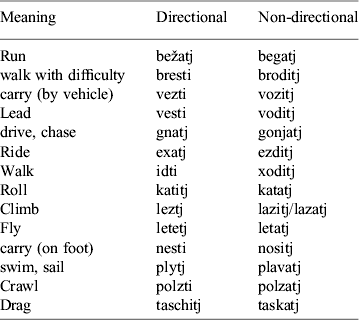
The list in Table 2 is a nearly exhaustive list (adapted from Janda Reference Janda2006: 4) of the motion verbs characterized by the presence of both directional and non-directional forms. The directional verbs involve a path and a goal, e.g. bežatj means ‘to run in a certain direction’. The non-directional verbs describe sporadic or repetitive movement, e.g. bégatj means ‘to run around, to run back and forth, to run regularly’.
Motion verbs: Directional and non-directional.

The prefixes with the directional verbs are lexical. As is shown in (4), they allow secondary imperfectivization and modify path.
- (4)
(a) pro-bežatj pjatj kilometrov
PRO-rundir.p five kilometers
‘to run five kilometers’
(b) pro-begátj pjatj kilometrov každoe utro
PRO-rundir.2impf five kilometers every morning
‘to run five kilometers every morning’
With non-directional verbs, the prefixes are superlexical and are not susceptible to secondary imperfectivization, as seen in (5b).
- (5)
(a) pro-xoditj pjatj časov
PRO-walknon-dir.I five hours
‘to walk for five hours’
(b) *pro-xaživatj pjatj časov každoe utro
PRO-walknon-dir.impf2 five hours every morning
‘to walk for five hours every morning’Footnote 5
Non-directional verbs do not involve a path to be modified, so the prefix refers to time; e.g. pro-, which refers to the length of the path when lexical, refers to the time duration when it is superlexical.
The following section provides an analysis of the directional/non-directional verb distinction and lexical/superlexical prefix distinction in the first phase syntax framework.
2.3 Prefixes in first phase syntax
On the basis of a cross-linguistic study of verb semantics and argument structure, Ramchand (Reference Ramchand2008) proposed a tripartite division of eventualities into initiation, process and result. Such decomposition is governed by the Principle of Event Composition (Ramchand Reference Ramchand2008: 44), where initiation leads to process and process potentially leads to a result state.
Res and init projections are optional, e.g. unaccusative verbs lack the init projection, and unergative verbs lack the res projection. Each of these subevents, when present, is represented as its own projection, ordered in the hierarchical embedding relation as shown in (6) (from Ramchand Reference Ramchand2008: 46).
(6)

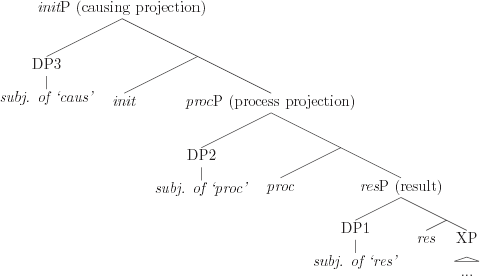
Each subevental head enters into a predicational relation with the specifier position. Thus, the three core projections suggested by Ramchand (Reference Ramchand2008: 48) are:
• initP introduces the causation event and licenses the external argument (‘subject’ of cause = initiator)
• procP specifies the nature of the change or process and licenses the entity undergoing change or process (‘subject’ of process = undergoer)
• resP gives the ‘telos’ or ‘result state’ of the event and licenses the entity that comes to hold the result state (‘subject’ of result = resultee)
Since verb meanings are compositional, there is no requirement that ‘first-phase predications’ be monomorphemic (Ramchand Reference Ramchand2008: 138). This predicts productive processes of result augmentation. Therefore, lexical prefixes are treated as a morphological consequence of such result augmentation. Ramchand shows that the verbs with lexical prefixes contain a res projection, as evidenced by the changed semantic participation of the object, idiosyncratic interpretations and cooccurrence restrictions, and incompatibility with ‘for an hour’ adverbials. Since the natural result of directional motion verbs is change in location, the domain of lexical prefixes is space.
Babko-Malaya (Reference Babko-Malaya1999) argues that the path is actually the argument of a motion verb, parallel to the patient of a real transitive verb, which further supports the tight connection of the res projection with the path.
With directional motion verbs, the subject is simultaneously the initiator, the undergoer and the holder of the result state (i.e. the new location, in the case of motion verbs). The ‘result’ of the directional verb is the location of the subject at the final point of the path specified (e.g. five kilometers from the initial location in (4a)), after having travelled that path. The diagram is (7) illustrates the composition of a directional verb with a lexical prefix and path in (4a) above.
(7)
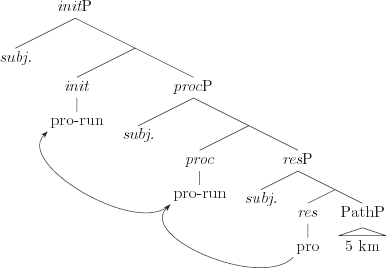
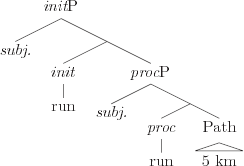
This contrasts with the unprefixed imperfective counterpart bežatj pjatj kilometrov ‘to run.dir five kilometers’, which lacks the result projection and path is the complement of the proc head.
(8)
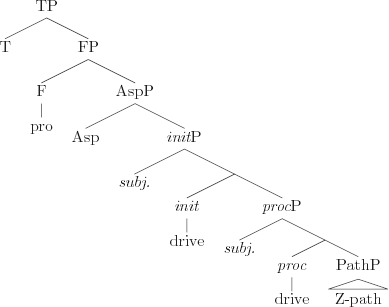
Romanova (Reference Romanova2007) suggests that the non-directed motion verbs incorporate a silent Z-path, introduced in Rheme, in the complement of process. The Z-path stands for Zwartsian path, that is paths that overlap, cross and go back, which describes the sporadic movement without a goal, denoted by non-directional motion verbs. Thus, while both directional and non-directional motion verbs have init and proc heads, the incorporated path projection, which occupies the proc complement position, makes it impossible for overt paths, and hence lexical prefixes, to merge. Furthermore, the presence of an incorporated element accounts for the morphological complexity of the non-directional motion verbs, compared to the less complex directional verbs. The structure of a non-directional motion verb (ezditj ‘to drive around’) with a superlexical prefix (pro-) is illustrated in (9).
(9)
At this point, it is important to clarify the distinction between telicity and perfectivity (see Borik Reference Borik2006). An imperfective verb may be telic under habitual and episodic readings, thus telicity does not entail perfectivity:
(10) Petja (uže) pere-sek-a-l etot kanal za polčasa
Petja already PERE-cross-impf-past this channel in half.hour
‘Petja used to cross this channel in half an hour.’
‘Petja has already once crossed this channel in half an hour.’
The presence of the result projection with a lexical prefix in its specifier makes the verb in (10) telic. The secondary imperfective ensures that it is not perfective.
Similarly, Borik (Reference Borik2006: 78) shows that perfective verbs with superlexical po- and pro- prefixes are atelic, by adverbial modification, progressive entailment and conjunction tests, but confirms that they are perfective because they are ruled out in the complement position of the phase verbs, like regular perfectives. This is a typical situation for superlexical prefixes. Thus, telicity and perfectivity are distinct categories and do not entail each other.
Richardson (Reference Richardson2007: 13) defines telicity in terms of cumulativity and divisiveness: ‘if a predicate can be divided into both parts and sums and those parts and sums are not equivalent, the predicate is telic’. Perfective eventualities are limited in time and packaged as single unitary actions.
If the complement selected by proc is a path (or any scale of change in terms of Rappaport-Hovav Reference Rappaport-Hovav and Rothstein2008), this path makes the verb, so to speak, potentially telic and select for a lexical prefix to measure it, and then the res projection can be the complement of proc, in which case the path becomes the complement of res.
If the complement of the proc contains conflated material, such as Z-path, the res projection cannot be attached because the proc complement position is occupied by material that is inseparable from the verb root in proc.
Superlexical prefixes are incompatible with verbs that select for a directed path (which is a subcase of a scale of change) because these verbs cannot be divided into parts and cannot be packaged as unitary action by perfective aspect. This operation applies only to atelic verbs.Footnote 6 In summing up the discussion in this subsection, the following two generalizations emerge:
(i) The lexical prefixes describe the movement of the resultee with respect to ground, attach inside the res projection, and hence require its presence and availability.
(ii) The superlexical prefixes attach to verbs above Aspect, and package atelic events into bounded chunks. Hence they are incompatible with telic events.
3. Lexical and superlexical prefixes and their interpretation
The previous section explored the contrast between the two distinct syntactic positions where prefixes may be potentially attached: the lexical and the superlexical sites of attachment. This section describes the identical lexical and superlexical prefixes as manifestations of a single lexeme. A central meaning for each lexeme emerges, and it turns out that lexical usage corresponds to path modification, while the superlexical usage belongs to the time domain.
Once the existence of the two classes of prefixes is established, lexical and superlexical, it turns out that each class should be subjected to a tripartite division. Path is decomposed into Goal, Source and Route (Pantcheva Reference Pantcheva2011), where Route is syntactically the most complex projection, containing both Source and Goal:
(11)
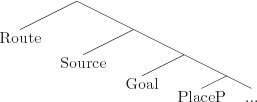
Source contains Goal and Place, and Goal is the simplest of the three, containing Place projection:
(12)

Similarly, I suggest that the superlexical projection, F, attached above AspectP, is subdivided into inception, completion and duration, as shown in the tree diagram in (13). The semantic contribution of each head is discussed in the subsequent sections. Duration, like Route, is the most complex.
(13)
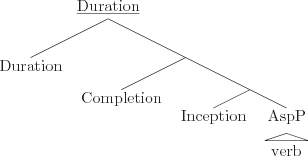
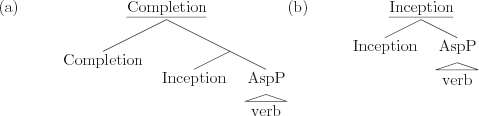
Completion, parallel to Source, contains Inception. Inception is parallel to Goal as the simplest projection:
(14)
Consider the visualization of Source, Goal, and Route suggested in Pantcheva (Reference Pantcheva2011) (adapted from Zwarts Reference Zwarts2005), where the pluses indicate being at a place, and minuses indicate not being there:

(Zwarts Reference Zwarts2005: 34)
I show in this section that superlexical prefixes will fall under the same typology. Goal paths correspond to inception: there is one strictly punctual transition from not being in a certain location/activity to entering the location (with lexical) or an activity (with superlexical prefixes). Source prefixes, similarly, correspond to completion prefixes, as both indicate a plus-to-minus transition, i.e. from being at a location or involved in an activity, to not being there. Route prefixes, thus, correspond to Duration, involving two transitions: either both source and goal of a path or both beginning and end of an activity.
3.1 Prefix za-: Goal and Inception, − − − +++
The prefix za- is notoriously versatile, and the whole diversity of its meaning may hardly be discussed in the limited space here, yet if we limit ourselves to motion verbs, the time–space parallel is clear. With directional verbs, the prefix modifies path, so that the figure enters into some closed space, as in (15a) below.Footnote 7 With non-directional verbs the subject enters a new state, for example, the clock enters the working state in (15b) and the uncle enters a jumping state in (15c). As a lexical prefix, za- means movement into a goal, while as a superlexical prefix, it gives rise to an inceptive meaning.
- (15)
(a) Čelovek za-šel v dom.
man ZA-walkeddir into house.acc
‘The man walked into the house.’
(b) Časy za-xodili.
clock ZA-walkednon-dir
‘The clock started to work.’
(c) Djadja za-prygal ot radosti.
Uncle ZA-jumped from joy
‘The uncle started jumping from joy.’
Thus, za- in the spatial domain introduces a bounded path, which ends up in a certain place, i.e. at time 0 the figure is not at the place specified, while at time 1 it is inside the closed area. This type of transition corresponds to Dowty's (Reference Dowty1979) become operator or Wunderlich's (Reference Wunderlich1991) change operator. As we can see in (16), the become operator is conveniently universal and can be applied to path and time.
(16) [becomex] is true at an interval I iff (i) there is an interval J containing the lower bound of I such that ¬x is true at J, (ii) there is an interval K containing the upper bound of I such that x is true at K…, there is no non-empty interval I′ such that I′ ⊂ I and conditions (i) and (ii) hold for I′ as well as I. (Pantcheva Reference Pantcheva2011: 70)
The diagram in (17) presents the structure of example (15a) above, Čelovek zašel v dom ‘The man walked into the house’.
(17)
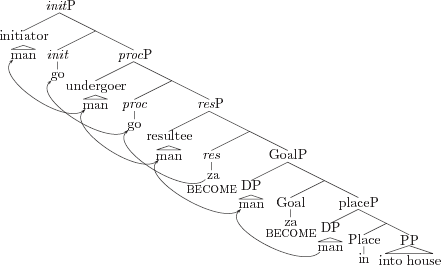
The subject moves up consecutively through Place, Goal, Result and Process. The prefix za- lexicalizes both Place and Goal projections, and moves up to left-adjoin the verb. The Goal projection contains the become operator, which takes the location (‘in the house’) as argument, i.e. za- means ‘become-in’.
In the temporal domain, a similar picture can be drawn to mark the transition, where at the time of the initial boundary of the event, the actor (initiator) is not performing the activity while at time 1 the actor is involved in the event. Thus, inception is very similar to a ‘goal’ type of path, involving one punctual transition from not being to being. The argument of the become operator is either the place projection, when we are in the path domain, or the Aspect projection for superlexicals, in which case x refers to the subject's involvement in the activity. Thus, x may be a place or a homogenous activity. The operator is not compatible with transitive verbs that do not provide an initiator and a homogenous property that may hold true or false of the subject at a certain interval. The structure of the inception projection in (15c) above, Djadja za-prygal ot radosti ‘The uncle started jumping from joy’ is given in (18) to illustrate this point.
(18)
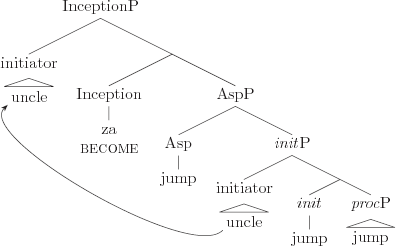
In this case, za- is a superlexical prefix and is generated in the projection above Aspect. Djadja ‘uncle’, referring to the initiator co-indexed with the undergoer, moves to the specifier position of the inception head. The verb moves from the proc head to init and Aspect, and is preceded by the superlexical prefix.
3.2 Prefixes ot- and s-: Source and Completion, +++ − − −
The Source projection is syntactically more complex than Goal, and takes Goal as an argument. Source is the locus of a semantic reversal operation (Pantcheva Reference Pantcheva2011), i.e. it takes a minus-to-plus path and reverses it into a plus-to-minus monotransitional path, i.e. Source path. Thus, a path directed into a certain location becomes a path directed out of the location.
Similarly, the completion projection reverses the meaning of the inception projection, creating a new type of transition event. I do not claim that the completion head reverses time; time linearity is preserved, but the point of view is changed. While, in case of inception, the time flows into the event denoted by the verb stem, in case of completion, time flows out of it (towards the reference time). For the inception projection at the lower boundary of the interval the subject is not involved in the activity, and at the upper boundary it is; for completion the lower and upper bounds change places. The x denoting involvement in the activity is true at the lower bound and false at the upper bound.
For directional verbs, ot- ‘from near’ refers to movement away from a point, where the distance separating the figure (the boy in (19a) below) from the ground (the fire in (19a)) is increasing, while for non-directional verbs, the time separating the figure (initiator, the airplane in (19b)) from the past event (flying in (19b)) is increasing.
- (19)
(a) Maljčik ot-skočil ot kostra.
boy OT-jumpdir from fire
‘The boy jumped away from the fire.’
(b) IL-76 svoe ot-letal.
IL-76 its OT-flynon-dir
‘[The airplane] IL-76 has done its flying (and will never fly again).’
Both lexical and superlexical usages of this prefix involve a transition from being in a certain location or involved in an activity, to not being, which is visualized by pluses changing to minuses (see table).
Another prefix involving the same kind of transition is s-. The prefix s-involves displacement from a ‘regular’ location in case of directional verbs (a movement ‘off course’), and a brief trip there and back, with subsequent return, in case of non-directional verbs. Let us consider the examples in (20).
- (20)
(a) poezd so-shel s reljs.
train S-walked from rails
‘The train derailed.’
(b) S-begaj za pivom!
S-runnon-dir for beer
‘Run get some beer (quickly, and then return)!’
The path is of Source type, +++ − − −, i.e. the figure is at a location at the beginning of the path, and away from it at the final point. The initial relationship between figure and ground (‘near’ in case of ot-, and ‘on’ in case of s-) must be a part of the lexical entry of the prefixes, and what makes them different, in spite of the shared path type features.
In the superlexical usage, illustrated in (20b), there is a punctual transition from running to get the beer to not running, i.e. a plus-to-minus type of transition. The lexical entry of the prefix contains information about the specific relationship between figure and ground preceding the displacement, as well as about the terminated activity (e.g. that it was a fast there and back trip), while the source/termination part of the meaning originates from syntax.
The tree diagram in (21) below illustrates how the source path is generated for lexical prefixes, as in (19a), Maljčik ot-skočil ot kostra ‘The boy jumped away from the fire’.
(21)
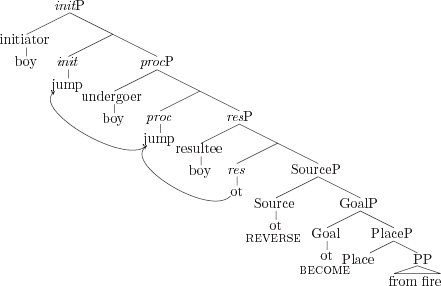
The Goal projection contains a to-path, where the figure comes to be at the ground, the Source reverses the become operator, so the figure comes to be away from the ground. Then the prefix moves to res, and to proc, where it left-adjoins to the proc head, lexicalized by directional ‘jump’, resulting in jumping away.
Similarly, completion is the reverse function of temporal operator become, introduced by the inception node, as shown in diagram in (22), which illustrates the structure of example (19b) above, IL-76 svoe ot-letal ‘[The airplane] IL-76 has done its flying (and will never fly again)’.
(22)
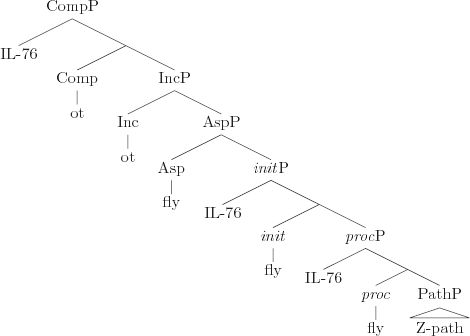
Thus, in this section we saw the similarity of the structure of Source and Completion prefixes. Both structures are complex and contain, correspondingly, Goal and Inception. Both projections take becomex as an argument and reverse it, creating an interval directed out of x, where x is either a place or an activity.
3.3 Prefixes pro- and do-: Via, duration, − − − +++ − − −
The prefix pro- ‘through’ is a measure of distance with directional verbs (as in 23a), and a measure of time with non-directional verbs (as in 23b). Two transitions are involved here: the beginning and end of a path or activity, and the distance/time between the two points can be measured.
- (23)
(a) pro-jti pjatj kilometrov
PRO-walkdir five kilometers
‘to walk five kilometers’
(b) pro-xoditj vesj denj
PRO-walknon-dir all day
‘to walk (around) all day’
The prefix do- ‘up to’ refers to movement (24a) or persistence of activity (24b) up to a certain point:
- (24)
(a) do-plytj do bereg-a
DO-swimdir up.to shore-gen
‘to swim up to the shore’
(b) do-plavatj rejs
DO-swimnon-dir trip-acc
‘to sail up till the end of the trip (and then quit)’
The prefix pere- ‘over’ refers to crossing a boundary, which may be a boundary in space for directional verbs, or a temporal boundary (e.g. after which swimming is too tiring) in (25b) for non-directional verbs.Footnote 8 This usage is similar to the English preposition ‘over’, which may also be used to refer to crossing a boundary both in space (‘the bridge over the river’) and in time (‘to overstay your welcome’).
- (25)
(a) pere-plytj rek-u
PERE-swimdir river-acc
‘to swim across a river’
(b) pere-plavatj v bassejne
PERE-swimnon-dir in swimming.pool
‘to swim too much in the swimming pool’
The prefix po- produces an inceptive reading with directional verbs, as in (26a), and delimitative reading with non-directional verbs, as in (26b).
- (26)
(a) po-bežatj
PO-rundir
‘to start running’
(b) po-bégatj
PO-runnon-dir
‘to run for a while’
Importantly, in both cases, po- patterns more with superlexical prefixes, thus breaking away from the general pattern where the lexical prefix appears with the directional motion verbs and the superlexical prefix appears with non-directional verbs. Like a lexical prefix, the inceptive po- attaches to the telic stem and cannot stack, but, like a superlexical prefix, does not allow secondary imperfectives. The delimitative po- attaches to the atelic stem, does not allow secondary imperfectives, and can stack – like a typical superlexical prefix. The meaning does not allow for immediate classification, but the syntactic combinatoric features of these uses of po- pattern with − − − +++ − − − prefixes (see Table 2 above).
The non-oriented paths, described above, are derived by the addition of a Route projection on top of the Source projection (Pantcheva Reference Pantcheva2011). Similarly, the duration can be derived by the addition of a Duration projection on top of completion. Both Source and Completion paths, as shown in the previous section, are monotransitional, where the first phase is positive. Route and duration paths are bi-transitional, and have the positive phase in the middle. Thus the highest, Route or Duration projection, is another transitional projection, which adds the transition to the positive phase.
The whole computation of a route path from Pantcheva (Reference Pantcheva2011: 72) is given in (27).
(27) The syntactic and semantic derivation of a Route paths
(a) [Place …]
(b) merger of Goal →
(c) [Goal [Place …]] representing a path of the shape − − − +++
(d) merger of Source →
(e) [Source [Goal [Place …]]] → reversal of Goal path +++ − − −
(f) [Route [Source [Goal [Place…]]]] → adding a second transition →
− − − +++ − − −
Duration in the superlexical domain is derived in a parallel fashion:
(28) The syntactic and semantic derivation of duration
(a) [Aspect [init [proc]]] provides the activity and initiator
(b) merger of Inception →
(c) [Inception [Aspect …]] introduces the transition − − − +++
(d) merger of Completion →
(e) [Completion [Inception [Aspect …]]] → reversal of the previous transition: +++ − − −
(f) [Duration [Completion [Inception [Aspect …]]]] → adding a second transition: − − − +++ − − −
To sum up this section, a clear parallel emerges between [Route [Source [Goal [Place]]]] and [Duration [Completion [Inception [Aspect]]]]. Every prefix is specified in the lexical entry with the corresponding abstract features, e.g. the prefix za- bears the [− − − +++] feature and thus can spell out either Inception or Goal nodes, but not or Completion. The prefixes ot- and s bear the [+++ − − −] feature (stacked on top of [− − − +++]) and can spell out corresponding Completion or Source nodes, while the prefixes po-, pro-, pere- and do- have two transitions [− − − +++ − − −] (on top of [+++ − − −] and [− − − +++]) and thus can spell out Duration or Route.
4. Syntactic evidence
The previous section explored the semantic properties of a set of prefixes, separating the part of meaning that is provided by the lexical entry from the part provided by the structure. The present section focuses on the internal structure of the lexical and superlexical prefixes and introduces syntactic evidence for a parallel tripartite division at lexical and superlexical levels.
4.1 Lexical prefixes
An important piece of evidence for the parallelism of properties demonstrated by prefixes across space and time comes from considerations of the possibility of modifying each transition point with prepositional phrases.
Thus, if a lexical prefix contains the Goal projection, the verb may be modified by a Goal PP, as in (29) (see Markovskaya Reference Markovskaya and Svenonius2006). Crucially, the source is not available for specification with a PP.
(29) My za-šli v dom/ *iz doma.
we into-went in house.acc/ out house.gen
‘We went into the house(/out of the house).’
However, with a Source prefix, both Source and Goal are available for modification:
- (30)
(a) My vy-jehali (iz Moskvy) v Saratov.
we out-went out Moscow.gen in Saratov.acc
‘We left for Saratov (out of Moscow).’
(b) My oto-šli (ot doma) k prudu/v tenj.
we from-went from house.acc to pond.gen/in shade
‘We went away (from the house) to the pond/into shade.’
(c) Deti s-katilisj s gorki/ na pol.
chidren off-slid off slide.gen/ on floor.acc
‘The children slid down from the slide/onto the floor.’
This asymmetry is predicted if the Source projection is more syntactically complex and contains the Goal projection, as Pantcheva (Reference Pantcheva2011) argues with reference to the two structures in (31).
(31)
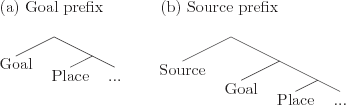
A Goal prefix introduces only the Goal and place Projections, which can be further specified by additional prepositional phrases, as in (30a) above. The Source projection is not present, so it is not surprising that Source PPs are unacceptable. The Source projection, on the other hand, contains the Goal projection under it, so both source and goal may be specified, as in (30b) above. Furthermore, when both Source and Goal PPs are present, as in (30c) there is a strong preference for the Source PP to precede the Goal PP (an inversion is possible, but requires a pause and a slightly different intonation which suggests movement conditioned by information structure).
The Route projection is even higher, according to Pantcheva (Reference Pantcheva2011), and contains both Source and Goal projections, and a possibility of specifying both source and goal, and to measure the route in addition, as illustrated in the following diagram:
(32)
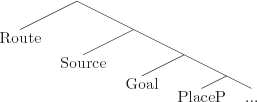
The Route prefixes include pere-, pro-, do- and po-. The Route prefixes pere- and pro- are special as they do not have corresponding prepositions (though route prepositions do exist in Russian). The examples in (33) include the route prefix pere-. As seen in (33b), they may introduce a direct object referring to the route traversed, expressed by a DP complement.
- (33)
(a) Mnogie PERE-bežali iż odnogo lagerja v drugoj.
many PERE-ran from one.gen camp to other.acc
‘Many fled from one side to the other.’
(b) Belka pere-bežala dorog-u.
squirrel PERE-ran road-acc
‘A squirrel ran across the road.’
(c) Ona pere-bežala v kabinet muža.
she PERE-ran in office.acc husband.gen
‘She ran across into her husband‘s office.’
(d) *Ona pere-bežala iż kabineta.
she PERE-ran from office.gen
(‘She ran across from the office.’)Footnote 9
The prefix pro- may also introduce the beginning and the end of a path, as in (34a), an argument specifying the trajectory, as in (34b), and an argument measuring the trajectory, as in (34c).:
- (34)
(a) Nikto ne smog pro-bežatj ot odn-ogo konc-a do
noone not could PRO-run from one-gen end-gen up.to
drugogo.
other.gen
‘Noone managed to run from one end to the other.’
(b) On pro-bežal v svoj kabinet.
he PROran in his office.acc
‘He ran by into his office.’
(c) Ja pro-exal odnu ostanovku po Arbatu.
I PRO-rode one bus.stop.acc along Arbat.dat
‘I went one stop along Arbat Street by bus.’
With the prefix do- it is also possible to specify goal, both source and goal, and the distance, as illustrated by the three examples in (35), respectively.
- (35)
(a) Iznyvaja ot žary, oni do-breli do lesa.
suffering from heat they DO-walked up.to forest
‘Suffering from heat, they walked (slowly, with great difficulty) up to the forest.’
(b) Ona do-šla ot mašiny do podjezda.
she DO-walked from car to entrance
‘She walked from the car to the entrance.’
(c) Tem ne menee Sonya rešila do-beža-tj distanciju.
it.instr not less, Sonya decided DO-run-inf distance
‘Nevertheless, Sonya decided to complete running the distance.’
Additional piece of evidence for classifying do- as a Route prefix comes from the fact that it provides information about the length/difficulty of the path in addition to goal all the examples found in the Russian National Corpus (www.ruscorpora.ru/en/) involved some obstacles, such as heat (in (35a)), snow (a snowstorm is mentioned in the text preceding (35b)) or sickness (in (35c)), which made covering the path to the goal long or difficult.
Thus, the examples in (29)–(35) illustrate a tight relationship between the complexity of the prefix with the complexity of the path denoting PP selected by the prefix. If the prefix contains only the Goal projection on top of place as illustrated in tree diagram (12b), only a Goal PP may be added. If the prefix contains both Source and Goal (as in (12a)), both Source and Goal PPs may be added. If the prefix contains Goal, Source and Route (as in (11)), all three PPs are allowed, as well as a measure of the path length.
At first sight, the prefix po- might present a problem for this classification, but I show below that its usage with motion verbs is compatible with my analysis. In spite of its inceptional meaning and some features of superlexical prefixes (incompatibility with secondary imperfectivization, which must be derived by separate mechanisms), the prefix patterns with Route prefixes (such as pro-, pere- and do-) in allowing specification of source and goal, as in (36a), as well as distance, as in (36b). It is also possible to specify source without goal, as well as vice versa.
- (36)
(a) On po-bežal (iz xaty) (v pole).
he PO-ran from house to field
‘He started running from the house to the field.’
(b) Sportsmen po-bežit pjatj kilometrov.
sportsman PO-ran.fut five kilometers
‘The sportsman will run five kilometers.’
Both of these are grammatical even without po-, i.e. with the imperfective form bežatj without the prefix. In such cases the PPs appear in the complement of the proc projection, which is less selective (as a thematic, as opposed to a functional element in terms of Abney Reference Abney1987).
The inceptive meaning is not always a part of the prefix, e.g. (36b) does not mean that the sportsman will begin to run, it simply means that he will run, with completion implied.
However, the prefix, does not necessarily entail completion. Compare (37a), where the speaker did not get to the destination due to illness, and thus the verb entails the beginning of walking, and (37b), where the speaker clearly arrived at the point of destination, to be caught by illness there, and thus the entails both the beginning and the completion of the trip.
- (37)
(a) Včera po-šla na lekciju; mne po doroge stało ploxo.
yesterday PO-went on class me-dat on way became bad
‘Yesterday I started walking to class, but felt sick on the way.’
(b) Včera po-šla na lekciju; mne tam stalo ploxo.
yesterday PO-went on class me-dat there became bad
‘Yesterday I went to class, but felt sick there.’
In addition, either the beginning of the process or just the arrival point may fall under the scope of negation. Ivan in (38a) stayed home, and never even started walking, while in (38b) he went in the direction of work, so the beginning portion did take place in spite of the negation, though he turned before getting to the destination.
- (38)
(a) Ivan za-bolel i na rabotu ne po-šel.
Ivan ZA-fell.sick and to work not PO-walked
‘Ivan fell sick and did not go to work.’
(b) Ivan na rabotu ne po-šel, a svernul v kabak.
Ivan to work not PO-walked but turned in pub
‘Ivan did not go to work, but swerved into a pub on his way.’
Thus, we see that neither the inception nor completion of the activity are a crucial part of the meaning of the prefix po- here. This is consistent with it being used as a lexical prefix. As a lexical prefix, it does involve a full path with a source, goal and duration, each of which may be specified, and the verb is always telic. Its lexical entry is the least specific, allowing the most freedom, and the largest variety of meanings depending on the structure where it is inserted.
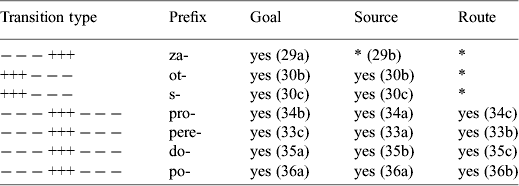
Table 3 summarizes the classification of the lexical prefixes and what may be modified.
Compatibility of lexical prefixes with PPs.

4.2 Superlexical prefixes
At the superlexical level, the starting point, the endpoint and the duration of an event may be modified by PPs or adverbs, parallel to the Source, Goal and Route at the lexical level. On the spatial level, the lowest projection, Goal ([Goal [Place]]), denotes a punctual transition from not being in a place to being there, i.e. minus to plus transition. On the temporal level, the shape of the lowest projection is parallel ([Inception [Aspect [Vp …]]]), but the transition is from not being involved in an activity, to starting the activity, i.e. inception. The Goal prefix za- thus can denote inception when it appears in this position. The inception point can be modified by punctual adverbs only, as is shown in (39).
- (39)
(a) Vdrug on za-begal po komnate.
suddenly he ZA-rannon-dir along room
‘Suddenly, he started running around the room.’
(b) V 6 utra vse vstali, za-begali, za-sobiralisj …
in 6 morning all woke.up ZA-rannon-dir ZA-get.ready
‘At six in the morning, everyone woke up, began to run about and started to pack …’
(c) *S dvux do trex on za-begal po komnate.
from two to three he ZA-rannon-dir along room
‘Between two and three o'clock, he started running around the room.’
Thus, both Goal and Inception position allow only one transition denoting an adverbial expression or PP. Since inception involves only one projection, no other types of modification are available.
With completion prefixes such as ot- and s-, the point of completion may be modified with ‘in an hour’ phrases, as illustrated in (40a),Footnote 10 and with phrases specifying a single point in time, as in the example in (40b), rather than a period of time. Duration may not be measured, as the duration projection (parallel to Route projection) is not available.
- (40)
(a) Trudno vosemj zanjatij ot-plavatj za dve nedeli.
hard eight classes OT-swim.inf in two weeks
‘It's hard to complete swimming eight classes in two weeks.’
(b) Da tuda za desjatj minut s-bega-tj možno!
but there in ten minutes S-run-inf possible
‘But it is possible to run there and back in ten minutes!’
Though (40a) makes it look like the duration of the activity may be measured, the measure (‘eight classes’) can be interpreted as an argument of the verb because a passive participle is possible, as in (41).
(41) No zlye tetki potrebovali denežku za každyj lišnij
but evil women demanded money for every extra
ot-plav-annyj čas.
OT-swim-pass.part hour
‘But the evil women demanded money for every extra hour that we swam.’
(lit.: ‘every extra hour swum’)
Another interesting feature of completion prefixes is that if a time is specified with the preposition do-, the completion point must be anywhere in the time interval up to the point specified by the PP with the prefix do-; for example, in (42), the plan must be completed any time before (or including) the first of December.
(42) A nado esche po planu ot-plavatj do pervogo
and necessary also according plan OT-swim.inf up.to first
dekabrja.
December
‘And it is also necessary, according to the plan, to finish swimming by the first of December.’
This is contrasted with the behavior of the duration prefixes (− − − +++ − − −), where (if such a phrase is possible) the only available interpretation is where the activity lasts exactly up to the point specified by the do- PP, as shown in the next section. Similarly, with lexical source prefixes, a Goal PP with the preposition k ‘towards’ does not imply reaching the goal, but just the direction, while with Route prepositions the same PP implies approaching the goal closely enough, if not reaching the goal, not just the direction of movement.
Thus, both inception and completion allow only one transition point to be modified. Unlike the lexical prefixes, the more complex completion prefixes (with plus-to-minus transition on top of minus-to-plus) do not usually allow two modifiers. The reason lies probably in the syntactic difference: the lexical prefixes are inside the result phrase, at the very bottom of the tree, and the path PPs are the complements, while the superlexical prefixes are above Aspect, and the temporal adverbs are the modifiers.
4.3 Duration prefixes: − − − +++ − − −
When the prefix specifies the beginning and the end of the activity, it is possible to measure its duration, as illustrated in (43). Note that the verbs in (43) do not allow passivization, unlike the verbs with the prefix ot- in the last section, so I assume that the measure phrase is an adjunct in this case, rather than an argument.
- (43)
(a) Pora vy-xod-itj, a Čertko vse esche net, desjatj lišnix
time.to out-go-inf but Čertko all yet no, ten extra
minut pere-plaval.
minutes PERE-swamnon-dir
‘It is time to get out, but Čertko is still not here, he swam for ten extra minutes.’
(b) Čertko pro-plaval dva časa.
Čertko PRO-swam two hours
‘Čertko swam for two hours.’
(c) Čertko po-plaval desjatj minut.
Čertko PO-swam ten minutes
‘Čertko swam (briefly) for ten minutes.’
(d) Čertko do-plaval dva časa.
Čertko DO-swam two hours
‘Čertko completed swimming the two hours.’
In the previous section it was shown (in example (42)) that when the verbs with one transition point are modified with a PP containing the preposition do ‘up to’, the activity ends at any point before the time specified by the PP. This contrasts with the behavior of the verbs with duration prefixes (see (44)). In this case, the activity must last exactly until the time in the PP, i.e. the do-phrase refers to the entire duration (from now until completion), rather than the completion point:
- (44)
(a) Nado do-plava-tj do pervogo dekabrja.
necessary DO-swim-inf up.to first-gen December.gen
‘We must keep swimming until December first.’
(b) Deti pro-begali do obeda.
children PRO-ran up.to dinner-gen
‘The children kept running until dinner.’
This shows that the verbs with the durational prefixes refer to events that last a certain time, so the duration of the activity may extend up to the point specified by the PP. The verbs with the completion prefixes described in the previous section refer to punctual events with no duration to be measured, hence completion of the event has to happen at a point on the interval that extends up to the time specified by the ‘do’ PP, rather than refer to the event itself extending up to that time.
The example below shows that the verbs with the prefix do- may allow the ‘in a year’ type modification. Note, however, that it is only possible in the presence of the goal reached, in very limited contexts.
(45) Za tri goda on do-plaval do kandidat-a v mastera
in three years he DO-swam up.to candidate-gen in masters
sporta.
sports
‘In three years he swam enough to be a Candidate for Master of Sports.’
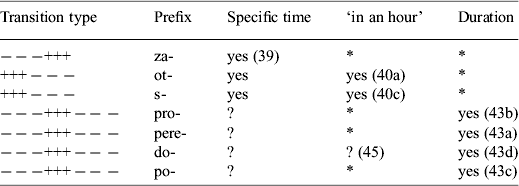
Table 4 sums up the properties of the superlexical prefixes, resulting in the tripartite classification coinciding with the classification of the lexical prefixes in the previous section. Goal prefixes turn out to be compatible with ‘suddenly’ and specific time modifiers in their superlexical use, source prefixes are compatible with ‘in an hour’ type modification, and Route prefixes allow duration of an activity to be measured when they are superlexical.
Compatibility of superlexical prefixes with modifiers.
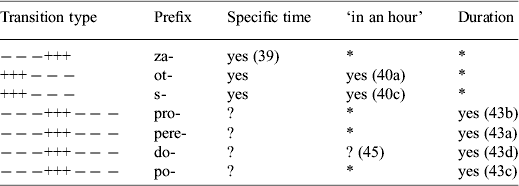
Unfortunately, the lexical prefixesin this table reveal no implicational relationships, and the source of the possibility of ‘in an hour’ modification is rather unclear, as it is connected more to the presence of the result state than the number of transitions. However, the tripartite division is present even if we ignore the ‘in an hour’ column. Furthermore, the inception and completion verbs may be modified by phrases denoting exact time, and then the point will coincide either with inception or with completion.
- (46)
(a) V polnoč vse za-begali.
in midnight all ZA-rannon-dir
‘At midnight everyone started running around.’
(b) V 6 utra ona sbegala v magazin.
at 6 morning she S-ran to store
‘At six in the morning she ran to the store and back.’
(Note that here it looks like both beginning and end happened around 6 in the morning.)
(c) V 1990 godu IL-76 svoe ot-letal.
in 1990 year IL-76 its OT-flynon-dir
‘In 1990 [the airplane] IL-76 has done its flying.’
With pro- and po- it is also possible to modify both the beginning and the end of an activity in a way parallel to source and goal of path with lexical prefixes:
(47) My po-/pro-brodili po gorodu s dvux do trex.
we PO-/PRO-wandered around town from two to three
‘We were wandering around the town from two to three.’
Like with lexical prefixes, source is not normally used without the goal (unless the final point is clearly the reference time of the utterance).
However, specifying both beginning and end time is not possible with pere- and do-. Therefore, perhaps, either a more fine-grained structure is necessary or there is some non-structural reason that makes the meanings of these prefixes incompatible with such modification. Possibly they involve some presupposition about the initial boundary (if part of the prefix meaning is that the activity took too long, the start of the activity was a while ago), which could be incompatible with stating it explicitly.
5. Conclusion
Following the discussion in this paper,, a clear distribution emerges of lexical and superlexical prefixes, where the lexical prefixes, occurring with directional motion verbs, belong to the spatial domain, modifying the movement of figure in space with respect to a certain ground. The superlexical prefixes, occurring with non-directional motion verbs, shift the central prefix meaning into the time domain, describing the movement of a figure in time with respect to the event.
This paper showed the possibility of a single lexical entry per prefix, which specifies the kind of transition it denotes (e.g. the lexical entry of do- contains information about two transitions, as well as the long distance between them that is overcome with difficulty), but the lexical entry is unspecified for the domain of the transition. This information is provided by the syntactic structure: if the prefix is attached VP-internally inside the res projection, the transition specified by the lexical entry is a spatial one, while if the same prefix is attached above Aspect, the transition cannot refer to path any longer and refers to time.
Shifting the computational burden to syntax makes it possible to preserve one common lexical entry for each prefix. Thus, even if the lexicon is responsible for some of the information, the approach suggested in this paper represents a significant progress compared to listing homophones and allows us to bring at least some order to the chaos of Russian prefixes.