Introduction
Scholars have long distinguished between patriotism and nationalism. Both concepts arise from a strong sense of vanity and identification with one's nation, but where one invokes admiration, the other implies zealotry. Patriotism is viewed as a noble national attachment that breeds pride and leads to good works, while nationalism is unrefined and breeds bigotry. The promotion of patriotism is cheered as its inclusive nature brings people together, while the growth of nationalism is bemoaned as it creates barriers to keep groups separate. But, are these concepts as distinct as scholars have presumed? Our research suggests not. This paper shows that, despite increasing acceptance in the scholarly community that nationalism and patriotism are distinct concepts, the two have become more similar in the face of threats. Terror Management Theory (TMT) suggests that, when confronted by great stress, such as the awareness of mortality brought on by traumatic events like 9/11, the concurrent wars in Iraq and Afghanistan, or the Paris Attacks of November 2015, individuals become less tolerant of those they view as deviating from the group. This tendency is especially pronounced among those who express strong group attachment. Thus, whereas American nationalists were more likely than American patriots to use national origin and religious criteria for defining American citizenship in 1996, we show that the extent of the difference between these two groups is diminished substantially in 2004 as patriots began to support these nativist criteria.
In addition to challenging the view that patriotism is “benign”, these findings also underscore the importance of tracking public opinion over time regarding patriotism and nationalism in order to gain a better understanding of the dynamics that render these attitudinal constructs similar or different. Further, if higher levels of national attachment are associated with different conceptions of what it means to be an American and, thus, different ideas of who belongs “in” the nation, then increasing national attachment could have profound effects on policy debates concerning immigration and citizenship policy. In a presidential election year in which such flag-waving patriotism is rife and policy discussions are especially heated, understanding the complex relationship between national pride and identity is particularly relevant.
We organize this article in five sections. First, we review the literature on American national attachment. Next, we provide a discussion of how and why differing conceptions of national attachment influence how Americans define criteria for citizenship and how threats, such as the 9/11 attacks, can alter the relationship between national attachment and how people define citizenship. We argue that the differences between the conceptions of citizenship shrink in the face of a threat, which is consistent with predictions from TMT. Third, using measures of two distinct dimensions of national attachment, which we label nationalism and patriotism, we use two waves of the General Social Survey (GSS) to test our explanation against alternatives suggested by the existing literature. Fourth, we bolster our results via an experimental analysis to test directly how the presence of threat moderates the relationship between national pride and conceptualizations of citizenship. We conclude with a discussion of possible future research on these topics.
Different Conceptions of American Attachment
Scholars studying national attachment have long argued that it is multidimensional (Allport Reference Allport1927; Citrin, Wong, and Duff Reference Citrin, Wong, Duff, Ashmore, Jussim and Wilder2001; de Figueiredo and Elkins Reference de Figueiredo and Elkins2003; Kosterman and Feshbach Reference Kosterman and Seymour1989). Specifically, they note two dimensions of national attachment, each posited to have different effects on policy positions and public opinion. These two dimensions are typically labeled patriotism and nationalism (Citrin, Wong, and Duff Reference Citrin, Wong, Duff, Ashmore, Jussim and Wilder2001; de Figueiredo and Elkins Reference de Figueiredo and Elkins2003). Patriotism refers to pride and devotion derived from national consciousness resulting from a deep, affective attachment to one's nation, while the pride and devotion intrinsic to nationalism arise from exalting one's nation as superior to other nations (de Figueiredo and Elkins Reference de Figueiredo and Elkins2003; Feshbach Reference Feshbach1987). In both the cases, the individual expresses an attachment to her nation, but the latter is rooted in comparisons between one's nation and others. Patriotism denotes a pride in the nation's history, culture, and structure, whereas nationalism denotes a feeling of superiority of one's nation over another.
The normatively troubling nature of nationalism has led to considerable scholarly attention on its potentially negative effects (Citrin, Wong, and Duff Reference Citrin, Wong, Duff, Ashmore, Jussim and Wilder2001). Allport (Reference Allport1927) compares nationalists with religious fundamentalists in terms of their undying devotion to the nation and the protection of its symbols. Further, he argues that its focus on symbols creates a “nationalistic fallacy” which can contribute to aggressive behavior against out-groups, such as support for wars. In contemporary analyses, this conjecture holds: Feshbach (Reference Feshbach1987) finds that those who express a nationalistic viewpoint are more supportive of nuclear armament, and this finding is bolstered by Kosterman and Feshbach (Reference Kosterman and Seymour1989), Hjerm (Reference Hjerm1998), and de Figueiredo and Elkins (Reference de Figueiredo and Elkins2003) who all show that nationalists are far more likely to be xenophobic than patriots.
Patriotism, by contrast, has been given a somewhat virtuous quality by scholars because of its decreased emphasis on the country's alleged superiority over other countries. Thus, to be a patriot does not require that one necessarily view one's country as superior to all others (Hurwitz and Peffley Reference Hurwitz, Peffley, Robinson and Shaver1999, 536). Sullivan, Freid, and Dietz (Reference Sullivan, Freid and Dietz1992), for instance, allowed respondents to define patriotism themselves, uncovering multiple and distinct notions of what it means to be a patriot. Common to all of these—whether they centered on commitments to the preservation of the environment, loyalty to the regime, support for democratic rules and norms, or belief in the value of capitalism—was a sense of pride in the actual practices and structures of the nation (see also Hurwitz and Peffley Reference Hurwitz, Peffley, Robinson and Shaver1999, 537). Further, their analysis identified a “shared view” of patriotism common to all their respondents, which emphasized the importance of political participation and criticism of the government to force it to live up to its ideals. This pragmatic commitment to the nation has been seen as far more tolerant and less chauvinistic than, and therefore importantly distinct from, nationalism which emphasizes an emotional and unreflective, or “blind”, attachment to symbols (Allport Reference Allport1927).
Important recent research on the effects of different types of national attachment on public opinion corroborates the theoretical distinctions made above. For instance, de Figueiredo and Elkins (Reference de Figueiredo and Elkins2003), using data from the 1996 GSS, show that nationalists express bigoted attitudes about immigrants to America, while patriots do not. That is, the type of national attachment one exhibits shapes one's opinions about those in the out-group. Parker (Reference Parker2010) finds similar differences between what he labels “symbolic” and “blind” patriots in their commitments to abstract democratic norms concerning out-groups. Symbolic patriots, those who express pride in the nation and its ideals, are far less hostile to outsiders than blind patriots, who espouse an uncritical view of the nation and its policies.Footnote 1
There is some reason to believe that the distinction between patriotism and nationalism is over-stated and in danger of being reified. In particular, experimental research suggests that the distinction might be context-conditional. Li and Brewer (Reference Li and Brewer2004) utilize the events of September 11, 2001, to investigate this distinction. Their experiments “support the idea that patriotism and nationalism are separable psychological constructs”, but that “the extent to which they are related depends, in part, on what meaning of citizenship is activated” (Li and Brewer Reference Li and Brewer2004, 736). In particular, when the priming condition emphasized 9/11 as a motivation to focus “on the core essence of what it means to be an American”, patriotism “appeared to be incompatible with acceptance of cultural diversity within the nation” (Li and Brewer Reference Li and Brewer2004, 736). Sidanius and Petrocik (Reference Sidanius, Petrocik, Ashmore, Jussim and Wilder2001) call this “exclusionary patriotism”. Parker (Reference Parker2010) similarly finds that distinctions between symbolic and blind patriotism are more muted when it comes to the application of concrete norms when the rights of out-groups are abrogated. Skepticism about a patriotism–nationalism distinction echoes a historical debate in the race and politics field between those who claimed opposition to progressive race-coded policies was the product of principled conservatism, and those who posited a symbolic racism effect (Kinder and Sears Reference Kinder and Sears1981; Sniderman and Tetlock Reference Sniderman and Tetlock1986). Ultimately, the principled conservatism conclusion has been largely unsupported, with the scholarly consensus demonstrating strong evidence of racism effects on American Anglo opinion and political behavior (Bobo and Hutchings Reference Bobo and Hutchings1996; Kinder and Sears Reference Kinder and Sears1981; Sidanius and Pratto Reference Sidanius and Pratto1999). Could the conclusions of the race and politics literature mirror the group dynamics of national attachment?
National Attachment and Criteria for Group Membership
Defining the criteria for belonging to one's nation requires establishing who can enter the group and who must stay out. Put another way, it requires demarcating boundaries. Like any boundaries, those governing citizenship can be more or less rigid. But what explains why some citizens adopt more rigid criteria than others? In this section, we argue that the level and type of national attachment exhibited by citizens can explain how they define the criteria for citizenship.
What Makes an American?
Discussions of what makes someone American coalesce around two distinct conceptions of American citizenship. The case for one side, and the overall debate, is summarized well by Huntington (Reference Huntington2004), who argues that Americanness is intrinsically linked to a particular set of political beliefs (a national creed) that crucially has its roots in Anglo-Protestant culture. When Alan Wolfe, in response to Huntington's argument, argues that Huntington's emphasis on the cultural bases of American identity is overstated and possibly mistaken, Huntington responds thusly:
The people of a nation may share a set of principles that shape their political life, but these principles cannot by themselves define their community and what distinguishes them from other communities. If Iraqis embrace the principles of the American creed, they may become Iraqi democrats, but they will not become American democrats (Huntington and Wolfe Reference Huntington and Wolfe2004).
This view of American identity as rooted in common cultural markers has a long tradition. Smith (Reference Smith1997) argues that the criteria for American citizenship have historically been defined by ascriptive markers of gender, race, religious affiliation, and sexuality, such that the prototypical American citizen is a White, male, Protestant, heterosexual. This view is supported by examinations of immigration policy that show that legal limitations on who could become an American based on such markers persisted well into the second half of the 20th century (Haney-López Reference Haney-López2006). The passage of the 1965 Immigration and Naturalization Act appeared to hail a new day in defining American citizenship. However, Smith (Reference Smith1997) argues that while the various legal barriers to American citizen decreased, the prototypical image of an American is so ingrained into the American political culture that it still persists. Indeed, Devos and Banaji (Reference Devos and Banaji2005) find that, while many citizens express egalitarian attitudes, when asked to think of an American, they envision someone who is White (see also Takaki Reference Takaki1989).
Of course, an alternative narrative of what it means to be an American argues that the relevant criteria include what might be considered “credal” or “inclusivist” conditions (Citrin, Reingold, and Green Reference Citrin, Reingold and Green1990; Conover, Searing, and Ivor Reference Conover, Searing and Ivor2004). This perspective suggests that Americans appear open to allowing other groups to join the nation and consider the image of America as a “nation of immigrants” central to their collective identity. However, the “privilege” of becoming an American carries with it expectations of accepting fundamental political principles of American freedom, democracy, and individualism (Citrin, Wong, and Duff Reference Citrin, Wong, Duff, Ashmore, Jussim and Wilder2001; Smith Reference Smith1997). As such, an adherence to an American creed is vital to be accepted into the nation, but this demand for adherence is not exclusionary: any immigrant, no matter what her race, religion, or country of origin, can in theory meet it by adopting these principles as her own.
To summarize this brief review, we highlight two strands to American conceptions of citizenship. The first, which we label “assimilationist”, emphasizes adherence to “American” political principles and ideals. The second, which we label “nativist”, stresses conformity with cultural criteria of religion, ethnicity, and, more extremely, racial background.Footnote 2 de Figuieredo and Elkins (Reference de Figueiredo and Elkins2003) and Citrin, Wong, and Duff (Reference Citrin, Wong, Duff, Ashmore, Jussim and Wilder2001) both show that nationalists are more likely to endorse the nativist conception of American citizenship than are patriots. Yet, their findings were based on data collected in the pre-9/11 era of American politics, and we suspect that this fact might have shaped the results in unanticipated and hitherto unexplored ways. This suspicion is bolstered by Li and Brewer's (Reference Li and Brewer2004) experiments, conducted after 9/11, which show that even patriots might increase their endorsement of nativist views if exposed to priming conditions emphasizing the common “essence” of Americanness.
The Relationship of National Attachment to Conceptions of Citizenship
Why should the relationship between patriotism and nationalism affect the criteria espoused for being a “true” American? As Social Identity theorists (SIT) have found, group identification tells us who we are and how we ought to behave (Tajfel and Turner Reference Tajfel, Turner, Austin and Worchel1979). Establishing and enforcing criteria for belonging to a group requires a psychological attachment to that group. People who do not feel the pride in a particular group identity, or do not attach much salience to that identity, are less likely to police its boundaries. The degree to which a particular group identity is central to one's identity, therefore, affects how much importance one attaches to defining the criteria for belonging to that group (Spinner-Halev and Theiss-Morse Reference Spinner-Halev and Theiss-Morse2003, 525). Since one's self-esteem is implicated by one's identification with the group, the boundaries of that group and the behavior of others belonging to it come to bear on one's own self-esteem. The more central the group identity to one's own self-identity and self-esteem, the more stringently one polices the boundaries and norms governing the group. Because of this, we expect those with high levels of group attachment, such as nationalists and patriots, to be highly aware of group norms and aware of individuals who violate group norms (Christensen et al. Reference Christensen, Rothgerber, Wood and Matz2004).
The logic of SIT suggests that those who exhibit greater pride-in-nation should be more likely to endorse firm criteria for belonging to that nation. To erase all criteria or, more realistically, to dilute the criteria for belonging too far, is to make belonging to the group less meaningful, and therefore to erode a central component of these citizen's identities. The existence of at least two distinct sets of criteria for national membership implies a related question of equal importance: what is the relationship between the two distinct sets of national attachment and the two distinct sets of criteria of citizenship?
History indicates that nationalist sentiments lead to support for policies excluding certain groups from citizenship (Klinkler and Smith Reference Klinkler and Smith1999). Sidanius et al. (Reference Sidanius, Feshbach, Levin and Pratto1997) explain how national attachment affects the evaluation of citizens. They find that, among Whites, patriotism and nationalism are associated with stronger support of social dominance, classical racism, and opposition to interracial marriages. Similarly, Citrin, Wong, and Duff (Reference Citrin, Wong, Duff, Ashmore, Jussim and Wilder2001) and Li and Brewer (Reference Li and Brewer2004) suggest that those with a nationalistic outlook are less in favor of cultural diversity than those who are more patriotic. Smith and Kim (Reference Smith and Kim2006), using a cross-national survey, find that “nationalists” endorse more demanding criteria for establishing true membership in a nation, while “patriots” are moderately less restrictive in defining citizenship. This scholarship suggests a testable hypothesis:
Hypothesis 1
Nationalism is more strongly associated with more restrictive conceptions of group membership than is patriotism.
An important question concerns the stability of this relationship between national attachment and citizenship. Theory suggests it need not be stable. For example, Group Dynamics Theory (Festinger Reference Festinger1950) predicts that increased out-group threat should encourage group cohesion, though it tells us little about how the “in-group” might be affected by such threats. TMT, on the other hand, suggests that threat perceptions shape not only one's attachment to the group, but also how one constructs that group's identity (Rosenblatt et al. Reference Rosenblatt, Greenberg, Solomon, Pyszczynski and Lyon1989). Evidence from psychological experiments suggests that subjects forced to confront the reality of their own mortality render particularly harsh evaluations of those they judge to violate cultural standards and to favor conformity with those standards (Brewer Reference Brewer, Ashmore, Jussim and Wilder2001; Moskalenko, McCauley, and Rozin Reference Moskalenko, McCauley and Rozin2006). Pyszczynski, Solomon, and Greenberg (Reference Pyszczynski, Solomon and Greenberg2003) argue that, because 9/11 was an attack on symbolic targets of America, identification with dominant values would be the anticipated response as people attempted to give order to their lives (see also Moskalenko, McCauley, and Rozin Reference Moskalenko, McCauley and Rozin2006). If correct, one should expect higher levels of national attachment to be associated with more “exclusionary” or “nativist” conceptions of American identity. Research published soon after the events of September 11, 2001, indicates that this is exactly what happens: Schildkraut (Reference Schildkraut2002) shows that Americans became more restrictive in their views of who is a citizen since the September 11 attacks. This argument suggests that the increased levels of national attachment, or patriotism, expressed in recent years have a darker aspect than previously acknowledged.
SIT has been used widely by political scientists studying the link between pride and nativism (Brown Reference Brown1995; Searle-White Reference Searle-White2001). It claims that attachment to one's group can lead to out-group derogation due to a central need to maintain self-esteem. One critique of SIT approaches is that they do not examine identities that can be transformed in a way that has the potential to motivate consequential changes in mass attitudes (see Huddy Reference Huddy2001). Our approach therefore offers an improvement over the more limited SIT approaches, as we examine national pride as a realistically fluid identity that might change in response to naturally occurring stimuli (i.e., events such as 9/11).
Given this, an implied empirical question is whether changes in the American national context wrought by the changed national security environment resulting from the attacks of September 11, 2001 have altered the relationship between the type of national attachment and citizenship criteria discussed above. Specifically, levels of both nationalism and patriotism have increased, but do the two concepts remain analytically distinct in the new climate? TMT predicts increases in identification with norms and a willingness to punish violators in response to existential threats, but it does not imply conditional increases based on factors such as the type of national attachment one espouses. The hypothesis therefore reflects an empirical implication of equal and consistent increases in individual's propensity to police group identity boundaries, but where one group—here, nationalists—are already close to the maximum levels of support for the enforcement of stricter criteria for group membership. There is therefore a ceiling effect that constrains the extent to which nationalists can increase their opposition to immigrants. Since patriots begin further from that ceiling, our argument would imply that they have more room to move, and therefore the observed differences between the two groups should decrease. Because the implications of such a claim would be quite profound for our understanding of national attachment, we treat it as a distinct hypothesis to be tested.
Hypothesis 2
Patriotism will be more strongly related to nativist conceptions of citizenship when faced with an external threat than when not facing a threat. Nationalism, however, will not see a similar increase in its effect. Observed differences between patriotism and nationalism will therefore be lower when faced with a threat than when not facing a threat.
Nationalism and Patriotism in American Life
The importance of national attachment along with the differences in its conceptualization has been well established in the literature. In this section, we provide an operationalization of both concepts and discuss the continuity of adherence to the two forms of national attachment under investigation. Using two installments of the GSS, we establish a measurement of the different forms of national attachment and document how adherence to these forms of national attachment has changed since the September 11 attacks and subsequent military responses. The 1996 GSS, in conjunction with the International Social Survey Program, included a battery of questions on how people define citizenship and attachment that has been used repeatedly to distinguish empirically between nationalism and patriotism (for examples see Citrin, Wong, and Duff Reference Citrin, Wong, Duff, Ashmore, Jussim and Wilder2001; de Figueiredo and Elkins Reference de Figueiredo and Elkins2003). Fortunately, the GSS included this battery of questions again in its 2004 iteration, which allows us to track changes in patterns of national attachment in the United States. This provides us with a unique opportunity to compare the dynamics of national attachment before and after a signal event in recent American history: the hijackings and subsequent attacks that occurred on September 11, 2001. The contrasts between 1996 and 2004 are notable and relevant. Both years witnessed presidential reelection campaigns, though in 1996 the incumbent was Democrat Bill Clinton and in 2004 Republican George W. Bush was the incumbent. The economic conditions, however, were different. In 1996, the United States was the middle of one of the more prosperous decades, while 2004 saw the U.S. economy in the midst of a slow and uncertain recovery from a recession. And, of course, the security conditions were markedly different. In 1996, the United States did not face imminent threats, whereas by 2004 it was scarred by the 9/11 attacks and involved in two foreign wars in Afghanistan and Iraq. From the perspective of TMT and Li and Brewer's (Reference Li and Brewer2004) research, the more uncertain and threatening environment of 2004 ought to lead to greater emphasis on in-group cohesion with a concomitant danger of out-group derogation. The contrast between public opinion in 1996 and 2004 thus provides leverage in understanding the consequences of nationalism and patriotism by allowing us to see if and how these attitudes changed over time.
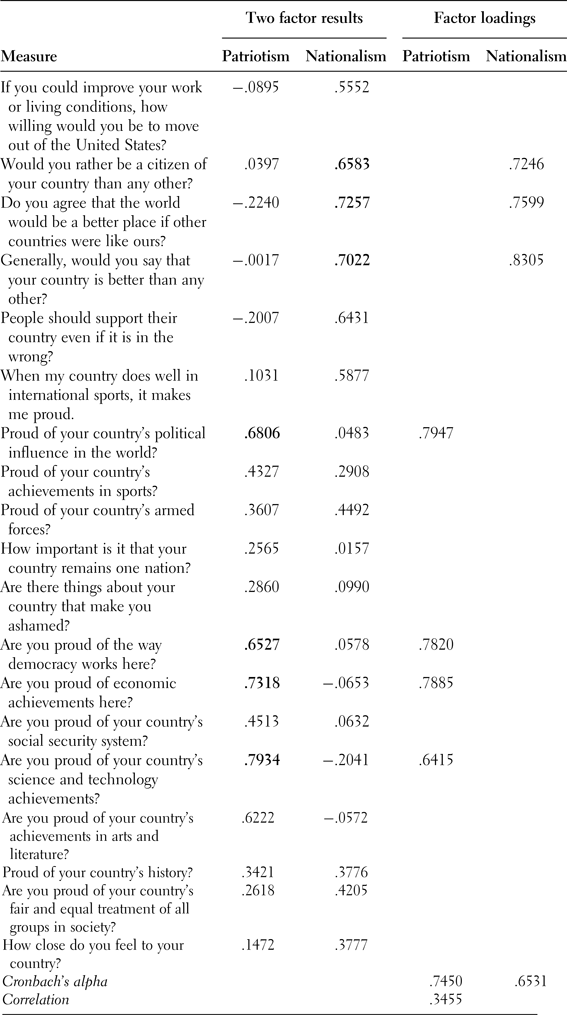
We begin by replicating the factor analysis conducted by de Figueiredo and Elkins (Reference de Figueiredo and Elkins2003) using the same set of qualities they did. Given the racial differences in expressions of national attachment and conceptualizing national attachment (Huddy and Khatib Reference Huddy and Khatib2007; Sidanius et al. Reference Sidanius, Feshbach, Levin and Pratto1997), we restrict our analysis to U.S. respondents who identify as white. The first two columns of Table 1 provide the factor loadings from a two-factor confirmatory factor analysis.
Patriotism and nationalism: factor analysis using pooled 1996/2004 General Social Survey

Notes: Cell entries are factor loadings from confirmatory principal components factor analysis with oblique rotation. All variables are scaled 0–1 and the resulting index is also scaled 0–1.
Primary loading of a variable on a factor is indicated by boldface type.
The results clearly show two distinct factors emerging. While these results are obtained from a pooled sample of respondents (1996 and 2004), the same two factors are revealed if we conduct the analysis separately by year. Further, we find that the same qualities utilized by de Figueiredo and Elkins (Reference de Figueiredo and Elkins2003) emerge as the key qualities on each dimension. Accordingly, we next focus our attention on these variables. Columns 3 and 4 in Table 1 provide the factor loadings used to create the “nationalism” and “patriotism” latent variables using a single factor confirmatory analysis (Bollen Reference Bollen1989). To enhance the comparability of our results with theirs, we use the same variables to generate these two variables.Footnote 3
The patriotism scale is created from responses to four questions about the sources of one's national pride (Cronbach's alpha = .74). These questions are: (1) whether the respondent is proud of the country's political influence globally; (2) whether the respondent is proud of how democracy works in the United States; (3) whether the respondent is proud of economic achievements in the United States; and (4) whether the respondent is proud of the U.S.'s achievements in science and technology.
Nationalism, on the other hand, is best measured by three different questions, each of which gets at whether the respondent believes the United States is “superior” to other nations in the world (Cronbach's alpha = .67). These questions are: (1) whether the respondent would rather be a citizen of another country; (2) whether the respondent believes the world would be better off if more countries were like the United States; and (3) whether the respondent agrees with the statement that the United States is better than any other country.
Having identified and created two variables tapping distinct dimensions of national attachment, we turn to a consideration of patterns in the data, especially with respect to changes observed between 1996 and 2004. Expectedly, respondents score more highly on both dimensions of national attachment: The mean patriotism score is higher in 2004 than in 1996 (P 96 = .73; P 04 = .76; p < .01), while the mean nationalism score is more stable (N 96 = .77; N 04 = 0.78; p < .10).Footnote 4 One concern is that any difference we pick up over time might be because our scales do a better job measuring the latent constructs of patriotism in one year than in the other. To demonstrate measurement invariance across the two samples, we estimate a confirmatory factor analysis by multiple groups, and compare the fit-statistics for a model in which the factor loadings are constrained to be equal to one in which they were allowed to vary across the two years (i.e., were unconstrained). The p-values for a degradation-of-fit test for the constrained model relative to the unconstrained one for each scale used are as follows: Patriotism (p = .502); Nationalism (p = .832); Nativism (p = .505); and Assimilationism (p = .014). The only scale that suffers from measurement non-equivalence is the assimilationism scale, and so we allow the factor loadings for that scale to vary by year (the construction of the assimilationism and nativism scales are described in more detail below). Further, a simple check reveals that patriotism and nationalism were more closely related in 2004 than in 1996. In 1996, (r = .31) the correlation between the two was marginally smaller (p = .06) than in 2004 (r = .37).
This analysis confirms the conventional wisdom that expressions of national attachment increased in the aftermath of the attacks on America in September 2001 (though it cannot establish a causal relationship between those events and the observed increase in national attachment). Further, the data reveal that those scoring higher in patriotism scored higher in nationalism in 2004 than did their counterparts in 1996. This, Li and Brewer (Reference Li and Brewer2004) argue, can be a toxic combination: “patriotism and nationalistic American identity combined are related to less tolerance to cultural diversity, negative attitudes toward minority groups, and restricted criteria for identification as a ‘true’ American” (736). Their findings are based on experiments conducted among an undergraduate student subject pool and a convenience community sample. Do they generalize to the general public?
We suspect they do. Studies have found that, when threatened, the influence of certain attitudes, such as authoritarianism and ethnocentrism, increases. Feldman and Stenner (Reference Feldman and Stenner1997) find that authoritarian attitudes have their greatest effect on shaping attitudes when individuals feel threatened. Davis and Silver (Reference Davis and Silver2004a) find that as the sense of threat grows Americans are more willing to sacrifice civil liberties. Kam and Kinder (Reference Kam and Kinder2007) find that ethnocentrism's influence on attitudes regarding border security, spending on national defense, and foreign aid increased after the September 11 attacks. If a threat can change the way these concepts affect attitudes, how might it change national attachment's effect on conceptions of American citizenship? If patriots were less bigoted than nationalists in 1996 as de Figueiredo and Elkins (Reference de Figueiredo and Elkins2003) show, were they still so eight years later in 2004 in the face of an external threat to the nation?
Threat, National Pride, and Citizenship Criteria
The purpose of this section is to examine empirically how differing conceptions of national attachment shape conceptions of citizenship. We have argued that nationalism with its more aggressive connection to the nation will lead to a more rigid definition of what it means to be an American, while patriotism will lead to a more accommodating definition of American citizenship. However, under times of great stress the distinction between the two will be less evident. In this section, we test these arguments. First, we test whether or not nationalists and patriots embrace divergent “stories” of what it means to be an American (on “stories” as a basis of political communities, see Smith (Reference Smith2003)). Second, we test if the changed political climate has sharpened or blunted differences between these two types of national attachment.
A first empirical task is to establish a measurement of different conceptions of citizenship criteria. Following Citrin, Wong, and Duff (Reference Citrin, Wong, Duff, Ashmore, Jussim and Wilder2001), we define nativism as a political theory about how society should be organized and how the nation should be defined to achieve cultural conformity (pp. 76–77, 80), and define assimilationism as the belief that there need to be only a minimal resolution of national and ethnic identities to preserve American identity (pp. 75–77, 80).Footnote 5 To measure these differing conceptions, we utilize six questions asked in both the 1996 and 2004 iterations of the GSS. These questions ask respondents to state the importance of different features for being a “true American”. The qualities investigated are: (a) whether someone is born in the United States; (b) whether someone is Christian; (c) whether someone has lived in the United States their whole life; (d) whether someone speaks English; (e) whether one feels American; and (f) whether someone has American citizenship. For each of these features, respondents state whether they think the factor is “very important”, “fairly important”, “not very important”, or “not important at all”. Indicators (a)–(c) are used to measure “nativism” and (d)–(f) are used to measure “assimilationism”.Footnote 6
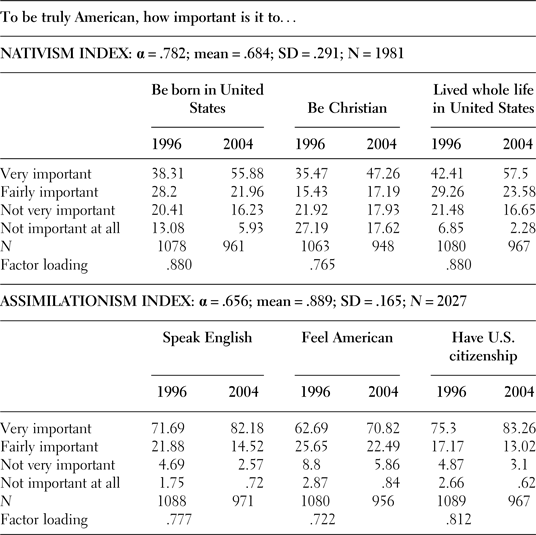
Table 2 provides the frequency distribution of answers to these six questions, the factor loadings for each indicator for its respective index, and basic descriptive statistics for the resulting indices. The individual variable frequencies are separated by year, so that shifts in their distributions are discernible.
Distribution of citizenship variables by year

Notes: Each index was created by principal components confirmatory factor analysis with oblique rotation using the three factors listed below it. The resulting indices are correlated at .59 White respondents only.
Source: 1996 and 2004 General Social Survey.
Of the six criteria for being American investigated, the importance of English-language competency and holding American citizenship are most clearly evident (Paxton and Mughan Reference Paxton and Mughan2006; Schildkraut Reference Schildkraut2005). Over 90% of respondents regard these two factors as very or fairly important, and the relative proportion of Americans identifying them as “very” important increased by over 10% in 2004.
The criteria of whether one was born in the United States and whether one has lived here for most of one's life also receive considerable support from the respondents. Ironically, despite the American predilection for thinking itself a “nation of immigrants”, almost three-fourths of the sample believes it's important for one to be born in the United States to truly be American. Further, this attitude became more prevalent in 2004 with over half of the respondents stating that being born in the United States is very important (an increase of over 15 percentage points compared with 1996). A similar response is drawn by the closely related question of whether it is important to have lived in the United States for one's entire life. Eighty percent of the respondents in 2004 believe that this is at least fairly important, and almost 60% believe that it is very important. Again, this marks an increase of about 15 percentage points relative to 1996.
The criterion with the most diverse response is the importance of Christianity to the notion of Americanness. Unlike the other factors on which a clear super-majority fell on one side, in 1996 just shy of half of the respondents (49%) said that being a Christian was either not very important or not important at all for being an American. In 2004, almost 65% of the respondents thought being a Christian was an important aspect of being an American.
Our analysis of the responses to six questions on the nature of American citizenship suggests that Americans overwhelmingly possess an assimilationist conception of what it means to be an American, while a substantial section holds a nativist conception. Importantly, these pictures of an “American”, appears to be more stringently applied in 2004 than in 1996. Americans became even more supportive of an assimilationist vision of America in 2004 compared with 1996. However, they also became increasingly supportive of a nativist view of America during that same time period. In 2004, Americans appeared to tighten the ranks in regards to who was viewed as “truly” American, compared with 1996. This tightening of the ranks led to greater support for assimilationist activities and an ethnocultural definition of what it means to be an American.
Proud to be an American
Do patriots and nationalists share this vision of the “ideal American” citizen? Previous research suggests that the answer to this question should be “no” and that patriots should espouse a less bigoted perspective on citizenship than nationalists. However, we have argued that the answer is more conditional on perceived threat conditions than previously acknowledged. To see if patriots and nationalists share a common vision of what it means to be American, we develop and estimate a set of regression models. In the first two of these, the “nativism” and “assimilationism” scales described above in Table 2 are treated as the dependent variables, respectively. Then, we estimate ordered probit models in which the six factors that comprise these scales are treated as the dependent variables.
To avoid spurious correlations, we control for the factors associated with national attachment that are plausibly related to one's attitudes toward American identity as well. First, we include a set of basic demographic controls to capture a respondent's gender, level of education, and income category (Citrin et al. Reference Citrin, Green, Muste and Wong1997; Fetzer Reference Fetzer2000). Second, we control for the number of the respondent's grandparents born in the United States. The presumption here is that descendants of recent immigrants should have a more assimilationist conception of what it means to be American (Paxton and Mughan Reference Paxton and Mughan2006). Third, we control for whether the respondent lived abroad at age 16. Our expectation is that the exposure to other societies at a young age should lead to more cosmopolitan worldviews and therefore more inclusive attitudes. Fourth, we control for whether the respondent resides in the American South, which is typically considered a more conservative region of the country (Ellison and Musick Reference Ellison and Musick1993). Fifth, we control for the size of the locality in which the respondent resides. We would expect that residents of more urban areas to have greater exposure to diversity and therefore to express a more inclusive vision of America. Finally, we control for political partisanship using a dichotomous indicator for whether the respondent self-identifies as a Republican. Ideally, we would have liked to control for political conservatism, but the GSS had an experimental political views question in 2004 so that all respondents were not asked the same question. Therefore, we rely on the partisanship control to capture this aspect of the relationship between national attachment and identity. Doing so does have the advantage of permitting a control for any co-partisanship effects since another difference between 1996 and 2004 is the party of the President.
Our main independent variables of interest are the nationalism and patriotism scores generated by the measurement models discussed earlier. Since we are interested in whether the effects of these measures differ in 2004 relative to 1996, we include them in the model interacted with the dummy variable for whether the year is 2004. Thus, we get four coefficients in each model: one for each variable in 1996 and one for each variable in 2004. We also specified the model with all the variables interacted with the year dummy variable, so that a separate coefficient is estimated for each variable for 1996 and 2004. In yet another robustness check, we split the sample by year and estimated the model separately for 1996 and 2004. Our results hold regardless of specification or sample. We report only the first version since it is both most parsimonious and makes the most efficient use of the available information (alternative results are available).
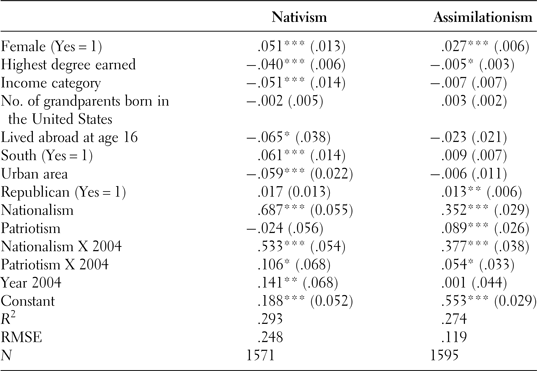
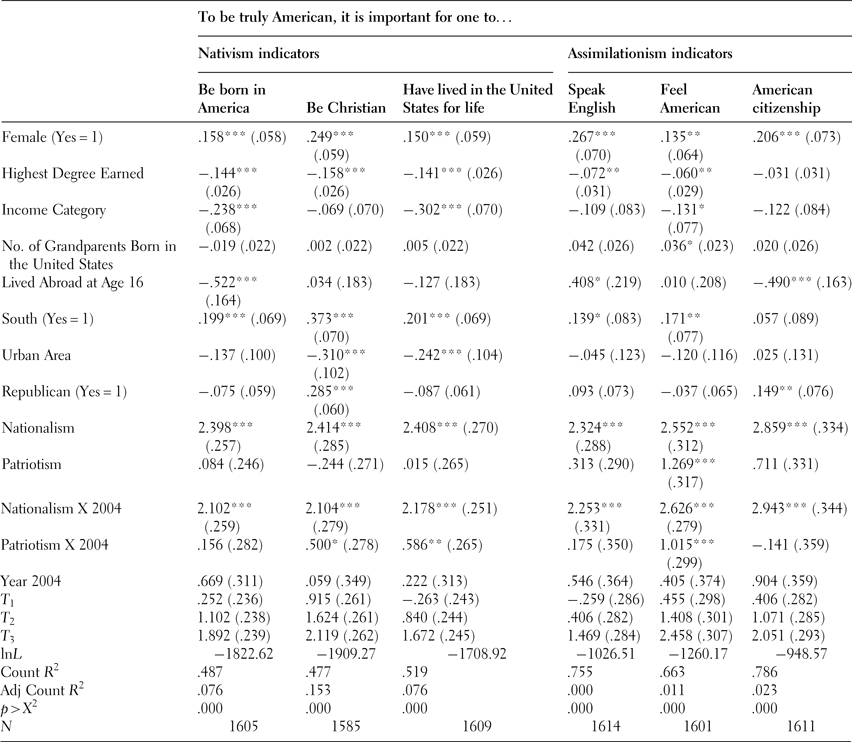
The results from the regression estimations are reported in Table 3, and those from the ordered probit models are reported in Table 4.
Regression results using pooled 1996/2004 General Social Survey

Notes: (1) Ordinary Least Squares coefficients reported with robust standard errors in parentheses; (2) *p < .10, **p < .05, ***p < .01, two-tailed; (3) dependent variables are scaled 0–1 with higher values indicating higher scores.
Ordered probit results for individual factors (using pooled 1996/2004 General Social Survey)

Notes: (1) Robust standard errors in parentheses; (2) *p < .10, **p < .05, ***p < .01, two-tailed; (3) dependent variables are scaled 0–1 with higher values indicating greater agreement with the statement.
Overall, the models perform well, with all the control variables having estimated effects in the expected direction. Therefore, to conserve space, we focus our discussion on the nationalism and patriotism measures, and the differences between the two. As expected, nationalism consistently has a positive and statistically significant coefficient, which means that respondents scoring higher on the nationalism measure were more likely to emphasize the importance of a given factor for being truly American, or, alternatively stated, are more likely to raise the bar for membership. Further, in each model, the absolute size of the coefficient on nationalism is larger than that on patriotism, which means that nationalists were more exclusive in their definition of Americanness than were patriots, which is consistent with previous research (Citrin, Wong, and Duff Reference Citrin, Wong, Duff, Ashmore, Jussim and Wilder2001; de Figueiredo and Elkins Reference de Figueiredo and Elkins2003). Note though that the patriotism variable has a positive coefficient in all but one instance (and then it was statistically insignificant). This provides strong confirmation for our first hypothesis: nationalism is more strongly related to such attitudes than is patriotism, though, again, we hasten to point out that patriotism is never negatively correlated with these attitudes and so does not act as a bulwark against them.
Turning to the second hypothesis, a comparison of the coefficients for the patriotism measure in 1996 and 2004 reveals an important point. In 1996, the patriotism measure is statistically indistinguishable from zero in all but two of the eight models reported in Tables 3 and 4 (“Assimilationism” in Table 3 and “Feel American” in Table 4). In 2004, however, the patriotism measure is statistically significant and has a positive coefficient in five of the eight models which means that patriots were more likely to enforce these criteria for being considered “truly American” in 2004 than they were in 1996. While two of these five are seen as inclusive criteria, it is important to note that patriots are more stringent in their support of people needing to meet these criteria in order to be viewed as American. Further and central to this study is the increased support for nativist criteria. Given the argument of the nobleness of patriotism, it is important to examine why we see this increase in support for nativist conceptions of American citizenship.
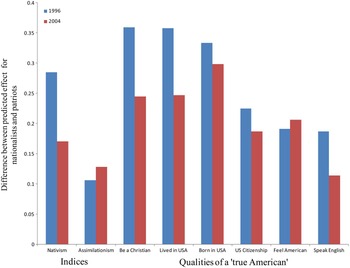
Hypothesis 2 posits that the observed differences between patriots and nationalists will be smaller in the face of threat. Evaluating this hypothesis requires more than a simple comparison of coefficients because of the inclusion of interaction terms and the non-linear nature of ordered probit models. Therefore, we follow standard practice and generate predicted values for our dependent variables at different informative profiles of our independent variables (King, Tomz, and Wittenberg Reference King, Tomz and Wittenberg2000). Figure 1 reports the difference in predicted scores for nationalists and patriots on the “nativism” and “assimilationism” scales, as well as the mean predicted probabilities of answering “Very Important” or “Fairly Important” for each of the individual factors. The predictions are made for a hypothetical respondent for whom the values of the control variables are set at their modal values and only the patriotism and nationalism values are manipulated. A “Patriot” was defined as someone with a .7 score on the patriotism measure and a .3 score on the nationalism measure, while a “Nationalist” had a .7 on the nationalism measure and a .3 on the patriotism measure (both measures had a range of 0–1). In every case, the gap is positive, meaning that nationalists continue to be more restrictive than patriots in their criteria for U.S. citizenship, a point to which we return in our concluding section. However, note that, in all but two cases, the gap shrinks in 2004 compared with 1996. Further, in the two that it is not significant, a closer examination of the values indicates that it is because the increase in the predicted value for the nationalists out-paced the increase in the predicted value for patriots. A sole exception here is that, for the “Importance of American citizenship” variable, the predicted probability for the patriotic respondent in 2004 was .02 lower than in 1996, but this difference is not statistically significant. So while the gap appears to have increased for this variable, it is not a statistically significant increase. Given our analysis we do not reject Hypothesis 2.
The difference between Nationalists and Patriots in 1996 and 2004 has grown smaller. Notes: (1) Bars represent the difference between the predicted effects for nationalists and patriots in 1996 and 2004 for a hypothetical respondent based on estimates reported in Tables 3 and 4 above. (2) “Patriots” were assigned a patriotism score of .7 and a nationalism score of .3; “Nationalists” have the inverse scores. The same pattern of the results obtains if we use .9 and .1 as our values for these variables to induce a greater difference between patriots and nationalists, or, indeed, .6 and .4 to bring them closer together. In fact, the closer the values used, the stronger are our results since, by construction, those we term “patriots” also score higher on the nationalism scale. (3) The hypothetical respondent is a White woman, with some college education, income greater than $25,000, living in a non-Southern state in a suburban locale. All her grandparents were born in the United States, and she lived in the United States at age 16. She identifies as a Republican.

In summary, we do find that there is a clear difference in the probability one endorses exclusive criteria for membership in the American nation based on whether one scores higher on the patriotism or nationalism scale, with nationalists being more likely to support the nativist vision of a Christian, native-born America. As such, this is encouraging news for those endorsing patriotism as a healthier type of national attachment, but there is a definite caveat: this difference has shrunk considerably in 2004 compared with 1996. Patriotic white Americans were more likely to endorse the nativist definition of American identity in 2004, such that their views have come to resemble those of their nationalistic counterparts more closely.
Testing the Causal Relationship
The results from the analysis of the GSS support our argument, but cannot demonstrate causality. To deepen our understanding of the dynamics at work, and to bolster confidence in our use of the TMT framework, we conducted an experiment examining how the priming of mortality salience and threat of terrorism affects the relationship between national attachment and definition of citizenship.
Respondents were recruited online using Mechanical Turk (MTurk). MTurk is a useful tool for recruiting subjects given its much lower costs, and, importantly, Berinsky, Huber, and Lenz (Reference Berinsky, Huber and Lenz2012) show that respondents recruited through MTurk behave as well or better than respondents recruited through other forms. We compensated respondents $.50 for their participation. The sample was recruited from February 15 through February 27, 2012, and overall 326 respondents participated. Given the nature of our study, non-U.S. citizens were excluded, leaving us with a sample of 203 respondents. The gender distribution is almost even with 49.2% of the respondents identifying as female. The mean age of the respondents is 37.7 years old with a minimum of 18 and maximum of 74. The sample is well educated with 89.9% of the sample have at least some college experience. Close to one-third (30.2%) of the sample are college graduates and 15.1% of the respondents hold a graduate or professional degree. The mean respondent has a total family income between $50 and $75,000 with 60.9% of the respondents making $50,000 or less. The sample does have a liberal leaning with 52.5% of the sample identifying as liberal and 46.3% identifying as Democrats.
The experiment is based upon the mortality salience work of those who have studied TMT (Greenberg et al. Reference Greenberg, Pyszczynski, Solomon, Rosenblatt, Veeder, Kirkland and Lyon1990; Reference Greenberg, Porteus, Simon, Pyszczynski and Solomon1995; Rosenblatt et al. Reference Rosenblatt, Greenberg, Solomon, Pyszczynski and Lyon1989). The purpose of this treatment is to invoke thoughts of their own mortality and examine how that influences attitudes toward citizenship criteria. The respondents were first exposed to either the mortality salience manipulation developed by Rosenblatt et al. (Reference Rosenblatt, Greenberg, Solomon, Pyszczynski and Lyon1989) or a control. The mortality salience manipulation is a two-part open-ended questionnaire. The first question asked the respondents to write about what will happen to them as they physically die. The second question asked them to write about emotions that the thought of their own death arouses in them. Those in the control condition were asked to write about the emotions aroused in visiting the dentist and the experience of dental pain. After completing the open-ended questions, they were asked to read an article either about a thwarted terrorist attack or a microbrewery. The purpose of the terrorism article is to focus their attention on an imminent threat, such as domestic terrorism. A pre-test of the articles found that those who read the terrorism article expressed higher levels of fear and hostility and lower levels of joviality and self-assurance. Given these two aspects of the instrument, there are four conditions total: Death and Terror, Death and Beer, Dental and Terror, and Dental and Beer. The Dental and Beer treatment serves as the control condition. We expect the relationship between patriotism and conceptions of citizenship, specifically nativist conceptions, to be the strongest when the respondents are primed with thoughts of their own mortality and reports of an imminent threat.
After being exposed to the manipulations, the respondents were then instructed to respond to several batteries of questions regarding citizenship criteria, the probability of another terrorist attack, the extent to which they fear another terrorist attack, and patriotism. The measures of citizenship criteria and patriotism are exact reflections of the measures used in the GSS.Footnote 7
A first-order analysis of the data indicates that the treatments did have an effect on how the respondents defined who is a true American citizen. Specifically, with regards to assimilationist citizenship, those in the death and terror (.68) and death and beer (.70) conditions are significantly less supportive (p-value = .03 and .05, respectively) of this than those in the control condition (.78). With regards to nativist citizenship, those in the death and beer condition (.28) are marginally (p-value = .07) less supportive of this criterion than the control condition (.36). While this does not fit with expectations, an examination of how patriotism drives these attitudes lends support to Hypothesis 2.
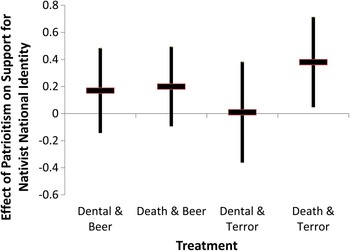
We focus our attention on the changing relationship between patriotism and views about citizenship criteria. Hypothesis 2 centers on the response of patriots to threat stimuli; specifically we are concerned with whether or not patriots become more nativist in their definition of what it means to be an American when confronted with an extreme threat. The results support this conjecture. As in the analysis of the GSS data, patriotism has a positive relationship with nativist definitions, but this relationship is only statistically significant in the death and terror condition (see Figure 2). This indicates prompting concerns about mortality and imminent threat leads patriots to move from having benign support for nativism to clearly defined support for a nativist definition of what it means to be an American. An examination of the assimilationist criteria finds that patriotism is positively and significantly related to this form of criteria in all of conditions except for the control. As in the case of nativist criteria, the coefficients are not statistically distinguishable.
Relationship between Patriotism and Support for Nativist Citizenship under Experimental Conditions. Note: N = 240 U.S. Citizens. Error bars represent 95% confidence intervals around the coefficient estimate obtained from a regression analysis.

In summary, as predicted by TMT, when reminded of their own mortality and the presence of an attack, patriots are more likely to enforce nativist criteria for group membership. Further analysis of this relationship finds that it is neither mediated nor moderated by beliefs of future attacks, fear of attacks or ideology. These results provide convincing corroboration of the findings uncovered in our survey analysis and of the underlying causal mechanisms posited by our use of TMT.
Discussion and Conclusions
This paper provides the first scholarly analysis of changing dynamics in national attachment and their impact on conceptions of American identity. Our findings not only expand upon the research on White Anglo national identity attitudes, but also extend to the broader race and politics literature by illustrating the continued conflict when White Anglos repeatedly resist inclusion of racial and ethnic minorities within their historically segregated civic spaces (Bobo and Hutchings Reference Bobo and Hutchings1996; Browning, Marshall, and Tabb Reference Browning, Marshall and Tabb1984; Kinder and Sears Reference Kinder and Sears1981; Nelson Reference Nelson1972; Sidanius and Pratto Reference Sidanius and Pratto1999). We report three main findings. First, Americans as a group report higher levels of national attachment in 2004 than in 1996, which confirms popular accounts of increased displays of national symbols by citizens. Second, an analysis of the White respondents in the GSSs of 1996 and 2004 indicates that they are more willing to embrace “nativist” conceptions of American identity today than they were in 1996. Third, both nativist and assimilationist conceptions of Americanness are positively correlated with levels of national attachment, but distinctions between types of national attachment are less meaningful in 2004 than they were in 1996. We argue that this phenomenon is a response to the threats posed by terrorist attacks on the nation. This argument is corroborated by an experimental analysis, which finds that patriots behave more like nationalists when primed to think about their own mortality and possible threats to the nation. Together, we believe these findings represent an important contribution to our understanding of how public opinion changes in the face of threat and open several avenues for future research.
First, one aspect of defining American citizenship that we were unable to tap given the questions asked in the GSS is its racial component. To what extent is the exclusive conception of American identity a White one? Since it is unlikely that conventional survey questions could ever tap this aspect of American identity reliably due to social desirability concerns, alternative methodologies such as content analyses and experiments would need to be used to describe more fully how race affects conceptions of nation in the United States. Relatedly, future research should extend our analysis to include non-White citizens. However, as implied above, doing so requires the development of a distinct theoretical framework since these groups have to define themselves vis-à-vis the majority group in the nation, while simultaneously considering their position relative to potential immigrants. Davis and Silver (Reference Davis and Silver2004b) attempt this in their examination of how different racial groups reacted to September 11 attacks (for other efforts along these lines, see Harlow and Dundes (Reference Harlow and Dundes2004)). Our own analyses (not reported here) underscore the concerns raised by these scholars. We find that relatively marginalized groups in American society, such as African Americans, lower educated citizens, and low-income citizens, express lower levels of national attachment in 2004 than they did in 1996. Explaining why this might be so falls well outside the scope of this paper, and we leave it for future research.
Second, our research suggests that the long-accepted distinction between patriotism and nationalism has less merit during this period, at least with respect to conceptions of citizenship. It might be interesting to reexamine our conventional wisdoms to see whether the events of this time period caused the same narrowing of the gap between these two aspects of national attachment in other domains of public opinion. For instance, de Figueiredo and Elkins (Reference de Figueiredo and Elkins2003) demonstrate that patriots in 1996 were less xenophobic and bigoted than nationalists. But did this hold true after the 9/11 attacks? While scholars have been able to show that patriotism and nationalism are distinct concepts and that they have differing effects on attitudes, our results show that the extent of this difference is context-specific. While patriotism may be more inclusive in its definition of citizenship, when outside threats to the nation are perceived, the line between nationalism and patriotism becomes more blurred. It is important that we pay attention to this, as the use of patriotism in the national rhetoric may become even more infused with nationalism.
Finally, while we believe the comparison of 1996 and 2004 survey data is useful, and are encouraged by the corroboration of the trends uncovered there by our experimental analysis, we do want to be careful about making any extrapolations beyond these two points. For example, if 1996 or 2004 were aberrations from the larger trend in national attachment and conceptions of citizenship, then a comparison between the two years tells us only how they differ, and not where we might be headed in the future. Therefore, and especially in light of the election of Barack Obama to the Presidency, replicating this study with data collected in upcoming years is an important task for future work, and speaks of the importance of retaining the national attachment and citizenship questions in the GSS. Finally, while we believe the comparison of 1996 and 2004 survey data is useful, and are encouraged by the corroboration of the trends uncovered there by our experimental analysis, we do want to be careful about making any extrapolations beyond these two points. If 1996 or 2004 were aberrations from the larger trend in national attachment and conceptions of citizenship, then a comparison between the two years tells us only how they differ, and not where we might be headed in the future. Future work should examine the alternative contextual-level effects. For instance, Hopkins (Reference Hopkins2010) and Gulasekaram and Ramakrishnan (Reference Gulasekaram and Ramakrishnan2015) show that increasingly prejudicial and intolerant attitudes are the result of an interaction between changing demographic contexts in concert with increased media attention given to immigration as well as to the risk of “homegrown” terrorists (on the latter points, see also Gadarian and Albertson Reference Gadarian and Bethany2014; Merolla, Ramakrishnan, and Haynes Reference Merolla, Ramakrishnan and Haynes2013; Nacos, Bloch-Elkon and Shapiro Reference Nacos, Bloch-Elkon and Shapiro2011). As it has for over a century, the national debate over immigration will continue unabated, and will undoubtedly be central in the campaigns leading to the 2016 U.S. Presidential election. Replicating our study with data collected in upcoming years is an important task for future scholars of national identification, and underscores the importance of retaining the national attachment and citizenship questions in the GSS.
Acknowledgements
We thank Erin Byrd, Rafaela Dancygier, Jennifer Fitzgerald, Josh Kertzer, Samara Klar, Harwood McClerking, Scott McClurg, Tasha Philpot, Karthick Ramakrishnan, Debbie Schildkraut, Heidi Sherman, and Dara Strolovitch, for detailed comments and helpful conversations, and Brooke Keebaugh and Mary C. Slosar for their valuable research assistance. Any mistakes are solely the fault of the authors.