Introduction
Anorexia nervosa and bulimia nervosa are complex disorders in which both genes and environment interact in a developmental and sociocultural context. However, aetiological studies have been hampered because of the unstable clinical phenotypes (Fairburn & Harrison, Reference Fairburn and Harrison2003; Collier & Treasure, Reference Collier and Treasure2004). Flux between the various eating disorders diagnosis is common and was first observed in several follow-up treatment studies (Collings & King, Reference Collings and King1994; Eckert et al. Reference Eckert, Halmi, Marchi, Grove and Crosby1995; Fairburn et al. Reference Fairburn, Norman, Welch, O'Connor, Doll and Peveler1995; Bulik et al. Reference Bulik, Sullivan, Fear and Pickering1997; Strober et al. Reference Strober, Freeman and Morrell1997; Herzog et al. Reference Herzog, Dorer, Keel, Selwyn, Ekeblad, Flores, Greenwood, Burwell and Keller1999; Eddy et al. Reference Eddy, Keel, Dorer, Delinsky, Franko and Herzog2002); as many as 50% of individuals with anorexia nervosa go on to develop bulimia nervosa, and among individuals with bulimia nervosa, nearly 30% report a history of anorexia nervosa (Keel & Mitchell, Reference Keel and Mitchell1997). Milos et al. (Reference Milos, Spindler, Schnyder and Fairburn2005) found in a prospective study that less than one-third of cases retained the same eating disorders diagnosis over a 30-month observation period. This creates difficulties for aetiological research in areas examining unchanging variables such as genetic polymorphisms or antecedent risk factors, as any association based on acute diagnosis will change over time.
One solution to overcoming the problem of unstable clinical phenotypes is to determine an extended clinical phenotype by considering symptoms and traits over the life course (Collier & Treasure, Reference Collier and Treasure2004). Childhood obsessive–compulsive personality traits are heritable (Eley et al. Reference Eley, Bolton, O'Connor, Perrin, Smith and Plomin2003; P. Liao et al. unpublished observations), and are associated with anorexia nervosa (Anderluh et al. Reference Anderluh, Tchanturia, Rabe-Hesketh and Treasure2003). Childhood risk factors may be particularly valuable because they occur during development, and may therefore be closer to the psychosocial and biological processes that underlie the development of eating disorders (P.-C. Liao et al., unpublished observations). These traits fulfil many of the criteria of an endophenotype (or an intermediate phenotype) (Gottesman & Gould, Reference Gottesman and Gould2003) in that they are associated with the disease, are present in first-degree relatives of patients (Lilenfeld et al. Reference Lilenfeld, Kaye, Greeno, Merikangas, Plotnicov, Pollice, Rao, Strober, Bulik and Nagy1998) and are stable traits that are present before illness onset and remain after recovery (Srinivasagam et al. Reference Srinivasagam, Kaye, Plotnicov, Greeno, Weltzin and Rao1995; Fairburn et al. Reference Fairburn, Cooper, Doll and Welch1999; Holtkamp et al. Reference Holtkamp, Herpertz-Dahlmann, Vloet and Hagenah2005). In addition, they appear to be clinically important as there is evidence that obsessive–compulsive personality traits are associated with poor outcome (Crane et al. Reference Crane, Roberts and Treasure2007). We were therefore interested in whether they had an impact on the lifetime course of eating disorder symptoms.
The aim of this study was to retrospectively examine the life course of eating disorders in adult females with anorexia and bulimia nervosa to determine the most common lifetime diagnostic categories. We also examined the prevalence of childhood obsessive–compulsive traits across the lifetime categories and their impact on the lifetime course. To minimize biases related to retrospective reporting and to enhance the reporting accuracy, we developed an instrument with life events as anchor points along the lifeline, an adaptation of the Longitudinal Interval Follow-up Evaluation (LIFE; Keller et al. Reference Keller, Lavori, Friedman, Nielsen, Endicott, McDonald-Scott and Andreasen1987; Herzog et al. Reference Herzog, Dorer, Keel, Selwyn, Ekeblad, Flores, Greenwood, Burwell and Keller1999; Kordy, Reference Kordy2005), to assess the lifetime course of eating disorders.
Method
Participants
The sample included 97 patients with eating disorders accepted for treatment in in-patient and out-patient programmes of the Eating Disorders Unit of the Maudsley Hospital, London, a secondary and tertiary referral centre, and presents an extended sample of a previous study (Anderluh et al. Reference Anderluh, Tchanturia, Rabe-Hesketh and Treasure2003). It included 35 females with a current ICD-10 (WHO, 1992) diagnosis of anorexia nervosa, restricting subtype, 32 females with anorexia nervosa, binge/purging subtype, and 30 female participants with a current ICD-10 diagnosis of bulimia nervosa. To avoid possible reporting biases related to acute physical state, patients who fulfilled the diagnostic criteria and were willing to participate were entered in the study 3–4 weeks after the beginning of treatment. Those with a history of psychotic disorder according to the ICD-10 criteria were excluded. All participants were native English speakers. The study was approved by the South London and Maudsley National Health Service Trust research ethics committee. Written informed consent was obtained.
Procedure
Specialists in the Eating Disorders Unit made the initial screening diagnosis of eating disorders using the ICD-10 criteria (WHO, 1992). Participants were then interviewed by a trained researcher (one of six postgraduate psychologists and psychiatrists) using a semi-structured EATATE interview. On the date of the interview, data on demographic characteristics were collected and the subject's weight and height were measured.
Measures
The EATATE Lifetime Diagnostic Interview
The EATATE interview was developed for the European Healthy Eating Project (QLK-1999-916), which examined genetic and environmental risk factors for eating disorders and obesity. (The instrument is available upon request from M.A.) Its first part, which is presented here, is a semi-structured diagnostic interview, adapted from the LIFE (Keller et al. Reference Keller, Lavori, Friedman, Nielsen, Endicott, McDonald-Scott and Andreasen1987; Herzog et al. Reference Herzog, Dorer, Keel, Selwyn, Ekeblad, Flores, Greenwood, Burwell and Keller1999; Kordy, Reference Kordy2005), to allow the assessment of lifetime course of the disorders. It uses items from the Eating Disorders Examination (EDE) interview (Cooper et al. Reference Cooper, Cooper and Fairburn1989) to produce an ICD-10 eating disorder diagnosis. It assesses body weight and height during the whole course of the illness, duration of periods when each of the symptoms of eating disorders are present, and their severity: behavioural (dieting, fasting, excessive exercising, binge eating, vomiting, using laxatives, slimming pills and other compensatory behaviours) as well as psychopathological symptoms (inappropriate weight concern, fear of food, eating and food preoccupation) and menstrual status. The course of each symptom is plotted on a lifeline, a time-line that spreads from the point when first symptoms developed to the inclusion in the study. As in ICD-10 we used 3 months' durational criteria and their severity to determine the symptoms present (described in more detail in the online Appendix). To enhance the accuracy of retrospective reporting, anchor points are used along the lifeline; these are significant life events such as treatment status, birthdays, etc. We distinguished a priori four subtypes of anorexia nervosa: restricting subtype (no binging or purging present), purging (vomiting or other purging behaviour present about once in 2 weeks or more over a period of 3 months), binge/purging (binging and purging behaviour present once in 2 weeks or more over a minimum of 3 months) and binging subtype (binging present with the same frequency as above, but no purging). As suggested previously (Hay et al. Reference Hay, Fairburn and Doll1996), two subtypes of bulimia nervosa (purging and non-purging subtypes) were identified. The diagnoses of binge-eating disorder and eating disorder not otherwise specified (EDNOS) were determined according to DSM-IV diagnostic criteria and research evidence (Cooper et al. Reference Cooper, Cooper and Fairburn2003). The determination of subsequent subtype diagnoses along the lifeline enabled us than to identify lifetime diagnostic categories. The interview also screened for lifetime obsessive–compulsive disorder (OCD) using the ICD-10 diagnostic criteria (excluding food and body-related obsessions) and for impulsive behaviours (abuse of alcohol or illegal drugs, self-harm, overdose, reckless spending, disinhibited or reckless sexual activities, shoplifting or stealing, interpersonal violence, violence to property, gambling or fire setting). The interview takes on average about 45 minutes, although the length of the interview depends grossly on the duration of the subject's illness and symptoms stability. The interview showed good inter-interviewer reliability for the assessment of weight and behavioural symptoms (κ coefficients 0.74–0.94), lower reliability for lifetime assessment of psychopathological variables and good validity (data available in the online Appendix).
The second part of the EATATE interview measures obsessive–compulsive traits in childhood (described in detail in Anderluh et al. Reference Anderluh, Tchanturia, Rabe-Hesketh and Treasure2003), including perfectionism, drive for order and symmetry, two traits reflecting rigidity (inflexibility and being bound by rules), and excessive doubt and cautiousness. The instrument uses behavioural examples to assess the traits and has high inter-rater reliability and validity (Anderluh et al. Reference Anderluh, Tchanturia, Rabe-Hesketh and Treasure2003). It also assesses ICD-10 diagnostic criteria of OCD and obsessive–compulsive personality disorder (OCPD) in adulthood.
Analysis
The clinical and demographic data were compared across the three groups defined by current diagnosis by using χ2 tests and a one-way analysis of variance. The Tukey test was used for post hoc comparisons of group differences. The chronological course of eating disorder subtypes for each individual case was presented graphically; cases were grouped according to their first eating disorder diagnosis.
To examine the relationship between childhood obsessive–compulsive personality traits, as assessed using previously defined criteria (Anderluh et al. Reference Anderluh, Tchanturia, Rabe-Hesketh and Treasure2003), and lifetime course of eating disorder symptoms, a χ2 test was used. To compare as diagnostically homogeneous groups as possible, we selected from the total sample the most common lifetime diagnostic categories: (1) a group with lifetime restrictive anorexia nervosa, (2) a group with lifetime binge/purging anorexia nervosa or with binge/purging anorexia nervosa preceded by an episode of restrictive anorexia, (3) a group of cases with bulimia nervosa with a previous episode of anorexia nervosa, and (4) a group of lifetime bulimia nervosa cases. About three-quarters of the total sample belong to one of those categories (n=76). The lifetime categories reflect steps on a continuum from restricting to bulimic subtypes of eating disorders and obesity (Treasure & Collier, Reference Treasure, Collier, Owen, Treasure and Collier2001).
We also compared the duration of eating disorder symptoms in people with and without childhood obsessive–compulsive traits. Because the distribution of those variables was not normal, a non-parametric Mann–Whitney test was used in the analysis. Although every effort was made to obtain complete data for all subjects, some data on childhood traits were missing for 17% of subjects. Subjects with fully completed assessment of childhood traits did not differ significantly from those with incomplete data on any of the clinical parameters. All analyses were carried out by using SPSS-PC release 11.0 (SPSS Inc., Chicago, IL, USA) and all statistical tests used a 5% level of significance.
Results
Subjects' characteristics
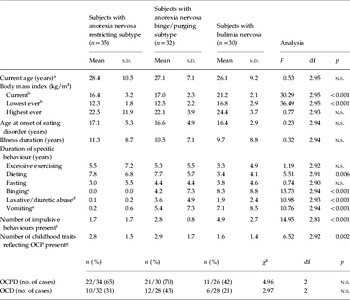
Table 1 summarizes the demographic and clinical characteristics across the groups defined by current diagnosis: (1) restricting anorexia nervosa, (2) binge/purging anorexia (binging and/or purging behaviour present at least once in 2 weeks over a period of 3 months) and (3) bulimia nervosa. The groups did not differ in current age, age at onset or duration of illness (mean duration 10.67 years, s.d.=8.11). As expected, body mass index (BMI) at assessment differed significantly across the groups (F=30.29, df=2.95, p<0.001); both anorexia nervosa groups had a significantly lower BMI (F=36.49, df=2.95, p<0.001). There were no significant differences across the groups on the mean of the highest adult BMI.
Description of the clinical characteristics of the sample included in the study grouped according to the current eating disorder diagnosis

OCP, Obsessive–compulsive personality; OCPD, obsessive–compulsive personality disorder; OCD, obsessive–compulsive disorder; s.d., standard deviation; df, degrees of freedom; n.s., not significant.
a Age range=15–52 years for subjects with anorexia nervosa restricting type, 18–52 years for subjects with anorexia nervosa binge/purging type, and 15–62 years for subjects with bulimia nervosa.
b Significant differences between subjects with anorexia nervosa (both types) and bulimia nervosa (p<0.001, Tukey).
c Significant differences between all three groups, between anorexia nervosa restricting type and anorexia nervosa binge/purging type (p=0.03, Tukey), between anorexia nervosa, restricting type and bulimia nervosa (p<0.001, Tukey), and between binge/purging type of anorexia nervosa and bulimia nervosa (p=0.04, Tukey).
d Significant differences between subjects with anorexia nervosa restricting type and subjects with anorexia nervosa binge/purging type and bulimia nervosa (p<0.001, Tukey).
e Significant differences between subjects with anorexia nervosa restricting type and bulimic type (p<0.01, Tukey) and between subjects with anorexia nervosa restricting type and bulimia nervosa (p<0.001, Tukey).
f Number of impulsive behaviours during her lifetime that is also plotted on the lifetime scale (abuse of alcohol, illegal drugs, self-harm, overdose, reckless expenditure, disinhibited or reckless sexual activities that could be described as disinhibited or reckless, shoplifting or theft, interpersonal violence, provoking fights or arguments breaking objects, gambling or fire setting). Significant differences between restricting type of anorexia nervosa and bulimia nervosa (p<0.001, Tukey) and binge/purging type of anorexia nervosa and bulimia nervosa (p<0.01, Tukey).
g Number of childhood traits reflecting OCP type present, including childhood perfectionism, drive for order and symmetry, rule bound, inflexibility and excessive doubt or cautiousness. Significant differences between the two groups with anorexia nervosa and the group with bulimia nervosa (p<0.01, Tukey).
The three groups differed significantly in the mean lifetime duration of binging, vomiting, laxative and diuretic abuse and dieting, but not in the mean lifetime duration of fasting or excessive exercising (data presented in Table 1). No significant differences were observed in mean lifetime duration of eating and food preoccupation, fear of food or inappropriate weight and shape concern (data not shown). However, the confidence of this finding was low as the reliability of the assessment of these items was low. There were no significant differences between the groups in the frequency of current or lifetime OCD or in the frequency of current OCPD co-morbidity. The anorexia nervosa groups had a higher prevalence of childhood obsessive–compulsive personality traits than the bulimia nervosa group (χ2=6.52, df=2.92, p=0.002).
Lifetime eating disorder diagnosis
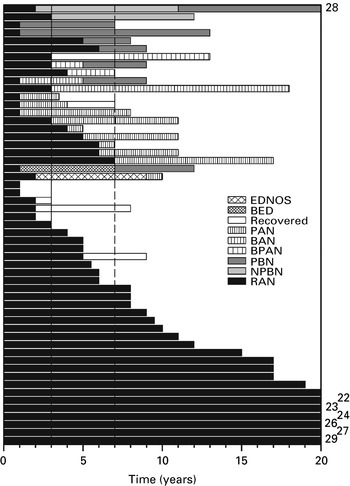
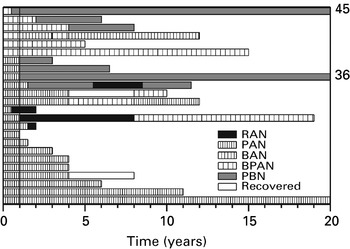
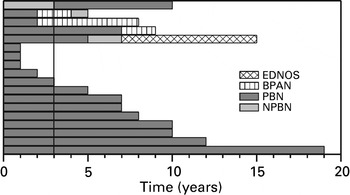
Detailed information on the time course of each individual eating disorder symptom was obtained. In 40% (n=38) of subjects who participated in the study, at least one diagnostic crossover was observed between different eating disorder subtypes during their illness. Thirty-seven per cent of those (n=14/38) satisfied criteria for three or more diagnostic subtypes during their lifetime. The study sample included cases with widely varied illness duration; 12% of the cases had illness duration equal to or less than the observed mean duration in which diagnostic crossovers occurred in the subsequent subtypes. This suggests that the real crossover rates are likely to be even higher than that reported in the study. The lifetime data are illustrated in Figs 1–3.
Retrospective lifetime eating disorders course in cases with restricting anorexia nervosa at onset (n=55). The solid vertical line shows the median duration of restrictive subtype before diagnostic crossover (3 years), the broken line shows the suggested durational criteria of 7 years to determine pure restricting anorexia nervosa. The numbers on the right present the total duration of the illness. EDNOS, Eating disorder not otherwise specified; BED, binge-eating disorder; PAN, purging anorexia nervosa; BAN, binge anorexia nervosa; BPAN, binge/purging anorexia nervosa; PBN, purging bulimia nervosa; NPBN, non-purging bulimia nervosa; RAN, restrictive anorexia nervosa.

Retrospectively assessed lifetime course of eating disorder in cases with binge/purging types of anorexia nervosa at onset (n=25). The vertical line shows the median duration before diagnostic crossover (1 year). RAN, Restrictive anorexia nervosa; PAN, purging anorexia nervosa; BAN, binge anorexia nervosa; BPAN, binge/purging anorexia nervosa; PBN, purging bulimia nervosa.

Retrospective assessment of lifetime course of eating disorders in cases with bulimia nervosa at illness onset (n=18). The vertical line shows the median duration of bulimia nervosa before diagnostic crossover (3 years). EDNOS, Eating disorder not otherwise specified; BPAN, binge/purging anorexia nervosa; PBN, purging bulimia nervosa; NPBN, non-purging bulimia nervosa.

Restricting anorexia nervosa
At the onset, over half of the participants in the study (n=55) fulfilled the diagnostic criteria for the restricting subtype of anorexia nervosa (Fig. 1). Of those 55, 38% (n=21/55) developed regular binging and/or purging (defined as at least once in 2 weeks for 3 consecutive months) during the course of the illness. All diagnostic crossovers occurred within 7 years of onset. The median duration of restricting anorexia nervosa in these cases was 3 years. In 62% (n=12/21) of cases crossover occurred after 3 or more years of duration of restricting anorexia nervosa. About one-third of those cases developed bulimia nervosa and two-thirds developed binge/purging subtypes of anorexia nervosa (Fig. 1).
Binge/purging anorexia nervosa
A quarter of the subjects (n=24) had an onset diagnosis of binge/purging subtypes of anorexia nervosa (Fig. 2). Purging anorexia nervosa was the most common of the three subtypes (n=18), with 6/24 subjects fulfilling diagnostic criteria for binge/purging anorexia nervosa. There were no cases with binging anorexia at the beginning of the illness. Diagnostic crossover occurred in half of the cases. The median time at which a change in the diagnostic subtype occurred was 1.0 year (Fig. 2). Nearly one-third of cases (7/24) developed bulimia nervosa (more commonly binge/purging anorexia nervosa than purging anorexia nervosa). The second most common crossover was to a different subtype of binge/purging anorexia nervosa (two subjects with the purging subtype developing an episode of binge/purging anorexia nervosa and one with binge/purging anorexia developed binging anorexia nervosa). Only four cases (18%) progressed to restricting anorexia nervosa (one later progressed to bulimia nervosa and the other to purging anorexia nervosa). This group had the shortest duration of illness before inclusion in the study (with median time of 7.3 years), with two exceptions who have had bulimia nervosa for over 30 years.
Bulimia nervosa
The third group, 18.5% (n=18/97) of the whole sample, fulfilled diagnostic criteria of bulimia nervosa at the beginning of their illness (Fig. 3). Less than one-fifth of cases (17%) changed diagnosis. The median time of change in diagnosis was 3 years. One of them progressed to EDNOS and in three cases binge/purging anorexia nervosa developed, in one as a transient episode during normal weight bulimia nervosa. Only three (16.7%) cases fulfilled criteria of non-purging subtype at any time during the illness.
Childhood obsessive–compulsive personality traits across the lifetime diagnostic categories
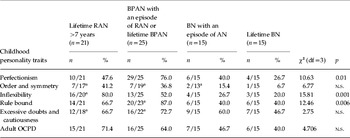
Frequencies of the assessed childhood personality traits were compared across the lifetime diagnostic categories: (1) a group with lifetime restricting anorexia nervosa (n=21) (to exclude subjects at risk of crossover, only cases with an illness duration >7 years were included), (2) bulimic subtypes of anorexia nervosa (n=25) (with or without a previous episode of restricting anorexia nervosa), (3) bulimia nervosa with a previous episode of anorexia nervosa (n=15), and (4) lifetime only bulimia nervosa (n=15). Although the additional durational inclusion criteria led to age differences in category 1 (current age, but not age of onset, was higher in this category), this enabled us to include a pure restrictive anorexia nervosa group in the analysis. The groups differed significantly in the prevalence of three of the five childhood traits (see Table 2), but not in the prevalence of adult OCPD.
Frequencies of the childhood traits reflecting obsessive–compulsive personality and the frequency of obsessive–compulsive personality disorder (OCPD) in adulthood across the four lifetime diagnostic groups (n=76)

RAN, Restricting anorexia nervosa; BPAN, binge/purging anorexia nervosa; BN, bulimia nervosa; AN, anorexia nervosa; df, degrees of freedom; n.s., not significant.
a The number of the subjects is reported individually for each analysis because of some missing data.
The greatest variability across the lifetime categories was in the two traits that represent childhood rigidity (inflexibility and rule bound) and childhood perfectionism. Childhood inflexibility was present in 80% of the participants in group 1, in 52% of the participants in group 2, 27% in group 3 and 20% in group 4. Being bound by rules was similarly more common in groups 1 and 2, especially in group 2 (87%), compared to the group with lifetime bulimia nervosa (40%). Significant differences across the groups were also observed in the frequency of perfectionism in childhood. Again, it was most common in group 2 (76%), followed by groups 1 (48%) and 3 (40%), and was least common in the lifetime bulimia nervosa group (27%).
Childhood obsessive–compulsive personality traits associated with lifetime symptoms
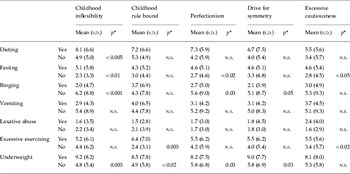
The examination of the influence of childhood traits on the duration of specific eating disorder behaviours using the whole study sample revealed that participants who reported inflexibility in childhood tended to have significantly longer duration of dieting (p<0.005), fasting (p<0.01) and lifetime duration of anorexia nervosa (p<0.005) and shorter duration of periods of regular binge eating (p<0.001) than subjects without this trait (Table 3). Subjects who reported being bound by rules in childhood tended to experience significantly longer lifetime periods of excessive exercising (p<0.005) than those without. The duration of underweight status tended to be longer if either of the rigidity traits was reported and was longest in those subjects with both rigidity traits present (p=0.001). Similar, although less significant, were relationships between the presence of perfectionism and drive for order and symmetry in childhood and lifetime duration of underweight status (p=0.03 and p=0.05). Excessive cautiousness was found to be significantly related to duration of excessive exercising (p<0.02) and fasting (p<0.05). Excessive doubt was not significantly associated with the duration of any of the eating disorder behaviours.
Differences in the duration (years) of eating disorder symptoms between subjects with childhood obsessive–compulsive type personality traits and those without these traits in childhood in the whole sample (df=92)

df, Degrees of freedom; s.d., standard deviation; n.s., not significant.
* The non-parametric Mann–Whitney test was used to test the differences between the groups.
Discussion
This study confirms and illustrates the temporal instability of eating disorder subtype diagnosis through retrospective assessment of lifetime symptoms. Based on the lifetime data, four of the most common lifetime diagnostic courses were distinguished: lifetime anorexia nervosa, binge/purge anorexia nervosa with or without an antecedent episode of restrictive anorexia nervosa, bulimia nervosa after an episode of anorexia nervosa, and lifetime bulimia nervosa. These lifetime categories differed in the prevalence of childhood obsessive–compulsive traits, suggesting that lifetime categories might offer a valid approach to defining more homogeneous eating disorder phenotypes. Subjects with childhood traits of perfectionism and rigidity experienced longer periods of underweight status and longer periods of severe food restriction and excessive exercising, as well as shorter periods of binge eating. This suggests that obsessive–compulsive traits might influence the shape of the eating disorder course and present a way of determining a more homogeneous eating disorders phenotype.
This approach, using a retrospective assessment of lifetime eating disorders and childhood traits, presents, to our knowledge, a unique approach in eating disorders phenotype studies. The EATATE diagnostic instrument is, to our knowledge, the first to retrospectively measure the course of traits and symptoms over a lifetime. Compared to the currently used instruments for retrospective assessment of eating disorders history (e.g. SIAB-EX; Fichter & Quadlieg, Reference Fichter and Quadflieg2001), which assess the worst ever symptoms only, with no time-line perspective, the EATATE offers a more comprehensive view on the past course of the symptoms and the disorder.
The assessment of lifetime symptoms enabled us to confirm and extend the findings from previous studies. Crossover rates from anorexia nervosa to bulimia nervosa were found to be similar to those in the prospective studies (Eckert et al. Reference Eckert, Halmi, Marchi, Grove and Crosby1995; Strober et al. Reference Strober, Freeman and Morrell1997; Herzog et al. Reference Herzog, Dorer, Keel, Selwyn, Ekeblad, Flores, Greenwood, Burwell and Keller1999; Eddy et al. Reference Eddy, Keel, Dorer, Delinsky, Franko and Herzog2002). Crossover rates were comparable in women who had either restricting or binge/purging subtype of anorexia nervosa at the illness onset. However, time elapsed before change was longer in the restricting group. Examination of the time course of the diagnostic crossovers showed that, in 60% of subjects where diagnostic crossover from restrictive anorexia nervosa occurred, it was after 3 years of illness, the period that has been used before to determine pure restricting subtype (Bergen et al. Reference Bergen, van den Bree, Yeager, Welch, Ganjei, Haque, Bacanu, Berrettini, Grice, Goldman, Bulik, Klump, Fichter, Halmi, Kaplan, Strober, Treasure, Woodside and Kaye2003). Once binging behaviour began, it was rare for restricting anorexia nervosa to re-emerge. Linkage studies of restricting anorexia nervosa on multiply affected families demonstrated a specific locus on chromosome 1 (Grice et al. Reference Grice, Halmi, Fichter, Strober, Woodside, Treasure, Kaplan, Magistretti, Goldman, Bulik, Kaye and Berrettini2002) that was not evident for a broader definition of anorexia, indicating that restricting illness may present the most homogeneous phenotype among eating disorders. Based on our results, extension of durational criteria to 7 years would substantially improve the homogeneity of restricting anorexia nervosa samples and the power of genetic studies (a decrease of misclassified cases from 60% to 18% and 5% was observed after extension of durational criteria from 3 to 5 and 7 years respectively). However, that would limit the number of cases available for study.
The crossover rate in women with bulimia nervosa at the illness onset was just over one-third that for women with anorexia nervosa. Crossover from bulimia to anorexia nervosa has been found to be rare (0–7%) in the majority of follow-up studies (Collings & King, Reference Collings and King1994; Fairburn et al. Reference Fairburn, Norman, Welch, O'Connor, Doll and Peveler1995; Keel & Mitchell, Reference Keel and Mitchell1997; Keel et al. Reference Keel, Mitchell, Miller, Davis and Crow2000). However, more recently, a higher crossover rate of 27% was reported in a large study of affected relative pairs (Tozzi et al. Reference Tozzi, Aggen, Neale, Anderson, Mazzeo, Neale and Bulik2004). The crossover rate of 17% found in our study is consistent with this as it fits within the interval of crossover rates suggested in the previous studies.
The four common lifetime groups differed significantly in three of the five childhood traits assessed, suggesting that those traits might be linked to development and maintenance of some of the eating disorder symptoms. By contrast, lifetime categories did not differ in the prevalence of adult OCPD. This confirms the discriminatory validity of the lifetime grouping approach and suggests that taking into account lifetime symptoms and traits offers comprehensive and more stable clinical phenotypes for future aetiological studies.
This paper is an extension of our previous study on temperamental traits in eating disorders. We previously reported a strong relationship between obsessive–compulsive personality type traits in childhood and the likelihood of developing an eating disorder later in life. Our findings suggest that pre-morbid personality traits may shape the lifetime course of the disorders. Traits such as being bound by rules, inflexibility and striving for perfection can facilitate persistent dietary restriction and the control of appetite. Subjects with those traits experienced significantly longer periods of strict dieting, fasting and excessive exercising during their illness and less binge eating when compared to patients without those traits. Participants with both rigidity traits tended to experience significantly longer periods of underweight status than those without them (p=0.001). Childhood obsessive–compulsive personality type traits might thus present not only the risk for eating disorder, as described previously (Anderluh et al. Reference Anderluh, Tchanturia, Rabe-Hesketh and Treasure2003), but also the maintenance factor of its restrictive symptoms. In a systematic review of treatment trails we have found that these traits moderate outcome (Crane et al. Reference Crane, Roberts and Treasure2007) and may be linked to set shifting (Tchanturia et al. Reference Tchanturia, Morris, Anderluh, Collier, Nikolaou and Treasure2004) and weak central coherence information processing styles that might also be part of the endophenotype (Lopez et al. Reference Lopez, Tchanturia, Stahl, Booth, Holliday and Treasure2008).
The absence of any links between observed childhood obsessive–compulsive traits and purging suggests that other factors are involved in the maintenance of bulimic behaviours. Impulsivity might be one of them. The continuum of eating disorder symptoms that spreads from restricting to bulimic symptoms may correspond to the continuum of personality traits spreading from compulsive to impulsive type traits. Eating disorders are clinically heterogeneous disorders, with an array of symptoms and traits that are present to different degrees in different individuals at a particular time, such as binge eating, restricting rigidity, perfectionism and impulsivity. A central question is whether this results from aetiological heterogeneity (Kendler et al. Reference Kendler, Myers, O'Neill, Martin, Murphy, MacLean, Walsh and Straub2000), which could occur through the differential effects of genes or environment or their interaction. Thus, a particular susceptibility gene or type of environmental event could predispose to a certain type or cluster of symptoms, such as perfectionism or impulsivity. Perfectionism (Tozzi et al. Reference Tozzi, Aggen, Neale, Anderson, Mazzeo, Neale and Bulik2004) and impulsivity (Rietveld et al. Reference Rietveld, Hudziak, Bartels, van Beijsterveldt and Boomsma2004) are both partly heritable and show a genetic influence. It is thus likely that specific genes predispose to specific eating disorder-related traits.
The study had several limitations. First, the retrospective assessment was subject to inaccuracies of memory. Anchor points were used as cues in the interview to ameliorate this. Data from additional informants, although difficult to obtain, given the subjects' age and duration of their illness, could also be helpful to override this. Second, the participants were recruited from a secondary and tertiary treatment centre that has biased the sample towards more severe cases with longer illness duration. However, observation of cases with long illness duration enabled us to describe the longitudinal course of the illness. Third, the instrument only measured childhood OCPD traits, which may be more closely linked to the restricting symptoms in eating disorders (Devlin et al. Reference Devlin, Bacanu, Klump, Bulik, Fichter, Halmi, Kaplan, Strober, Treasure, Woodside, Berrettini and Kaye2002). A broader spectrum of personality traits should be assessed to investigate the links between the traits and bulimic behaviour. Fourth, studies with a larger sample size would be needed to confirm our findings.
Our study presents a new approach to determine the eating disorder phenotype. Lifetime diagnostics may have implications for therapy by focusing on the lifetime instead of the current symptoms, as well as for nosology in eating disorders. The observed relationship of childhood obsessive–compulsive traits and lifetime symptoms offers a comprehensive phenotype assessment for future aetiological studies.
Acknowledgements
This study was supported by grant QLK-1999-916 from the European Commission Framework V programme. We thank Rudolf Uher and Andrej Blejec for comments on the manuscript and the referee for valuable suggestions.
Note
Supplementary material accompanies this paper on the Journal's website (http://journals.cambridge.org).
Declaration of Interest
None.