In the past 5 years, healthcare facilities have contended with several infectious disease scares, from the largest documented outbreak of Ebola virus disease (EVD) to multiple transmission events of Middle Eastern respiratory syndrome coronavirus. 1 – 3 The risk of healthcare worker (HCW) contamination and associated personal protective equipment (PPE) have become global topics of concern, as reflected in preparedness activities largely focusing on the selection and acquisition of PPE.Reference Decker, Sevransky, Barrett, Davey and Chertow 4 – 8 Components of PPE, including gloves, gowns, coveralls, boots, and respiratory protection, are normally combined at the hospital level to form a complete protective system for HCWs. Incompatibilities between various PPE components can increase the risk of exposure and create opportunities for contamination.Reference Edmond, Diekema and Perencevich 9
The lack of a global standard for the selection and use of PPE when dealing with patients with highly infectious diseases is a challenging issue.Reference Morgan, Braun and Milstone 10 Although the Centers for Disease Control and Prevention and other organizations have published educational material on PPE combinations for managing infectious diseases, 11 , 12 they do not account for the numerous PPE brands and models currently available on the market. Protocols must be in place to enable hospitals to evaluate the risks and carefully choose a combination of PPE that is suitable for their specific needs and environments.Reference Edmond, Diekema and Perencevich 9 Currently, there is a lack of empirical evidence to guide such decision making.Reference Larson and Liverman 13 Here we build on previous researchReference Valdez 14 – Reference Tomas, Kundrapu and Thota 16 by using human factors methodology to investigate various combinations of PPE products for dealing with highly infectious diseases. We leveraged recent EVD preparedness planning in order to inform the management of future analogous infectious disease outbreaks.
METHODS
The study was conducted between October and December 2014. A mixed methods approach was used, including human factors usability testingReference Salvendy 17 and a qualitative constructivist analysis of participant feedback.Reference Creswell 18 – Reference Mills, Bonner and Francis 20 Usability testing is an observational technique where end users perform representative tasks in a semi-realistic simulated environment, while under the observation of human factors experts, to assess the appropriateness and ease of use of a system.Reference Creswell 18 , Reference Vicente 21 , Reference Beyer and Holtzblatt 22 Through usability testing it is possible to identify how separate PPE components (eg, gloves, headwear, and body coverings) perform when integrated into 1 complete PPE system.
Participants
Eighty-two participants from 4 academic health sciences centers (hospitals) in Toronto, Canada, took part in the usability trials. The hospitals included 2 adult hospitals, 1 pediatric hospital, and a regional trauma center. Participants were representative of potential users of PPE for the management of infectious diseases within a Western healthcare environment, including nurses, respiratory therapists, anesthesiologists, and intensive care unit physicians, as well as occupational health and safety, infection prevention and control, security, and environmental service providers. Participants worked in pairs or in groups of 3, depending on hospital protocol. On the basis of usability testing guidelines, where saturation of identified issues is normally achieved after 5 trials,Reference Salvendy 17 a minimum of 5 participants tested each ensemble.
Materials
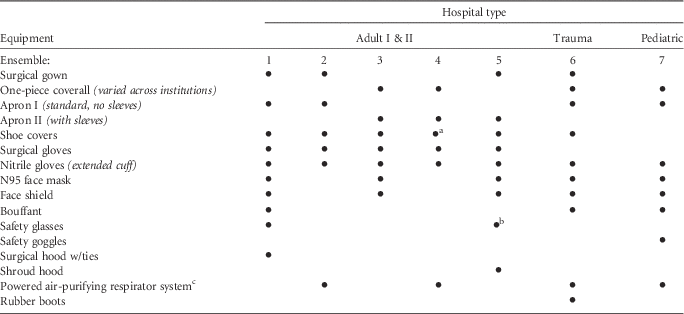
Seven combinations of PPE (Table 1) were tested. Three cameras (Hero3 White; GoPro) were used to record test proceedings. Cameras were mounted at specific locations to ensure capturing of multiple angles of performed tasks.
Ensembles of Personal Protective Equipment Tested in Each Institution
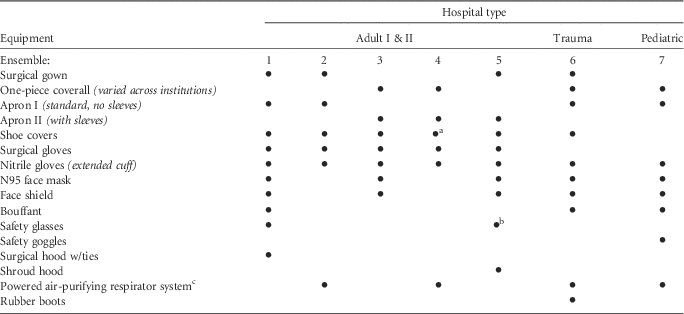
NOTE. Ensembles 1–5 were tested at both adult hospital I and II. Equipment type (ie, gown vs 1-piece coverall) did not differ substantially across institutions; however, the combinations of equipment (ie, the complete ensemble), the environment, and the institutional protocol varied substantially.
a One-piece coverall dependent.
b Optional.
c Blower/filtration unit, breathing tube, shroud hood.
Testing Environment
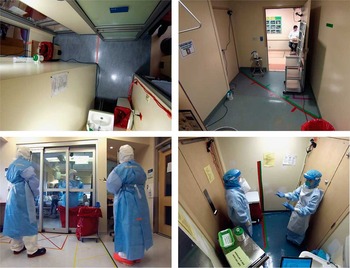
In keeping with patient management plans in the participating hospitals, testing environments included intensive care units and/or emergency departments. Testing locations included the hallways outside the anteroom for donning, the patient room, and a mixture of patient room and anteroom for doffing. The environment and equipment (eg, disposal bins and hand sanitizers) were set up according to each hospital’s EVD protocol (Figure 1).
Anterooms varied substantially in size and layout. Top row from left to right: adult hospital 1 intensive care unit, adult hospital 2 emergency department; bottom row from left to right: trauma center, adult hospital 2 emergency department.

Procedures
Depending on hospital protocol, each trial consisted of 2 or 3 HCWs in the following roles.
With 2 HCWs, the first was primary—the person donning/doffing PPE; the second was secondary—an additional HCW to provide direction and assistance. This protocol was followed at the 2 adult hospitals.
With 3 HCWs, the first was primary; the second was secondary; the third was a trained observer/safety leader—an individual dedicated to overseeing the donning and doffing process (observes and provides guidance, but does not provide assistance; remains outside of potential contamination zones). This role was introduced into EVD preparedness protocols later in the testing period and was followed at the pediatric and trauma hospitals.
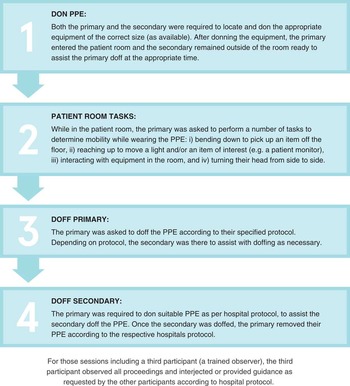
Trials consisted of an orientation session and task-based scenarios (Figure 2). To identify contributing factors and seek clarification, debriefs occurred after each scenario. At the end of each usability session, participants completed a questionnaire on the safety of the equipment tested and its ease of use. Sessions lasted 90 minutes.
Task-based scenarios completed by participants during each usability session. PPE, personal protective equipment.

Two human factors specialists independently observed, recorded, and documented actions and dialogue. A qualitative constructivist approachReference Creswell 18 – Reference Mills, Bonner and Francis 20 was used to analyze participant feedback with regard to difficulties experienced during the trials.
RESULTS
Our analysis revealed numerous opportunities for improvement in PPE design. Further, in addition to PPE, the design of the environment and the design of institutional protocol and instructional materials were found to have a dramatic impact on HCW safety.
Design of PPE
Participants found it difficult to distinguish between “clean” and “dirty” sides of PPE
PPE design does not enable easy distinction between the dirty (outside) and the clean (inside) sides of the equipment. Several participants were unaware of touching clean areas of PPE while doffing with potentially contaminated gloves.
Use of tape to secure PPE components was problematic
Use of tape to secure gloves to gown sleeves increased risk of contamination by making items more difficult to doff. Attaching tape circumferentially around the wrists to secure gloves resulted in pulling and tearing of equipment during doffing.
Overheating was common for all forms of PPE
Although internal body temperature was not measured, participants reported overheating in all forms of PPE, often after wearing PPE for a short period.
Disposal of large PPE items increased contamination risk
Placing 1-piece coveralls into disposal bins was a challenge owing to the large amount of material. Coveralls often ended up on the ground, potentially contaminating the environment and subsequent HCWs in the room. The hoods of powered air-purifying respirator (PAPR) systems took up a sizable amount of space within disposal bins. Disposal bins would reach capacity quickly, resulting in overflow of contaminated items, sometimes into “clean” areas.
Gowns did not provide sufficient coverage around the neck area
Gowns were often too large and left parts of the neck exposed even when sized appropriately.
There was potential for gowns to open at the back
Participants’ backs often became exposed during patient care simulations.
One-piece coverall zipper introduced risk of contamination
When undoing the zipper, the front section of the coverall often curled inwards, coming into contact with participants’ scrubs and neck. Unzipping the suit led to ripped gloves as they became caught in the zipper. Similarly, while unsealing the flaps covering the zipper of the suit, gloves stuck to the adhesive, creating the potential for ripping.
One-piece coverall sizing did not accommodate different body proportions
With limited sizing available, adequate fit was not achieved across the entire coverall. Excess material posed a tripping hazard, made it more difficult to maneuver during patient care simulations, and increased contamination risk due to dragging across surfaces and excess folds.
Doffing apron posed potential spatter risk
The trialed aprons stretched considerably and required significant force to break during removal. As such, apron doffing posed a spatter contamination risk.
Surgical hood with ties did not offer full neck coverage
Parts of the neck were exposed or became exposed as participants moved their heads while wearing a surgical hood with ties. Some participants struggled to untie the hood while doffing because the ties were too short and difficult to grip, or tied too tightly and were difficult to undo.
Bouffant did not stay secured on head
Participants found it difficult to keep the bouffant in position while donning. The bouffant also often came off unintentionally while doffing, increasing the risk of HCWs unknowingly touching exposed hair.
Elasticated 1-piece coverall hood created a potential contamination risk
After the user pulled the hood back to remove it, the elastic contracted and pulled the outside of the hood inwards towards participants’ hair and neck.
Face/head coverings restricted field of view (FOV)
Face shields restricted FOV, particularly when looking downward. Participants tended to adjust the face shield in an attempt to increase their FOV. Bringing hands near the face increased the likelihood of contamination, particularly because some HCWs reached inside the face shield to make an adjustment. PAPR hoods similarly restricted the lower FOV. Participants were able to overcome this by leaning over or pulling the hood down. This latter technique may increase the risk of contamination from the gloved hands to the hood and vice versa.
Forehead became exposed between head coverings and face shield
Using separate pieces for the head covering and face shield left potential for the forehead to become exposed.
Removing the PAPR hood was problematic for HCWs wearing glasses
The inside neck portion of the hood created a seal at the neck/shoulder level that caught on glasses while being doffed.
PAPR hood suspension system did not remain secure during use
Some PAPR hoods included a suspension system to secure the hood to the HCW’s head. The PAPR hood would spontaneously lift up on some participants’ heads, limiting the lower FOV and leading to over-tightening of the support system. The latter was reported to cause headaches. Some participants readjusted the suspension system or pushed the hood down, making unnecessary contact between potentially contaminated gloves and the PAPR hood.
Fogging of safety glasses/goggles restricted visibility
Fogging of safety glasses/goggles occurred frequently and within a short period, restricting visibility. Wearing the N95 respirator in addition to the safety glasses/goggles worsened the fogging.
Gloves did not stay secure, exposing the wrists
Although extended cuffed gloves were used, they often did not stay secured, resulting in exposed skin around the wrist area.
Donning and doffing multiple pairs of gloves posed difficulty
Donning and doffing the second layer of gloves was particularly difficult because it tended to stick to the first layer. Participants also noted the challenge of knowing which layer of gloves they were currently doffing since they were often the same color.
Shoe covers were difficult to doff
All shoe covers were difficult to remove, particularly over the heels. Non-integrated shoe covers (ie, those worn separate to coveralls/gowns) proved to be particularly difficult. Assistance was often required for doffing, increasing the risk of cross-contamination of HCWs. Footwear worn by participants underneath the shoe covers also affected doffing. On some occasions, slip-ons were partially removed when doffing the shoe covers, and larger running shoes with a bulkier design made for a tighter fit.
Doffing of the PAPR required technical expertise
PAPRs comprise multiple components and each must be dealt with systematically during the doffing process. Some components are disposable whereas others require downstream disinfection and as such increased the complexity of the doffing process and risk for downstream contamination.
Operation noise generated by the PAPR hindered communication
Participants noted difficulty hearing and understanding their peers while wearing a PAPR. Participants also noted that communication with patients might be difficult. The tested sites did not use wireless communication systems.
When the PAPR blower is turned off, air supply concerns began to set in
Some protocols required the PAPR blower to be turned off before removing the PAPR hood. This led some participants to become concerned about the lack of air supply and consequently start to panic, rushing the doffing procedure and increasing the risk of contamination.
Environmental Design
The design of the environment was found to increase contamination risk in a number of ways. Importantly, the position of equipment within the environment influenced doffing safety. For example, participants were seen throwing items into disposal bins that were not located within arm’s reach. If disinfectant wipes and hand sanitizer dispensers were not secured to walls, participants struggled to use them. Unsecured containers were also easy to move about within the doffing area and consequently were often found in inconsistent, unhelpful locations. In addition to the layout of equipment, the physical layout of the environment (eg, absence of windows, closed doors, size of patient room and anteroom) had a significant impact on safety through its effect on communication between HCWs.
Protocol and Instructional Materials
Institutions heavily rely on protocols and guidelines that describe how to don and doff equipment to remind HCWs of the processes to be followed in the moment. A heavy reliance on posted instructions was found to hinder doffing safety by limiting participants’ ability to troubleshoot problems and maintain situational awareness. The order in which instructions were presented was also found to significantly impact doffing safety. For example, removing the face shield after doffing body coverings leaves the potential for the outmost layer, the face shield, to touch a cleaner inside layer (eg, HCWs’ scrubs). When instructional checklists were used, the location of such material was found to affect where a participant looked and maneuvered while doffing equipment, sometimes increasing the risk of cross-contamination.
As noted earlier, participating hospitals adopted a 2- or 3-HCW protocol for donning and doffing. Unfortunately, making firm conclusions with regard to these differences is beyond the scope of this study. However, it should be noted that the ability for the trained observer to be able to detect breaches is limited by 2 factors: (1) the environment: adding a third HCW restricts valuable space within the donning/doffing environment; (2) human factors: due of the lack of interaction between the trained observer and other HCWs, the observer’s level of vigilance will likely decrease with time, increasing the chance of missing a critical breach. Finally, it was clear during testing that when the trained observer’s role was not clearly defined, team dynamics were negatively affected because the trained observer role impinged on that of the secondary.
DISCUSSION
This study demonstrates that PPE requires greater rigor in its design for the management of patients with highly infectious diseases. We focused on testing various combinations of PPE used for EVD, a disease that is transmitted by contact with blood and body fluids and requires a high level of barrier and respiratory protection during high-risk patient care events. However, these results may be extrapolated to various other infectious diseases requiring lower levels of protection.
Of all the PPE combinations tested, not one provided a complete satisfactory solution. To date, a limited number of studies have evaluated the usability-related safety of PPE systems.Reference Guo, Li and Wong 23 , Reference Barratt 24 In general, PPE is tested and evaluated individually, without identifying interactions that may influence the safety of different combinations of PPE (eg, when paired with a gown surgical hoods do not offer sufficient neck coverage). Without empirical guidance to direct the selection of PPE, procurement decisions are often based on anecdotal evidence and driven by either familiarity with products, fear of contamination, or cost.
In designing the next generation of PPE, industry must address these gaps by approaching PPE as a complete system.Reference Edmond, Diekema and Perencevich 9 , Reference Casanova, Alfano-Sobsey, Rutala, Weber and Sobsey 25 A human factors iterative design approach including representative users performing representative tasks within representative environments is of prime importance.Reference Salvendy 17 The focus on the physical and chemical properties of PPE, while warranted, should expand to include the usability of the entire PPE system, including how the selected PPE functions as a whole while managing care of a patient with an infectious disease. Our study touches on this aspect but greater in-depth studies are required to understand unique care management issues.
The ease with which PPE can be doffed safely has a substantial impact on the effectiveness of the equipment and as such should be weighted accordingly when designing and/or selecting PPE. Simple design changes could have a dramatic effect on decision-making. For example, different colored gloves for each glove layer will improve awareness with regard to the layer of gloves an HCW is currently removing. In addition, creating a clear distinction between the clean inside and dirty outside of PPE will help to improve safety while doffing by reducing cognitive load.
While it is helpful to improve the next generation of PPE design, it is also imperative to focus on supporting the procurement and usage of currently available systems. To this end, the importance of human factors testing of currently procured equipment within the actual healthcare environment should not be underestimated. Our findings highlight that it is also necessary to consider the environment in which PPE is used and the design of protocols and instructional materials when selecting and using PPE.
By using human factors methodology this study highlights important, and previously overlooked, issues associated with the selection and use of PPE. However, as with any testing of this nature, there was not an immediate threat or risk and therefore some participants may have behaved differently owing to perceptions of the simulated environment and scenarios. Additionally, the findings may be limited to the specific models of the products tested.
To conclude, healthcare institutions are encouraged to select and modify PPE on the basis of iterative human factors evaluations that include participation of representative users. Manufacturers of PPE solutions should include usability as a key consideration when designing the next generation of PPE. It is also recommended that the selection of PPE should not be taken out of context; the design of the environment in which the PPE is to be used and the design of protocols and instructional materials should also be carefully considered and tested. Optimally designed and procured PPE (ie, using human factors methods) will likely decrease risk to HCWs, enhance HCW and patient safety, and reduce dependency on instructional checklists. Future research should seek agreement by experts on personal protection principles for HCWs managing highly infectious diseases.
ACKNOWLEDGMENTS
Financial support. The Ontario Ministry of Health and Long-Term Care.
Potential conflicts of interest. All authors report no conflict of interest relevant to this article.