


Highlights
-
This study of over 50,000 acute stroke patients in Ontario found that high hospital-based frailty is independently associated with thrombolysis rates but not thrombectomy rates.
-
High frailty increased short-term mortality in males, but not females.
-
Comparative studies of stroke care and outcomes should account for frailty.
Introduction
Ischemic stroke is more common in the elderly, Reference Joundi, Smith and Yu1 with a higher incidence in elderly women relative to elderly men. Reference Vyas, Silver and Austin2 Thrombolysis or thrombectomy can decrease the risk of disability in patients with acute ischemic stroke, Reference Roaldsen, Jusufovic and Berge3–Reference Boulanger, Lindsay and Gubitz5 and this association remains true across all age ranges in clinical trials. Reference Emberson, Lees and Lyden6 Yet, in clinical practice, there is variation in the receipt of reperfusion treatments in eligible older stroke patients, potentially driven by a practitioner’s perception of how frail the patient may be. Reference Adcock, Schwamm and Smith7 A potential consideration is how frailty is determined at the time of an acute stroke when treatment decisions need to be made promptly.
Frailty is defined as the reduced ability of people to cope with acute stressors due to increased vulnerability of multiple organ systems with age-associated decline in physiological function. Reference Kim and Rockwood8 While the prevalence of frailty rises with increasing age, Reference Gale, Cooper and Sayer9 they are different constructs, and with more people living longer, chronological age alone is unable to capture the aging process. Reference O’Caoimh, Sezgin and O’Donovan10 Although the definition of frailty is heterogeneous across studies, women have been shown to have higher rates of frailty than men at all ages. Reference Gordon, Peel and Samanta11 It is estimated that 22% of patients with stroke are frail at the time of stroke, and this prevalence is twice as high as in age-matched controls without stroke. Reference Burton, Stewart and Blair12,Reference Palmer, Vetrano and Padua13 Further, frailty is associated with delirium, Reference Taylor-Rowan, Cuthbertson and Keir14 poor cognition Reference Taylor-Rowan, Cuthbertson and Keir14 , and reduced quality of life Reference Wæhler, Saltvedt and Lydersen15 in stroke survivors, even after adjusting for age. In practice, providers may perceive frail patients as having a poor prognosis and not offer reperfusion treatments, regardless of their benefits. Yet, empirical evidence on the impact of frailty and age on receipt of reperfusion treatments and short-term mortality in females and males with ischemic stroke is lacking because older patients with certain comorbidities, and thus, higher frailty, are often excluded from clinical trials. Reference Nguyen, Ahmad and Lindley16
We conducted a population-based retrospective observational study to evaluate the independent association between frailty and age (and their interaction) with receipt of reperfusion treatments (thrombolysis or thrombectomy) and 30-day all-cause mortality in females and males with ischemic stroke. We hypothesized that a) increasing age and higher levels of frailty would be independently associated with lower rates of reperfusion therapy and higher mortality and b) frailty would modify the association between age and these outcomes.
Methods
Setting
Ontario, Canada’s most populous province, has a publicly funded, single-payer health insurance plan (Ontario Health Insurance Plan, OHIP) for all of its residents, which covers essential health services, including thrombolysis and thrombectomy. This study was conducted using administrative databases that were linked using unique encoded patient identifiers and analyzed at ICES (previously the Institute for Clinical Evaluative Sciences).
Cohort creation
We identified a population-based cohort of patients with ischemic stroke using linkage of several databases. We included Ontario residents aged 18 years and above who were admitted to an acute care hospital with a most responsible diagnosis (most resource-intensive) of ischemic stroke (ICD-10 code I63 [except I63.6], I64 or H34) between April 1, 2018, and March 31, 2022. This definition has high specificity in Ontario administrative datasets. Reference Hall, Mondor and Porter17 We excluded those who had a stroke while hospitalized and those who were admitted electively. If an individual had more than one admission for ischemic stroke during the study accrual period, the first hospitalization was considered the index stroke hospitalization and included in the study.
Sex, age and frailty
Information on age and sex was derived from the Registered Persons Database (RPDB), which includes information on all people registered with the province’s health insurance plan (almost all persons residing in Ontario have provincial health insurance). Gender is not available in our datasets.
Using hospitalization records in the 2 years prior to and including the index stroke hospitalization, we identified frailty for each individual based on a hospital-based frailty index. Reference Amuah, Molodianovitsh and Carbone18 The frailty index uses 36 deficit categories and 595 diagnostic codes to create a continuous score (a proportion of deficits divided by 36). Reference Amuah, Molodianovitsh and Carbone18 Unlike comorbidity indices like the Charlson comorbidity index, the hospital-based frailty index is based on factors such as function (incontinence, functional dependence), sensory loss (hearing loss), cognition and mood (delirium, dementia) in addition to morbidity (diabetes, malignancy) (e-Table 1). However, the continuous score is difficult to interpret in a clinical context and is converted to an ordinal measure (1 to 8) of risk groups from lowest to highest severity. For the current study, this ordinal measure of frailty was recategorized as low (score of 1), medium (2–3) or high frailty (≥4) using previously defined prespecified cutoffs. Reference Amuah, Molodianovitsh and Carbone18 This three-level frailty variable is associated with in-hospital mortality and length of stay. Reference Amuah, Molodianovitsh and Carbone18
Covariates
We identified people experiencing homelessness using a validated algorithm that relies on previous hospitalizations and use of community health centers. Reference Richard, Hwang and Forchuk19 Immigration status was obtained by linkage with immigration records from the Immigration, Refugee, and Citizenship Canada’s (IRCC) Permanent Residents Database. People born outside of Canada who arrived in Canada after 1985 were classified as immigrants and the remaining Ontario residents as long-term residents. Reference Vyas20 We obtained information on neighborhood-level material resources from the Ontario Marginalization Index Database, which is derived from 2016 census-derived data on dissemination areas and census tracts. Ontario neighborhoods were categorized by quintile of material resources from the lowest (Q1: lowest) to the highest quintile (Q5: highest). We also classified individuals as residing in a rural (<10,000 people) or urban (≥10,000 people) area based on their postal code and the size of the defined geographic area of residence using previously defined geographic census tracts and dissemination areas. Reference Kapral, Austin and Jeyakumar21
We also obtained information on the following comorbid risk factors as recorded on the stroke hospitalization date: hypertension, Reference Tu, Chen and Lipscombe22 diabetes, Reference Hux, Ivis and Flintoft23 hyperlipidemia, atrial fibrillation Reference Tu, Nieuwlaat and Cheng24 and chronic obstructive pulmonary disease Reference Gershon, Wang and Guan25 using validated algorithms.
Outcomes
Our primary outcome was receipt of thrombolysis or thrombectomy as separate outcomes. Our data sources do not include information on the time of last seen normal, presence or absence of large vessel occlusion, or all the contraindications for these treatments. Hence, we are unable to identify the subset of “eligible” patients with ischemic stroke, and we instead used all patients with ischemic stroke as the denominator. The data on thrombectomy were only available from 2018 onwards in our datasets. Our secondary outcome was 30-day all-cause mortality, identified using the RPDB that records the date of death.
Statistical analyses
Baseline characteristics were compared among people in the three categories of frailty, using Fischer’s exact test for categorical variables and ANOVA for continuous variables. We then evaluated the association between frailty and receipt of thrombolysis or thrombectomy, with an a priori decision to stratify by sex, knowing that the effect of frailty on health outcomes varies by sex. Reference Gordon, Peel and Samanta11 To account for clustering at the neighborhood level, we used generalized estimating equations (GEEs). Reference Austin, Kapral and Vyas26 We then created multivariable modified Poisson models estimated using GEE methods separately for thrombolysis and thrombectomy in females and males. We categorized age in 5-year increments and frailty as low (reference), medium and high. Age and frailty were added along with the covariates listed above to obtain adjusted risk ratios (aRRs) of each outcome. We then added a two-way interaction term between age and frailty to our models. We reported the P value for this interaction term and used a cutoff (<0.05) for statistical significance. Reference Brookes, Whitely and Egger27 Finally, we plotted the aRRs for receipt of treatment and 30-day mortality among those with medium or high frailty versus low frailty across different ages, separately in males and females.
We repeated these analyses for our secondary outcome of 30-day mortality. The first set of models did not account for hyperacute reperfusion treatments, and the second set did. This allowed us to examine the attenuation in the associations between age and frailty and 30-day mortality after adjusting for hyperacute reperfusion treatments.
Sensitivity analyses
Because most patients with atrial fibrillation may be on anticoagulants, making them ineligible for thrombolysis, we conducted an ad hoc sensitivity analysis to evaluate the association between frailty and thrombolysis after excluding patients with atrial fibrillation. Finally, we re-evaluated the associations between frailty and our outcomes of interest in a subset of patients whose frailty index was based on prior hospitalizations, that is, excluding people whose frailty score was based on the index stroke hospitalization.
Results
Baseline characteristics
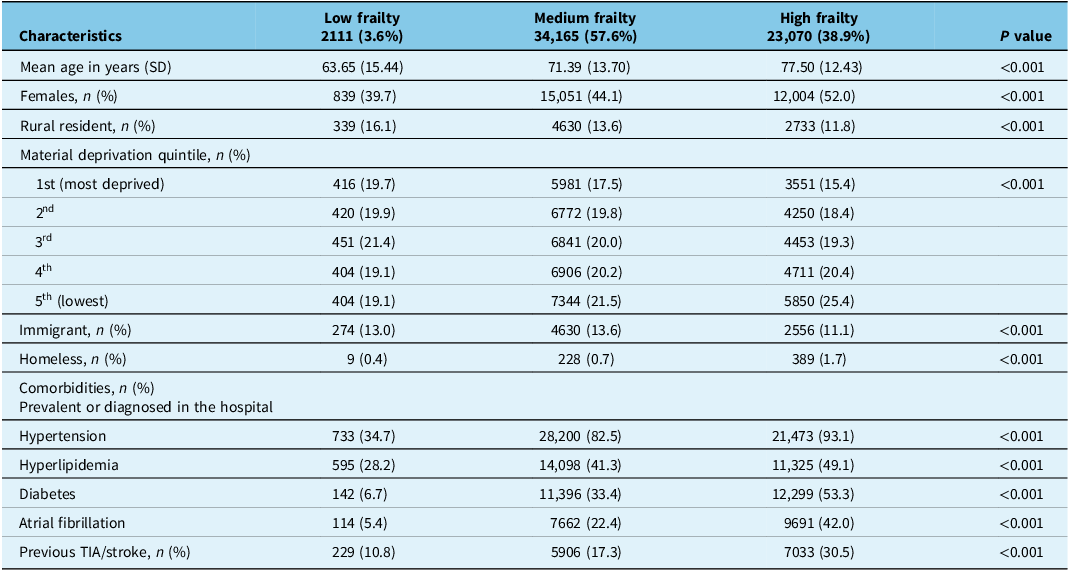
We included 59,346 adult patients (mean age 73.5 years, 47% female) with an acute ischemic stroke as their primary diagnosis, admitted to a hospital in Ontario between 2018 and 2022 (Figure 1). Of these, 2111 (3.6%) had low frailty, 34,165 (57.6%) had medium frailty and 23,070 (38.9%) had high frailty. Patients in the high frailty group were older (mean age 77.5 vs. 63.7 years) and were more likely to be female (52% vs. 39.7%) when compared to the low frailty group (Table 1). In total, 8859 (14.9%) of the cohort received thrombolysis, 4454 (7.5%) received thrombectomy and 11,232 (18.9%) received thrombolysis, thrombectomy or both. Compared to males, females were equally likely to receive thrombolysis (14.7% vs. 15.1%, P = 0.18), marginally more likely to receive thrombectomy (7.8% vs. 7.2%, P = 0.005) and more likely to die within 30 days (7.4% vs. 6.4%, P < 0.001).
Flow diagram of included patients.

Baseline characteristics of all acute ischemic stroke patients in Ontario between 2019 and 2023
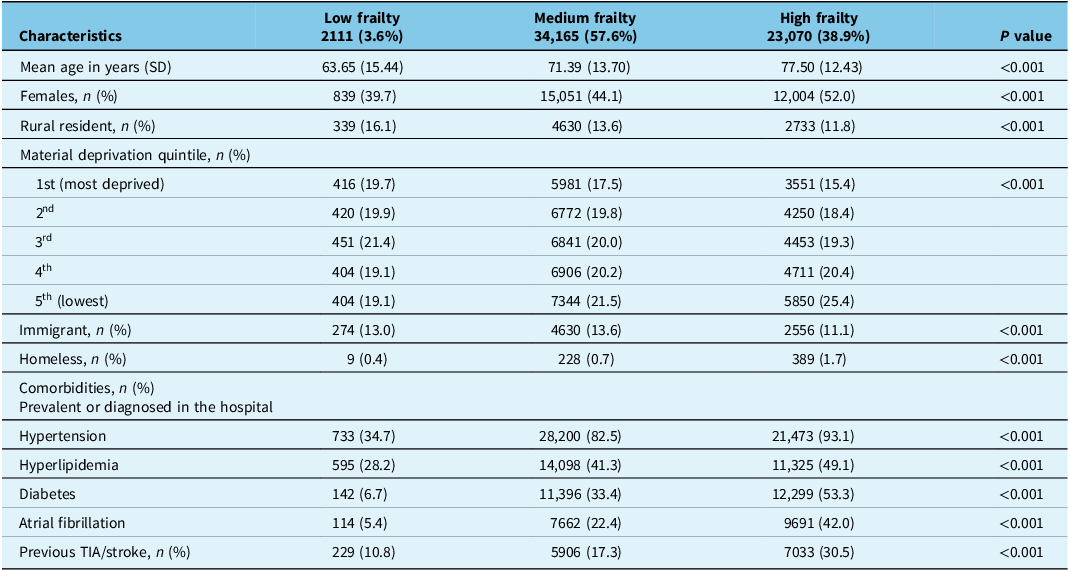
Table 1. Long description
A table comparing baseline characteristics of acute ischemic stroke patients in Ontario between 2019 and 2023, categorized by frailty levels: low, medium, and high. The table has 15 rows and 6 columns. Column headers are Characteristics, Low frailty, Medium frailty, High frailty, and P value. Row labels include Mean age in years, Females, Rural resident, Material deprivation quintile, Immigrant, Homeless, and Comorbidities. Row 1: Mean age in years (SD), 63.65 (15.44), 71.39 (13.70), 77.50 (12.43), <0.001. Row 2: Females, n (%), 839 (39.7), 15,051 (44.1), 12,004 (52.0), <0.001. Row 3: Rural resident, n (%), 339 (16.1), 4,630 (13.6), 2,733 (11.8), <0.001. Row 4: Material deprivation quintile, 1st (most deprived), n (%), 416 (19.7), 5,981 (17.5), 3,551 (15.4), <0.001. Row 5: Material deprivation quintile, 2nd, n (%), 420 (19.9), 6,772 (19.8), 4,250 (18.4), <0.001. Row 6: Material deprivation quintile, 3rd, n (%), 451 (21.4), 6,841 (20.0), 4,453 (19.3), <0.001. Row 7: Material deprivation quintile, 4th, n (%), 404 (19.1), 6,906 (20.2), 4,711 (20.4), <0.001. Row 8: Material deprivation quintile, 5th (lowest), n (%), 404 (19.1), 7,344 (21.5), 5,850 (25.4), <0.001. Row 9: Immigrant, n (%), 274 (13.0), 4,630 (13.6), 2,556 (11.1), <0.001. Row 10: Homeless, n (%), 9 (0.4), 228 (0.7), 389 (1.7), <0.001. Row 11: Comorbidities, Hypertension, n (%), 733 (34.7), 28,200 (82.5), 21,473 (93.1), <0.001. Row 12: Comorbidities, Hyperlipidemia, n (%), 595 (28.2), 14,098 (41.3), 11,325 (49.1), <0.001. Row 13: Comorbidities, Diabetes, n (%), 142 (6.7), 11,396 (33.4), 12,299 (53.3), <0.001. Row 14: Comorbidities, Atrial fibrillation, n (%), 114 (5.4), 7,662 (22.4), 9,691 (42.0), <0.001. Row 15: Comorbidities, Previous TIA/stroke, n (%), 229 (10.8), 5,906 (17.3), 7,033 (30.5), <0.001.
TIA = transient ischemic attack.
Frailty, age and reperfusion therapy
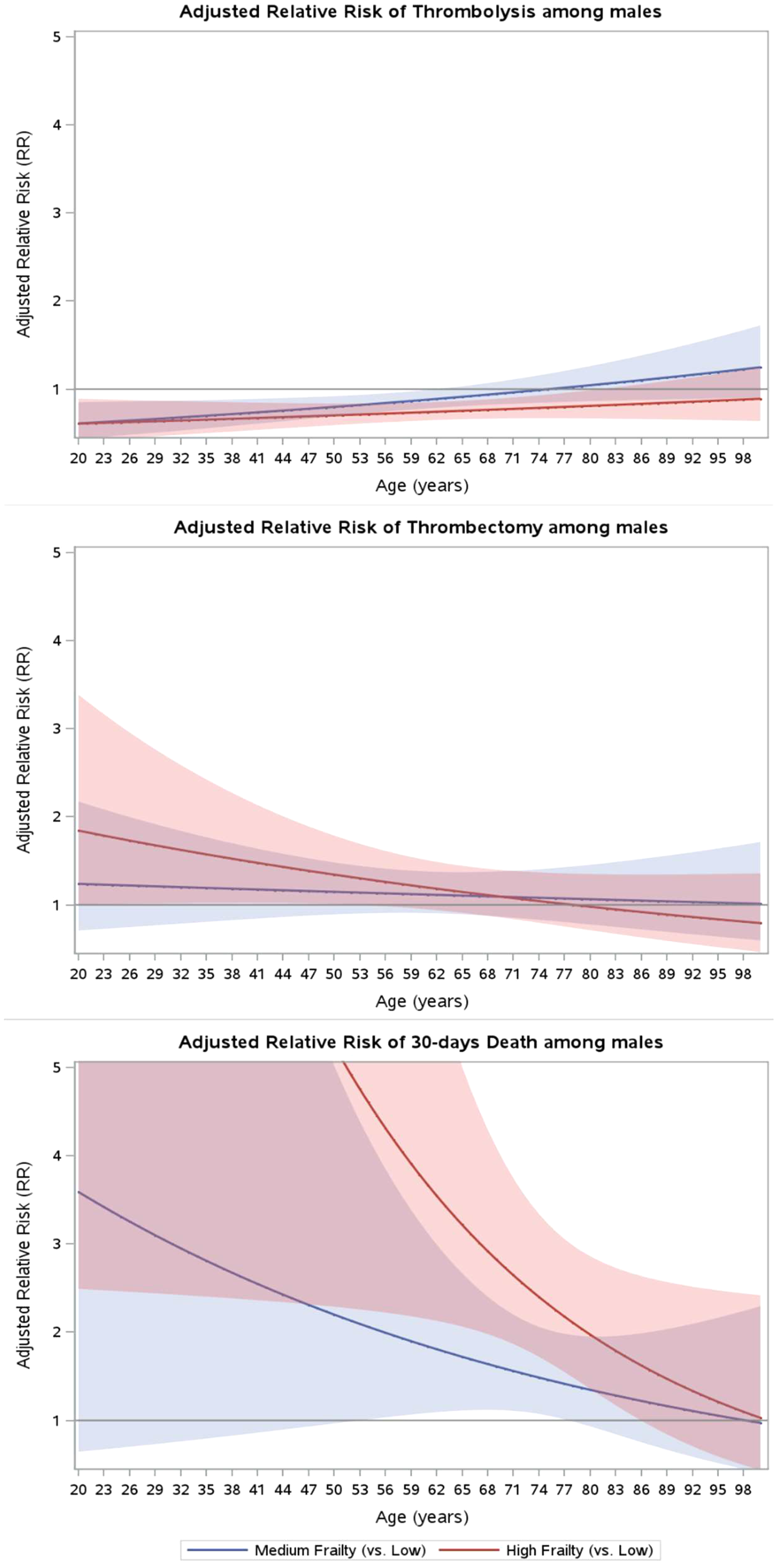
In total, 426 (20.2%) patients with low frailty, 5613 (16.4%) patients with medium frailty and 2820 (12.2%) with high frailty received thrombolysis. Among both females and males, older age (aRR for every 5-year increase in age in females = 0.98, 0.97–0.99 and males = 0.98, 0.97–0.99), and high frailty (aRR female = 0.66; 0.57–0.77 and male = 0.72; 0.63–0.82) were independently associated with a lower likelihood of thrombolysis (Tables 2 and 3). The interaction between age and frailty was not significant in females, but it was in males (P age*frailty, female = 0.53 and male = 0.03) (Figures 2 and 3), where, compared to low frailty, high frailty was associated with lower odds of thrombolysis at younger ages but higher odds at older ages (Figure 3). In total, 178 (8.4%) patients with low frailty, 2621 (7.7%) patients with medium frailty and 1655 (7.2%) with high frailty received thrombectomy. Older females and males were again less likely to receive thrombectomy (aRR for every 5-year increase in females = 0.91, 0.89–0.92 and males = 0.92, 0.91–0.93). Higher frailty was not associated with receiving thrombectomy in females (aRR high vs. low frailty = 0.87; 0.69–1.09) or males (aRR high vs. low frailty = 1.11; 0.88–1.39) (Tables 2 and 3). The effects of frailty varied with age in females (P age*frailty = 0.003) and males (P age*frailty = 0.04) (Table 3). For example, compared to those in the low frailty group, receipt of thrombectomy in females with high frailty declined with age (Figures 2 and 3).
Variation in the effect of frailty across different ages as it relates to thrombolysis, thrombectomy and 30-day mortality in females.
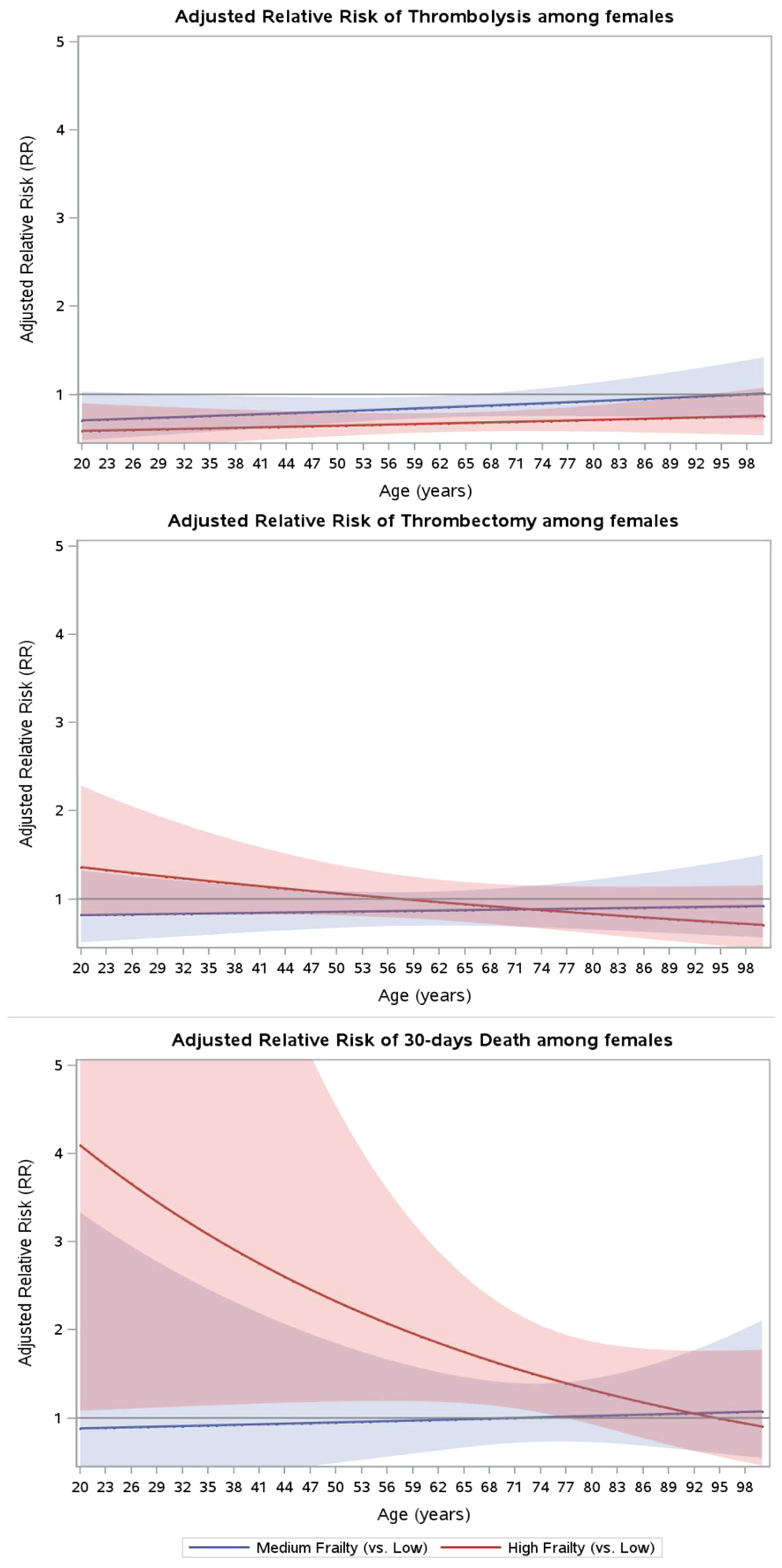
Figure 2. Long description
Panel A: A line graph shows the adjusted relative risk of thrombolysis among females. The x-axis represents age in years, ranging from 20 to 98. The y-axis represents the adjusted relative risk (RR), ranging from 0 to 5. Two lines are plotted: one for medium frailty (vs. low) in blue and another for high frailty (vs. low) in red. The blue line remains relatively stable around an RR of 1 across all ages. The red line also stays close to an RR of 1 but shows slight variations. Panel B: A line graph illustrates the adjusted relative risk of thrombectomy among females. The x-axis represents age in years, ranging from 20 to 98. The y-axis represents the adjusted relative risk (RR), ranging from 0 to 5. Two lines are plotted: one for medium frailty (vs. low) in blue and another for high frailty (vs. low) in red. The blue line starts above an RR of 1 and gradually decreases to around 1 as age increases. The red line starts above an RR of 2 and decreases to around 1 as age increases. Panel C: A line graph depicts the adjusted relative risk of 30-day death among females. The x-axis represents age in years, ranging from 20 to 98. The y-axis represents the adjusted relative risk (RR), ranging from 0 to 5. Two lines are plotted: one for medium frailty (vs. low) in blue and another for high frailty (vs. low) in red. The blue line remains relatively stable around an RR of 1 across all ages. The red line starts above an RR of 4 and decreases sharply to around 1 as age increases.
Variation in the effects of frailty across different ages as it relates to thrombolysis, thrombectomy and 30-day mortality in males.
Association between age and frailty on receipt of thrombolysis, thrombectomy and 30-day mortality in females

Table 2. Long description
The table presents data on the outcomes of thrombolysis, thrombectomy, and 30-day mortality based on age and hospital-based frailty levels. It has 3 rows and 4 columns. The columns are labeled as Outcomes of interest, Age (every 5-year increase), Hospital-based frailty (Low as reference category), and Interaction between age and frailty. The row labels are Thrombolysis, Thrombectomy, and 30-day mortality. Each cell contains specific values and confidence intervals. For thrombolysis, the age increase shows a value of 0.98 (0.97-0.99), medium frailty 0.86 (0.74-0.99), and high frailty 0.66 (0.57-0.77) with an interaction P value of 0.53. For thrombectomy, the age increase shows a value of 0.91 (0.89-0.92), medium frailty 0.90 (0.72-1.12), and high frailty 0.87 (0.69-1.09) with an interaction P value of 0.003. For 30-day mortality, the age increase shows a value of 1.13 (1.10-1.15), medium frailty 1.05 (0.78-1.42), and high frailty 1.12 (0.90-1.66) with an interaction P value of <0.001.
All models were adjusted for covariates (rural residence, material deprivation index, homeless status, immigration status, hypertension, diabetes, hyperlipidemia, atrial fibrillation and history of stroke or transient ischemic attack).
*In addition to the other covariates, this was additionally adjusted for receipt of stroke unit care and stroke severity.
Multivariable association between age, frailty and thrombolysis, thrombectomy and 30-day mortality in males

Table 3. Long description
The table presents the outcomes of thrombolysis, thrombectomy, and 30-day mortality based on age and hospital-based frailty in males. It has 3 rows and 4 columns. The columns are labeled as Outcomes of interest, Age (every 5-year increase), Hospital-based frailty (Low as reference category), and Interaction between age and frailty. The row labels are Thrombolysis, Thrombectomy, and 30-day mortality. Each cell contains specific values and confidence intervals. For thrombolysis, the values for age are 0.98 (0.97-0.99), for medium frailty are 0.89 (0.79-1.01), and for high frailty are 0.72 (0.63-0.82) with an interaction P value of 0.03. For thrombectomy, the values for age are 0.92 (0.91-0.93), for medium frailty are 1.13 (0.92-1.40), and for high frailty are 1.11 (0.88-1.39) with an interaction P value of 0.04. For 30-day mortality, the values for age are 1.18 (1.16-1.20), for medium frailty are 1.46 (1.07-1.99), and for high frailty are 2.09 (1.52-2.87) with an interaction P value of <0.001.
All models were adjusted for covariates.
*In addition to the other covariates, this was additionally adjusted for receipt of stroke unit care.
Frailty, age and 30-day mortality
The 30-day mortality increased with higher frailty: 74 (3.5%) in low frailty, 1832 (5.4%) in medium frailty and 2197 (9.5%) in high frailty. In both females and males, older age was associated with a higher risk of 30-day mortality (aRR for every 5-year increase in females = 1.13, 1.10–1.15 and males = 1.18, 1.16–1.20) (Tables 2 and 3). Compared to those with low frailty, high frailty was associated with 30-day mortality in males (aRR high frailty vs. low in males = 2.09; 1.52–2.87), but this was not true in females (aRR high frailty vs. low in females = 1.12; 0.90–1.66). The interaction between age and frailty was significant in both sexes: compared to low frailty, the effects of high frailty on 30-day mortality declined with age (Figures 2 and 3). In sensitivity analyses, adding receipt of thrombolysis and thrombectomy to regression models did not alter the observed associations between age and frailty and 30-day mortality in both sexes (data not shown).
Sensitivity analyses
When excluding people with frailty measured at the index hospitalization only (n = 6983), the estimates of associations between high frailty and thrombolysis and thrombectomy did not change for both females and males (e-Tables 2 and 3). When excluding people with atrial fibrillation, the association between high frailty and thrombolysis was observed; however, medium frailty was now associated with thrombolysis (female: 0.80; 0.69–0.93 and male: 0.88; 0.78–1.00).
Discussion
In a population-based cohort with acute ischemic stroke cared for in a health system with universal access, age and frailty were independently associated with receipt of acute reperfusion treatments in females and males. We observed variation in the effects of frailty across different ages on receipt of thrombectomy and 30-day mortality in both sexes, with frailty appearing to play a larger role in therapy decisions in younger patients.
The association between frailty and the receipt of thrombolysis or thrombectomy is seldom reported, and the definitions of frailty vary considerably. In a single-center study of 433 patients with ischemic stroke in the UK, compared to those who were not frail, those who were frail (Canadian Study of Health and Aging Clinical Frailty Scale score between 5 and 8) had lower rates of thrombolysis (18.1% vs. 11.5%, P = 0.05). Reference Evans, Wall and To28 In Shanghai, China, frail individuals (measured using the FRAIL scale Reference Pérez-Sáez, Dávalos-Yerovi and Redondo-Pachón29 ) were less likely to receive thrombolysis (5.8% vs. 1.1%) and thrombectomy (1.9% vs. 0.4%) than non-frail patients. We used a hospital-based frailty index and found that high frailty, but not medium frailty, was associated with a 20–30% lower risk of receiving thrombolysis in both females and males. In comparison, frailty was not associated with thrombectomy. The latter may be because of the overall low number of thrombectomies in our study, with a particularly low event rate in those with low frailty. Alternatively, this could be due to other unmeasured confounders that could determine treatment eligibility, for example, patients with low frailty may not have severe strokes, or those with high frailty cannot recognize symptoms and arrive on time or are more likely to be alone, and thus, consent for thrombectomy may not be possible. It is also important to note that our definition of frailty may inherently include conditions which could influence the thrombolysis decision (e.g., cancer). Taken together, frailty may play a role in determining candidacy, recommendations or willingness to accept thrombolysis; its importance for thrombectomy needs further evaluation, especially given the longer time windows for treatment and possibly perceived low-risk nature of the treatment, even in frail individuals. Pre-stroke modified Rankin score (mRS) is a functional outcome scale and may be poorly suited as a measure of baseline pre-stroke; however, it is commonly used in research studies. Reference Saposnik, Kapral and Liu30 Hence, despite evidence that pre-stroke mRS and frailty have a poor correlation in patients with acute stroke, mRS remains a determinant of treatment decisions. Reference Fearon, McArthur and Garrity31 Ideally, reperfusion treatments may be best determined by frailty, functional disability, stroke severity, presence of a large vessel occlusion, and the patient’s premorbid wishes, but not age alone. However, including these factors in acute treatment decisions can be challenging and may require the development of well-performing prediction models to determine variation in treatment effectiveness across all these factors.
Frail patients with ischemic stroke are at an increased risk of mortality, Reference Evans, Wall and To28 longer length of stay Reference Baker, Rubens and Appunni32 and poor treatment response following thrombectomy. Reference Tiainen, Martinez-Majander and Virtanen33–Reference Tan, Ho and Leow35 We found that high frailty was associated with a two-fold increase in the risk of 30-day mortality in males, whereas the confidence intervals included the null value in females. Further, adjusting for receipt of thrombolysis or thrombectomy did not alter the magnitude or direction of these sex differences. In one study of community-dwelling older adults in Taiwan, frailty (using the Fried frailty index) was associated with mortality in males but not females. Reference Lu, Chang and Chou36 In a study in Germany, frailty (estimated based on 32 deficit conditions) was associated with mortality in both male and female community-dwelling older adults. Reference Dallmeier, Braisch and Rapp37 Both these studies were in older adults and not patients with ischemic stroke. These observed sex differences in the association between frailty and stroke fatality in our study need to be replicated in other populations to further understand prognostic contributions of frailty.
Overall, the effects of frailty were pronounced at younger ages than at older ages. However, the confidence intervals were wide. One possibility is that frailty was defined using a deficit-based model compared to a phenotype-based frailty score. The latter uses weight loss, endurance, slowness or physical activity and may be more relevant when considering treatment decisions. Reference Dent, Kowal and Hoogendijk38 It is also possible that frailty may add little to clinical decision-making and mortality after a certain chronological age. Also, older age is strongly related to higher frailty, making the distribution of frailty groups skewed at older ages, that is, most older patients have moderate or high frailty and very few younger patients have high frailty. Finally, as we did not have information on treatment eligibility, the apparent effect of frailty on use of thrombectomy at younger ages could be due to differences in stroke severity, mechanism or time of presentation among young versus old patients.
Our observation that older age is associated with higher stroke mortality has been well described previously. However, previous research has shown significant benefit with thrombolysis or thrombectomy in the elderly (aged 80 years or over), Reference Bluhmki, Danays and Biegert39,Reference Chen, Jindal and Miller40 yet prior studies have often found that older patients with ischemic stroke are less likely to receive thrombolysis and thrombectomy. Reference Adcock, Schwamm and Smith7, Reference George, Asemota and Dorsey41–Reference Bray, Campbell and Hoffman43 One possibility is that older patients may be more likely to decline treatments for life-altering illnesses than younger patients. We also found a 2–3% decline in the receipt of thrombolysis and thrombectomy for every 5-year increase in age, suggesting that older age may be one of the most important determinants of acute reperfusion therapies in patients with ischemic stroke, irrespective of frailty. This finding is similar to the therapeutic inertia observed in the treatment of hypertension among elderly patients, regardless of frailty status. Reference Zheutlin, Addo and Jacobs44 However, unlike treatment of chronic conditions like hypertension and diabetes, thrombolysis and thrombectomy may be effective in all eligible patients with acute ischemic stroke, and this could vary based on a complex interplay between frailty and stroke severity. A greater understanding of these factors in treatment decisions can help standardize adequate use of reperfusion treatments for all.
Our study has limitations. We did not have information on stroke severity, presence of large vessel occlusion or arrival within treatment-eligible windows, so we could not determine the appropriateness of thrombolysis or thrombectomy in our study cohort. Our definition of frailty relied on information from previous interactions with the healthcare system and misclassification error may occur in those who are most marginalized, who have not used the healthcare system before their stroke hospitalization, as has been shown in chronic obstructive pulmonary disease. Reference Chin, Kendzerska and Inoue45 Only high frailty, and not medium frailty, was associated with reperfusion therapies and mortality, suggesting that the effect of frailty may be threshold-dependent. Further, unlike previous studies on frailty, Reference Burton, Stewart and Blair12 our definitions of frailty included a very low proportion of people with low frailty, which potentially created an exposure with skewed distribution. We used a composite score to define frailty and thus cannot determine the most important deficit categories associated with reperfusion treatments; for example, dementia may be more important than cancer, as it can influence obtaining consent. Finally, we cannot determine the pathways responsible for the observed treatment disparities in patients with high versus low frailty because we could not examine measures of access, such as proximity to hospitals offering these treatments or pre-hospital delays that affect treatment eligibility. It is also important to note that the patient’s frailty status may not be accessible to the treating physicians, limiting our ability to conclude how the availability of this information may influence treatment decisions.
Conclusions
Frailty in both males and females with ischemic stroke may be independently associated with a lower likelihood of receiving thrombolysis, but not thrombectomy, and a higher likelihood of death in 30 days, highlighting the importance of measuring and adjusting for frailty when assessing stroke care and outcomes. Healthcare providers should provide evidence-based care for all patients with acute ischemic stroke, and researchers should include frail patients in clinical trials to evaluate if frailty would influence the effect of reperfusion treatments. Future work should evaluate the effect of frailty on long-term mortality and functional outcomes of people with and without reperfusion treatments.
Supplementary material
The supplementary material for this article can be found at https://doi.org/10.1017/cjn.2026.10673.
Data availability statement
The use of data in this project was authorized under section 45 of Ontario’s Personal Health Information Protection Act, which does not require review by a research ethics board. Data sharing agreements prohibit ICES from making the dataset publicly available, but access may be granted to those who meet prespecified criteria for confidential access (available at www.ices.on.ca/DAS).
Acknowledgements
Parts of this material are based on data and/or information compiled and provided by the Ontario MOH, Canadian Institute for Health Information and Immigration, Refugees and Citizenship Canada, current to September 2020. However, the analyses, conclusions, opinions and statements expressed herein are solely those of the authors and do not reflect those of the funding or data sources; no endorsement is intended or should be inferred. This document used data adapted from the Statistics Canada Postal CodeOM Conversion File, which is based on data licensed from Canada Post Corporation, and/or adapted from the Ontario Ministry of Health Postal Code Conversion File, which contains data copied under license from ©Canada Post Corporation and Statistics Canada. We thank the Toronto Community Health Profiles Partnership for providing access to the Ontario Marginalization Index.
Author contributions
Conceptualization: MVV, MKK and NK; Analysis: MS, AC and JF; Interpretation: All authors; Writing – Original Draft: MVV; Writing – Review and Editing: All authors; Project administration: MVV; Funding acquisition: MKK and NK.
Funding statement
This study was supported by ICES, which is funded by an annual grant from the Ontario Ministry of Health. This project has received additional funding from and has been made possible by Brain Canada, with the financial support of Health Canada through the Canada Brain Research Fund and the Heart and Stroke Foundation of Canada.
Competing interests
Dr McAlister has received funding from CIHR and Alberta Innovates outside of the submitted work. Dr Khan has received funding from Brain Canada, Heart and Stroke Foundation of Canada, and Canadian Institutes for Health Research outside of submitted work. Dr Razak reports support as a Tier 2 Canada Research Chair in Data Informed Health Care Improvement from the Canadian Institute of Health Research. They have also received funding from government agencies and philanthropic donors, including the Ministry of Health in Ontario, Ontario Health, CIHR, University of Toronto, St Michael’s Hospital, PSI Foundation, New Frontiers in Research Fund, and Women’s College Hospital, outside of submitted work. Dr Hill reports grants from Covidien (Medtronic LLC), during the conduct of the study; personal fees from Sun Pharma, grants from Boehringer-Ingelheim, grants from NoNO Inc., grants from Medtronic LLC, grants from Biogen Inc., outside the submitted work; In addition, Dr Hill has a patent US Patent Office Number: 62/086,077 licensed to Circle Neurovascular Inc., and a patent US Patent Office Number: US 10,916,346 licensed to Circle Neurovascular Inc. and owns stock in Pure Web Incorporated, a company that makes, among other products, medical imaging software, is a director of the Canadian Federation of Neurological Sciences, a not-for-profit group, a director of the Canadian Stroke Consortium, a not-for-profit group, is a director of Circle NeuroVascular Inc., and has received grant support from Alberta Innovates Health Solutions, CIHR, Heart & Stroke Foundation of Canada, National Institutes of Neurological Disorders and Stroke. Dr Yu holds a Canada Research Chair (Tier 2) in Data-driven design of stroke systems and has received operating grants from the Ontario Ministry of Colleges and Universities’ Early Researcher Award program, Canadian Institutes of Health Research, Heart & Stroke, and the Brain Canada Foundation outside of the current study. Dr Ganesh reports institutional research funding from the CIHR, Alberta Innovates, Campus Alberta Neuroscience, Brain Canada, the Heart and Stroke Foundation of Canada, the MSI Foundation and the France-Canada Research Fund and personal honoraria from Alexion, Biogen, Servier Canada and Eli Lilly; advisory board participation with Eisai and Eli Lilly; and noncontrolling interests in SnapDx Inc. and Collavidence Inc.
Other disclosures
Drs Vyas and Ganesh hold a New Investigator Award from the Heart and Stroke Foundation of Canada. Dr Yu holds a Tier 2 Canada Research Chair in data-driven design of stroke systems. Dr Kaul holds a Canada Research Chair in Sex and Gender Differences and the Heart & Stroke Chair in Cardiovascular Research. Dr Kapral holds the Sir John and Lady Eaton Chair of Medicine in the Temerty Faculty of Medicine, University of Toronto. Dr Lee holds a Ted Rogers Chair in Heart Function Outcomes.







 Open access

