During the second half of the eighteenth century, solar microscopes were among some of the most popular instruments in the field of natural philosophy. This can be inferred both from accounts in printed sources and from the numbers of extant instruments in collections.Footnote 1 Solar microscopes were meant to project images of microscopic specimens, allowing these images to be shown to an audience. However, despite these devices' popularity, we have only a very meagre understanding of the peculiarities of these demonstrations. This is partly due to the limited sources. There are few descriptions of actual projections, some written by demonstrators and to be considered as advertisements. This also partly results from a more general problem. It turns out to be difficult, if not impossible, fully to verbalize practical experience, even if the task is itself attempted. Eighteenth-century authors had no intention of composing a complete report for the benefit of future generations. Consequently, in order to develop an understanding of the eighteenth-century popularity of solar microscopes, the analysis has to go beyond what is to be found in written sources. In so doing, I first discuss the solar microscope as a technical device and then describe experiences gained in using two original solar microscopes. These experiences offer an additional basis for an analysis of practice with the solar microscope and help provide another approach to the existing source material. I will develop a more complex description of the meaning of the solar microscope in the eighteenth century.
The instrument
Eighteenth-century encyclopedias report that ‘the ordinary solar microscope for transparent objects consists of a tube, a plain mirror, an illuminating lens and an ordinary Wilson microscope’.Footnote 2 Further discussion shows that the solar microscope is a projection microscope that uses sunlight as a light source and projects the images of the microscopic specimen onto a screen. It can thus be taken as a device that originated from the scioptic ball.Footnote 3 The development of the solar microscope is frequently attributed to the Berlin microscopist Johann Nathanael Lieberkühn, who is said to have shown a solar microscope in England in 1739. However, the device did not yet have a mirror. This component was reportedly added by the instrument-maker John Cuff.Footnote 4 According to other accounts the instrument had been developed by Daniel Fahrenheit, and Lieberkühn learnt of it when he visited him on his way to England.Footnote 5 The situation can probably best be summarized as follows. Lieberkühn was ‘responsible for the introduction of the solar microscope to England’Footnote 6 and ‘it was John Cuff's model of 1742 and Henry Baker's subsequent publications on the use of the microscope that marked the beginning of its regular production and use’.Footnote 7
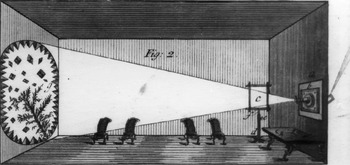
Descriptions of solar microscopes began to appear around 1740. The instrument achieved widespread popularity in the second half of the eighteenth century. Its working principle can be deduced from Figure 1. A mirror is used to reflect sunlight onto a condensing lens. The microscopic specimen is placed slightly in front of the focal point and is thus completely illuminated. A microscope is placed behind the specimen and produces an image of the specimen that can be seen on a projection screen (Figure 2). Solar microscopes must be used in a darkened room. As Henry Baker, one of the most influential mid-eighteenth-century promoters of microscopes, explicitly stated, ‘when this Microscope is employed, the room must be rendered as dark as possible: for on the Darkness of the Room, and the Brightness of the Sun-shine, depend the Sharpness and Perfection of your Image’.Footnote 8 As Figure 2 shows, the instrument was placed in the shutter of a window so that the mirror was outside the room and the microscope inside. During use of the microscope the mirror had to be readjusted continuously to compensate for the apparent solar motion. This could be done from inside the room.
Working principle of the solar microscope, in B. Martin, Philosophia Britannica: Neuer und faßlicher Lehrbegrif der Newtonschen Weltweisheit, Astronomie und Geographie, 3 Bände, übersetzt und mit Zusätzen von Christian Heinrich Wilke. Leipzig, 1772. © Deutsches Museum, Munich.

Using a solar microscope, originally coloured plate, in M. F. Ledermüller, Nachlese seiner mikroskopischen Gemüths- und Augen- Ergötzung, Nürnberg, 1762. © Deutsches Museum, Munich.

The image reproduced in Figure 2 is also remarkable with regard to the setting of the room. In addition to a table for various other objects such as slides, it shows several seats clearly meant for an audience that was to attend the projection. One reason for the solar microscope's popularity can be inferred from a remark made by the London instrument-maker Edward Nairne in a leaflet that accompanied one of the instruments he sold: ‘Of all Kinds of Microscopes the Solar may be justly reckoned the most entertaining’.Footnote 9 As we know from various studies, public demonstrations played an important role in natural philosophy during the second half of the eighteenth century.Footnote 10 Nairne's observation can be taken as an indication that the solar microscope was considered to be adequate for these entertaining demonstrations. Joseph Priestley's description of the microscope offers a more detailed explanation of this popularity:
The sun's rays being directed by the looking glass through the tube upon the object, the image or picture of the object is thrown distinctly and beautifully upon a screen of white paper, and may be magnified beyond the imagination of those who have not seen it.Footnote 11
Similar statements can be found repeatedly in eighteenth-century texts. The phrase ‘beyond the imagination of those who have not seen it’ is very characteristic.Footnote 12 One should, however, be cautious in taking these descriptions too literally. Several authors had vested economic interests in the success of the solar microscope, being either instrument-makers or demonstrators, while others simply copied claims from their publications. The need to be somewhat sceptical about these descriptions becomes evident when the status of the solar microscope in the nineteenth century is taken into consideration. In 1827 the British microscopist C. R. Goring published a characteristic and influential assessment of the images produced by solar microscopes:
The image of a common solar microscope may be considered as a mere shadow, fit only to amuse women and children … The utmost it can do is to give us the shadow of a flea, or a louse as big as a goose or a jackass … The swinish vulgar will always be gratified by such spectacles, because they have no idea that a microscope of any kind is to do more than exhibit objects very much dilated in point of bulk.Footnote 13
What is relevant to this discussion is not Goring's statement itself, but the fact that this judgement (and the associated judgement of other microscopes) has been accepted by many historians of microscopy, who tend to describe the solar microscope as a mere toy.Footnote 14 However, if the quality of the images were so weak, how could the great eighteenth-century popularity of solar microscope projections be plausibly explained? It is not only its popularity that raises such questions but also contemporary characterizations of the solar microscope's images as ‘distinctly and beautifully’ projected and ‘magnified beyond the imagination’, as Priestley put it. In several eighteenth-century publications on natural philosophy the solar microscope was ascribed the status of a philosophical instrument such as the common microscope or the telescope. It was not judged a toy. Moreover, in this respect the solar microscope was clearly to be distinguished from the magic lantern. There therefore seems to be a discrepancy between historians' descriptions and the eighteenth-century status of the device. This discrepancy has provided important motives for my research project.
Re-enacting observations with eighteenth-century solar microscopes
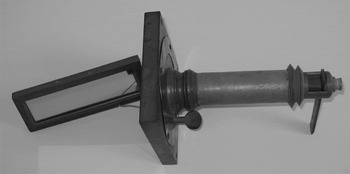
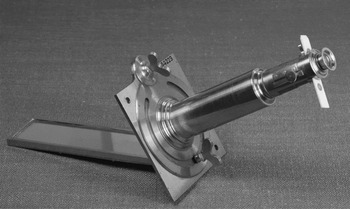
To develop an understanding of the visual culture connected with solar microscopic projections, I set out to re-enact practice with the solar microscope. This decision resulted from experiences gained during analysis of the experiments of Jean-Paul Marat using the replication method.Footnote 15 In that case it emerged that the visual impression of working with reconstructed apparatus played a crucial role in the analysis.Footnote 16 However, in the case of the solar microscopes it turned out to be unnecessary to reconstruct the instrument, since it became possible to work with original instruments. I had the opportunity to use eighteenth-century devices at the Deutsches Museum in Munich. Two of the instruments from the collection were suitable for my purpose, one made by the German military chaplain Junker (Figure 3),Footnote 17 the other by Dollond, one of the most prestigious London optical-instrument workshops (Figure 4). The optical parts of both instruments were in good condition, particularly after the instruments had left the restoration workshop.Footnote 18 The original slidersFootnote 19 with preparations, sold with the microscopes, still existed. I used a modern laboratory; all windows in the room were shuttered, except one in which a board was placed so that the solar microscope could be inserted.
Solar microscope by Junker.

Solar microscope by Dollond. © Deutsches Museum, Munich.

At the beginning of the experiment the instrument, minus the microscope, was placed in the shutter. It was thus possible to look through the tube onto the mirror and to begin adjusting it. In so doing, the mirror was moved until the light became too intense to allow direct observation of the mirror. Through this adjustment a spot of light appeared on the projection screen. Exact adjustment of the mirror was controlled by the light spot's shape. When the light spot became circular, this meant that the correct adjustment had been reached. The tube and the microscope were then added, a slider with specimens placed in the microscope and the image focused onto the screen.Footnote 20
At this point a revealing difficulty arises. It is impossible to give an adequate written account of the impressions the images made on the viewer. Moreover, neither printed pictures nor even projections of these pictures can be used to communicate the experience of the projected images, since they provide only meagre and unsatisfactory reproductions of what could be seen in the darkened chamber. This inadequacy results mainly from the brightness of the images in the darkened chamber. The intensity of focused sunlight is much greater than the artificial light sources currently used in projection devices. Moreover, the contrast between the darkened room and the brilliant luminous image on the screen has a direct impact on the visual impression. Due to these difficulties, I am in a situation rather like that of an eighteenth-century demonstrator who cannot communicate the result of his experiments adequately and must refer to honest witnesses who attended his demonstrations. One way of dealing with this difficulty would of course be to use a similar tactic and call upon respectable persons who can serve as eyewitnesses.Footnote 21 I have asked one of them to prepare an individual report on her experiences in the darkened chamber.Footnote 22 Although it is impossible to give an adequate account of what can be seen and experienced in the darkened chamber, it is still possible to use these experiences as a starting point for analysing the projections. Apart from this, I either conducted (audio-taped) individual interviews immediately before and after the demonstration or asked the viewers to answer a pre- and a post-demonstration questionnaire, a common technique in classroom evaluations.Footnote 23 The feedback obtained this way has helped me develop a broader basis for interpretation of the images and, in particular, the impression these images make on an audience. In this respect it was important for me that everyone pointed out their surprise at the images' brightness and quality – this was the case even for those colleagues who attended the presentation of my research project from the start.Footnote 24
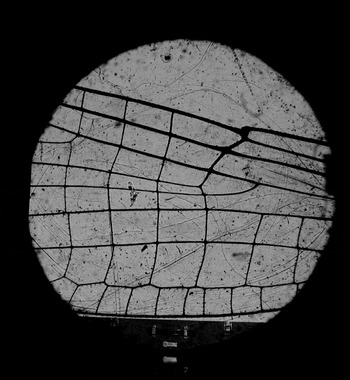
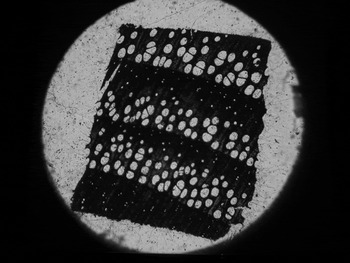
Thus when Dollond's solar microscope is used, the image on the screen might look like Figure 5 – an insect's wing.Footnote 25 There was in fact one slider with four different insect wings that could be clearly differentiated in the image, though they could not be attributed to specific insects. An image such as the one in Figure 6 is more problematic, however. Viewers unfamiliar with an image like this one would probably be unable to identify the respective object – a sectioned cut of wood. Despite obvious differences due to the specimens in the slider, there are also several similarities. One striking aspect of the image on the screen is the very sharp and clear boundary formed by the slider. In addition, the light intensity across the image is typically very consistent. Differences appear only if the mirror is not adjusted in time, a process that has to be repeated roughly every five minutes. As I learnt during work with the instrument, after some minutes a yellowish gleam appeared in one part of the image that became increasingly intense. This gleam resulted from reflection of the mirror's brass frame and served as an indication that adjustment was overdue. It is thus possible for a trained demonstrator to carry out these readjustments without attracting the attention of the audience.
Projection of an insect's wing with Dollond's solar microscope. The diameter of the light circle is (as in the following images) 1.60 metres, the exposure time was (as in the other pictures) 8 seconds.

Projection of a wood section with Dollond's solar microscope.

Using the Junker solar microscope was different in several respects. As the spot of light indicated, the quality of the optical components was not as good as in Dollond's apparatus. Whilst Dollond's instrument produced a consistently clear circle of light, the one created by Junker's device was uneven and streaky. This had consequences for the projected images, since the preparation in the slider was also not as well illuminated as it had been in Dollond's solar microscope. The image on the screen was not only streaky. It had no clear boundary and instead appeared to be simply fading towards the outside. Moreover, in some cases it became necessary to move the slider to see the entire specimen and thus to project the different parts of the specimen in a manner that can be best characterized as scanning. Apart from the differences in the images, Junker's instrument turned out to be less user-friendly than Dollond's. In the case of the latter device, the mirror was adjusted with toothed wheels and a worm gear. In Junker's instrument the mirror angle was changed by turning the tube and the inclination altered with a string that could be shortened or lengthened by winding a cord fixed to the mirror. Likewise, the focusing mechanisms differed significantly. In Dollond's instrument the microscope lens could be moved with a cograil, while in Junker's instrument the lens had a screw thread. The technical simplicity of the Junker instrument meant the user had to develop certain skills to project images of the specimens sold with the microscope. I had to learn how to readjust the mirror by turning the tube. Yet due to the different images it was hard to achieve this when the mirror was in the correct position, so it had to be moved back and forth. Moreover, as the tube as well as the peg suffered significant friction, it was not easy to move both in the necessarily delicate manner.
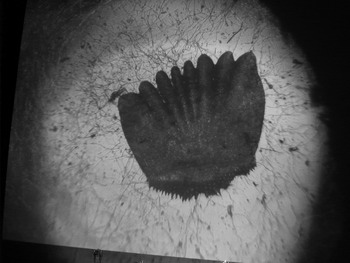
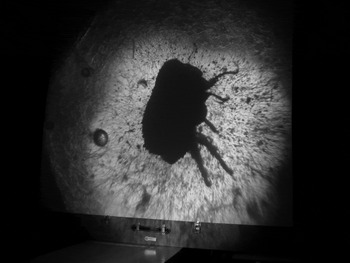
Remarkably, the samples are fairly similar to Dollond's. There are again, for example, an insect wing, in this case a gnat; a fish scale, from a perch (Figure 7); wood; and finally the flea (Figure 8). This specimen, like the louse also included among Junker's sliders, cannot be found among the ones that Dollond delivered with his instrument. However, some of his preparations were destroyed, even though the coverslip was still intact. Since the flea was one of the standard eighteenth-century specimens,Footnote 26 it seems likely that specimens such as the flea or louse might have been among the destroyed preparations. I have been rather vague about identifying the preparations used with the Dollond instrument but very specific with respect to the ones with Junker's: fortunately for my project, the list of identified specimens originally provided with Junker's instrument has survived.
Projection of a perch scale with Junker's solar microscope.

Projection of a flea prepared by Junker with Junker's solar microscope.

The role of the preparations
The images may give the impression that their quality is less satisfactory than might be desired. This is due in part to the fact that the reproductions in print are a poor representation of what could be seen in the original projection, but it also became clear during the image projections that the preparations were contaminated and that this had affected their optical appearance. In addition to the destruction of some of the Dollond preparations, others both from Dollond's and from Junker's instrument had been infested by mites or mould. For this reason it is questionable whether the images produced with these preparations were at all comparable to those projected in the eighteenth century. To test this, I made my own preparations. I used wooden sliders in which I placed a glass disc, onto which I placed the specimen. I then covered it with a second glass disc and fixed the latter with the help of a brass circlip. I was thus able to project several images including the wing of a gnat (Figure 9)Footnote 27 and a flea without these contaminations.
Projection of a gnat's wing (modern preparation) with Dollond's solar microscope.

Alongside my own attempts to make preparations I also asked a technician from the Ludwig-Maximilians-Universitaet Munich to make some preparations for my demonstrations. I asked her not to bleach or artificially colour the specimens. The result of her efforts can be seen from the image of a flea (Figure 10). The original image is very colourful. The flea shows an amber-like colour and some internal structures can even be distinguished. The difference in appearance between this image of a flea and mine is striking, particularly when both images are projected consecutively. The appearance of the image, it would seem, depended neither on the weather nor on the quality of the instrument but on the quality of the preparation. This is a result of different methods of preparation. While I simply placed the flea between two glass discs, the technician first dried her specimen with alcohol then embedded it in entellan. She made the preparation in the sense that she attempted to stabilize the object. The techniques she employed were, however, to the best of my knowledge not used in the eighteenth century.Footnote 28 Nevertheless, by using these preparations, it became evident that the quality of the projected images depends critically on the quality of the preparations. In this respect, the procedures used to make the preparations play a critical role, an aspect underestimated in the historiography of microscopy.Footnote 29
Projection of a flea (modern preparation with drying and embedding) with Dollond's solar microscope for an audience.

Analysing the experiences with the solar microscopes
In addition to the importance of preparation quality, one of the first findings in the darkened chamber was that the quality of the images was much better than expected. Even preparations over two centuries old provided images that were surprisingly bright, clear and well focused. Moreover, they were aesthetically appealing.Footnote 30 This is even more striking when one recalls Goring's statement quoted at the start of this paper: ‘The utmost it [the solar microscope] can do is to give us the shadow of a flea, or a louse as big as a goose or a jackass.’ The acceptance of such a statement by historians of science appears rather absurd when one is standing in front of the image of a flea some four meters long.
However, one should be careful in generalizing these experiences. Dollond's instrument was probably of the best quality available at the time. Junker's device was constructed for use in schools, therefore it is unsurprising that this instrument's projection quality is merely mediocre, although still better than I had expected on the basis of nineteenth-century accounts. However, the Magazin für das Neueste aus der Physik und Naturgeschichte published a description of Junker's instrument with the following verdict: ‘I have examined this solar microscope and found that both lenses not only permit a huge magnification but also a fair brightness and great distinctness; the preparations are very well chosen and nicely prepared.’Footnote 31 Since the quality of the images is praised, it seems likely that there were other solar microscopes that produced poorer images. This could be a possible explanation of some eighteenth-century complaints about these images' quality.Footnote 32
Part of my project included showing these projections to an audience. In so doing, other aspects became clear. The images stimulated audience discussion.Footnote 33 Although the images' aesthetic appearance could provide a partial explanation, another possibly relevant fact is that the image can be discussed directly and its details shown on the screen. It appears to be simple to verbalize the visual impression and to communicate it to other persons in the room. This aspect of the images produced with the solar microscope constitutes a major difference from images created with other eighteenth-century microscopes. The images could be viewed immediately without any preliminary training or experience. In contrast to traditional microscopes, the solar microscope produces a real image that can be projected on a screen instead of a virtual image produced by common microscopes. The production of the latter is partly dependent upon observers' visual skills. One has to learn how to produce a well-focused virtual image in the eye. The necessary process is completely different from the one in normal vision; consequently optical experience is required in order to use a microscope adequately.Footnote 34 With the solar microscope, in contrast, the image is a real image on a screen that can be seen like a painting on the wall. However, to make this more epistemologically precise, it would be better to say that one can look at the image with no previous experience. In what follows I use Ludwik Fleck's distinction between ‘seeing’ and ‘looking’.Footnote 35 In brief, ‘looking’ refers to the physical aspect of visual cognition, whereas ‘seeing’ also refers to the cognitive procedure of identifying an object represented by the image.
In order to see the image and identify the object in the slider, skills are necessary. Someone who has not seen the image of a fish scale prior to the projection will not recognize the image of the fish scale as such. They will, however, be able to look at the image and discuss with others in the room what they think they see. Moreover, when the list of specimens still exists, it is possible to use the solar microscope as a tool to develop the skills necessary to see the microscopic images without undergoing the trouble of learning how to look at them. This potential of the instrument accompanies its capacity to allow collective experiences. Alice Walters refers to this when she argues of microscopic practice in the second half of the eighteenth century that ‘social dangers handicapped other instruments. By their very nature, most common microscopes invited solitude, and so were easy to associate with impoliteness’.Footnote 36 Characterized thus, microscopes seem to embody a stereotype contrasted to polite science:
The most challenging obstacle to overcome in the effort to associate science with politeness was dispelling contemporary caricatures of those interested in natural philosophy as solitary, pedantic, asexual, melancholic bores, more comfortable with the microscopic creatures found in pond water than with the polite ladies and gentlemen of society. To counter this image, polite science explicitly associated the study of natural philosophy with conversation, the fundamental activity of polite society.Footnote 37
According to Walters, the solar microscope differed from these endangered devices: ‘Indeed, solar microscopes strongly encouraged common observation … The popularity of these instruments in the eighteenth century undoubtedly derived in large part from their ability to illuminate the religiously and aesthetically inspirational microscopic world in polite social settings.’Footnote 38 I am far from disagreeing with Walters's characterization, though I feel she puts too much weight on this aspect of the solar microscope's use. Other issues must also be taken into account to develop an understanding of the eighteenth-century success of solar microscopes. According to my analysis, significant aspects include the simplicity of looking at aesthetically appealing images and the instrument's potential to develop an understanding of how to see microscopic images.Footnote 39
Both these aspects can be related to functions ascribed to Robert Hooke's Micrographia. In particular, the images included in Hooke's monograph have been seen as relevant to training readers' visual abilities to let them carry out their own microscopic experiments.Footnote 40 The necessity of adequate microscopic seeing was seen as an important factor in eighteenth-century microscopy. As Jutta Schickore has observed, the ‘observer's mental activities were understood to be one major factor conditioning the outcome of microscopical investigations … If the observers exerted strict control over their mental operations, they could prevent erroneous results’.Footnote 41 With respect to the solar microscope, the collective visual examination of the microscopic image is particularly relevant since it lets the audience produce a consensus about the result. Here, not only the collective experience of a polite discussion encouraged by the images but also the possibility of developing shared knowledge about the microcosm made the solar microscope attractive. Indeed, some of the historical actors explicitly pointed out this educational potential:
Besides this particular Property it hath, that the Numbers of People may view an Object at the same Time, and may point to different Parts thereof, and by discoursing on what they see, may understand each other better, and more probably find out the Truth, than when they are obliged to look one after the other.Footnote 42
One quality of the solar microscope that the London instrument-maker George Adams emphasized here was the ability to discourse while using the device. This statement seems to confirm Alice Walters's interpretation. However, taking Jutta Schickore's argument into consideration, the image shifts. Discourse is a means by which people better understand each other; with such discourse, users of the solar microscope are more likely to find out the truth. Thus the instrument's central quality to which Adams refers lies in its potential to make possible collective development by the audience of (explicit) knowledge about the microcosm as well as (implicit) competences with respect to microscopic seeing. In this regard development or improvement of visual faculty seems to be a relevant issue in these discussions and thus played an important role in the design of experiments. Consequently, the importance of the solar microscope, key to understanding its eighteenth-century acceptance, lay in its being appropriate for the development of collective competence in seeing microscopic specimens, a competence that can be labelled ‘visual faculty’.Footnote 43 Taking into consideration the standards of eighteenth-century experimental practice, this aspect becomes an important feature in understanding the solar microscope's success. As science was then meant to be a collective project, enabling persons to develop competences could play a role in the status of a device. One could ascribe a didactic potential to the instrument that made it attractive to a scientific approach characteristic of the later eighteenth century.
On the other hand, the quality of the solar microscope can also provide insights into the later rejection of the device and its characterization as a mere toy. These characterizations are found in nineteenth-century texts. As my analysis shows, they cannot simply be accepted as adequate descriptions of the instrument, but must be interpreted as indications of changes in the criteria used to determine whether the solar microscope was an adequate microscope that could be used in a scientific context. For various reasons, science and scientific practice became more professional and elitist in the nineteenth century.Footnote 44 A part of this process was the definition of new standards of practice; one method of setting these standards lay in distancing them from, and discrediting, apparently inappropriate past practices. This interpretation allows a solution of the discrepancy between the characterization of the solar microscope in the eighteenth and in the nineteenth centuries. It also points to a weakness in the historiography of the microscope. There is a certain tendency to adopt the assessments of nineteenth-century microscopists and to describe the solar microscope as a mere toy. The following characterization can be seen as typical:
Capitalizing on the sun's rays, the solar microscope not only intensely illuminated lice and fleas but also thrust their magnified portraits onto a distant sheet for the amusement of the entranced spectators … Prior to the romantic era, chromatic aberration – due to bubbles trapped in the imperfect ground glass of slides – tended to deform figures and evocatively ring them with nebulous halos.Footnote 45
Some scholars even go so far as to find a rationalized justification for the description of the solar microscope as a toy: ‘The solar microscope cannot be considered for scientific research as it was afflicted with too many defects that reduce its resolution significantly below that of a simple microscope.’Footnote 46 This does not match the experiences I had in the darkened chamber using a solar microscope.
Perception with the solar microscope
In addition to the quality of the images and the ease of looking at them, yet another aspect is relevant for understanding the positive and sometimes even enthusiastic eighteenth-century accounts of solar microscopic projections. Again, this aspect can be seen as a significant contrast with the common microscope and its importance became evident during experimental work with the solar microscope. In order to discuss this point, I would like to add the category of ‘perceiving’ to Fleck's dual description of visual cognition under the terms of ‘looking’ and ‘seeing’.Footnote 47 With a common microscope the user is able to look into the microscopic world. This description was used by the historical actors. The Augsburg instrument-maker Georg Friedrich Brander, for example, asked, ‘What can be more pleasant and more appealing than when we, even without stepping out of our parlour, seemingly catch sight of a new world, or at least of completely new inhabitants, that were entirely unknown to us until now?’Footnote 48
However, an important point for my analysis is that the user is only able to look into the microscopic world with the help of the microscope. They remain physically in the macroscopic world. Consequently, it can be argued that the common microscope stands between the microscopic and the macroscopic world. It mediates between them and separates them at the same time.Footnote 49 This is not the case with the solar microscope; this device creates a new space in which the observer of the microscopic image is no longer looking into the microscopic world. Instead, the (image of the) microscopic object (the inhabitants of the new world, as Brander labelled them) enters the room. The audience can stand directly in front of the image (see Figure 10). Yet the difference is not limited to the perception of the microscopic world. The room in which the projection takes place is also no longer part of the macroscopic world. This becomes manifest when the room suddenly gets dark. The reason is obvious: a cloud has moved between the sun and the mirror. However, in the room it is not certain whether this is just a small cloud, so that observations will again be possible in a couple of seconds, or whether it is a larger cloud and one will have to wait several minutes, or whether the weather is changing completely as a thunderstorm approaches and the instrument will need to be taken back into the room before the rain starts. All one can do is stand in the dark and wait, or open the shutter to one of the windows. But, in doing so, the projection room is destroyed. Even if the cloud recedes, it is not possible to see the image. Only if the space is restored do the inhabitants of the microscopic world become visible again and only then can they be encountered by the audience.
This specific perception of the inhabitants of the microscopic world can also be seen in eighteenth-century accounts of demonstrations with a solar microscope. An anonymous account from 1781 can be read from this perspective:
To see this well-known little animal, I mean the flea, living at the size mentioned above, arouses no little pleasure, particularly for the fair sex. They laugh at the quaint shape in which it appears. They point a finger at it, and, when they exclaim sarcastically against this wretch, they taste the sweetness of revenge for the mischief it did to them. Now they finally see how terrible is their hereditary enemy whom they have long known.Footnote 50
From my point of view it is particularly remarkable that the audience addresses the flea explicitly as if they were in the same room, and, so I argue, in some sense they were.Footnote 51 While this encounter seems to have been entertaining for some human participants, others left a somewhat different impression. As Hermann von Pückler Muskau observed, after visiting a demonstration with the solar microscope,
What it shows is really enough to drive a man of lively imagination mad. Nothing can be more horrible, no more frightful devilish figures could possibly be invented, than the hideous disgusting water animalculae … which we daily swallow. They look like damned souls darting about their filthy pool with the rapidity of lightning, while every motion and gesture seemed to bespeak deadly hate, horrid torture, warfare and death.Footnote 52
In this case, it is my impression that it was not only the actual situation in the darkened room that turned out to be threatening, but also the thought that these beings seen moving on the screens were regularly ingested.Footnote 53 Nevertheless, in this description the animalculae seemed to address with their gestures the observer in the darkened chamber.
Dynamic projections
Pückler Muskau's report is also remarkable in that he describes an example in which the projected objects were not static specimens, but moving and dynamic. Dynamic projections could be realized either with living organisms or by demonstrating the crystallization of salts. The latter were characterized as ‘one of the pleasantest observations that can be made with a solar microscope’.Footnote 54 I also carried out some of these experiments with different salts. According to a description that Brander gave for the observation of crystallization with an ordinary microscope, one simply had to dissolve the salt in water and ‘to let one little drop fall onto the glass slider and to watch the shooting of the crystals as the aqueous liquid evaporates’.Footnote 55 The simplicity of this description made it appealing to transfer this procedure as well to the solar microscope: it worked.
There are at least two aspects that seem to be relevant when analysing the practices related to these projections. First, the preparations for these experiments could not be sold together with the microscope. Instead, they had to be made immediately before the projection. However, since various instrument-makers regularly included an empty slider, some cover slips and circlips in their set, they most probably expected that microscopists would make their own preparations, although not necessarily with specimens that could be used in dynamic projections. Another consideration concerns the meaning assigned to these projections. As Martin Frobenius Ledermüller pointed out, crystallization was seen as an example where ‘the most secret work of nature itself is placed before the eyes’.Footnote 56 Likewise, Coulembier stressed the necessity of observing the formation of crystals and not just the result, since in order ‘to be able to admire the precise image as well as the magnificence of the colours displayed during the crystals’ growth as well as the forms' regularity, one has to observe nature itself during their formation'.Footnote 57 Thus the solar microscope made it possible collectively to observe nature at work, something of particular importance in this context as each process is an individual event. The solar microscope made it possible to develop a collective visual faculty with respect to such processes.
Conclusion
It has become clear through working with the solar microscopes that these instruments can potentially create projections that are significantly better than nineteenth-century accounts would lead one to believe. The quality of the projected images is superior to what might be expected from these criticisms. Moreover, the experiences also shed new light on eighteenth-century accounts. Even though some of these descriptions seem somewhat hyperbolic in regard to claims about quality, modern visual prior experiences might differ significantly from eighteenth-century experiences. At the least, the eighteenth-century accounts cannot be disregarded as being pure advertisement and entirely fictitious. Yet the question of interpreting the discrepancy in the descriptions of the solar microscope between the eighteenth and nineteenth centuries remains. One aspect that may at least partly serve as an explanation is changes in standards of what was considered to be ‘scientific’. Whilst in the eighteenth century the solar microscope matched such criteria, it did not in the nineteenth. In this respect, the quality of the projected images is only one among several factors relevant for understanding these instruments' success in the eighteenth century. Others can be identified in the actual observational situation. Not only can the images be viewed and discussed in a group, they can be looked at without any prior experience of microscopic images. As a result, the images can serve as a medium to develop competences that are necessary in order to see microscopic images.
Seen in this way, the emphasis that historical accounts place on the usefulness of the solar microscope for dynamic specimens also becomes understandable. Here it is an individual process that has to be observed. If a second drop of solution is placed on the glass disc, the crystallization will look different in several details. The solar microscope enables a group jointly to watch this process. Consequently, they can exchange opinions on what they think they have seen and develop a common ‘true’ understanding of these observations. This strength of solar microscopes in the eighteenth-century context may have become a weakness in the nineteenth. Criteria for scientific practice and scientific instruments changed, while scientific activities became more exclusive and professionalized.Footnote 58 Thus the criticisms levelled against the solar microscope can be interpreted as an indication of the changing meaning of what was considered to be ‘scientific’. Beside these characteristics, one significant difference between solar and common microscopes can be identified with respect to perception. The creation of a specific space in which the observers from the macroscopic world could ‘meet’ the inhabitants of the microcosm makes the solar microscope unique. Apart from these findings, which help develop an understanding of the meaning solar microscopes and their projections had in the eighteenth century, it has also become clear not only that image quality relies on the quality of the optical parts of the instrument, but that the preparations and the manner in which they were actually made play a significant role. This case study can be seen as motivating a deeper analysis of preparations and preparation techniques.
This case study also strengthens a general conclusion that goes well beyond the topic of microscopy. In order to analyse the visual culture of solar microscopic projections, it is not sufficient simply to look at residual material traces such as books, images or instruments in showcases. Instead, a more thorough approach to the analysis of this visual culture becomes possible by using these devices as well. It thus becomes possible to develop a better understanding of what solar microscopes may have meant in the Enlightenment.