INTRODUCTION
The intertidal zone of rocky shores is a dynamic environment important for conservation issues (e.g. Thompson et al., Reference Thompson, Crowe and Hawkins2002; Ellis, Reference Ellis2003) where the diversity and abundance of organisms are a result of biological and physical processes (see reviews by Menge, Reference Menge2000; Underwood, Reference Underwood2000; Benedetti-Cecchi, Reference Benedetti-Cecchi2006; Jenkins et al., Reference Jenkins, Moore, Burrows, Garbary, Hawkins, Ingolfsson, Sebens, Snelgrove, Wethey and Woodin2008). In this environment, top-down control by sedentary consumers plays an important role on populations of prey, since the grazing activity of limpets and sea urchins influence the abundance and distribution of microalgae and macroalgae (e.g. Andrew, Reference Andrew1993; Benedetti-Cecchi et al., Reference Benedetti-Cecchi, Bulleri, Acunto and Cinelli2001; Jenkins et al., Reference Jenkins, Arenas, Arrontes, Bussell, Castro, Coleman, Hawkins, Kay, Martinez, Oliveros, Roberts, Sousa, Thompson and Hartnoll2001, Reference Jenkins, Coleman, Della Santina, Hawkins, Burrows and Hartnoll2005; Coleman et al., Reference Coleman, Underwood, Benedetti-Cecchi, Aberg, Arenas, Arrontes, Castro, Hartnoll, Jenkins, Paula, Della Santina and Hawkins2006; Scheibling et al., Reference Scheibling, Kelly and Raymond2009), while whelks and sea stars negatively impact populations of sessile invertebrates (e.g. Paine, Reference Paine1971; Fairweather & Underwood, Reference Fairweather and Underwood1991; Navarrete, Reference Navarrete1996; Navarrete & Menge, Reference Navarrete and Menge1996). As abundance and distribution of those consumers on shores can be altered by their coexistence and resource partitioning (e.g. Bulleri et al., Reference Bulleri, Benedetti-Cecchi and Cinelli1999; Arrontes et al., Reference Arrontes, Arenas, Fernandez, Rico, Oliveros, Martinez, Viejo and Alvarez2004; Firth & Crowe, Reference Firth and Crowe2008; Scheibling et al., Reference Scheibling, Kelly and Raymond2009) information about spatial and temporal coexistence of consumers is important to understand their influence on ecosystem functioning through impact on populations of prey.
In addition to top-down control, wave exposure also influences abundance and distribution of prey, both algae and filter-feeding animals. Wave action directly affects the abundance of filter-feeding animals due to the positive influence of flow rate on feeding and settlement rates, and mitigation of desiccation stress (e.g. Leonard et al., Reference Leonard, Levine, Schmidt and Bertness1998, Reference Leonard, Ewanchuk and Bertness1999). Also, waves indirectly affect populations of prey by controlling the distribution of sedentary consumers. Higher hydrodynamic action decreases emersion stress but increases dislodgement risk of animals due to wave impact, consequently, density and aggregation of consumers are increased near crevices where foraging pressure is particularly high (e.g. Kensler, Reference Kensler1967; Johnson et al., Reference Johnson, Hughes, Burrows and Hawkins1998; Rilov et al., Reference Rilov, Gasith and Benayahu2005; Stafford & Davies, Reference Stafford and Davies2005; Jonsson et al., Reference Jonsson, Granhag, Moschella, Aberg, Hawkins and Thompson2006; Stafford et al., Reference Stafford, Davies and Williams2007). Therefore, diversity, distribution, competition and abundance of both algae and animals on intertidal rocky shores are driven by the interplay between physical factors and consumer stresses.
Although literature to date from much of the world shows the composition and ecological processes on intertidal rocky shores (see reviews by Menge, Reference Menge2000; Jenkins et al., Reference Jenkins, Moore, Burrows, Garbary, Hawkins, Ingolfsson, Sebens, Snelgrove, Wethey and Woodin2008), there are only a few studies on the ecological processes in this ecosystem on the south-west Atlantic coast (e.g. Sauer Machado et al., Reference Sauer Machado, Chapman and Coutinho1996) and, to our knowledge, there is no published data comparing composition of intertidal communities in the gradient of wave exposure. Here, we aim to describe the diversity and the spatio-temporal variation patterns of abundance of sedentary consumers and the main functional groups of sessile organisms in intertidal zones exposed to different degrees of wave exposure along a subtropical coastline of Brazil.
MATERIALS AND METHODS
This study was carried out on six rocky shores in the Ubatuba region, located on the north coast of São Paulo State, south-east Brazil (23°25′–33′S 45°02′–13′W). Shores were classified in moderately exposed (Matarazzo, Praia Grande and Brava da Fortaleza) and sheltered (Itaguá, Enseada and Maranduba) in function of wave impact (see Bueno & Flores, Reference Bueno and Flores2010). Field locations were visited monthly from October 2006 to September 2007, but occasional rough weather prevented us from actually sampling at a constant interval of 30 days. Although fieldwork was resumed as soon as weather conditions allowed us, monthly comparisons proved to be difficult and so data were pooled by seasons (‘spring’: from October to December; ‘summer’: from January to March; ‘autumn’: from April to June; ‘winter’: from July to September). We surveyed during low tides, from the lower limit of the sublittoral fringe, just above the Sargassum spp. cover, to the upper limit of the low midlittoral, below the zone of prevailing cover of the barnacle Chthamalus bisinuatus Pilsbry, 1916. On each level (sublittoral fringe and low midlittoral), and during each of the field visits, the abundance of sessile and sedentary organisms was estimated as a percentage of cover in 10 randomly allocated replicate quadrats (0.5 × 0.5 m; with 100 intersection points) along a 300-m stretch on each shore.
Firstly, all sedentary consumers that could be visualized inside the quadrat, without removing the secondary substrate, were identified and counted. Limpets were not classified by species but as a ‘main group’ due to their small size and, occasionally, high abundance. In this latter case, they were sub-sampled and counted in 10 random smaller quadrats (5×5 cm) inside the larger sampling unit. The percentage cover of sessile organisms was estimated by counting intersection points falling in each group. Due to the very high diversity found in subtropical areas, we focused on functional groups rather than species based on four categories: (1) ‘bare rock’ when no macro-organisms could be visualized; (2) ‘crustose algae’; (3) ‘upright macroalgae’ including turfs, foliaceous, erect calcareous, and filamentous algae; and (4) filter-feeding animals, including barnacles (Tetraclita stalactifera (Lamarck, 1818) and C. bisinuatus), mussels (Perna perna (Linnaeus, 1758), Isognomon bicolor (C.B. Adams, 1845) and Brachidontes spp.), vermetids and colonial polychaetes (Phragmatopoma spp.).
The spatial and temporal variation in abundance of sedentary consumers and sessile groups were evaluated using a specific model of analysis of variance (ANOVA) for each group separately. For sedentary consumers, only the most important groups (>150 animals observed in the total sum) had their vertical and seasonal distribution evaluated. The percentage cover of the above-mentioned groups of sessile organisms and the density of limpets and the whelk Stramonita haemastoma (Linnaeus, 1767) were evaluated using an ANOVA model with four factors; ‘exposure’ (fixed, 2 levels), ‘shore’ (random, nested within exposure, with 3 levels), ‘shore level’ (fixed, 2 levels) and ‘season’ (fixed, 4 levels). For sea urchins ‘shore-level' was removed from the analysis because they were not found in the low midlittoral level. The Cochran's procedure was used to test homoscedasticity and transformations were applied when needed. In cases when variances remained heterogeneous after transformation, the same procedure was still performed using raw data, since ANOVA is robust when large balanced designs are analysed (Underwood, Reference Underwood1997). When necessary, a post-hoc Student–Newman–Keuls (SNK) test was applied for multiple comparisons of means.
RESULTS
Sedentary consumers
The most abundant sedentary consumers found were limpets (Fissurela sp. and Colisella sp.; 77,680 individuals), the whelk Stramonita haemastoma (798 individuals), and the black sea urchin Echinometra lucunter (Linnaeus, 1758) (190 individuals). Other gastropods such as Cerithium atratum (Born, 1778) (11 individuals at Enseada and 2 at Itaguá), Morula nodulosa (C.B. Adams, 1845) (10 individuals at Enseada), Tegula viridula (Gmelin, 1791) (6 individuals at Enseada), and Leucozonia nassa (Gmelin, 1791) (1 individual at Enseada), were rarely found on sheltered shores and never observed on exposed shores.
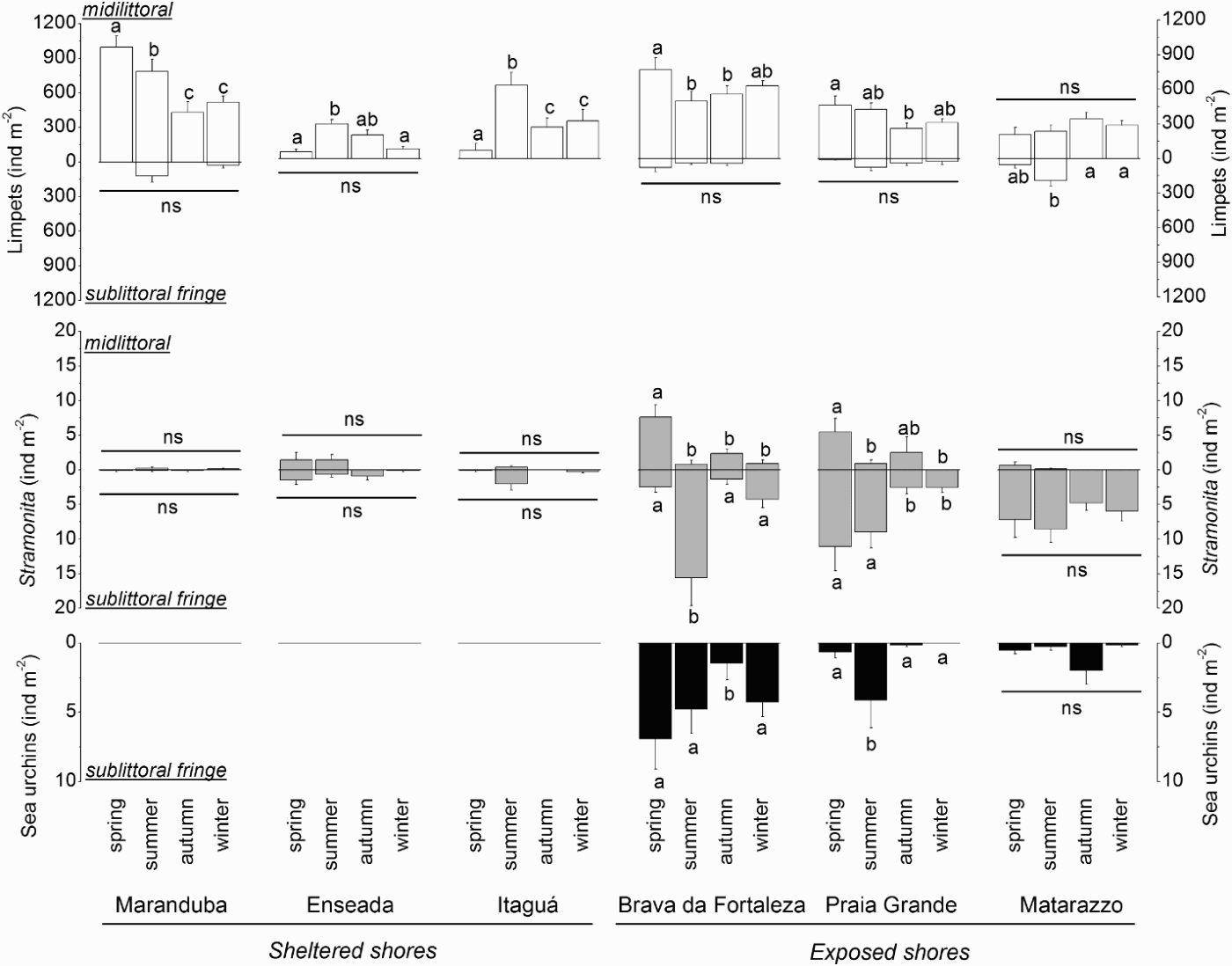
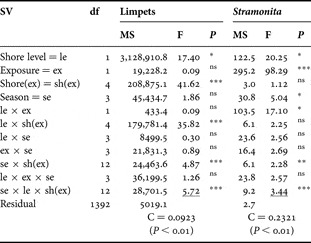
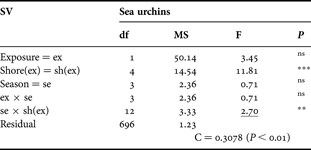
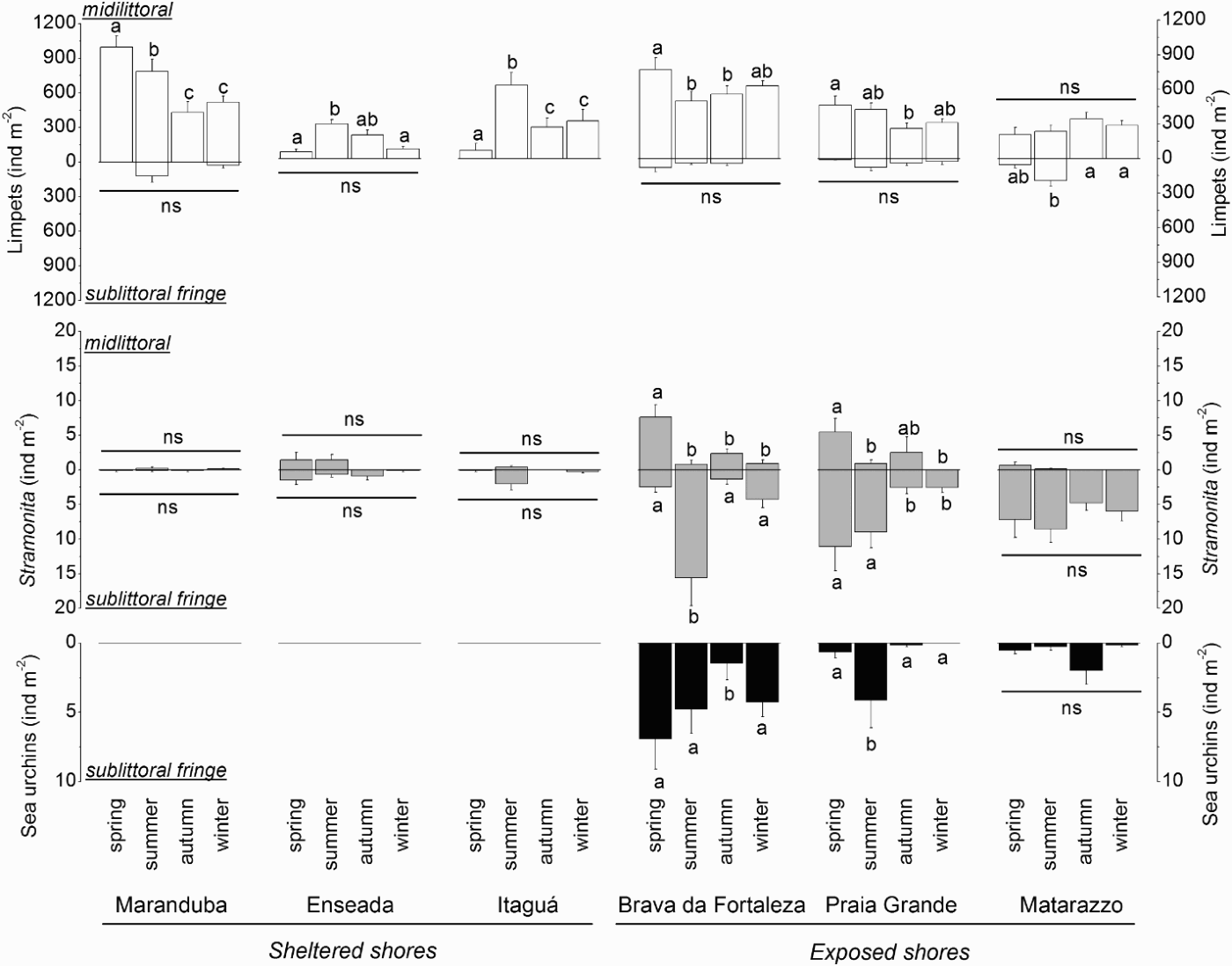
Sedentary consumers were generally more abundant in exposed than sheltered areas (Figure 1), but variation did occur among shores without consistency of the ‘exposure’ factor (Tables 1 & 2). The abundance of limpets varied considerably, mainly in sheltered areas where we observed the highest (360.1 ± 509.4 ind m−2 at Maranduba) and the lowest (80.6 ± 167.1 ind m−2 at Enseada) overall mean among all shores. The density of the whelk S. haemastoma was consistently higher on exposed (from 3.4 ± 7.8 ind m−2 at Matarazzo to 4.4 ± 10.3 ind m−2 at Brava da Fortaleza) than sheltered shores (from 0.1 ± 0.6 ind m−2 at Maranduba to 0.8 ± 3.1 ind m−2 at Enseada), and sea urchins were only found in the sublittoral fringe of exposed areas (from 0.7 ± 2.9 ind m−2 at Matarazzo to 4.4 ± 9.0 ind m−2 at Brava da Fortaleza) (Figure 1).
Seasonal variability of density (mean ± SE, ind m−2) of limpets, the whelk Stramonita haemastoma and sea urchins on the sublittoral fringe and low midlittoral of shores of different wave exposure. For each animal group, distinct letters in same shore level within each shore identify significantly seasonal changes, and absence of letters indentify that animals were not found in that shore level.
Analysis of variance of density of limpets and the whelk Stramonita haemastoma in relation to shore level (sublittoral fringe and low midlittoral) and seasons in shores of different wave exposure (sheltered and moderately exposed) in the subtropical area of Brazil. Results of the Student–Newman–Keuls test for the significant factor (underlined) are presented in Figure 1.

ns, not significant; *P < 0.05; **P < 0.01; ***P < 0.001.
Analysis of variance of density of sea urchins in the sublittoral fringe in relation to seasons in shores of different wave exposure (sheltered and moderately exposed) in the subtropical area of Brazil. Results of the Student–Newman–Keuls test for the significant factor (underlined) are presented in Figure 1.
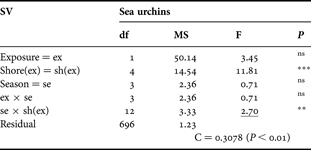
ns, not significant; **P < 0.01; ***P < 0.001.
All these groups showed a clear vertical zonation (Figure 1). Limpets were abundant on the low midlittoral and rarely found on the sublittoral fringe. In contrast, Stramonita was more abundant on the sublittoral fringe and sea urchins were found only on this level at the exposed shores (Figure 1). In addition, density of consumers tended to be higher in warmer (spring and/or summer) than in colder seasons (autumn and/or winter) (e.g. limpets on low midlittoral and S. haemastoma and sea urchins on the sublittoral fringe of exposed shores) (Figure 1). Only at Matarazzo were there no seasonal changes in the abundance of groups, with the exception of an increase in density of limpets on the sublittoral fringe during summer compared to autumn and winter (Figure 1).
Sessile organisms
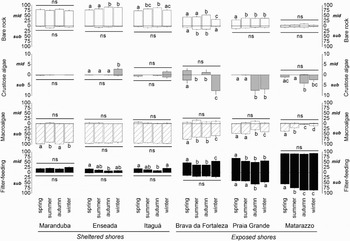
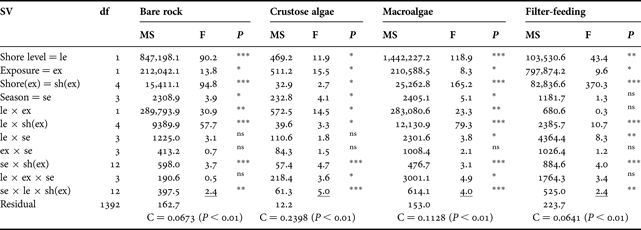
Although the cover of sessile organisms varied across shores (Table 3), clear trends in relation to wave exposure and shore level were observed (Figure 2). Sheltered areas presented a similar pattern among them while a higher variability was observed among the exposed shores (Figure 2). At sheltered shores the low midlittoral was represented by a bare rock surface with a low percentage cover (< 25%) of filter feeding animals (Figure 2). On the other hand, the low midlittoral of exposed shores presented a higher abundance of filter-feeding invertebrates (Figure 2) corresponding to the main cover at the Matarazzo shore. In all shores, macroalgae and crustose algae were rarely found on the low midlittoral (Figure 2). In contrast, the macroalgae was the dominant cover on the sublittoral fringe of sheltered shores where bare rock, crustose algae and filter-feeding animals were rarely found (Figure 2). The cover of macroalgae was lower at exposed areas where filter-feeding animals were found in higher abundance and bare rock and crustose algae were occasionally found on the sublittoral fringe (Figure 2). There was no consistent pattern of seasonal variability of intertidal cover, although, there was a trend of higher abundance of crustose algae during the coldest seasons (Figure 2).
Seasonal variability of density (mean ± SE, ind m−2) of the bare rock and functional group on the sublittoral fringe (sub) and low midlittoral (mid) of shores of different wave exposure. For each animal group, distinct letters in same shore level within each shore identify significantly seasonal changes, and absence of letters indentify that organisms were not found in that shore level.

Analysis of variance of percentage of cover of the functional groups of sessile organism and bare rock in relation to shore level (sublittoral fringe and low midlittoral) and seasons in shores of different wave exposure (sheltered and moderately exposed) in the subtropical area of Brazil. Results of the Student–Newman–Keuls test for the significant factor (underlined) are presented in Figure 2.
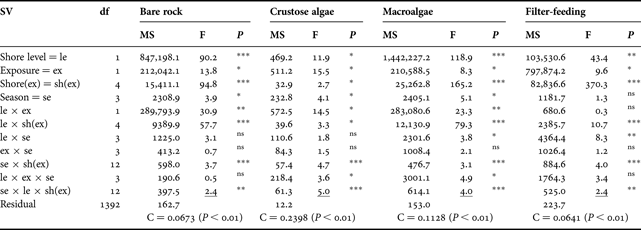
ns, not significant; *P < 0.05; **P < 0.01; ***P < 0.001.
DISCUSSION
Our results show clear patterns of abundance and distribution of sedentary consumers and sessile prey over both vertical (shore level) and horizontal (shore exposure) scales along a subtropical coastline in Brazil. These results are based on observational data and are apparently related to well-known processes ruling community dynamics in other regions. Therefore, this information may be used as a standpoint for further experimental research and as a guide to initial conservation programmes in a region where rocky shore communities are still not properly described.
The differences observed in zonation and abundance of organisms between exposed and sheltered shores are probably a result of competition among basal organisms and changes in the relative importance of bottom-up and top-down processes, as reported for other areas (Menge & Lubchenco, Reference Menge and Lubchenco1981; Leonard et al., Reference Leonard, Levine, Schmidt and Bertness1998, Reference Leonard, Ewanchuk and Bertness1999; Bertness et al., Reference Bertness, Crain, Silliman, Bazterrica, Reyna, Hildago and Farina2006). In this study we show a clear difference in the abundance of sessile organisms in relation to wave exposure. On the sheltered shores, the lower level is dominated by macroalgae and the bare rock makes much of the space in the midlittoral. In contrast, filter-feeding animals were more abundant on both levels of exposed areas covering up to 90% of the available space at Matarazzo. These patterns are consistent with processes verified in temperate regions. Higher flow rates, often verified at exposed sites, are responsible for increased delivery of food resources and larval supply (both considered bottom-up drivers), allowing a higher abundance of filter-feeding organisms (e.g. Leonard et al., Reference Leonard, Levine, Schmidt and Bertness1998). Because filter-feeding invertebrates are dominant competitors by space (e.g. Menge et al., Reference Menge, Lubchenco, Ashkenas and Ramsey1986a, Reference Menge, Lubchenco, Gaines and Ashkenasb; Bell, Reference Bell2008) they decrease the abundance of macroalgae in exposed shores, as clearly observed in Figure 2. In addition, the crab Pachygrapsus transversus presents a strong top-down control in sheltered shores decreasing the abundance of filter-feeding animals (Christofoletti et al., in press).
The vertical distribution patterns of sessile organisms are most likely due to the effect of physical stresses. The low cover of macroalgae and filter-feeding animals at the midlittoral zone seems to be a result of desiccation stress, which is higher in sheltered than exposed shores (e.g. Leonard et al., Reference Leonard, Levine, Schmidt and Bertness1998; Bertness et al., Reference Bertness, Crain, Silliman, Bazterrica, Reyna, Hildago and Farina2006). In our study area, grazing pressure could also explain these zonation patterns, because limpets were found in higher densities at the midlittoral level of all these shores (Figure 1), and they can play an important role controlling populations of macroalgae and sessile invertebrates through their foraging activity (e.g. Benedetti-Cecchi et al., Reference Benedetti-Cecchi, Bulleri and Cinelli2000; Boaventura et al., Reference Boaventura, Alexander, Della Santina, Smith, Re, da Fonseca and Hawkins2002; Jenkins et al., Reference Jenkins, Coleman, Della Santina, Hawkins, Burrows and Hartnoll2005; Coleman et al., Reference Coleman, Underwood, Benedetti-Cecchi, Aberg, Arenas, Arrontes, Castro, Hartnoll, Jenkins, Paula, Della Santina and Hawkins2006). Therefore, based on the importance of the macroalgal cover on ecosystem functioning (Arenas et al., Reference Arenas, Sanchez, Hawkins and Jenkins2006, Reference Arenas, Rey and Pinto2009) and the patterns of abundance and distribution observed herein, the role of sedentary consumers in our study system has to be evaluated in detail to better assess their influence on community dynamics.
Although sea urchins are predominantly sublittoral animals, their presence on the intertidal level of exposed shores is probably allowed due to the lessened desiccation stress provided by wave action, and also, migration to feeding activities as shown by Agatsuma et al. (Reference Agatsuma, Yamada and Taniguchi2006). In addition to such influence, the higher abundance of Stramonita on exposed areas seems to be also influenced by prey availability, as observed elsewhere (e.g. Ota & Tokeshi, Reference Ota and Tokeshi2000; Rilov et al., Reference Rilov, Benayahu and Gasith2001, Reference Rilov, Gasith and Benayahu2002; Ramírez et al., Reference Ramírez, Tuya and Haroun2009). The distribution patterns of sedentary consumers at the studied shores appear to be an effect of bottom-up processes. The lower abundance and diversity of filter-feeding animals at the sublittoral fringe may impose a critical limitation of prey availability for whelks. At exposed areas, however, the abundance of mussels and barnacles is still high and whelks may not be under limitation of food resources. Therefore, the high abundance of Stramonita haemastoma at the sublittoral fringe of exposed shores is most likely to be a combined result of prey availability and reduced desiccation stress.
In summary, the spatial distribution of sessile organisms and sedentary consumers in the study area suggests both physical and biological control of community dynamics. Their abundance varies according to wave exposure gradient. Sheltered shores are dominated by primary producers, while filter-feeding animals prevail in more exposed areas, probably because they overcompete with macroalgae. The high abundance of sessile invertebrates in exposed areas seems to be the main factor increasing the abundance of predators at the sublittoral fringe. In addition, wave action allows the presence of sea urchins at this zone, increasing grazing pressure. Limpets were much less abundant at the sublittoral fringe, where their effect on macroalgal cover seems to be negligible.
ACKNOWLEDGEMENTS
The authors thank all the volunteers who helped in the fieldwork especially R. Ota and V. Murakami for their valuable support. We are also grateful to Dr H.G. Choi for his comments on an early version of the manuscript. Financial support was provided by FAPESP to R.A.C. (#2006/00559-4 and #2006/60237-0) and D.N.O. (#2007/58436-8).