In early 2016, the Prime Minister of Australia's report card on Closing the Gap in Aboriginal and Torres Strait Islander or Indigenous disadvantage found little improvement in life expectancy: Indigenous Australians were dying at least 10 years earlier than their non-Indigenous counterparts (Department of Prime Minister, 2016). The reasons for this are complex. Higher morbidity and mortality rates persist in this population group in cardiovascular disease (Katzenellenbogen et al., Reference Katzenellenbogen, Sanfilippo, Hobbs, Briffa, Ridout, Knuiman and Thompson2010; Katzenellenbogen et al., Reference Katzenellenbogen, Sanfilippo, Hobbs, Briffa, Ridout, Knuiman and Thompson2012), renal disease (Maple-Brown, Reference Maple-Brown2011), and while Aboriginal and Torres Strait Islander cancer rates are lower, incidence of cancers with poorer prognosis is higher (Condon et al., Reference Condon, Garvey, Whop, Valery, Thomas, Gruen and Cunningham2013). In addition, the ongoing negative effects of colonisation and dispossession of Aboriginal and Torres Strait Islander peoples from their land, culture and language continue to negatively impact on their health along with discriminatory practices across sectors including housing, education, criminal justice, employment (DOHA, 2012) and health services (Henry, Houston, & Mooney, Reference Henry, Houston and Mooney2004; Johnstone & Kanitsaki, Reference Johnstone and Kanitsaki2009). The Australian Health Ministers’ Advisory Council's Cultural Respect Framework identified barriers in Australia to Indigenous Australians accessing healthcare that include:
. . .health service provider attitudes and practice, communication issues, mistrust of the system, poor cultural understanding and racism. (AHMAC, 2004, p. 6)
While increasing the number of Aboriginal and Torres Strait Islander staff working at a health service improves Indigenous Australians’ access to, and experience of healthcare (Taylor et al., Reference Taylor, Thompson, Smith, Dimer, Ali and Wood2009), the responsibility for reducing disparities and improving Indigenous health outcomes rests with all Australians (Durey et al.; Reference Durey, Wynaden, Thompson, Davidson, Bessarab and Katzenellenbogen2012). This includes building the capacity of tertiary health science students to deliver care respectful of cultural differences to Indigenous Australians. For this to occur, tertiary educators require support to effectively prepare students in this context.
This paper presents ‘Working Together’, an intercultural academic leadership programme designed and delivered within Curtin University's health science faculty in 2011. Its aim was to support educators teaching a compulsory first year Aboriginal and Torres Strait Islander culture and health unit to over two thousand interdisciplinary health science students to build their capacity to deliver culturally safe care. The paper presents the background and theoretical framework informing the Working Together programme and preliminary evaluation findings.
Context and Theoretical Framework
Following the colonisation of Australia by the British, ‘whiteness’, as in white Anglo-Australian racial and cultural dominance, was constructed as the ‘invisible omnipresent norm’ against which differences from that norm were measured, valued and judged (Moreton Robinson, Reference Moreton Robinson2009, p. xix; Pease, Reference Pease2010). Rigney (Reference Rigney1999) argued that race was constructed to reflect relations of power in Australia and position people in a hierarchical structure with white colonisers at the top and Indigenous people at the bottom. Social structures informed by British beliefs and values were created and persist in current social institutions such as the legal and education systems. In the health system, health providers are trained in the western biomedical model of care where ‘epistemological privilege granted to western science’ has ignored Indigenous and other knowledge systems (Pease, Reference Pease2010, p.51).
Such racial and cultural dominance is often assumed and rarely interrogated by those benefitting from this system. Instead it is accepted as the norm, rendering it invisible despite the inequitable privileges and opportunities accorded this group (Frankenberg, Reference Frankenberg1993; McIntosh, Reference McIntosh1990; Moreton Robinson, Reference Moreton Robinson2009; Pease, Reference Pease2010). Making ‘visible’ the ‘invisible’ by acknowledging the centrality of such dominance, and the inequity resulting from it, underpins the notion of working competently and respectfully with Aboriginal and Torres Strait Islander Australians. This requires shifting the power balance so the invisible norm of whiteness is not assumed in mainstream healthcare delivered to Indigenous Australians. Rigney (Reference Rigney1999, p. 113) highlights the importance of critiquing social structures, such as the education and health systems that discriminate against Aboriginal and Torres Strait Islander peoples, silencing their voices and rendering ‘irrelevant’ their knowledge and experiences of colonisation. In an Indigenous research context, Rigney (Reference Rigney1999) argued for positioning Aboriginal and Torres Strait Islander peoples at the centre of the process, not the margins. In the same way, acknowledging and moving Aboriginal and Torres Strait Islander perspectives and experiences of health and culture from the margins to the centre of mainstream teaching and learning about health service delivery to Indigenous Australians is also necessary (Indigenous Higher Education Advisory Council, 2011).
It is in this context that the Working Together programme was located, where teaching Indigenous culture and health involved foregrounding Aboriginal and Torres Strait Islander knowledge and experience rather than conceptualising it through a ‘western scientific filter where it is disembodied from its people’ (Nakata, Reference Nakata2007, p. 9). This decolonised approach to intercultural education opened a:
. . .discourse of possibility, where the missing voices and knowledges can be heard and validated . . . [in] an educational system that is both more inclusive and better able to respond to the varied multiple knowledges. (Wane, Reference Wane2008, p. 194)
In doing so, being culturally capable means taking ‘a political standpoint that recognises the impacts of colonisation, the complexities of racism and the power and privilege that continue to persist in dominant societies’ (Dudgeon, Wright, & Coffin, Reference Dudgeon, Wright and Coffin2010, p. 29). In order to work effectively as health providers in the ‘highly politicised, complex and dynamic Indigenous and non-Indigenous interface’ (Walker & Sonn, Reference Walker, Sonn, Purdie, Dudgeon and Walker2010, p. 168), students are required to learn skills in critical reflection to deconstruct notions of privilege and power inherent in the concept of whiteness (Dudgeon et al., Reference Dudgeon, Wright and Coffin2010). Educators teach students to reflect on how their own attitudes and beliefs about Aboriginal and Torres Strait Islander peoples may promote or compromise Indigenous health and wellbeing (Durey & Thompson, Reference Durey and Thompson2012). Failure to do this can perpetuate unconscious discriminatory attitudes or stereotypes about marginalised racial groups that, in a health care context, can negatively influence the interpretation of behaviour or symptoms (Burgess, van Ryn, Dovidio, & Saha, Reference Burgess, van Ryn, Dovidio and Saha2007; van Ryn, Reference van Ryn2002). Evidence also suggests that those who do critically reflect on biases about different racial groups are less likely to project their assumptions onto their clients (Pitner & Sakamoto, Reference Pitner and Sakamoto2005).
In 2011, a compulsory first year Indigenous Cultures and Health unit (ICH) at Curtin University was implemented for over 2000 students across all undergraduate courses in the health science faculty. Currently, over 12,500 students have completed the course since its inception with over 3,300 students completing it annually. In 2014, ICH was recognised with an Australian University Award for University Teaching. The unit aims to build students’ ability to work respectfully and competently with Aboriginal and Torres Strait Islander clients by exposing them to Indigenous knowledges, beliefs and values as expressed by Indigenous community members. The central focus of the unit was prerecorded narratives from Indigenous people on a range of issues and experiences related to health and health care that were presented to small groups of students via video broadcasts or vodcasts. Indigenous and non-Indigenous educators were recruited as facilitators to guide students on this intercultural journey. Students discussed their responses to the issues raised in the vodcasts, completed activities linked to them and were encouraged to critically reflect on their own cultural and racial positioning in relation to Aboriginal and Torres Strait Islander peoples and to consider the impact of such positioning on their delivery of healthcare. Student assessments were predominantly structured around reflexive activities and journal writing. In addition, a community of practice was developed with unit coordinators supporting Indigenous and non-Indigenous educators to meet regularly to debrief and share knowledge and experiences of teaching in an intercultural context. The educators’ different teaching experiences provoked considerable discussion that made it apparent how charged and at times volatile teaching and learning in the intercultural space can be for both educators and students (Henricks, Britton, Hoffman, & Kickett, Reference Henricks, Britton, Hoffman and Kickett2014; Kickett, Hoffman, & Flavell, Reference Kickett, Hoffman and Flavell2014).
Theoretical Underpinnings to the Working Together Programme
The Working Together programme was developed to support educators facilitating Indigenous content and perspectives in an adult learning space. The programme drew on Homi Bhaba's ([Reference Bhaba1994] Reference Bhaba2012; Rutherford, Reference Rutherford and Ders1990) theory of a ‘third space’ as a framework to guide teaching in an intercultural context. The third space is conceptualised as an in-between or liminal space where different cultural beliefs and world views intersect rather than necessarily oppose each other. ‘Essentialism’ — where cultures or races are assumed to have immutable characteristics, and which often leads to fixed and opposing views about specific races and cultures — is resisted. However, resisting such familiar positioning is often unsettling and can create uncertainty and ambivalence. Nonetheless, Bhaba argued that withstanding tension inherent in uncertainty and opening to the complexity and nuances of the third space can also be transformative, disrupting conventional narratives and allowing new positions, ideas and identities to emerge.
However, the programme also took note of Dudgeon and Fielder's (Reference Dudgeon and Fielder2006) contention that essentialism was a necessary strategic response to the hegemonic view that, for so long, had devalued and dismissed Aboriginal and Torres Strait Islander history, knowledge and experiences. Taking an essentialist position challenged the hegemonic view by making space in the academy for Aboriginal and Torres Strait Islander voices to reclaim, revalue and restory Indigenous perspectives. The Working Together programme also concurred with Nakata, Nakata, Keech, and Bolt, (Reference Nakata, Nakata, Keech and Bolt2012, p. 21) that, while essentialism and privileging Aboriginal and Torres Strait Islander knowledge was a good starting point to understand knowledge systems and societies that had been decimated through colonisation, it was not a position to uncritically maintain. Further, while unsettling entry-level students’ presuppositions about Indigenous–western relations can be a useful way to begin, ongoing binary positioning runs the risk of shutting down rather than opening up enquiry and discussion therefore limiting the potential for more understanding (Nakata et al., Reference Nakata, Nakata, Keech and Bolt2012).
One way to open up such enquiry is to invite students to participate in rigorous discussion to share ideas, experiences and understandings at the cultural interface, that contested space between two knowledge systems ‘where things are not clearly black or white, Indigenous or Western’ (Nakata, Reference Nakata2007, p. 9). While this often creates discomfort, McDermott (Reference McDermott2012, p. 15) suggests that ‘good cultural safety education generates disquiet, but makes the uncomfortable comfortable enough through sensitive classroom facilitation in a mutually respectful environment’.
The Working Together programme recognises the complexity of this intercultural space and the need to support educators to create a safe space, foster such discussion among students, resist reductionist solutions to the problem and open the door to more critical enquiry (Nakata et al., Reference Nakata, Nakata, Keech and Bolt2012). In the programme, educators learn skills to support students to engage with the discourse and explore the challenges and complexities of this space, reflect on their own beliefs and assumptions about Aboriginal and Torres Strait Islander peoples as they struggle with theoretical dilemmas and the conceptual limits of their own thinking (Nakata et al., Reference Nakata, Nakata, Keech and Bolt2012).
The Working Together Intercultural Academic Leadership Programme
A review of peer reviewed journal articles and grey literature was undertaken to synthesise a wide range of intercultural teaching and learning resources from Australian and international university contexts to help inform the Working Together programme prior to its development. Given the political and socially sensitive nature of the content in the compulsory first year ICH unit, this included reviewing literature on leadership in intercultural contexts. This was relevant given that discussions related to personal experiences of racism can sometimes lead to an emotionally charged atmosphere requiring educators to apply their leadership skills to avoid binary positioning and keep the space open for learning.
To address this issue, the Working Together programme looked to Frawley, Fasoli, D'Arbon, and Ober (Reference Frawley, Fasoli, D'Arbon and Ober2010, p. 14) to identify attributes, skills and knowledge educators need as leaders in this intercultural space. These were organised into five key capabilities:
-
i. personal capabilities include educators reflecting on beliefs and values that guide their work in an intercultural context;
-
ii. relational capabilities include interpersonal communication skills that are inclusive, collaborative, foster intercultural partnerships and reach shared understandings;
-
iii. professional capabilities include responsiveness to the individual student, developing and exercising good judgment when faced with contested values and applying ethical principles in complex situations;
-
iv. organisational capabilities include responding to complex and often unfamiliar situations with confidence;
-
v. intercultural capabilities enable educators to work in intercultural contexts and create opportunities for students and community members to engage and discuss a range of issues.
The Working Together programme was developed on the premise that educators teaching in the intercultural space also require institutional support in this leadership role. Curtin University had introduced a Reconciliation Action Plan (RAP) with objectives that included providing more units with Indigenous content, increasing the employment of Indigenous staff and improving community engagement (Curtin University, 2008). The programme was developed in consultation with internal and external reference groups comprising Indigenous and non-Indigenous educators and researchers as well as academics working in the compulsory first year ICH unit. Engaging senior leadership at the university to support this professional development initiative was part of a multi-pronged institutional approach to produce health science graduates capable of delivering healthcare that improved ‘attitudes and practice, communication issues . . . poor cultural understanding and racism’ (AHMAC, 2004, p. 6) in health services with a view to improving Indigenous health outcomes.
Working Together Programme Modules
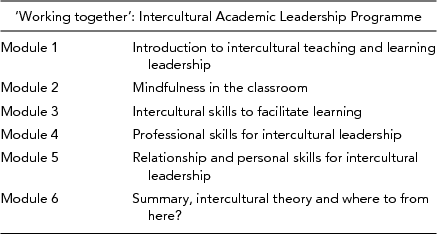
The Working Together programme involved six interactive modules each lasting two and a half hours with a focus on small group work (see Table 1). The first five modules were delivered consecutively over two and a half days and the sixth was presented several weeks later with the aim that participants apply what they had learnt to practice. Each module was prepared and delivered by an Indigenous and non-Indigenous facilitator to model working together equitably and respectfully in the intercultural space. Indigenous and non-Indigenous educators brought unique perspectives and understandings filtered through their own lens of racial and cultural knowledge and experience in ways that highlighted similarities and differences and offered a more complex and nuanced perspective of the intercultural space.
Working Together Programme Modules*

*Adapted from source: (Scott et al., Reference Scott, Bessarab, Durey, Taylor, Hoffman, Kickett and Austen2013).
The first or introductory module contextualised the topic by considering the importance of Indigenous perspectives in higher education at national and local levels; it discussed qualities of a good leader and the notion of intercultural leadership; it introduced the concept of self-reflection and journal writing and considered various ways to identify and articulate a shared history. During the programme, participants learnt how to critically reflect on producing knowledge in the classroom that avoided simplistic understandings of culture and facilitated open, exploratory and creative enquiry.
The second module drew on the work of Jon Kabat-Zinn (Reference Kabat-Zinn2003) to explore the practice of mindfulness to help participants develop skills in listening and managing stress when teaching and responding to difference or conflict in the intercultural space and also to build resilience.
Module three examined theories and practices of intercultural teaching and learning and reflected on and identified cultural and racial positioning. It provided tools to facilitate student engagement and understand the principles underlying cultural safety and competence.
The fourth module explored reasons students resist moving into the intercultural space, developed strategies to avoid students ‘fence sitting’ and improved problem solving skills and ways to facilitate intercultural learning in a range of contexts.
The fifth module explored how to manage interpersonal discomfort and conflict in the intercultural space. The module recognised key competencies in communication for intercultural teaching and learning leadership, initiated a personal care plan to work in this space, developed reflective strategies and recognised the importance of building relationships with the local Aboriginal and Torres Strait Islander community when engaging in this space.
The final sixth module, presented several weeks later, summarised the first five modules, reiterated the theory of the intercultural space and the practice of intercultural leadership and invited educators to establish a community of practice as a resource for each other. This module also provided an opportunity for educators to engage with a panel of senior academic managers to discuss concerns working in this space, institutional support required and future strategic directions of the university. This aspect of the programme offered educators the potential to influence institutional and organisational change and link with broader initiatives to improve policy and practice.
Programme Evaluation
Approval was granted to conduct an evaluation of the Working Together programme by the Curtin University Human Research Ethics Committee. Eleven educators who completed the inaugural programme (see Scott et al., Reference Scott, Bessarab, Durey, Taylor, Hoffman, Kickett and Austen2013) participated in the evaluation and all were involved in teaching the ICH unit. The evaluation was undertaken at three intervals; before the programme, after module five (three days later) and after module six, approximately eight weeks later. The evaluation aimed to explore participants’ experience of Working Together and whether they felt more confident teaching Indigenous content after participating in the programme.
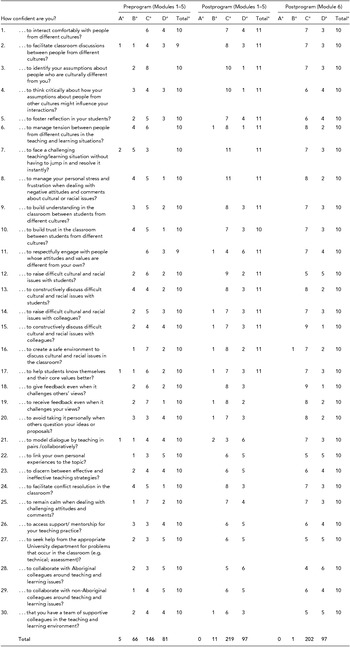
The evaluation format involved a two-part mixed-method questionnaire. In part one, a Likert scale assessed participant responses to 30 statements covering various aspects of teaching Indigenous content in an intercultural space. Participants rated their self-perceived confidence level ranging from ‘not at all confident’, ‘a little bit confident’, fairly confident’ to ‘extremely confident’. Participant answers were analysed based on the number of responses to each statement (see Table 2). In part two, participants were given a series of questions to prompt open-ended answers in relation to their experience of the Working Together programme and its impact on their teaching. As this was a self-reported questionnaire with very small participant numbers (n = 11), these open-ended answers allowed programme evaluators to understand at a more nuanced level, individuals’ perceptions of how their confidence to teach Indigenous content had been influenced by participating in the programme.
Pre and Post Programme Questionnaire Findings

*A - Not at all confident; B* - A little bit confident; C* - Fairly confident; D* - Extremely confident; Total* Total number of participants responding.
Findings
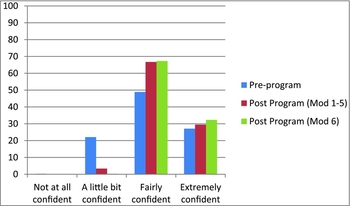
Quantitative questionnaire responses suggest that before the programme, 22% of participants had little or no confidence teaching Indigenous content in the intercultural space, despite 76% indicating they felt fairly or extremely confident. Immediately following the implementation of Modules 1–5, this increased overall to 96% of participants feeling either fairly or extremely confident. After the delivery of Module 6, eight weeks later when participants had had the opportunity to apply what they had learnt, responses indicated that confidence had increased further with virtually all participants feeling either fairly or extremely confident to teach Indigenous content in the intercultural space.
However, differences in confidence between statements were also noted. After the initial questionnaire, feeling ‘a little bit confident’ was common, particularly in statements around difficult teaching and learning scenarios, such as managing tensions and classroom conflict, personal stresses associated with the educator role and ‘discussing differences’. Most participants were ‘fairly confident’ they could receive and give feedback and interact confidently with people from other cultures and most participants felt ‘extremely’ confident collaborating with colleagues, Indigenous or otherwise and seeking support through the university.
Responses to the questionnaire at the end of Module 5 indicated that participants were at least ‘a little bit confident’ to be an intercultural educator and leader. These responses revealed a shift from before the programme where some participants were ‘not at all confident’ to most becoming ‘fairly confident’; other participants who were ‘extremely confident’ to facilitate classroom discussions between people from different cultures before the Working Together programme showed no difference after the programme. Those who felt ‘a little bit confident’ teaching in the intercultural space before the workshop, became ‘fairly confident’ after the five modules.
Findings indicate the confidence levels further increased following Module 6 (see Figure 1). This suggests the effectiveness not only of participants having time to link knowledge learnt from the first five modules to practice, but also that Module 6 provided an opportunity to revise what they knew, interact in small groups and discuss any concerns or queries.
Changes in levels of confidence pre and post programme.

Open ended qualitative responses described how the programme helped participants develop their confidence; participants perceived their ability improved to ‘foster reflection’; ‘think critically of own assumptions’; ‘raise difficult cultural/racial issues’ and to ‘facilitate conflict resolution in the classroom’. Responses to the mindfulness module were particularly powerful in helping participants feel more confident to facilitate discussion despite the inherent complexities of the intercultural space:
(Mindfulness) provides me with tools eg STOP, to manage difficult situations (and not feel that) I have all the answers. . .to not react. . .
The experience of bringing educators together to discuss teaching in the intercultural space was identified as a particular strength of the programme. Participants reflected on how they often felt isolated working in the intercultural space, particularly sessional staff whose casual employment was a challenge to developing ongoing supportive collegial relationships. Indigenous staff teaching in mainstream settings also spoke of feeling isolated, although one participant commented that attending the programme showed her:
. . .that I am not alone, that other Aboriginal academics and I deal with issues in the same manner.
The intercultural nature of the programme created a space for Indigenous and non-Indigenous participants to come together, explore, share and understand other styles and experiences of teaching in this field that:
. . . gave me a perspective on how non-Aboriginal staff deal and cope with teaching in this area.
These findings suggest the benefits of Indigenous and non-Indigenous participants working together and establishing a community of practice to meet and discuss issues related to teaching in this often challenging context. Findings also suggest that participants felt more confident in their capacity to foster culturally safe Indigenous and non-Indigenous relations:
I have entered the classroom often wondering whether the strategies that I was using were appropriate; some were, some needed further development. This course has ‘plugged the gaps’. As an experienced tutor in the area I am thankful for that. It decreases my own anxiety regarding my concerns to create a culturally safe environment for myself and most importantly the students.
The delivery of Working Together by a team of eight Indigenous and non-Indigenous educators with considerable experience teaching in the intercultural space also appeared to be a major strength of the programme. Programme facilitators were perceived as ‘role models’, and the interweaving of their experiences as intercultural leaders with core programme content impacted on participants:
The role models provided by staff who presented – courage, perseverance, self-determination – excellent inspirational leaders pioneering this vital unit in student learning.
The connection between developing confidence and shaping participants’ leadership capabilities was also discussed in relation to the programme:
The course has given me the confidence to feel assured about my position as a tutor of Indigenous studies and my important role as a person of influence who can aid in a shift of thought within students’ minds.
Overall, findings indicate that participants’ confidence increased following the Working Together programme leaving them better equipped to exercise leadership skills and teach in this intercultural space. The programme provided an opportunity not only to share their knowledge, skills, tools and resources to build their capacity to teach in this space but also to form intercultural collegial relationships as part of a community of practice.
Limitations
Limitations in the method used to evaluate the Working Together programme suggests caution in interpreting the findings conclusively. In evaluating the programme, developers used self-reported feelings of changes in ‘confidence’ to assess the success of the programme. This clearly is a subjective assessment, and while participants may have reported feeling more confident across a range of indicators, whether this could be demonstrated and observed without bias was not included in the evaluation. Given ‘confidence’ was a key term used throughout the evaluation, how participants understood confidence and their measure for assessing changes such as feelings, thoughts, behaviours is understandably diverse. Participants’ responses also highlighted the impact of specific educators responsible for delivering the programme who shared their unique stories and experiences. This suggests that, with different educators delivering the programme participants responses are likely to also be different, indicating that findings can't be generalised to other contexts.
Yet, despite these limitations and the small number of participants, as Spector (Reference Spector1994) argues, self-reported surveys have a powerful place in providing doorways for future exploration and understanding. Despite the evaluation's limitations, these preliminary findings suggest offering professional development of this type can build the capacity of educators to reflect, build strategies and relationships to work with more confidence and efficacy in the complex intercultural space.
Discussion and Conclusion
The Working Together programme was developed as an intervention to respond to evidence that healthcare for Indigenous Australians needs improving. The programme adopted an upstream approach to better prepare educators to develop the capacity of interdisciplinary health science students to deliver health care to Indigenous Australians that was respectful of cultural differences. It aimed to build educators’ capacity, skills and confidence in foregrounding Indigenous knowledge and experience of health and mainstream health services when teaching health science students. The Working Together programme recognised that strategies are needed for educators to improve their own learning and teaching in the intercultural space:
. . . not an easily mastered practice and requires academics to think about how to manage dialogue and discussion. . .so students do not revert to resigned fence-sitting but move on to re-thinking and re-articulating more complex positions. (Nakata et al., Reference Nakata, Nakata, Keech and Bolt2012, p. 135)
Education and training in cultural differences are not without risks; if they fail, racism can be reinforced rather than reduced (Kowal, Franklin, & Paradies, Reference Kowal, Franklin and Paradies2013). The Working Together programme acknowledged broader concepts of race and privilege in a colonised country such as Australia and their ongoing impact on the health and wellbeing of Indigenous Australians. To address this issue, participants learned how to facilitate robust student discussion on a range of topics including racism. Building the capacity of educators to be self-reflexive about their own cultural and racial positioning can help explain its importance to students when delivering healthcare to Indigenous Australians. According to Emirbayer and Desmond (Reference Emirbayer and Desmond2012, p. 574):
. . . our understanding of the racial order will remain forever unsatisfactory so long as we fail to turn our analytic gaze back upon ourselves, the analysts of racial domination, and inquire critically into the hidden presuppositions that shape our thought.
Findings from the evaluation of the inaugural Working Together programme highlighted the importance of reflexivity and discussion on Indigenous/non-Indigenous relations and issues and of wrestling with how knowledge is produced and represented (see Nakata et al., Reference Nakata, Nakata, Keech and Bolt2012). Reflective skills included participants identifying their own racial and cultural positioning in relation to the racial and cultural ‘other’ and recognising how beliefs and assumptions they hold in this context can impact on practice. Learning how to create intercultural, interdisciplinary and interactive learning spaces that are inclusive, safe for students from all cultures yet challenging and stimulating was important to better prepare students to work respectfully as graduates in Indigenous health contexts.
Our findings suggest that the Working Together programme increased the confidence of Indigenous and non-Indigenous participants to teach Indigenous culture and health to interdisciplinary health science students. By developing knowledge and skills in this context, educators were better able to help students critically engage with hegemonic discourse on how knowledge is produced in relation to Indigenous issues. This included discussing how the legacy of colonisation and racism against Indigenous people can undermine rather than promote health and wellbeing and how fence-sitting is discouraged so as to move beyond the familiarity of binary positioning into a more unfamiliar intercultural space (Nakata et al, Reference Nakata, Nakata, Keech and Bolt2012). Importantly, participants learned how to respond sensitively to students’ resistance to changing their ideas, beliefs and practices. By creating a safe space for this to occur, educators can encourage and facilitate the emergence of new ideas, positions and identities (Nakata et al., Reference Nakata, Nakata, Keech and Bolt2012). While engaging in this space can be risky, confronting and uncomfortable, the Working Together programme supported educators to assist students to delve deeper into engaging critically with learning, creatively engaging with ideas to produce a more textured response that reflects the complexity of this intercultural space, deepens understanding and opens up new possibilities for action (Nakata et al., Reference Nakata, Nakata, Keech and Bolt2012).
Acknowledgements
Support for this project has been provided by the Australian Government Office for Learning and Teaching grant (LE11-2082). The views in this project do not necessarily reflect the views of the Australian Government Office for Learning and Teaching. We also thank tutors, senior executive Curtin university staff and reference group members who participated in this programme and Louise Austen for her assistance in analysing findings. The resources for the Working Together programme can be accessed from: http://academicleadership.curtin.edu.au/IALP/program/program.cfm.
Competing Interest Statements
No competing interests were known.
About the Authors
Dr Angela Durey is non-Indigenous anthropologist who has worked and published widely in rural and Aboriginal and Torres Strait Islander (Indigenous) health research and education. Her theoretical and empirical interests include exploring racism, whiteness and the intercultural space particularly in the context of mainstream health service delivery to Indigenous Australians. She is currently Associate Professor Research in the School of Dentistry at the University of Western Australia and holds an Adjunct Associate Professor position at Centre for Aboriginal Studies, Curtin University.
Kate Taylor has been working in Indigenous health and education for over a decade. Her experience spans Indigenous health service research and evaluation across primary and tertiary health service contexts, cardiac care, training and education, curriculum development and project management. Kate's recent work has specifically involved enhancing the skills of educators and universities to deliver Indigenous content to health science students, and developing the cultural capabilities of health graduates. Kate is currently the project manager and team developer of a national Aboriginal and Torres Strait Islander Health Curriculum Framework.
Professor Dawn Bessarab is an Aboriginal woman of Bard (West Kimberley) and Yjindjarbandi (Pilbara) descent and Director of the Centre for Aboriginal Medical and Dental Health, University of Western Australia. Dawn is an experienced Senior Social worker and Health researcher with extensive experience in Aboriginal research, publishing widely both individually and collaboratively. She was awarded her PhD in 2007 and is Chief Investigator on several NHMRC grants; the Centre for Research Excellence Transformative Methods for Aboriginal Health and Wellbeing at the Telethon Kids Institute and a member of the National Indigenous Research and Knowledges Network (NIRAKN) Health Node.
Professor Marion Kickett is Director of the Centre of Aboriginal Studies at Curtin University. Marion has a background in Nursing and has worked in various contexts across Australia. For many years, she was involved in health education and in 2012 was awarded her PhD for her thesis: examining how resilience impacts on the physical and mental health of Aboriginal people. Given the huge disparities in Aboriginal and non-Aboriginal health, Marion is passionate about educating students and health professionals on how to improve healthcare to Aboriginal people and address factors that constrain or facilitate that. Marion is a Ballardong Noongar woman from York in Western Australia. She grew up with her family on the York Aboriginal reserve.
Associate Professor Sue Jones is Director of Learning Design at Curtin University and leader of a university wide curriculum reform project. Sue has successfully led two (then) ALTC leadership grants and one Office for Learning and Teaching (OLT) grant on interprofessional leadership and practice. She was a project team member on the OLT grant: Working together: Intercultural academic leadership for teaching and learning in Indigenous culture and health. Sue is currently Project Leader on a Commonwealth Department of Health Aboriginal and Torres Strait Islander Health Curriculum Framework.
Associate Professor Julie Hoffman is a social, cultural and behavioural scientist who has been strongly involved in health sciences and Indigenous education for over 20 years, working in consultation and partnership with Aboriginal and non-Aboriginal families, organisations and communities. She is currently Dean of Teaching and Learning in the Centre for Aboriginal Studies at Curtin University and is an Office of Learning and Teaching co-recipient of the 2010 Neville Bonner Award and the 2014 OLT Australian Awards for University Teaching for Programs that Enhance Learning. Dr Hoffman was co-unit designer and coordinator of the Indigenous Cultures and Health 130 unit.
Dr Helen Flavell is a wadjela (non-Aboriginal) woman and the Coordinator, Scholarship of Teaching and Learning, in the Faculty of Health Sciences at Curtin University which is located on Noongar Wadjuk country. Helen has worked on two national projects related to embedding Indigenous Australian content into the curriculum and has taught non-Aboriginal health students Aboriginal history and culture.
Kim Scott is a multi-award winning novelist. His most recent novel is That Deadman Dance (Picador). Proud to be one among those who call themselves Noongar, Kim is founder and chair of the Wirlomin Noongar Language and Story Project which, among other achievements, has resulted in the publication of a number of English/Noongar language picture books (see www.wirlomin.com.au). He is the recipient of an Australian Centenary Medal and was the 2012 West Australian of the Year. Kim is currently Professor of Writing at Curtin University.