In the field of SLA, unlike that of bilingualism, the relationship between the first language (L1) and the second language (L2) in the mind of a learner has traditionally been viewed from a unidirectional perspective. Thus, in addition to other factors shaping a L2, many features of the L2 find their origin in the L1 (see overviews in Gass & Selinker, 1992; Kellerman & Sharwood Smith, 1986; Odlin, 1989, 2003). Much evidence of L1 influence has been gathered from studies on speech production, but recent research has also suggested that gestures might provide an additional window through which cross linguistic influence can be observed, particularly for speakers whose speech sounds targetlike (see Gullberg, 2008, for an overview; Kellerman & van Hoof, 2003).
The bias in focus on L1 influence, however, ignores the fact that linguistic systems within an individual learner might interact, just as has been suggested for bilingual or very advanced L2 speakers (e.g., Grosjean, 1998), particularly in the domain of lexical processing (e.g., Kroll & Sunderman, 2003; Van Hell & Dijkstra, 2002). If the linguistic systems do interact, this would have considerable consequences for the notion of the native-speaker standard, a standard regularly used in research on and assessment of SLA. Although the validity of this rather mythical benchmark has been questioned (Davies, 2003), SLA remains largely characterized in terms of deviation from this allegedly homogeneous norm (Birdsong, 2005).
This study investigates the possibility that linguistic systems interact within the multilingual mind. Utilizing the framework of crosslinguistic influence (Kellerman & Sharwood Smith, 1986), we ask whether and to what extent influence between an emerging and an established language is bidirectional and whether analyses of gesture reveal more than analyses of speech alone.
BACKGROUND
Crosslinguistic Influence in SLA
Second language phenomena explained by L1 influence have been found in practically every linguistic domain: sound system (e.g., Purcell & Suter, 1980), lexicon (e.g., Ringbom, 1978), syntax (e.g., Odlin, 1990), pragmatics (e.g., Olshtain, 1983), discourse (e.g., Carroll & Lambert, 2003), and processing strategies (e.g., MacWhinney, 1992). Effects of L1 influences have even been observed in cospeech gesture patterns (e.g., Yoshioka, 2005). Research has shown crosslinguistic influence to be affected by the level of L2 proficiency (e.g., Major, 1986; Takahashi & Beebe, 1987), social context (e.g., Tarone, 1982), markedness (e.g., Zobl, 1983), learner perception of prototypes (e.g., Kellerman, 1986), and language distance and psychotypology (e.g., Kellerman, 1979).
In contrast to the vast number of studies that characterize effects of the L1 on the L2, only a handful of studies have begun to examine the reverse case: influence of the L2 on the L1. Research on grade school students has found that L2 study yields positive effects on development of L1 reading (Yelland, Pollard, & Mercuri, 1993), L1 writing (Kecskes & Papp, 2000), and L1 vocabulary (Cunningham & Graham, 2000). Research on adults has found effects of the L2 on the L1 in syntactic processing (Cook, Iarossi, Stellakis, & Tokumaru, 2003), interrogative structure (Dewaele, 1999), and pragmatics (Cenoz, 2003). Although these findings showed no negative impact of the L2, other research has revealed errors in the L1 traceable to L2 knowledge in the lexicon and semantics (Balcom, 2003; Jarvis, 2003; Laufer, 2003; Pavlenko, 2003), morphosyntax (Jarvis; Pavlenko), and discourse (Chen, 2006; Pavlenko). Finally, the rate of gesturing in the L1 has also been found to be affected by the L2 (Pika, Nicoladis, & Marentette, 2006).
However, with the exception of studies on school-age children in which the focus is on a L1 still in development, studies of L2 effects on the L1 have primarily been conducted in populations of functional bilinguals, where a certain amount of interaction is expected. Therefore, we do not yet know whether such influence occurs with less exposure to a L2. Furthermore, because these populations are often living in the L2 speech community at the time of observation and because much research employs error-based analyses, differences observed in the L1 might be interpreted as signaling initial stages of language loss. Hence, it remains to be seen whether all influence of a less developed L2 on a mature L1 yields attrition. Finally, whereas some research has examined influence of a L2 on a L1 cross-modally, the focus has primarily been on the effects of cultural exposure. Thus, we do not know whether linguistic effects of bidirectional crosslinguistic influence across modalities can be observed independent of culture.
To address these issues, a test domain with sufficient crosslinguistic differences to make crosslinguistic influence visible is needed. The linguistic expression of motion, specifically manner of motion (e.g., climb, roll), is one such domain.
The Expression of Manner of Motion
All languages encode motion, but they differ in the precise ways in which semantic concepts are mapped onto lexical items (cf. Talmy, 1985, 1991, 2000). Talmy (1985) suggested that the expression of manner of motion—the way in which a protagonist moves (e.g., jump, roll)—depends on how path of motion—the trajectory followed by a protagonist (e.g., up, down)—is expressed. In satellite-framed languages (Talmy, 1991) like English, the core component of path is normally lexicalized in a satellite (i.e., verb particle) outside the main verb; therefore, the main verb slot is free for lexicalization of manner, as seen in (1). Verb-framed languages like Japanese, on the other hand, typically reserve the main verb slot for path, leaving manner to be lexicalized in a subordinated verb, as in (2), or adverbial, as in (3).

Of course, both satellite- and verb-framed languages have alternative options available. English speakers might also lexicalize manner as an adverbial or a subordinated verb, as shown in the translations of (2) and (3). Similarly, Japanese has a certain number of compound verbs available that lexicalize manner along with path in a single lexical item (e.g., koroge-ochiru “roll-fall”). Also common in Japanese (Hamano, 1998) is the lexicalization of manner in ideophones or mimetics, giseigo or gitaigo “words which imitate sound or shape” (Weingold, 1995, p. 319), which can function as adverbials (e.g., guruguru “rotate repeatedly”).
Typological predictions for lexicalization of manner—in the main verb or an accompanying verblike element—are seen as preferences exhibited in the language as opposed to grammatical requisites. Such preferences have been well documented for English (e.g., Naigles, Eisenberg, Kako, Highter, & McGraw, 1998; Slobin, 2004a, 2004b).
Although all languages thus possess morphosyntactic devices to talk about manner, Talmy (1985) hypothesized that the independent expression of manner in verb-framed languages in an awkward subordinated verb or adverbial might be avoided altogether. Work by Slobin (e.g., 1996b, 1997, 2004a, 2004b, 2006) and colleagues in a range of languages has provided substantial empirical support for this assumption. These observations lie at the heart of the concept of “thinking for speaking” (Slobin, 1996a); that is, the idea that speakers typically attend to the aspects of an event that their language has the readily available linguistic means to express and that, over time, this habitual attention leads to certain rhetorical styles (e.g., habitual encoding or nonencoding of manner). Slobin (1997, 2004a) has further proposed that typological constraints on expression of manner affect the size and composition of the manner verb lexicon.
However, the idea that manner is typically not encoded in spoken verb-framed discourse has been challenged. When morphosyntactic elements other than the verb are examined, such as modification phrases in Spanish, manner is found to be encoded in verb-framed discourse at much higher rates than previously reported (Hohenstein, Eisenberg, & Naigles, 2006; Naigles et al., 1998).
Furthermore, in the manner fog hypothesis, McNeill (2001, 2005) proposed that manner might be alternatively expressed in gesture instead of in the complex semantic and syntactic structures required in verb-framed speech. Drawing on individual examples from Spanish discourse, McNeill described cases of manner absent from speech but present in gesture. In the absence of a corresponding word with which to align, these manner gestures often blanket an entire motion event description in a manner fog. Conversely, in the manner modulation hypothesis, McNeill showed how speakers of English, a satellite-framed language, gesture less about manner when it is present in speech, perhaps to modulate its significance in discourse.
Note that these observations are not really mirror images of each other. In the case of the manner fog hypothesis, not talking about manner is the default, and manner might be added in gesture or not. The typical pattern is therefore [−manner speech, ±manner gesture]. In the case of the manner modulation hypothesis, the assumption is that talking about manner is the default and that manner might be encoded in an accompanying gesture or not. The typical pattern here is thus [+manner speech, ±manner gesture]. Nevertheless, underlying both hypotheses is the idea that speech and gesture form a single coexpressive unit and that gestures can either foreground or background manner information in discourse (see Slobin, 1997, for discussion of foregrounding and backgrounding in speech).
Acquisition of Expression of Manner of Motion in L2 and Crosslinguistic Influence
In a L2, the acquisition of expression of manner constitutes a challenge even though manner is lexicalized in verbs in both verb- and satellite-framed languages. Often the forms are not difficult, particularly in the case of basic-level manner verbs common to all languages, such as jump and roll (Slobin, 1997). The greater challenge, however, is the acquisition of the syntactic configurations of these elements. This is particularly true for learners of English, in which both verb-framed and satellite-framed constructions are equally grammatical, but the latter are typologically preferred.
Existing studies of SLA of manner generally suggest evidence of L1 influence. L1 knowledge of subcategorization frames appears to govern grammaticality judgments concerning transitivity of manner verbs in the L2 (Montrul, 2001). As expected, however, the L1 influence on lexicalization patterns is mitigated by proficiency such that it is less visible at advanced levels of proficiency (Cadierno & Ruiz, 2006). Furthermore, influence of the L1 in speech might affect L2 gesture patterns. Native Spanish speakers, who rarely encode manner in L2 English speech, have been observed to add manner information in gesture, presumably showing evidence of L1 manner fog (Negueruela, Lantolf, Jordan, & Gelabert, 2004; Stam, 2006).
THE PRESENT STUDY
The aim of the present study is to further our understanding of the relationship between languages in the multilingual mind by looking for evidence of bidirectional influence (i.e., effects of the established L1 on the emerging L2 as well as effects of the emerging L2 on the established L1). We investigate this issue in the domain of expression of manner, particularly at lower levels of L2 proficiency and across modalities. To this end, speech and gesture patterns are examined in monolingual speakers of Japanese, a verb-framed language, and monolingual speakers of English, a satellite-framed language, as well as in native Japanese speakers with intermediate knowledge of L2 English.
Three specific questions are addressed. First, to investigate whether the encoding of manner in speech depends on typological framing, we examined how often speakers mention manner in descriptions of target motion events. Monolingual English speakers are predicted to encode manner more often than Japanese speakers. Second, to investigate the manner fog hypothesis, we examined how often manner is absent from a clause but added in an accompanying gesture. Monolingual Japanese speakers are predicted to exhibit manner fog in gesture. Third, to investigate the idea that gesture modulates manner information in speech, we examined how often manner is encoded in a clause but not in the accompanying gesture (i.e., the gesture encodes only path). Monolingual English speakers are predicted to display manner modulation in gesture. In L1 and L2 production from Japanese speakers with intermediate knowledge of English, these domains constitute areas in which bidirectional influence might potentially be observed. On the basis of previous research with highly proficient Spanish learners of English, Japanese learners of English are expected to encode manner less often than native speakers of English (cf. Hohenstein et al., 2006) and to transfer patterns regarding manner fog from their L1 (cf. Negueruela et al., 2004). However, in the absence of parallel research on the L1, no predictions can be made for the reverse direction of influence: effects of the L2 on the L1. Nonetheless, if a bidirectional influence were present, Japanese speakers with intermediate knowledge of English would be expected to differ from monolingual Japanese speakers by, for instance, encoding manner more often in speech and displaying less manner fog or more manner modulation than monolingual Japanese speakers.
METHODOLOGY
Participants
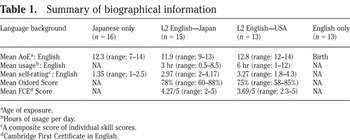
A total of 57 adults (age 18–48 years) participated in this study. They comprised four groups: monolingual Japanese speakers living in Japan (Japanese-only), native Japanese speakers with intermediate knowledge of English living in Japan (Japanese-English [Japan]) or in the United States (Japanese-English [USA]), and monolingual English speakers living in the United States (English-only). Biographical information and information on general language usage was gathered using a detailed questionnaire developed by the multilingualism project at the Max Planck Institute.2
This measure ensured that the Japanese-English speakers were engaged in active use of English. The so-called monolingual speakers of each language illustrated through this test that they were, at best, “minimally bilingual” (Cook, 2003): They had had minimal exposure to a L2, they were not engaged in active study of a L2, and they did not use a L2 in their everyday lives.The choice of two Japanese-English groups living in different language environments was made to control for possible effects of L1 attrition and for effects of cultural exposure. First, effects seen in the L1 only among Japanese-English (USA) speakers might be explained by loss of the L1 due to residence in the L2 community. However, similar L1 patterns in both groups would render an explanation based on L1 attrition less likely. Second, gesture patterns can be culturally determined or motivated by the linguistic patterns of the accompanying speech. In the former scenario, different gesture patterns would be observed between the two Japanese-English groups. In the latter case, comparable gesture patterns would be observed in the two Japanese-English groups.
Learners' proficiency in English was formally measured in three ways. Participants rated their own English language proficiency in speaking, listening, writing, reading, grammar, and pronunciation. Participants also completed the first grammar section of the Oxford Placement Test (Allan, 1992), a written cloze test consisting of 50 items. Finally, because the data elicitation procedure employed in this study elicited oral data, the third measure was an evaluation of oral proficiency using the University of Cambridge Local Examinations Syndicate (UCLES) oral testing criteria for the first certificate in English (FCE).3
More information can be found at http://www.cambridgeesol.org.
Summary of biographical information

Both the Oxford and the FCE proficiency measures descriptively placed the Japanese-English groups within intermediate range. The groups did not significantly differ in proficiency as measured by the Oxford Placement Test, t(25) = 0.795, p = .434, and only marginally differed in proficiency as measured by the Cambridge FCE criteria, t(26) = 1.982, p = .058, with the Japanese-English (Japan) group scoring slightly higher than the Japanese-English (USA) group. The groups were thus matched on formal proficiency in English.
Stimuli
Data were obtained through a narrative retelling task. Short narrative descriptions were elicited based on the 6-min animated Sylvester and Tweety Bird cartoon Canary Row (Freleng, 1950) commonly used in gesture research on motion events. The cartoon was divided into scenes following McNeill (1992), and the order of scenes was systematically varied in the presentation of the stimulus across all groups. Each scene contains numerous motion events, and narrative description of the scenes typically elicits abundant gestures (cf. Kita & Özyürek, 2003; McNeill, 1992, 2001; Özyürek, 2002). From the stimulus material, four motion events consistently described by participants were selected for coding and analysis, yielding the following manner + path combinations: climb + through, roll + down, clamber + up, swing + across.
Procedure
Monolingual subjects (English and Japanese) participated in the study once, producing narratives in their native language only. The Japanese-English groups participated in the study twice and produced narratives based on the same set of stimuli both in their L1 and in their L2. The language order in which the learners gave descriptions was counterbalanced across participants, and a minimum of 3 days passed between the first and second occasions.
All participants were tested individually by a confederate, a native speaker of the language of the experiment. The participant and experimenter first engaged in a brief warm-up that consisted of small talk in the target language; the goal was to relax participants—increasing the likelihood of gesturing—and to put them in so-called monolingual mode (Grosjean, 1998). Next, the experimenter told participants that they would be watching a series of animated scenes from a cartoon on a computer screen and should retell what they had seen to the experimenter in as much detail as they could remember. The experimenter was trained to appear fully engaged in the participants' narratives but to avoid asking questions and, crucially, to avoid supplying the target manner.
Participants performing in L2 English also had a word list containing key nouns from each scene. This word list remained within view throughout the experiment and served to minimize appeals to the experimenter for lexical assistance with low-frequency nouns, such as birdcage and trolley, and as a memory aid, relieving the processing load of performing in the L2.
Data Treatment
All narratives were transcribed from digital video by a native speaker of the relevant language. Elan, a digital video tagging software program developed at the Max Planck Institute for Psycholinguistics, was used to code the data.4
Elan enables a frame-by-frame analysis (at 40-ms intervals) of movement as well as sound.Speech Segmentation and Coding
Narratives were divided into clauses; a clause is defined as “any unit that contains a unified predicate … (expressing) a single situation (activity, event, state),” following procedures laid out in Berman and Slobin (1994, p. 660). Next, clauses describing the four target motion events were identified and coded. Analysis of speech was conducted at the level of the target motion event description based on the presence or absence of manner. The description was favored over the clause as the unit of analysis for speech to avoid confounding rhetorical patterns with syntactic constraints. A large proportion of clauses in Japanese were expected not to have manner encoding simply because speakers employed subordinated verbs to express manner and thus distributed manner and path information across two clauses (Kita & Özyürek, 2003). Therefore, an analysis of the whole event description would yield a more accurate picture of manner encoding in discourse.
Given the different findings of previous research on manner encoding, a maximally inclusive system was followed, by which any element lexicalizing information about the way in which the figure underwent its translocational motion was coded as manner, including adverbials (mimetics and comparison phrases). The manner terms used by each group to describe the four events are shown in the Appendix.
Japanese speakers displayed a surprisingly wide array of manner verbs in their L1 in comparison to what is typically expected from a verb-framed language. This pattern is in accordance with Ohara (2004), who found that literary translation of The Hobbit (Tolkien, 1937) into Japanese actually contained almost as many verb types to express manner as the original in English and that the greatest variety of manners was conveyed in verbs, often manner-path compound verbs, as opposed to mimetics.
Also notable is that participants from the Japanese-English groups displayed some instances of borrowing from English in their Japanese speech (i.e., janpu-suru “do jump” and suwingu-suru “do swing”), which were not seen in Japanese-only participants' descriptions of these particular events. Additionally, they exhibited more verb types to lexicalize manner in their L1 than monolingual Japanese speakers. It is important to note that borrowing from English in L1 descriptions from the Japanese-English group was not common, and monolingual Japanese speakers also displayed borrowing from English, albeit in descriptions of other events. Therefore, this particular phenomenon does not appear to constitute evidence of L2 influence. Furthermore, the greater number of verb types in L1 learner discourse might simply be a reflection of differences in group sizes. Participants from the Japanese-English groups were combined in the examples, yielding twice as many participants in this group as in the monolingual groups. Note, however, that the learners did not concurrently display more adverbial types, which might indeed be considered evidence of L2 influence. In the L2, the lexical inventory for expression of manner was relatively close to the monolingual English target, although interpreting meaning in L2 discourse was occasionally problematic. In such cases, interpretation was contextually determined based on events in the stimulus.
Gesture Segmentation and Coding
As mentioned previously, research across modalities might provide additional insight into the interaction between linguistic systems; therefore, this study examined gesture as well as speech. Analyses focused on representational gestures (iconics, metaphorics, and deictics; Kita, 2000), specifically the stroke, which is the most effortful part of the gesture and contains semantic information (for an operational definition of gesture strokes, see Kendon, 1972; Kita, van Gijn, & van der Hulst, 1998; Seyfeddinipur, 2006). Representational gesture strokes (hereafter simply gestures), which depicted target motions and which co-occurred with clauses containing target motion event speech, were coded for presence or absence of manner.
Gestures were coded as exhibiting a manner component if the gesture articulator(s) displayed movement that could be interpreted as depicting the manner of a given event. This generally involved movement of fingers or rotation of the wrist, such as wiggling of fingers, twirling of the arm, or the portrayal of a climbing action, with or without a concurrent translocational movement from one point to another (manner-path conflated vs. manner-only gestures). In gestured descriptions of swing across, the arc shape of the gesture reflected the manner component (swinging action) of these motion events.
Analyses of manner gestures consisted of identifying the extent to which the gesture overlapped with the semantics of the accompanying clause, specifically with respect to manner information. Examples of gesture coding processes as applied to clauses describing climb through are in (4) and (5), with individual gesture strokes in boldface and manner expressions underlined.5
Demarcation of gesture strokes follows the widely accepted system laid out in McNeill (2005).

Example (4), in which a clause with no spoken encoding of manner is accompanied by a manner gesture, illustrates manner fog. Here, manner information is foregrounded through gesture. Example (5), on the other hand, in which a clause with spoken encoding of manner is accompanied by a path gesture, illustrates manner modulation. This time, manner information is backgrounded through gesture. Recall that these patterns are not the inverse of one another. The inverse of foregrounding (i.e., manner fog) is not backgrounding (i.e., manner modulation) but lack of foregrounding and vice versa. An absence of foregrounding, then, would simply consist of talking and gesturing about path, whereas an absence of backgrounding would consist of talking and gesturing about manner (and probably also about path).
Segmenting and coding gestures produced in L2 discourse presented some challenges. From a lay perspective, one might expect learner discourse to be littered with full-blown mimes to compensate for lexical difficulties. Whereas learners might recruit other types of gestures to facilitate discourse, they do not typically replace speech with fully iconic mimes (Gullberg, 1998). Nonetheless, to control for potential bias in the results from representational gestures related to repair in L2 discourse, gestures functioning strategically were identified and excluded, following Gullberg. This procedure involved the assessment of disfluencies on the basis of signs of obvious lexical difficulty (e.g., in the use of paraphrases or circumlocutions) or on the basis of performance features (Faerch & Kasper, 1983), the accumulation of which indicated strategic behavior. Such features included unfilled pauses, filled pauses, slower articulation, mumbling, laughing, message abandonment, self-corrections, repetition, hedges, use of L1, and looks to listener for assistance or confirmation (see Brown, 2007, for more information). If at least two performance features were simultaneously present in any stretch of discourse, the accompanying gesture was classified as strategic and not analyzed further.
Reliability of Speech and Gesture Data Coding
To establish reliability of data coding, 15% of the entire dataset was segmented and blind-coded by an independent second coder. An agreement of 100% was reached on semantic coding in L1 and L2 speech data. An agreement of 94% and 85% was reached on semantic coding in L1 and L2 gesture data, respectively. In cases of disagreement, coding by the initial coder was employed.
RESULTS
Results are presented in three sections. First, encoding of manner in speech and gesture among L1 groups is compared. As not all participants gestured in their L1, only a subset are included in gesture analyses (sample numbers are indicated in each figure and in Table 1).6
In order for participants to be included in the gesture analyses, they had to contribute at least one gesture in a description of any of the four events.
Encoding of Manner in L1 Speech and Gesture
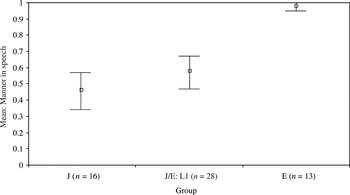
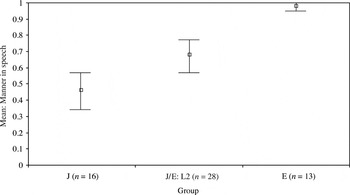
In the analyses of L1 production, we tested all three hypotheses: encoding of manner in speech, manner fog in gesture, and manner modulation in gesture. Figure 1 shows the mean proportion of descriptions containing manner information in speech out of the total number of descriptions of target motion events. Because there was no significant difference between the learners in Japan and the ones in the United States in their L1, z = −0.754, p = .451, the subgroups were collapsed.

Mean proportion of spoken descriptions encoding manner: J (Japanese-only speakers), J/E: L1 (Japanese-English speakers: L1 Japanese productions), and E (English-only speakers)
There was a significant difference between the groups in their tendency to encode manner in speech in event descriptions, χ2(2, 57) = 27.952, p < .001. Specifically, the English-only group encoded manner significantly more often than both the Japanese-only group, z = −4.693, p < .001, and the Japanese-English groups, z = −4.597, p < .001, who did not significantly differ from each other, z = −1.671, p = .095. Notice that although the Japanese data were rather variable, there was no evidence of a bimodal distribution in either group; that is to say, all speakers patterned in comparable ways, and the means did not conceal underlyingly different patterns.
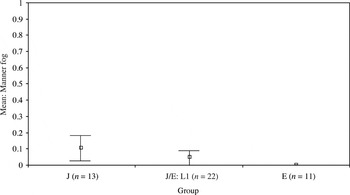
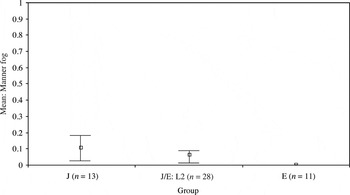
Figure 2 shows the mean proportion of gestures expressing manner when no manner was present in the accompanying clause (manner fog). Again, the two subgroups of learners did not differ in their L1 productions, z = −0.084, p = .933, and, therefore, their data were collapsed.

Mean proportion of motion gestures expressing manner with no manner information in accompanying clause (manner fog): J (Japanese-only speakers), J/E: L1 (Japanese-English speakers: L1 Japanese productions), and E (English-only speakers)
As monolingual English speakers never exhibited evidence of manner fog, they were not included in the statistical test. There was no difference in the mean proportion of gestures expressing manner with no manner in the accompanying clause between Japanese-English and Japanese-only speakers, z = −1.595, p = .111. Again, whereas the monolingual Japanese data were somewhat variable, there was no evidence of a bimodal distribution.
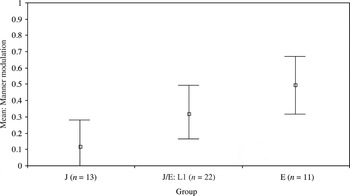
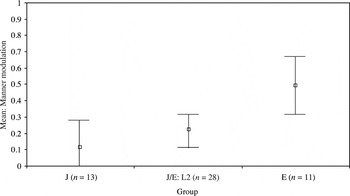
Finally, Figure 3 shows the mean proportion of motion gestures expressing only path when manner appeared in the accompanying clause (manner modulation). Again, L1 data from the two subgroups of learners were collapsed, as there was no significant difference between them, z = −0.440, p = .660.

Mean proportion of motion gestures expressing path when manner was present in accompanying clause (manner modulation): J (Japanese-only speakers), J/E: L1 (Japanese-English speakers: L1 Japanese productions), and E (English-only speakers).
The groups differed in the mean proportion of gestures expressing path alone when manner was present in the accompanying clause, χ2(2, 46) = 10.544, p < .01. More specifically, Japanese-English speakers produced a greater proportion of path-only gestures when talking about manner in the accompanying clause than did Japanese-only speakers, z = −2.070, p < .05, but did not significantly differ from English-only speakers, z = −1.835, p = .066. Again, there was no evidence of a bimodal distribution in any group.
Summary and Discussion of L1 Results
The analyses of speech revealed differences between Japanese and English. In line with previous research, monolingual English speakers had a variety of manner verbs readily available to fill main verb slots, which they deployed with great frequency, therefore displaying ceiling levels of manner encoding in descriptions of motion. Japanese speakers also employed a wide variety of lexical items to encode manner (verbs and adverbials), but they encoded manner significantly less often in motion event descriptions than did monolingual English speakers. Therefore, like in other verb-framed languages, complexity of manner expression outside the main verb in Japanese might have constrained encoding of manner in speech.
Analyses of gesture revealed both between- and within-language differences. On the one hand, Japanese speakers, monolingual and nonmonolingual, displayed manner fog in gesture, whereas monolingual English speakers did not. It is noteworthy that the Japanese speakers here patterned much less like the Spanish speakers reported in other studies, in that proportions of manner fog are rather small; only 11% of monolingual Japanese clauses contained instances of manner fog compared to the performance of monolingual Spanish speakers reported in Negueruela et al. (2004), for whom an average of 75% of manner gestures were cases of manner fog. This in turn suggests that although Japanese speakers do gesture about manner in its absence in speech, it is not the preferred pattern. Furthermore, although the existence of manner fog in monolingual Japanese discourse was far from compelling, it was even less compelling in nonmonolingual Japanese discourse, which more closely resembled monolingual English discourse.
On the other hand, with manner so ubiquitous in monolingual English descriptions, speakers appeared to background its significance by not gesturing about it, although they gestured about other aspects of the motion event (i.e., path) significantly more often in comparison to monolingual Japanese speakers. This pattern strongly supports the between-language manner modulation hypothesis. However, in this case, the within-language finding is crucial. More specifically, when Japanese-English speakers encoded manner in L1 speech, they also displayed manner modulation in gesture, tending to gesture only about path significantly more often in comparison to Japanese-only speakers.
Because there were no differences between the Japanese-English groups and because production in the L1 was not ungrammatical in this domain, these results do not seem to indicate any kind of loss of the L1. Instead, they suggest the presence of an influence of the L2 on the L1.
Encoding of Manner in L2 Speech and Gesture
On the basis of previous research in this area, Japanese learners of English were expected to display evidence of influence of their L1 when speaking their L2. However, with respect to manner fog, because monolingual Japanese speakers, unlike monolingual Spanish speakers, did not actually follow this pattern to any great degree, L1 transfer in this area is somewhat less likely.
Figure 4 shows the mean proportion of descriptions containing manner information out of the total number of descriptions of target motion events. With no significant difference between the two Japanese-English groups in English, z = −0.378, p = .705, the subgroups were collapsed.

Mean proportion of spoken descriptions encoding manner: J (Japanese-only speakers), J/E: L2 (Japanese-English speakers: L2 English productions), and E (English-only speakers).
There was a significant difference between the groups in the mean proportion of event descriptions encoding manner, χ2(2, 57) = 24.659, p < .001. L2 speakers encoded manner significantly less often than English-only speakers, z = −3.659, p < .001, but more often than Japanese-only speakers, z = −2.420, p < .05. As in the L1, variability in the L2 data were not indicative of a bimodal distribution.
Figure 5 shows the mean proportion of gestures to express manner when no manner was present in the accompanying clause (manner fog). Again, there was no significant difference between the two subgroups of learners in the L2, z = −0.838, p = .402, whose data were therefore collapsed.

Mean proportion of motion gestures expressing manner with no manner information in accompanying clause (manner fog): J (Japanese-only speakers), J/E: L2 (Japanese-English speakers: L2 English productions), and E (English-only speakers).
Second language speakers differed from the English-only speakers, who never showed any evidence of manner fog. L2 speakers were marginally less likely than Japanese-only speakers to produce gestures expressing manner with no manner in the accompanying clause, z = −1.867, p = .062. However, again, the proportions are actually very small.
Finally, Figure 6 shows the mean proportion of motion gestures expressing only path when manner appeared in the accompanying clause (manner modulation). Once again, L2 data from the two Japanese-English groups were collapsed, as there was no significant difference between them, z = −0.023, p = .981.

Mean proportion of motion gestures expressing path when manner was present in accompanying clause (manner modulation): J (Japanese-only speakers), J/E: L2 (Japanese-English speakers: L2 English productions), and E (English-only speakers).
The groups differed significantly in the mean proportion of gestures expressing path alone when manner was present in the accompanying clause, χ2(2, 52) = 15.135, p < .001. L2 speakers produced significantly fewer path-only gestures when talking about manner in the accompanying clause than did English-only speakers, z = −2.947, p < .01, but significantly more than Japanese-only speakers, z = −2.489, p < .05.
Summary and Discussion of L2 Results
From the analysis of their L2 speech, native Japanese speakers did not appear wholly targetlike, as evidenced by less frequent encoding of manner than monolingual English speakers. This is in line with Hohenstein et al. (2006), who found overall less mention of manner in motion event descriptions in L2 discourse compared to L1 discourse. However, although this pattern might have been caused by lexical difficulty, the Japanese-English speakers in this study looked rather targetlike in terms of their lexical inventory for manner expression, and they actually encoded manner more often than monolingual Japanese speakers. Instead, results might be explained by the influence of the L1 in rhetorical patterns (i.e., less attention to manner as a result of lexicalization patterns in the L1).
In the analyses of gesture accompanying L2 discourse, there were some cases of manner fog but not as many as seen in monolingual Japanese discourse. This is in contrast to previous findings for Spanish learners of English, where manner fog appeared to be a relatively common phenomenon, albeit in a rather small sample (Negueruela et al., 2004). This is not particularly surprising because this pattern was much less frequent in the monolingual Japanese data compared to the monolingual Spanish data. On the other hand, as not all event descriptions contained manner, one might have expected cases of gestural manner fog—if not from influence from the L1, then perhaps to compensate for lexical difficulty. However, this was rarely observed. Such an outcome supports the proposal that L1 influence in rhetorical patterns is a more compelling account than lexical difficulty and is in line with the observation that iconic gestures rarely replace speech in L2 discourse (Gullberg, 1998).
Regarding manner modulation, L2 performance was again midway between target and source languages. This finding is interesting because one might have expected learners to display less manner modulation than all groups, opting instead to clarify intended meaning in the L2 through gesture. Taken together with the results on manner fog, we see that learners, in general, appear not to use gesture as a learner-specific compensatory strategy either to replace manner in speech or to refine existing manner information. Instead, gesture use in learner discourse appears to exhibit properties of the source and target languages, suggesting crosslinguistic influence. Moreover, the absence of a difference between the Japanese-English groups confirms that gesture patterns, in particular, were not affected by cultural exposure.
In sum, L2 learners show evidence of learning in the L2 as they are on their way toward targetlike patterns, seen in their greater tendency to encode manner in speech and their greater tendency for manner modulation in gestures. Yet, there is also some evidence of possible influence of the L1 in manner fogs; that is, learners talk about path but gesture about manner.
Within-Subject Comparison of Encoding of Manner in L1 and L2 Speech and Gesture
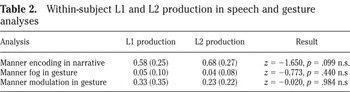
The final set of analyses concerns the relationship between L1 and L2 production in speech and gesture of the Japanese-English speakers. These repeated-measures analyses were conducted using Wilcoxon tests, the results of which are summarized in Table 2, with group means from the preceding analyses repeated for convenience. Because participants in the Japanese-English (Japan) group did not differ from participants in the Japanese-English (USA) group in either the L1 or the L2 in any of the preliminary analyses, they have been combined into one nonmonolingual group with common scores in L1 and L2.
Within-subject L1 and L2 production in speech and gesture analyses

Quite remarkably, although the learners were speaking two very different languages, which pattern significantly differently in monolingual discourse, there were no significant differences in encoding of manner in speech or any differences in gestural patterns of manner fog and manner modulation in L1 and L2 production. This phenomenon is illustrated in (6), which is taken from the same learner in her L1 and her L2. Again, gesture strokes are highlighted in bold and manner expressions are underlined.

Example (6) shows the same native Japanese speaker with knowledge of English modulating manner through gesture—that is, encoding manner in speech but gesturing only about path—in both her L1 and L2. In sum, it appears that, with respect to the encoding of manner in speech and gesture, differences lie between subjects (monolinguals vs. learners) rather than within subjects (learners in their L1 and their L2).
GENERAL DISCUSSION AND CONCLUSION
Despite enormous interest in how a L1 shapes the acquisition and development of a L2, the issue of whether that L2 exerts influence of its own has largely been ignored. The few studies examining effects of a L2 on a L1 have predominately been limited to populations of functional bilinguals. Furthermore, these populations have typically been observed in the L2 speech community, with analyses designed to reveal errors in L1 production. Therefore, influence of the L2 on the L1 has largely been characterized in terms of a trade-off, generally to the detriment of the L1. Additionally, no study has yet examined whether bidirectional crosslinguistic influence across modalities is linguistically—as opposed to culturally—motivated.
As a first attempt to redress this imbalance, this study probed the relationship between languages in the multilingual mind, concurrently addressing issues of proficiency, attrition, and modality. There are three main observations. First, in encoding manner in speech, L1 and L2 production from Japanese-English speakers significantly differed from monolingual English production but not from monolingual Japanese production. Therefore, patterns in rhetorical style, which arguably arose from lexicalization of manner outside the main verb in Japanese, appeared to be maintained in the L1 despite knowledge of English and were, as predicted, seemingly transferred to the L2. Second, in encoding manner of motion in gesture, learners in their L1 and L2 again differed from monolingual English speakers but not from monolingual Japanese speakers, in that they occasionally encoded manner in gesture instead of speech, a phenomenon labeled manner fog (McNeill, 2001). These results correspond to those in speech, generally pointing to the expected Japaneselike rhetorical style in both L1 and L2, in which foregrounding of manner information may be achieved through gesture. Third, different results were found in the extent to which gesture backgrounded manner information, a phenomenon labeled manner modulation (McNeill). Here, learners in their L1 and L2 significantly differed from Japanese-only speakers by encoding manner in speech but often not in accompanying gesture. This observation strongly suggests a shift toward an Englishlike rhetorical style in both L1 and L2. However, without further research on additional language pairings, we cannot tease apart influence arising from specific knowledge of English versus general knowledge of any other language.
It is necessary to reconcile these seemingly different conclusions regarding dominant rhetorical style (i.e., Japaneselike or Englishlike). Interestingly, a closer inspection of the data reveals that similar patterns might actually be present in all domains. Even though there were no significant differences between Japanese-English speakers and Japanese-only speakers in encoding of manner in speech and manner fog in gesture, there were trends suggesting bidirectional influence and a shift toward an Englishlike rhetorical style. The seeming disparity, then, is simply a result of differences in the strengths of the observations. This might be explained in two ways.
First, encoding of manner in speech, although not wholly constrained by lexical knowledge, might have been partially affected by this factor. In L1 Japanese, learners descriptively mentioned manner slightly more often than monolingual Japanese speakers but were still faced with some lexical gaps (in descriptions of swing across) that might have been difficult to overcome. In L2 English, whereas encoding of manner was higher than in monolingual Japanese discourse and although the inventory of manner expressions largely resembled the target, some learners might have omitted manner simply because they did not know the word. Thus, lexical constraints might have counteracted the influence of English, rendering learners unable to encode manner to the same extent in the L1 or the L2 as English-only speakers.
Second, the relative scarcity of manner fog versus the abundance of manner modulation in gestural encoding of manner is predicted on the basis of differences in the salience of the various components of a motion event. Manner information is secondary to path information (Talmy, 1991). As a result, one would expect foregrounding of manner in gesture to be less frequent than backgrounding of manner in gesture. In other words, English speakers, who have a strong preference to encode manner in speech by default, might have more reason to background its significance than Japanese speakers, who rarely encode manner in speech. In the few cases in which manner is particularly salient, Japanese speakers might encode it in gesture. As a result, influence of English in learner L1 or L2 discourse might have been more obvious in cases of backgrounding than in cases of foregrounding.
Of course, these explanations of the monolingual baseline leave in question the interpretation of cases in which manner is encoded in both modalities. This issue might be related to the fact that manner expressions can be divided into two classes: one class of basic-level manner terms lexicalized by all languages and a second class of more fine-grained manner terms lexicalized primarily by satellite-framed languages (Slobin, 1997). Indeed, McNeill (2001) has argued that both manner fog and manner modulation in gesture are restricted to basic-level manner concepts. If this is true, double-marking of manner information in speech and gesture for fine-grained manner concepts might be universal in all languages and therefore not a domain in which crosslinguistic influence would be visible. The question, of course, remains how basic and less basic manner concepts are to be distinguished on independent grounds.
Perhaps the most striking observation of all was the within-subject comparison: the performance of the Japanese-English speakers in their L1 and L2. Due to the fact that these individuals were speaking two different languages, one would have expected differences. However, even in the context of crosslinguistic differences in the monolingual baseline, production in the L1 and L2 was indistinguishable. This suggests convergence between L1 and L2 linguistic systems (Bullock & Toribio, 2004) in the domain of encoding manner in speech and gesture such that the L1 and L2 of a Japanese-English speaker look more similar to each other than to the L1s of monolingual speakers of the relevant languages. It remains to be seen whether convergence is a phenomenon characteristic of other linguistic domains, but we hope that we have here the beginnings of a new line of investigation.
Overall, we propose that these results suggest that crosslinguistic influence might be bidirectional, even with intermediate proficiency in a L2. Importantly, because there were no differences between learners residing in the L1 versus the L2 community and because production was largely grammatical in the L1, these results do not seem to indicate any kind of language loss. Finally, analyses of gesture provided important insights on crosslinguistic influence beyond those obtained from analyses of speech alone.
A final issue is the question of what mechanism underlies the patterns we see here. Given the exploratory nature of this research, it is somewhat premature to attempt to propose a model to account for the existence of crosslinguistic influence in encoding of manner, particularly as the domain involved—distribution of manner information across modalities—is not one characterized by structural rules or presence versus absence of ambiguity (cf. Döpke, 1998; Hulk & Müller, 2000). At this point, we simply suggest that the similarity between L1 and L2 behavior might be prompted by the same sort of interactions between systems that are attested, for instance, in the lexical processing literature. Such studies have demonstrated that lexical items belonging to different languages are typically all active and compete even if only one language is relevant. Moreover, such crosslinguistic interactions occur bidirectionally and are not necessarily an effect of advanced bilingualism but rather the normal result of processing more than one language, regardless of proficiency (e.g., Costa & Santesteban, 2004; Van Hell & Dijkstra, 2002). The consequences of interactions between lexical items could arguably be reflected even at higher levels, such as linguistic conceptualization or event construal (cf. Slobin, 1996a). In this sense, we propose that such interactions permeate the system and may also account for the patterns revealed in gesture, which essentially reflect crosslinguistic differences in foregrounding and backgrounding of manner.
In conclusion, these findings offer empirical support for two similar positions. The first is Grosjean's (1982) notion that a bilingual should not be expected to resemble two monolinguals in one. The second is Cook's (1992) concept of multicompetence, in which multiple competencies exhibited by multilinguals differ from single competencies shown by monolinguals. This study applies these models to learner as opposed to bilingual data, showing that the L1 and L2 of even a less proficient speaker of a L2 might be qualitatively different from the L1s of monolinguals. Therefore, in the domain of expression of manner at least, the native-speaker standard should perhaps be viewed as more of a moving target than a static benchmark.
APPENDIX
MANNER TERMS USED BY EACH GROUP
Japanese-Only Group
a. Verb types: korogaru “roll,” moguru “dive,” suberu “slide,” tobu “fly,” yojiru∼ (compound) “clamber,” yurasu “swing”
b. Adverbial types: buranko-no youni “resemble a swing,” buun “mimetic-buzz,” byuu “mimetic-whizz,” daa “mimetic-quickly and vigorously,” daan “mimetic-bang,” gaa “mimetic-bang,” gorogoro “mimetic-roll,” guruguru “mimetic-roll,” korokoro “mimetic-roll,” kuu “mimetic-quickly and quietly,” taazan mitai ni “look like Tarzan,” taazan-no youni “resemble Tarzan”
Japanese-English Group: Japanese Production
a. Verb types: hashiru “run,” janpu-suru “do jump,” kakeru “run,” korogaru “roll,” moguru “dive,” nagasareru “cause to be swept,” shinobu “sneak,” suwingu∼suru “do swing,” tobu “fly,” tsu∼ (compound) “barrel,” yojiru∼ (compound) “clamber,” yurasu “swing”
b. Adverbial types: biyoon “mimetic-stretch,” byuu “mimetic-whizz,” dondon “mimetic-quickly,” furiko-no youni “resemble a pendulum,” gaa “mimetic-bang,” gorogoro “mimetic-roll,” guwaa “mimetic-move all at once,” korokoro “mimetic-roll,” pyoon “mimetic-jump,” syuu “mimetic-whizz,” taazan mitai ni “look like Tarzan,” taazan-no youni “resemble Tarzan”
Japanese-English Group: English Production
a. Verb types: climb, fly, jump, roll, round (verb use), run, sneak, suck, swing
b. Adverbial types: like a pendulum, like tarzan, roll (nonverb use)
English-Only Group
a. Verb types: climb, crawl, creep, roll, run, slither, squeeze, swing
b. Adverbial types: like Tarzan