South Asia has featured fascinating practices of multilingual communication and learning for centuries. Present records show the existence of more than 700 spoken languages in a region that now consists of India, Pakistan, Nepal, Bangladesh, Sri Lanka, and Afghanistan. According to the Summer Institute of Languages, India has 454, Nepal 122, Pakistan 77, Afghanistan 41, and Bangladesh 44 actively spoken languages (Lewis, Simons, & Fennig, Reference Lewis, Simons and Fennig2013). The Greenberg diversity index for India is 0.916 (ranking it fourteenth in the world), while for Pakistan it is 0.775 (ranking it at number 40). At 1, it would be absolute, which means that no two people in the country would have the same language as their first or heritage language (Lewis et al.). In reality, the boundaries between many languages and dialects are not clearly defined (Annamalai, Reference Annamalai2001; Tariq Rahman, Reference Rahman2002). Such diversity distinguishes the multilingual competence of the people and the plurilinguality of the region from many other communities.
However, it is ironic that countries in South Asia are still struggling to develop a multilingual policy for education that is equitable and effective. Diverse historical developments have complicated the current language planning efforts. British colonization introduced a hegemonic language, and new educational institutions that have reconfigured the language ecology in this region. Colonization also unleashed local reactionary movements that were chauvinistic, generating exclusivist ideologies and communal tensions that go against the pluralism of the region. The nationalistic impulses that motivated independence from Britain and gave rise to the development of local linguae francae (such as Hindi and Urdu) have now been overtaken by new forms of globalization that reintroduce English as a linguistic capital. These dilemmas create challenges for educational policy that are not dissimilar to those experienced in other developing countries.
In reviewing studies on policy and practice in language-in-education planning in the region, we pay special attention to two important countries—India and Pakistan. Both countries are not only immensely multilingual, they also share a related but divergent history that raises some interesting comparisons. India and Pakistan parted ways during independence from Britain, based on ethnic, religious, and political differences. However, both countries have to still contend with multiple languages, ethnicities, and religions within their borders. Pakistan has faced greater success in unifying the nation around Urdu. India experiences more challenges in having Hindi accepted as the official language, particularly in its southern states whose languages belong to the Dravidian family. These states are arguing for the classical status of their languages, such as Telugu and Tamil. It appears that religion (Islam) still plays an important role in unifying the country in Pakistan, whereas linguistic and ethnic identities are vibrant in India and cannot be appeased by recourse to religious sentiments. There have also been different responses to English in both countries. Muslims were more resistant to English and English education during colonization (Tariq Rahman, Reference Rahman and Hathaway2005) fearing a threat to their religious identity. However, Hindus embraced English education relatively more willingly, perhaps because of the syncretic tradition in Hinduism that motivated them to accommodate English and Western culture within a secular framework. Currently, India has attracted more outsourced industries compared to Pakistan. This is partly in recognition of the political stability and economic development in India. It could also be attributed to the larger supply of English-proficient personnel in India, whereas English accents and proficiencies are reported to be more variable on the Pakistani side (see Tariq Rahman, Reference Rahman2009). Such developments in recent forms of globalization have generated a renewed interest in English education in both countries. Though we must keep in mind the historical and social differences, the language policy challenges for both countries turn out to be shared and similar, as in the case of other countries in the region.
In this chapter, we begin with the current language-in-education policy in both countries to articulate the manner in which they propose to accommodate multilingualism. We then review the challenges they face in implementing this policy. We consider these challenges especially in relation to English language. We proceed to articulate the new social relations and communicative practices engendered by these policy–practice tensions, which in they themselves create new challenges for policy. In order to contextualize these challenges and developments, we then provide an orientation to the traditional ways in which language relationships have been practiced in this region. In contrast to the currently dominant framework of multilingualism, we present a more dynamic and integrated plurilingualism with mother-tongue maintenance as indigenous to the region. In the light of traditional language practices and contemporary communicative needs, we conclude by considering how a policy framed around plurilingualism might offer a way forward.
CURRENT LANGUAGE-IN-EDUCATION POLICY
India has had a tripartite language formula (TLF) to support the use of mother-tongue, state-level (i.e., regional), and pan-national (i.e., Hindi and English) languages in educational and administrative domains. The TLF was floated first in 1957 and was revised several times in subsequent years (including 1964 and 1968). Recently, Pakistan, Bangladesh, and Nepal have also introduced multilingual education policies recognizing regional languages along with the dominant national linguae francae (see Giri, Reference Giri2009, for Nepal; Tania Rahman, Reference Rahman2010, for Bangladesh; Shamim, Reference Shamim and Coleman2011, for Pakistan). These policies aim to facilitate literacy and equity and develop learners’ competence in local languages and English (see Khubchandani, Reference Khubchandani, May and Hornberger2008; Mohanty, Reference Mohanty, Skutnabb-Kangas and Garcia2006; Tania Rahman, Reference Rahman2010). Though mother tongues are affirmed and used to provide a foundation in early education, there is also a focus on transitioning to advanced competence in English, in recognition of its place in higher education and employment.
To focus on India and Pakistan, the constitutions in both countries uphold certain common principles. In both, minority language rights are protected; primary education in the mother tongue is favored; and the language of administration, legislature, and judiciary is projected to change from colonial English to the local languages (i.e., state languages in India and Urdu in Pakistan) under a prescribed timetable (see Annamalai, Reference Annamalai2001; Khubchandani, Reference Khubchandani, May and Hornberger2008; Tariq Rahman, Reference Rahman, May and Hornberger2008). Regarding language in education, TLF in India recommends that schools encourage the learning of state-level regional languages, preferably having them as the media of education, with gradual introduction to national language(s) and English. The formula gives the schools room for not just increasing access to education for all people regardless of their family language, but also focusing on an incremental mastery of English, which dominates higher education and many other institutional domains within the country. In its latest policy, Pakistan has also formally adopted such an approach in its National Education Policy (NEP; Pakistan, 2009) in an effort to balance the needs of mother tongues for early foundation, national languages for national identity, and global linguae francae such as English for economic development.
There is considerable variability in the languages chosen for instruction according to TLF, which provided a basis for the language-in-education policy in India. The three languages that students were expected to have sufficient control of included the mother tongue and two nonnative languages (see Khubchandani, Reference Khubchandani, May and Hornberger2008). In the course of time, TLF has been interpreted differently by the different states (Khubchandani, Reference Khubchandani, May and Hornberger2008; Mohanty, Reference Mohanty, Skutnabb-Kangas and Garcia2006, Reference Mohanty2010b). Mother tongue was not always a regional language and led to difficulties for nonnative speakers of the dominant language in a given state (see Mohanty, Reference Mohanty, Skutnabb-Kangas and Garcia2006, Reference Mohanty2010a); while the nonnative languages were broadly seen to be Hindi and English. As mentioned earlier, the status of Hindi has been contested in many states, making space for a second dominant language or a classical language, like Sanskrit (see Annamalai, Reference Annamalai2001; Mohanty, Reference Mohanty, Skutnabb-Kangas and Garcia2006).
TLF is implemented differently in different states. Mallikarjun (Reference Mallikarjun2001) described the following ideal schema:
The First language to be studied must be the mother tongue or the regional language.
• The Second language:
• In Hindi speaking states, the second language will be some other modern Indian language or English;
• In non-Hindi speaking states, the second language will be Hindi or English.
• The Third language:
• In Hindi speaking states, the third language will be English or a modern Indian language not studied as the second language;
• In non-Hindi speaking states, the third language will be English or a modern Indian language not studied as the second language. (Mallikarjun, Reference Mallikarjun2001)
In practice, there is considerable deviation. States that resist the imposition of Hindi, such as Tamil Nadu, choose to teach English as their second language. As a non-Hindi-speaking state, they then interpret English as fulfilling the policy mandate for a so-called third language, effectively turning TLF into a two-language policy (see Khubchandani, Reference Khubchandani, May and Hornberger2008; Mohanty, Reference Mohanty, Skutnabb-Kangas, Phillipson, Mohanty and Panda2010b). Mohanty (Reference Mohanty, Skutnabb-Kangas, Phillipson, Mohanty and Panda2010b) argued that though the purpose of TLF was to deal with the place of mother tongue, regional languages, and Hindi and English at different levels of education, yet its essence was not effectively translated into practice. The distinction between mother tongue and regional language is still not clear, English is the most popular second language across all states, and is followed by Hindi or Sanskrit as the third language (see Mohanty, Reference Mohanty, Skutnabb-Kangas and Garcia2006, Reference Mohanty2010b).
The three languages are also not taught simultaneously, nor has any specific rule been devised for teaching of any language in a specific order. The first language is supposed to begin from primary stage, second from the upper primary, and third from secondary school (Annamalai, Reference Annamalai2001). The breakup of school categories is also not uniform, and the stages of learning vary. The following is one arrangement of how languages can be introduced:
• Primary—Grades 1 to 5: One language taught: the mother tongue or the regional language.
• Upper primary—Grades 6 to 8: Two languages taught: the mother tongue or the regional language, and a modern Indian language or English.
• Secondary education
• Lower secondary—Grades 9 and 10: Three languages taught: the mother tongue or the regional language, modern Indian language, and English.
• Higher secondary—Grades 11 and 12: It is left to the state, and most states focus on Hindi and/or English separated from the other languages (see Mallikarjun, Reference Mallikarjun2001).
However, here again, there is considerable variation. In the government schools all over India, at least two languages are used in the primary grades—the dominant state language as the language of teaching and Hindi or English as a language subject—with English as the most common second language introduced in Grade 1 in a majority of the states in India.
Over the years there have been several amendments to TLF. This is what the current policy on the Department of Higher Education (n.d.) website states:
The Language Policy of India relating to the use of languages in administration, education, judiciary, legislature, mass communication, etc., is pluralistic in its scope. It is both language-development oriented and language-survival oriented. The policy is intended to encourage the citizens to use their mother tongue in certain delineated levels and domains through some gradual processes, but the stated goal of the policy is to help all languages to develop into fit vehicles of communication at their designated areas of use, irrespective of their nature or status like major, minor, or tribal languages. The policy is accommodative and ever-evolving, through mutual adjustment, consensus, and judicial processes.
As we can see, there is greater flexibility permitted for the implementation of the policy. There is also an acknowledgment that the mix of languages will be highly diverse in different schools. A Ministry of Human Resource Development (n.d.) report from its website says the following about languages in school: “Although we get varying accounts, India's schools teach 58 to 69 different languages either as subjects or as media of instruction.” As we can see, there is considerable variability in implementing TLF.
In Pakistan, though the TLF was not formulated as explicitly as in India, it has always existed as part of the educational practice in state and private schools. Even in underdeveloped schools, particularly in rural areas, students get familiar with and learn some Urdu, some regional languages, the reading and writing of Arabic, and some basic English. The NEP supports regional languages, yet commits itself to expanding opportunities for the learning of English. After describing Policy Action on the role of government for providing quality education, the NEP of 2009 clarifies the place of languages as follows:
Ministry of Education in consultation with Provincial and Area education departments, relevant professional bodies and the wider public, shall develop a comprehensive plan of action for implementing the English language policy in the shortest possible time, paying particular attention to disadvantaged groups and regions.
The curriculum from Class I onward shall include English (as a subject), Urdu, one regional language, and mathematics along with an integrated subject.
The Provincial and Area Education Departments shall have the choice to select the medium of instruction up to Class V.
English shall be employed as the medium of instruction for sciences and mathematics from class IV onwards.
For 5 years Provinces shall have the option to teach mathematics and science in English or Urdu/official regional language, but after five years the teaching of these subjects shall be in English only.
Opportunities shall be provided to children from low socio-economic strata to learn English language. (Pakistan, 2009, p. 20)
Though multilingualism is expected to be an essential part of the curriculum in Pakistan, note the heavy emphasis on English. There is an urgency expressed in the desire to introduce English at the shortest possible time. Unlike in India, English is introduced from Grade 1 onwards. The teaching of content-level subjects is also expected to switch to English soon. In addition to English, the national language (Urdu), and regional languages, the Constitution stipulates the learning of Arabic (Pakistan, 2009).
In both India and Pakistan there is considerable latitude given to deciding between the languages to be taught and the order in which they are to be taught. These decisions are based on the availability of resources, demography of the student populations, and language attitudes and motivations. Scholars consider this variability in choice as a strength of the policy. Such latitude is perceived to be motivated by a “differential provision” in India (Khubchandani, Reference Khubchandani, May and Hornberger2008, p. 375) and a vision that facilitates children in both the “eclectic” urban areas and linguistically “monolithic” parts of Pakistan (Aly, Reference Aly2007, p. 33).
TENSIONS IN POLICY AND PRACTICE
Despite the good intentions motivating the multilingual language-in-education planning in both these countries, several factors complicate the outcomes of the policy. In practice, language teaching and learning also work differently because of people's changing attitudes toward the languages, the varying currency of the available languages, and uneven resources for teaching. Some of these factors are the fallout of the policy itself. Unwittingly, TLF sets up a hierarchy of languages that militates against true multilingualism in education. We will discuss these factors in this section and consider the way these contingencies complicate the implementation of policy.
Notwithstanding the state's intention of affirming all available languages and developing a multilingual competence that will resolve the demands of local identities, national unity, and global economic progress, people's attitudes are tilted favorably toward particular languages due to various historical and geopolitical reasons. Because of the historical association of English with the local elite, local communities treat English as enjoying more capital than the available local languages (Ashraf, Reference Ashraf2008; Tariq Rahman, Reference Rahman2002, Reference Rahman, May and Hornberger2008). Furthermore, the dramatic shift in the global spread and demand for English in the past two decades has also led to a rather reluctant acceptance of its superior status in providing access to personal and social mobility. The global functions of English in technology, economy, and knowledge construction no doubt provide it a higher place compared to local languages in the minds of the people. The introduction of outsourced companies in the region also creates a demand for English among local people in order to vie for the jobs in this sector. English as “the passport to success,” “the key to national progress” (Shamim, Reference Shamim and Coleman2011, p. 291), and the gateway to the “wondrous world of English” (Advani, Reference Advani2008, p. 16) are popular sentiments reflecting the perspectives of both the rich and poor in both countries.
Such attitudes create a huge demand for English in both urban and rural communities in both countries. However, the region doesn't have a well-trained and large enough pool of English teachers to satisfy this demand. As many local scholars have observed, the level of teacher preparation also hampers the ability to implement an egalitarian language-in-education policy (Advani, Reference Advani2008; Mohanty, Reference Mohanty, Skutnabb-Kangas and Garcia2006, for India; Tariq Rahman, Reference Rahman2002; Shamim, Reference Shamim and Coleman2011, for Pakistan). Since the better-trained teachers tend to teach in the urban and better-resourced schools, the student population develops uneven proficiency in English. Teachers are known to possess inadequate proficiency in English or lack of familiarity with communicative pedagogies to develop the required competence among students for their social needs. Also, inadequate training affects the teachers’ ability to scaffold children's learning and improve their language proficiency (see Mohanty, Reference Mohanty, Skutnabb-Kangas, Phillipson, Mohanty and Panda2010a, for India; Shamim, Reference Shamim and Coleman2011, for Pakistan).
Given the limitations of teachers and other material and infrastructural resources, state-level (or public) schools are unable to cater to the demand for English education among local people. As Jalal (Reference Jalal, Mansoor, Meraj and Tahir2004) observed, such schools create “a vacuum, because English medium schools run by the government itself are very few in number and simply cannot meet the rising demand” (p. 24). To fill this vacuum, there is a mushrooming private education system providing English education for those who can afford it. The private sector has proliferated in both urban and rural areas to offer English education and meet people's demands. Recent research from both countries shows the increasing importance of private English education (see Advani, Reference Advani2008, for India; Asadullah, Reference Asadullah2009; Tariq Rahman, Reference Rahman2009, for Pakistan; Vaish, Reference Vaish2008, for India). There is the perception that so-called standard forms of English are in demand for employment gains, and that private schools are able to provide such competence better than under-resourced public schools. The better-resourced private schools, including the convent or missionary schools, claim to offer American English or follow the British ordinary level and advanced level curriculum for a superior education (see Khubchandani, Reference Khubchandani, May and Hornberger2008, for India; Tariq Rahman, Reference Rahman2002, Reference Rahman, May and Hornberger2008, for Pakistan). Schools with the best quality are considered those that don't use English only for lessons and examinations, but also feature English as the medium of communication in formal and informal domains (see Ashraf, Reference Ashraf2006; Tariq Rahman, Reference Rahman and Hathaway2005). Thus, the public and private schools provide different types of competencies in English based on the resources available. Studies do demonstrate better test results of students from private schools in both India and Pakistan in the past two decades (Asadullah, Reference Asadullah2009, for Pakistan and Bangladesh; Kingdom, 2007, for India).
Though English is introduced from Grade 1 in both systems, the quality of teaching differs in private and public schools. In private schools, English is the formal medium of teaching, while in government schools it is a subject only. The private schools are distinctly Westernized in school practices and teaching. Students are not allowed to use any language other than English on the premises, and the school culture is Anglicized (Mohanty, Reference Mohanty, Skutnabb-Kangas, Phillipson, Mohanty and Panda2010b; Tariq Rahman, Reference Rahman2002, Reference Rahman, May and Hornberger2008). Through early socialization, children from privileged classes have access to English and are well prepared for the private English schools. Scholars have observed that much of the teaching in public schools is done bilingually (see Advani, Reference Advani2008, for India; Gulzar, 2010, for Pakistan), and most of the learning of English is by rote (Advani Reference Advani2008; Tariq Rahman, Reference Rahman2002; Shamim, Reference Shamim and Coleman2011).
If there are differences in the type of English education provided by public and private schools, there are also differences within private schools. Jalal (Reference Jalal, Mansoor, Meraj and Tahir2004) observed of private schools, that some “are really good, others are passable” (p. 24). Students in these schools are exposed to divergent models of English literacy (Ramanathan, Reference Ramanathan2005, Reference Ramanathan, Martin-Jones, Blackledge and Creese2012). The teaching practices in these schools are also varied. According to Mohanty (Reference Mohanty, Skutnabb-Kangas, Phillipson, Mohanty and Panda2010b), reliance on the first language and/or languages other than English is accepted in the classroom discourse of less expensive schools. For instance, the learning of English may be in Hindi or Urdu or in any other mother tongue. There is also a pseudo-culture of cosmetic Anglicization in the less expensive schools, with emphasis on Western uniforms and behavioral routines (Advani, Reference Advani2008; Ashraf, Reference Ashraf2006; Vaish, Reference Vaish2008, for India; Tariq Rahman Reference Rahman and Hathaway2005, Reference Rahman2009, for Pakistan). Parents are proud that their children's English schooling trains them in “presenting themselves neatly and cleanly, by giving them a sense of belonging through ID cards, about morning assemblies beginning with some form of prayer” (Advani, Reference Advani2008, p. 16). Many parents prefer to believe that by sending their children to English-medium schools, they are ensuring that their children will gain access to dream jobs and a secure future (Shamim, Reference Shamim and Coleman2011; for India, see also Advani, Reference Advani2008; Mohanty, Reference Mohanty, Skutnabb-Kangas, Phillipson, Mohanty and Panda2010b; Ramanathan, Reference Ramanathan2005). However, the pseudo-Westernization doesn't provide the language competence necessary for privileged jobs and opportunities that many poorer communities dream of. Students’ home language and environment, inadequate support from schools, and limited access to English don't allow students in less expensive schools to compete with their counterparts from higher-cost schools. Yet, regardless of the quality of education in private schools, they have become very enterprising commercial ventures, as there is a demand for English that far exceeds the ability of the government to cater to through its schools.
The divide in the school types results in an unequal distribution of English in both India and Pakistan (see Advani, Reference Advani2008, for India; Mansoor, Reference Mansoor2005, for Pakistan; Mohanty, Reference Mohanty, Skutnabb-Kangas and Garcia2006, for India; Shamim, Reference Shamim2008, Reference Shamim and Coleman2011, for Pakistan), playing a powerful role in social stratification. The less-resourced (mostly public) schools provide limited access to English, which limits the chances of advancement for these students in the new economy, providing them lower social status (Mohanty, Reference Mohanty, Skutnabb-Kangas, Phillipson, Mohanty and Panda2010b). Confirming a vicious circle, it is the less privileged students who populate the under-resourced schools. Students studying in government-sector schools are from the lower income groups and farthest from English on the language continuum. According to Advani (Reference Advani2008), in India, the students in these schools are also mostly from lower castes. Lack of resources prevents them from access to better-resourced English schools and limits their English proficiency. Students from poorer backgrounds, in both India and Pakistan, demonstrate poor proficiency in English, having learned it only as a subject, indifferently, and at a fairly late stage.
There is a limited possibility for English education to help people transcend existing social hierarchies. Though only the rich can go to private schools, reifying the class divide in the region, these schools do allow people to transcend caste and other hierarchies for those who can afford private education. Private English-medium schools are heterogeneous in terms of the socioeconomic strata that they cater to. However, only a few from the lower class and caste groups have the means to go to these private schools.
Even in the case of those who manage to find the resources for English education, or for those who are fortunate to attend government schools that possess reasonable resources for English teaching, their uptake is different. To begin with, differences between the home languages and school languages put immense pressure on students from poorer backgrounds, and many find English a difficult subject. What is learned is not retained, as they forget what they have learned and continuously need to relearn the material (Advani, Reference Advani2008). According to Mohanty (Reference Mohanty, Skutnabb-Kangas and Garcia2006), “mismatch between school language and home language and the subtractive language development triggered by the forced submersion are major educational issues” (p. 275). The home culture and resources of a majority of students in the region thus thwart the good intentions of the policy in developing advanced English proficiency for everyone and providing equal access for all students.
Such differences in types of schooling and English acquisition reproduce social inequality. The quality of education confirms the social hierarchy assigned to the children and families of poorer communities. As many scholars have observed, the major indicator for class in both India and Pakistan is English (Ashraf, Reference Ashraf2006, for Pakistan; Mohanty, Reference Mohanty, Skutnabb-Kangas, Phillipson, Mohanty and Panda2010a; Ramanathan, Reference Ramanathan2005, for India; Shamim, Reference Shamim and Coleman2011, for Pakistan). Shamim (Reference Shamim and Coleman2011) wrote, referring to the rich families,
The outcomes for these children, who also have acquisition-rich home environments, are higher levels of proficiency in English compared to those children studying in poorly resourced classrooms who have little or no exposure to English outside the 30–35-minute English class every day in school. (p. 295)
In this manner, social inequality shapes the uptake of English education of students from different backgrounds and reifies the existing hierarchy. Ramanathan (Reference Ramanathan, Martin-Jones, Blackledge and Creese2012) pointed to similar gaps in her study of English-medium and vernacular-medium schools. Most colleges are English-medium, which perpetuate inequalities as students from vernacular-medium schools compete with their English-medium counterparts (Ramanathan, Reference Ramanathan, Martin-Jones, Blackledge and Creese2012).
In addition to the English–vernacular divide that reproduces social inequality, there is also the divide between dominant regional languages and less privileged local languages. The latter includes tribal languages of the indigenous people. Mohanty (Reference Mohanty, Skutnabb-Kangas, Phillipson, Mohanty and Panda2010b) asked that we include the latter hierarchy also in our consideration of language education. Children from tribal communities learn English as a foreign or third language. For these children, the mismatch is not just between their language at home and the language of instruction at school, but also a third language that has negligible presence in their local surroundings—that is, the languages of their villages or tribes (Mohanty, Reference Mohanty, Skutnabb-Kangas, Phillipson, Mohanty and Panda2010b). This environmental condition further limits their contact with English, so even if the teachers have competence in English and the school has sufficient resources, they are not of much use to students from such backgrounds.
Such differences in types of schools, resources available for teaching, and different types of competence available in English construct a layered and multitiered social hierarchy. In addition to inequalities between English and local languages, there are inequalities between regional linguae francae and vernaculars. In India, Mohanty (Reference Mohanty, Skutnabb-Kangas, Phillipson, Mohanty and Panda2010b) referred to this situation as “a double divide with English at the top of the three-tiered hierarchy, the mass languages(s) of the majority at the middle rungs, and the marginalized indigenous and minority languages—often stigmatized as dialects—at the bottom” (p. 141). This equally applies to Pakistan. Such social hierarchies and inequalities contradict the good intentions of the egalitarian multilingual policy of the state.
The attitudes of the people and social inequalities have implications for the currency of the different languages in the multilingual mix. Mohanty (Reference Mohanty, Skutnabb-Kangas and Garcia2006) referred to this situation in India as a “multilingualism of unequals” (p. 262). The languages of the poorer communities have reduced functionality, primarily serving purposes of maintaining their ethnic identity. These languages are thus pushed into domains of lesser significance as their speakers are further disadvantaged. The multilingual policy in India hasn't been able to support the functionality of all languages among speakers at different social levels, as the hierarchy of languages isn't just sustained but reinforced through the languages of education (Mohanty, Reference Mohanty, Skutnabb-Kangas and Garcia2006, Reference Mohanty2010a, Reference Mohanty, Skutnabb-Kangas, Phillipson, Mohanty and Panda2010b). Mohanty (Reference Mohanty2010a) observed:
Marginalization and shift of languages occur not because the languages in question are inherently weak, but because, in the hierarchical positioning of languages in a vicious circle of language disadvantage, they are weakened systematically and cumulatively by prolonged exclusion from socially and economically significant domains including education. (p. 150)
As Mohanty suggested, the social inequalities have implications for the currency of the languages in education itself. Only the dominant languages are supported and maintained throughout professional and higher education, with the less prestigious languages losing their place in education. While regional languages are used since primary education, English remains the dominant language for higher education, except for some disciplines in the humanities for which there isn't sufficient material in English. Universities adopt English because they are faced with challenges “to achieve internationally recognized academic standards, mainly through the medium of English, while at the same time serving the needs of the local population” (Shamim, Reference Shamim and Coleman2011, p. 10). When local languages don't have importance for tertiary education, this reduces the motivation among students and families to learn languages other than English.
Though the local, regional, and national languages are woven in and out of the curriculum at various stages in TLF, the actual usefulness of these languages therefore varies. Lacking linguistic capital, certain languages lose currency in later years of schooling. Annamalai (Reference Annamalai2001) argued that in India, though three languages are learned by students in 10 years of education, and Hindi is usually the state language or the second language, Hindi's function remains limited in later years of education. Mostly a regional language or English is used. In some states in India, along with a state language and a regional language (instead of Hindi), mostly English is learned as the second language (Mohanty, Reference Mohanty, Skutnabb-Kangas, Phillipson, Mohanty and Panda2010b). In recent years, demands for selective bilingualism have affected the learning of major contact languages. In India, these are Hindi and English; while in Pakistan they are Urdu and English. Preferences for Hindi and Urdu are diminishing though, and the spread of these languages across the countries show weakened intensity (see Khubchandani, Reference Khubchandani, May and Hornberger2008; Shamim, Reference Shamim and Coleman2011).
Such inequalities between languages point to larger ideological conflicts in society. In both countries, the greater emphasis on English marks the tensions between the local needs and global trends. On the one hand, emphasis on learning through one's first languages is considered a learner's basic right; on the other hand, there is an acknowledgment that globalization creates a demand for English. This difference has resulted in creating a distinct hierarchical divide with all other languages that are indigenous to the subcontinent in spite of widespread multilingualism. Advani (Reference Advani2008) argued that the location of English in the curriculum reflects the uneasy and often competing demands of national aspirations and market economy. Despite the desire to focus on national unity and the empowerment of citizens through its local languages, the region faces challenges from English. People's communicative practices in media, Internet, and popular culture show a pragmatic appreciation of English in the context of globalization and its relation to more advantageous education and employment. The emerging hybrid identities, ideological tensions, and class divide are posing new policy dilemmas that are difficult to resolve for governments. Over the years successive governments have been attempting to resolve these dilemmas without much success.
The unequal place of English language in educational life has an impact on social relations and identities. Shamim (Reference Shamim and Coleman2011) referred to this marginalization of local languages and the speakers of those languages as creating a “language apartheid” (p. 300) in Pakistan. The place of regional languages is relatively weaker in Pakistan compared to India. One is either “English-medium” or “Urdu-medium” (Shamim, Reference Shamim and Coleman2011; see also Mansoor, Reference Mansoor2004) in educational background. Claiming English-medium provides a superior status as it indexes education, social class, and family prestige. Tariq Rahman (Reference Rahman, May and Hornberger2008), arguing for democratizing education, criticized depriving the majority and privileging a few with better and costly opportunities. He observed that the “strengthening of English as an elitist preserve, may lead to ‘ghettoization’ . . . i.e., the weak and the marginalized sections of society will remain underprivileged because the education system creates obstacles for them, which they may find difficult to transcend” (p. 391). According to Tariq Rahman, therefore, the social stratification needs to be challenged linguistically. These policy outcomes in Pakistan (and also in the other South Asian countries) may be understood along Myers-Scotton's (Reference Myers-Scotton1993) theory of “elite closure” (p. 160) according to which persons in power limit access of the nonelite to certain registers and nonformalized usage for their own social advancement and economic status. Myers-Scotton argued that due to different strong and weak functions of the elite closure, including the aspirations of community members to gain advancements through specific official languages and various sociolinguistic parameters, the elite closure is strengthened and maintained. Chand (Reference Chand2011), studying the elite positioning toward English and Hindi in India, stressed that the multiple sociolinguistically discordant groups may contest such ideologically constructed closures.
The challenges facing multilingual educational policy emphasize the point that we cannot separate status planning from acquisition planning. The social and educational status of languages has implications for their role in classrooms. As scholars have observed about problems in other parts of the world, well-intentioned language-in-education policies come into tension with the unequal social status of languages (see Hornberger, Reference Hornberger2003). If parents and students see little or no functionality for less privileged languages, they will gradually veer toward focusing on the languages with more capital.
CHALLENGES FROM EVERYDAY COMMUNICATIVE PRACTICES
Another major source of challenge to the model of multilingualism informing the language-in-education policy in India and Pakistan is the communicative practices in social institutions, schools, and everyday life. Rather than being separated and enjoying their own autonomous domain, the languages (including English) are coming into contact in hybrid forms of communication. Such communicative practices show the need for a competence in hybrid modes of literacy and conversation that are not planned by the governments. They thus emphasize the need for corpus planning to go hand in hand with acquisition planning. There is a serious question as to what types of English (and other languages) are required for social and educational purposes for people in the region.
English is widely interspersed with local languages in everyday oral communication and in social and institutional domains. This practice of appropriation and mixing codes finds many forms. Print and digital media exemplify a lot of transliteration, code mixing, and switches. One frequently comes across language hybridity in print media, where local languages are transliterated in English. In many cases, the Roman script is used for local terms. Consider the following uses:
(a) “Bread, Roti prices increased in Pindi” (from The News, English newspaper from Pakistan).
(b) “Maharani mein 93.6% cutoff” [93.6% cutoff in Maharani] (transliterated from a Hindi newspaper:
 ).

In (a), Roti is transliterated from Urdu, and used for chapatti to distinguish it from bread. In (b), the four-word headline appears in Hindi, out of which the first half comprises Hindi words, and the second, English. In the headline, cutoff has been appropriated to Hindi implying that it is a borrowing in Hindi language. Note also that while Nastaliq numerals are traditional in Urdu writing, nowadays Roman numerals are frequent in various text types, as the above instance shows.
In the context of new media of communication, one also comes across text messages, emails, and weblogs where meshing of codes and new lexical and grammatical constructions are evident. Consider the following everyday example of a text message from Pakistan:
Plz call me,
its urgent.
Ek axident ho gaya hai.
The text can be glossed as follows:
Please call me.
It's urgent.
An accident has occurred.
In addition to the abbreviations in English (Plz), we also see grammatical deviations (“its”), and borrowings and transliterations (“axident”).
The urban landscape in the region is also linguistically hybrid, featuring fascinating mixtures of language embedded in multimodality:
The McDonald's advertisement (in
Figure 1) features Hindi/Urdu transliterated in Roman script for localization. The advertisement can be glossed as follows:
Our treat.
Come to McDonald's
and enjoy.
Figure 1

The italicization flags the switches and provides emphasis. In
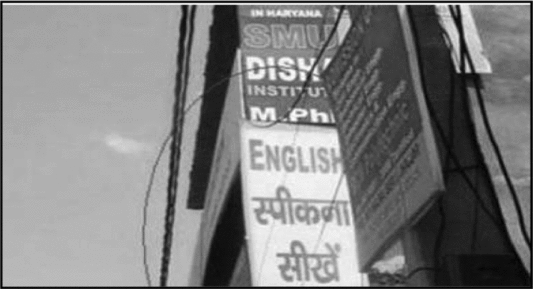
Figure 2, the code meshing in a banner that advertises English coaching classes is quite ironic. It says “English speakna seekhein” (i.e., “Learn to speak English”). The word “English” has been printed in Roman script, while the verb “speakna” (i.e., to speak) has been hybridized with both languages and printed in Hindi. Only “seekhein,” an originally Hindi word, appears in its own script.
Figure 2
Unlike Hindi language (and most Indian languages), the Urdu script changes directions. Urdu is read from right to left, and the challenge to make sense doubles in such texts. This challenge is evident in print media, where advertisements would have both English and Urdu texts meshed in fascinating ways. The advertisement in
Figure 3is an offer to obtain a free CD with two 1.5-liter bottles of Coke (translation: “Now with two 1.5-liter Cokes, you get a free Coke Studio Favorites CD”). From line 1, it wouldn't be clear from which side to start reading the text. One would assume that it should be read from the left side (since it includes a word in English), but the statement makes sense when one begins on the right. However, from line 3 the direction switches to English. Readers are expected to negotiate the directionality of reading through context, intuition, and guess work. As many scholars have pointed out, such hybridity in language use, which they call plurilingualism, is quite common to the language ecology of the region (Canagarajah, Reference Canagarajah2009; Khubchandani, Reference Khubchandani1997). What is perhaps new is the new media contexts and new languages featured in these communicative practices nowadays.
Figure 3
From this perspective, we have to take another look at the mixed language instruction in classrooms that we discussed in the previous section. Though such pedagogical practice may not be successful in developing advanced proficiency in so-called standardized varieties of English, it might develop plurilingual competence. Let's now take a closer look at classroom interactions in the region. The medium of instruction in these schools is often bilingual, with explanations in the regional language (Shamim & Allen, Reference Shamim and Allen2000; see also Mansoor, Sikandar, Hussain, & Ahsan, Reference Mansoor, Sikandar, Hussain and Ahsan2009). In an effort to help students who have no exposure to English or to make up for their own limited training and resources, teachers accommodate diverse local languages with English. One also frequently comes across textbooks that often feature multiple languages. The mixing takes various forms and plays various functions. Sometimes, readers are given English equivalents for scholarly terms as annotations. Sometimes instructions and clarifications are provided in local languages for materials in English. Consider the following illustrations from Indian and Pakistani academic books:
In
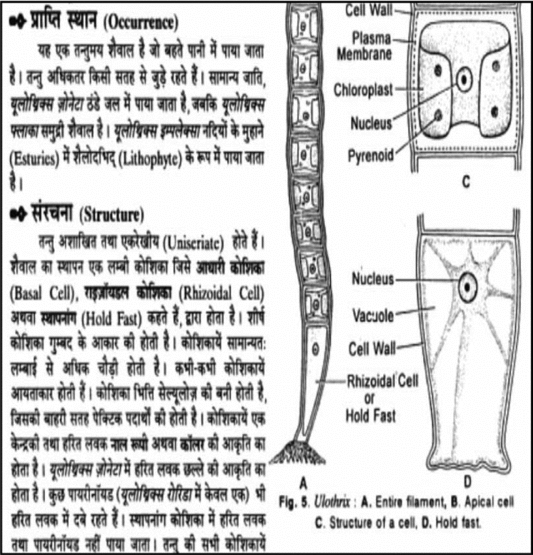
Figure 4, from a science textbook used in India, the structure of the cell is labeled in English, while the adjacent text is in Hindi with English annotations for technical or scientific terms. Such texts put to test the traditional monolingual assumptions of literacy as graphocentric (i.e., featuring only one language at a time; Mignolo, Reference Mignolo2000). One may also come across locally produced books, where the text may be in English, but instructions for teachers and students are in local languages (see also Ramanathan, Reference Ramanathan2005). In
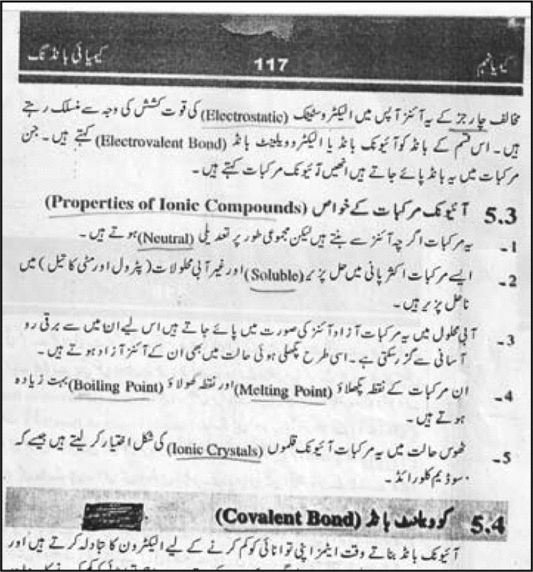
Figure 5, from a textbook in Pakistani schools, the Urdu text is interspersed with English annotations in translations as for ionic, neutral, and soluble. English terminology is repeated in parenthesis, in addition to phrases in English without Urdu equivalents. The insertion of English is followed by different masculine and feminine verbs as per Urdu verb requirement, thus negotiating the English neutral objects along with it. Using both English and Urdu (or any other local language) is a normal feature in classrooms (Hakim, Reference Hakim2010). Since technical or scientific terms in local languages are less well known, the texts introduce the better-known English terms in their textbooks in the vernacular medium.
Figure 4
Figure 5
Some mixing of languages can also be found in textbooks designed to teach English.
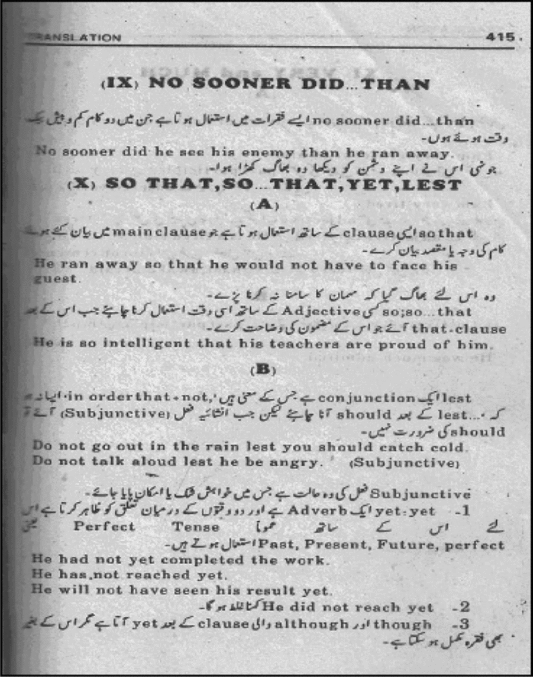
Figure 6, which is from an English grammar book in Pakistan, illustrates the syntax changes, transliteration, and language mixing to develop English language skills (Hakim, Reference Hakim2010). These materials, therefore, rely on Urdu for learning English.
Figure 6
The textbook below in Figure 6 uses Urdu to illustrate how different phrases in English (no sooner did . . . than, so that, yet, lest) are used. It describes in Urdu the context, phrases, and clauses in which these expressions are used in English sentences.
To clarify the language repertoires needed for local people in their everyday communication, we mustn't think that only these hybrid varieties are always required. There are also the expectations of elite varieties of English. While even the best private schools can at best develop an Indian or Pakistan variety of English, as the teachers are inevitably local, the needs of globalization and outsourced industries sometimes require nonlocal varieties of English. Some recent studies on call centers discuss the English proficiency levels demanded in such domains (see Blommeart, Reference Blommeart2010; Cowie, Reference Cowie2007; Tariq Rahman, Reference Rahman2009). There is an effort to neutralize the local accent in order to cross linguistic boundaries and speak like native British or Americans (Cowie, 2007; Tariq Rahman, Reference Rahman2009). The training for local employees involves the substitution of certain phonetic, phonological, and prosodic features of native (American and British) varieties of English for Indian (and Pakistani) varieties of English. Having undergone British colonization, people in both India and Pakistan have divided opinions on preferences for British versus American English. The older generation (age 30+) in India (Cowie, 2007) and (age 50+) in Pakistan (Tariq Rahman, Reference Rahman2009) shows a preference for a British accent, while the younger generation is keen to use American English. From this perspective, there is a negative evaluation of the local varieties: Indian English or Pakistani English. Such tensions throw light on the gaps between the skills demanded in outsourced work sectors and those that are learned in the educational institutions in the region. Furthermore, in the curriculum of both countries the major focus is on reading and writing. Until very recently, listening and speaking were not addressed in most language pedagogy. Employment centers, however, focus on communicative practices and interactional skills. Local people, then, must not only learn to engage in hybrid language practices but also need the competence to engage in translocal varieties of English for certain contexts. This realization conveys the scope of the repertoires local people need for social life.
The above studies point to the gap between the orientation to language of the state (as expressed in its language policy) and the orientation to language in everyday contexts. The plurilingual communicative practices we see in schools and social domains point to a different orientation to language contact. While the policy statements envision the relationship between languages in one way, everyday practices at the ground level point to a different orientation. We will turn to this distinction below.
A PERSPECTIVE FROM LOCAL TRADITIONS AND PRACTICES
What we learn from the communicative practices both inside and outside classroom in this region is a different orientation to the relationship between languages. One might say that while the TLF is modeled around the notion of multilingualism, everyday practices revolve around plurilingualism. The difference can be summarized as follows: While multilingualism treats the different languages as having their separate systems, enjoying autonomy, plurilingualism perceives these languages as meshing with each other to form hybrid grammatical and communicative practices (for a detailed discussion of this difference, see Canagarajah, Reference Canagarajah2009, Reference Khubchandani, May and Hornberger2013). In terms of competence, while multilingualism perceives language proficiency as constituting separate competencies in each language involved, the plurilingual orientation perceives the competence as constituting an integrated repertoire. There are powerful pedagogical implications deriving from this distinction. Plurilingualism would mean that advanced proficiency in all the relevant skills is not required for the languages in one's repertoire. People in the region use different languages for different functions with the required levels and types of proficiency in each. In this sense, there will be varied proficiency in each of the languages in their repertoire. What we learn from history is that language relationships and competencies in this region have a rich plurilingual tradition, which is not reflected in the contemporary multilingual policies that are modeled around modernist philosophical assumptions introduced after European colonization. It is important to understand this plurilingual orientation to explain the failure of the current policies and envision new language plans.
Because of various philosophical, social, and economic reasons, plurilinguality in South Asia helped maintain most of the regional languages despite functional hierarchies (Annamalai, Reference Annamalai2001; Canagarajah, Reference Canagarajah2009; Khubchandani, Reference Khubchandani1997, Reference Khubchandani, May and Hornberger2008; Tariq Rahman, Reference Rahman and Hathaway2005, Reference Rahman2011). According to Annamalai (Reference Annamalai2001), there has always been a tendency to accept new languages, along with the ability to live with and accept other languages, cultures, and religions in this region. This openness allows for mixing of languages and cultures as a regular phenomenon for communication at different stages and contexts. The Indian caste system prevented upward social mobility through languages, which helped sustain many indigenous languages. Plurilingualism was also fostered through intermarriages among communities belonging to similar language groups. People were, therefore, open to accepting and adapting new languages for the different customs and interactions (see Pandit, Reference Pandit and Wurm1979).
This plurilingualism has also been maintained through diverse social functions of communication for different languages. To begin with, one's mother tongue is a symbol of one's ethnicity, which may or may not be adopted in economic or political domains. The mother tongue may not be the language of education, due to the diversity of languages spoken in this region. One's mother tongue may even be a minority language, or minority in a specific location while dominant in another. In addition to one language for ethnic identity, there could be one for business transactions, one for official dealings, one for entertainment, one for religious rituals, and some others for education (Annamalai, Reference Annamalai2001). People hold these multiple linguistic identities in tension. They shift linguistic codes as they move from one social domain to another. They may call into play different linguistic identities in different contexts, or many at the same time, depending on the extent of formality or needs (Annamalai, Reference Annamalai2001; Khubchandani, Reference Khubchandani, May and Hornberger2008). These constant shifts help avoid identity crises, as language conflict may not arise in one's personal space when the social distances are underplayed. Yet through marked shifts of code, one may manage distance or hierarchy (Annamalai, Reference Annamalai2001).
Other forms of variations are on the situational axis (see Annamalai, Reference Annamalai2001). In formal and informal domains, people switch among dialects, codes, and languages. Speakers manipulate the marked features for particular social purposes. Politeness forms mark the hierarchical differences of interlocutors. On the horizontal dimension are the variations of lexicon, grammar, and codes, as one may borrow from various languages and dialects; on the vertical dimension are the geographical distribution and the stratification due to the caste system (specific to India), and the class divide common to both India and Pakistan (Annamalai, Reference Annamalai2001).
The maintenance of functional languages therefore doesn't just imply demographic presence. In other words, language varieties cannot be always associated with a particular community claiming ownership over it. Furthermore, according to Annamalai (Reference Annamalai2001), the functional status of languages and their distribution are not static, as new languages keep overtaking others due to changes in the social and political environment. A language is believed to have continuity of maintenance if it is at least acquired at some level of competence in the successive generations to perform personal, family, or social functions (Annamalai, Reference Annamalai2001). Many languages may have cultural values for their speakers, though not economic value, especially the mother tongue. This fluidity also helps maintain languages as well as a repertoire of languages. Language acquisition for diverse functions thus becomes part of the dynamics of language maintenance in the subcontinent. The shift is not in replacement of one mother tongue by another, “but the shift in the composition of the languages of the repertoire in terms of their functions and numbers” (p. 69).
The mixing of codes is an expression of the blurring of identities of languages in both India and Pakistan. The fuzziness of boundaries makes it difficult to distinguish one language or dialect from another. Many of these languages do not have more than a thousand speakers; and yet many dialects and languages are maintained due to mutually intelligible varieties that allow for communication (Tariq Rahman, Reference Rahman2002, Reference Rahman, May and Hornberger2008). Unlike other communities, where ethnic differences are preserved through languages, in South Asian countries languages also help maintain overarching community identity with other groups (Canagarajah, Reference Canagarajah2009). People resort to constructing and using contact languages for such purposes. Many scholars consider the Urdu, Hindi, Punjabi, Potohari, Pahari, and Gujrati spoken in Pakistan and North India as distinguished more on ideological rather than linguistic grounds (see Khubchandani, Reference Khubchandani, May and Hornberger2008; Tariq Rahman, Reference Rahman2002). The rigid distinction between languages and dialects becomes immaterial in communication at the everyday ground level.
Consider the relationship between Urdu and Hindi, the dominant national languages of Pakistan and India, respectively. Both are derived from a common language and are mutually intelligible in spoken form. During the British rule, the language was referred to as Hindustani, and even earlier as Hindvi. Treated as a common lingua franca, and if considered in combination, Hindi/Urdu currently has more than 1,017,290,000 speakers, for a majority of whom these are second dialects (Tariq Rahman, Reference Rahman2011). In a history of similarities and differences between Urdu and Hindi, Tariq Rahman (Reference Rahman2011) threw light on the procedural implications of the standardized varieties of languages, and corpus planning that break the speech continuum in the plurilingual subcontinent where the learned varieties of languages become polarized. Tariq Rahman delineated the spoken form of Urdu and Hindi, as popularized by Bollywood, and Indian and Pakistani songs followed by people in both countries. Thanks to globalization and social media, these popular films and songs are also available in Afghanistan, the United States, the United Kingdom, the Middle East, African countries, and even far-off islands like Fiji. The language is taught in both Hindi and Urdu varieties in world universities. In the spoken form today, Hindi and Urdu are the most widespread varieties of languages among common people. Some variety of this language has been the lingua franca of the subcontinent for a long period in the history of this region. Most of the spoken forms used in both Pakistan and North India, especially in the urban and popular culture, are still referred to as Hindustani, and the distinction between both languages is not considered significant. Nevertheless, corpus planning has now altered the language so that Hindi and Urdu are now at two opposite ends of the continuum at the literate level. As linguistic historians describe them:
These standardized varieties, Sanskritized-Hindi and Perso-Arabicized Urdu, diverge so much from each other at the higher, more learned levels that they are almost unintelligible for the speakers of the other variety. (Tariq Rahman, Reference Rahman2011, p. 4)
Similar comparisons may be drawn between the Bengali spoken in West Bengal in India and Bangla in Bangladesh. Such polarization is visible in the corpus planning of many languages in India (Annamalai, Reference Annamalai2001). As a result of this, the spoken and written varieties differ considerably in lexicon and morphology. The varieties come closer in spoken forms. The polarized new corpus of communication discourages code mixing. The practices of people, on the other hand, allow for hybridization and the continual restructuring of the linguistic repertoire.
LOOKING TO THE FUTURE
Could such a dynamic and hybrid plurilingual tradition be translated into structured language-in-education policies? This is a creative and imaginative enterprise, one of thinking outside the box to devise contextually relevant and socially appropriate policies for each country. What we can do in this chapter is to identify emergent policy and pedagogical approaches to show the differences with currently dominant models and inform policy alternatives. There is also a strong consensus forming among local scholars that a return to traditional models will paradoxically help the region grapple with the needs of globalization in late modernity. Several scholars warn of the danger in responding to the needs of globalization from an exogenous perspective, adopting Western language models. Shamim (Reference Shamim2008, Reference Shamim and Coleman2011) argued against policy decisions that are driven mainly by global change forces. Shamim feared that recent policy changes in Pakistan create more harm than good.
Khubchandani (Reference Khubchandani, May and Hornberger2008) has been a longtime critic of current policies and an advocate for returning to traditional orientations to language in the region, arguing that contemporary educationists stick to traditional standard language pedagogy centered on monolingual proficiencies and discourage mixing of languages. Khubchandani argued for a pluralistic model that has a grassroots approach in education that appreciates the diversity in various language forms and in speech varieties in everyday life. The grassroots approach makes education more meaningful and productive as sensitivity to speech variety and grasp over the ethos of multilingual communication would enhance language skills in natural settings.
Various constraints in the spread of education are attributed to the multiplicity of languages, whereas the real issues to cope with are the confrontation between tradition and modernity concerning the role of language in education, and the dogmatic rigidity in claiming privileges and parity of different languages in the thrust for autonomy. (Khubchandani, Reference Khubchandani, May and Hornberger2008, p. 379)
Based on the plurilingual tradition described in the last section, we can understand why Khubchandani (Reference Khubchandani, May and Hornberger2008) was critical of policies based on “privileges and parity.” He favored a pedagogy that facilitates functional proficiency in different languages for different purposes.
Khubchandani (Reference Khubchandani1997) also helped theorize the underlying differences between the local and exogenous models for language diversity. He observed that local practices in South Asia display an organic pluralism, different from modernist Western practices that display a structural pluralism. In an organically pluralistic society, individuals belonging to different ethnoreligious and ethnolinguistic backgrounds have an integral relationship that can be represented as 1 × 1 × 1 = 1, thus proliferating difference. Structural pluralism, as it exists in the Western world, is based on the premise that different primary groups are separate in terms of their ethnolinguistic and ethnoreligious affiliations. This premise can be represented as 1 + 1 + 1 = 3, which is a combined relation and attempts to contain difference. Khubchandani considered practices of language contact of the past as more fluid, less socially stratified, and less institutionally imposed. The different language groups are melded into a richer and integrated whole without losing their separate identities in the South Asian model, whereas languages and communities are compartmentalized in the Western model.
Ajit Mohanty argued that language pluralism in South Asia works most effectively through functional distribution of languages, not hierarchies. He averred that the modernist policy based on centralized single languages and hierarchy of differences (such as TLF) are alien to the practices and ethos of the region. What is indigenous to the region is how individuals, families, and communities assign different languages for different domains of communication without treating one as superior to the other. Drawing an analogy from his personal life to illustrate the complementary relationship between languages, Mohanty (Reference Mohanty, Skutnabb-Kangas and Garcia2006) said: “These languages fit in a mutually complementary and non-competing relationship in my life. Under such conditions of multilingual functioning individuals naturally need and use different languages because no language is sufficient or suitable for meeting all the communicative requirements across different situations and social activities” (p. 263). Mohanty argued that such patterns of individual and community bilingualism at the local or regional level constitute “the first incremental step towards concentric layers of societal multilingualism” (p. 263). He went on to argue that the strategy of individuals and communities to accommodate languages rather than separate them, thus becoming more plurilingual, is the secret for the “stable form of bi/multilingualism in contact situations in India” (p. 264). He found that the imposition of English in colonial times and now as the global language upset the balance in India, leading to social and educational policies based on hierarchical relationship of languages, resulting in the denigration of certain minority languages, language loss, and attrition.
The observations of Khubchandani and Mohanty show them favoring a policy based on complementary rather than hierarchical and exclusive relationship between languages. To some extent, certain non-Western communities (India, Singapore, Hong Kong, Brunei, and countries in the Middle East and North Africa), have adopted forms of education that provide a complementary relationship to languages. Garcia (Reference Garcia2009) called this multiple multilingual education:
[These programs] use more than two languages in education and often have moveable parts—that is, languages are weaved in and out of the curriculum as needed. Multilingualism is considered a resource for all children in the society. As a result of the inclusion of all children, there is considerable variation in bilingual proficiency; translanguaging is therefore a common feature of this education. Transculturalism is promoted, as not only languages, but also cultures, are blended. (p. 283)
If we treat Garcia's term “translanguaging” as similar to plurilingualism, we can see how the practices promoted in this form of education go against dominant policies of multilingualism. Students may learn different subjects in different languages. The goal is not to develop parity of competence in all languages. Switching and mixing languages in classrooms is permitted. Language awareness is combined with intercultural competence. Along these lines, Hornberger (Reference Hornberger2003), in the continua of biliteracy model, identified four intersecting variables along what she called a traditionally less powerful versus traditionally more powerful continuum. The variables are context (micro/macro, oral/literate, bi(multi)lingual/monolingual), development (reception/production, oral/written, L1/L2), content (minority/majority, vernacular/literary, contextualized/decontextualized), and media (simultaneous exposure/successive exposure, dissimilar structures/similar structures, divergent scripts/convergent scripts; Hornberger, Reference Hornberger2003, p. 39). Teachers and policymakers would find the right balance in relation to the subject, language of instruction, teacher, and context of the school to develop an appropriate curriculum. An imbalance among these considerations leads to the hegemony of some languages over others and goes against the development of plurilingualism. Such pedagogies are not merely aspirational. In some South Asian pedagogical contexts, teachers are already adopting such approaches. Ramanathan (Reference Ramanathan2006) drew on data from English language classrooms where hybridized pedagogical practices exhibited vernacular-medium teaching of English language textbooks. English teachers were encouraged to switch to the local or vernacular. Such hybridized pedagogical approaches develop plurilingual language competence.
We must be careful not to treat plurilingualism as a laissez-faire approach of letting every language compete for people's attention. Language relationships are not equal, and some languages do lose out. Besides, certain languages are important for people's identities and chosen affiliations. In South Asia, local communities do identify with certain mother tongues, though critical linguists consider the label ideological. However, language ideologies are enabling as well as limiting, and an identification with the mother tongue is empowering for certain communities. As argued by Khubchandani (1983, cited in Khubchandani, Reference Khubchandani, May and Hornberger2008), the term mother tongue is categorized by one's allegiance to a particular tradition, and it is societally identifiable. While mixed codes are natural to the speakers in this region, an affiliation with mother tongues is also natural. Therefore, a plurilingual approach that affirms mother tongues—without disregarding plurilingual communicative patterns and yet demystifies monolingual target language proficiency as in English—is consistent with local traditions and practices.
Skutnabb-Kangas (Reference Skutnabb-Kangas2009) argued against teaching an indigenous/minority/tribal child in any other language (including the national language, such as Nepali) than the mother tongue. She therefore recommended a mother-tongue-based multilingual education (MLE) for the first eight years of education. Developing proficiency in all other languages including English becomes faster and better if the child becomes proficient in mother tongue or first language, according to Skutnabb-Kangas. Teaching through any other language in the first few years at school would make the child mechanically repeat lessons without developing the capacity to linguistically function in that language. (See also Nurmela, Awasthi, & Skutnabb-Kangas, Reference Nurmela, Awasthi, Skutnabb-Kangas, Heugh and Skutnabb-Kangas2010.) MLE is not irreconcilable with the pedagogical approach promoted in this article.
Since dominant orientations to language competence treat proficiency as developed for separate languages, in isolation from each other (see, for a critique, Firth & Wagner, Reference Firth and Wagner2007), scholars are now retheorizing language competence to accommodate plurilingual repertoires (see Atkinson, Reference Atkinson2011; Canagarajah, Reference Canagarajah2013). Already, students in the region are developing a rich metalinguistic competence as they shuttle between languages in their textbooks and classroom discourse, as we saw earlier. Similarly, those who engage in hybrid language practices in everyday life are exercising a plurilingual competence that they have developed through socialization in local interactions. Scholars have identified the pedagogical shifts that would facilitate such a competence (see Canagarajah, Reference Canagarajah2013). Rather than focusing on a single language or dialect as the target of learning, teachers have to develop in students a readiness to engage with a repertoire of codes in transnational contact situations. While joining a new speech community was the objective of traditional pedagogy, now we have to train students to shuttle between communities by negotiating the relevant codes. To this end, we have to focus more on communicative strategies than on forms of communication. Students would develop language awareness (to cope with the multiple languages and emergent grammars of contact situations), rather than focusing only on mastering the grammar rules of a single variety. In a context of plural forms and conventions, it is important for students to be sensitive to the relativity of norms. Therefore, students have to understand communication as performative, not just constitutive. That is, going beyond the notion of constructing prefabricated meanings through words, they will consider shaping meaning in actual interactions and even reconstructing the rules and conventions to represent their interests, values, and identities. In other words, it is not what we know as much as the versatility with which we can do things with language that defines proficiency. Pedagogical movements such as learner strategy training and language awareness go some way toward facilitating such instructional strategies and repertoire development. Such competence might enable students to both engage in hybrid practices and recognize elite norms for more regulated institutionalized and translocal purposes. Such pedagogical shifts will enable them to balance global functions with local identities, and transnational mobility with a grounding in local values and resources.