Introduction
It is well established that psychotic experiences (PEs) are common in adolescents, with the prevalence reported to be 7.5% (Kelleher et al. Reference Kelleher, Connor, Clarke, Devlin, Harley and Cannon2012a ). PE encompass delusional or hallucinatory experiences that are on a continuum with psychotic symptoms however they are usually experienced with less frequency and conviction, and reality-testing generally remains intact (Kelleher et al. Reference Kelleher, Devlin, Wigman, Kehoe, Murtagh, Fitzpatrick and Cannon2013). Adolescents endorsing PE are more likely to have mental health problems, as manifested by both internalizing and externalizing symptoms (Yoshizumi et al. Reference Yoshizumi, Murase, Honjo, Kaneko and Murakami2004; Laurens et al. Reference Laurens, West, Murray and Hodgins2008; Scott et al. Reference Scott, Martin, Bor, Sawyer, Clark and McGrath2009; Kelleher et al. Reference Kelleher, Murtagh, Molloy, Roddy, Clarke, Harley and Cannon2012d ). Although PEs are transitory in most individuals, persistence of psychotic experiences is associated with increased likelihood of poor mental health outcomes and an associated need for care (Hanssen et al. Reference Hanssen, Bak, Bijl, Vollebergh and Van Os2005; Rubio et al. Reference Rubio, Sanjuan, Florez-Salamanca and Cuesta2012; Linscott & van Os, Reference Linscott and van Os2013).
Suicidal ideation and behaviours and non-suicidal self-injury (NSSI) are also serious mental health concerns in adolescents. In particular NSSI, defined as the self-inflicted deliberate destruction of body tissue without suicidal intent (Nock, Reference Nock2010), is common and carries a significant cost to the community (Martin et al. Reference Martin, Swannell, Hazell, Harrison and Taylor2010). Systematic reviews of adolescent NSSI has reported a lifetime prevalence of greater than 15% internationally (Muehlenkamp et al. Reference Muehlenkamp, Claes, Havertape and Plener2012; Swannell et al. Reference Swannell, Martin, Page, Hasking and St John2014). Determining associated risk factors for NSSI will inform potential methods of screening and interventions. To date, no studies of adolescents have examined the association between PE and NSSI.
However, three studies using adolescent samples have examined the association between PE and suicidal ideation and behaviours (Nishida et al. Reference Nishida, Tanii, Nishimura, Kajiki, Inoue, Okada, Sasaki and Okazaki2008; Kelleher et al. Reference Kelleher, Lynch, Harley, Molloy, Roddy, Fitzpatrick and Cannon2012c , Reference Kelleher, Devlin, Wigman, Kehoe, Murtagh, Fitzpatrick and Cannon2013). Nishida et al. (Reference Nishida, Sasaki, Nishimura, Tanii, Hara, Inoue, Yamada, Takami, Shimodera, Itokawa, Asukai and Okazaki2010), conducted a cross-sectional survey in a school-based sample (aged 12–15 years, N = 4894) to investigate the relationship between PE and risk of suicide. Psychotic experiences were assessed using four items from the Diagnostic Interview Schedule for Children (DISC). PEs were associated with suicidal feelings and deliberate self-harm, after controlling for psychological distress (PD) as measured by the General Health Questionnaire-12 (GHQ-12). There was a dose–response relationship between the number of PEs endorsed and the odds of suicidal ideation and behaviours (Nishida et al. Reference Nishida, Sasaki, Nishimura, Tanii, Hara, Inoue, Yamada, Takami, Shimodera, Itokawa, Asukai and Okazaki2010). The study did not examine if the self-harm was associated with suicidal intent or otherwise.
Kelleher et al. (Reference Kelleher, Lynch, Harley, Molloy, Roddy, Fitzpatrick and Cannon2012c ) reported the association between PEs and suicidal behaviour, using two independently conducted case-control clinical interview studies with adolescents in community samples (N = 212, N = 211, respectively). PEs were associated with significantly increased odds of any suicidal behaviour (ideation, plans, or acts). In addition, those adolescents who had a depressive disorder and PEs were significantly more likely to experience suicidal ideation compared to those with depressive disorder only. Similarly, in a case-control study of adolescent patients, Kelleher et al. (Reference Kelleher, Lynch, Harley, Molloy, Roddy, Fitzpatrick and Cannon2012c ), reported those patients with a depressive, anxiety or behavioural disorder who also had PEs were at increased odds of suicide attempts, compared to adolescents with the same disorders and no PE. Together these studies suggest that PEs are an important risk factor for suicidal ideation and behaviours in adolescents. However, all three studies were cross-sectional, preventing any examination of the temporal relationship between PE, PD and suicidal ideation and behaviours. The cross-sectional methodology also precluded examination of the association between persistent PEs and suicidal behaviour. Finally, the highly prevalent problem of NSSI and its association with PE is yet to be researched.
In a longitudinal study of adolescents, we aimed to examine associations between PEs (including persistent PE), and contemporaneous and incident NSSI and suicide attempts. We hypothesized that PEs both with and without PD would be associated with current and future NSSI and suicide attempts. Furthermore, we predicted that persistent PEs would be strongly associated with an increased risk of NSSI and suicide attempts.
Method
Participants
Participants were drawn from the HEALing Project (Helping to Enhance Adolescent Living), a longitudinal cohort study of Australian adolescents (12–17 years). Forty-one secondary schools (23 Catholic, 18 independent) agreed to participate in the study. An information sheet and consent form was sent home to parents of 14841 students, of which 3119 (21%) were returned, a participation rate consistent with previous Australian school-based studies of adolescents (Yung et al. Reference Yung, Buckby, Cotton, Cosgrave, Killackey, Stanford, Godfrey and McGorry2006, Reference Yung, Buckby, Cosgrave, Killackey, Baker, Cotton and McGorry2007; Armando et al. Reference Armando, Nelson, Yung, Ross, Birchwood, Girardi and Nastro2010). Of those with parental consent, 2640 (85%) students completed the survey at baseline (T0). Of these, 1975 (75%) completed the survey at 1-year follow-up (T1). Reasons for non-participation at follow-up (n = 665) included absenteeism (65%), withdrawal of one school (17%), students no longer enrolled at the school (14%), and withdrawal by parent or student (4%). There were no cases of suicide completion in the sample.
Four students were excluded because they were older than 17 years at both data collection points, and 75 were excluded because they did not complete all psychosis items and all the PD items. In total, 1896 (mean = 14.87 years, s.d. = 0.95, 71.6% female) participants were included in this study. Due to the participation of 11 single-sex girls’ schools, females were over-represented relative to the Australian adolescent population (50.3%) (Australian Bureau of Statistics, 2011). The remainder of the sample were from three single-sex boys’ schools, and 27 co-educational schools. Overall, 52.1% of participants identified as being religious with most reporting being Catholic (27.1%), or unspecified Christian (18.9%). Relative to the Australian population, the sample were more likely to live in metropolitan and higher socioeconomic areas. Consistent with the national population of Australian adolescents, most participants were born in Australia (89.4%), and 2.4% identified as Aboriginal or Torres Strait Islander (Australian Bureau of Statistics, 2008a , b ).
Procedure
The study was approved by Monash University and The University of Queensland Research Ethics Committees, with ethical clearance also obtained from relevant Catholic Education Archdioceses. Consent was provided by school principals, parents and students. On the day of survey administration, a researcher was present to address any issues raised by participation in the study. Information contained in the survey was treated as confidential and not provided to schools or parents. However, if a student's responses indicated imminent mental health risk requiring referral to a mental health professional, the school counsellor was informed. On completion, students were given information packs containing brochures promoting youth mental health awareness, and telephone contact details and online resources of national mental health support services.
Measures
The Self-Harm Behaviour Questionnaire (SHBQ) is a four-part self-report measure of NSSI and suicide attempts (Gutierrez et al. Reference Gutierrez, Osman, Barrios and Kopper2001). Each section comprises forced choice and free response items, used to assess features of self-injurious behaviours including intent, frequency, methods and potential lethality. The SHBQ has good psychometric properties across young adult and adolescent community samples (Gutierrez et al. Reference Gutierrez, Osman, Barrios and Kopper2001; Brausch & Gutierrez, Reference Brausch and Gutierrez2010). In the current study, we used Part A, specifically designed to measure NSSI. This includes the items ‘Have you ever hurt yourself on purpose?’ (yes or no), if yes, ‘What did you do?‘(free response), ‘Approximately when did you first do this to yourself?‘(age in years), and ‘When was the last time you did this to yourself?’ (T0: age in years; T1: 1–3 weeks, 1 month, 2–6 months, 7–12 months or >12 months ago). Suicide attempts were assessed using the items ‘Did you ever try to end your life?’ (yes or no), if yes ‘What did you do?’ and ‘How did you try to end your life?’
The GHQ-12 is a self-report screening measure, extensively used to assess PD in the general population (Goldberg & Williams, Reference Goldberg and Williams1988; Goldberg et al. Reference Goldberg, Gater, Sartorius, Ustun, Piccinelli, Gureje and Rutter1997). Although originally developed for adult populations, the GHQ-12 has subsequently been used and validated for adolescents (D'Arcy & Siddique, Reference D'Arcy and Siddique1984). The GHQ comprises 12 statements about perceived psychological wellbeing, half are positively framed (e.g. ‘Over the past few weeks, have you been able to enjoy your normal day to day activities?’) and half negatively framed (e.g. ‘Over the past few weeks, have you lost much sleep over worry?’). Participants rated each item on a 4-point scale; for positively framed items 0 is ‘more so than usual’ and 3 is ‘much less than usual’. For negatively framed items 0 is ‘not at all’ and 3 is ‘much more than usual’. A total GHQ-12 score was calculated by summing all scores, where higher scores indicated increased levels of PD.
The DISC is a structured standardized instrument used for diagnosis of mental disorders in children and adolescents (Costello et al. Reference Costello, Edelbrock, Kalas, Kessler and Klaric1982). Three DISC items assess for delusions and one item for hallucinations. Participants respond to each item as either ‘no’, ‘yes, likely’ or ‘yes, definitely’. These four items have been used to screen for PEs in adolescents (Poulton et al. Reference Poulton, Caspi, Moffitt, Cannon, Murray and Harrington2000; Kelleher et al. Reference Kelleher, Keeley, Corcoran, Lynch, Fitzpatrick, Devlin, Molloy, Roddy, Clarke, Harley, Arseneault, Wasserman, Carli, Sarchiapone, Hoven, Wasserman and Cannon2012b ), and have previously shown good predictive validity of clinical psychotic symptoms (Kelleher et al. Reference Kelleher, Harley, Murtagh and Cannon2011).
Statistical analysis
Total GHQ-12 scores were calculated by summing scores (0, 1, 2, 3) for each item. Participants were classified according to sex-stratified cut-offs previously reported in an Australian adolescent sample (Tait et al. Reference Tait, French and Hulse2003). Males were classified as experiencing PD if they scored ⩾13, and females were classified if they scored ⩾18. Participants were classified as endorsing PEs if they responded ‘yes, definitely’ to any of the four psychosis items from the DISC. Using participants’ responses at T0, adolescents were grouped as follows: (i) no PD and no PE (reference group), (ii) PD only, (iii) PE only, (iv) PD and PE. Responses to SHBQ items at T0 and T1 were used to assess NSSI and suicide attempts independently. Adolescents reporting only one act of NSSI were excluded from analyses (N = 37), given recent debates arguing that a single act may be experimental and a non-genuine form of NSSI (Wan et al. Reference Wan, Hu, Hao, Sun and Tao2011). Incident NSSI (two or more reported acts), and incident attempted suicide 1 year later were coded if the participant responded ‘no’ at T0 but ‘yes’ at T1.
We first examined the descriptive statistics stratified by sex of PD, PEs, NSSI and suicide attempts at baseline and follow-up. Using logistic regression, we examined the relationship between PE and PD at baseline adjusting for age and sex.
Multivariate logistic regression was used to examine unadjusted cross-sectional association between the four PD and PE groups [no PD and no PE (reference group), PD only, PE only and PD and PE] and (i) NSSI and (ii) attempted suicide at baseline. In the second model we adjusted for age and sex. We then examined the association between PD and PE groups at baseline, and incident NSSI and attempted suicide 1 year later. In the longitudinal analyses the reference group had no history of PD or PE at baseline, nor did they have any history of (i) NSSI at baseline, or (ii) attempted suicide at baseline.
To examine the association between PE persistence and NSSI and suicide attempts, participants were categorized into four groups: (i) those who did not report PE at baseline or follow-up (reference group), (ii) those who reported PE at baseline but not at follow-up (PE remit group), (iii) those who did not report PE at baseline but did at follow-up (PE onset group), and (iv) those who reported PE at both baseline and follow-up (PE persistent group). We then explored the unadjusted (model 1) association between PE persistence, and (i) incident NSSI at follow-up, and (ii) incident attempted suicide at follow-up. As PE persistence has been shown to be associated with an increased need for care and therefore most likely PD, in addition to adjusting for age and sex, a second analysis (model 2) also adjusted for PD at baseline and at follow-up. A missing values analysis was undertaken to examine the percentage of missing data for predictor and outcome variables, where <5% of values were missing and were not significant. Therefore, analyses were conducted using complete cases. SPSS v. 20 (SPSS Inc., USA) was used for all analyses.
Attrition
Analysis of factors associated with attrition was conducted comparing those participating at baseline and follow-up (n = 1975), with those who were lost to follow-up (LTF) (n = 667). Adolescents LTF were older (t 2638 = 3.70, p < 0.001) and more likely to be male (χ 2 = 48.10, p = 0.001). Being LTF was not associated with PD. There was a non-significant trend for those participants with PEs to be LTF [χ 2(1, N = 2640) = 3.69, p = 0.06] and those reporting NSSI or attempted suicide at baseline were more likely to be lost to follow-up (OR 103.94, 95% CI 23.16–466.39, p < 0.001 and χ 2 = 4.63, p < 0.03, respectively).
Results
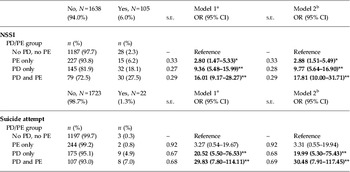
Descriptive sample characteristics of predictor and outcome variables are shown in online Supplementary Table S1. Participants were classified into four groups using baseline data: (i) those who neither endorsed PE nor were psychologically distressed (reference group, n = 1258, 69.6%), (ii) those who were psychologically distressed but did not endorse PE (PD only group, n = 191, 10.6%), (iii) those who endorsed PE but were not psychologically distressed (PE only group, n = 241, 13.3%), and (iv) those who were psychologically distressed and endorsed PE (PD and PE group, n = 118, 6.5%). Compared to adolescents with no PD, adolescents with PD had significantly increased odds of also reporting PE, after adjusting for age and sex (OR 3.14, 95% CI 2.40–4.11, p < 0.001).
NSSI at baseline
At baseline, 6% (n = 109) of participants had engaged in two or more acts of NSSI. Compared to the reference group, adolescents with PEs (only) had almost three times the odds of engaging in NSSI (OR 2.88, 95% CI 1.51–5.49). Those with PD (only) had nine times the odds of engaging in NSSI (OR 9.77, 95% CI 5.64–16.90). Twenty-seven percent of adolescents who were psychologically distressed and endorsed PEs reported engaging in NSSI (OR 17.81, 95% CI 10.00–31.71), (Table 1; see online Supplementary Fig. S1).
Cross-sectional relationship between psychological distress (PD) and psychotic experiences (PEs), and non-suicidal self-injury (NSSI), and suicide attempt

OR, Odds ratio; CI, confidence interval.
a Unadjusted.
b Adjusted for age and gender.
** p < 0.001, * p = 0.002.
Suicide attempt at baseline
At baseline, a small number of participants (1.3%, n = 22) reported having attempted suicide. There was a non-significant association between endorsement of PEs and attempted suicide (OR 3.31, 95% CI 0.55–19.94). Those adolescents who were psychologically distressed (only) had almost 20 times the odds of having attempted suicide (OR 19.99, 95% CI 5.30–75.43). Adolescents who were both psychologically distressed and endorsing PEs had more than 30 times the odds of having attempted suicide (OR 30.48, 95% CI 7.91–117.45). Given this was such a small group, effect sizes in this set of analyses may be inflated; however, standard errors (s.e.) indicated the model remained stable, all s.e.<0.92 (Table 1, see online Supplementary Fig. S2).
Incident NSSI at follow-up
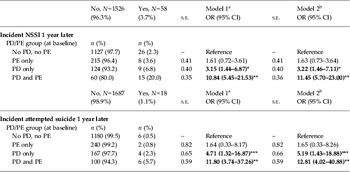
Overall, 3.7% (n = 58) of participants reported incident NSSI at 1-year follow-up. Compared to adolescents in the reference group (no history of PD or PE, no NSSI at baseline), those with PD (only) had three times the odds of incident NSSI (OR 3.22, 95% CI 1.46–7.11) and those who were psychologically distressed and reported PEs at baseline had 11 times the odds of incident NSSI at follow-up (OR 11.45, 95% CI 5.70–23.00). PEs in the absence of PD at baseline did not predict incident NSSI at 1-year follow-up (OR 1.63, 95% CI 0.73–3.64) (Table 2, see online Supplementary Fig. S3).
Association between psychological distress (PD) and psychotic experiences (PEs) at baseline, and incident non-suicidal self-injury (NSSI) at follow-up, and incident attempted suicide at follow-up

OR, Odds ratio; CI, confidence interval.
a Unadjusted.
b Adjusted for age and gender.
** p < 0.001, * p < 0.004, *** p < 0.02.
Incident suicide attempt at follow-up
Incident attempted suicide at follow-up occurred for a small percentage of adolescents (1.1%, n = 18). Compared to the reference group (no history of PD or PE, no suicide attempt at baseline), adolescents who were psychologically distressed (only) were significantly more likely to have attempted suicide in the year following (OR 5.19, 95% CI 1.43–18.88). However, there was no significant association between baseline PEs (only) and incident attempted suicide at follow-up (OR 1.65, 95% CI 0.33–8.26). One in 20 adolescents who had PD and PEs at baseline reported having attempted suicide in the following 12 months (OR 12.81, 95% CI 4.02–40.88) (Table 2; see online Supplementary Fig. S4).
Persistence of PEs and incident NSSI at follow-up
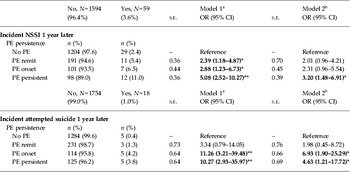
Participants were classified into four groups using baseline and follow-up data in order to determine the effect of PE persistence on the outcome variables: (i) those who did not report PE at baseline or follow-up (reference group, n = 1371, 72.3%), (ii) those who reported PE at baseline but not at follow-up (PE ‘remit group’, n = 246, 13.0%), (iii) those who did not report PE at baseline but did at follow-up (PE ‘onset group’, n = 131, 6.9%), and (iv) those who reported PE at both baseline and follow-up (PE ‘continuation group’, n = 148, 7.8%). After adjusting for age, sex, and PD at baseline and follow-up, there was no association between PE remission or PE onset and incident NSSI (OR 2.01 95% CI 0.96–4.21; OR 2.31, 95% CI 0.96–5.54, respectively), compared to adolescents with no history of PE or NSSI at baseline. However, adolescents with persistent PE (the PE ‘continuation group’) had significantly increased odds of reporting incident NSSI at follow-up (OR 3.20, 95% CI 1.48–6.91) independent of PD, age and sex, compared to adolescents with no history of PE or NSSI (Table 3; see online Supplementary Fig. S5).
Association between psychotic experiences (PE) persistence, and incident non-suicidal self-injury (NSSI) at follow-up, and incident attempted suicide at follow-up

a Unadjusted.
b Adjusted for age and gender, psychological distress baseline and follow-up.
** p < 0.001, * p < 0.03.
Persistence of PEs and incident suicide attempt at follow-up
Compared to the reference group (no history of PE, nor attempted suicide at baseline), there was no significant association between incident attempted suicide at follow-up and PE remission (OR 1.98, 95% CI 0.45–8.72). However, those adolescents who experienced onset of PEs or persistent PEs in the 12 months between sampling, were more likely to attempt suicide (OR 6.93, 95% CI 1.90–25.39 and OR 4.63, 95 CI% 1.21–17.72), after adjusting for age, sex and PD (Table 3; see online Supplementary Fig. S6).
Discussion
To the best of our knowledge this is the first longitudinal study to examine the association between PEs and contemporaneous and future NSSI and attempted suicide in adolescents. At baseline, participants who were either psychologically distressed or reported PEs were at increased risk of contemporaneous NSSI and those who were psychologically distressed had increased odds of having attempted suicide. Of concern, adolescents who were both psychologically distressed and had PEs had the strongest association with NSSI and suicide attempts with more than one quarter engaging in NSSI and 7% reported having attempted suicide.
In longitudinal analyses, adolescents with PD, with and without PEs were at significantly increased risk of future NSSI and attempted suicide. In contrast to our hypothesis, adolescents reporting PEs in the absence of PD were not at increased risk of future NSSI or attempted suicide. The final novel finding of this study was that independent of PD, those adolescents with incident PE were at increased risk of attempting suicide whilst those with persistent PE were at increased risk of both NSSI and attempting suicide.
Consistent with previous studies, participants commonly endorsed both PEs (Scott et al. Reference Scott, Martin, Bor, Sawyer, Clark and McGrath2009; Kelleher et al. Reference Kelleher, Keeley, Corcoran, Lynch, Fitzpatrick, Devlin, Molloy, Roddy, Clarke, Harley, Arseneault, Wasserman, Carli, Sarchiapone, Hoven, Wasserman and Cannon2012b ) and NSSI (Wilcox et al. Reference Wilcox, Arria, Caldeira, Vincent, Pinchevsky and O'Grady2012; Swannell et al. Reference Swannell, Martin, Page, Hasking and St John2014). This study extends previous findings, which report a relationship between PEs and PD (Nishida et al. Reference Nishida, Tanii, Nishimura, Kajiki, Inoue, Okada, Sasaki and Okazaki2008; Saha et al. Reference Saha, Scott, Varghese and McGrath2011b ) and a strong association between PEs and suicidal ideation and behaviours (Nishida et al. Reference Nishida, Sasaki, Nishimura, Tanii, Hara, Inoue, Yamada, Takami, Shimodera, Itokawa, Asukai and Okazaki2010; Saha et al. Reference Saha, Scott, Johnston, Slade, Varghese, Carter and McGrath2011a ; Kelleher et al. Reference Kelleher, Lynch, Harley, Molloy, Roddy, Fitzpatrick and Cannon2012c , Reference Kelleher, Devlin, Wigman, Kehoe, Murtagh, Fitzpatrick and Cannon2013). This association may be explained by the presence of risk factors common for PEs, NSSI and suicidal behaviours such as depressed mood and exposure to trauma and other adverse life events (Spauwen et al. Reference Spauwen, Krabbendam, Lieb, Wittchen and van Os2006; Scott et al. Reference Scott, Nurcombe, Sheridan and McFarland2007; Wilcox et al. Reference Wilcox, Arria, Caldeira, Vincent, Pinchevsky and O'Grady2012; Voon et al. Reference Voon, Hasking and Martin2013). It is also known that NSSI and suicidal behaviours are more likely to occur in people who are emotionally dysregulated (Wilcox et al. Reference Wilcox, Arria, Caldeira, Vincent, Pinchevsky and O'Grady2012; Voon et al. Reference Voon, Hasking and Martin2013), which has recently also been reported to occur in those with PEs (Armando et al. Reference Armando, Lin, Girardi, Righetti, Dario, Saba, Decrescenzo, Mazzone, Vicari, Birchwood and Fiori Nastro2013; Fusar-Poli et al. Reference Fusar-Poli, Nelson, Valmaggia, Yung and McGuire2014). In this study, the presence of PD strengthened the association between PE and current and future NSSI and suicide attempts.
PEs alone at baseline were not associated with contemporaneous suicide attempts or future NSSI or suicide attempts. The non-significant association between PE and suicide attempts at baseline was most probably attributable to the low numbers and lack of power for the analysis. The absence of an association between PE and future NSSI or suicide may reflect the fact that psychological morbidity is not always present in those with PEs (Daalman et al. Reference Daalman, Boks, Diederen, de Weijer, Blom, Kahn and Sommer2011). However, persistent PE was associated with an increased risk of incident NSSI and suicide attempts independent of PD. As previously reported, persistent PEs have been shown to be predictive of a greater need for care (Hanssen et al. Reference Hanssen, Bak, Bijl, Vollebergh and Van Os2005; Linscott & van Os, Reference Linscott and van Os2013) and are thought to reflect greater severity as reflected in increased frequency and intensity of the experiences (Rubio et al. Reference Rubio, Sanjuan, Florez-Salamanca and Cuesta2012).
Our results show the combination of PEs with PD in young people is a strong predictor of contemporaneous and future NSSI and suicidal behaviours. It identifies a symptom profile for adolescents who are at very high risk of future suicide attempts. This emphasizes the importance of clinicians screening distressed help-seeking adolescents for PEs to ensure appropriate support and risk management plans can be instigated, so as to reduce the likelihood of the adolescent attempting suicide. It also enables scarce resources available for targeted interventions to prevent suicide to be directed to this high-risk group of adolescents (Olfson et al. Reference Olfson, Marcus and Bridge2014).
Like all research, our study has a number of limitations. Our sample was collected from only Catholic and independent schools. This population represents adolescents whose parents contribute financially to their child's education. Students accessing free education through government-funded schools could not be studied because the HEALing Project was not approved by state governments. The requirement to collect parental consent may have added a further source of bias to our sample. Our sample is likely to consist of adolescents from families who are better educated and socioeconomically advantaged compared to the wider Australian population. Given the association between PD and socioeconomic disadvantage, our prevalence of mental health problems may be an underestimate, compared to the wider Australian community. There were only a small number of subjects with incident suicide attempts (n = 18) at follow-up, which resulted in a lack of power for analyses. Our study, like other longitudinal studies, experienced attrition and, of note, those who engaged in NSSI or attempted suicide at baseline were more likely to be lost to follow-up. It may have been that those who had experienced incident NSSI or suicide attempts between T1 and T2, were also less likely to complete the survey at follow-up contributing to the small number of subjects in these groups. This may have contributed to the small numbers in some of the variables of interest. Finally, the self-reporting of PEs, NSSI and suicide attempts is prone to recall bias.
Despite these limitations, the current study is the first to use longitudinal methodology to examine associations between PEs and PD with contemporaneous and future NSSI and attempted suicide. Further research is now required to explain why adolescents with PE and PD have such an increased risk of future suicide attempts. Furthermore, it is important to test whether the presence of PD in those with PEs increases the risk of other serious outcomes such as transition to psychosis. A combination of adolescent PD and PEs increases risk for future acts of NSSI and attempted suicide. Mental health professionals need to be aware of this, and screen for this symptom profile in adolescents referred on suspicion of NSSI or suicidal thoughts and plans. Overall, this should enhance decision-making and access to clinical care for adolescents at high risk of suicide.
Supplementary material
For supplementary material accompanying this paper visit http://dx.doi.org/10.1017/S0033291714001615.
Acknowledgements
This work was supported by a grant from the Australian Research Council, Discovery Grant (project 0985470).
Declaration of Interest
None.