

In 2015 this yearbook published an excellent presentation, by Daniel Walden, of the overall strategy of Boethius’s approach to the theory of music, musica speculativa, as described in the first book of his Arithmetica and presented in a twelfth-century manuscript.Footnote 1 There was increasing interest in the music theory of Boethius during the first century of the University of Paris, culminating in the encyclopedic Speculum musicae of Jacobus de Ispania (otherwise known as Jacobus Leodiensis).Footnote 2 This six-hundred page encyclopedia of music theory was written largely in Paris in the period 1290 to the 1320s.Footnote 3 Over the centuries interest in the work of Jacobus has been fragmentaryFootnote 4 and usually centred on his last book and his dispute with Jean des Murs, but I shall only be concerned with Books I and II.Footnote 5
In writing his enormous Speculum Jacobus lamented it had required ‘many cogitations’.Footnote 6 Understanding and plausibly reconstructing some of these cogitations is the aim of this article.Footnote 7 In writing his first two books Jacobus was clearly following in the footsteps of Boethius and his approach was Pythagorean. He refers to both the De institutione musica and the De institutione arithmetica,Footnote 8 and frequently mentions the newly rediscovered ideas of Aristotle that were increasingly current when he was writing. In his first two books, although he mentions the Philosopher, his concerns with musical proportions are purely intellectual and do not involve the senses.Footnote 9 Both Boethius and Jacobus had access to the first few books of Euclid.Footnote 10 It is not clear which version (or versions) of Euclid Jacobus was familiar with. In III. 24 he simply says: ‘But the excerpts are in the main from part of Jordanus’s Arithmetic and Euclid’s Geometry.’Footnote 11 Robert of Chester’s version, however, was widely used at that time.Footnote 12 In fact relatively little Euclidean knowledge is required and much of what is needed was already in the texts of Boethius (though Boethius does not explicitly mention Euclid) or else via Jordanus. Indeed, apart from his explicit reference to Euclid’s Book VII there is no indication that he obtained his knowledge of Euclid other than via Boethius and Jordanus’s Arithmetic.Footnote 13
The great advantage of Jacobus is his knowledge of algorism – the use of Hindu-Arabic numerals and calculations with them, especially their facility for calculations with large numbers.Footnote 14 Using algorism Jacobus extends the techniques of Boethius and takes them to new heights so that his Speculum marked the zenith of Boethian ideas about the theory of music.
In order to reconstruct his cogitations it seems necessary to revisit the works of Boethius and his inspiration, Nicomachus of Gerasa. Some of these ideas appear to have been lost in translations into English, so they will be discussed first. Next, the techniques of Nicomachus will be discussed, though these are not always explicitly described by him. This remains a problem even in modern mathematics since mathematicians from Euclid on seem to work backwards: they work out how the numbers, formulae and axioms, etc., should be and then present the work going from the last-discovered, but basic, elements; Boethius and Jacobus exhibit the same trait.Footnote 15 Nevertheless there is strong circumstantial evidence provided from their works. After that I turn to Jacobus’s own advances in pushing the ideas and techniques of Boethius even further. Boethius was concerned to identify musical intervals with numerical proportions and, at the end of his second book (II, [126]), Jacobus lists fifty-one such intervals, the largest extending to three octaves plus a tone.Footnote 16 How Jacobus managed the necessary computations is my final contribution.
The influence of Boethius on music theory was felt until at least the nineteenth century. In the thirteenth and fourteenth centuries his influence was significantly revived seven hundred years after his death and eventually all five books of his De institutione musica were studied ‘around 1320 . . . after a 200-year eclipse’.Footnote 17 Key figures in this revival were Jerome of Moray (fl. 1272) and Jacobus. The former revived interest in Boethian music theory and considered all five books of De musica, rather than just the first two, and the latter specifically extended the work of Boethius.Footnote 18
It was in Paris that Jacobus studied the De institutione musica of Boethius in detail.Footnote 19 He himself mentions being in Paris twiceFootnote 20 and it seems generally agreed that he was there sometime between the 1290s (certainly after 1277) and 1310.Footnote 21
Jacobus refers to works of Boethius 620 times: De institutione musica, De institutione arithmetica and the Consolation of Philosophy. Jacobus himself records that he heard [lectures on] the first two books of the De Musica in Paris. It is clear, however, that he ultimately read all five books,Footnote 22 and this was made possible because a ‘certain worthy man’ (quodam valente) made a copy of the Musica available to him.Footnote 23
Despite his persistence, Jacobus found the mathematics of Boethius hard to understand and he states this quite firmly at the very beginning: ‘But the work that I took on was laborious and long for me, and many cogitations had to be expended, and it was begun too late [in my life].’Footnote 24 He is explicit in his treatment of Boethius: ‘In some places of Boethius’s text I added no notes, nor abbreviated with glosses, and in other places which seemed to me more difficult, wherever this occurred, I endeavoured to explain in text and figures.’Footnote 25
At that time there were two traditions in mathematics: one in academia, the other in commerce. Jacobus seems to have taken advantage of both. In academia the focus was on theoretical mathematics (mathematica speculativa) and was not concerned with calculation; rather it focused on the abstract properties of numbers together with relations between numbers. This academic tradition considered, for example, the notions of square, triangular and even pentagonal numbers.Footnote 26 De institutione arithmetica is a principal source for Jacobus and he refers to it more than two hundred times. He also refers to Jordanus Nemorarius fifteen times,Footnote 27 but Euclid only five times, though he cites these two, together with Boethius’s inspiration, Nicomachus, as his mathematical authorities.Footnote 28
Jacobus was clearly familiar with algorism,Footnote 29 although calculation was the primary concern of those engaged in commerce and the union of the two traditions – academic and commercial – only really came about in the sixteenth century.Footnote 30 The methods of algorism not only included the four basic operations of addition, subtraction, multiplication and division, but also fractions and the extraction of square and even cube roots. These were known increasingly widely because algorism had originally reached western Europe in the preceding century through the Maghreb in works such as those of al-Khwārizmī and Fibonacci (Leonard of Pisa).Footnote 31
While it is true that Latin translations from both Greek and Arabic of essentially the whole of Euclid were available at the time, only a fraction of the work of Euclid was known at all widely.Footnote 32 In the University of Paris, the syllabus centred on just the first six books.Footnote 33 It appears from what he writes that Jacobus did not use, and perhaps did not even understand, material from the books beyond Book VI (except for one reference to Book VII with Jordanus in III. 28). These earlier books had already been available to Boethius though he had developed most of his Arithmetic from Nicomachus, who lived c. 100 ce.Footnote 34 The influence of Jordanus, in particular his De elementis arithmetice artis, however, should not be underestimated.Footnote 35 According to Karen Desmond, his ‘four-hundred proposition De elementis arithmetice artis was his best-known text and became the standard source of theoretical arithmetic in the Middle Ages’.Footnote 36
Before proceeding to the techniques involved it may be useful to recall the attitude to the teaching of mathematics and number. Instruction in Paris in the late twelfth and early thirteenth centuries concentrated on the Trivium: Logic, Grammar and Rhetoric. The Quadrivium of mathematical sciences: Arithmetic, Geometry, Astronomy and Music, was very much relegated to a lower role. Guy Beaujouan pointed out long ago that these subjects were only taught on feast days, of which there were, it must be said, very many (but not on very solemn feasts, though there were about sixty supplementary teaching days).Footnote 37 The Quadrivium was not part of the regular cursus studiorum.Footnote 38 Indeed the newly felt influence of Aristotle drove people away from mathematics.Footnote 39 As early as 1255 a detailed statute stipulating the syllabus conspicuously excludes the Quadrivium,Footnote 40 though a century later a statute of 1366 decreed that the ‘scholars at Paris were obligated to attend lectures on “some mathematical books”’.Footnote 41 Gilles Rico, however, has recently shown that there was much more teaching of, and interest in, mathematics than has previously been noted.Footnote 42
The Quadrivium, the mathematical part of the seven arts, was traditionally divided into two parts: those concerned with number, namely Arithmetic and Music, and those concerned with magnitudes: Geometry and Astronomy. The distinction between number and magnitude goes back at least to Euclid.Footnote 43 Magnitudes – length, area, weight, etc. – have an obvious connection with geometry and astronomy; quite literally we see (or feel) the relation. The division between number and magnitude had been absolutely fundamental in the thinking of Euclid and dominated Boethius also. Once this connection had been established between music and numbers, the medieval mind, when thinking about music, only thought of numbers – and not magnitude.
Boethius defined music as ‘numbered sound’.Footnote 44 Guy of Saint-Denis, writing about the time Jacobus was in Paris, said: ‘For since music is, according to Boethius, about number related to sound,Footnote 45 or about sound numbered “harmonically”,Footnote 46 just as arithmetic is about number in itself and considered absolutely,Footnote 47 because this proportion is in the numbers themselves this seems to be concord in musical sounds.’Footnote 48 So if music is numbered sound, as Boethius and others called it, then it has nothing to do with magnitudes. This mind-set was handed down to Jacobus and was the source of his problems with the equal division of the tone, which I have discussed elsewhere.Footnote 49
Nowadays it is hard to appreciate this difference; for us lines, areas, volumes all have numerical sizes and we compare them willy-nilly by using those numbers. It was not so in the Middle Ages, and certainly not for Jacobus. In order to understand some of the difficulties consider how we compare sizes of clothing even within one system.Footnote 50 Baby clothes, although there are sizes 1, 2, 3, also have 0 and 00 because the number series does not fit. Shoes come in sizes with, sometimes, an additional letter indicating the fit. To Euclid the connection between magnitude and number was through the idea of measuring.Footnote 51 If we have a given length, and we regard that as a unit, then when we try to measure another length by counting the number of times it takes putting our unit measure end to end along the line we sometimes get a whole number. This is not always the case and the most famous counter-example is the diagonal of a unit square. This cannot be represented as a fraction, so there is no fraction of the unit that divides the length of the diagonal exactly.Footnote 52
When musical intervals were compared discrepancies were immediately apparent: discrepancies that would not have occurred if they had been treated in terms of magnitudes. However, for this we shall need to consider proportions and their use, in particular the composition of proportions, but before that the relation between arithmetic and music, which is more philosophical, must first be considered.
Boethius’s abhorrence of basing ideas on the senses is well known and recorded at several places in his work. Jacobus followed Boethius and Pythagoras in not trusting the senses but requiring the theory of music to be in the domain of rules and reason.Footnote 53 In this he follows the authority of Boethius, Book I, chapter 9: ‘Not all judgement ought to be given to the senses but reason ought more to be trusted. . . . The ultimate perfection and the faculty of recognition consists in reason, which, holding itself to fixed rules, does not fall into any error.’Footnote 54 So music was put on a firm intellectual foundation, rather than one based on the senses, and this view persisted. Indeed, as will be seen below, for Jacobus number had a much more valid place than magnitude.Footnote 55
From at least the time of Aristotle 1 was not regarded as a number but the source of numbers. The other numbers were the usual, so-called ‘natural numbers’, otherwise known as cardinal numbers. Ordinal numbers 1st, 2nd, 3rd, etc. were used in two ways: first as numbering items listed in order, as the name suggests, but also as names of parts or fragments, e.g. one third, one eighth.Footnote 56 Fractions are not used as such but parts of a whole play a central role in the theory of proportions, since all three authors, Nicomachus, Boethius and Jacobus, are particularly concerned with proportions that involve one or several such parts.
‘Proportion’ seems the most appropriate term and the best translation of λόγος as used by Nicomachus and proportio as used by Boethius and Jacobus. As Margaret Bent pointed out to me, the Latin word ratio was rarely used in the sense of the modern English word ‘ratio’ by medieval writers on music theory,Footnote 57 who generally reserved it for the sense of ‘reason’, yet seems to have largely been used by many translators in translating proportio.Footnote 58 Medieval writers seem to have been more circumspect.
It therefore seems important to be more precise and distinguish between ratios and proportions, both of which are nowadays normally written a : b. A ratio is given by two numbers and we write a : b. Proportions are represented by ratios.Footnote 59 Nevertheless even the Oxford Encyclopedic Dictionary (but not the Oxford English Dictionary) says ‘the ratios 1:5 and 20:100 are the same’.Footnote 60 One wonders what a medieval writer would have made of this! Clearly the expressions 1 : 5 and 20 : 100 are different. The natural question for a medieval (or even a modern) person then is, ‘What is the name of this ratio?’ Amending the quotation to ‘the ratios 1:5 and 20:100 are in the same proportion’, resolves the problem and then the name of the proportion is clear: ‘one fifth’.Footnote 61 Nicomachus’s definition of λόγος: ‘a proportion is a relation between two numbers’ is then also clear.Footnote 62 Nicomachus also uses ’αναλογία for a combination of proportions. Boethius translates ’αναλογία as proportionalitas, which Jacobus also uses. The Latin preserves both the sense and the grammar of the Greek using the abstract noun. Proportionalitas is a sequence of numbers such that each is in the same proportion to its predecessor, for example, 9 12 16, where successively we have the proportion of 3 : 4. The modern term is ‘continued proportion’ which retains the meaning of the ’ανά as well as the λογός. Boethius, II. 12 says: Proportionalitas est aequarum proportionum collectio (A continued proportion is a collection [sequence] of equal proportions).Footnote 63 On occasion Boethius and Jacobus present a sequence of numbers not in the same proportion, and this will be my first example.
Pythagoras is reputed to have determined that the musical intervals of an octave (diapason), fourth and fifth corresponded to the proportions 2 : 1, 4 : 3 and 3 : 2; these were the basic intervals used by Boethius and Jacobus. All of these numbers can be obtained from just the numbers 1, 2, and 3 by multiplication; no other numbers, except products of these numbers, are needed for the calculations presented in this article.Footnote 64 The most important point is that 2 and 3 are numbers whose only divisors are 1 and themselves.Footnote 65
These numbers generate what is possibly the most notable example of a sequence of proportions, namely 6 8 9 12, which occurs at the end of Book II of the Arithmetica of Boethius.Footnote 66 This sequence demonstrates all the basic proportions of Pythagorean music theory: 8 : 6 is in the same proportion as 4 : 3, which is the musical fourth (diatessaron, for example, C–F); 9 : 8 is the tone (e.g. F–G), and 12 : 9 is in the same proportion as 3 : 2, which is the fifth (diapente, e.g. F–C) while 12 : 6, which is in the same proportion as 2 : 1 (taking the extreme terms), is the octave (diapason).Footnote 67 (The fifth is also represented by the proportion 9 : 6.)
Other musical intervals have proportions that can be calculated from these basic ones and such are the main concern of Jacobus in his Book II, as will be seen below. When we add two tones together on the musical scale, e.g. F–G and G–A we get the interval F–A: a third, or interval of two tones; similarly for other intervals. Because proportions are being composed together, instead of addition we have to ‘multiply’ the elements together, so I shall write ⊗ instead of+for the putting together (addition) of proportions.Footnote 68 When we consider the proportions for the two tones we are composing, namely 9 : 8 with 9 : 8, then the resulting proportion is 9 : 8 ⊗ 9 : 8, i.e. 81 : 64.Footnote 69 Conversely, when we subtract one interval from another we ‘divide’ proportions.
The simplest forms of numbers in a given proportion, a : b, are given when it is in its lowest terms, that is to say, there is no number (other than 1) that divides both a and b. Footnote 70 For example 3 : 2 or 9 : 8, but not 18 : 12 since 2 divides both numbers. Boethius and Jacobus usually present proportions in their lowest terms; the Boethian term is primi numeri but Jacobus also uses primi termini, which is to say that in a proportion a : b, there is no number (except 1) that divides both a and b. The obvious translation is ‘prime numbers’ but a better translation is ‘relatively prime numbers’ since although 9 and 8 are relatively prime, neither is a prime number.Footnote 71 Modern parlance also uses the term co-prime. For example 18 : 12 reduced to its lowest terms is 3 : 2, and the ratio 256 : 243, which will feature below, cannot be reduced because only powers of 2 (namely, 2, 22=4, 8, 16, 32, 128) divide 256 and only powers of 3 (3, 32=9, 81) divide 243 and these are the only divisors of all the numbers used below. Any ratio a : b can be reduced to a ratio in its lowest terms.Footnote 72 The fact that only 2 and 3 are used makes determining whether a proportion is expressed in its lowest terms easy since one only has to check whether both numbers are divisible by 2 or 3. The general property from Euclid Book VII, Proposition 30, that a prime number divides a product only if it divides one of the factors, is not needed since we are only concerned with the two small numbers 2 and 3, and Jacobus nowhere explains how he knows the numbers are co-prime.
Considerations of proportions occupy Books I and II of the Speculum musicae. Book I provides a thorough presentation of proportion as it was then conceived.Footnote 73 It relentlessly pursues Jacobus’s desire to set music on a comprehensive and firm mathematical, or more precisely numerical, footing. This means, in particular, that he needs to include material from Boethius’s De institutione arithmetica. The niceties of modern mathematical notation were not available to him, so everything had to be done in words (and numerals).Footnote 74 Moreover, early writers had no great facility with fractions (though they were used). These matters are reflected by the concern of the three authors with terminology. In particular they treat proportions expressed as so many wholes plus so many parts to so many wholes. However, almost all of the proportions lie between 1 : 1 and 1 : 2 or, the other way round, between 1 : 1 and 2 : 1; indeed, it is usually the latter order that is used. The octave (diapason) is struck on the monochord by halving (or doubling) the length of the struck string. So any discussion can usually be reduced to talking about an interval within an octave.Footnote 75
All of the musical proportions mentioned are of a small number of special kinds. Their logical relations are well illustrated in the Cambridge University MS Ii.3.12, fol. 22v discussed by Walden and succinctly described by Moyer.Footnote 76 Jacobus is only concerned with the major kinds of ‘inequalities’ as Boethius calls them: multiplex, superparticular, superpartient, multiplex superparticular and multiplex superpartient – the mention of ‘inequality’ comes from the fact that the two numbers representing a proportion are different.Footnote 77 These names came from Nicomachus and have a simple logic.Footnote 78 A multiplex proportion is one where the first number is a (whole number) multiple of the second, such as represented by 2 : 1 (or with some whole number larger than 2). ‘Super’ in superparticular and superpartient means the first number exceeds the second, ‘particular’ refers to one n-th and ‘partient’ refers to more than one n-th. Although the authors do not use fractional notation it is convenient to do so here. Thus a superparticular proportion is given by a ratio equivalent to 1+1/n : 1, though only whole numbers are used, for example, 3 : 2 is a superparticular proportion, while a superpartient proportion is given by a ratio equivalent to 1+m/n : 1 where m is larger than 1 and less than n, and the m is added to the name. For example, 7 : 4 is in supertripartient proportion: one whole plus three fourths to one (1¾ : 1).
Names were given to specific superparticular proportions, such as sesquialter (or sesqualter), sesquitertia, etc., sesqui indicating one plus one part and the general form corresponding to the Latin ordinal number altera, tertia, quarta, etc., reflecting the nth part; such proportions will often be named in the form ‘sesqui-nth-particular’ below.Footnote 79 For superpartient proportions the same principle applies. The forms are now of the form ‘super-m-partient’ where m indicates the number of parts, for example, superbipartient corresponds to a ratio of the form 1+2/m : 1. Note, however, that the number m may, or may not, be indicated.Footnote 80 For example, in Book II, chapter 87, Jacobus considers the proportion of 128 to 81.Footnote 81 This is a super-47-partient proportion of 81st parts (1+47/81 : 1). Multisuperpartient proportions correspond to ratios of the form k+m/n : 1 where k is larger than 1. In an example from both Boethius and Jacobus treated below, the size of the parts is often not stated explicitly by Jacobus.Footnote 82
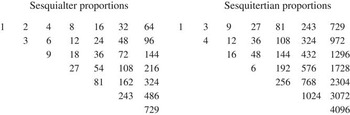
The first thing needed here is a method for calculating sesqui-nth proportions. It was apparently by straight experimentation that Nicomachus had worked out a technique for adjusting numbers in a proportion in order to be able to take successive sesqui-nth proportions.Footnote 83 In his Book II, chapters III and IV, he generates tables for successive numbers in sesquialter and sesquiterita proportions (see Figure 1).Footnote 84 The principle he uses is ‘since doubles generate sesquialters corresponding to them in number, the first row of multiples will be 1, 2, 4, 8, 16, 32, 64.Footnote 85 Now since 2 is the first after unity, this will be the origin of one sesquialter only, 3,’ which is not divisible by 2. The next double, 4, is indeed divisible by 2 twice, so generates two sesquialters, and so on.Footnote 86 For the case of sesquitertian proportions start with repeated products of 3, namely, 1, 3, 9, 81, . . . and then add one-third of a number to get the number below it. E.g. 144 has 144 ÷ 3=48 added to it, yielding 192, as in the third row and fifth column of the second table in Figure 1.
Tables of sesquialter and sesquitertian proportions

Although Boethius and Jacobus would surely have known this technique they use a different one. In describing the genesis of sesquialters Boethius starts with three numbers, apparently in the style of Nicomachus but reversed:
 $${4\quad 2\quad 1}$$
Then he says to write down three new numbers: ‘the first is equal to the first, that is 4, the second to the first and second, that is 6, and the third equal with the first, twice the second, then the third, that is 9’ (my italics). So we get
 $$\eqalignno{ & {4\quad 2\quad 1} \cr & {4\quad 6\quad 9} $$
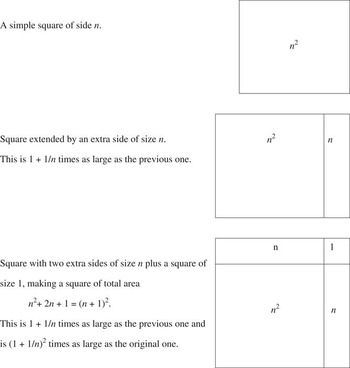
This was an ancient technique, known in the second century bce, and termed the ‘Adrastus rule’.Footnote 87 No explanation is given for the ‘twice’. However it seems likely that Nicomachus was thinking of square numbers, which are figurate numbers, a class he considers at length in his Book II from chapter VII.Footnote 88 It can then be seen that the square of one plus a number is the number squared plus twice the original number plus one: the original square plus two sides plus an extra 1 in the corner: (n+1)2=n 2+2n+1 (see Figure 2). Therefore in order to get successive sesqui-nth proportions one needs to start with a number that is divisible by n twice. Obviously the least such number is n 2. Multiplying this by (1+1/n) is the same as dividing by n and then multiplying by (n+1), which gives the next number in sesquialter proportion: (n+1)n or n 2+n. The third number is this number divided by n and multiplied by (n+1), and is therefore (n+1)×(n+1) or (n+1)2, which is n 2+2n+1. In calculating all his numbers Jacobus, like his predecessors, needed to compose proportions because all other musical intervals have proportions that can be calculated from these basic ones. When we add two tones together on the musical scale, e.g. C–D and D–E we get the interval C–E: two tones; similarly for any other interval. Because these are proportions that are being composed together, instead of addition we have to ‘multiply’ the elements together. When we consider the proportions for the two tones we are composing, namely 9 : 8 with 9 : 8 then the resulting proportion is 81 : 64. Conversely, when we subtract one interval from another we ‘divide’ proportions.
Forming a continued proportion of size 1+1/n, i.e. a sesqui-nth proportion. The areas are n 2 : n 2+n : n 2+2n+1 or n 2 : n(n+1) : (n+1)2.

As mentioned above, mathematicians, and specifically Boethius and Jacobus, generally work backwards, but there is one place where their ratiocinations are clear: the determination of the numbers follows the intuitive rather than the mathematical sequence. This is given by Boethius in his De musica, II. 28, and Jacobus in II. 55, when calculating the proportion of a semitone.Footnote 89
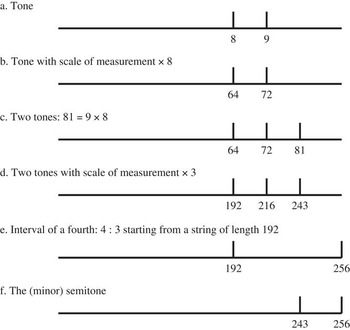
A semitone is the difference between two tones and a fourth, for example the interval between the pair of tones that go from C to E, and the fourth, C–F. The process is illustrated in Figure 3. Since one tone corresponds to 9 : 8, write down 8 as the starting point. By advancing a tone one moves to 9. However an interval of two tones is required. One cannot take 9/8 of 9 as this would not give a whole number, so go back to the beginning and, instead of using 8, use 8×8=64 as the starting point. The proportion is unchanged, the ratio is now changed to 72 : 64. Advancing one tone yields 9/8×64=72 and, because the extra 8 has been used, it is now possible to advance another tone, which gives 9/8×72=81.Footnote 90 This yields the continued proportion 64 : 72 : 81 (where the order of the numbers has been reversed).
Reconstructing Boethius’s numbers for the minor semitone

The technique of looking at just the smaller number in a proportion and multiplying by that number is something that occurs frequently. Boethius sometimes points this out; Jacobus seems not to.Footnote 91 Once Boethius has the sequenceFootnote 92
 $$64\quad 72\quad 81$$
he can now consider the enveloping interval of a fourth, whose proportion is 4 : 3 or one and a third to one (1⅓ : 1). He therefore needs to add one third to the starting point in order to find the number n to fit the sequence
 $$ 64\quad 72 \quad 81 \,n$$
where n represents adding one third of 64 to 64. Again fractions are to be avoided. Boethius therefore multiplies the first three numbers by 3 and this does not disturb the proportions. This gives
 $$ 192 \quad 216\quad 243$$
and now it is possible to take a third of 192 (namely 64) and add it to 192. In this way the final sequence is obtained:
 $$192\quad 216\quad 243\quad 256 $$
Here 192 : 256 is in the same proportion as 3 : 4 (= 64×3 : 64×4). It is clear how the proportions work since 192 : 216 is in the same proportion as 8 : 9, and so is 216 : 243.Footnote 93 So finally the proportion for the semitone is revealed by the difference between two tones and a fourth (diatessaron) and is the proportion of 256 : 243. Moreover this is in its lowest terms: 256 and 243 are relatively prime.Footnote 94 Incidentally, this proportion is a super-13-particular proportion, since 256/243=1+13/ 243.Footnote 95
Jacobus follows Boethius in analysing the numerical proportions for all sorts of combinations of musical intervals and then extends Boethius’s work. The beginning of Book II provides descriptions and mathematical details of the basic intervals and their relation to mathematical proportions. As noted above, despite the difficulties of calculating with Roman numerals, Boethius managed to calculate proportions involving numbers as large as about half a million.Footnote 96 Jacobus rehearsed all of these and took matters a step further, going into the millions. This is the culmination of his Book II: it is principally devoted to establishing the proportions corresponding to an exhaustive list of musical intervals.Footnote 97 These combinations go far beyond those to be found in Boethius’s De institutione musica and involve extensive computations.Footnote 98
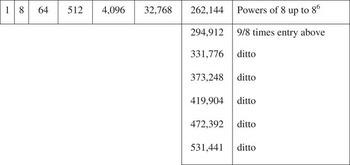
Now I turn to investigating Jacobus’s cogitations when he conducted his exhausting analysis of numerous intervals in Book II. One way to approach Jacobus’s calculations can be demonstrated by looking at the end of the second book of Boethius, II. 30, or his IV. 2.Footnote 99 This result is taken from the ancient Sectio canonis but with some changes.Footnote 100 Jacobus is showing that the diapason (octave) does not comprise six tones.Footnote 101 He uses the above ideas and rather than immediately attempt to multiply by the fraction 9/8 (corresponding to a tone) six times he first looks at successively multiplying 8s, starting from 1.Footnote 102 This gives 1, 8, 64, 512, 4,096, 32,768 and finally 262,144, as shown in the first row of the table in Figure 4.Footnote 103 Then, starting with the last number, he will get whole numbers each time he multiplies by 9/8 (up to six times) so that the final proportion (where he has had to divide by 8 six times) will have (whole) numbers.Footnote 104 This yields the numbers in the penultimate column in Figure 4. Eventually he arrives at 531,441 and so the proportion for six tones is 531,441 : 262,144. In modern terms we would simply look at 96/86, which is indeed 531,441/262,144.
A version of the Boethian figure for comparing six tones with an octave

Boethius is always interested in getting such pairs of numbers in their lowest terms (ensuring they are co-prime), that is to say, such that there is no number (apart from 1) that will divide both of them. Now the only number (apart from 1 and 9) dividing 9 is 3 and the only numbers (apart from 1 and 8) dividing 8 are 2 and 4, so 9 and 8 have no common divisors.Footnote 105 A fortiori the powers of 9/8, in particular 96/86, are automatically in their lowest terms: there are no common divisors of top and bottom numbers. It follows that in order to get a ratio corresponding to 96/86 involving only whole numbers then the smallest choice has to be 531,441 : 262,144.
Musically speaking, we can think of 262,144 as corresponding to the highest of the seven notesFootnote 106 and 531,441 as the lowest, or alternatively regard these numbers as being the relevant lengths of a string on a monochord. To get an octave below we need to double the length of the string. Thus 262,144 is doubled to 524,288. Finally, it is clear that the octave (corresponding to 524,288) is smaller than the six tones (corresponding to 531,441). The resulting proportion of 531,441 : 524,288 is called the Pythagorean comma.Footnote 107
Jacobus uses this approach in discussing the comma further (II. 44). He directly quotes Boethius III. 10, saying ‘The [Pythagorean] comma is the smallest interval of sounds perceptible to the senses’,Footnote 108 but then goes on to discuss its proportion. Like Boethius he considers the Pythagorean comma in a number of different ways and enumerates several equivalent definitions: A comma, as is said, is that particle or interval by which a perfect tone exceeds a minor tone or the sesquioctave proportion two minor semitones, or a hexatone [exceeds] a diapason.Footnote 109 As has already been seen, the proportion of a Pythagorean comma is 531,441 : 524,288. Jacobus proceeds to calculate the characterisation of the comma as the difference between six tones and an octave. From Figure 4, six tones correspond to 531,441 : 262,144, and an octave to 2 : 1. The difference is therefore that between 531,441 : 262,144 and 2 : 1, that is to say, 531,441 : 524,288.Footnote 110 Jacobus, however, does not present this calculation. Instead he simply lists the numbers:Footnote 111
 $$531441\quad 524288 \quad 497664\quad 472392$$
Where do these numbers come from? Jacobus seems to be using the same technique as above but with larger numbers and to be working from right to left. However, all Jacobus points out is ‘Between the first and the fourth numbers there is a sesquioctave proportion in which lies the perfect tone; between the second and <the fourth> is the proportion of two minor semitones in which lies a minor tone’.Footnote 112
The following explanation may give some idea of the cogitations of Jacobus – and also demonstrate his facility with large numbers. The perfect tone is 9 : 8 and a minor semitone is 256 : 243. So he starts with
 $$256\quad 243 $$
In order to get another minor semitone, starting from 256 he needs to find a number in the proportion 256 : 243. As noted above, 256 : 243 is in its lowest terms, so it is necessary to multiply both numbers by 243, obtaining
 $$ 256\, \times\, 243 243\, \times\, 243\ {\rm or}\ 62208\quad 59049 $$
All numbers can then be divided by 243 and a further number put on the left in the proportion 256 : 243, thus
 $$256\, \times\, 256 256\, \times\, 243 243\, \times\, 243\ {\rm or} \ 65536\ 62208\ 59049 $$
Finally a number in the proportion of a tone (9 : 8) to the last number (59049) is required. Now the last number is only divisible by 3 (in fact ten times) and not by 8, so all numbers need to be multiplied by 8. This yields
 $$ 524288\quad 497664\quad 472392$$
and finally Jacobus can take 9/8 of the last number, i.e. 472,392×9/8=531,441, yielding his list:
 $$531441\quad 524288\quad 497664\quad 472392 $$
Jacobus has hidden his calculations; he simply observes that the first and the fourth form a tone and that two minor semitones form a minor tone.Footnote 113 He does not mention that the two proportions between the second and third and between third and fourth each correspond to a minor semitone. He does, however, mention that he cannot take the proportions he wants, so he has to multiply all the numbers.Footnote 114
Jacobus gives altogether a list of fifty-one musical intervals he considers and the list may be found near the end of Book II (chapter 126). Here is just one example, but it involves the largest numbers he employs. Halfway through Book II (in chapter 72) he calculates the proportions for a major tone, which comprises two major semitones. A major tone is two major semitones and a major semitone is the difference between a minor semitone and a whole tone. It is therefore in the proportion 9 : 8 ÷ 256 : 243=9×256 : 8×243=2187 : 2048, or 1+139/2048 : 1 since 2048 − 2187=139.Footnote 115 Therefore the composition of two major semitones corresponds to the ratio 2187×2187 : 2048×2048 or 4,782,969 : 4,194,304.
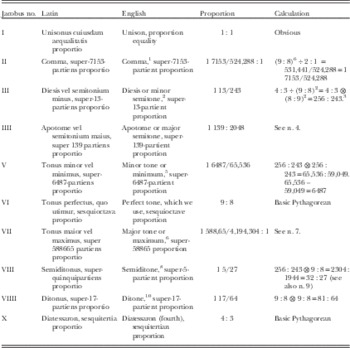
A list of the first ten of his fifty-one interval proportions and modern calculations for them may be found in the Appendix below. In some cases there is more than just the calculation of the proportion of a musical interval. In the case of the major semitone he proves the proportion is greater than 9 : 8 and less than 8 : 7. The modern calculator would simply express all these ratios as decimal fractions and then compare them, but the proof Jacobus gives for the former is remarkably simple. He simply compares the differentiae, i.e. the difference in the number of parts. For 4,782,969 and 4,194,304 it is 588,665;Footnote 116 and for 9 and 8 it is 1. Division is not an option for Jacobus since he is already dealing with fractions. So instead he looks at the size of 588,665 relative to the whole (4,194,304) and compares this with one-ninth. We could say: he scales matters up. So he multiplies 588,665 by 9 to get 5,297,985, but when he multiplies by 8 he gets 4,709,320.Footnote 117 Clearly 4,782,969, the first number of the proportion for a major tone, lies between these two numbers so the proportion is less than sesquiseptima (1 1/7 : 1) and greater than sesquioctava (1 1/8 : 1).Footnote 118
One thing remains of note, the facility that algorism provided to Jacobus. As mentioned above, Jacobus was heavily influenced by Jordanus Nemorarius, but the De elementis arithmetice artis of Jordanus does not treat algorism. Jordanus, however, wrote another work on algorismFootnote 119 and there were other algorisms circulating (in many copies), notably by Johannes Sacrobosco and Alexandre de Villedieu.Footnote 120 The art of algorism comprises how to write and read Arabic numerals and the methods of doing arithmetical computations with them. Jacobus only mentions algorism on two occasions. First, he commends Robert Kilwardby, who includes algorism as a practical art extending the theory of numbers in his De ortu scientiarum.Footnote 121 On the second occasion he revels in the value of arithmetic and shows great enthusiasm for the advantages of algorism: ‘Oh commendable arithmetic! Oh how useful is the science of algorism!’Footnote 122
As I have shown elsewhere, the Arabic numerals (which form the basis of the science of algorism) were only very slowly taken up despite their appearance in western Europe by the eleventh century.Footnote 123 The methods of calculating, in particular multiplying, were much simpler once one was used to operating with, or even just reading, the numerals. Jacobus’s knowledge of algorism surely made an enormous difference to him in doing his calculations and indeed was what made his Books II and III possible, even though it was feasible to perform the same operations without algorism, as Boethius had done in many cases.
Before algorism was available calculations were usually made on an abacus. Arithmetic operations could be performed with Roman numerals but, while addition and even subtraction were not too hard, and while it is possible to multiply Roman numerals, the inherent difficulties are readily apparent.Footnote 124 For example, consider 40 times 90. In Roman numerals this is XL times XC and the, clearly unintuitive, answer is MMMDC. As Murray pointed out long ago, people in the Middle Ages used ready-reckoner tables to multiply Roman numerals.Footnote 125 In this way multiplication was reduced to repeated addition. It is most likely that Boethius used the abacus, but Jacobus used even larger numbers than Boethius.
Hindu-Arabic numerals were certainly regarded in the early days of their introduction into western Europe (and even much later) as quite strange. On occasion they were written in boxes, as is often the case in Paris 7207, though the boxes are sometimes incomplete, missing the bottom side.Footnote 126 Thus Arabic numerals in a medieval manuscript often look more like figures (in the sense of diagrams), rather than abbreviations for (number) words as Roman numerals do.Footnote 127 Charles Burnett and the present author have independently suggested that these new ‘figures’ were indeed more akin to diagrams and therefore not part of the standard alphabet used by scribes.Footnote 128
Another distinguishing feature of algorism is the way that calculations (addition, subtraction, multiplication and division) are made. When one works with an abacus no trace remains of the steps in the calculation once it is complete. By contrast, when using Arabic numerals on paper the techniques of algorism leave traces that can be independently verified: one can check the working. This also reduces the chance of error.
Finally, while the mathematics taught in Paris was very much Boethian,Footnote 129 and although Johannes de Muris (Jean de Murs, c. 1290–5 to after 1344) contended that mathematics was neglected in Paris because the students found it ‘unintelligible or excessively difficult’,Footnote 130 algorism had begun to be taught.Footnote 131 Jacobus used his knowledge of algorism to revive (not merely revise) and extend the work of Boethius.
Exactly how Jacobus acquired his knowledge of algorism we do not know. His work does not contain any references to treatises on algorism. However, there were people in Paris, even before 1300, who knew algorism. That is not to say it was widely known. It is unknown what number or fraction of people taught or knew such matters. It seems very likely that those few knowledgeable in mathematics would have known each other. Moreover, Jacobus was expecting lovers of mathematics – and algorism – to enjoy the results of his cogitations: ‘If I have been lacking, it is because I am not sufficient to fully understand such hard material, which requires many cogitations, and many operations with numbers’, but then he continues: ‘If they [the readers] are lovers of music theory, they will delight in it. They will revel in the proportions of numbers, in the varieties and stupendous comparisons of [huge] numbers.’Footnote 132
All of this seems to confirm his remark that he has had many cogitations.Footnote 133 A table of the first ten of the fifty-one intervals that he lists at the end of II. 126, for which he provided the proportions, may be found in the Appendix. The calculations there have been done in the modern manner, not following the method of Jacobus as presented above. The proportions for the other forty-one intervals are tedious, rather than difficult, for a modern reader equipped with a calculator – or simply pen and paper – to work out. They certainly bear out the comment of Jacobus that the work was long and laborious.Footnote 134
When Jacobus is determining the proportion corresponding to a musical interval he introduces a sequence of numbers but does not explain how they arise; he does, however, make clear the proportions between them. Boethius, on the other hand, has given a clearer insight into whence these numbers come. I am led to believe that Jacobus thought of the length of a monochord stringFootnote 135 for the musical note (or pitch) from which he started his considerations, and then worked along the string assigning the appropriate number to match the musical interval.
In general I conclude that Boethius and later Jacobus wanted to use whole numbersFootnote 136 and the proportions encountered would often have introduced fractions if applied directly. They therefore changed the scale of measurement by multiplying by appropriate numbers – but always ensuring that these multipliers were as small as possible.Footnote 137 When they had climbed up through the various intervals being used they would then have the result that the extreme numbers gave them the proportion sought. The evidence provided by Boethius and Jacobus supports this analysis of how Jacobus obtained the huge numbers in his work in this way. He, however, had the great advantage that he knew algorism, though in his cogitations he still found the work hard. Nevertheless the facility that algorism gave him was what permitted him not only to understand and verify all five books of Boethius’s De musica but also to extend the work of Boethius.Footnote 138
APPENDIX
The proportions of the first ten intervals as determined by Jacobus in his Speculum musicae, Book II, Chapter 126