INTRODUCTION
With over 1·1 million ha, Italy is the second-ranking country in Europe for organic farming area. The outbreeding species lucerne (Medicago sativa L.) is a key species for the organic crop–livestock systems of several European countries because of its suitability for low-input conditions, its favourable effects on soil fertility and nitrogen balance, and the high protein content and quality of its forage (Campiglia et al. Reference Campiglia, Caporali, Barberi, Mancinelli, Olesen, Eltun, Gooding, Jensen and Köpke1999; Rahmann & Böhm Reference Rahmann, Böhm, Rowlinson, Wachirapakorn, Pakdee and Wanapat2005). However, organically grown lucerne should ensure sufficiently high forage and seed yields to sustain the profitability of organic production chains.
Until recent decades, agriculture relied for centuries only on farm landraces. Because of their history of exposure to a diversity of selective pressures, landraces may be more resilient than modern cultivars to biotic and abiotic stresses (Newton et al. Reference Newton, Akar, Baresel, Bebeli, Bettencourt, Bladenopoulos, Czembor, Fasoula, Katsiotis, Koutis, Koutsika-Sotiriou, Kovacs, Larsson, Pinheiro De Carvalho, Rubiales, Russell, Dos Santos and Vaz Patto2009). Farmers may believe old germplasm to be superior to modern cultivars in organic environments, although research results for cereals usually do not support this view (e.g. Carr et al. Reference Carr, Kandel, Porter, Horsley and Zwinger2006). There is inconsistent evidence on the usefulness of direct selection under organic farming of cultivars targeted to organic systems (e.g. Murphy et al. Reference Murphy, Campbell, Lyon and Jones2007; Lorenzana & Bernardo Reference Lorenzana and Bernardo2008), although some plant attributes such as competitive ability against weeds, tolerance to major biotic stresses and nutrient use efficiency are expected to be more useful in these systems than in conventional ones (Casler et al. Reference Casler, Riday, Undersander, Rosellini and Veronesi2007).
Farm landraces grouped into 14 regional landraces as a function of their production area had the largest share of the Italian seed market of lucerne until 2003, when they were banned because of the lack of effective control on their seed production. Italian landraces revealed specific adaptations to drought stress levels and soil types similar to those of their environments of origin, and performed comparably with cultivars for forage (Russi & Falcinelli Reference Russi and Falcinelli1997; Annicchiarico & Piano Reference Annicchiarico and Piano2005; Annicchiarico Reference Annicchiarico2006) or seed yield (Annicchiarico et al. Reference Annicchiarico, Pecetti and Romani2007) under non-organic testing conditions similar to those under which they evolved. Italian cultivars of lucerne largely derive from landraces and maintain traces of the specific adaptation pattern of their constitutive germplasm (Annicchiarico Reference Annicchiarico1992; Annicchiarico & Piano Reference Annicchiarico and Piano2005). Information is lacking on the relative value of landrace and cultivar germplasm of lucerne under organic management.
Morphologically non-conventional lucerne germplasm, with semi-erect or semi-prostrate habit, has recently been developed for enhanced grazing tolerance (Brummer & Bouton Reference Brummer and Bouton1991; Pecetti et al. Reference Pecetti, Romani and Piano2006, Reference Pecetti, Romani, De Rosa and Piano2008). It is not known whether alternative growth habits confer any advantage over conventional, upright germplasm under organic farming.
In the present study, lucerne populations were grown organically in two contrasting regions of Italy with the objective of assessing the impact on forage and seed yields of: (i) type of germplasm (landrace or commercial cultivar); (ii) possible specific-adaptation effects arising from the region of origin or selection of the population; and (iii) plant growth habit (conventional or non-conventional). The yield response of one cultivar selected under organic farming was concurrently assessed and compared with those of cultivars selected under conventional cropping conditions.
MATERIALS AND METHODS
Lucerne populations
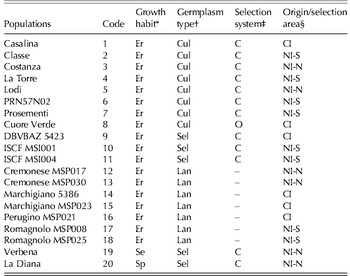
The populations tested (Table 1) included: (i) seven cultivars bred under conventional management that featured high forage yield in earlier conventionally managed regional testing; (ii) one cultivar selected under organic management (Falcinelli & Torricelli Reference Falcinelli and Torricelli2001); (iii) seven farm landraces belonging to four of the former regional landraces, including two accessions for those landraces that historically had larger production area; (iv) five breeding selections bred in conventional systems, of which three with erect growth habit had been selected under a mowing regime and two with semi-erect or semi-prostrate habit that had been selected for grazing tolerance. The populations were further classified depending on their area of origin/selection, either in central Italy (CI) or northern Italy (Table 1). Northern Italy was further split into a northern (NI-N) and a southern (NI-S) side relative to the Po river, owing to the differences in summer water availability and soil texture and the associated cultivar×environment interaction effects usually observed between these areas (Annicchiarico Reference Annicchiarico1992). NI-S tends to have lower summer water available due to rainfed cropping in its clayish soils relative to NI-N. Environments of CI also feature rainfed cropping and tend to clayish soils, but their summer drought is usually greater than anywhere in northern Italy because of greater evapotranspiration (due to higher temperatures) and less favourable rainfall distribution.
Code, growth habit, germplasm type, selection cropping system and area of origin or selection of tested lucerne populations

* Er, erect; Se, semi-erect; Sp, semi-prostrate.
† Cul, cultivar; Sel, breeding selection; Lan, landrace.
‡ C, conventional; O, organic.
§ CI, central Italy; NI-N, northern Italy, north of the Po river; NI-S, northern Italy, south of the Po river.
Sites
The 20 populations were evaluated for 3 years in Lodi, northern Italy (45°19′N, 9°30′E, 81 m asl), and in Perugia, CI (43°02′N, 12°24′E, 127 m asl). The former location is characterized by the sub-continental climate of lowland northern Italy, whereas the latter has a transitional sub-Mediterranean climate. Mean annual rainfall is similar for the two locations (802 and 794 mm, respectively), but Perugia has higher mean daily minimum temperatures in winter (1·0 v. −0·7°C) and daily maximum temperatures in summer (29·6 v. 27·6°C) than Lodi. Mean annual rainfall over the test years was lower than average (c. −20%) at both locations. The soil was sandy-loam with pH of 6·5 and organic matter content of 17 g/kg in Lodi, and silty-clay with pH of 7·6 and 16 g/kg of organic matter in Perugia.
Although Lodi is in the NI-N area, its cropping environment may experience greater summer drought than typical NI-N environments, because irrigation amounted to just 40 mm every year, applied at the end of July. At both Lodi and Perugia, 94 kg/ha of P2O5 provided by an organic agriculture-approved fertilizer were applied prior to sowing. The populations were drill-sown at the end of winter 2005 in plots of 1·5×4·0 m arranged in a randomized complete block design with four replications. Seed rates were 30 kg/ha in Perugia and 35 kg/ha in Lodi. The higher rate in Lodi reflected local practices and was justified by the greater weed competition which typically features in this region of evaluation (Tomasoni et al. Reference Tomasoni, Borrelli and Pecetti2003).
Data collected
Lucerne dry matter (DM) yield was recorded over three cropping years (2005–7), which encompassed 13 harvests in Lodi (four in the first, five in the second and four in the third year) and seven harvests in Perugia (three in the first year and two each in the second and third year). The lower number of harvests in Perugia was due to the concentration of forage production in spring and autumn (coinciding with the two peaks of rainfall that feature its sub-Mediterranean climate). Lucerne DM yield was estimated from total plot fresh yield and from DM content and proportion of lucerne in an herbage sample of c. 1 kg fresh herbage per plot, after separating and oven-drying lucerne and weeds of the sample. In Perugia, the plots were practically devoid of weeds, except for the first harvest in the year of sowing. Conversely, weed competition was severe in Lodi.
In both locations, the second harvest of the third year was only performed on half of each plot, allowing the plants on the other half to blossom and set seed for evaluating seed yield and its components. At seed maturity, the number of fertile (i.e. pod-bearing) stems/m2 was estimated by counting the stems in a 0·3×0·3 m plot sample area. The numbers of racemes per stem, pods per raceme and seeds per pod were estimated across a random sample of five stems per plot. The whole half-plot was harvested by plot combine to measure the seed yield, expressing it on a dry basis after assessing the seed moisture by oven-drying a sample of 200 seeds per plot. This sample was also used for estimating the individual seed weight.
Statistical analysis
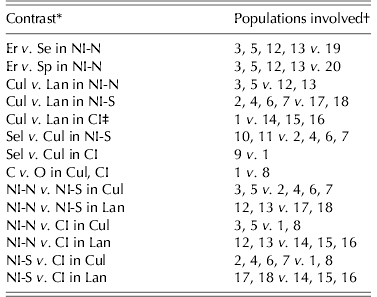
A combined analysis of variance (ANOVA) including the fixed factors population and location and the random factor block within location was performed on plot data of total DM yield, seed yield and the components of seed yield. Both population main effects and population×location interaction effects relative to specific hypotheses were assessed through 14 linear contrasts, each accounting for one ANOVA degree of freedom. The contrasts compared sets of populations which were homogeneous for characteristics other than that under comparison. The contrasts and the concerned sets of populations are reported in Table 2. They implied comparisons of erect v. semi-erect or semi-prostrate germplasm, erect cultivar v. landrace germplasm, erect breeding selections v. cultivars, and conventionally selected v. organically selected cultivars within NI-N, NI-S or CI areas of origin or selection, as well as comparisons of cultivars or landraces from different geographical areas. A second ANOVA including the fixed factors germplasm group, population within germplasm group and location, and the random factor block within location, aimed at comparing for DM yield and seed yield the six germplasm groups formed by the factorial combination of two erect germplasm types (landrace and cultivar) by three areas of origin or selection (NI-N, NI-S and CI). An ANOVA including population and block factors was carried out for lucerne proportion over the crop cycle in Lodi (the only site where weed proportion was sizeable).
ANOVA linear contrasts and concerned populations
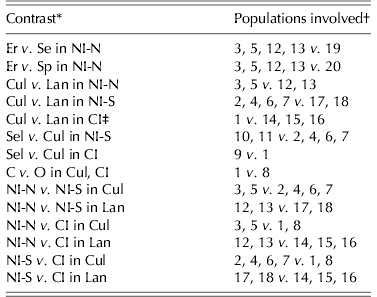
* Relative to: growth habit (Er, erect; Se, semi-erect; Sp, semi-prostrate), germplasm type (Cul, cultivar; Sel, breeding selection; Lan, landrace), selection cropping system (C, conventional; O, organic), and area of origin or selection (CI, central Italy; NI-N, northern Italy, north of the Po river; NI-S, northern Italy, south of the Po river).
† See Table 1 for population code.
‡ Excluding the cultivar selected under organic farming.
The extent of population×location interaction (when significant in the ANOVA) was assessed by estimating the genetic correlations (r g) for population response across locations according to Burdon (Reference Burdon1977):

where r is the phenotypic correlation for population value between the two locations, and h 1 and h 2 are the square roots of the broad-sense heritability on a population mean basis for each of the locations. For each site, h2 was estimated as:

where s g2 and s e2 are variance components for population (here random factor) and experiment error, respectively, estimated by a restricted maximum-likelihood method and n is the number of replications.
Relationships among forage and seed yield traits of the populations were assessed for each location by simple correlation analysis, excluding the traits that failed to display variation (P<0·10) in separate ANOVAs performed for each site. The SAS software was used for all analyses.
RESULTS
Forage yield
Lucerne DM yield in Lodi was markedly lower than in Perugia (16·33 v. 29·13 t/ha; P<0·001), because of the much lower proportion of lucerne on the 3-year DM (only 0·50 v. 0·94). The most common weed species observed in Lodi were Polygonum persicaria L. (mainly in the first year), Veronica persica Poiret, Stellaria media (L.) Vill., Capsella bursa-pastoris (L.) Medicus, Convolvulus arvensis L., Chenopodium album L., Polygonum aviculare L., Lolium multiflorum Lam., Digitaria sanguinalis (L.) Scop. (in summer) and Plantago lanceolata L. (in late summer). The most common weed species in Perugia were Diplotaxis erucoides (L.) DC and Lolium multiflorum. Populations are referenced hereafter according to their codes reported in Table 1. Lucerne proportion on total DM in Lodi ranged from 0·26 for the semi-prostrate population 20 to 0·64 for two erect populations, i.e. cultivar 3 and the breeding selection 11. Germplasm competitive ability as expressed by lucerne proportion was strictly correlated (r=0·95, P<0·001) with population DM yield in Lodi.
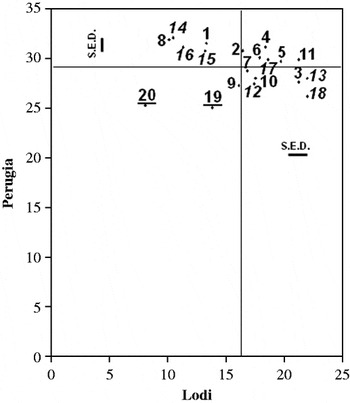
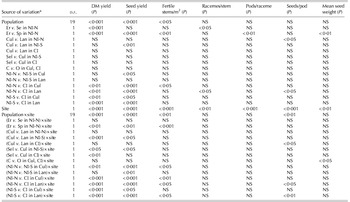
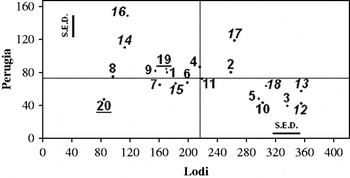
The combined ANOVA detected significant variation for overall population and population×location interaction and some of their contrasts (Table 3). On average, erect germplasm was 19% higher yielding than semi-erect germplasm (23·24 v. 19·47 t/ha; P<0·001) and 39% higher yielding than the semi-prostrate selection (23·24 v. 16·70 t/ha; P<0·001). Its superiority was manifest in both locations but tended to be greater in Lodi than in Perugia relative to the semi-prostrate selection 20 (Fig. 1), leading to interaction with location of erect v. semi-prostrate germplasm type (P<0·01; Table 3).
Scatter plot of DM yield (t/ha) over 3 years at Lodi (NI-N) and Perugia (CI) of 20 organically grown lucerne populations (erect cultivars or selections in roman type, landraces in italic, and non-erect selections underlined; see Table 1 for codes of populations; site mean values indicated by solid lines).

F test significance of population main effects and population×site interaction effects for DM yield over 3 years and for seed yield and its components at the third cropping year of 20 lucerne populations organically grown at Lodi (NI-N) and Perugia (CI)

NS, not significant (P>0·05).
* Linear contrast relate to growth habit (Er, erect; Se, semi-erect; Sp, semi-prostrate), germplasm type (Cul, cultivar; Sel, breeding selection; Lan, landrace), selection cropping system (C, conventional; O, organic) and area of origin or selection (CI, NI-N and NI-S); see Table 1 for population characteristics and Table 2 for contrast composition.
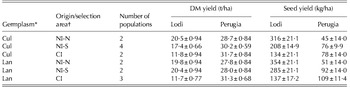
On average, cultivar and landrace germplasm types did not differ for DM yield in any of the three geographic sets of populations (NI-N, NI-S and CI; Table 3). Interaction of cultivar v. landrace germplasm type with location was observed for germplasm originating from NI-S conditions (P<0·001; Table 3), owing to relatively better response of landraces in Lodi and of cultivars in Perugia (Table 4).
Comparison of organically grown cultivar and landrace germplasm groups selected or originating from different areas, for DM yield over 3 years and seed yield at the third cropping year at Lodi (NI-N) and Perugia (CI) (means±s.e; error d.f.=42)

* Cul, cultivar; Lan, landrace.
† CI, central Italy; NI-N, northern Italy, north of the Po river; NI-S, northern Italy, south of the Po river.
Erect breeding selections did not differ from cultivars for DM yield across locations (Table 3). Interaction with locations of these germplasm groups reached P<0·01 significance for populations bred in CI, owing to the trend of the breeding lines to respond relatively better in Lodi and worse in Perugia in comparison with the local cultivar (see cultivars 9 v. 1 in Fig. 1).
Germplasm group×location interaction was detected in five out of six ANOVA contrasts that compared different geographic origins for cultivar or landrace germplasm (P<0·01; Table 3). The interaction patterns implied definite specific adaptation to environmental conditions similar to those under which the germplasm evolved or was selected. In particular, cultivars and landraces that originated in NI-N were high yielding in the test site similar to NI-N environments (Lodi) and low yielding in the location representing CI environments (Perugia), whereas populations originated in CI displayed the opposite adaptation pattern (Table 4). Populations originating from NI-S, whose major environmental characteristics could be considered somewhat intermediate between NI-N and CI, tended to be mid-ranking for yield response in each site, except for the good adaptation of landraces from NI-S in Lodi (Table 4).
The inconsistent yield response of the populations across locations and the excellent yield response of specifically adapted populations can be seen in Fig. 1. The five top-ranking populations in Lodi (populations 3, 5, 11, 13 and 18) originated in NI-N or NI-S (Table 1) and were different from the five top-ranking populations in Perugia (populations 1, 4, 8, 14 and 16), which originated in CI or NI-S. Several top-ranking populations showed significant (P<0·05) cross-over interaction across locations (e.g. population 3, 13 or 18 with population 1, 8 or 14; Fig. 1). The large population×location interaction was confirmed by the lack of significance and the slight trend towards negative sign of the genetic correlation for population yield across locations (r g=−0·25, P>0·20).
Seed yield traits and their relationships with forage yield
Although fairly low in absolute terms, seed yield in Lodi was much higher than in Perugia (217·5 v. 75·7 kg/ha; P<0·001), mainly because of the severe summer drought which occurred in the latter site. Lodi also exhibited about 2-fold more racemes per stem (18·9 v. 8·8) and pods per raceme (11·0 v. 5·5), 40% more seeds per pod (3·60 v. 2·54), 32% less fertile stems per m2 (172 v. 251) and 21% lighter seeds (1·72 v. 2·19 mg) relative to Perugia (P<0·01).
Population responses for seed yield tended to parallel those for 3-year forage yield in Lodi (r=0·84, P<0·01) and, to a lesser extent, in Perugia (r=0·50, P<0·05). Erect populations exhibited similar seed yield as semi-erect germplasm and over 2-fold greater seed yield than semi-prostrate germplasm across locations. Germplasm type×location interaction occurred because of the greater seed yield advantage of erect over semi-prostrate germplasm in Lodi than in Perugia (Table 3; Fig. 2). Significant difference for seed yield between cultivars and landraces emerged only in the populations from NI-S, where the landraces out-yielded (P<0·01) the cultivars in Lodi (Tables 3 and 4).
Scatter plot of seed yield (kg/ha) at the third cropping year at Lodi (NI-N) and Perugia (CI) of 20 organically grown lucerne populations (erect cultivars or selections in roman type, landraces in italic, and non-erect selections underlined; see Table 1 for codes of populations; site mean values indicated by solid lines).

All ANOVA contrasts relative to interaction with location of germplasm groups from different geographic origin were significant for seed yield (Table 3). The pattern of each germplasm group×location interaction for this trait was similar to that recorded for forage yield, implying higher seed yield of populations from NI-N in Lodi and of populations from CI in Perugia, and the mid-ranking response in both locations of populations from NI-S (Table 4). The top-ranking populations for seed yield differed between test sites (Fig. 2) and mostly originated in NI-N for Lodi (e.g. populations 3, 12 and 13) and in CI for Perugia (e.g. populations 14 and 16) (Fig. 2, Table 1). Several top-yielding populations showed significant (P<0·05) cross-over interaction across locations (Fig. 2). The inverse genetic correlation for population seed yield across locations (r g=−0·68, P<0·05) indicated outstandingly large population×location interaction for this variable.
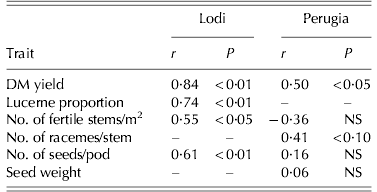
The overall variation among populations was significant at P<0·05 for density of fertile stems and at P<0·10 for number of racemes per stem, number of seeds per pod and seed weight. Population×location interaction was significant (P<0·01) and fairly large (on the ground of nil genetic correlation across locations) for density of fertile tillers (r g=−0·21) and number of seeds per pod (r g=−0·31). Most main effects or interaction effects for seed yield components paralleled and justified those described for seed yield. For example, the lower mean seed yield of semi-prostrate germplasm relative to the erect one was associated with less pods per raceme (−19%) and lighter seeds (−10%), whereas the interaction with location of these germplasm types for number of fertile tillers was consistent with that described for seed yield (data not reported). The only difference in mean value between cultivars and landraces was the lower number of seeds per pod of the cultivars (2·72 v. 3·48) in germplasm from NI-N. The germplasm group×location interaction relative to populations of different geographic origins that were observed for density of fertile tillers and number of seeds per pod (Table 3) implied site-specific group differences consistent with those for seed yield (data not reported). However, population seed yield was associated with different seed yield components in the two locations. In Lodi, where density of fertile tillers was lower than in Perugia as a consequence of much greater weed competition, seed yield was correlated to this trait and to the number of seeds per pod (Table 5). In Perugia, population seed yield was associated with the number of racemes per stem (Table 5).
Coefficients of correlation (r) of seed yield at the third cropping year with DM yield and lucerne proportion on total DM over 3 years and seed yield components, for 20 organically grown lucerne populations at Lodi and Perugia*
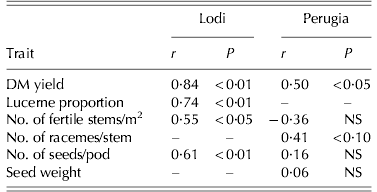
NS, not significant (P>0·10).
* d.f.=18. Results for traits with non-significant population variation (P>0·10) are not reported.
DISCUSSION
The contrasting extent of weed development and competition exerted on the crop in the two test sites reflected the known difference in this respect between the geographic areas (NI-N and CI) that these sites represented. The difference in site weed development may have contributed, along with site differences due to climatic and soil factors, to the large population×location interaction of cross-over type which emerged for forage and seed yield, when considering that the germplasm ability to compete against weeds was important for adaptation only in Lodi. Indeed, population DM yield and competitive ability (the latter expressed as lucerne proportion on total DM) were strictly associated in this site. Another study performed in Lodi on eight of the current populations revealed no population×environment interaction for forage yield across non-weeded and chemically weeded environments (Annicchiarico & Pecetti Reference Annicchiarico and Pecetti2010). This finding, implying the strict association between competitive ability against weeds and forage yielding ability in the absence of weeds of the populations, was attributed to the overwhelming importance of high relative growth rate also for germplasm competitive ability in vigorous crop species grown in productive environments (Campbell et al. Reference Campbell, Grime and MacKey1991). As a consequence, germplasm adaptation to local climatic or soil factors, determining the relative growth rate, would be the main determinant of site-specific yield responses and population×location interactions both in the presence and in the absence of weed competition. High relative growth rate may have lower impact on plant competitive ability than other traits associated with plant plasticity in weakly competing forage species, e.g. white clover (Annicchiarico Reference Annicchiarico2003).
The large extent of specific adaptation effects displayed by lucerne populations in relation to their area of origin and/or selection agrees with previous findings relative to agricultural environments of northern Italy (Annicchiarico Reference Annicchiarico1992) or managed environments (Annicchiarico & Piano Reference Annicchiarico and Piano2005) featuring contrasting drought stress levels and soil types. Different combinations of shoot and root traits proved to be associated with those specific adaptation patterns both in farm landraces and cultivars (Annicchiarico Reference Annicchiarico2007b). The much greater impact on lucerne germplasm yield responses of specific adaptation to pedoclimatic conditions than to organic management is supported by: (i) the large population×location interaction for forage yield; (ii) the lack of population×environment interaction for forage yield across non-weeded and chemically weeded environments (Annicchiarico & Pecetti Reference Annicchiarico and Pecetti2010); and (iii) the forage yield response of Cuore Verde, selected under organic farming in CI and poorly yielding in the test site of northern Italy. A similar conclusion has also emerged for bread wheat in Italy, where cultivar×environment interaction was negligible when comparing conventional and organic systems while being high in comparisons between southern Italy and the rest of the country (Annicchiarico et al. Reference Annicchiarico, Chiapparino and Perenzin2010a). For lucerne, specific breeding for two contrasting areas of northern Italy (NI-N and eastern part of NI-S) provided higher forage yield gains over the region than selection for wide adaptation (Annicchiarico Reference Annicchiarico2007a). This breeding strategy is likely to be even more valuable for the broader region encompassing NI-N, NI-S and CI, selecting specifically for the contrasting areas NI-N and CI. If required by marketing considerations, lucerne selection for wide adaptation to this region should be performed under intermediate environmental conditions such as those of the NI-S area. Cultivar recommendations should be defined specifically for NI-N, NI-S and CI.
Lucerne seed was produced in the present work according to a common practice in Italy, where growers harvest seed on the regrowth following the first spring cut in the third or fourth cropping year (Falcinelli & Martiniello Reference Falcinelli and Martiniello1998; Annicchiarico et al. Reference Annicchiarico, Pecetti and Romani2007). A dedicated seed crop, implying wide inter-row spacing and moderate sowing density, may result in better seed yield potential of lucerne (Rincker et al. Reference Rincker, Marble, Brown, Johansen, Hanson, Barnes and Hill1988), although the lower plant density may complicate weed control under organic cropping when facing severe weed competition. The seed yield observed in Lodi for well-adapted germplasm, ranging between 300 and 360 kg/ha, was c. 20–32% lower than that recorded on average in Italy under conventional management (2005–9 period: http://www.ense.it, verified 4 July 2011). Crop seed yield was markedly lower in Perugia than in Lodi despite the higher plant density, as a consequence of severe drought stress at the flowering/seed-set stage. The higher number of racemes per stem in Lodi than in Perugia was in line with the reported increase of this yield component on decreasing the plant density (Zhang et al. Reference Zhang, Wang, Han, Wang, Mao and Majerus2008). However, there is a limit beyond which increased racemes per stem can no longer compensate for the decline in stem density (Zhang et al. Reference Zhang, Wang, Han, Wang, Mao and Majerus2008). Numbers of fertile stems remained suboptimal in Lodi, as suggested by the positive correlation between stem number and seed yield of the populations. Numbers of racemes per stem can be reduced by drought and heat stress (Simon Reference Simon1997; Fick et al. Reference Fick, Holt, Lugg, Hanson, Barnes and Hill1988): this may explain the association of this component with the population seed yield only at Perugia, the most drought-stressed site. On the whole, the site-specific seed yield responses of the populations reflected largely their local adaptation as expressed by forage yield responses. In fact, population×location interaction effects for seed yield were even wider than those for forage yield, implying significant negative genetic correlation for population response across locations. This was probably due to the accumulation over 3 years, before seed yield was eventually recorded, of site-specific adaptive responses of the whole plant stand and of individual seed yield components, as well as to the different seed yield components associated with seed yield in the two sites. The markedly region-specific population response for seed yield has implications for seed production chains, highlighting the importance of multiplying cultivars in their area of adaptation.
Differences in forage and seed yielding ability emerged when comparing erect v. non-erect germplasm. The semi-prostrate selection displayed distinctly lower DM yield than erect germplasm especially at the location where weed competition was severe (Lodi) because of poor competitive ability, which is consistent with the low relative growth rate implied by its growth habit (Smith & Bouton Reference Smith and Bouton1989; Pecetti et al. Reference Pecetti, Romani, De Rosa and Piano2008). Under intense grazing, which minimizes the competition exerted by vigorous weeds, the same plant type showed remarkable persistence under both conventional and organic management owing to its morphology, enabling high tiller density and turnover (Battini et al. Reference Battini, Pecetti, Romani, Annicchiarico, Ligabue, Piano, Rosellini and Veronesi2007; Pecetti et al. Reference Pecetti, Romani, De Rosa and Piano2008). The semi-prostrate selection confirmed the lower seed yielding ability relative to erect germplasm that is common for this plant type and is the consequence, along with fewer pods per raceme and lighter seeds, of the introgression of subsp. falcata in its germplasm (Smith & Bouton Reference Smith and Bouton1989; Pecetti et al. Reference Pecetti, Romani, De Rosa and Piano2008). The semi-erect selection was only somewhat unadapted to the current utilization, as it tended to display lower forage yield but similar seed yield in comparison with erect germplasm.
Landraces and cultivars from the same area of origin or selection exhibited similar forage yielding ability in both locations. Also the seed yielding ability of these germplasm types did not differ, except for the higher seed yield of landraces over cultivars from the NI-S area. Italian landraces already proved as valuable as cultivars in conventionally managed environments for DM yield or persistence (Annicchiarico & Piano Reference Annicchiarico and Piano2005; Annicchiarico Reference Annicchiarico2006), seed yield (Annicchiarico et al. Reference Annicchiarico, Pecetti and Romani2007) and forage quality as expressed by the leaf:stem ratio (Annicchiarico Reference Annicchiarico2007c). The current yield responses of novel selections confirmed the difficulty for local breeding to overcome the forage and seed yields of landraces. It should be noted, however, that most tested landrace accessions actually represented the top-yielding germplasm within each regional landrace as determined by previous testing of a larger sample of accessions. The modest progress of local breeding is consistent with the slow rate of genetic gain observed for lucerne relative to other crops (Woodfield & Brummer Reference Woodfield, Brummer and Spangenberg2001). Various factors may account for this trend, such as autotetraploidy, high rate of non-additive genetic variance arising from gene interactions and high genotype×environment interaction, besides the outbreeding mating system and the perennial growth cycle. Tapping the large intra-population diversity of landraces and cultivars, exploiting positive genotype×location interaction by selecting cultivars targeted to distinct cropping areas and defining novel selection schemes able to exploit heterosis from complementary gene interactions are current strategies to overcome the intrinsic limits of lucerne breeding (Brummer Reference Brummer1999; Annicchiarico et al. Reference Annicchiarico, Scotti, Carelli and Pecetti2010b), while awaiting possible developments from genomics aimed at improving complex traits such as forage and seed yield (Julier et al. Reference Julier, Barre, Hébert, Huguet and Huyghe2003; Li et al. Reference Li, Wei, Moore, Michaud, Viands, Hansen, Acharya and Brummer2011).
This research was funded by the Italian Ministry of Agricultural and Forestry Policies and the Region Umbria within the project ‘Sviluppo rurale’ – Subprogramme ‘Innovazione e ricerca – Azioni di innovazione e ricerca a supporto del Piano sementiero (PRIS2)’. We are grateful to Professor Mario Falcinelli for excellent project co-ordination and stimulating scientific support and to Mr Sandro Proietti and Mr Francesco Vecchietti for precious technical assistance.