1. Introduction
The principal theme of our inquiry is the relationship between capitalism and organisational corruption in the public sector. Hodgson and Jian (Reference Hodgson and Jiang2007) affirm:
[O]rganizational corruption involves at least two agents, X and Y, where at least Y occupies at least one designated role that is attached to a particular organization. This organizational role obliges Y to follow an established set of ethical rules, at least some of which are consistent with the goals of the organization. X consciously intends an action, which is deliberately designed to cause or persuade Y to breach at least one of these goal-consistent ethical rules, of which X and Y are both aware. With the option of acting otherwise, Y violates this rule in accord with the wishes of X (2007: 1053).
This definition has several notable virtues among which we emphasise, first, that corruption entails violations of ethical rules that promote organisational goals and second, it is sufficiently general to encompass public and private corruption. Corruption occurs in the private sector and examples abound: e.g., in sports, consumption of performance-enhancing substances; at the corporate level, Enron, WorldCom and Parmalat come to mind inter alia; in Venezuela as a consequence of boards’ predatory practices the phrase ‘rich owners with bankrupt companies’ has become a popular adage, and the outright theft, ‘tunnelling’, of bank deposits subsequently transferred to international bank accounts occurred in three privately owned banks as recently as 2010.Footnote 1 In the USA, the names of Bernard Madoff and Allen Stanford are associated with fraud and worldwide Ponzi schemes.
Taking into account that existing corruption indices measure corruption in the public sector and that to the best of our knowledge a comprehensive and reliable database measuring private corruption does not exist, this research relies on a public corruption metric.Footnote 2 Nonetheless, we do not lose sight of the fact that corruption in the public sector frequently occurs with private sector members’ complicity.
The recent political economy and political science literature documents numerous deleterious economic and social consequences of public perceived corruption.Footnote 3 These findings beg the question of how to abate corruption. This is not a fully answered question to the extent of inducing puzzlement among some scholars: ‘Why have there been so few (recent) successful attempts to fight corruption?’ (Svensson, Reference Svensson2005: 34)Footnote 4 We contend that this is a pressing question not only as a matter of principles and morality but also of consequences given the social fabric's decay induced by corruption and its attendant social costs (see Coase, Reference Coase1960). Taking into account these findings and the relatively little success in the fight against corruption, the fundamental query of this paper is whether the culprit of public perceived corruption is capitalism.
However, to avoid ideological misconceptions concerning the purpose and implications of this research, and consequently stating clearly its limitations, we also elucidate what we mean by capitalism. We use the term ‘capitalism’ as equivalent to ‘economic freedom’, which is defined by James D. Gwartney et al. at www.freetheworld.com:
Individuals have economic freedom when property they acquire without the use of force, fraud, or theft is protected from physical invasions by others and they are free to use, exchange, or give their property as long as their actions do not violate the identical rights of others. An index of economic freedom should measure the extent to which rightly acquired property is protected and individuals are engaged in voluntary transactions.
Thus the emphasis here is on negative freedom in the economic sphere protected by a legal infrastructure generally, though not always, established and enforced by government. Consequently, capitalism as envisioned in this paper is an ethical rule-bounded economic system grounded in natural law and therefore anthropologically consistent.Footnote 5 Accordingly, private property is an institution innate to human beings that is legally formalised and enforced in capitalist economies. ‘So it is that property is as ubiquitous as man, a part of the basic fabric of all society.’ (Hoebel, Reference Hoebel1958: 431)
Importantly, having clarified what we mean by corruption and capitalism, we rephrase our main research question with greater accuracy: Can the institutions and policies that comprise capitalism, measured by the Economic Freedom of the World (EFW) index (see below), reduce public perceived corruption?
The answer to this question, however, is far from clear. For example, the financial industry, emblematic of a capitalist economy, has been roiled by scandals associated with the 2007 financial crisis prompting politicians, regulators, Hollywood and average citizens alike to curb what are perceived as corrupt practices in Wall Street. Numerous calls for more regulation of financial markets have been recently made, decrying excessive leverage, outrageous executive compensations packages and practices adopted by banks, hedge funds and now defunct investment banks.Footnote 6
Nonetheless, according to Friedman (Reference Friedman1962) and Hayek (Reference Hayek1944, Reference Hayek1960, Reference Hayek1988) who were mainly concerned with public corruption, economic freedom, capitalism, entails adoption of market solutions, friendly business regulations, low trade barriers, simplified taxation rules, high quality of government, among others, that foment competition and reduce government officials’ discretion, lower the cost of compliance with governmental requirements and increase transparency, therefore leading to decreased opportunities for corrupt activity in the public sphere. More recently, theoretical models by Ades and Di Tella (Reference Ades and Di Tella1999) have called for increased competition among firms while Rose-Ackerman (Reference Rose-Ackerman1978) and Shleifer and Vishny (Reference Shleifer and Vishny1993) have pointed to greater economic and political competition to lessen corruption.
On the other hand, Shleifer (Reference Shleifer2004) presents examples whereby in the short run keen competition may lead to the spread of corruption, and Bliss and Di Tella (Reference Bliss and Di Tella1997) develop a theoretical model whereby increased competition does not predict lower corruption. Thus, the role of competition, which is an important ingredient of a capitalist economy, deterring corruption is an unresolved issue (see Svensson, Reference Svensson2005). Further, Stiglitz (Reference Stiglitz2002) is skeptical of market-friendly institutions, warns about the dangers of elitist capitalism and recommends subjecting economic freedoms to democratically induced policies which promote equalisation of economic results through more governmental intervention. Thus, it appears that the role of capitalist institutions in abetting or attenuating corruption becomes an empirical issue.
Daniel Treisman (Reference Treisman2007) finds that development, proxied as the natural log of income per capita, is the most robust determinant of corruption. This finding, however, is of little solace to policymakers taking into account that development is not only a protracted process but basically an economic outcome with many social implications, induced in our view by institutions protective of citizens’ rightfully acquired private property.Footnote 7
Fortunately, there is evidence indicative of variables associated with economic and political freedom which fall under the purview of policy makers capable of deterring corruption. Treisman (Reference Treisman2007) in corruption regressions shows that political rights, freedom of the press, fuel exports, trade openness, inflation volatility and entry barriers to open a new business survive a variety of controls including historical determinants.Footnote 8
These findings, whereby some dimensions of a capitalist economy are strongly linked to less corruption, contribute to influencing our view on the role of capitalism, envisioned by Friedman (Reference Friedman1962) and Hayek (Reference Hayek1944, Reference Hayek1960, Reference Hayek1988) as economic freedom, as a robust determinant of corruption. For augmented concreteness, we investigate if the EFW index, our proxy for capitalist institutions and policies published by the Fraser Institute, is capable of ebbing public perceived corruption measured by Transparency International.Footnote 9 An advantage of using the EFW index is that a country could show low levels of economic freedom due to mercantilist policies such as trade restrictions and/or to socialist policies induced by numerous state-owned firms or price controls. Thus, use of the index may cast light on the propensity of different economic systems to discourage corrupt behaviour among public servants given the systems’ diverse incentive structures induced by dissimilar institutional frameworks.
We find, applying ordinary least square (OLS) methods to cross-country data, that economic freedom is a significant predictor of corruption after controlling for its robust determinants uncovered by Treisman (Reference Treisman2007), the interaction between economic and political freedoms and allowing for historical and geographical exogenous sources of variation of corruption such as legal origin, latitude and ethno-linguistic fractionalisation.Footnote 10 Moreover, robustness checks of our main OLS results using instrumental variables (IVs) suggest existence of a direction channel from economic freedom to corruption. That is, countries with higher levels of economic freedom exhibit less public corruption.Footnote 11
To the extent that economic freedom is enhanced by lower trade barriers, absence of price and foreign exchange controls, simplified taxation and regulation, rule of law, protection of property rights and sound money among others, our cross-country-level evidence supports the contentions of Friedman (Reference Friedman1962) and Hayek (Reference Hayek1988) who mainly denounced corruption in the public sector. Our findings are also consistent with contentions articulated by Rose-Ackerman (Reference Rose-Ackerman1978), Shleifer and Vishny (Reference Shleifer and Vishny1993) and Ades and Di Tella (Reference Ades and Di Tella1999), who argue that greater competition can deter corruption.
The rest of this paper is structured as follows. The next section briefly surveys related recent research. Section 3 describes the data. The empirical strategy is succinctly explained in section 4, which also reveals our main results. Section 5 discusses our findings and the final section presents concluding comments.
2. A brief survey of recent related literature
Our paper is related to several recent empirical investigations that lend credence to the contention that greater competition and transparency reduce public corruption. Djankov et al. (Reference Djankov, La Porta, Lopez-de-Silanes and Shleifer2010) report that public disclosure by members of parliament complemented with democracies that exhibit freedom of the press and independent judiciaries is associated with lower perceived corruption.Footnote 12 Koyuncu et al. (Reference Koyuncu, Ozturkler and Yilmaz2010) find a highly statistically significant and negative association between privatisation and corruption in transition economies. Fan et al. (Reference Fan, Lin and Treisman2008) uncovered that countries with more complex government structures reported that briberies were more frequent.
Beck et al. (Reference Beck, Demirguc-Kunt and Levine2006) using micro evidence find that disclosure of accurate information by banks is more effective in reducing lending corruption than strengthening bank supervisory power. Barth et al. (Reference Barth, Lin, Lin and Song2009) using firm level evidence find that greater competition in banking contributes to deter corruption in lending.
Goel and Nelson (Reference Goel and Nelson2005) using OLS find that enhanced economic and political freedom reduce corruption. Moreover, increasing economic freedom appears to be more effective in deterring corruption than augmenting democracy levels. However, Goel and Nelson (Reference Goel and Nelson2005) do not test if their results are robust with a two-stage least squares (2SLS) identification strategy, which would correct for endogeneity, in particular for explanatory variables measured with errors.Footnote 13 More importantly, they do not control for all robust determinants of corruption recently uncovered, inducing misleading cross-national estimates, and do not allow either for possible non-linear effects in the form of interactions between economic and political freedom.
In sum, extant evidence suggests that some subsets of economic freedom such as free trade, sound money, friendly business regulations, competition and disclosure are capable of deterring corruption. Other studies indicate that political rights, freedom of the press, fiscal decentralisation and expressions of political freedom can inhibit corruption. Our contribution is different because, in the spirit of Friedman (Reference Friedman1962) and Hayek (Reference Hayek1944, Reference Hayek1960, Reference Hayek1988), we evaluate if a comprehensive measure of the institutions that comprise capitalism, proxied by the EFW index, is a robust determinant of public corruption. Although other studies have examined the role of economic freedom in restraining corruption, to the best of our knowledge this is the first study that conditions for all robust determinants of public perceived corruption and uses IV methods as a corroborative check of OLS results, casting light into the issue of causal effects and measurement error.
3. Data
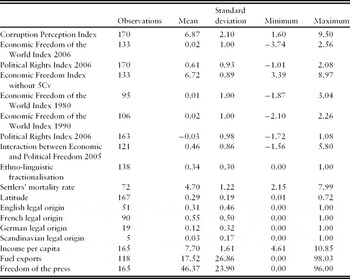
This section presents the variables used in this research. The corresponding descriptive statistics for our sample of countries are displayed in Table 1. This section is organised as follows. The first subsection describes public perceived corruption, the dependent variable. The second one presents the independent variable of interest, which is economic freedom. The next subsection discusses robust determinants of corruption. The last one delves on exogenous determinants of corruption based on geographical and historical considerations.
Summary statistics

Dependent variable
This research uses the Corruption Perceptions Index (CPI) from 2009 that Transparency International publishes annually as our measure of corruption. This index ‘ranks countries in terms of the degree to which corruption is perceived to exist among public officials and politicians’ (http://www.transparency.org). It is an ordinal index and includes a larger number of nations than other indices. The CPI is based on surveys of experts about the levels of corruption that they perceive in the public sector of 163 countries and it encompasses 14 different sources provided by 12 independent institutions. Some factors that are assessed in the construction of this indicator are corruption in the form of excessive patronage, job reservations, favour-for-favours and nepotism.
We rely on a measure of perceived corruption as opposed to experience-based corruption for various reasons. First, subjective measures of corruption are highly correlated. The Transparency International CPI used in this study is highly correlated with the World Bank's Control of Corruption Index. For available years the correlation ranges from 0.95 to 0.98, in spite of different methodologies and somewhat different definitions of corruption used, suggesting that the results are not idiosyncratic. Second, experience-based surveys of corruption and perceived corruption are highly correlated, between 0.6 and 0.8. However, correlation among different sources of experience-based corruption is lower, ranging between 0.448 and 0.665, not surprisingly, since corruption acts are unobservable and surrounded by secrecy. Finally, the copious and pernicious economic and social ill-effects of corruption, partially cited in footnote 1, are associated and/or caused by perceived corruption. Thus, perceived corruption in the public sector matters in spite of the limitation of not reflecting corruption in the private sector.Footnote 14
The values of the CPI range from 0 to 10, where a value close to 0 represents the perception of a high level of corruption; 5 is moderate and 10 is low level. To enhance understanding of our results, we inverted the direction of CPI, expressing it on a scale from 0 to 10, where higher levels imply a greater perception of corruption.Footnote 15
The truncation of the data at both ends implies that economic freedom experiences diminishing returns to abate corruption as any given country approaches the minimum value of corruption. This interpretation, however, in practice is incorrect. Nonetheless, to the extent that there is little clustering of countries at both ends of the finite scale, this is not a major problem.
Independent variable of interest: economic freedom
Our proxy for capitalist institutions is the EFW index published by the Fraser Institute. Specifically, we use 2008 Economic Freedom of the World Annual Report which contains data corresponding to the year 2006 (Gwartney et al., Reference Gwartney, Lawson and Norton2008).
The basic components of economic freedom are personal choice, voluntary exchange coordinated by markets, freedom to enter and compete in markets and protection of persons and their property from aggression by others. The major areas of the EFW index are: (1) Size of Government: Expenditures, Taxes, and Enterprises; (2) Legal Structure and Security of Property Rights; (3) Access to Sound Money; (4) Freedom to Trade Internationally; and (5) Regulation of Credit, Labor, and Business (http://www.freetheworld.com). Accordingly, the EFW index proxies for the soundness of policies in several important dimensions and for institutional quality.
The values of the EFW index range from 0 to 10, where a value close to 0 indicates low level of economic freedom and 10 is the highest possible. Thus, a country with a value close to 10 reflects widespread existence of capitalist policies and institutions.
Some researchers have criticised the EFW index for not providing specific policy advice. For example, De Haan and Sturm (2006) suggest that research emphasis should be placed on the individual components of the index. Our goal, as stated earlier, is to assess if capitalism is capable of effectively deterring corruption, hence our reliance on the index as a whole.
Moreover, (Lawson, Reference Lawson2006: 401) on the issue of the EFW index and growth warns against studies that decompose the index: ‘The point is that the relationship between EF [economic freedom] and economic growth is complex. We can parse EF out into various parts, ingredients if you will, but it is conceptually difficult to say which is most important.’ Putting it differently, looking at the areas or individual components misses the synergies emanating from the interaction of the areas and specific components present in the index.Footnote 16
For instance, in an application of Lawson's critique to corruption, inflation volatility, which is a component of the EFW index, has been found to be a robust determinant of corruption (see Braun and Di Tella, Reference Braun and Di Tella2004). However, inflation volatility is positively correlated with inflation, which is always a monetary phenomenon. The EFW index contains measures of inflation volatility, inflation levels and growth rate of monetary aggregates. Although neither growth of monetary aggregates nor inflation levels have been linked to corruption, what makes possible low volatility of inflation is low levels of inflation induced by monetary aggregates growth commensurate with real output growth. Thus, not surprisingly, the EFW index should be a better predictor of corruption than inflation volatility.
Results based on the EFW index are not devoid of policy advice. The main policy recommendations would be to control inflation, open up the economy, streamline regulations and taxes, and establish rule of law to promote market solutions as a mechanism of social coordination. Further, to the extent that Lawson's critique is accurate, these reforms would have a synergistic effect on the reduction of corruption.
Robust determinants of public corruption uncovered by Treisman (Reference Treisman2007)
‘By far the strongest and most consistent finding of the new empirical work is that lower perceived corruption correlates closely with higher economic development.’ (Treisman, Reference Treisman2007: 223) Thus, we allow for the presence of the natural log of income corresponding to the year of 2005 and taken from the World Bank Development Indicators.
Political rights, democracy, implies an independent judiciary, existence of open and free private discussion, free and fair elections, competitive parties, an opposition that plays an important role in the political process, whether those who are elected rule, among others, all of which contribute to greater accountability, information, enforcement and consequently less corruption. Accordingly, our proxy for democracy is the 2005 Political Rights Index of Freedom House (http//freedomhouse.org). This index goes from 1 to 7, where 1 indicates most free and 7 least free. To facilitate understanding of the results, we inverted and standardised the index; thus, lower values indicate less political freedom.
Brunetti and Weder (Reference Brunetti and Weder2003: 1801) wrote: ‘An independent press is probably one of the most effective institutions to uncover trespassing by government officials. The reason is that any independent journalist has a strong incentive to investigate and uncover stories on wrongdoing.’Footnote 17 We use the index provided by Freedom House (2005), whereby higher values indicate lower press freedom.
In accordance with the Introduction section, other variables found to have a robust predictive power of corruption are trade openness, inflation, particularly its standard deviation, and encumbered business regulations. Since the EFW index includes measurement of these variables we do not use them as explicit controls.
Finally, Friedman (Reference Friedman1962: 10) argues that: ‘The relation between political and economic freedom is complex and by no means unilateral.’ To partially test this contention we allow for a non-linear multiplicative term. For concreteness, we control for the interaction between economic freedom and political rights in order to assess if they are complementary or substitutes in curbing corruption. In other words, are increases in economic freedom more effective reducing corruption when political freedoms are low (substitutes) or when political freedoms are high (complements)? This variable is treated in deviations from the sample means.Footnote 18
Legal, geographical and ethnic determinants of corruption
The law, economics and finance view summarised in La Porta et al. (Reference La Porta, Lopez-de-Silanes and Shleifer2008) classifies countries according to national commercial legal origins and distinguishes between civil and common law families. These legal traditions shaped institutions differently; for example, countries with a civil legal tradition, particularly French legal origin countries, have a tendency to erect rules that increase the power of government. On the contrary, countries with an English legal tradition attempt to limit the power of government and to protect property rights (Hayek, Reference Hayek1960). Accordingly, legal origin is associated with types of capitalism. In the context of OECD countries, Pistor (Reference Pistor, Hopt, Wymeersch, Kanda and Baum2006) finds that in common law countries the main mechanism of social coordination is based on market solutions whereas in civil law countries, in particular French civil law countries, strategy relies more on government solutions that distort market functioning or suppress markets altogether.
Moreover, in financial development regressions controlling for legal origin, cultural variables such as religion become insignificant (La Porta et al. Reference La Porta, Lopez-de-Silanes and Shleifer2008). Further, La Porta et al. (Reference La Porta, Lopez-de-Silanes, Shleifer and Vishny1999, Reference La Porta, Lopez-de-Silanes and Shleifer2008) and Djankov et al. (Reference Djankov, La Porta, Lopez-de-Silanes and Shleifer2002, Reference Djankov, La Porta, Lopez-de-Silanes and Shleifer2003) unveil a systematic relation between legal origin and corruption. In particular, French legal origin countries exhibit greater corruption levels than English common law countries. Thus, legal origin, besides being a determinant of corruption, is closely related to the varieties of capitalism. In addition, allowing for legal origin cultural variables exhibit little predictive power.
In addition, legal origin is exogenous to the extent that most countries inherited significant parts of their legal system involuntarily through conquest and colonisation. Thus, countries’ approach to social coordination is mostly determined by the history of transplantation rather than through autochthonous selection.Footnote 19 In our study we control for legal origin introducing a dummy variable that takes the value of 1 if the country belongs to the English legal family tradition and 0 otherwise.
According to the geography endowment hypothesis, more temperate latitudes are more inclined toward agriculture, settlement and colonisation because of better climatic conditions and a less-harmful disease environment. When Western Europeans settled, they brought with them high-quality institutions that protected private property and reduced corruption. However, Western Europeans settled in climates similar to that of Europe. Thus, countries with greater distance from the equator measured by latitude are more likely to have better institutions and therefore less corruption (Hall and Jones, Reference Hall and Jones1999).Footnote 20
A geographic explanation, as opposed to institutional, of the impact of latitude on corruption is provided by Landes (Reference Landes1998: 5) who contends that ‘few manage to work at full when hot and wet’. An even blunter explanation is provided by Machiavelli (Reference Machiavelli1987), who argues: ‘fertile countries . . . are apt to making men idle and unable to exercise any virtue’.Footnote 21
Latitude is a variable scaled to take values between 0 and 1. Hall and Jones (Reference Hall and Jones1999), Treismann (Reference Treisman2000), Easterly and Levine (Reference Easterly and Levine2003) and Rodrik et al. (Reference Rodrik, Subramanian and Trebbi2004), amongst others, have used latitude as an IV. Information on this variable is provided by La Porta et al. (Reference La Porta, Lopez-de-Silanes, Shleifer and Vishny1999).
Ethno-linguistic fractionalisation is an index that measures ethnic and linguistic heterogeneity, the probability that two randomly selected individuals from a country are from different ethno-linguistic groups. Huntington (Reference Huntington1968) argues that governments in countries with a more fractionalised population tend to implement policies that benefit the winning minority at the expense of groups not represented in government. Further, Mauro (Reference Mauro1995) indicates that divided countries are prone to greater political instability and are associated with more corruption, because bureaucrats tend to favour members of their own group and attempt to take as many bribes as possible given the uncertainty about their tenure in office. Thus, ethnic groups tend to favour members of their own groups engaging in ethnocentric behaviour.
This variable has been identified as an exogenous source of government predisposition to political infighting, to enact redistributive policies, weakening institutional quality and consequently hindering economic prosperity (Mauro, Reference Mauro1995; Easterly and Levine, Reference Easterly and Levine1997, Reference Easterly and Levine2009).Footnote 22 Consequently, more fractionalised societies should exhibit greater corruption levels; see Dincer (Reference Dincer2008) for recent evidence.Footnote 23 This variable is taken from La Porta et al. (Reference La Porta, Lopez-de-Silanes, Shleifer and Vishny1999). For ease of explanation when we refer to legal origin, latitude and ethno-linguistic fractionalisation as a group we will call them ‘historical controls’ which are treated throughout the paper as exogenous variables.
4. Results
We present OLS results based on specifications that allow for all documented robust determinants of corruption. Thus in principle we control for omitted variable bias. In addition, our explanatory variable observations are taken from time periods that precede observations of the dependent variable to control for potential reverse causality. Additionally, we use heteroskedasticity-consistent standard errors.
However, using OLS methods we cannot control for problems associated with noisy signals of economic freedom stemming from measurement error. Thus, as a robustness check, we also comment results based on IV methods.Footnote 24
Impact of economic freedom on corruption allowing for law, endowments and ethnicity
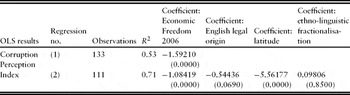
Table 2 displays OLS results that relate corruption to the EFW index for our sample of countries. The parameter estimate of the EFW index is negative and statistically significant, suggesting that higher levels of economic freedom reduce corruption. The regression coefficient of the EFW index enters statistically significantly in both the univariate regression (1) and in the regression (2) that controls for legal, geographical and ethnic determinants of corruption.
Corruption, economic freedom and historical controls (dependent variable: Corruption Perception Index 2009)

Notes: P values are given in parentheses. P values and F statistics were calculated using robust standard errors. The Corruption Perception Index takes values from 0 to 10, where higher values imply more corruption. Economic Freedom 2006 takes values from 0 to 10, where higher values indicate higher levels of economic freedom. English legal origin takes the value of 1 if a country belongs to the common law tradition and 0 otherwise. Latitude takes values between 0 and 1. Ethno-linguistic fractionalisation takes values between 0 and 1, where higher values suggest more fractionalised societies.
Main results: impact of economic freedom on corruption allowing for robust determinants of corruption
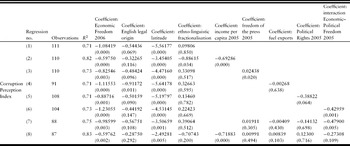
Table 3 presents OLS results on the impact of economic freedom on corruption controlling for historical determinants of corruption, robust determinants reported by Treisman (Reference Treisman2007) plus the interaction between economic and political freedom. To facilitate comparisons, we reproduce in regression (1) of Table 3 OLS results controlling for historical variables shown in Table 2 regression (2). We introduce each of the Treisman's controls one at a time, regressions (2) to (5), and likewise the interactive term, regression (6), followed by a specification that allows for all the controls except income, regression (7). In the last specification all controls are simultaneously included, regression (8).
Corruption, economic freedom and historical controls, plus robust determinants (dependent variable: Corruption Perception Index 2009)

Notes: P values are given in parentheses. P values and F statistics were calculated using robust standard errors. The Corruption Perception Index takes values from 0 to 10, where higher values imply greater levels of corruption. Economic Freedom 2006 takes values from 0 to 10, where higher values indicate higher levels of economic freedom. English legal origin takes the value of 1 if a country belongs to the common law tradition and 0 otherwise. Latitude takes values between 0 and 1. Ethno-linguistic fractionalisation takes values between 0 and 1, where higher values suggest more fractionalised societies. Income per capita 2005 is the logarithm of gross domestic product per capita in constant US$ of the year 2000 in 2005. Freedom of the press 2005 takes values between 0 and 100 where higher values mean less freedom of the press. ‘Fuel exports’ is the percentage of the merchandise exports for each country in 2005. ‘Political rights 2005’ takes values between 1 and 7, where higher values indicate more political rights. Interaction Economic–Political Freedom 2005 is the product of Economic Freedom of the World and Political Rights in 2005.
Point estimates associated with economic freedom in all specifications enter negatively, and highly significantly. OLS regression coefficients hover around –1.00; however, they fall to about half when income is included. Further, income also always enters significantly. This finding buttresses the assertion: ‘By far the strongest and most consistent finding of the new empirical work is that lower perceived corruption correlates closely with higher economic development.’ (Treisman, Reference Treisman2007: 223)
In the third corruption regression (3) of Table 3, freedom of the press, the only Treisman control included, enters significantly and positively. Thus, higher values indicating less press freedom are correlated with more corruption. The other Treisman controls, fuel exports and political rights, do not enter significantly at the 5% level as shown in regressions (4) and (5).
Interestingly, in regression (6) the interactive term enters negatively and significantly at the 1% level in the specification where only the interaction term is the additional control. The regression coefficient associated with the interaction is negatively significant at the 1% level in specification (7) where all historical and Treisman controls are included except income, and is negative and almost significant at the 10% level (P value of 0.109) when we allow for all the controls. Further, the negative sign of the coefficient associated with the interaction suggests that economic and political freedoms are complementary. That is, increases in economic freedom have a greater impact in deterring corruption when political rights are higher.
Finally, specification (8) includes all the robust determinants of public perceived corruption known in the literature, in particular income. The parameter estimate associated with economic freedom is negative and statistically significant at the 1% level and the regression explains 83% of the total variation of corruption. We find this result striking:
The correlation between economic development and perceived corruption is extremely robust. It survives the inclusion of a variety of controls (for ethno linguistic fractionalization, latitude, region, religion, culture, democracy, trade, inequality, inflation, and various policy variables), and it can be found in each region of the world (Treisman, Reference Treisman2007: 225).
That is, in spite of the strength of development explaining corruption, economic freedom survives income and all the robust determinants of corruption.
Robustness of these findings (not shown) is investigated employing a 2SLS strategy, whereby we exploit exogenous variation in the EFW index driven by settlers’ mortality rates and lagged the EFW index from 1990. Interestingly, the general thrust of these results is that economic freedom enters negatively, statistically significant at the 5% level and greater in absolute value than OLS estimates, suggesting a correction for attenuation bias.Footnote 25 Perhaps, more surprisingly, income does not predict corruption; its regression coefficient fails to enter significantly.Footnote 26
5. Discussion of the main results
Our results indicate that capitalism, measured by the EFW index, is a determinant of public corruption as robust as development, measured by income per capita. In the OLS specifications, both economic freedom and income enter highly significantly and with the expected sign. In the IV regressions income loses significance whereas economic freedom remains significant.
Moreover, Dawson (Reference Dawson1998), Cole (Reference Cole2003), Gwartney et al. (Reference Gwartney, Holcombe and Lawson2004, Reference Gwartney, Holcombe and Lawson2006) and Faria and Montesinos (Reference Faria and Montesinos2009), amongst others, provide evidence consistent with the existence of a direction channel from capitalism, economic freedom, to growth and higher levels of income. We do not know of any country that after increasing its level of economic freedom has not experienced growth. The torrid growth of Hong Kong and Singapore is associated with major economic reforms during the late 1950s and early 1960s. The high growth rates of China and India are also associated with major institutional reforms implemented in the early 1980s and 1990s, respectively. The high growth rates of Chile and lately Peru are also linked to reforms implemented in the late 1970s and early 1980s in the former and mid-1990s in the latter. The turnaround of the US and UK economies is rooted in reforms implemented in the 1980s. The stagnation of Venezuela is associated with the destruction of capitalist institutions, starting timidly in the 1950s but accentuated since the 1960s, with no end in sight given Chavez socialist leanings and the inability of the opposition to garner massive popular support in order to oust him through democratic means.
Further, not denying that development may increase economic freedom and in general improve the quality of the country's capitalist institutions, clear cases exist of greater income not accompanied by quality improvements of policies and institutions protective of private property. OPEC oil-producing countries fall in this category. Consequently, our evidence is consistent with the view that stresses the primacy of capitalist institutions and policies to abate corruption and increase income.
This view is not inconsistent with the human capital hypothesis espoused by Glaeser et al. (Reference Glaeser, La Porta, Lopez-de-Silanes and Shleifer2004), Galor et al. (Reference Galor, Moav and Vollrath2009) and Galor (Reference Galor2010) to the extent that greater education leads to the implantation of institutions and policies protective of private property. If this is not the case, the economy will not experience sustained growth, as communist countries have clearly shown in spite of enormous educational efforts; see Hall and Jones (Reference Hall and Jones1999). Further, Faria and Morales (Reference Faria and Morales2012) provide evidence indicating that both economic freedom and human capital are significant predictors of growth.
The results presented in Table 3 suggest that after controlling for economic freedom, democracy is not a robust predictor of corruption at the 5% level. This finding resonates with Buchanan and Tullock (Reference Buchanan and Tullock1962) who showed existence of numerous inefficiencies inherent to democratic governments, and with Olson (Reference Olson1965) and Tullock (Reference Tullock1967), who emphasise the potential problem of manipulating democratic government through rent-seeking activity favouring privileged groups at the expense of the majority.
Similarly, results displayed in Table 3 indicate that freedom of the press is a fragile predictor of corruption after allowing for the EFW index. Freedom of the press enters significantly in one out of three regressions presented in Table 3. This evidence is consistent with the notion that the press has to be free from governmental meddling but also from private rent-seeking groups to become an effective corruption fighter.Footnote 27 If there are media financed by rent-seeking groups, it is critical that there is existence of a counterweight by means of social communication outlets financed by wealth-creating groups (see Becker, Reference Becker1983, Reference Becker1985). In much of Latin America and in particular in Venezuela, the government-owned media are socialist oriented and the privately owned media have a mercantilist bias (rent-seeking), not pro-capitalist.
A variety of economic orientation among media outlets in the private sector, capitalist versus mercantilist, is relevant for corruption abatement because rent-seeking is a corrupt practice. Baumol (Reference Baumol1990), Murphy et al. (Reference Murphy, Shleifer and Vishny1993) and Alesina and Angeletos (Reference Alesina and Angeletos2005) model corruption as a rent-seeking activity and formally show the presence of inertial forces that tend to perpetuate bad equilibriums. For example, Alesina and Angeletos (Reference Alesina and Angeletos2005) explain the permanence of low equilibriums in Latin America democracies due to the existence of a paradoxical coalition between the poor, who benefit from redistribution financed by high taxes, and the privileged rich who benefit from corruption and rent-seeking in an enlarged government.
Fuel exports do not enter significantly in any OLS regression specification as documented in Table 3. This evidence suggests that holding economic freedom constant, fuel exports do not exert an independent effect on corruption. Thus, the high level of economic freedom of oil-exporting countries such as Canada, UK and Norway explains their low levels of corruption in spite of being oil-exporting nations. On the contrary, high levels of corruption associated with oil-exporting countries such as Ecuador, Mexico and Venezuela are therefore driven by their low levels of economic freedom. Finally, the interaction term between capitalism and democracy is generally consistent with the hypothesis of complementariness.
To further cast light on potential causality mechanisms from greater economic freedom to less corruption, consider various illustrative examples. Price controls, typically set below market clearing levels, attempt to prevent the workings of a natural basic economic law which is the price increase in the presence of excess demand. Some entrepreneurs will not find it profitable to sell their products at the regulated levels; consequently, they are incentivised to bribe bureaucrats in charge of enforcing the government-decreed price to look the other way and allow the sale of goods and services at higher prices. Similar lines of reasoning can be applied to cases of exchange rate controls and interest rate controls.
High and complex tariff structures also encourage corrupt behaviour to the extent that it is cheaper to pay customs enforcers than to comply with the tariff. By the same token, in the case of import quotas, where government officials are in charge of extending a lucrative contract to a private agent, the agent may be coerced and/or may be voluntarily willing to surrender some of the gain in exchange for the quota privilege.
Consider the case of government-owned enterprises, e.g., a hospital. Resources of the hospital face an increased probability of suffering a sort of tragedy of the commons considering that the absence of a profit motive may considerably reduce the requisite monitoring to prevent depredation of medicinal assets. In fact, it is common in countries like Venezuela to witness the outright theft of resources in government-owned hospitals whereas in privately owned ones this social malady is substantially tamed. This reality suggests the convenience of adopting a more capitalist institutional structure whereby hospitals are privately owned but the government finances the health service demand of low-income people. This solution is perhaps less pressing in countries with human capital traits characterised by greater civic virtues.
A necessary condition for a capitalist economy to function efficiently is the establishment of an ethical, legal and regulatory infrastructure that treats everyone equally and whereby transgressors are subjected to commensurate punishments to deter behaviour that contravenes existing institutional rules. Absence of this legal framework, rule of law and its enforcement may explain why the process surrounding privatisations in Argentina and Russia during the 1990s were met with high levels of perceived corruption.
On the contrary, the high quality of the judiciary and of government in general in Scandinavian countries may help to explain why in spite of some governments absorbing more than 60% of gross domestic product (GDP) and the correspondingly high taxation, these countries exhibit low levels of corruption. Revealingly, Latin American countries typically score high on corruption and have relatively small government size. Thus, it is not just size that matters for public corruption, but governmental quality.Footnote 28 Add to this attribute of high governmental quality in Scandinavian countries, low tariffs, and virtual absence of exchange rate controls, price and interest rate controls, relatively small number of government-owned enterprises, stable money, business-friendly regulations and the overall picture is one of countries with fairly high levels of economic freedom.
Culture is potentially another countervailing factor to big government in rich Western European countries and particularly among Scandinavian nations. Algan and Cahuc (Reference Algan and Cahuc2009) document that these are countries with high levels of social capital, especially in the dimension of trust. In addition, La Porta et al. (Reference La Porta, Lopez-de-Silanes, Shleifer and Vishny1997) inter alia find a significantly negative relation between corruption and trust. Nonetheless, a caveat is in order: ‘Instead of measuring trust, the WVS [World Values Survey] measure may instead proxy the well-functioning of institutions.’ (Beugelsdijk, Reference Beugelsdijk2006: 371) Supportive evidence is reported in Faria and Morales (Reference Faria and Morales2012), who in growth regressions find that after controlling for economic freedom, trust does not predict growth.
Summarising, the information conveyed by the results of Table 3 suggests that economic freedom is a robust determinant of public corruption. The EFW index enters significantly at the 1% level with the hypothesised sign conditioning for all the historical covariates and Treisman's robust determinants of corruption which have at best a tenuous impact on corruption in the presence of the EFW index.Footnote 29
6. Concluding remarks
A large body of recent research documents numerous inimical consequences of public perceived corruption on economic growth and welfare. This research explores the question of whether the EFW index published by the Fraser Institute, which can be construed as a proxy for capitalism, is capable of deterring public perceived corruption. In other words, does the change in incentives brought about by a capitalist institutional structure induce a response on behalf of bureaucrats, politicians and their private-sector counterparts to act more honestly?
We find that the EFW index survived a rich set of covariates, methods and specification checks. Specifically, OLS results suggest that economic freedom is robustly linked to public corruption after allowing for historical variables, non-linear terms and Treisman's (Reference Treisman2007) determinants of corruption. We checked the robustness of these findings using a 2SLS identification strategy and found that IV estimates of the EFW index are significant and systematically greater in absolute value than corresponding OLS estimates.
Perhaps our results could be illuminated further by presenting some illustrative examples. China had a level of economic freedom of 5.2 in 1995, and the corruption level measured in 1997 was of 8.1. In 2009, the level of economic freedom had increased to 6.4 and for the same year the corruption level had declined to 7.4. Thus, an increase in economic freedom of 1.2 is associated with a decline in measured perceived corruption of 0.7. Other similar cases, to mention the most conspicuous, are India, Colombia, Nigeria and Ghana.
Not all is good news. Zimbabwe's corruption perception level in 1998 was of 6.8 and the level of economic freedom stood at 5.8. For the year 2009, corruption had increased to 8.8 and economic freedom had declined to 4.1. Accordingly, a reduction over the period of 0.7 in economic freedom is associated with an increase in corruption of 2.0 points. Other prominent countries in a similar predicament are Malaysia, Philippines and Portugal. This issue, however, of changes in corruption matched with changes in economic freedom or of within-country variation in both variables is left as future research when the time series on perceived corruption has been lengthened with more annual observations.
In summary, a candid interpretation of our findings is that economic freedom trumps all other determinants of public corruption, including income, which is suggestive of the primacy of institutions. Further, the presence of capitalist institutions substantially helps to explain why rich high-income countries showcase low levels of corruption, that is, why honesty is a normal good. Furthermore, the evidence uncovered suggests that due to the incentive structure of capitalist economies characterised by greater competition and more impersonal norms (North et al., Reference North, Wallis and Weingast2009), on average people behave more honestly and will be incentivised to be more industrious and creative, engendering higher growth rates, than in economies with mercantilist and socialist institutions. These findings lend credence to the Friedman–Hayek hypothesis on the role of capitalism in curbing public corruption.
Finally, restraining public corruption does not imply its eradication. As indicated by Hodgson and Jiang (Reference Hodgson and Jiang2007), a tension emerges between public corruption and capitalism to the extent that corruption tends to undermine the institutional rules that abate it. Consequently, solving the problem of corruption entails an adequate institutional design and instilling ethical values that refrain people from corrupt practices.