Introduction
Failure to maintain the clinical gains achieved during acute treatment is unfortunately a common phenomenon in the course of anorexia nervosa (AN). Not only is this disorder challenging to treat but also, among patients who do undergo successful weight restoration, long-term maintenance of gains is tenuous. Depending, in part, on how relapse is defined, reported relapse rates range from 9% to 42% (Eckert et al. Reference Eckert, Halmi, Marchi, Grove and Crosby1995; Strober et al. Reference Strober, Freeman and Morrell1997), with the greatest risk of relapse occurring during the first year following discharge from initial treatment (Isager et al. Reference Isager, Brinch, Kreiner and Tolstrup1985; Pike, Reference Pike1998; Herzog et al. Reference Herzog, Dorer, Keel, Selwyn, Ekeblad, Flores, Greenwood, Burwell and Keller1999).
The identification of characteristics of individuals who are able to maintain weight following acute weight restoration offers the potential to bolster the effectiveness of both initial treatment approaches and relapse prevention strategies. If characteristics predicting successful weight maintenance can be reliably identified, it may be useful for treatment programs to focus on and to enhance and sustain those characteristics.
Previously we reported the results of a randomized controlled trial of maintenance treatment among weight-restored patients with AN that found fluoxetine was no better than placebo in sustaining recovery (Walsh et al. Reference Walsh, Kaplan, Attia, Olmsted, Parides, Carter, Pike, Devlin, Woodside, Roberto and Rockert2006). We now report on the results of a secondary analysis of these data that attempts to identify factors that predict maintenance of a minimally normal weight among patients with AN who achieved weight restoration during intensive structured in- or out-patient treatment.
Method
Participants
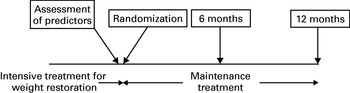
Details of the study have been reported previously (Walsh et al. Reference Walsh, Kaplan, Attia, Olmsted, Parides, Carter, Pike, Devlin, Woodside, Roberto and Rockert2006). Participants were females, aged 16–45 years, meeting the criteria for AN specified in the DSM-IV, as determined by the Structured Clinical Interview for DSM-IV (SCID; First et al. Reference First, Spitzer, Gibbon and Williams1996) at the initiation of weight-restoration treatment. Amenorrhea was not required as a diagnostic criterion because of literature suggesting that clinical populations with and without this feature do not differ significantly (Garfinkel et al. Reference Garfinkel, Lin, Goering, Garfinkel, Spegg, Goldbloom, Kennedy, Kaplan and Woodside1996; Cachelin & Maher, Reference Cachelin and Maher1998; Watson & Andersen, Reference Watson and Andersen2003). Eligibility at the time of entry into intensive treatment for weight restoration required a body mass index (BMI) <18.5 kg/m2 and duration of illness ⩽15 years. Patients attended either a structured in-patient or a day hospital program until they reached a BMI >19.0 kg/m2 that was maintained for at least 2 weeks prior to entry into the trial (see Fig. 1).
Schematic outline of time course. Potential predictors were assessed at the end of initial weight-restoration treatment prior to randomization. Outcome was determined over 6 and 12 months of maintenance treatment.

Ninety-three women, 48 from Toronto General Hospital and 45 from the New York State Psychiatric Institute, were randomized into the medication trial following weight restoration. After complete description of the study to the subjects, written informed consent was obtained. This study was reviewed and approved by the Institutional Review Boards of Toronto General Hospital and the New York State Psychiatric Institute.
Treatment
The main focus of the in-patient and day hospital treatment programs used in this study was the provision of supervised meals, as well as cognitive and behavioral interventions to facilitate nutritional rehabilitation through both group and individual formats. Following weight restoration and several weeks of weight maintenance, patients were discharged from these intensive treatment programs and randomly assigned to receive up to 80 mg/day fluoxetine or placebo for up to 1 year (Fig. 1). In addition, all patients were eligible to receive 50 sessions of cognitive behavioral therapy (CBT) adapted specifically for use in the relapse-prevention treatment of AN (Pike, Reference Pike1998; Pike et al. Reference Pike, Walsh, Vitousek, Wilson and Bauer2003). Patients participated in the study for 12 months or until they either met criteria for withdrawal from the study or voluntarily withdrew from treatment. Patients were weighed at each CBT session, which occurred at approximately weekly intervals throughout the year of treatment.
Definition of successful weight maintenance
Because of the salience of maintaining normal weight in sustaining recovery from AN, successful weight maintenance was defined as maintaining a BMI ⩾18.5 kg/m2. Patients whose BMI fell below 18.5 kg/m2 for four consecutive weeks were considered to have failed to maintain weight. In addition, study guidelines required that patients be withdrawn from the study for severe clinical deterioration, defined as (1) a BMI ⩽16.5 kg/m2 for two consecutive weeks, (2) severe medical complications (other than low weight) as a result of the eating disorder, (3) imminent risk of suicide, or (4) the development of another severe psychiatric disorder requiring additional treatment. Patients who voluntarily withdrew from treatment (‘dropped out’) were also considered to have failed because it could not be determined that these individuals successfully maintained weight. Thus, the definition of ‘successful weight maintenance’ was very stringent; it required maintaining a minimally normal BMI, remaining in treatment, and not exhibiting severe medical or psychological deterioration.
Although the original study provided for 12 months of out-patient treatment, in the current report we focus primarily on maintenance of recovery over the first 6 months. We chose to examine this briefer period because most of the patients whose BMI fell below 18.5 kg/m2 or who ended treatment did so during the first 6 months. In addition, because most of the psychological measures selected as possible predictors were assessed only at the beginning of the study, we assumed that their relationship to maintenance of successful recovery would be more robust closer to the time of their assessment. We also examined the relationship of these putative predictors to successful weight maintenance over both 6 and 12 months.
Assessments
Possible predictors were assessed after weight restoration and prior to discharge from intensive treatment (Fig. 1). An independent research coordinator who was not involved in the provision of therapy during the course of the study and who was blind to medication assignment administered the interviews and self-report questionnaires. Socio-economic status (SES) was determined by the Hollingshead Occupational Categories (Hollingshead & Redlich, Reference Hollingshead and Redlich1958). A rating of high SES was assigned to Hollingshead categories 1 and 2 and low SES was assigned to all other categories. After weight restoration and within 4 weeks of entry into the study, patients completed a battery of measures to assess eating disorder-specific psychopathology. These included the Eating Disorder Examination, 12th Edition (EDE; Fairburn & Cooper, Reference Fairburn, Cooper, Fairburn and Wilson1993), treatment and illness history interviews, a questionnaire assessing expectations for recovery designed by the investigators for the study, the Eating Disorder Inventory (EDI; Garner & Olmsted, Reference Garner and Olmsted1984), the Mizes Anorectic Cognitions (MAC) scale (Mizes et al. Reference Mizes, Christiano, Madison, Post, Seime and Varnado2000), the Commitment to Exercise Scale (CES; Davis et al. Reference Davis, Brewer and Ratusny1993) and the Yale–Brown–Cornell Eating Disorder Scale (YBC EDS; Mazure et al. Reference Mazure, Halmi, Sunday, Romano and Einhorn1994). Patients also completed the Temperament and Character Inventory (TCI; Cloninger et al. Reference Cloninger, Przybeck, Surakic and Wetzel1994), the SCID-1 (First et al. Reference First, Spitzer, Gibbon and Williams1996) and the Quality of Life Enjoyment and Satisfaction Scale (QLESQ; Endicott et al. Reference Endicott, Nee, Harrison and Blumenthal1993). Patients were weighed prior to randomization and at every therapy session during the relapse-prevention out-patient treatment.
Predictors
On the basis of the existing literature on the prediction of relapse in AN, we identified potential factors that might predict successful weight maintenance. These included clinical parameters (AN subtype, presence or absence of a history of suicide attempt(s), duration of illness, number of previous hospitalizations, pre-randomization weight) and symptom ratings from structured interviews or questionnaires (the presence or absence of exercise during the 4 weeks previous to randomization during intensive treatment as assessed by the EDE, total number of SCID diagnoses, EDE weight concerns and shape concerns, YBC EDS total score, and scores on the psychometric scales: EDI Ineffectiveness and Perfectionism, MAC, QLESQ, CES and TCI). Prior to study entry, patients were also asked to estimate on a 100-point scale the likelihood that they would maintain their weight over the next 12 months, and the likelihood that they would relapse over the next 12 months. As an additional predictor, for each patient, the average change in weight per week over the first 28 days of the study was calculated using all available weights.
Data analysis
The statistical significance of potential predictors was examined using univariate logistic regression (with successful weight maintenance, as defined above, as the dependent measure) and Cox regression (with time from randomization to failure to maintain weight as the dependent measure). Successful weight maintenance for 6 and 12 months was examined separately. Differences between groups were compared using independent-sample t tests for continuous variables and χ2 tests for categorical variables. Analyses were completed using SPSS version 11 (SPSS Inc., Chicago, IL, USA).
Results
Logistic regression analyses
At admission to intensive treatment for weight restoration, 48 patients met DSM-IV criteria for AN restricting subtype, and 45 met criteria for AN binge-purge subtype, as assessed by the EDE. The 93 participants had a mean age of 23.3±4.6 years and duration of illness of 4.5±3.6 years. After weight restoration, the mean BMI was 20.3±0.5 kg/m2. After 6 months, 53 (57.0%) of the 93 patients had failed to maintain recovery; the BMI of 30 patients fell below 18.5 kg/m2 for at least 1 month, nine patients were withdrawn by the treatment team (four for severe depression, two because of adverse events, one because of clinical deterioration, and two for non-compliance with sessions) and 14 chose to withdraw from the study (eight were dissatisfied with treatment, four were unable to keep appointments and, for two, the reasons were unknown). In the next 6 months, an additional 14 patients failed to maintain recovery; the BMIs of seven additional patients fell below 18.5 kg/m2 for at least 1 month, two more were withdrawn by the treatment team (one for severe depression and one for non-compliance with medications) and five more chose to withdraw from the study (four were dissatisfied with treatment and one was unable to keep appointments).
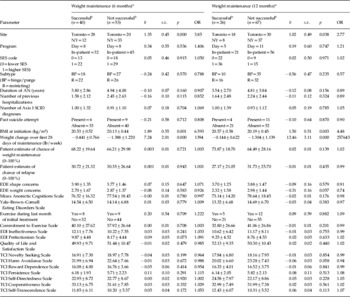
Comparisons of the outcome groups at 6 and 12 months on the possible predictor variables are shown in Table 1. The two groups were comparable on almost all parameters. However, two weight-related variables were associated with successful weight maintenance. The average BMI at the initiation of the study was higher in the successful weight maintenance groups in both time periods and the average rate of weight loss over the first 28 days was lower. In addition, a higher proportion of patients at the Toronto site successfully maintained weight. The two weight-related parameters were significantly correlated; a higher BMI at initiation of the study was associated with a lower rate of weight loss (r=0.32, df=91, p=0.002). The BMI at initiation did not differ between sites [New York: 20.1±0.51 (s.d.) kg/m2, Toronto: 20.4±0.52 kg/m2, t=1.15, df=91, p=0.3], but the rate of change in weight tended to be higher in New York (NY: –1.21±1.33 lb/week, Toronto: –0.76±0.91 lb/week, t=1.92, df=90, p=0.06). There were no statistically significant interactions between site and these parameters.
Association between predictors and successful weight maintenance at 6 and 12 months assessed by logistic regression

SES, Socio-economic status; NY, New York; AN, anorexia nervosa; SCID, Structured Clinical Interview for DSM-IV; BMI, body mass index; EDE, Eating Disorder Examination; EDI, Eating Disorder Inventory; TCI, Temperament and Character Inventory; b, regression coefficient; OR, odds ratio; s.e., standard error of regression coefficient.
a Successful maintenance coded as 1, unsuccessful as 0.
b Mean±standard deviation (for continuous measures) or counts (for categorical measures).
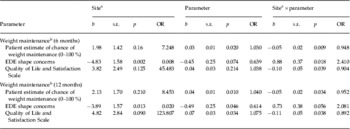
Because of the site differences in outcome, we determined whether there were significant site differences in any of the potential predictive factors. Patients at the New York site were more optimistic about their chances of maintaining weight (New York: 74.3±21.5, Toronto: 60.2±28.5, t=2.61, df=87, p=0.011), rated their quality of life higher on the QLESQ (New York: 53.1±9.1, Toronto: 48.6±10.4, t=2.135, df=90, p=0.035), and expressed less concern about shape on the EDE (New York: 3.51±1.42, Toronto: 4.13±1.34, t=2.21, df=91, p=0.029). There were also statistically significant interactions between these factors and site (Table 2). In general, the relationship was in the intuitively sensible direction in Toronto, but counter-intuitive in New York. For example, patients who rated their chances of weight maintenance higher were more likely to maintain weight successfully in Toronto but less likely to do so in NY.
Results of logistic regression analyses including site-by-predictor interactions for predictors of successful weight maintenance significantly different between sites

EDE, Eating Disorder Examination; b, regression coefficient; OR, odds ratio; s.e., standard error of regression coefficient.
a Site coded as New York=1; Toronto=0.
b Successful maintenance coded as 1, unsuccessful as 0.
Cox regression analyses
The results of the Cox regression analyses of time to fail to maintain weight in the 6 and 12 month time periods were similar to those of the logistic regression analyses. Therefore, only the results are summarized; details are available from the authors on request. BMI at initiation, rate of weight change in the first 28 days, and site were significantly associated with time to failure in both time periods. There were statistically significant interactions between site and rate of change in weight over both time periods, with site, rate of change in weight, and their interaction, all being statistically significant; a higher rate of weight loss and being in New York were both associated with a higher risk, and the impact of rate of weight loss was greater in Toronto. Interactions between site and BMI at initiation were not significant. As in the logistic regression analyses, there were statistically significant interactions between site and the patient's estimate of her chances of maintaining weight, QLESQ, and shape concerns assessed by the EDE.
Discussion
The current study of AN found that most clinical and symptomatic measures of core eating disorder psychopathology were not related to remaining in treatment and successfully maintaining weight in the year following restoration to normal weight in a structured program. Only a higher BMI at the time of entry into the out-patient program, a lower rate of weight loss over the first month, and site were clearly associated with successful weight maintenance. The fact that patients with higher BMI at entry had lower rates of weight loss in the first 28 days of out-patient treatment may indicate that the difference in BMI is a reflection of a greater capacity of some patients to achieve and tolerate being a higher weight at the end of intensive treatment, and that this ability foreshadows greater success with weight maintenance. If so, this capacity was not clearly identified by the measures of psychopathology used in this study.
Most previous studies of predictors of the course of AN have not examined factors associated with sustained weight maintenance, but instead have focused on relapse, which may involve more severe deterioration. Factors suggested as predictors of relapse include a history of suicide attempts, previous eating disorder treatment, higher levels of obsessional symptoms, greater concerns about weight, shape and eating, and a tendency to avoid problems (Carter et al. Reference Carter, Blackmore, Sutandar-Pinnock and Woodside2004). Increased levels of exercise (Strober et al. Reference Strober, Freeman and Morrell1997; Carter et al. Reference Carter, Blackmore, Sutandar-Pinnock and Woodside2004), longer duration of illness (Richard et al. Reference Richard, Bauer and Kordy2005), greater disturbance in body image and worse psychosocial functioning post-treatment (Keel et al. Reference Keel, Dorer, Franko, Jackson and Herzog2005) have also been reported as predictors of relapse. Among studies that have focused on maintenance of weight, one qualitative study of a subset of the patients in the Toronto sample who participated in this trial and who relapsed reported that even though they were weight restored at the end of intensive treatment, they never felt truly ‘psychologically recovered’. Those who were able to successfully maintain their weight reported that recovery for them was an ongoing process that required internal motivation, belief in the capacity to change, the ability to trust others, and the healthy expression of emotion (Federici & Kaplan, Reference Federici and Kaplan2008). One study of weight maintenance after hospitalization in an adolescent sample of patients with AN found that motivation to change was the best predictor (Castro-Fornieles et al. Reference Castro-Fornieles, Casula, Saura, Martinez, Lazaro, Vila, Plana and Toro2007), a measure not obtained in the current study.
Maintenance of weight and relapse are not necessarily mirror images of one another as the definition of relapse may require more severe deterioration than only a failure to maintain a normal weight. In the current study, we chose to focus on factors associated with the maintenance of weight, rather than the prediction of relapse, because, at least theoretically, identification of such factors might allow treatments to be designed to focus on their enhancement. Given the salience of weight in AN and the relative ease of assessing this parameter, we included several weight-related measures as potentially useful predictive factors. Our results suggest that successful weight maintenance might be improved by helping patients to achieve a higher BMI during the weight-restoration phase of treatment, and by focusing on the avoidance of weight loss in the weeks immediately following discharge from structured treatment. Biologically, there is evidence (Garfinkel & Kaplan, Reference Garfinkel and Kaplan1985) that the effects of long-term starvation on brain processes may not reverse with acute refeeding and initial weight restoration. Longer-term weight maintenance may be required to reverse some of the biological processes that may serve to perpetuate AN.
A potential concern about the current study is that our definition of success was based primarily on the maintenance of a minimally normal BMI. Therefore, our finding that the best predictors of success were weight related may not be particularly surprising. Nonetheless, clinical experience and ample data indicate that weight maintenance is a crucial determinant of the course of AN. Most women with AN do not resume normal menstrual cyclicity unless they achieve and maintain normal weights, and normal menstrual function is closely tied to the minimization of osteoporosis (Miller et al. Reference Miller, Lee, Lawson, Misra, Minihan, Grinspoon, Gleysteen, Mickley, Herzog and Klibanski2006). Substantial data demonstrate the deleterious effects of weight loss on psychological functioning and improvement in psychological state in AN with weight gain (Garfinkel & Kaplan, Reference Garfinkel and Kaplan1985). Thus, there is substantial justification for focusing on the maintenance of normal weight. Our finding that weight change in the few weeks following discharge from an intensive structured treatment program is a strong predictor of course over the next 6 to 12 months echoes accumulating data on the prediction of response to acute treatment in other psychiatric disorders. In the treatment of depression, schizophrenia and bulimia nervosa, the early response to treatment appears to be a robust predictor of longer-term response (Olmsted et al. Reference Olmsted, Kaplan, Jacobsen and Rockert1996; Mulder et al. Reference Mulder, Joyce, Frampton, Luty and Sullivan2006). Furthermore, as described briefly above, the current results are of potential clinical relevance in suggesting that longer-term recovery, which certainly includes more than weight maintenance, might be enhanced by focusing on the achievement of a higher BMI during structured treatment programs and on the prevention of weight loss immediately following discharge from such programs.
Site was consistently associated with outcome in the current study, with patients at the Toronto site faring better than those at the New York site. In addition, there were several differences between sites in the mean levels of possible predictive factors, and a few interactions of predictors with site. We do not have a compelling explanation for these observations. On most demographic and clinical measures, patients at the two sites were similar. The treatment philosophies and techniques underlying the initial treatment programs that helped patients to achieve normal weight were also similar, and treatment during the maintenance period was governed by an identical protocol (Walsh et al. Reference Walsh, Kaplan, Attia, Olmsted, Parides, Carter, Pike, Devlin, Woodside, Roberto and Rockert2006). The site differences identified may be related to factors external to the study rather than differences in subject characteristics or in the treatment between the two sites. Factors such as the different health-care systems in the two countries where this study took place may have impacted the ability of subjects who considered dropping out to access alternate treatments and therefore influenced drop-out rates. In Toronto, there are almost no other adult treatment services for AN other than those available at Toronto General Hospital. Patients may therefore have been more hesitant to drop out, knowing there was no other place to receive specialized treatment covered by the provincial health insurance. Many patients in Toronto had a prolonged relationship with the clinical program, having received treatment in it over many years; as a result, they may have felt a greater commitment to remaining in treatment than did patients in New York.
These site effects highlight the fact that different centers may identify different predictors of outcome, and the difficulties of identifying consistent predictors. We also note that, in this secondary analysis, no corrections were made for multiple statistical tests. However, BMI at the initiation of the maintenance phase and the rate of weight change over the first 28 days were strong predictors of both 6- and 12-month outcomes at both sites in both logistic and Cox regression analyses.
Strengths and limitations
This study has significant strengths as well as limitations. Its strengths include the participation of two sites, the use of an extensive battery of measures of psychological functioning at the beginning of the study and the use of a standard treatment protocol for all patients. Although this is among the largest controlled studies of the treatment of older adolescent and adult women with AN, the sample size (n=93) was modest, and may have limited statistical power to identify predictors of successful weight maintenance. Moreover, there was no comprehensive assessment of motivational status, which may be important in predicting recovery. Nonetheless, the current study provides evidence for an anecdotally recognized clinical phenomenon, that early weight loss following acute treatment and weight restoration among patients with AN is a slippery slope and a worrisome early marker of poor long-term outcome.
Summary
The results of this multisite study suggest that the psychopathological factors we assessed are of limited use in predicting maintenance of weight following initial treatment for AN. Achievement of a higher weight during acute treatment and avoidance of weight loss immediately following such treatment were associated with longer-term weight maintenance. These results suggest that more emphasis on greater weight restoration as well as on aggressive weight maintenance strategies following acute care may improve outcome of patients with AN.
Acknowledgements
This study was supported in part by grants MH 60336 and MH 060271 from the National Institutes of Health. Eli Lilly and Co. supplied fluoxetine and placebo for the treatment study.
Declaration of Interest
Dr Walsh has reported receiving research support from Eli Lilly and Co., Abbott Laboratories, Ortho McNeil Pharmaceuticals and GlaxoSmithKline. Drs Kaplan and Woodside have reported receiving research support from Eli Lilly and Co. Dr Devlin has reported receiving research support from Eli Lilly and Co. and Ortho McNeil Pharmaceuticals. Dr Attia has reported receiving research support from Eli Lily and Co. and Pfizer Inc. No other authors reported disclosures.