


Introduction
Multiplexed gastrointestinal polymerase chain reaction (PCR) panels (MGPP) are frequently employed as an aid in diarrhea management in various patient populations because of their ability to simultaneously determine the presence or absence in stool samples of the DNA from multiple bacteria, viruses, and protozoa with pathogenic potential. MGPP use has been touted as resulting in more rapid results, faster treatment, and lower costs. Reference Cybulski, Bateman and Bourassa1–Reference Axelrad, Freedberg, Whittier, Greendyke, Lebwohl and Green3
Diarrhea is a frequent complication in patients with acute leukemia undergoing therapy and may result from multiple potential causes including acute infections, antibiotic microbiome disruption, anti-neoplastic agent toxicity, supportive drug side effects, etc. In this vulnerable immunosuppressed population correctly diagnosing a diarrhea etiology is central to advantageous management and optimal outcomes. Especially important to identify or eliminate are symptomatic and treatable infectious etiologies, potentially making MGPP an attractive option in these patients.
There are insufficient currently available data addressing the value of and optimal use of MGPP in patients with acute leukemia, and many unresolved questions remain about MGPP diagnostic stewardship in this cohort. In this large single-institution retrospective study, we review our experience with MGPP and discuss how our results might contribute to an improved understanding of MGPP optimal utilization in patients with acute leukemia.
Methods
Patients and procedures
The Intermountain Acute Leukemia Program (IALP) at LDS Hospital in Salt Lake City, Utah includes a 30-bed inpatient unit dedicated to the care of patients with hematologic malignancies, bone marrow failure syndromes, hematopoietic stem-cell transplant (HCT) recipients, and patients requiring other cellular therapies. Patients are housed in individual rooms with high-efficiency particulate air filtration and positive-pressure airflow, have central venous catheters placed, and receive prophylactic proton pump inhibitors. In the absence of an indication for alternatives, all neutropenic patients with acute leukemia receive antibacterial prophylaxis with levofloxacin and antifungal prophylaxis with micafungin. Prior to May 2018, prophylactic penicillin was also administered with levofloxacin. In some patients, principally those experiencing prolonged neutropenic periods or steroid-containing regimens, Pneumocystis jirovecii prophylaxis with trimethoprim/sulfamethoxazole may be added. Empirical treatment for febrile neutropenia is either cefepime or piperacillin/tazobactam (PTZ), the choice alternated monthly. This was a quality improvement project of the Intermountain Acute Leukemia Program.
Multiplexed gastrointestinal PCR panels and Clostridioides difficile antigen and toxin testing
During the study period, a stool submitted to the clinical laboratory for C. difficile detection underwent testing for glutamate dehydrogenase (GDH) and C. difficile Toxin (CDIFF QUIK CHECK COMPLETE, TechLab, Blacksburg, VA). All GDH-positive/toxin-negative samples were assessed for the presence of toxin genes by PCR using Cepheid Xpert C. difficile PCR/EPI (Cepheid, Sunnyvale, CA) unless a concomitant MGPP was ordered, in which case the latter result was substituted. In September 2018 we introduced a new program guideline for submission of GDH/toxin testing and diagnosis/treatment of C. difficile infections, all of which were recently shown to have significantly decreased following guideline initiation in our stem-cell transplant recipients. Reference Ford, Hoda, Lopansri, Parra, Sharma and Asch4
Beginning in June 2015, the 22-pathogen BioFire FilmArray® Gastrointestinal Panel (BFA) has been in use at our institution. We retrieved all BFA performed on 662 consecutive patients referred to IALP for a new diagnosis of acute leukemia between June 2015 and May 2024. BFA results following administration of chimeric antigen receptor T-cell therapy or initiation of a preparative regimen for hematopoietic stem-cell transplantation were excluded.
Patient data
Clinical stool testing results were obtained from the Intermountain Health Enterprise Data Warehouse. Other clinical patient data were acquired from our program’s clinical databases.
Definitions
A MGPP on admission was defined as one ordered on the day of or within 48 hrs. following admission. Testing requested >48 hours after admission was considered to be for evaluation of hospital-onset diarrhea. Testing <48 hours after admission and in clinics was considered to be for evaluation of community onset diarrhea.
Statistical analyses
Groups were compared using a 2-tailed Fisher’s exact test or Mann-Whitney test. A P value ≤ 0.05 was considered significant.
Results
Patient characteristics for the 662 patients are shown in Table 1. The myeloid predominance and patient demographics are as expected for this relatively unselected adult community population. Fifty-five patients received no anti-leukemic therapy because of patient choice and/or clinical unsuitability. During the study period the 662 patients underwent 1888 total hospital admissions, and 198 of the patients underwent 305 BFA determinations.
Characteristics of the 662 patients with acute leukemia

CML, chronic myelogenous leukemia.
Prevalence and results of testing for infectious diarrhea
Diarrhea was a frequent complication in our 662-patient cohort, especially diarrhea without an identified infectious etiology. During the study period 352 (53%) of the patients had undergone testing (BFA and/or C. difficile antigen/toxin) with 101 (29%) patients showing any positive result during their treatment course. Of the total tests submitted 136/856 (16%) were positive.
Positivity of BFA testing
Fifty-one (17%) of the 305 requested tests were positive. These included 43 patients, 8 of whom had 2 positive tests each (Table S1). In 4 of the positive tests (8%) C. difficile was identified in association with a second pathogen (Table S2).
A BFA test was more likely to be positive when obtained for evaluation of diarrhea in an outpatient setting [20/52(38%)] as compared with hospital-onset diarrhea [17/191(9%); P <0.0001)], but not when diarrhea was present at hospital admission [14/62(23%); P = 0.1)] (Table 2). The probability of a positive requested BFA test was not statistically significantly related to the patient’s type of leukemia (AML vs. other), sex, or age.
Pathogens identified by BioFire FilmArray® for evaluation of diarrhea
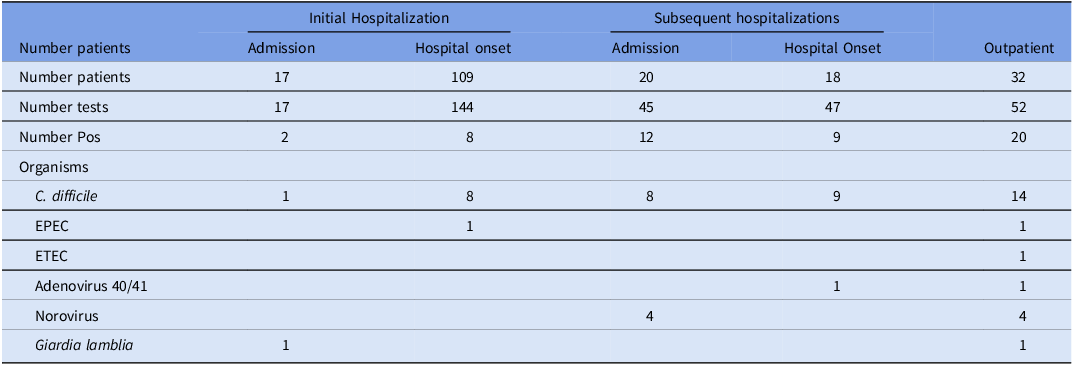
EPEC, Enteropathogenic Escherichia coli; ETEC, Enterotoxigenic Escherichia coli.
BFA pathogens identified
The pathogens identified at various stages of acute leukemia treatment are summarized in Table 2 and by year in Table S3. Of the 22 potential pathogens evaluated in the 51 positive results, those detected included C. difficile [40/51 (78%)], norovirus [8/51 (16%)], enteropathogenic Escherichia coli (EPEC) [2/51 (4%)], adenovirus 40/41 [2/51 (4%)], Giardia lamblia [2/51 (4%)], and enterotoxigenic Escherichia coli (ETEC) [1/51 (2%)]. Three patients had a positive and a negative test within 14 days of each other; the pathogens identified included C. difficile, C. difficile, and norovirus.
BFA results and changes in patient management
Thirty (59% of the positive and 10% of all submitted tests) positive BFA tests resulted in the initiation of treatment. These included 28/40 (70%) with C. difficile and 2/2 with Giardia lamblia.
The predominance of C. difficile
For our cohort undergoing BFA, predominance of C. difficile among positive stool results was apparent for all subgroups in Table 2. Only 15/305 (5%) of the total tests and 7/253 (3%) of the inpatient tests identified a pathogen other than C. difficile; with only the two Giardia lamblia results actionable. Of the 40 total BFA tests that identified C. difficile, 38 included concomitant testing for the presence of C. difficile toxin and 19 of these were positive. C. difficile therapy was administered to 16/19 (84%) toxin-positive and 11/19 (58%) toxin-negative patients. Notably, all but 2 of the BFA tests detecting pathogens other than C. difficile had been ordered at admission or as an outpatient, reflecting likely community acquisition (Table 2).
Discussion
Diarrhea is frequently encountered in patients undergoing therapy for acute leukemia and expeditiously arriving at a diagnosis and initiating treatment, when necessary, may significantly contribute to maximizing desired outcomes and minimizing costs. As in our program, MGPP is likely frequently employed at other institutions in the investigation of leukemia-associated diarrhea, resulting in increased odds of identifying a potentially pathologic organism. However, the clinical significance of these identifications is not always clear, and there is a need for better definitions of the judicious use of MGPP in these patients.
Our data show that the most efficient use of MGPP in patients undergoing therapy for acute leukemia is in the evaluation of outpatient diarrhea. This is not surprising as a new diarrhea in these instances is more likely to be due to community acquired pathogens, and all targets in the MGPP except for C. difficile are most commonly acquired in the community setting. Conversely, hospitalized patients would be expected to more frequently have diarrhea caused by the multiple potential noninfectious etiologies seen in the acute leukemia population. In addition, the lack of actionable diarrheagenic organisms other than C. difficile (with the rare exception of Giardia lamblia) identified in our cohort with admission and hospital-onset diarrheas suggests that testing for C. difficile, perhaps including an assay for C. difficile toxin, may be the more efficient approach in these situations.
A potentially significant problem with the use of PCR methodologies is overdiagnosis and overtreatment. Although detecting more potential pathogens because of greater analytic sensitivity, such tests do not distinguish between non-viable forms, colonization, and clinically insignificant infections, and can lead to delays in identifying the actual etiology of the diarrhea. In patient populations such as our leukemia cohort, a higher prevalence of noninfectious diarrhea, especially in the inpatient setting, combined with increased colonization rates may contribute to a significant lowering of MGPP testing specificity.
The problem of overdiagnosis is especially concerning for C. difficile, the most frequently and consistently identified organism in MGPP testing. Our data show that diarrhea is common in patients undergoing therapy for acute leukemia with the majority of instances due to causes other than C. difficile infection. Also, we have previously reported a C. difficile colonization rate at admission of 13% in our acute leukemic population. Reference Ford, Lopansri and Webb5 The risk for overdiagnosis may be greater when the PCR positivity is accompanied by a negative toxin assay. Prior studies in large general inpatient populations have shown that only toxin-positive stools are associated with significant morbidity and mortality and that reliance on molecular testing alone may lead to overdiagnosis and overtreatment. Reference Planche, Davies and Coen6–Reference Polage, Gyorke and Kennedy8 Similar results may apply to our acute leukemia cohort, although more information is needed. It was with these challenges in mind that our new guidelines for C. difficile diagnostic and antibiotic stewardship were adopted in our unit in 2018. Reference Ford, Hoda, Lopansri, Parra, Sharma and Asch4
Similar issues of overdiagnosis/treatment are encountered with the detection of diarrheagenic E. coli species, which are commonly reported in MGPP series. Reference Cybulski, Bateman and Bourassa1–Reference Axelrad, Freedberg, Whittier, Greendyke, Lebwohl and Green3,Reference Khare, Espy and Cebelinshi9,Reference Spina, Kerr and Cermican10 These seemed to be less common in our acute leukemia cohort and our hematopoietic stem-cell transplant patients, which is not surprising as many of these targets (EPEC, EAEC, ETEC) are less common causes of gastroenteritis in the United States. In addition, the lack of reproducibility for certain MGPP rare targets Reference Hitchcock, Hogan, Budvitiene and Banaei12 and the inability to confirm the presence of EPEC, EAEC, and ETEC may create other challenges in a cohort of patients such as our leukemia population with numerous potential causes of diarrhea, especially since these targets are not infrequently detected with other targets. These observations point to important questions for future study such as how to establish the clinical significance, need for treatment, and impact of colonization of these organisms in the acute leukemia population.
Limitations of our study include a retrospective design, a single institution experience that may reflect local practice preferences and dependence on chart reviews for clinical data. Given the long duration of the study data, it is likely that changes in policies during the interval, such as introduction of the C. difficile guideline, may have affected clinician ordering and treatment patterns.
In summary, we conclude that when used to evaluate for an infectious cause of diarrhea in patients with acute leukemia, BFA is most useful in the outpatient setting. For hospital-acquired diarrhea, targeted testing for C. difficile toxin is a more efficient, cost-effective approach, and routine testing with MGPP, which consists mostly of pathogens that are transmitted in the community, is not warranted. The clinical significance of diarrheagenic E. coli, other than STEC, and MGPP rare targets needs further evaluation.
Supplementary material
The supplementary material for this article can be found at https://doi.org/10.1017/ice.2024.182.
Acknowledgments
The authors thank the physicians, nurses, and other hospital staff who cared for the patients.
Financial support
This work was supported by grants from the Intermountain Research and Medical Foundation and the Richard K. and Shirley S. Hemingway Foundation.
Competing interests
CDF reports no conflicts of interest.
BKL is a member of the Scientific Advisory Board for Seegene, Inc.
BDH has received honoraria from Kite Pharma, Novartis, BMS, ADC Therapeutics, Janssen, Genmab, Notable Labs, AbbVie, Genentech, Astellas, In8 Bio, and Regeneron. He has been a member of the speakers’ bureau for AbbVie, Genmab, and Kite Pharma.
JW reports no conflicts of interest.
JA reports no conflicts of interest.
DH reports no conflicts of interest.



