Introduction
Recent studies into the prevalence of dementia estimate that the number of patients suffering from the disease worldwide will have tripled by the year 2050 (Prince, Bryce, Albanese, Wimo, Ribeiro & Ferri, Reference Prince, Bryce, Albanese, Wimo, Ribeiro and Ferri2013). With these numbers on the rise, the amount of research into protective factors and cognitive reserve (i.e., functional compensation of brain degeneration; Stern, Reference Stern2002) that may delay the manifestation of symptoms of dementia is of great importance. Factors such as socioeconomic status (SES), social network, and leisure activities all seem to contribute to behavioural brain reserve and a delay in incident dementia (Fratiglioni, Winblad & von Strauss, Reference Fratiglioni, Winblad and von Strauss2007; Scarmeas, Levy, Tang, Manly & Stern, Reference Scarmeas, Levy, Tang, Manly and Stern2001; Valenzuela & Sachdev, Reference Valenzuela and Sachdev2006).
Bilingualism is another factor that contributes to cognitive reserve (Bak, Nissan, Allerhand & Deary, Reference Bak, Nissan, Allerhand and Deary2014; Perquin, Vaillant, Schuller, Pastore, Dartigues, Lair & Diederich, Reference Perquin, Vaillant, Schuller, Pastore, Dartigues, Lair and Diederich2013) and enhances neural efficiency (Gold, Kim, Johnson, Kryscio & Smith, Reference Gold, Kim, Johnson, Kryscio and Smith2013). For instance, bilinguals show increased density in both white (Luk, Bialystok, Craik & Grady, Reference Luk, Bialystok, Craik and Grady2011) and grey matter (Abutalebi, Canini, Della Rosa, Green & Weekes, in press; Abutalebi, Canini, Della Rosa, Sheung, Green & Weekes, Reference Abutalebi, Canini, Della Rosa, Sheung, Green and Weekes2014) compared to age-matched monolinguals. These studies provide a neural basis for a potential bilingual advantage in brain reserve, as cognitive decline has been associated with a decrease in white matter integrity (Madden, Spaniol, Costello, Bucur, White, Cabeza, Davis, Dennis, Provenzale & Huettel, Reference Madden, Spaniol, Costello, Bucur, White, Cabeza, Davis, Dennis, Provenzale and Huettel2009) and reductions in grey matter volume (Fjell & Walhovd, Reference Fjell and Walhovd2010).
These efficient cognitive and neural networks in bilinguals are often assumed to result from the extensive functional integration of both languages. When processing a given language (either the first - L1 - or second - L2), other known, irrelevant languages always get active to a certain degree, and influence processing of the relevant language (Van Assche, Duyck & Hartsuiker, Reference Van Assche, Duyck and Hartsuiker2012; Van Assche, Duyck, Hartsuiker & Diependaele, Reference Van Assche, Duyck, Hartsuiker and Diependaele2009). This constant competition requires considerable cognitive control (Green, Reference Green1998), specifically imposed on bilinguals. In this rationale, a new line of research has started to investigate the cognitive advantages of bilingualism and this associated cognitive control experience, also outside the verbal domain. Consequently, there are now strong claims that bilinguals show better executive functions and even increased brain plasticity (Bialystok, Reference Bialystok2009). It is this enhanced executive functioning and plasticity that is assumed to lead to more cognitive reserve in older bilingual adults (Bialystok, Craik, Klein & Viswanathan, Reference Bialystok, Craik, Klein and Viswanathan2004).
Accordingly, bilingualism has been suggested to delay the clinical manifestation of one frequent and serious manifestation of brain degeneration, namely Alzheimer's disease (AD). A recent neuroimaging study showed that bilinguals could match monolinguals on cognitive and memory tasks, even though bilingual patients had already suffered from significantly more cerebral atrophy through AD (Schweizer, Ware, Fischer, Craik & Bialystok, Reference Schweizer, Ware, Fischer, Craik and Bialystok2011). Another Canadian study showed that this bilingual advantage translated into about a five-year delay in clinical AD manifestation (Bialystok, Craik & Freedman, Reference Bialystok, Craik and Freedman2007), with a follow-up study confirming these results (Craik, Bialystok & Freedman, Reference Craik, Bialystok and Freedman2010). Bialystok, Craik, Binns, Ossher and Freedman (Reference Bialystok, Craik, Binns, Ossher and Freedman2014) determined the onset of AD and mild cognitive impairment (MCI) and the progression of cognitive decline in a monolingual and bilingual group of patients, controlling for diet, smoking, alcohol consumption, physical activity, and social activity. The results showed a comparable delay in MCI and AD manifestation (3.5 and 7.2 years, respectively). Moreover, monolinguals and bilinguals performed similarly on executive function tasks at time of diagnosis and did not differ in rate of decline, hereby indicating that deterioration was not more severe for bilinguals than monolinguals at the time of the first clinic visit and that the later symptom onset in bilinguals was not associated with a subsequently faster deterioration of cognitive abilities. It must, however, be noted that 47% of the AD patients in this study were also included in the study by Craik et al. (Reference Craik, Bialystok and Freedman2010).
It is, however, striking that most of the patients in the abovementioned studies were a specific sample of immigrants living in an L2-dominant country (i.e., the regional language was English, which was their L2) and had very particular language experience. Bialystok et al. (Reference Bialystok, Craik and Freedman2007) did report that the interval between onset of symptoms and time of appointment was the same for immigrants and non-immigrants, while Craik et al. (Reference Craik, Bialystok and Freedman2010) also controlled for immigration by entering immigration status as a factor in the ANOVA model. They noted that the effect of language group remained, without a significant effect of immigration status. Nevertheless, their study included only few non-immigrant patients. Chertkow, Whitehead, Phillips, Wolfson, Atherton and Bergman (Reference Chertkow, Whitehead, Phillips, Wolfson, Atherton and Bergman2010) aimed to confirm the effect for non-immigrants in a large cohort of bilingual native Canadians and therefore compared 135 immigrant and 118 non-immigrant bilinguals to a group of monolinguals. They replicated the earlier results in their Canadian immigrant group, but did not find the same effect for the native group. This raises questions about the origin of the reported earlier effects. Immigrants are by definition not a random sample of the population in many ways (e.g., they may possess greater resilience), and any of these differences from the overall population may have caused the bilingual effect. Conversely, another study, conducted in India (Alladi, Bak, Duggirala, Surampudi, Shailaja, Shukla, Chaudhuri & Kaul, Reference Alladi, Bak, Duggirala, Surampudi, Shailaja, Shukla, Chaudhuri and Kaul2013), did show a delay of dementia manifestation in bilingual non-immigrants. They compared 391 bilingual patients and 257 monolingual patients diagnosed with either AD, vascular dementia (VaD), frontotemporal dementia (FTD), diffuse Lewy body (DLB) or mixed dementia. Languages included Telugu, Dakkhini, English, and Hindu. In general, the results indicated that symptom onset was 4.5 years later for bilinguals than for monolinguals. Specifically for AD, this delay was estimated at 3.2 years. Furthermore, a similar difference between groups was observed for FTD and VaD, independent from confounding variables, such as SES. The effect was also found in a smaller sample of 98 illiterate patients, and there was no additional benefit to speaking more than two languages. Nevertheless, it should be noted the bilinguals’ age of L2 acquisition (L2 AoA) and overall L2 proficiency were not mentioned. Therefore it is unclear which type of bilinguals exactly this study included. Additionally, the patient sample was very heterogeneous, including different minority groups, who were not immigrants, but had another dominant language than that of the environment in which they were living.
The present study aimed at testing the bilingual advantage in a non-immigrant sample of European patients. All studies demonstrating an effect of bilingualism on AD were conducted in Canada or India, which constitute truly bilingual environments, with a lot of language switching and mixing. To our knowledge, a similar study has never been carried out in a European context. Therefore, we investigated the supposed bilingual AD delay in a non-immigrant sample of Belgian patients. Belgium has three official regions; Dutch-speaking Flanders and French-speaking Wallonia are almost exclusively Dutch- and French-dominant, while Brussels as a whole is Dutch–French bilingual, but it is composed of regions that still have one dominant language, without noteworthy language mixing. A very small section of Wallonia is also German-speaking, but no participants came from this area. Our bilingual participants all lived in Flanders or in one of the Dutch- or French-dominant regions in Brussels and mainly acquired their L2 through one French- and one Dutch-speaking parent or going to an L2 school. Consequently, our bilinguals all master the same language combination (i.e., Dutch–French), live in an L1-dominant environment, and use one specific language for one specific context, without language mixing.
Methods
Study population
We assessed all incoming new and clear AD subjects, systematically referred to us by two neurologists (co-authors A. Sieben and J. Versijpt) from Ghent University Hospital (83 patients) and Brussels University Hospital (51 patients), between March 2013 and May 2014. Ultimately, data were collected from 134 native Belgian patients diagnosed with probable AD (Jack, Albert, Knopman, McKhann, Sperling, Carrillo, Thies & Phelps, Reference Jack, Albert, Knopman, McKhann, Sperling, Carrillo, Thies and Phelps2011). Clinical AD diagnosis was made by the neurologist, in consultation with a neuropsychologist. The assessment included heteroanamnesis, physical examination, mental status evaluation (including Folstein Mini-mental State Examination – MMSE – at initial diagnosis), screening blood tests, and neuroimaging (SPECT, PET, CT, and/or MRI). Age of diagnosis was recorded at the hospitals, and the age of clinical symptom manifestation was formally assessed by the neurologists and based on (caregiver) interviews inquiring into the manifestation of memory complaints. Initial symptoms included onset of impaired short-term memory or other cognitive domain problems beyond age-related memory or cognitive impairment.
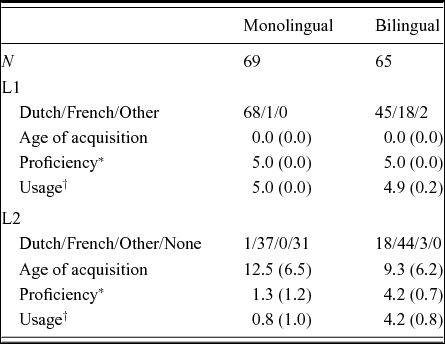
Language history and social background information were obtained from patient and caregiver interviews. During this interview, patients were asked to sum up all the languages that they had mastered and to estimate their proficiency for listening, speaking, reading, and writing. They were given the choice between ‘perfect/native language’, ‘very good’, ‘good’, ‘moderate’, ‘poor’, and ‘non-existing’. These responses were registered on a 6-point Likert scale, ranging from 0 (= none) to 5 (= perfect). Patients were also asked how often they used these languages, early in life (when they were still at school and at work) and now. Here, the options were ‘daily’ (= 5), ‘almost daily’ (= 4), ‘weekly’ (= 3), ‘monthly’ (= 2), ‘a few times a year or less’ (= 1), and ‘never’ (= 0). A composite score was created for overall usage by averaging the scores for ‘now’ and ‘early in life’.
Bilingualism was determined on the basis of L2 proficiency and frequency of use. A patient was considered bilingual if he/she rated him/herself as ‘good’ or higher for all four L2 skills and spoke this L2 at least weekly before and now. In total, 113 patients indicated that they had some level of proficiency in a second language. Only nine patients also reported relatively good knowledge of a third or fourth language. Ultimately, we identified 69 monolingual and 65 bilingual patients (see Table 1). The monolingual group consisted of 68 Dutch-speaking patients and one French-speaking patient. In the bilingual group, 45 patients reported Dutch as the native language (L1), 18 reported French, one reported Spanish, and another one English. The patients who indicated Spanish and English as their L1 were raised bilingually from birth and had Dutch as L2. For most patients, L2 was Dutch or French. For only two patients, it was German and English. In the bilingual group, L2 AoA ranged from birth to age 25; age 0–3 (18 patients), 3–6 (6 patients), 6–12 (21 patients), 12–18 (16 patients), and 18–25 (4 patients). The 38 monolinguals indicating basic L2 knowledge typically learnt this language at school (limited obligatory courses, around age 10), but did not use it in later life.
Self-reported language data with standard deviation between parentheses.

*L1 and L2 proficiency were indicated on a 6-point Likert scale (5 = perfect, 0 = non-existing).
†L1 and L2 usage were indicated on a 6-point Likert scale (5 = daily, 0 = never).
Furthermore, we assessed the education level (years) of each patient and determined his or her primary occupation. Occupation (also a proxy for socioeconomic status, SES) was assessed using five categories (ISCO, 2008), but because two occurred very infrequently in our sample (15 unemployed, 5 managers), this was recoded into three groups; lower (unemployed, unskilled workers), medium (skilled workers), and higher (professionals, managers). Analyses using the five original categories yielded the same pattern of results.
Results
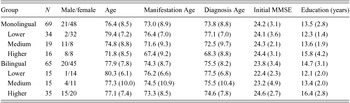
The data were analysed using linear regression models with AD Manifestation Age and Diagnosis Age as the dependent variables. The predictor of interest was Group (monolingual vs. bilingual) and the control variables were Gender (factor), Education (in years), and Occupation (three levels). We also controlled for L1 (three levels: Dutch, French, and other), as there was only one French monolingual, one L1-Spanish bilingual and one L1-English bilingual patient. Furthermore, we controlled for MMSE at diagnosis (score on 30) to ascertain that the effects were not due to one group seeking medical care at an earlier stage. Table 2 gives an overview of all abovementioned variables, including the recorded mean AD manifestation and diagnosis age for both language groups.
Means (and standard deviations) of dependent variables by language group, and occupation.

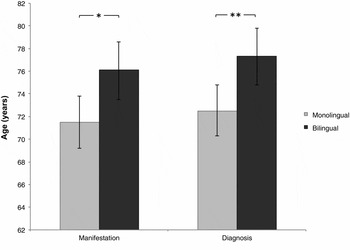
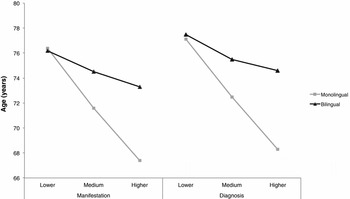
In the analysis of Manifestation Age, we found a significant effect of Group [F (1, 109) = 6.18, p = .014, Beta = 4.64 years], indicating that bilingualism delays the manifestation of symptoms by 4.6 years. The marginal expected age (i.e., average manifestation age when controlling for all other predictors) was 71.5 for monolinguals with 95% CI = [69.2; 73.8] and 76.1 for bilinguals with 95% CI = [73.6; 78.7] (see Figure 1). There was a linear decrease with Occupation [Beta = -3.41, t(109) = -2.00, p = .048], but no quadratic effect (u-shape) of Occupation [Beta = 0.82, t(109) = 0.55, p = .582] (see Figure 2). Taken together, Occupation did not yield any significant results [F (2, 109) = 2.19, p = .117]. We also found no effects of Gender [F (1, 109) = 0.17, p = .683], Education [F (1, 109) = 0.58, p = .449], MMSE [F (1, 109) = 0.47, p = .492] or L1 [F (2, 109) = 2.16, p = .120]. When taking into account L2 AoA, the effect of bilingualism was 4.1 years [t = 1.99, p < .05] and the additional effect of L2 AoA was non-significant [t = 0.13, p = .893].
Marginal expected age of AD manifestation (left) and AD diagnosis (right) for monolinguals and bilinguals. Error bars reflect 95% CI. Horizontal bars indicate significant comparisons. *p < .05, **p < .01

Age of AD manifestation and diagnosis for monolinguals and bilinguals per occupation category.

For Diagnosis Age, we observed a significant effect of Group [F (1, 109) = 7.05, p = .009, Beta = 4.84 years], implying that bilingualism postpones the age of diagnosis by 4.8 years. Here, the marginal expected age was 72.5 for monolinguals, 95% CI = [70.2; 74.7], and 77.3 for bilinguals, 95% CI = [74.6; 79.8] (Figure 1). Occupation yielded no effect [F (2, 109) = 1.96, p = .145], neither linear [Beta = -3.12, t(109) = -1.87, p = .064] nor quadratic [Beta = 0.84, t(109) = 0.58, p = .562] (see Figure 2). There were no effects of Gender [F (1, 109) = 0.13, p = .717], Education [F (1, 109) = 0.80, p = .373], MMSE [F (1, 109) = 0.75, p = .389] or L1 [F (2, 109) = 2.10, p = .127]. Adding L2 AoA to the model, the effect of bilingualism dropped only slightly to 4.6 years [t = 2.23, p < .05]; the effect of L2 AoA was again non-significant [t = -0.21, p = .831].
Discussion
The purpose of this study was to determine whether bilingualism delays the clinical manifestation of dementia symptoms, and more specifically of AD. We investigated this in a homogeneous European non-immigrant population living in an L1-dominant environment, by comparing a systematic sample of 69 native Belgian monolinguals and 65 native Belgian bilinguals. These were all patients diagnosed with probable AD, systematically referred to us by two neurologists from the University Hospitals of Ghent and Brussels. Controlling for confounding variables (such as gender, education, occupation, initial MMSE, and L1), we observed a clear delay of 4.6 years for clinical manifestation age and 4.8 years for diagnosis age in our systematic sample of bilingual AD patients. Age of L2 acquisition did not influence this effect. We found no strong significant effects of control variables, although there was a linear effect between AD manifestation and occupation, with more demanding occupations yielding earlier AD manifestation. This may seem counterintuitive, but note that faster AD progression with higher education has also been reported earlier (Scarmeas, Albert, Manly & Stern, Reference Scarmeas, Albert, Manly and Stern2006). Furthermore, other more demanding occupations may be associated with other factors, such as stress due to high job strain and sleep deprivation, which have been shown to speed up clinical AD manifestation (Di Meco, Joshi & Praticò, Reference Di Meco, Joshi and Praticò2014; Wang, Wahlberg, Karp, Winblad & Fratiglioni, Reference Wang, Wahlberg, Karp, Winblad and Fratiglioni2012).
Our findings strengthen the claim that bilingualism contributes to cognitive reserve and postpones the symptoms of dementia, even when AD patients are non-immigrants living in an L1-dominant environment, coming from a homogeneous population with regard to ethnicity, culture, environment, and patterns of language use. The Canadian studies found an onset delay only in immigrant groups (Bialystok et al., Reference Bialystok, Craik and Freedman2007; Craik et al., Reference Craik, Bialystok and Freedman2010; Schweizer et al., Reference Schweizer, Ware, Fischer, Craik and Bialystok2011), but not in non-immigrants (Chertkow et al., Reference Chertkow, Whitehead, Phillips, Wolfson, Atherton and Bergman2010). The former group is by definition not a random sample of the population in many ways, and their advantage, albeit interesting, may originate from a rather particular and demanding language (L2-dominant) context. It is for instance conceivable that immigrants who learn the main language of the community (as opposed to immigrants who do not, but also relative to non-immigrant community members) are less isolated and socially or cognitively active people, so that they are not a random sample of the population, comparable to the monolinguals. It is also feasible that later L2 acquisition or living in an L2-dominant environment requires greater cognitive effort, leading to more cognitive reserve. Studies demonstrated that this advantage would then only apply to people who immigrated during young adulthood (Bialystok et al., Reference Bialystok, Craik and Freedman2007; Reference Bialystok, Craik, Binns, Ossher and Freedman2014), but not to those who did so later (i.e., over the age of 34; Zahodne, Schofield, Farrell, Stern & Manly, Reference Zahodne, Schofield, Farrell, Stern and Manly2014). Although the current study did not find an effect of L2 AoA, it must be noted that the oldest L2 learners were only 25.
These findings are also consistent with a recent study conducted in India, also showing differences in dementia onset between monolingual and bilinguals (Alladi et al., Reference Alladi, Bak, Duggirala, Surampudi, Shailaja, Shukla, Chaudhuri and Kaul2013). In this study, the bilingual population was very heterogeneous, even containing illiterates, and a lot of different language combinations. These participants seemed to live in a truly bilingual environment, including minority groups with a different native language (i.e., Dakkhini) from the dominant language of the environment (i.e., Telugu). We were able to generalise this effect to a non-immigrant and non-minority bilingual population. Furthermore, unlike most previous studies, we took into account both age of L2 acquisition and extent of L2 language use, as reported measures of these two linguistic variables were also evaluated.
To conclude, our results are consistent with the body of literature started by Bialystok et al. (Reference Bialystok, Craik and Freedman2007). Furthermore, they replicate the effect bilingualism has on a variety of dementias in non-immigrant patient samples (Alladi et al., Reference Alladi, Bak, Duggirala, Surampudi, Shailaja, Shukla, Chaudhuri and Kaul2013), specifically for AD. Additionally, these findings are not only important for cognitive wellbeing of patients, but also for health care policy. Brookmeyer, Johnson, Ziegler-Graham and Arrighi (Reference Brookmeyer, Johnson, Ziegler-Graham and Arrighi2007) forecasted the global burden of AD and evaluated the potential impact of interventions that delay disease onset and progression. They demonstrated that prevention programmes with two-year delays would decrease the prevalence of AD by 22.8 million cases. Even a modest one-year delay would result in 11.8 million fewer cases worldwide. It is staggering that bilingualism generates effects, to which no pharmacologic intervention up to date can aspire. This also implies that bilingualism could reduce health care cost and possibly postpone institutionalisation.