Introduction
The wide development of artificial insemination (AI) in French sheep farming date from the early 1970s. At this time, a hormonal treatment to induce and synchronise the oestrus and ovulation of females became available. Fertility rate after cervical insemination using frozen-thawed semen in sheep is very low (Salamon and Maxwell, Reference Salamon and Maxwell1995) and unacceptable compared to results obtained with fresh semen. Even though intrauterine insemination of frozen-thawed semen by laparoscopy results in acceptable lambings, the cost, the small surgery and the expertise required by this procedure limit its utilisation. For these reasons, more than 99% of the 848 691 French sheep AI realised in 2005 were done with fresh semen collected a few hours before insemination (Perret and Lagriffoul, Reference Perret and Lagriffoul2006).
In the Roquefort area, dairy industries collect milk from November to July. In this context, AI associated with hormonal treatment allowed breeders to fit the ewe lambing with the beginning of the milk-collecting period. It also allowed setting up an efficient breeding scheme based on planned mating, progeny testing and dissemination of genetic merit. Presently, about 90% of the ewes in the nucleus are inseminated each year for these genetic purposes, and approximately 300 000 ewes are inseminated out of the nucleus to disseminate the genetic progress (Perret and Lagriffoul, Reference Perret and Lagriffoul2006). Other breeding schemes exist for dairy sheep breeds located in the Pyrenean Mountains. They tend more or less towards a similar organisation as the Lacaune scheme although the insemination rate of ewes within the nucleus is lower (about 60%).
In order to improve their efficiency, French AI centres are interested in the identification of the main environmental effects affecting the AI result, and the estimation of the corresponding genetic parameters. This complex trait may be viewed as a combination of two main traits, which can be analysed jointly (David et al., Reference David, Bodin, Lagriffoul, Leymarie, Manfredi and Robert-Granié2007b), one relative to the female (i.e. female fertility), the other relative to the male (i.e. semen fecundancy or male fertility). Combining all this information in a joint model should improve the precision of the estimates. The aim of this paper was to analyse the environmental and genetic effects that affect AI success using a joint model. The implementation of a joint model could be made since, in the French sheep situation, each on-farm recorded insemination can be matched to the corresponding ejaculate produced at the AI centre and to the corresponding outcome, which is a binary response observed at lambing of either success (1) or failure (0).
Material and methods
Data
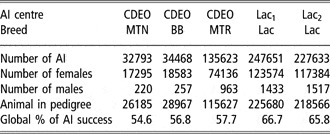
The present study refers to dairy sheep inseminations performed on private farms from 2001 to 2005 by three AI centres. Centre 1 (Centre Départemental de l’Elevage Ovin, CDEO) is located in the French Basque region and performs inseminations for three breeds: Manech tête rousse (MTR), Manech tête noire (MTN) and Basco-béarnaise (BB). Centres 2 (Lac1) and 3 (Lac2) are located in the Roquefort region and both perform inseminations for the Lacaune (Lac) breed. These AI concern adult ewes (more than 1-year old) in flocks that participate in the selection scheme of these four dairy breeds. The numbers of inseminations per centre and breed with the global rate of AI success are shown in Table 1. Data came from a specific database built by the ANIO (Association Nationale des centres d’Insémination Ovine) for this study. This base combined information from two data sources. The first source was the sheep AI centres, which provided information on males (e.g. identification, age), characteristics of semen for a particular collect (e.g. volume, concentration, motility) and identification of ewes inseminated a few hours after collection by the fresh semen of a given sire. The second source originated from the French national performances recording scheme that holds pedigree information and ewe performances (e.g. reproduction type, date of lambing, number of lambs born). For each breed/centre, less than 4% of the initial data set containing missing data was removed from the data samples.
Global percentage of AI success, number of inseminations and animals involved in the study for each breed/centre

AI = artificial insemination; MTN = Manech tête Noire; BB = Basco béarnaise; MTR = Manech tête rousse; Lac = Lacaune.
Rams and semen management
Rams belonged to dairy selection schemes and ranged in two categories: young rams (<1-year old) under progeny testing and adult rams (⩾2 years) having proven genetic value. In order to increase their libido, their semen production and their semen quality, these males were given a melatonin implant (Mélovine®; CDEO centre) or a photoperiodic treatment (Lac1 and Lac2 centres) according to recommendations, about 2 months before the beginning of the annual collecting period (Chemineau et al., 1989). Ejaculates were obtained after natural ejaculation in an artificial vagina; only those collected during the intensive period of ram collection (May to August) were considered in this analysis. Each ram was collected from 1 to 5 years and within a year the interval between its semen collections varied from 1 to 32 days.
Trait definition and data analysis
For a given ram, the pool of 1 to 3 successive ejaculates, obtained over a 2 to 5 min period, was evaluated immediately after collection. Three traits were evaluated for each pool: volume that was read directly from a graduated collection tube (ml), semen concentration that was determined using a standard spectrophotometer (106 spermatozoa/ml) and mass motility that was scored subjectively on a 0 to 5 scale. The ejaculate volume was defined as the pool volume divided by the number of ejaculates. After measuring the quality (volume, concentration and motility assessment), semen with a motility higher than 4 and a concentration higher than 1.4 × 10⁹ spermatozoa/ml was diluted in a milky extender (Baril et al., Reference Baril, Chemineau, Cognié, Guérin, Leboeuf, Orgeur and Vallet1993) to prepare about 10 doses with a concentration of 1.4 or 1.6 × 10⁹ spermatozoa/ml. Each dose was stored at 4°C in a 0.25 ml straw until insemination a few hours later.
Female management and inseminations
In the French dairy sheep system, there is only one reproduction period, which extends from late spring to summer and corresponds to the end of the previous milking period. In each flock, at the beginning of the joining period, breeders with the help of the selection scheme organisation choose the ewes to inseminate. After having received a synchronisation treatment (FGA vaginal sponge (Sanofi or Intervet) inserted for 14 days, followed by a PMSG injection at withdrawal (Folligon® or PMSG; Sanofi Animal Health Ltd, Libourne, France)), these ewes received cervical insemination with fresh semen irrespective of oestrus expression about 55 h after sponge withdrawal according to standard recommendations (Chemineau et al., Reference Chemineau, Cognié, Guérin, Orgeur and Vallet1991). They were subsequently systematically joined with males 6 days after insemination to ensure fecundation by natural mating. The interval between insemination and lambing dates was used to determine the fertile oestrus (after insemination or natural mating).
Model
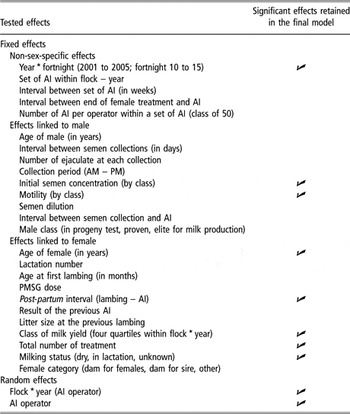
For each insemination, many potential risk factors were recorded and analysed. They were clustered into three categories: the effects related to the female (synchronisation, reproductive and productive career, as well as the female genetic effect), those related to the male (sperm characteristics, collection, as well as the male genetic effect) and non-sex-specific effects that were either related to the insemination (operator, interval collection-AI, etc.) or common to all previous categories (year, fortnight, flock). All environmental effects tested in the analysis are presented in Table 2.
List of environmental effects tested in the analysis

AI = artificial insemination.
Five separate analyses within breed/centre were performed using the linear model already described by David et al. (Reference David, Bodin, Lagriffoul, Leymarie, Manfredi and Robert-Granié2007b), which jointly estimates male and female effects by considering the AI success as a continuous variable.
The model was as follows:

where y is the vector of the binary result of insemination, β f, β m and β c are vectors of fixed effects related to the female, the male or common to both sexes, respectively. uf and um are vectors of female and male random genetic effects, respectively. pf and pm are vectors of female and male random permanent environmental effects, c and h are the random vectors of AI operator and flock * year intra AI operator effects, respectively. ε is the vector of residuals. Xf, Xm, Xc, Zf, Zm, Wf, Wm, K and L are the corresponding known incidence matrices. All random effects are distributed as a centred normal distribution with variance covariance matrix equal to  for the genetic effects i (i = u f or u m), and
 for the other random effects j (j = c, h, p f, p m, ε) where A is the known relationship matrix, Ij are identity matrices of appropriate order. Random effects are assumed to be independent of each other. In particular, it supposes that male and female fertility traits are genetically independent, which has been shown by David et al. (Reference David, Bodin, Lagriffoul, Leymarie, Manfredi and Robert-Granié2007b).
The fixed effects and all one-way interactions with biological meaning included in the model were preliminarily selected step-by-step by comparing the nested models with the likelihood ratio test. For this selection, models were fitted using the mixed procedure of SAS version 8.1 (SAS®, 1999) and the maximum likelihood method. Once the final model was chosen, estimations of fixed effects and variance components were obtained using Asreml software (Gilmour et al., Reference Gilmour, Gogel, Cullis, Welham and Thompson2002). Heritability was computed as  for male fertility and
 for female fertility; repeatability was computed as
 for male fertility and
 for female fertility with
 .
Final model
After selection, female effects considered in the final model were age, time interval between previous lambing and insemination, milking status for the female: already dried or still milking when inseminated, milk quantity produced during the previous year expressed as quartile intra flock * year and total number of synchronisation treatments received during the career. Male effects entering this model were semen motility and concentration. Non-sex-specific effects were year * fortnight combination. These significant effects are listed in Table 2. The random effects that were also included in the model along with the male and female genetic effects were the male and female permanent environmental effects as well as the AI operator, and the flock * year interaction nested within the AI operator.
Results
Environmental fixed effects
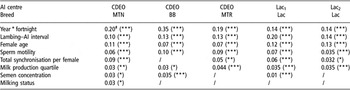
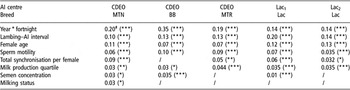
The main fixed effects that significantly affected the AI success are presented according to their importance. Table 3 shows for each effect and breed/centre, the variation range of the least squares mean and the significance of the effect.
Variation range of least squares means of the main environmental fixed effects for AI success for each breed/centre and level of significance (in brackets)
AI = artificial insemination; MTN = Manech tête Noire; BB = Basco béarnaise; MTR = Manech tête rousse; Lac = Lacaune.
‡0.20→difference between lowest and highest fertility due to this effect (*P < 0.05; **P < 0.01; ***P < 0.001).
Year * fortnight interaction
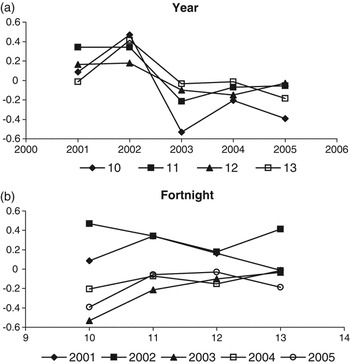
In all breed/centres, the year * fortnight interaction effect was significant (P < 0.01). It was the main effect affecting AI success; however, there was no general trend associated with year. Thus for Lac2, AI success increased slightly from 2001 to 2005 while it decreased for MTN (Figure 1a) and did not present any trend for the other breed/centres. Changes with fortnight were large between years (Figure 1b for MTN) and no clear common trend could be viewed.
Estimated values of AI success for the year * fortnight interaction in the Manech Tête Noire breed (MTN) in relation to year (a) and fortnight (b) levels.

Other fixed effects
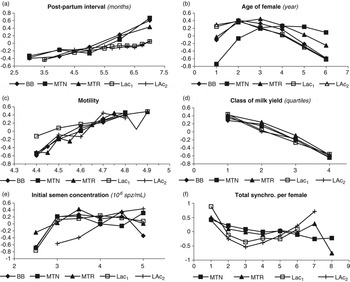
Least squares solutions of fixed effects affecting AI success for each breed/centre and plotted in standard error unit are given in Figure 2. For multiparous ewes, the post-partum duration until insemination (Figure 2a) had a very large effect on AI success in all breed/centres. Under French dairy sheep management, lengthening this interval from about 3 to 7 or 8 months increased AI success by 10% to 20% according to the breed.
Least square means of AI success in proportion to maxima variability within breed/centre for: (a) post-partum interval until AI for multiparous ewes, (b) female age, (c) semen motility, (d) quartile of milk production, (e) semen concentration and (f) total number of synchronisation treatments per female.

Female ages (Figure 2b) were at least highly significant (P < 0.01) for all breed/centres. AI success tended to decrease regularly after two years, except for MTR and MTN breeds, for which the maximum success was reached with 3- and 4-year old ewes, respectively.
The regular increase of AI results with increasing semen motility was very clear in all situations (Figure 2c). However, this significant effect (P < 0.05) accounted only for 3.5% to 10% of the success rate according to the breed/centre. The quartile of total milk yield evaluated each year within flock at the end of the lactation of a ewe had a significant (P < 0.05) effect on the success of the following insemination (Figure 2d); however, this effect was low since the difference between extreme quartiles was about 3.5% of success.
The total number of synchronisation treatments that females had received during their life had a curvilinear effect on the AI results (Figure 2f). For a low number of treatments, the results highly decreased at each new treatment, while success difference between successive AI was almost nil or slightly positive at an older age. The highest difference (from 3% to 6%) was observed between ewes that had received 1 and 2 treatments.
Concentration of semen before processing affected the AI results in all breed/centres except one. We observed a fertility gap (about 3%) on three occasions when using semen with a concentration lower and higher than 2.5 × 10⁶ spermatozoa/ml. The other breed/centres presented a similar increase of the AI results with increasing semen concentration. Although for this breed/centre we observed a threshold concentration effect, it was higher (around 4 × 10⁶ spermatozoa/ml) and not so drastic (Figure 2e).
Although the very same trend was observed for all breed/centres, the effect of milking status of a ewe was significant for only two breeds (MTN and MTR). The negative consequence of inseminating still milking ewes was low and induced a loss of about 3% of success compared to AI on already dried ewes.
Random effects and genetic parameters
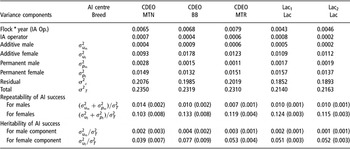
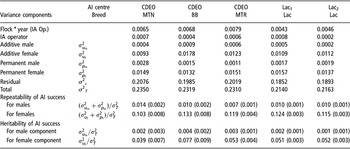
Estimations of all variance components (Table 4) were very consistent among breed/centres; moreover, they were all very low regarding the residual variance that represented between 81% and 84% of the total phenotypic variance. The largest variance components were those of the permanent female effect that accounted for about 40% of the explained variance. Variances of the female additive genetic effect were of the same order, so the sum of these two female components accounted for about 75% of the variance part explained by the model and about 11% of the total variance. In contrast, the two male variance components were extremely low for all breed/centres. Heritability of female success was always low, varying from 0.04 to 0.08 but different from zero; the repeatability was about 0.10. Genetic parameters were consistently much lower for the male component of AI success. Thus, repeatability of the male component was about 1% and heritability was in some occasions not different from zero.
Variance components and genetic parameter estimates for each breed/centre, standard error of estimate in brackets
AI = artificial insemination; MTN = Manech tête Noire; BB = Basco béarnaise; MTR = Manech tête rousse; Lac = Lacaune.
The variance due to the flock * year interaction within the AI operator accounted for about 3% of the total variance, while the component for the AI operator explained only 0.2% of the total variance.
Discussion
This study considered the binary results of artificial insemination as a continuous variable and we used linear models that are more suitable for continuous than for categorical data. Nevertheless, several studies showed that linear models and threshold models give similar results in some conditions on the incidence of the categorical trait (Meijering and Gianola, Reference Meijering and Gianola1985; Boichard and Manfredi, Reference Boichard and Manfredi1994), and the sire family size (Ramirez-Valverde et al., Reference Ramirez-Valverde, Misztal and Bertrand2001). These conditions were respected in our data set. Moreover, a comparison of both methods using data of one breed/centre analysed in the present study has already been presented by David et al. (Reference David, Bodin, Lagriffoul, Leymarie, Manfredi and Robert-Granié2007b); the differences between these methodologies were negligible. The model was mainly built to estimate genetic parameters of AI success free of environmental variation effects; therefore, some effects strongly linked to genetic effects were not included in this model. For instance, AI success was not adjusted for the result of the previous insemination although we had shown in preliminary studies that it was one of the major variation factors. For this reason, breeders should avoid inseminating females that were not pregnant at the previous AI.
The results of independent analysis made on the five breed/centres were strongly consistent and agreed very well with the literature in spite of the breed diversity, the variability of male management in the three AI centres and the different environmental conditions in which females are bred. In our study, each AI centre uses a specific photoperiodic treatment for stimulating testicular development and optimising sperm production to fit their specific seasonal demand (Briois et al., 1988; Arranz et al., 1995); consequently, there is no global trend of AI success with months. In contrast with observations on dairy cattle (Barbat et al., 2005), there is no clear trend of AI success over this period in French dairy sheep, except for one centre.
The effect of post-partum delay on sheep fertility is well known and Cognié et al. (1984) recommended not to inseminate ewes with less than 150 post-partum days, which is the time interval threshold observed in our study while this admissible delay is 50 days for Anel et al. (Reference Anel, Kaabi, Abroug, Alvarez, Anel, Boixo, de la Fuente and de Paz2005). The decrease in AI success with increasing female age is a very classical effect; our results agree with the 15% drop per year described a long time ago in the Lacaune breed by Colas et al. (Reference Colas, Thimonier, Courot and Ortavant1973) and recently in a Spanish dairy breed by Anel et al. (Reference Anel, Kaabi, Abroug, Alvarez, Anel, Boixo, de la Fuente and de Paz2005).
In French sheep, dairy production lactation of ewes are seasoned and synchronised. At the end of the lactation period, ewes of a flock that were given the same feeding presented a variability of body condition score, which was related to the total milk quantity they have produced and therefore to their quartile of production within flock and year. The broad relationship between body condition score and fertility viewed in this way was slightly positive (about 3 points of fertility drop between extreme classes of milk production quartile). In dairy cattle, Roche (Reference Roche2007) found a positive effect of the body condition score on the ratio of pregnant cows at first service, and in a more precise study Grimard et al. (Reference Grimard, Freret, Chevallier, Pinto, Ponsart and Humblot2006) reported a similar positive effect of the body condition score on late embryonic survival.
We found in our experiment, above the culling threshold, a permanent and positive relationship between motility and fertility. This small effect contrasts with the absence of effect previously found by Colas (Reference Colas1981) in Ile de France and by Duval et al. (1995) in one Lacaune centre even if this centre displayed a lower effect in our study. But this agrees with the important role of this characteristic on the transport and survival of spermatozoa in the female reproductive tract and fertility (Salamon and Maxwell, Reference Salamon and Maxwell2000). A positive relationship between the percentage of motile spermatozoa and female fertility is well documented in other species (Linford et al., Reference Linford, Glover, Bishop and Stewart1976; Correa et al., Reference Correa, Pace and Zavos1997; Colenbrander et al., Reference Colenbrander, Gadella and Stout2003; Gadea, Reference Gadea2005).
The threshold effect of semen concentration on AI results has not been previously noticed. A lack of effect is generally claimed, but it is in studies that involved a low number of data (Hulet et al., Reference Hulet, Foote and Blackwell1965; Colas, Reference Colas1981). This absence of effect was also found in the Lac2 centre, which is the only breed/centre where the effect was not significant in our study (Duval et al., 1995).
The operator effect, which in our study was considered as a random effect, explained very little of the total variance. However, the theoretical extreme values provided by a Gaussian distribution would result in a large difference: 9 to 16 points, according to the breed/centre. This agreed with results in the literature (Duval et al., 1995; Anel et al., Reference Anel, Kaabi, Abroug, Alvarez, Anel, Boixo, de la Fuente and de Paz2005).
The very low male components of additive genetic variance and permanent environmental variance agreed with the general results obtained in other species for fecundancy (Varona and Noguera, Reference Varona and Noguera2001; Piles et al., Reference Piles, Rafel, Ramon and Varona2005). They also agreed with the low variance components reported for service sires in many studies of female fertility (Weller and Ron, Reference Weller and Ron1992; Averill et al., Reference Averill, Rekaya and Weigel2004; Donoghue et al., Reference Donoghue, Rekaya and Misztal2004; Robinson and Buhr, Reference Robinson and Buhr2005).
Female components of AI success are in the range of values found in the literature for female fertility of sheep as well as other species (Matos et al., Reference Matos, Thomas, Gianola, Tempelman and Young1997; Boichard et al., 1998; Ranberg et al., Reference Ranberg, Heringstad, Klemetsdal, Svendsen and Steine2003; David et al., Reference David, Bodin, Lagriffoul, Leymarie, Manfredi and Robert-Granié2007b). Although these components were low compared to the residual variance, they induced a genetic coefficient of variation of 16% to 23% according to breed/centres, which would permit to envisage selection on this trait.
There are very few joint estimations of genetic parameters for female fertility and male fecundancy. The few studies in cattle (Ranberg et al., Reference Ranberg, Heringstad, Klemetsdal, Svendsen and Steine2003), rabbits (Piles et al., Reference Piles, Rafel, Ramon and Varona2005) or pigs (Varona and Noguera, Reference Varona and Noguera2001) did not consider the effect of semen characteristics on mating success. David et al. (Reference David, Bodin, Lagriffoul, Leymarie, Manfredi and Robert-Granié2007b) compared different models for the genetic analysis of AI success in sheep and considered the environmental effects linked to semen and showed that it was the best model. However, the very large residual variance was poorly affected by the model used and genetic parameters remained nearly constant. The present study confirms that this residual variability is very consistent over different conditions of breeds and centres.
Conclusion
The model used to analyse the AI results took into account all available information relative to the male, female and to non-sex-specific effects, leading to potentially more precise estimates. To our knowledge, it is the first model that included effects relative to the semen in a joint model of female fertility and male fecundancy. In agreement with the literature, the main variation factors of AI success, evidenced by this joint model, were relative to non-sex-specific effects and to female effect. Nevertheless, semen motility had a small but significant effect. According to these results, choosing females to inseminate might slightly improve the AI results. Heritabilities estimated with this joint model were very low and were lower for male fecundancy than for female fertility. It means that genetic improvement of AI results through a classical polygenic selection would be difficult. In spite of combining a large number of variation factors related to the male and the female, the joint model explained a very small part of the total variability. Perhaps the way to combine the influence of both sexes on the AI results is not additive but multiplicative. New joint product models are being developed in order to go one step further from the joint additive model in the analysis of fertility (David et al., 2007a).
Acknowledgements
The authors thank the French Ministère de l’Agriculture for supporting this study in the frame of the innovating action BELIA directed by the ANIO and INRA. They are also grateful to the AI centres that provided the data. We thank Wendy Brand-Williams for editing of the English language.