Introduction
The Epigonidae Poey, 1861 (order: Acropomatiformes) commonly known as deepwater cardinalfishes, belonging to the family of small to moderately sized marine fish groups distributed in tropical and temperate oceans across the globe. They are found in a wide range of environments, from shallow waters to depths of more than 1000 m (Fricke and Couperus, Reference Fricke and Couperus2024; Krupp et al., Reference Krupp, Zajonz and Khalaf2009; Okamoto et al., Reference Okamoto, Long, Claro and McCosker2025). The genus Epigonus Rafinesque, 1810 is the most diverse and widely distributed within the family, comprising 43 recognized species grouped into four species groups (Epigonus constanciae group, E. oligolepis group, E. pandionis group, and E. telescopus group) (Abramov, Reference Abramov1992; Mayer, Reference Mayer1974; Okamoto et al., Reference Okamoto, Baldwin and Long2024, Reference Okamoto, Long, Claro and McCosker2025; Okamoto and Miyamoto, Reference Okamoto and Miyamoto2022). The genus Epigonus can be distinguished by the presence of two separate dorsal fins and two anal fin spines, with a total of 25 vertebrae, and over 30 lateral line scales (Gon, Reference Gon1985; Mayer, Reference Mayer1974). The Western Indian Ocean region is rich in deepwater cardinalfish, with 15 species distributed across mainland continental states, islands, and Madagascar region (Idrees Babu and Akhilesh, Reference Idrees Babu and Akhilesh2020; Okamoto and Gon, Reference Okamoto and Gon2018). In India, four species, namely Epigonus pandionis (Goode & Bean, 1881), Epigonus marimonticolus Parin & Abramov, 1986, Epigonus indicus Idrees Babu & Akhilesh 2020, and Epigonus telescopus (Risso, 1810), were documented from the southwestern coast and Andaman & Nicobar and Lakshadweep Islands (Idrees Babu and Akhilesh, Reference Idrees Babu and Akhilesh2020; Okamoto and Gon, Reference Okamoto and Gon2018; Sileesh, Reference Sileesh2021; Venu, Reference Venu2009, Reference Venu, Venkataraman, Sivaperuman and Raghunathan2013).
The two-spined deepwater cardinalfish, Epigonus bispinosus Okamoto & Gon, 2018 was originally described from northern Madagascar Island and known to be distributed only along the coasts of South Africa and Madagascar Island (Okamoto and Gon, Reference Okamoto and Gon2018). Being E. constanciae group with 21 species, they are characterized by a pungent opercular spine (Okamoto, Reference Okamoto2018). The present study confirms the presence of E. bispinosus in Indian waters based on morphological examination, along with the first mitochondrial DNA analysis using cytochrome oxidase subunit I (COI) and 16S ribosomal RNA (rRNA) genes.
Materials and methods
Two specimens of E. bispinosus were collected from Sakthikulangara fishing harbour (08° 56ʹ N, 76° 32ʹ E), Kerala, India, southeastern Arabian Sea (Figure 1) during September and October 2024. The specimens were caught as by-catch in commercial deep-sea shrimp trawlers operating at depths of 250–420 m.
Global distribution of Epigonus bispinosus (the map was constructed using QGIS version 3.40.1).

Species identification and morphometry
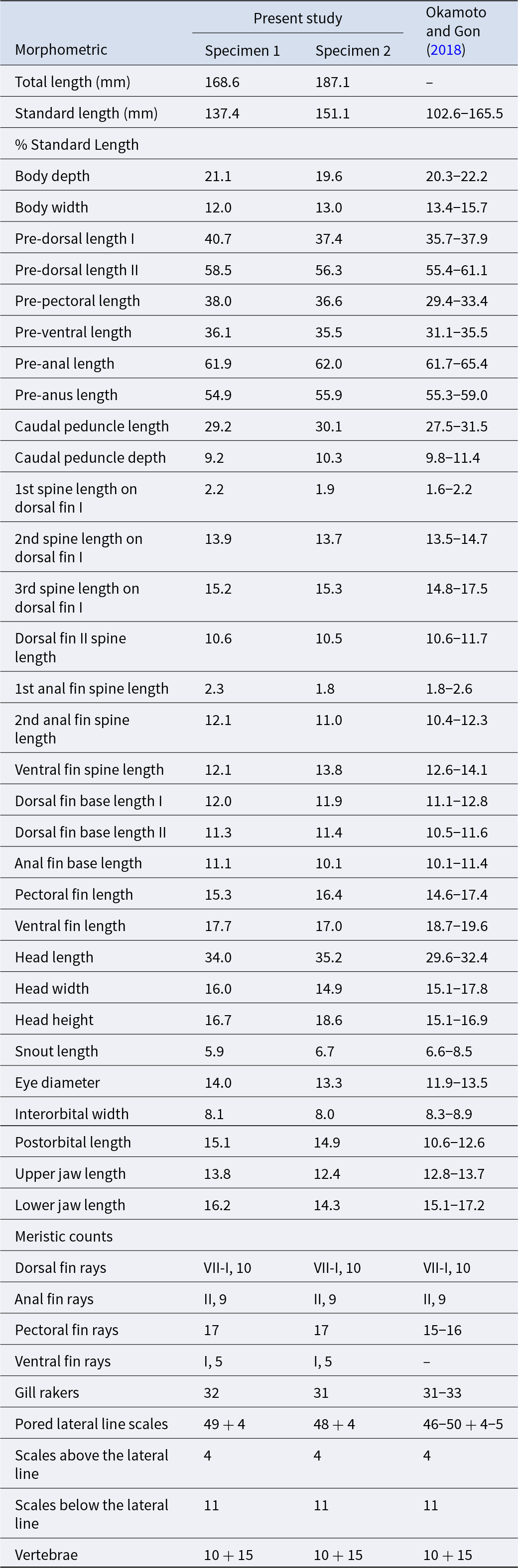
The specimens were identified based on the characteristics and keys outlined by Okamoto and Gon (Reference Okamoto and Gon2018). The morphometric measurements of the specimens were made using a digital vernier caliper with an accuracy of 0.1 mm, and meristic counts (Table 1) were taken under a dissection microscope, which was compared with previous literature (Okamoto and Gon, Reference Okamoto and Gon2018). The photograph of the specimen was taken with a Nikon D-5300 camera. The specimens were preserved in 10% formalin and deposited at the National Fish Repository of the ICAR – National Bureau of Fish Genetic Resources, Lucknow, India with accession no. EPIEBIS.1/NBFGR. The abbreviations TL, SL, and HL denote total length, standard length, and head length respectively.
Morphometric and meristic traits of Epigonus bispinosus compared with the previous study

Molecular analysis
The fin tissue samples were collected and preserved in 95% ethanol and isolation of genomic DNA was done following the protocol of the DNeasy Blood & Tissue Kit (Qiagen India Pvt. Ltd., New Delhi, India). The partial mitochondrial cytochrome oxidase subunit I (COI) and 16S ribosomal RNA (rRNA) region were amplified using the universal primers (Palumbi, Reference Palumbi, Hillis, Moritz and Mable1996; Ward et al., Reference Ward, Zemlak, Innes, Last and Hebert2005), under standard PCR conditions. The amplified PCR products were sequenced using an ABI 3730XL Sequencer at GeneSpec Pvt. Ltd., Kochi, India. The sequences generated in the study were aligned, using the ClustalW Multiple alignment function in BioEdit software version 5.0.9 (Hall, Reference Hall1999). The gene sequences were submitted to the NCBI Gene Bank and obtained accession numbers: PQ818119 (COI), PQ849340 (COI), and PQ817784 (16S rRNA). The COI and 16S rRNA gene sequences were aligned with the sequences of other valid species of the genus Epigonus retrieved from GenBank. The phylogenetic tree was constructed using the maximum likelihood method, considering the best-fit model HKY+F+G4 (COI) and TPM2u+R2 (16S rRNA) and 1000 bootstrap replicates with IQ-TREE v 3.0.0 software (Wong et al., Reference Wong, Ly-Trong, Ren, Banos, Roger, Susko, Bielow, Maio, Goldman, Hahn, Huttley, Lanfear and Minh2025). The sequence of Parascombrops spinosus Schultz, 1940 was used as an out-group for phylogenetic tree generation.
Results
Systematic position
Order: Acropomatiformes Davis, Sparks & Smith, 2016
Family: Epigonidae Poey, 1861
Genus: Epigonus Rafinesque, 1810
Species: Epigonus bispinosus Okamoto & Gon, 2018
Common name: Two-spined Deepwater Cardinalfish (Figure 2a; Table 1)
Lateral view of the fresh specimen (a) and radiograph (b) of Epigonus bispinosus EPIEBIS.1/NBFGR, 187.1 mm TL, 151.1 mm SL.

Type locality
Off northern Madagascar, western South Indian Ocean, 11°58.41 S, 49°22.26 E, 453–455 m depth; holotype: SAIAB 189476.
Material examined
EPIEBIS.1/NBFGR (187.1 mm TL, 151.1 mm SL) coll. by N. K. Suyani and A. A. Rasheeq, 18 October 2024 and non-type (168.6 mm TL, 137.4 mm SL) coll. by B. M. Raj and E. R. Sangamithra, 21 September 2024, Sakthikulangara fishing harbour, Kerala, southwest coast of India (08° 56ʹ N, 76° 32ʹ E).
Description
Counts and proportional measurements (%SL) are given in Table 1. Body laterally compressed, deep at pectoral fin base (body width 12.0–13.0%; body depth 19.6–21.1%); nape not humped; ribs present on last abdominal vertebrae (Figure 2b); symphysis of lower jaw with two spines (Figure 3a); head large and broad (head length 34.0–35.2% and head width 14.9–16.0%); maxillary moustache-like process absent (Figure 3b); operculum with strong pungent spine forming ridge; eye larger than snout and slightly smaller than postorbital length (eye diameter 2.43–2.65 in HL; snout length 5.23–5.81 in HL; postorbital length 2.25–2.37 in HL); interorbital distance 4.18–4.41 in HL; two nostrils positioned near the upper edge of pupil with anterior nostril lacking membranous tube and posterior nostril being elliptical without a dermal flap; mouth large, terminal; gape oblique; maxilla not extending to base of centre of pupil; lower jaw projecting when mouth closed (upper jaw 2.47–2.85 in HL and lower jaw 2.10–2.47 in HL); teeth diminutive, present on maxilla, dentary, vomer, and palatine; and basihyal toothless.
Ventral view of symphysis of lower jaw (a) and dorsal view of snout (b) of Epigonus bispinosus EPIEBIS.1/NBFGR.

Dorsal fin I origin above anterior part of pectoral fin (pre-dorsal length I 37.4–40.7%; pre-pectoral length 36.6–38.0%); first dorsal spine minute (1.9–2.2%); third dorsal spine longest (15.2–15.3%); no spine between dorsal fin I and II; anal fin origin below about centre of dorsal fin II base (pre-dorsal length II 56.3–58.5%; pre-anal length 61.9–62.0%); first anal spine tiny (1.8–2.3%), second anal spine long (11.0–12.1%); proximal radial of first anal fin pterygiophore broad (Figure 2b); pectoral and ventral fins short, not reaching to anus (pectoral fin length 15.3–16.4%; ventral fin length 17.0–17.7%); upper edge of the pectoral fin base is positioned below the level of a horizontal line passing through the center of pupil; caudal fin deeply forked; scales weakly ctenoid (Figure 4); series of pored lateral line scales complete with 52–53 scales (4 on caudal fin); scale row above lateral line 4 and below lateral line 11; ventral luminous organ absent.
Pored lateral line scale of Epigonus bispinosus EPIEBIS.1/NBFGR.

Colouration (fresh specimen)
Body greyish-brown; all fins uniformly dark brown; operculum silvery-white; oral cavity and tongue pale.
Distribution and habitat
Epigonus bispinosus is known only from the Southwestern Indian Ocean (South Africa and northern Madagascar) at a depth of 250–455 m (Okamoto and Gon, Reference Okamoto and Gon2018). Two specimens are herein documented for the first time from the Kerala coast, India, off the southeastern Arabian Sea (Figure 1) at a depth of 250–420 m.
Molecular analysis
In the present study, we sequenced the mitochondrial genes of E. bispinosus for the first time. The sequencing of mitochondrial COI and 16S rRNA genes yielded lengths of 685 and 590 bp, respectively. Further editing and alignment of the sequences yielded 565 bp for COI and 507 bp for 16S rRNA, which was used for analysis. The observed nucleotide frequency in COI sequences of E. bispinosus was G 18.6%, C 29.7%, A 21.8%, and T 29.9%, while, in 16S rRNA sequences, it was G 24.3%, C 25.8%, A 28.4%, and U 21.5%. A maximum likelihood phylogeny of E. bispinosus and its closely related species was established using COI and 16S rRNA sequences. In the COI analysis, all species of Epigonus formed a distinct clade, and the present sample was also placed in a separate clade, marking the first molecular record of E. bispinosus globally (Figure 5). Similarly, the phylogenetic tree of 16S rRNA revealed a separate clade, confirming the species identity (Figure 6).
Phylogenetic tree of Epigonus bispinosus Okamoto & Gon, 2018 and related species based on the COI gene by maximum likelihood analysis.

Phylogenetic tree of Epigonus bispinosus Okamoto & Gon, 2018 and related species based on 16S rRNA gene by maximum likelihood analysis.

Discussion
Previously, the genus Epigonus was represented by only four species in the Indian EEZ; however, the present study has confirmed the existence of Epigonus bispinosus in Indian waters, increasing the diversity to five species. The majority of the morpho-meristic traits of the current specimens fall within the ranges observed in the previous study (Table 1). In contrast, the current study recorded 17 rays on a pectoral fin and an eye diameter smaller than the postorbital length, which differed from the 15–16 rays on a pectoral fin and an eye diameter larger than the postorbital length documented by Okamoto and Gon (Reference Okamoto and Gon2018). This might be due to intraspecific population variation between the Southwest Indian Ocean and Northwest Indian Ocean (Okamoto, Reference Okamoto2018).
Epigonus bispinosus is classified within the E. constanciae group due to its distinctive sharp opercular spine. The species differs from other species in the group such as E. heracleus, E. lenimen, E. machaera, E. chilensis, E. crassicaudus, and E. robustus by the presence of 10 + 15 vertebrae (vs. 11 + 14 in others). The species also differs from others like E. lenimen, E. waltersensis, E. pectinifer, E. elegans, E. robustus, and E. affinis by the presence of 10 rays on dorsal fin II (vs. 9 rays). The gill raker count is an important parameter for identifying E. bispinosus (31–33) within this group. A similar higher number of gill rakers was observed in E. lenimen, E. marimonticolus, E. robustus, E. waltersensis, and E. affinis. In contrast, lower gill raker counts (20–26) were recorded in E. draco, E. megalops, E. atherinoides, E. occidentalis, and E. ctenolepis. Moreover, the radiograph analysis of Epigonus species reveals that E. bispinosus varies from E. marimonticolus, E. affinis, E. atherinoides, E. ctenolepis, E. constanciae, and E. megalops by the presence of ribs on last abdominal vertebrae (vs. absent in latter species). The maxillary moustache-like process present in E. lenimen, E. pectinifer, E. robustus, E. atherinoides, E. mayeri, E. constanciae, and E. megalops distinguishes these species from E. bispinosus, which lacks this process (Okamoto, Reference Okamoto2011, Reference Okamoto2012, Reference Okamoto2015; Okamoto et al., Reference Okamoto, Chen and Shinohara2018; Okamoto and Gon, Reference Okamoto and Gon2018; Okamoto and Motomura, Reference Okamoto and Motomura2011). Epigonus bispinosus closely resembles E. glossodontus and E. exodon in having two teeth on the symphysis of the lower jaw, but differs in lacking the pungent opercular spine and ribs on the last abdominal vertebrae (Okamoto and Motomura, Reference Okamoto and Motomura2012). The Epigonus idai recently described by Okamoto and Gon (Reference Okamoto and Gon2018) can be differentiated from E. bispinosus by the presence of strongly ctenoid scales (vs. weakly ctenoid scales) and more pectoral fin ray counts (18–19 in E. idai vs. 15–17 in E. bispinosus).
Epigonus bispinosus was originally characterized solely by its morphological traits, highlighting the need for molecular information for future comparisons. The maximum likelihood evaluation in the present investigation revealed that the COI and 16S rRNA sequences of E. bispinosus were generated for the first time. The species forms a distinct clade from its congeners within the genus Epigonus, confirming the species status of the collected specimens.
The study confirms the first record of the two-spined deepwater cardinalfish, Epigonus bispinosus from the Arabian Sea, and is an addition to the Epigonus species diversity of India. Given that the species primarily inhabits deeper waters and appears relatively rare, this might explain the non-observance of this species in the Arabian Sea region. Increased sampling effort is needed to comprehend the current distribution and potential range expansions of the species in the Arabian Sea and Bay of Bengal. The current record provides valuable insights and highlights the need for the conservation of the species in Indian waters.
Acknowledgements
The authors are thankful to the Director, ICAR – National Bureau of Fish Genetic Resources for the facilities and encouragement. They are extending gratitude to the Ministry of Earth Sciences, Government of India for funding support under the Deep Ocean Mission programme.
Author contributions
N.K.S.: specimen collection, identification, molecular analysis, image preparation, writing – original draft. A.A.R.: specimen collection, molecular and phylogenetic analysis. B.M.R: specimen collection, identification. E.R.S.: specimen collection, identification. A.K.: conceptualization, supervision, taxonomic corrections, review and editing of the manuscript. T.T.A.K.: supervision of the study, review and editing of the manuscript.
Funding
This work was supported by the Ministry of Earth Sciences, Government of India under the Deep Ocean Mission programme (F. No. MoES/PAMC/DOM/71/2023(E-13084)).
Competing interests
The authors declare no conflicts of interest.
Ethical standards
No research ethics committee approval was required to accomplish the goals of this study because the study was carried out on deceased specimens.
Data availability statement
The datasets generated and/or analysed during the current study are included in this published article.