Introduction
Emotional intelligence (EI) is perhaps best defined as ‘the ability to recognise, understand and manage emotions in ourselves and others’.Reference Salovey and Mayer1 This ability is distinct from, but complementary to, academic intelligence.Reference Victoroff and Boyatzis2 A number of different models of EI have been proposed that define it as an ability,Reference Mayer and Geher3 a set of traits and abilities,Reference Bar-On4 or a combination of skills and personal competencies.Reference Goleman5–Reference Kooker and Codier7 Although a number of different models of EI exist, awareness and management of emotion are central to all.Reference Emmerling and Goleman8 EI is frequently classified as either ‘ability’ or ‘trait’. Ability EIReference Petrides, Furnham and Frederickson9 refers to cognitive abilities and is generally measured through performance tests, whereas trait EIReference Matthews, Zeidner and Roberts10 refers to emotional self-efficacy and is generally measured using a self-report questionnaire.
Although EI theory initially related to leadership and management performance,Reference Goleman11 it is increasingly being associated with key skills required by health professionalsReference Dulewicz and Higgs12 with positive outcomes for patients, the profession and the health professional. Healthcare work demands high levels of empathy,Reference Ioannidou and Konstantikaki13 particularly in professions where a therapeutic relationship with a patient is crucial. Weng’s et al. studyReference Weng, Steed and Yu14 of surgeon–patient relationships concluded that high surgeon EI correlated well with post-surgical patient satisfaction. Another key skill linked with EI is that of reflectionReference D’Cruz, Gillingham and Melendez15; reflective practice is a cornerstone of both effective holistic care and ongoing education. Aside from benefits to patients, evidence suggests that high EI confers some resilience to stressReference Schneider, Lyons and Khazon16 and may help healthcare professionals avoid burnout. Empathy, reflection and resilience can be seen to be core attributes of radiotherapy (RT) professionals. Therapy radiographers need to develop strong therapeutic relationships with patients while working in a stressful fluid environment. The rapid development of technology and techniques also demands a strong reflective approach to practice. Thus, it can be seen that high EI should be a particularly desirable trait of RT professionals.
EI traits were originally reported as stable, until a 2004 paper confirmed that EI can be developed in managers.Reference Dulewicz and Higgs12 In healthcare there is a growing body of evidence addressing EI development in medical,Reference Cherry, Fletcher, O’Sullivan and Dornan17 dentalReference Victoroff and Boyatzis2 and nursingReference Shanta and Gargiulo18 students. Controversy remains with one recent paperReference Shanta and Gargiulo18 failing to identify any development in EI in nursing students, whereas a study of social work studentsReference Grant, Kinman and Alexander19 concluded that interventions could improve EI scores. The disparity in findings can, perhaps, be explained by the different models and measurements relating to EI. The nursing study, for example, measured ‘ability’ EI, which is strongly linked with cognitive ability as opposed to ‘trait’ EI. Clearly care is needed with measurement tools and the intended focus of interventions.
Despite this work in other health professions, to date there is little reported evidence relating to EI development in pre-registration RT students. MacKay et al.Reference Mackay, Hogg, Baker and Dawkes20 have measured EI in both qualified diagnostic and therapy radiographers, but evidence relating to EI development in RT training is lacking. The modern RT curriculum is enriched by the introduction of reflective assessments,Reference Findlay, Dempsey and Warren‐Forward21 user involvementReference Bridge, Pirihi and Carmichael22 and a range of other educational interventions that aim to increase empathy, reflection and other aspects of ‘trait’ EI. It is clear, however, that evidence-based recommendationsReference Dulewicz and Higgs12 concerning the need for long-term studies evaluating the impact of these on students are absent from the evidence base.
This study aimed to address this gap in the evidence base by establishing the role and potential development of EI in pre-registration RT students. It also sought to evaluate the impact of various interventions by tracking their ‘trait’ EI scores at various points throughout the duration of a 3-year undergraduate course. The project aimed to answer the following research questions:
(1) Does EI improve from start to end of the course?
(2) Which aspects of EI change most throughout the course?
(3) What demographic factors influence EI development?
(4) What points in the course are associated with EI changes?
Methods
Trait EI, which is strongly linked to the previously discussed RT attributes, is best measured with self-reporting tools.Reference Petrides, Furnham and Frederickson9 Although more reliable performance testing has been used in previous studies,Reference Matthews, Zeidner and Roberts10 these aim to measure ability-based cognitive EI aspects and have limited value for the RT-valued trait EI domains. All 26 students in the cohort were therefore invited to provide regular self-evaluation of their EI using a simplified paper-based Likert-style questionnaire (see Figure 1) adapted from Fullan.Reference Fullan23 There were no exclusion criteria with students being advised to complete the self-assessments for their own reflective practice even if they were unwilling to participate. Evaluation opportunities accompanied key pre-clinical preparation seminars and post-clinical reflection tutorials. Students completed questionnaires in class; the paper-based format was selected to improve completion rates.
Emotional intelligence (EI) questionnaire statements.

Participants were asked to rate their own performance on a five-point scale in relation to 18 statements relating to different aspects of EI. Data were collected at six points throughout the 3-year undergraduate course as seen in Figure 2. The first survey was deployed just before the first year 2 placement, which was the first ‘long’ placement of the course. This point represented the end of the generic foundation teaching before commencement of formal EI teaching and interventions. As evidence suggests a link between experiential learning and EI development, the second survey was deployed upon return from placement and subsequent surveys preceded and followed the second year 2 placement. The fifth survey was used before the first year 3 placement and the final survey after graduation.
Project timeline.
All responses were anonymous with participants choosing a codeword or phrase to identify themselves. This allowed longitudinal tracking of participants while preserving anonymity. Participation was voluntary and ethical approval for the data collection was provided by the University Human Research Ethics Committee as part of a wider course development project. Participant scores were collated for each question and as an overall score at each instance of data harvesting. Statistical analysis within Excel explored longitudinal trends in order to answer the research questions.
Results
Cohort
There was a 100% participation rate from the 26 students within the cohort. Out of these, 14 students missed data collection events and returned only partial datasets; however, initial and final data were provided by 16 of the students. Gender for the group comprised three male, 18 female and five undisclosed, and the age ranged from 20 to 40 years old at completion of the final survey.
EI development
The total survey scores for each participant and subtotals within each of the EI domains were converted to percentages and tabulated for each intervention stage. Normality testing with the Shapiro–Wilk test confirmed that the data were normally distributed and that parametric statistical analysis tools were appropriate. A two-tailed paired t-test was used to compare the mean scores per domain and overall for the 16 participants who supplied initial and final data. The results are presented in Table 1; it is clear that overall there had been a highly statistically significant (p<0·0001) improvement in overall absolute EI score of 12·5 throughout the course. This was derived from the raw Likert data, which ranged from a minimum of ‘1’ to a maximum of ‘5’ per question. Application of a scaling factor converted this increase to an adjusted percentage change of 17·2%. Variance and standard deviations in responses were generally smaller at the end of the course. There were larger increases in score associated with the ‘social awareness’ and ‘relationship’ domains; again these were statistically significant.
Emotional intelligence total score improvement

Demographic factors
Correlation analysis was problematic for gender owing to low numbers of male respondents. There was a moderate positive correlation of age to starting score (r=0·636) suggesting that more mature individuals tended to score higher than their younger peers. There was also a moderate negative correlation (r=−0·649) of age to improvement in score suggesting that younger individuals tended to improve their score more than their mature counterparts. Absolute difference in performance between different age groups was not evident at the final survey, although initial variance was noticeable.
EI variation with time
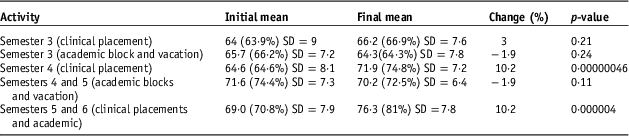
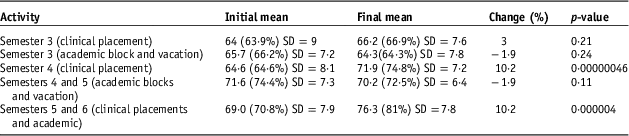
Analysis of variance was performed to identify changes in variance with progression through the course. Scores throughout the course were measured and plotted for the different domains and questions as seen in Figures 3 and 4. It can be seen that there was little difference between the trend in student performance within the different questions and domains. It is also clear from Figures 3 and 4 that EI scores increase upon return from clinical placements compared with scores before placement. In particular, there was a statistically significant increase in score after the Semester 4 clinical block and after the final clinical blocks as seen in Table 2. This table also depicts a slight decline in score during academic blocks, although this lacked statistical significance. As previously noted, there was a reduction of variance with time. Total variance in responses changed from 0·659 in the first survey to 0·442 in the last. Figures 5 and 6 depict the change in variance per domain and question, respectively.
Mean emotional intelligence (EI) per question.
Mean emotional intelligence (EI) per domain.
Variance per domain.
Variance per question.
Successive changes in emotional intelligence mean total score
Discussion
Limitations of the study
One of the key limitations of this study is the reliance on self-reporting. A number of authors highlight the difficulty of measuring EI via self-report,Reference Schneider, Lyons and Khazon16, Reference Dulewicz and Higgs24 especially in relation to self-awareness. Self-awareness is more likely to be accurately reported by students who have high self-awareness than by those who lack it. In addition, a risk with longitudinal measurement is the practice effect with students potentially recalling previous scores and desiring to demonstrate improvement or high scoring in traits they perceive as desirable. Thus, the findings related to self-awareness development may be flawed. A more reliable means of testing EI, and particularly self-awareness would be a valuable tool for future work. The other issue in relation to self-reporting is that of reporting bias with students perhaps wishing to report clear progression of their clinical skills. The anonymity measures underpinning this study were designed to ameliorate this but it is possible that some respondents’ data is unreliable. The results do indicate good coherence between the responses and there are few outliers, suggesting good reliability.
Sample size is a consistent threat to research in RT education with typically low clinical placement positions restricting course intake. The presented data, however, represented the whole cohort; further participants could not be gathered owing to class size limitations. Although it is tempting to consider introducing data from additional cohorts, this would have introduced additional variables. Most participants provided data at most collection instances and it was only sporadic absence that led to gaps in the data, reducing potential bias in dropout. Reasons for not completing the questionnaire were entirely owing to non-attendance at the data collection sessions. Despite small cohort sizes, it is clear from p-values that sufficient statistical power was available within the reported study.
EI development during training
Despite these caveats, in relation to the first research question, it is clear that EI does develop with time during a pre-registration radiation therapy course. This reinforces recent published findings from a range of health professions.Reference Dulewicz and Higgs12, Reference Landa and López-Zafra25 There is some contradictory evidence from studies that failed to identify changes in EI during the first year of educationReference Grant, Kinman and Alexander19, Reference Birks, McKendree and Watt26 across different healthcare disciplines. Some key factors may have influenced these apparent differences including a relatively short duration and a lack of specific EI interventions. It is also worth noting that there is considerable variation in EI measurement tools and aspects measured within the evidence base. This study aimed to measure those ‘trait EI’ aspects that are core to RT as opposed to the more cognitive ‘ability EI’.
Aspects of EI that change most throughout the course
The results suggested that students’ social awareness and relationship skills improved more than those domains related to self-awareness and management. The nuances of the clinical environment are particularly unfamiliar to students first embarking on clinical placement; however, the social and relational complexities become better understood through exposure over time. Therefore, it is not surprising that social awareness and relationship management increased more than self-awareness and management, which are constructs less impacted by environment. This finding is consistent with the EI theory underpinning the University of North Carolina leadership development programmes for healthcare professionals.Reference Fernandez, Peterson, Holmstrőm and Connolly27 Their research and experience indicates that personal competence is psychologically foundational for EI development. Emotional self-awareness forms part of this competency, allowing the individual to understand how they feel and why. From the basis of personal competency, social competence (which includes social awareness and relationship management) can be built. These skills are much more complex and allow the individual to communicate with tact, empathy and attentiveness, and foster cooperation and good team performance.Reference Fernandez, Peterson, Holmstrőm and Connolly27 Although the efficacy of their programmes has not been quantified, their theories offer an explanation as to why students’ self-awareness would improve less than their social awareness and ability to manage relationships during their course of study. Personal competence and emotional self-awareness are attributes that are most likely to be found in potential health students. It would be interesting to compare health course applicants’ EI performance with the general population to test this supposition.
Factors affecting EI development
In terms of demographic information, there was insufficient data to determine the impact of gender on EI development. Existing evidenceReference Fernández-Berrocal, Cabello, Castillo and Extremera28 suggests that age acts as a mediating factor on EI gender differences. Interestingly, in this study it was clear that although mature students started with higher EI scores, younger students generally caught up by the end of the course. It is possible that previous life skills enable mature students to develop higher levels of EI before the start of the course. It is reassuring to note that the nature of the course engenders a range of increases in EI with all graduates attaining similar levels by the time of completion. Future work could help identify students who require earlier or more concentrated interventions to bring all students to the same level early on.
This study strongly suggests that EI development takes place predominantly during clinical placement. It is tempting to conclude that EI development is slightly inhibited during academic blocks but caution must be applied to these findings. A more likely cause of EI decline may have occurred because of pre-clinical anxiety as a result of the time between placements. It is possible that students experience doubt and a decrease in self-perceptions after spending time away from the clinical environment. A corresponding increase in EI score after placement may be due to the recency effect with students readily recalling specific examples of recent EI performance. Further work is needed to determine if this is the case and may indicate the need for a more integrated curriculum model with more regular placements or contact with patients.
Impact of EI changes
Little work has been published linking EI formally to clinical performance. One published studyReference Victoroff and Boyatzis2 found a correlation between EI self-management scores and clinical grade for year 3 and 4 dental students but no correlation between relationship management and clinical grade. It is likely that this reflects the more solitary nature of dental work compared with the team environment in RT with its high expectation of forming ongoing therapeutic relationships. What can be determined from this study, however, is the fact that RT students report significantly increased levels of a range of EI indicators throughout their course. Improvements in EI are closely associated with return from clinical placement. Interventions designed to prepare students for clinical placement and encourage reflection on practice should ensure that these learning opportunities are maximised. Measuring the specific impact of this is fraught with challenges but this study provides a useful baseline for ongoing evaluation of the effectiveness of different EI interventions on clinical education and practice.
Conclusions
This study demonstrated that self-reported EI scores increased by over 17% throughout a 3-year Bachelors’ degree in Radiation Therapy with high statistical significance. Improvements in students’ EI scores were strongly associated with clinical placement blocks. Mature students tended to start the course with higher EI scores than their junior peers but variance decreased over time until all students graduated with a similar score. The aspects of EI that increased most were associated with social awareness and relationship skills, vital for a team-working environment. This work not only confirms the common assumption that RT curricula impact on development of empathy and EI but also forms the foundation for future evaluation of specific EI interventions. Given the higher increases in social awareness and relationship management skills, perhaps interventions in academia aimed at facilitating development of self-awareness and self-management would be of value. Above all else, these results confirm that clinical placement is the optimal environment for EI development in RT students and that all potential opportunities for clinical experience should be nurtured and maximised where possible.
Acknowledgement
The authors would like to acknowledge the financial support generously provided as a Vacation Research Experience Scholarship from Queensland University of Technology.