1. Introduction
Studies on the nexus of welfare and conflict are not new, as this topic has been widely observed by many researchers over the last five decades (e.g. Birrell and Murie, Reference Birrell and Murie1975; Crost et al., Reference Crost, Felter and Johnston2016; Nagels, Reference Nagels2016; Pena et al., Reference Pena, Urrego and Villa2017; Taydas and Peksen, Reference Taydas and Peksen2012). Some of them believe that welfare provision effectively reduces conflict and helps to maintain civil peace. The Pilipino conditional cash transfer (CCT) program, for instance, reduces conflict and insurgent influence in some regions in the Philippines (Crost et al., Reference Crost, Felter and Johnston2016). The Peruvian CCT program diminishes violence caused by social conflict in Peru (Nagels, Reference Nagels2016). Similarly, the Colombian CCT program lessens civil conflict by increasing the average number of demobilized combatants (Pena et al., Reference Pena, Urrego and Villa2017). In more general terms, government welfare spending on health, education, and social security programs can effectively minimize the risk of civil conflicts and significantly help to sustain civil peace (Taydas and Peksen, Reference Taydas and Peksen2012).
However, the Indonesian experience of welfare provision through the unconditional cash transfer – Bantuan Langsung Tunai (BLT) program stimulated multifaceted conflicts in communities. Unlike CCT, which can be seen as a cash benefit for poor households specifically to bring their children to school and primary healthcare to promote long-term social investment (Von Gliszczynski and Leisering, Reference Von Gliszczynski and Leisering2016), BLT is a temporary cash assistance distributed for poor households as compensation for the fuel subsidy reduction to help them to access basic needs.
The BLT program was initiated as part of considerable welfare reforms after the 1997-Asian financial crisis (Aspinall, Reference Aspinall2014; Rosser and van Diermen, Reference Rosser and van Diermen2016), aimed at providing social protection for the poor, which led to the change in the Indonesian welfare regime (Sumarto, Reference Sumarto2017). During the history of the Indonesian welfare policy, the government provided BLT four times, i.e. 2005, 2008, 2013, and 2015. Prior to 2005, the Government of Indonesia (GoI) did not provide BLT, although the government reduced the fuel subsidy several times.
Among these BLT programs, the one implemented in 2005 gave rise to the most problematic dispute, causing conflicts between people and community leaders, among people, and between village heads – kepala desa (kades)/hamlet heads – kepala dusun (kadus) and their political rivals. Moreover, the program caused massive protests, which damaged public facilities and threatened public security. These complicated conflicts reveal a functioning community-based initiative in reducing the conflicts through an informal redistribution and show limited government’s capacity in resolving such conflicts. The redistribution, however, caused policy distortion and modification, bringing about policy failure.
This article aims at using the 2005 BLT program as a lens to answer three important questions: how and why welfare policy stimulates conflict; how the conflict de-escalated and was resolved; and what the policy implications of the conflict. To answer these questions, this article employs a narrative analysis of qualitative data resulting from in-depth interviews, supported by descriptive statistic examination of national survey data and government document analysis. The survey data resulted from national social-economic survey – Survei Sosial-Ekonomi Nasional (Susenas) Panel 2006 and Governance and Decentralization Survey (GDS)-2006Footnote 1 were tabulated to look at a broad picture of the conflicts and harmful protests throughout Indonesia. For meticulous analysis, the author analyzes qualitative data collected through face-to-face interviews held in 2010Footnote 2 . The sample included research participants that were classified into national, district, and community levels. The national level covered senior politicians and government officers, while the district level included mayors/regents, local government officers, and local politicians. Finally, the community level comprised kades, kadus, neighborhood leader, head of the village consultative body, a women leader, youth leader, and religious leader. All the participants were selected using purposive method. The interviews were conducted in six communities covering rural, urban, and fishery neighborhoodsFootnote 3 under three districts/municipalities in Java, i.e. Blitar District, Blitar Municipality, and Cirebon District. In every community, the author conducted seven interviews. In each district and national government, the author undertook six and eight interviews respectively: thus, all together, the author held 68 interviewsFootnote 4 . All the interviews were conducted by the author. To protect the identity of participants, particularly the conflicting kades/kadus and their political rivals, the pseudonyms of ‘Mulyo’ hamlet and ‘Luhur’ village are used.
2. Welfare, Conflict, and Policy Change – Theoretical Discussion
Theoretically, welfare distribution should promote social integration (Goodin et al., Reference Goodin, Headey, Muffels and Dirven1999) but, in practice, it has the potential to bring about social conflict. The term ‘social conflict’ refers to ‘a struggle over values and claims to scarce status, power, and resources in which the aims of the opponents are to neutralize, injure, or eliminate their rivals’ (Coser, Reference Coser1956, p. 8). The conflict covers latent and manifest conflicts, where the manifest conflict can be seen as the initial stage of the emergence of the manifest clash, with the former potentially leading to the latter (Dahrendorf, Reference Dahrendorf1959; Hardin, Reference Hardin1995).
The current literature on theories of social conflict (e.g. Coser, Reference Coser1989; Dahrendorf, Reference Dahrendorf2008; Hardin, Reference Hardin1995) puts welfare as a central subject in the rise of social conflict in society. Dahrendorf (Reference Dahrendorf2008) argues that social conflict in modern society is about enhancing life chances. Coser (Reference Coser1989) believes that social disruption may occur when the interplay between entitlement and provision is not in balance. Concurrently, Hardin (Reference Hardin1995) emphasizes that distributional goods, including income and welfare benefits, may trigger social conflict.
Literature on welfare studies (e.g. Gough, Reference Gough, Gough, Wood, Barrientos, Bevan, Davis and Room2004; Mitchell et al., 1994 (Reference Mitchell, Harding and Gruen2000)), at the same time, argues that welfare distribution aggravates social stratification in society. However, it is important to consider that some prominent authors on social conflict theories (e.g. Dahrendorf, Reference Dahrendorf1959; Collins, Reference Collins1971) stress that social stratification is a key starting point of social conflict. Therefore, both social conflict and welfare theories agree that welfare distribution potentially stimulates conflict in society. In a practical way, welfare takes shape in social protection, which can be defined as all sorts of support provided by public institutions, private organizations, voluntary groups, and informal networks to help households and individuals to overcome socio-economic risks (Barrientos, Reference Barrientos, Barrientos and Hulme2008).
Selective welfare distribution is an efficient way of distributing scarce welfare resources (Barcena-Martin et al., Reference Barcena-Martin, Blanco-Arana and Perez-Moreno2018), but this method is vulnerable to causing social conflict. The conflict stimulated by the selective welfare approach may arise in two ways. First, selective approach causes unfair distribution, which generates distrust (Rothstein and Uslaner, Reference Rothstein and Uslaner2005). Those who perceive that they are not fairly treated (Mitchell et al., 1994 (Reference Mitchell, Harding and Gruen2000)) distrust the welfare bureaucracy because they think that welfare bureaucrats withhold welfare entitlements (Rothstein and Uslaner, Reference Rothstein and Uslaner2005). Distrust here refers to ‘negative expectations about the actions of others (of their harmful, vicious, detrimental actions toward myself), and it involves negative, defensive commitment’ (Sztompka, Reference Sztompka1999, p. 26).
Distrust may, consequently, lead to conflict because distrust encourages people to perceive that the distrusted person has goals that are incompatible to one’s own (Rubin et al., Reference Rubin, Pruitt and Kim2004). In addition, distrust mobilizes hostility (Sztompka, Reference Sztompka1999), which can easily surface in a situation where people experience unfair distribution of their entitlements (Coser, Reference Coser1956), such as the right to receive welfare benefit. Hostility and incompatible goals are the main factors triggering social conflict in society (Bartos and Wehr, Reference Bartos and Wehr2002). However, distrust and hostility are unlikely to bring about conflict without legitimacy (Coser, Reference Coser1956). A legitimacy for the parties to get involved in a conflict may take shape in support coming from community members to the conflicting parties (Rubin et al., Reference Rubin, Pruitt and Kim2004).
Second, social conflict arises due to mis-targeted distribution, which covers inclusion and exclusion errors. The inclusion error refers to the proportion of ineligible people who receive welfare benefit, while the exclusion error means that people intended to be targeted are excluded from the welfare provision. Inclusion errors decrease the amount of funding available for eligible people, which may lead to scarcity. Concurrently, exclusion errors cause needy people to be excluded from welfare distribution, provoking those excluded into experiencing a ‘zero sum’ feeling. Both scarcity (Coser, Reference Coser1956) and zero sum feelings (Rubin et al., Reference Rubin, Pruitt and Kim2004) cause the rise of conflict.
These conflicts may escalate or de-escalate. Conflict escalation means an increase in the intensity of a conflict (Rubin et al., Reference Rubin, Pruitt and Kim2004), while de-escalation refers to a lowering of conflict (Zartman, Reference Zartman2008). The escalation takes place because some parties use overwhelming power over their opponents (Bartos and Wehr, Reference Bartos and Wehr2002). In conflict escalation, the parties may use force against each other to attain their goals.
The de-escalation of the conflict caused by selective welfare policy occurs in two ways. First, the de-escalation takes place when one or both parties involved in the conflict run out of resources or achieve a consensus (Zartman, Reference Zartman2008). The conflict may end if the conflicted parties agree on the goals and determination of the outcome. ‘Once a goal has been reached by one of the parties and this is accepted as a clue to the acceptance of defeat by the other, the conflict is ended’ (Coser, Reference Coser1967, p. 43).
Second, the conflict de-escalates due to a policy change. It occurs because the selective rule weakens, leading to a less-meticulous selective distribution in which less-eligible households and the excluded recipients due to exclusion error are included in the distribution. Under this blurred selective rule, therefore, the zero sum feeling diminishes and results in de-escalation.
The blurred institution may happen if the selective principle interacts with another institution (Migdal, Reference Migdal2004), which promotes universal principle of welfare distribution, eroding the selective principle. This occurs because the government initiates the selective policy alongside with an existing institution, such as an informal welfare system, which causes the problem of layering and nesting. Layering refers to a mechanism of policy change in which a new policy is introduced alongside or on top of the existing ones (Mahoney and Thelen, Reference Mahoney, Thelen, Mahoney and Thelen2010), while nesting means a mode of institutional change where a rule nestles inside another larger one (Ostrom, Reference Ostrom2015). Layering and nesting blur the selective rule because the informal system exercises collectivism principle, where all community members believe that they struggle against social-economic austerity collectively – thus, if they receive any social-economic assistances including government welfare benefits, these benefits should be shared to all members (see Sumarto, Reference Sumarto2017; McCarthy and Sumarto, Reference McCarthy and Sumarto2018). This situation lessens the conflict, but the engagement of a set of rules within government policy may cause policy modification that may change the substantial role of the policy (Migdal, Reference Migdal2004).
3. Program Administrative Arrangement
The conflict of the 2005-BLT program was considerably affected by the program’s administrative arrangement, which covers some technical-administrative issues. Administratively, BLT was an ad hoc program which was governed by presidential decree. In the decree, the president mandated some ministries and government agencies to serve as ‘welfare bureaucrats’ for the program. The leading institution of the program was the Ministry of Social Affairs. The welfare bureaucrats involved in the BLT program differ from those of other social programs, comprising the Attorney General, the Commander of National Army, and the Chief of National Police, as the GoI believed that the program might generate conflict and social unrest.
Another important administrative arrangement was program entitlement. The entitlement of poor households to BLT was decided by the central government. The 2005-BLT program provided IDR 100,000 monthly for each poor household for 12 months, from October 2005 to September 2006. The government distributed three-month BLT payments so that,` in every distribution, each poor household received IDR 300,000.
To distribute BLT, the GoI channeled the BLT cash directly from the national government through the post office, which has branches in most sub-districts in Indonesia. Recipients claimed BLT at a sub-district post office by showing a BLT coupon, which was sent to them a few days prior to the distribution. If any post office did not have appropriate facilities, such as a large room for queues, the post office brought the distribution venue to sub-district office, kades office, and public school.
When the GoI planned to distribute BLT, the government mandated the National Statistics Board – Badan Pusat Stastik (BPS) – to conduct a population socio-economic survey – Pendataan Sosial Ekonomi (PSE-2005) – set up specifically to collect data on poor households to support the BLT and other social protection programs. Prior to the PSE-2005, all social protection programs for the poor, which were introduced in 1998 (see Sumarto, Reference Sumarto2017), used the data collected by the National Family Planning Coordinating Agency to support family planning program, so the data did not fit any social protection programs.
However, the PSE-2005 and other technical preparations of the BLT distribution were very problematic. Two weeks prior to the date of BLT distribution, i.e. October 1, 2005, the data collection of PSE-2005 was not yet completed. Concurrently, the BLT coupon and BLT program guideline had not been printed out yet. Without the guideline, the welfare bureaucrats could not understand the technical aspects of BLT distribution.
The last issue of administrative arrangement was program socialization. The BLT-program socialization was not conducted systematically, so the population did not receive comprehensive information on the program. This disadvantage caused people to have inaccurate perceptions, leading to inappropriate attitudes toward the program.
4. Mis-targeted Distribution and Social Stratification
The problems with the program administrative arrangements resulted in the mis-targeted distribution of BLT. The mis-targeted distribution is evidenced by the fact that the targeting score of the BLT program is only 24 out of 100 (World Bank, 2012). This caused problematic inclusion and exclusion errors. The inclusion error of the 2008 BLT program, for instance, was about 60 percent, and its exclusion error was nearly 50 percent (Alatas et al., Reference Alatas, Purnamasari and Wai-Poi2011).
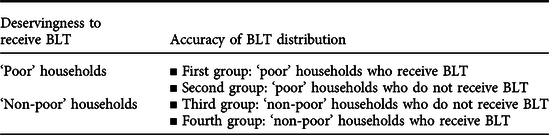
The mis-targeted distribution, as shown in Table 1 below, caused a complicated social stratification. The first column of the table is social division resulting from deservingness to receive welfare benefit, which differentiates people into two groups: namely, ‘poor’ and ‘non-poor’ groups. The ‘poor’ group comprises those entitled to BLT and the ‘non-poor’ group comprises those not eligible for these entitlements. The second column contains four groups of social division resulting from the mis-targeted distribution. The groups are as follows: (1) ‘poor’ households who receive BLT, (2) ‘poor’ households who do not receive BLT, (3) ‘non-poor’ households who do not receive BLT, and (4) ‘non-poor’ households who receive BLT. The exclusion error brought about the second group of people. Concurrently, the inclusion error caused the emergence of the fourth group of people.
Creation of social division caused by the BLT program

Source: author
5. Social Conflicts in Communities
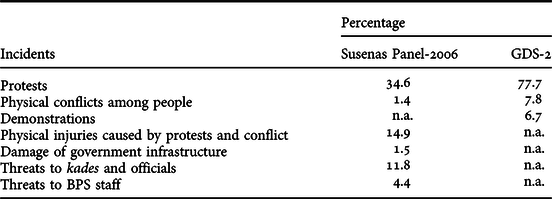
The mis-targeted distribution and social stratification triggered protests, physical conflict, and demonstrations. The term ‘protests’ is differentiated from the term ‘demonstrations’. Protests are an individual expression of dissatisfaction, while demonstrations are group public rallies. Table 2 below summarizes the protests, physical conflicts, and demonstrations. The table shows that the BLT program also resulted in physical injuries, damage to government infrastructure, threats to kades and officials, and threats to BPS staff. The conflicts spread throughout Indonesia. GDS-2006 data show that protests took place in 29 provinces, 140 districts, and 651 villages. Demonstrations occurred in 20 provinces, 45 districts, and in 65 villages. Physical conflicts were reported in 17 provinces, 36 districts, and 56 villagesFootnote 5 .
Protests, demonstrations, and conflicts stimulated by BLT distribution 2005

Source: Susenas Panel-2006 and Governance and Decentralization Survey (GDS)-2 2006 (N Susenas panel: 566 villages; N GDS-2: 834 villages).
The qualitative data resulting from in-depth interviews at district and community levels find conflict between people and community leaders and conflict between kades/kadus and their political rivals, which were not recorded by the Susenas Panel-2006 and GDS-2006. In sequence, the first conflict was between people and community leaders, followed by conflict among people and conflict between kades/kadus and their political rivals.
5.1. Conflict between People and Community Leaders
The conflict between people and community leaders began when BLT coupons were distributed by BPS officials to the recipients at the end of September 2005. Community leaders include kades, kadus, and neighborhood leaders. People who did not receive the coupons but believed that they should receive BLT were shocked because they realized that the data collection under PSE-2005 conducted by BPS staff a few weeks prior to the coupon distribution was for the BLT program. When BPS staff collected data for BLT distribution, they did not inform people that it was for the BLT program. The reason for the secrecy of the data collection was in order not to bias the information provided by people.
When those who did not receive BLT coupons were aware that they were not selected as BLT recipients, they were dissatisfied with community leaders and blamed the leaders because they perceived that they did not receive BLT due to an unfair decision of the leaders. To conduct PSE-2005, BPS staff visited community leaders, asking for recommendations of the list of poor households to be surveyed. Those who did not receive BLT believed that the households recommended by the leaders were the nominees of BLT recipients. When they knew that they were excluded from the BLT program, they claimed that this was because the leaders did not recommend them but recommended other people who colluded with leaders, so they accused the leaders of nepotism. This caused people to distrust the leaders.
Blaming community leaders for the unfair BLT distribution stimulated those who did not receive BLT to be aggressive (see Rubin et al., Reference Rubin, Pruitt and Kim2004) and hostile toward the leaders. These people rallied protests at the houses of the kades, questioning their ineligibility. These protests, originally spontaneous in nature, turned into large collective protests because people protested simultaneously. To strengthen the protest, during the protests, people bargained with community leaders over their involvement in a community-based collective action, termed gotong-royong (see Sumarto, Reference Sumarto2017). Protesters demanded that they were given BLT; otherwise, they would not take part in the gotong-royong.
The protesters’ feelings of dissatisfaction, distrust, and hostility provoked them to support one another to protest to community leaders about access to BLT. This collective support provided a group justification to continue the conflict with community leaders. The collective protest transformed individual shock, dissatisfaction, hostility, and distrust into conflict (Rubin et al., Reference Rubin, Pruitt and Kim2004) between those who did not receive BLT and community leaders.
The process of transformation of these feelings into conflict was rapid because people who wanted to receive BLT had only a few days’ notice before the distribution was due. They aggressively confronted community leaders in order to attempt to change the BLT nominations; otherwise, they would be excluded for the remainder of the program. The collective discontent mobilized people to persist in their aspiration to receive BLT and legitimized aggression toward community leaders.
Conflict between community leaders and people varied from latent conflict to manifest conflict. Latent conflict caused tension between community leaders and people. For example, in public, people made insinuating remarks about the kades regarding BLT distribution. The manifest conflict was accompanied by harmful social unrest. The conflict, as described in Table 2, took shape as the physical abuse of community leaders, which caused physical injury. The manifest conflict also took place in destructive demonstrations, which damaged kades offices. Given these destructive demonstrations, BLT distributions conducted at kades offices were guarded by police officers and military troops to prevent any potentially destructive actions.
5.2. Conflict among People
Those who did not receive BLT distrusted not only community leaders but also BLT recipients, because they perceived that the recipients had colluded with community leaders, including making claims of nepotism against the leaders. They believed that they were of a similar socio-economic status to the nominated BLT recipients. The data of GDS 2006 show that 91.11 percent of individuals believed that they were entitled to BLT because they felt they were poor but they did not receive it. This situation stimulated social jealousy and hostility of non-recipients to recipients.
Conflict among people occurred when people in the second group (resulting from the social division described in Table 1) and the third group who wanted to receive BLT were jealous, hostile, and distrustful of people in the first and fourth groups over BLT distribution. Conflict among people caused the inter-group boundary to become clearer. When conflict took place, the parties restrained themselves from communication with their opponents because the conflicted parties were afraid that the communication might lead to an inaccurate interpretation: i.e. they accepted the opponents’ aspirations (see Rubin et al., Reference Rubin, Pruitt and Kim2004).
The emergence of the third group who wanted to receive BLT and fourth one generated relative scarcity. The term ‘relative scarcity’ in this context refers to a condition in which the shortage of distributional goods arises because the ineligible party intends to get the goods, but the level of goods remains stagnant. This condition leads to the inability of the supply of the goods to meet the demand of the growing population who want to receive the goods. The BLT program could not meet the needs of ‘eligible’ households due to this scarcity. This situation caused people to have zero sum feelings, which intensified conflict among people. The conflict among people occurred almost at the same time as the conflict between people and community leaders.
5.3. Conflict between Kades/Kadus and their Political Rivals
The term ‘political rival’ denotes a political competitor of the kades/kadus when the kades/kadus elections were conducted and the contender was defeated in the elections. After the elections, some rivalries turn out to be a conflict because the competitor still struggles to seize the kades’s office while the kades tussle for the office. The BLT program was used by the rival as an instrument to defeat the kades/kadus, causing the kades/kadus to be sentenced to jail and the rival could assume the kades/kadus position.
Differing from the two other conflicts, which represent a communal tension spreading throughout Indonesia, the conflict between kades/kadus and their political rivals is a personal conflict. The latter has a higher variation than the former and depends on the local political situation. To understand this conflict, therefore, it is helpful to see two different cases involving different types of rivalries of the kades and kadus and their political competitorsFootnote 6 . Among several cases of conflicts, the ‘Mulyo’ case in the Blitar District, East Java and the ‘Luhur’ case in the Cirebon District, West Java can be used as a lens to analyze the conflict.
The Mulyo case started when the kadus of Mulyo hamlet arranged informal redistribution. The details of the informal redistribution are elaborated in section 6.2 ‘Community Leaders’ Response’ below. He held the informal redistribution in response to constant protests by those who did not receive BLT and accused the kadus of being involved with collusion and nepotism in the selection process of BLT recipients.
The kadus arranged the redistribution using existing small enterprise groups, formerly utilized for the distribution of other social benefits. Each group consisted of BLT recipients and non-recipients who wanted to receive BLT. In the redistribution, each recipient who received BLT of IDR 300,000 contributed IDR 60,000 voluntarily to the group, and this amount was redistributed to the non-recipients. On average, the non-recipients obtained IDR 75,000 per person. In conducting the redistribution, the Mulyo kadus was assisted by a committee of social leaders who supervised the redistribution. To gain legitimacy for the redistribution, the kadus held a village meeting (musyawarah desa) (see section 6.2 ‘Community Leaders’ Response’ below) with village officers, religious leaders, and social leaders.
The first and second BLT redistributions proceeded without any problem. In the third redistribution, however, some BLT recipients did not want to make their voluntary contribution because they were provoked by the kadus’s political rival not to make any contribution. This caused serious tension among the members of the groups and the kadus. The kadus’s political rival reported this situation to the district police station, accusing the Mulyo kadus of coercing and extorting the BLT recipients.
An investigation was carried out by police officers on the basis of these allegations, bringing the kadus to be charged and sent to the district court. He was sentenced to a three-month probation. This case frustrated the kadus, and he felt that it had devastated his career and dignity. After the probation period, the kadus resumed his old position, and the conflict between the kadus and his rival remained latent.
Differing from the Mulyo experience, the Luhur case shows a relentless effort made by a kades’s rival in litigating a kades of Luhur desa, Cirebon District for the illegal practice of taking people’s entitlement to BLT for his own use. The case involved the kades being sued by the vice-head of the village consultative body – Badan Permusyawaratan Desa (BPD) in Luhur desa. The problem of this illegal practice is a complicated issue, as this happens in many programs, such as health insurance program (Aspinall, Reference Aspinall2014; Rosser and van Diermen, Reference Rosser and van Diermen2016).
During the BLT distribution, the BPD vice-head did not receive any report from the kades. The BPD vice-head sent a formal letter to the kades asking him to report the BLT distribution in a meeting attended by village officers, but he could not present an accurate report of the distribution. On the grounds of illegal practice charges, the BPD vice-head sent a lawsuit to the district court against the kades.
To support his legal action, the BPD vice-head collected detailed data of the BLT distribution in Luhur desa. He found that BLT recipients consisted of 407 households, 72 of which did not receive BLT. To gather authentic supporting data, the BPD vice-head asked all 72 household heads to sign a legal statement confirming that they did not receive BLT. Out of 72 people, 41 signed the legal statement. They served as witnesses and were interrogated by the police. The BPD vice-head felt that the Luhur kades took seven months of BLT payment, i.e. IDR 700,000, intended for each of the 72 recipients, or about IDR 50 million in total.
To support the lawsuit, the BPD vice-head spent about IDR 15 million. By contrast, the kades spent about IDR 400 million to counter the lawsuit. During the litigation, the BPD vice-head and six social leaders who supported the BPD vice-head’s lawsuit suffered intimidation by the kades. The intimidation discouraged the social leaders from continuing to support the BPD vice-head.
6. Government and Community Leaders’ Responses to the Conflict
6.1. Government Response
The GoI responded to people’s dissatisfaction, protest, and conflict by developing units of grievance in all districts, but this response stimulated other complicated protest. Soon after the first BLT distribution in October 2005, the units of grievance were built to provide the chance for a second registration of poor people who had not received BLT coupons. Poor people would come to the units and register themselves to receive BLT in the second distribution, which was conducted in January 2006.
The data resulting from GDS-2006 show that 91.1 percent of kades and 82.1 percent of kadus stated that the second registration via units of grievance was held in their villages. As a result, around 12 million people entered the second registration because these people believed that they were entitled to BLT and had missed out on the first round of BLT distribution. However, the GoI believed that most of them were ‘non-poor’ people. The GoI decided to include only 4.2 million of these claimants and excluded the rest of the 7.8 million people. This caused the second wave of protest and social unrest. This protest was even more serious than the first one because some of the protesters felt that they were excluded twice.
Expecting that the second registration might stimulate social unrest, government officers anticipated physical threats from dissatisfied people. To verify the data of a household as a result of the second registration claims, BPS staff and other officers verifying data were accompanied by policemen and security officers. Some local governments, such as East Java Province, responded to the protest, conflict, and social unrest by postponing the second distribution until they were sure that they could minimize these issues. The request of the East Java Province government for postponement is expressed in a formal letter dated January 9, 2006, submitted to the Coordinating Ministry of People Welfare (Kemenkokesra):
‘… considering some points mentioned above [limited time for verification and the possibility of arising social unrest], we sincerely request that the Minister of Kemenkokesra allow us to postpone the second three-month distribution of BLT until the second week of February 2006’ (East Java Province Government, 2006).
6.2. Community Leaders’ Response
Community leaders’ response to people’s protest was completely different from that of the GoI. When the leaders were pressured by the protesters to help them to obtain BLT, the leaders did not have sufficient time to think of a strategic response because the period between the distribution of BLT coupons and the date of BLT distribution was only one week. During this limited time period, community leaders struggled to minimize these protests by asking the head of the local parliament, the mayor, and the district BPS head to help them in resolving the issue, but none of them could help. The community leaders themselves thus arranged the informal redistribution of BLT to minimize protest, avoid conflicts, and prevent the decline of gotong-royong.
Informal redistribution is a community-based redistribution of a government selective social protection by collecting the distributed social protection received by the recipients and then redistributing it to all people who intend to receive it regardless of their socio-economic status. Through the informal redistribution, community leaders collected a portion of the BLT received by the recipients and redistributed the collected funds to those who insisted on their entitlement to receive BLT. The informal redistribution, however, was considered an illegal practice, so that any of those who conducted the redistribution may be prosecuted in a legal court. In many cases, legal defenders and police officers did not take any legal action unless they received a legal lawsuit.
To minimize the risk of legal action, community leaders searched for legitimacy from local leaders. They believed if they obtained legitimacy, they would not suffer any legal consequence from conducting the informal redistribution. To obtain legitimacy, the leaders organized a musyawarah desa, which refers to a community-based meeting organized by community leaders to reach a communal consensus to solve socio-economic issues in the community. In the musyawarah desa, community leaders, religious leaders, and actors in the conflict outlined their aspirations to achieve a consensual outcome. Most musyawarah desa came to a consensus to reduce the conflict by organizing informal redistribution. At the end of the musyawarah desa, all the parties signed the agreement of the informal redistribution. Thus, the informal redistribution represents an outcome of bargaining process in which the conflicting parties intend to resolve the conflict as the parties believe they are dependent on cooperation (such as gotong-royong) with the other parties (Birrell and Murie, Reference Birrell and Murie1975).
7. Conflict Escalation and De-escalation
All three types of conflicts elaborated above had stages of escalation and de-escalation. Although they similarly had escalation and de-escalation, there were various sequences to a different number of events because BLT was used differently by the conflicting parties. People became involved in the conflict between people and community leaders as well as the conflict among people because they wanted to obtain BLT. In the conflict between kades/kadus with their political rivals, all parties used BLT as a political vehicle to achieve a political goal.
The conflict between kades/kadus with their political rivals escalated when one party took advantage of the BLT distribution to discredit another party. The time of the escalation for each individual conflict did not occur simultaneously but sporadically depending on the right momentum for one party to increase her/his political advantage (Rubin et al., Reference Rubin, Pruitt and Kim2004) and resources to assault her/his opponent. The Mulyo case escalated when the Mulyo kadus was sent to district court and sentenced to a three-month probation. The escalation of the Luhur case took place when the BPD vice-head sued the Luhur kades in the district court.
The Mulyo case de-escalated after the Mulyo kadus was released from the three-month probation and the kadus did not avenge his rival. In the Luhur case, the conflict de-escalated gradually after the BPD vice-head and the Luhur kades spent a relatively high amount of financial resources, even though the case remained unresolved.
The conflict between people and community leaders as well as the conflict among people escalated simultaneously across Indonesia. The conflict escalated in the first and second distributions of BLT in October 2005 and January 2006. When BLT coupons were distributed at the end of September 2005, shock, hostility, dissatisfaction, and distrust transformed into conflict escalation in a very short time. People struggled aggressively to receive BLT, which would be distributed in few days; otherwise, they felt that they would not get it. The conflict escalation lasted for about five months. Data on the length of the escalation are limited. However, from the formal letter written by the East Java Province government dated January 9, 2006, regarding a request for deferring the second BLT distribution to the second week of February, it can be estimated that the escalation of the conflict started from the time of the protests and demonstrations in the end of September 2005 and continued to February 2006.
During the escalation period, large protests and demonstrations led to a chaotic and insecure situation. Some welfare bureaucrats divided their areas of work into two categories, i.e. secure and insecure regions. This division is evident from a formal letter sent by the head of the East Java BPS to the deputy of social statistics in BPS, dated 21st October 2005:
‘… considering the chaotic situation, the data verification for registered households would be conducted in these ways:
-
a. In secure areas: … the verification will be conducted by surveyors with the coordination of security officers.
-
b. In insecure areas: … data verification will be carried out by surveyors and local government officers accompanied by security officers’ (East Java BPS, 2005).
After experiencing high escalation in the first and second distributions of BLT, the conflicts de-escalated gradually prior to the third distribution. The conflicts de-escalated because the conflicting parties could eliminate the dissatisfaction through a musyawarah desa. Given that the conflicting parties were satisfied, their incompatible goals disappeared, and the conflict de-escalated (Coser, Reference Coser1956).
The conflict de-escalation continued from the third distribution of the BLT program until the end of BLT distribution in 2006. This trend continued in the BLT distributions, which were conducted in 2008, 2013, and 2015, and the conflict did not escalate because community leaders had already anticipated potential conflict. The leaders took the same measures as in the 2005-BLT distribution to prevent conflict from escalating out of control in the distributions in 2008, 2013, and 2015.
8. Conflict, Layering, and Policy Failure
The appearance of the multifaceted conflicts elaborated above shows that the central government not only failed to reduce the conflicts, but also became the source of the conflicts. When the GoI formulated the BLT program, it was foreseen that the program would stimulate conflict. The involvement of the Attorney General, the Commander of National Army, and the Chief of National Police was to anticipate the emergence of conflicts. Community leaders successfully lessened the conflict through informal redistribution. The community leaders are, thus, a ‘safe-guarder of social integration’ but some of them were sentenced to jail. In this context, the leaders played a contradictory role compared to that of the government, which can be described as a ‘conflict catalyst’.
The informal redistribution reflects a community-based mechanism, which weakened the selective rule of welfare distribution and smudged the government capacity to control over the social protection program, particularly at the local level. This mechanism however, effectively minimized social conflicts in communities, which the government failed to do. The government would not need the redistribution if its response could eliminate the conflict. Therefore, despite the government claiming that the informal redistribution was illegal, the government owed a debt of gratitude to the redistribution. The informal redistribution, therefore, is an unexpected mechanism, which is nested in a larger institution (Ostrom, Reference Ostrom2015), i.e. the collectivism principle causing this mechanism to get legitimacy from both the government and community members (see McCarthy and Sumarto, Reference McCarthy and Sumarto2018).
This informal redistribution represents a complicated consequence of institutional layering, particularly informal-formal layering. In another account, the author (see Sumarto, Reference Sumarto2017) explores the term ‘informal-formal layering’ as a problematic consequence of the initiation of a formal social protection program on top of the informal ones. Policymakers tend to reform social policy using a layering approach as they believe that this may not cause potential obstacles to policy change because the supporters of the status quo may preserve the old policy. Concurrently, layering may cause limited socio-economic shock, because layering does not intend to replace the old social policy but stimulates gradual change through amendment, revision, or additions to that old policy (Mahoney and Thelen, Reference Mahoney, Thelen, Mahoney and Thelen2010).
In the concept of informal-formal layering, informal redistribution is understood as a mechanism that took place because the government introduced BLT as a selective social protection and instructed all community members to respect the rule of selectivism by sacrificing their logic of collectivism. Unfortunately, community members did not want to compromise the value of collectivism, but the government failed to restrain the less-compromised behavior of community members. Under the norm of collectivism adopted by community, community leaders organized the redistribution whereby the leaders modified the selectivism rule. In the selective rule modification, the community leader included all ineligible community members into ‘eligible’ BLT recipients, as long as those community members demanded to receive BLT. It is important here to argue that the selective rule modification shows that the ‘formal-formal layering’ theory stating that the state amends and revises the old institution to encourage gradual change cannot happen, but instead, the community modifies the state’s new institutions.
The informal redistribution thus shows an interconnection of the selectivism rule and collectivism norm, leading to a policy distortion. At the national level, the government designed the program as a selective welfare program, but, as this value of selectivism did not match with local values, the community modified the selective approach that resulted in a ‘quasi-selective program’. Using Migdal’s idea, which looks at the interconnection of a formal state regulation and another rule produced by social alliance or network (see Migdal, Reference Migdal2004, p. 20), it can be argued that the ‘quasi-selective program’ took place because the informal redistribution blurred the boundary of the state’s selective rule and the community’s collectivism norm. The blurred image of the state and the sharper picture of the community norm led to the informal redistribution as a ‘legitimate’ informal method to minimize conflicts in communities.
This situation depicts complicated policy failures. A policy formulated by government may experience failure due to three major causes: namely, poor policy design, incompetent officials, and insufficient resources (Migdal, Reference Migdal2004). The BLT policy design did not work at the local level because of the serious gap between the state’s selectivism principles initiated by the policy and the collectivism norm. However, the welfare bureaucrats did not have sufficient capacity to fix the gap, which caused the conflicts leading to the practice of informal redistribution. The redistribution reveals a policy modification that produced two problematic implications, i.e. policy distortion and the blurred boundary of the state’s capacity in policy practice.
9. Conclusion
Answering the questions discussed in the introduction, this article concludes that the selective approach of the BLT program has stimulated complicated conflicts within communities and harmful protests. The conflicts cover conflict between people and community leaders, conflict among people, and conflict between kades/kadus and their political rivals. The driving factor of the first two conflicts was an intention to receive BLT, whereas, for the third one, the parties wanted to use the BLT as a tool to win political rivalry in kades/kadus elections. The government failed to minimize the conflicts and protests, while community leaders came up with an effective solution through informal redistribution. The informal redistribution reflects a problematic informal-formal layering and nesting, which caused policy distortion and modification leading to policy failure.
The policy failure reveals important theoretical implications on the nexus of conflict and institutional change. The institutional change theory is closely relevant to understand the de-escalation of conflict. The policy modification lessens conflicting actors’ incompatible goals, which diminishes hostility, dissatisfaction, and distrust, resulting in the de-escalation. The institutional change theory, however, deals with difficulty to explain how the policy modification takes place. The theory believes that policy development occurs through amendment and revision of an old institution, bringing about gradual policy change (Mahoney and Thelen, Reference Mahoney, Thelen, Mahoney and Thelen2010). In the BLT program, however, the old institution that embeds in local community collectivism modifies the new institution, leading to policy distortion.
Acknowledgements
I am grateful to the reviewers for their valuable comments. The editing process of this article received a slight fund from Master and Doctoral programs in Leadership and Policy Innovation, Graduate School, Universitas Gadjah Mada. All the arguments in this article are the author’s responsibility.