The 2013–2016 Ebola virus disease (EVD) epidemic resulted in 28,601 cases and 11,300 deaths. More than 10 countries were affected, with the heaviest tolls in Sierra Leone, Liberia, and Guinea.1 The Ebolavirus genus can cause viral hemorrhagic fever (VHF), a severe multisystem syndrome that impairs the body’s ability to regulate itself, leading to high individual mortality, particularly since treatment options are limited.2,3 Therefore, the care of patients with these infections poses additional safety risks for medical providers and institutional challenges for hospitals.
As the EVD epidemic grew, a response that was initially coordinated in West Africa transformed health systems globally. The United States assisted the response in West Africa, and some US hospitals cared for exported cases.Reference Uyeki, Mehta and Davey4 This caused other US institutions to focus on preparedness measures, utilizing Centers of Disease Control and Prevention (CDC) guidance.5 The CDC guidelines were updated as data emerged from West Africa, but they remained limited regarding critical care and emergency interventions, and they only provided detailed guidance on acute hemodialysis.Reference Bell, Damon and Jernigan6,7 Therefore, deliberations regarding safe, feasible interventions were often left to individual institutions. Many institutions struggled with balancing quality care provision with healthcare worker (HCW) safety, particularly during interventions with close patient contact, such as cardiopulmonary resuscitation (CPR).Reference Edelson8 The same dilemma has emerged with severe acute respiratory coronavirus virus 2 (SARS-CoV-2) and has only been amplified by the greater infectiousness of SARS-CoV-2 and the scarcity of PPE.Reference Kramer, Lo and Dickert9
After the 2013–2016 EVD epidemic, the US Assistant Secretary for Preparedness and Response (ASPR) and the CDC partnered with state departments of health to designate a subset of US healthcare institutions as Ebola treatment centers (ETCs), which were given funding to construct facilities and train staff to care for patients with VHF. Although 55 ETCs were originally designated, the number of these facilities has grown due to states designating their own ETCs, local capacity, and need. ASPR also established the National Ebola Training and Education Center, now renamed the National Emerging Special Pathogens Training and Education Center (NETEC), a consortium of 3 healthcare institutions that treated patients with EVD: Emory University, the University of Nebraska Medical Center/Nebraska Medicine, and New York City Health and Hospitals/Bellevue Center.10 NETEC has provided technical assistance to prepare the United States for future emerging infectious disease outbreaks, which is now being leveraged for the COVID-19 response.10,11 However, there is still a wide range in institutional comfort and experience with providing critical care interventions to patients with VHF, and a lack of national consensus on which interventions should be offered, and when.
In this study, we aimed to clarify the range of critical care interventions that are offered to patients with VHF, and the reasoning for undertaking (or deferring) each intervention both in the case of a person under investigation (PUI) for VHF and in a person with confirmed VHF at designated ETCs in the United States. To better inform this national discussion, we also explored the factors that influence case-based decision making, the barriers to performing certain interventions, and the changes in care provision policies for VHF patients since the 2013–2016 EVD epidemic. Hopefully, better knowledge of institutional policy differences will help identify best practices, improve patient care, and elucidate areas where additional national training guidelines are needed.
Methods
Study instrument
A 58-item survey was prepared using Qualtrics. The survey was designed to obtain information about institutional policies in 9 critical care areas: (1) renal replacement therapy (RRT), (2) endotracheal intubation and mechanical ventilation, (3) extracorporeal membrane oxygenation (ECMO), (4) chest compressions, (5) pharmacological cardioversion, (6) electrical cardioversion, (7) defibrillation, (8) cricothyrotomy, and (9) code status. Participants were asked “yes or no” questions pertaining to whether or not their institution had a policy in a given critical care area, whether their institution had prior experience providing a given critical care intervention to a PUI and/or a VHF, and whether the institution was currently ready to provide that intervention to either a PUI and/or a VHF. Participants were also given free-response text questions in which they were asked to summarize their institution’s policy in each area.
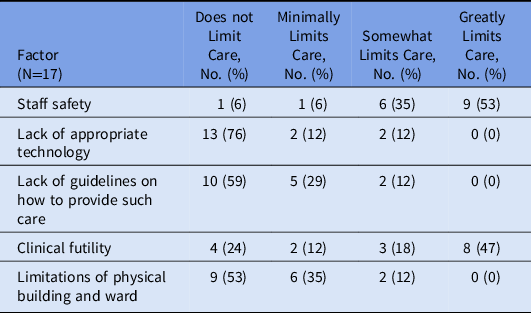
The survey also inquired about limits to providing critical care interventions. Participants were asked to rate how much the following 5 factors influenced their ability to provide critical care to a PUI and/or a VHF using a Likert scale: (1) staff safety, (2) lack of appropriate technology, (3) lack of guidelines on how to provide care, (4) clinical futility, and (5) limitations of the physical building or ward. Participants were also asked both “yes or no” and free-response questions regarding how their philosophy on providing critical care to a PUI and/or a VHF had changed over time, and what innovations their institutions had used to provide critical care.
Inclusion criteria
The survey was distributed by e-mail to 82 institutions that identified as ETCs. Institutions were identified from their affiliation with NETEC, from previous participation in studies pertaining to ETCs, and from internet searches, e-mail exchanges, and telephone communication.Reference Herstein, Le and McNulty12,Reference Herstein, Le and McNulty13
Participants were eligible to take part in the study if they were currently or previously had been part of the staff designated for care or planning the care of a PUI or a VHF patient at their institution.
IRB approval and participant consent
This study was approved by the Boston Medical Center Institutional Review Board (H-38993). Consent was obtained through an introductory e-mail that described the study goals. Participation was voluntary. If a participant chose to start the survey, they were considered to have provided consent. All participants were given a unique survey link, and responses were de-identified upon receipt.
Study period
The survey was initially sent out in January 2020 with 3 e-mail reminders sent to participants at ∼2–3-week intervals. Data collection concluded on March 2, 2020.
Data analysis
We calculated frequencies and percentages for ordinal and categorical data pertaining to the participating centers’ characteristics and policies. We also collected descriptive data about the participating centers’ critical care policies, perceived challenges, and innovations used to provide care.
We used the Fisher exact test to compare whether institutions that had previously taken care of a PUI or a VHF patient were more likely to have critical care policies compared to those without prior experience. We used the Mann-Whitney U test to compare the attitudes of centers who had previously taken care of a PUI or a VHF patient to those who had never taken care of either. P < .05 was considered significant.
Results
Respondent characteristics
In total, 27 respondents began the survey; however, 6 were excluded because they did not meet the inclusion criteria. Of the 21 institutions that responded and were eligible to take the survey, 17 of the initial 82 invitees (21%) are included in this analysis. Four surveys were excluded because the participants responded to <25% of the survey questions.
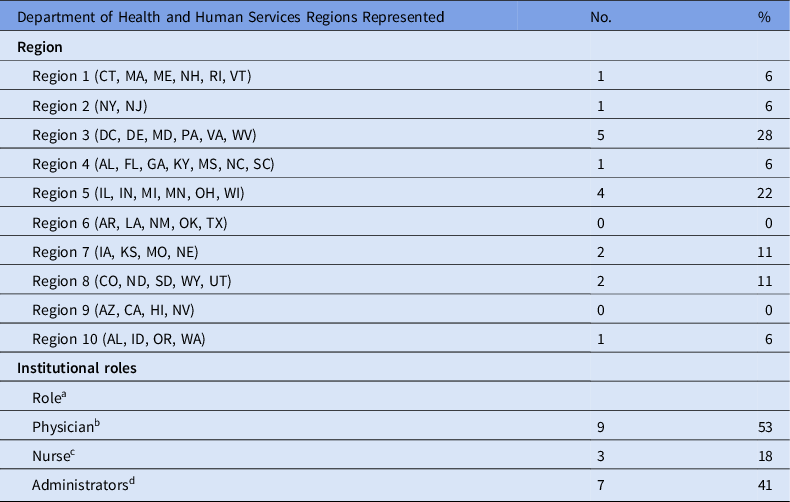
The sample includes institutions from 8 of the 10 Department of Health and Human Services (DHHS) regions, with the most being from Region 3 (DC, DE, MD, PA, VA, WV) and Region 5 (IL, IN, MI, MN, OH, WI), respectively (Table 1). Most respondents were physicians representing fields such as critical care, emergency medicine, and infectious diseases (56%), followed by administrators associated with operation of the ETCs (41%) and nurses (18%).
Respondent Characteristics

a Under institutional roles, 3 participants listed 2 roles, administrator and then nurse (n=1) or physician (n=2).
b Specialties represented were critical care, emergency medicine, and infectious diseases.
c Specialties represented included critical care and emergency medicine.
d Administrative roles were held in emergency management, hospital epidemiology, intensive care, and operations.
Policy scope, patient experience, and institutional readiness
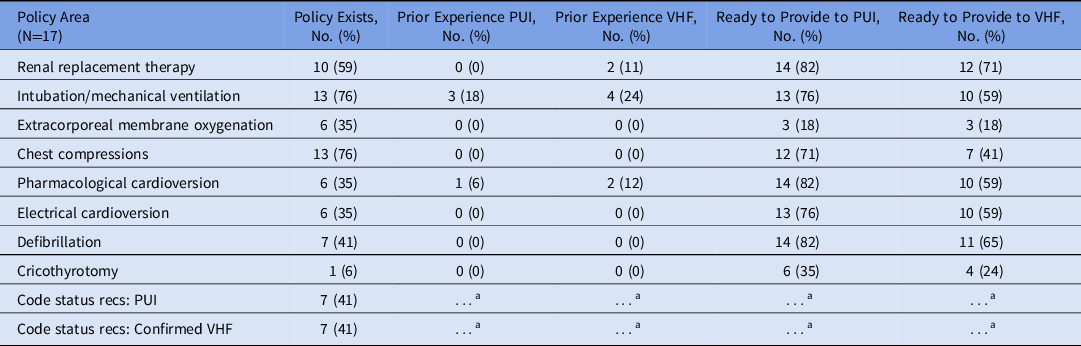
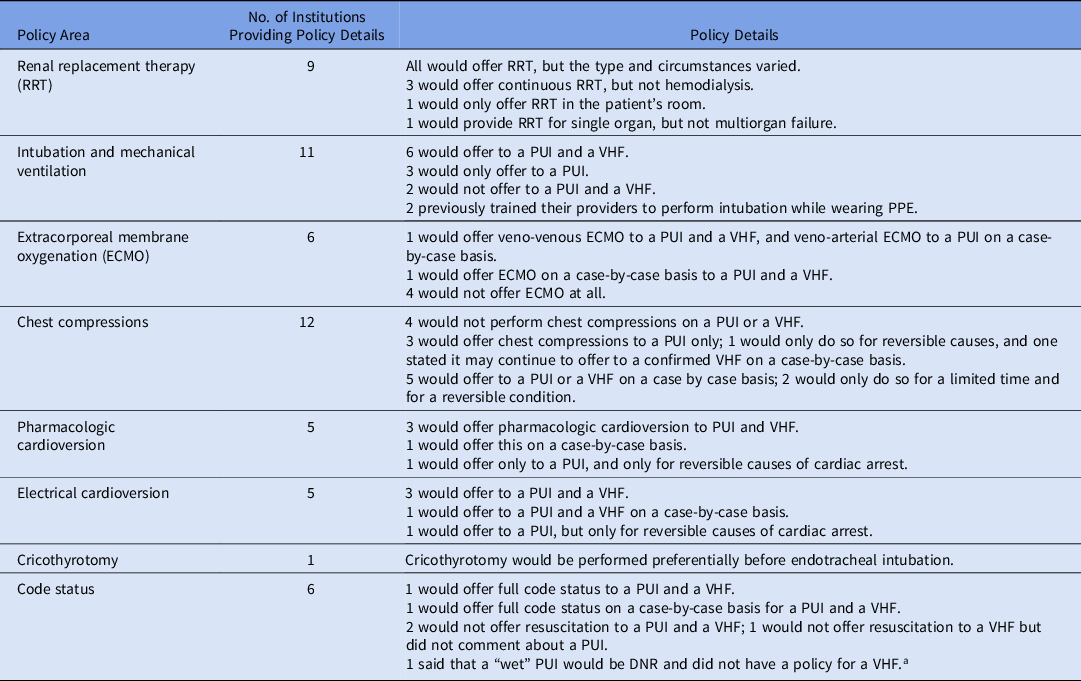
Most institutions had existing policies for intubation and mechanical ventilation (76%), chest compressions (76%), and RRT (59%, see Table 2). Policy details are described in Table 3. Roughly 40% of institutions had policies pertaining to defibrillation and code status, and approximately one-third had policies pertaining to ECMO, electrical cardioversion, and pharmacological cardioversion. Only 1 institution provided cricothyrotomy policy details, and this intervention was offered preferentially. All institutions providing RRT policy details would offer RRT to both a PUI and a VHF patient. Most would offer intubation and mechanical ventilation to both a PUI and a VHF patient. However, many institutions only provide ECMO, chest compressions, pharmacologic cardioversion, electrical cardioversion, full code status, and defibrillation to specific patients under certain circumstances.
Critical Care Policy Experience for Persons Under Investigation (PUI) and those confirmed with Viral Hemorrhagic Fever (VHF)

a These areas were not investigated.
Critical Care Policy Details for Persons Under Investigation (PUI) and those confirmed with Viral Hemorrhagic Fever (VHF)

a A “wet” PUI generally refers to those with gastrointestinal or marked hemorrhagic features which would result in significant fluid that could contaminate the environment and pose risk to staff.Reference Garibaldi and Chertow22
Just less than half of institutions reported prior experience caring for a PUI or a VHF patient in some capacity. Most experience was limited to RRT and mechanical ventilation, with a minority having performed pharmacologic cardioversion. None of the institutions in this study had prior experience providing ECMO, chest compressions, electrical cardioversion, defibrillation, or cricothyrotomy to either a PUI or a VHF patient. Prior experience caring for a PUI or a VHF patient was not significantly associated with having an existing policy in any of the 9 critical care areas.
Although many institutions did not have prior experience providing all these critical care interventions to either a PUI or a VHF patient, many stated that they felt ready to do so now. More than half of respondents stated that they were ready to provide RRT, intubation and mechanical ventilation, pharmacological conversion, electrical cardioversion, and defibrillation to either a PUI or a VHF patient. Approximately 70% of institutions felt ready to provide chest compressions to a PUI, but only ∼40% felt ready to do so for a VHF patient. Far fewer institutions were ready to provide cricothyrotomy and ECMO.
Factors influencing provision of critical care
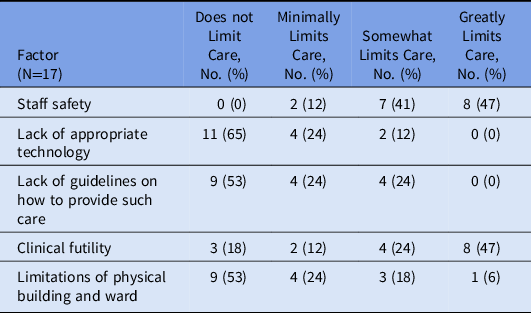
When deciding which critical care interventions to provide to a PUI, 88% stated that staff safety greatly or somewhat limited the care provided, and 71% stated the same for clinical futility. However, only 12% of participants felt that lack of appropriate technology, and only 24% of participants felt that lack of clinical guidelines and limitations of the physical building and ward greatly or somewhat limited care (Table 4).
Factors That Influence Institutional Decision to Provide Critical Care Interventions and Cardiopulmonary Resuscitation to a Person Under Investigation

Similar trends were observed regarding care provision to a VHF patient, with 88% stating that staff safety and 65% stating that clinical futility greatly or somewhat limited care. Only 12% felt that lack of appropriate technology, lack of guidelines for care provision, and limitations of the physical building or ward greatly or somewhat limited care (Table 5).
Factors That Influence Institutional Decision to Provide Critical Care and Cardiopulmonary Resuscitation to a Patient With Confirmed Viral Hemorrhagic Fever

Institutional responses regarding these factors were not significantly different when comparing those institutions that had previously cared for a PUI or a VHF with those that had not.
Innovations used to provide care
Institutions reported using innovations in 3 primary areas (ie, procedures, equipment, and training) when providing care to a PUI and a VHF. Two institutions increased their reliance on ultrasound to avoid transporting the patient for a CT or X-ray. Another included the proactive placement of peripherally inserted central catheter (PICC) lines for easy access blood draws. Innovations in equipment included enhanced communication systems (eg, Bluetooth stethoscopes) that can enable communication between providers inside the infectious area and those outside, as well as using halo foggers for room disinfection. Lastly, many institutions used simulation training as an innovative way to prepare their staff. Specific examples included training providers to don and doff PPE and then having them practice interventions requiring close patient contact, such as CPR, while wearing PPE.
Discussion
The study data suggest broad similarities among respondents in philosophy and policy, which highlights both trends in medical literature and shared knowledge among institutions, particularly in their association with NETEC.Reference Edelson8,Reference Murthy14,Reference Blais and White15 The fact that many institutional policies exist where only a handful of institutions have cared for a PUI or a VHF patient and the perceived readiness of institutions to provide interventions to either without prior experience also suggests sharing of best practices. However, while some degree of collaboration between institutions is apparent, there are nuances. All institutions providing policy details would provide RRT to a PUI or a VHF, but the circumstances varied. Some would only offer continuous veno-venous hemofiltration (CVVH) rather than hemodialysis (HD), which may be because the former produces less dialysate fluid and poses less of an infection risk.Reference Connor, Kraft and Mehta16 Furthermore, given the high infection risk, several institutions did not want to perform CPR in clinically futile situations.
Most institutions had formal policies for chest compressions and intubation/mechanical ventilation, which may be because these interventions are performed frequently and pose a high infection risk to HCWs.Reference Torabi-Parizi, Davey, Suffredini and Chertow17 Prior experience providing these interventions for a PUI or a VHF patient was minimal. Yet despite limited experience, most institutions felt ready to perform most interventions (except for ECMO and cricothyrotomy) to both a PUI and a VHF patient.
Staff safety and clinical futility were most important when respondents considered whether to offer an intervention. Factors that influenced HCW comfort level during the EVD epidemic included clarity of protocols, use of simulation training, confidence operating in PPE, and degree of media or staff scrutiny, all of which should be addressed in future efforts to improve care delivery.Reference Belfroid, Van Steenbergen and Timen18 Clinical futility was often brought up regarding chest compressions, pharmacological and electrical cardioversion, and defibrillation. Given that more efficacious treatments for at least Ebola Zaire disease have been developed, these interventions may not be viewed as futile in the future.Reference Mulangu, Dodd and Davey19 However, such consideration will remain for other VHFs, and they highlight the importance of identifying medical countermeasures for these diseases.
This study has several strengths. It is the first to survey healthcare institutions about their critical care experience with VHF patients. Our sample includes ETCs from almost all the DHHS regions and individuals that represent multiple types of healthcare professionals and institutional roles. This study also has several limitations. The sample size was small, which may be due to the small number of existing ETCs and the fact that this survey was distributed near the beginning of the COVID-19 pandemic. Selection bias may also have affected our results: those with more experience may have been eager to participate, whereas those with less experience may have opted out. Lastly, our sample includes responses from institutions with departments specialized to care for patients with VHF. Therefore, the generalizability of our findings to care centers without these capabilities is limited.
Although the survey’s timing may have limited participation, institutional responses may change after the COVID-19 pandemic. Ebola and SARS-CoV-2 are not the same pathogen, but their experience providing critical care to COVID-19 patients may make institutions more comfortable providing critical care to patients with other highly infectious pathogens and may lead to more formal critical care policies for these types of patients and settings. The respondents also cited many innovations that have been employed during COVID-19: greater reliance on ultrasound, proactive placement of PICC lines, and use of communications systems that can be worn under PPE.Reference Farrow, Becherer-Bailey, Mantuani and Nagdev20–Reference Gossen, Mehring and Gunnell23 Future studies could re-evaluate ETCs’ policies and readiness to provide critical care to patients with highly infectious pathogens after COVID-19, particularly in areas where there was less experience, such as ECMO and cricothyrotomy. This information will help ensure that the necessary policies and training are in place to prepare for future infectious disease outbreaks.
Acknowledgments
The authors thank Kathleen Baudin, Robert Canelli, MD, and Michael Ieong, MD, for their feedback on our study design.
Financial support
No financial support was provided relevant to this article.
Conflicts of interest
All authors report no conflicts of interest relevant to this article.