INTRODUCTION
Congestive heart failure (CHF) is a chronic and progressive syndrome resulting from impairment of the heart's ability to maintain normal blood circulation (McCall, Reference McCall, Stein, Hutton and Kohler1994). Common symptoms include difficult and painful breathing even during rest, fluid retention and swelling of the lower extremities, and general weakness and fatigue (American Heart Association, 2007). The progressive nature of CHF, with concomitant limitations in functioning, frequent hospitalizations, ever-present and increasing threat of mortality, and unremitting need for tightly controlled self-care, make living with CHF very difficult (Freedland & Carney, Reference Freedland and Carney2000).
Severity of CHF can be classified using the New York Heart Association (NYHA) Classification scheme, in which severity is rated from Class I, involving minimal limitations in activities, to Class IV, involving confinement to rest and discomfort and symptoms even at rest. Advanced CHF (typically defined as NYHA Classifications III/IV; Jaagosild et al., Reference Jaagosild, Dawson and Thomas1998) has very high mortality rates, estimated at up to 30%–40% annually (Levenson et al., Reference Levenson, McCarthy and Lynne2000; American Heart Association, 2007). The course of CHF is highly variable and notoriously difficult to predict, with most patients having periods of acute symptom exacerbations interspersed with periods of relatively good functioning; death often comes suddenly and with little warning. Thus, CHF typically does not have a distinct terminal phase, and patients and their health providers live with a great deal of prognostic uncertainty (Gottlieb, Reference Gottlieb2003).
The trajectory of advanced CHF, therefore, is very different than that of the illnesses on which most end-of-life research is based, and many questions remain about how patients with this uncertain prognosis face end-of-life issues. Research to date indicates that very little attention is given to these issues in treating CHF patients (e.g., Gibbs et al., Reference Gibbs, McCoy and Gibbs2002). Recently, health care providers and health and policy researchers have begun to urge the implementation of a model of supportive or palliative care in the context of CHF (Goodlin et al., Reference Goodlin, Hauptman and Arnold2004; Hauptman & Havranek, Reference Hauptman and Havranek2005). The present study explored issues regarding patients' perceptions of their remaining life span and examined whether their spirituality was related to changes in estimated longevity over time.
Estimations of Longevity
Little is known about advanced CHF patients' perceptions of their mortality or how those perceptions correspond to clinical or functional indicators. Given the high mortality rate of advanced CHF, it is important to know whether these patients have realistic perceptions of their likely survival. Holding realistic expectations regarding prognosis is related to engagement in activities helpful to patients potentially facing the end of their lives (Levenson et al., Reference Levenson, McCarthy and Lynne2000), such as having conversations with their physicians and their family regarding treatment decision making and planning, completing advance directives, and making financial arrangements. Conversely, unrealistic expectations may curtail opportunities to engage in such conversations and planning (Gibbs et al., Reference Gibbs, McCoy and Gibbs2002). Further, it is not known how CHF patients arrive at estimates of their survival; such perceptions may be based on the same types of clinical indicators used in prognostic studies of survivorship, such as physical capacity and functioning, or these estimates may be based on subjective indicators such as their quality of life. It is also not clear whether these estimates change over time or with changes in clinical or subjective indicators. In addition, it is not known whether patients' expectations of their longevity affect their psychological well-being. Given that CHF patients have little objective information about their prognosis, their perceptions may be an important determinant of their emotional adjustment.
Spirituality and Perceptions of Approaching End of Life
Spiritual issues are very important to many individuals as they approach the end of their lives (Pulchaski et al., Reference Pulchaski, Dorff and Hendi2004). As Sulmasy (Reference Sulmasy2002) noted, “Broadly construed, spiritual issues arise naturally in the dying process. In a sense, these are the obvious questions—about meaning, value, and relationship. No matter what the patient's spiritual history, dying raises for the patient questions about the value and meaning of his or her life, suffering, and death” (p. 26). A recent review of qualitative research described the variety of spiritual issues that are salient at the end of life (Williams, Reference Williams2006), ranging along a “spectrum” from spiritual despair (alienation, struggle) to spiritual work (e.g., forgiveness, self-exploration) to spiritual well-being (e.g., connection, self-actualization). This tripartite framework is a useful way of conceptualizing spiritual concerns for individuals who may be facing the end of their lives. Positive and comforting aspects of spirituality are often present (Pulchaski et al., Reference Pulchaski, Dorff and Hendi2004). However, many people also experience significant spiritual struggle and distress as they approach the end of their lives (Kaut, Reference Kaut2002; Koenig, Reference Koenig2002). Further, the tasks of dying often include making peace in one's relationship with God and with others and readying oneself for the life to come, such as forgiving others and receiving forgiveness (Koenig, Reference Koenig2002). The small number of studies specifically examining spiritual issues in advanced CHF, although rare, have also documented expressions of strong interest in issues of spirituality, transcendence, and meaning by most of these patients (e.g., Murray et al., Reference Murray, Kendall and Boyd2004; Bosworth et al., Reference Bosworth, Steinhauser and Orr2004) as well as the presence of spiritual struggle (Fitchett et al., Reference Fitchett, Murphy and Kim2004).
Although the importance of spirituality in life-limiting illness is well documented, less is known about how spirituality changes as people perceive the approaching end of their lives. People tend to turn to religion or spirituality when facing crises (Pargament, Reference Pargament1997) and often report increases in their spirituality, such as closeness to God and deepened faith, following highly stressful events such as cancer (e.g., Hamrick & Diefenbach, Reference Hamrick and Diefenbach2006). It is also a widely held notion that people are particularly likely to become more religious or spiritual when experiencing threats to their mortality (Sulmasy, Reference Sulmasy2002); such effects have been documented experimentally by, for example, asking college students to imagine their deaths or exposing them to death-related images (e.g., Jonas & Fischer, Reference Jonas and Fischer2006). However, little research has investigated whether those actually facing life-threatening or terminal illness experience changes in their spiritual lives. One cross-sectional study of terminal cancer patients reported higher levels of religious practices among patients who were aware that their life expectancy was less than 6 months long compared to a sample of patients who were not aware (Sodestrom & Martinson, Reference Sodestrom and Martinson1987), although spirituality was not repeatedly assessed. Several longitudinal studies conducted in hospice have examined spiritual shifts. One study of terminal cancer patients found that faith and spiritual values increased over time (Hinton, Reference Hinton1999), but another found little evidence for spiritual change (Bretscher et al., Reference Bretscher, Rummans and Sloan1999). However, none of these studies assessed spirituality as a multidimensional construct with positive and negative aspects. The present study examined whether and how different dimensions of spirituality relate to estimates of longevity and changes in those estimates across time.
The Present Study
The present study examined issues of estimated longevity and changes in spirituality in a sample of advanced CHF patients. Specifically, three questions were asked: (1) How do advanced CHF patients' perceive their longevity? This issue was addressed by asking participants to estimate their longevity and examining whether these estimates corresponded to a variety of functional and subjective indicators. (2) How do perceptions of longevity change over time? This question was answered by examining change in longevity estimates across the assessment periods. (3) Do changes in perceptions of longevity correspond to changes in spirituality over time? This issue was addressed by examining relations between longevity estimates and measures of the dimensions of spirituality noted to be important at the end of life. Three dimensions were assessed: spiritual despair (spiritual struggle), spiritual work (forgiveness), and spiritual comfort (daily spiritual experiences and religious meaning in life) (Williams, Reference Williams2006).
METHOD
Participants
The participants were 111 patients (67 men, 44 women; 39% African-American, 5% Native American, 56% Caucasian; 10% of participants were of Latino ethnicity) with severe CHF (NYHA Classification Level III and IV) who were ineligible for transplantation. Mean length of CHF diagnosis was 6.5 years (SD = 5.6 years). Sixty-one percent of participants were married, 19% were widowed, 14% were divorced, and 6% were single. Income and education ranged widely: annual household income ranged from under $10,000 (15%) to over $50,000 (15%), and education level ranged from “some high school” (20%) and “high school diploma” (33%) to “some college” (31%), “college degree” (10%), and “graduate degree” (6%).
Procedure
Participants were recruited from a large regional cardiology practice in Cincinnati, Ohio. Participants were assessed twice, separated by 6 months. At both times, assessment consisted of questionnaires and a small number of open-ended questions as well as administration of the Six-Minute Walk Test (described below). The study was conducted with the approval and oversight of the University of Connecticut Institutional Review Board.
Measures
Demographics
Participants reported on their gender, age, education/income, other medical conditions, and religious affiliation.
Dimensions of Spirituality
Three subscales of the Fetzer/NIA Brief Measure of Religion/Spirituality (Fetzer Institute/National Institute on Aging Working Group, 1999) were assessed. These included (1) the Forgiveness subscale, consisting of three questions assessing forgiveness (of self, of others, by God); e.g., I have forgiven myself for things that I have done wrong). Forgiveness items were rated from 1 (never) to 4 (always or almost always); (2) the two item Religious Meaning subscale (e.g., I have a sense of mission or calling in my own life), rated from 1 (strongly disagree) to 4 (strongly agree); and (3) the Daily Spiritual Experience subscale, which assesses the individual's perceptions of the transcendent (God, the divine) in daily life (e.g., I feel God's presence) rated from 1 (never or almost never) to 6 (many times a day). Internal consistency reliability for these three Fetzer/NIA scales in the present sample were .74, .68, and .61, respectively. In addition, Spiritual Struggle was assessed with the brief version of the Spiritual Struggle scale (Exline, Yali, & Sanderson, Reference Exline, Yali and Sanderson2000). Participants rated their agreement with six items (e.g., “see God's actions as unfair,” “feel that God has let you down” from 0 (not at all) to 10 (extremely). Internal consistency reliability in the present sample was .84.
Longevity Estimate
Patients' subjective longevity estimate was assessed with an item adapted from Sulmasy et al. (Reference Sulmasy, Terry and Weisman1998). Participants were asked, “How long do you think that you are going to live?” and selected a rating on a scale from 1 (don't know) to 8 (more than 10 years). On this scale, the increments on the response scale increase as it extends into the future (e.g., 2 = less than 3 months, 3 = 3–6 months, 4 = 6–11 months, 5 = 1–2 years, 6 = 3–4 years, 7 = 5–10 years). This scale was designed to assess patients' sense of nearness to death without causing undue distress; thus, a “don't know” response is included, although based on the scale properties, it clearly indicates a sense of less rather than more time, and a shift toward lower numbers indicates movement toward less time as well as increased uncertainty. This scale has been used successfully in research with patients facing terminal illness (Sulmasy et al., Reference Sulmasy, Terry and Weisman1998). Importantly, in this study, a change variable was calculated to examine shifts in estimated longevity over time by subtracting the score at Time 1 from the score at Time 2, yielding a difference score such that a negative score indicates change toward less time or toward uncertainty from baseline (Time 1) to follow-up (Time 2).
Clinical and Subjective Functioning and Psychological Adjustment
A broad array of well-being indices were used. These included clinical outcomes, subjective quality-of-life (QOL) assessments, and psychological adjustment indices.
Clinical indices included ejection fraction, a measure of the effectiveness of the heart's pumping ability, documented in patients' charts, and the Six-Minute Walk Test (Zugck et al., Reference Zugck, Kruger and Kell2001), a standardized assessment of how far patients can walk in 6 minutes. Both of these variables have been related to functional abilities and to quality of life (Heo et al., Reference Heo, Moser and Riegel2005; Zugck et al., Reference Zugck, Kruger and Kell2001).
Subjective functioning indices included two indicators of quality of life, the Minnesota Living with Heart Failure Scale (MLWHF; Rector et al., Reference Rector, Francis and Cohn1987) and the SF-12 (Ware & Kosinski, Reference Ware and Kosinski2001). The MLWHF is a widely used CHF-specific QOL measure that asks patients to rate the extent to which each of 21 symptoms of CHF (e.g., making your sleeping well at night difficult) prevented them from living their life as they wanted in the past month, rated from 0 (not at all) to 5 (very much). Internal consistency reliability in the present sample was .88 The SF-12 assessed two dimensions of QOL. A physical component was assessed with the four physical health subscales (general health, pain, physical functioning, and role interference due to physical health). Mental quality of life was assessed with the four mental health subscales (social functioning, vitality, emotional well-being, and role interference due to emotional health). The various items on the SF-12 are rated on different scales (e.g., yes-no, not at all to very much) and an algorithm generated a mean score for each component. Internal consistency reliability in the present sample was .82 and .87, respectively.
Psychological adjustment was assessed in terms of depressive symptoms and life satisfaction. Depressive symptoms were assessed with the 20-item CESD (Radloff, Reference Radloff1977), a widely used measure of depressive symptoms in which participants rate the frequency with which they experienced each of 20 symptoms of depression over the past week from 0 (rarely or none of the time [“Less than 1 day”]) to 3 (most or all of the time (“5–7 days”)). Internal consistency reliability in the present sample was .91. Satisfaction with life was assessed with the five-item Satisfaction with Life Scale (Diener et al., Reference Diener, Emmons and Larsen1985), in which participants rate each of five items regarding their lives (e.g., “I am satisfied with my life,” rated from 7 (strongly agree) to 1 (strongly disagree). Internal consistency reliability in the present sample was .89.
RESULTS
Attrition
Across the 6 months from baseline (Time 1) to follow-up (Time 2), 26 participants were lost to the study. The study ended before all participants could be contacted for their second assessment, resulting in the loss of 13 participants. In addition, 5 participants died, 5 participants reported being too ill to participate, and 3 were lost due to relocation or other reasons. To determine whether there were systematic differences between participants who completed the study and those who did not, t tests were conducted on all study variables. Results indicated no significant differences (all ps > .10).
Descriptions of Longevity Estimates
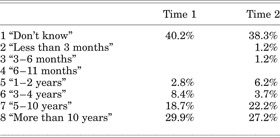
Table 1 presents the percentage of patients at each level of perceived longevity at both assessments. The mean on the scale did not differ from Time 1 to Time 2 (Xs = 4.96 and 4.65, respectively, p > .20). Calculated change scores on this variable also indicated a fair amount of stability: 68.4% did not change across 6 months, whereas approximately one sixth increased their estimation (increments of +1, 7.6%; +2, 1.3%, +4, 1.3%, and +6, 3.8%) and one sixth decreased their estimation (increments of −2, 1.3%; −5, 2.5%; −6, 5.1%, and −7, 2.5%).
Participants' estimates of their lifespan at Time 1 and Time 2

Relations of Perceptions of Longevity to Clinical and Functional Outcomes and to Psychological Adjustment
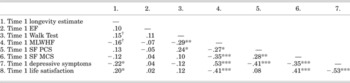
Relations of patients' Time 1 longevity estimate with their scores on measures of functional outcomes and psychological adjustment were examined by way of bivariate correlational analysis. Results, presented in Table 2, indicated that although many of the clinical and functional outcomes were related to one another, none was significantly related to perceptions of longevity (with the marginally significant exceptions of the Minnesota Living With Heart Failures Scale score and the Six-Minute Walk Test). However, perceived longevity was related to both measure of psychological adjustment.
Bivariate correlational analyses of Time 1 longevity estimates and clinical and functional indices and psychological adjustment

Note: †p < .10, *p < .05, **p < .01, ***p < .001.
Spirituality and Spiritual Change
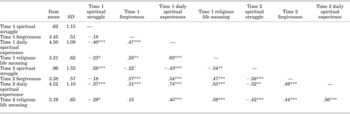
Table 3 lists mean levels, standard deviations, and ranges of each of the four spirituality measures at Time 1 and Time 2 as well as intercorrelations among them. Paired t tests on each spiritual variable indicated that only one dimension of spirituality reliably changed across the 6-month period, spiritual struggle, which increased significantly (p < .01).
Descriptive and bivariate correlational analysis of Time 1 and Time 2 spirituality dimensions

Note: †p < .10, *p < .05, **p < .01, ***p < .001.
Do Changes in Perceptions of Longevity Predict Changes in Spirituality?
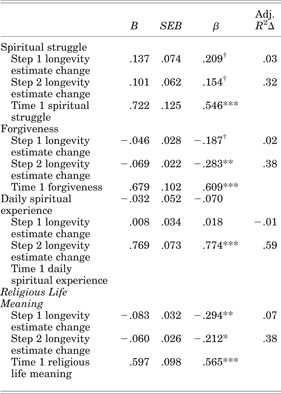
Finally, to assess how changes in perceptions of longevity predicted changes in spirituality over time, a series of four regression analyses were conducted, one for each of the spirituality dimensions. These regression analyses allowed examination not only of longitudinal effects of changes in perceptions of longevity on dimensions of spirituality, but also prospective effects (i.e., controlling for Time 1 levels of each measure of spirituality, in effect predicting change in spirituality). The first step was the Time 1 − Time 2 change in longevity estimate, and the second step was the initial level of that dimension of spirituality.
The hierarchical regression analysis for Time 2 spiritual struggle indicated that longevity estimate was marginally significantly predictive, F(1, 77) = 3.46, p < .10; when the second step, Time 1 spiritual struggle, was added, the model was significantly predictive, F(2, 76) = 19.22, p < .001. The hierarchical regression analysis for Time 2 forgiveness indicated that longevity estimate was marginally predictive, F(1, 77) = 2.72, p < .10, but after adding the second step, Time 1 forgiveness, the model was significantly predictive, F(2, 76) = 24.27, p < .001. The hierarchical regression analysis for Time 2 daily spiritual experience indicated that longevity estimate was not predictive, F(1, 77) = .38, ns, but the model became significantly predictive after adding the second step, Time 1 daily spiritual experience, F(2, 76) = 56.12, p < .001. Results of these regression analyses are presented in Table 4. Finally, the hierarchical regression analysis for Time 2 religious life meaning indicated that longevity estimate was predictive, F(1, 77) = 6.79, p < .01, and after adding the second step, Time 1 religious life meaning, the model remained significantly predictive, F(2, 76) = 23.58, p < .001.
Hierarchical multiple regression analyses of longevity estimates and spirituality dimensions

Note: †p < .10, *p < .05, **p < .01, ***p < .001.
DISCUSSION
This study examined several questions regarding estimated longevity and corresponding changes in spirituality, and the results are quite illuminating, albeit preliminary. The questions addressed in this study were exploratory and were posed in an attempt to open up these issues to investigation; the current results highlight potentially important directions for future study.
The first question asked how advanced CHF patients perceive their longevity and the second asked whether these estimates change over time. Participants were asked to estimate their longevity at two time points, 6 months apart. Although many participants did not answer the question with a specific time estimate, a surprisingly high 50% estimated their longevity as at least 5 years. Further, patients' estimates changed little across 6 months, and of those who changed, nearly equal numbers adjusted their estimates in higher and in lower directions. Many of these CHF patients were likely overestimating their longevity, given that the annual mortality rate of NYHA Class III and IV CHF patients is estimated at 30% or more (American Heart Association, 2007). A supplemental analysis examining the Time 1 longevity estimates of the five patients who had died by the Time 2 assessment revealed that one had reported “don't know,” whereas three had estimated “5–10 years” and one “10 or more years.”
Perhaps this tendency for optimistic estimates reflects a hopefulness that sustains CHF patients through the chronic suffering involved in living with this illness. However, these estimates also likely reflect a lack of information about their disease and prognosis. Qualitative studies of advanced CHF patients report that they desire more information regarding their condition, including prognosis and treatment options. There is a clear desire on the part of many advanced CHF patients to discuss with their health care providers their treatment preferences as well as living wills and advance directives that encompass a variety of contingencies throughout the course of CHF, with ongoing opportunities to revisit these issues as the patient's clinical status changes (Hauptman & Havranek, Reference Hauptman and Havranek2005). Patients also express a desire for opportunities to discuss their concerns about their families' future (Murray et al., Reference Murray, Boyd and Kendall2002; Bosworth et al., Reference Bosworth, Steinhauser and Orr2004). A lack of awareness of their prognosis and other relevant information about their illness may keep seriously ill CHF patients from opportunities to have these important discussions, developing advance directives, and dealing with important end-of-life personal and social issues (Gibbs et al., Reference Gibbs, McCoy and Gibbs2002; Hanratty et al., Reference Hanratty, Hibbert and Mair2002).
At this point, it is not clear how patients arrive at their longevity estimates. In this study, estimates were very modestly, if at all, tied to any of the clinical or functional indicators of health assessed. Although there was a trend for patients feeling more bothered by their symptoms or being less able to walk estimating that they had less time left, longevity estimates appeared to be more closely related to their psychological adjustment. Some patients may get information, either formally or informally, about their prognosis from their health care providers or others or may pick up clues from their own functioning or feelings. It is important to understand more about the types of external and internal cues on which patients base their estimates and how closely their estimates correspond with any prognostic information provided as well as the accuracy of these estimates (Sulmasy et al., Reference Sulmasy, Terry and Weisman1998).
The third question asked in this study was how changes in the spirituality of advanced CHF patients corresponded with their estimates of longevity and changes in those estimates over time. Previous research has demonstrated that people report increased levels of spirituality as they perceive the approach of death (e.g., Hinton, Reference Hinton1999), although results are inconsistent (e.g., Bretscher et al., Reference Bretscher, Rummans and Sloan1999). The present study built on this previous work by examining a broader range of spiritual dimensions and assessing actual change over time rather than retrospective reports. Although patients evinced, in general, constancy in their longevity estimates as well as their mean levels of spirituality, results indicated that changes in longevity estimates were indeed related to changes in spirituality in some expected ways, although the effects were not strong. In particular, shifting estimates toward less time or toward uncertainty was related to increases in religious life meaning and forgiveness over the 6-month interval. Thus, those who perceived their deaths nearing did indeed increase their spiritual work in terms of forgiveness as well as their perceptions of a meaningful religious life. This increased spirituality may be due to a feeling of increased urgency to get their spiritual affairs in order (Hamrick & Diefenbach, Reference Hamrick and Diefenbach2006). It is not clear why effects were not found for daily spiritual experience (cf. Hamrick & Diefenbach, Reference Hamrick and Diefenbach2006).
In addition, shifting longevity estimates toward less time or toward uncertainty was marginally related to lessening of spiritual struggle. This is the first time that this question has been prospectively addressed. Spiritual struggle is generally related to poorer health as well as higher levels of distress and depression (see Exline & Rose, Reference Exline, Rose, Paloutzian and Park2005, for a review); those perceiving an increasing urgency to prepare spiritually for the end of their lives may be compelled to seek out the positive elements of their spirituality and to let go of the more emotionally upsetting aspects. Alternately, it is possible that experiencing decreases in one's spiritual struggle allowed individuals to become more comfortable acknowledging uncertainty and the possible life-limiting aspects of their illness. It is not clear how some individuals in this study managed to reduce their spiritual struggle; perhaps they sought out the spiritual guidance of their clergy or others with whom they shared faith, an aspect of spiritual life not assessed in the current study. Because spiritual struggle is so pernicious in its effects, understanding more about how very seriously ill patients let go of their struggles could prove to be quite valuable in helping patients make spiritual peace (Exline & Rose, Reference Exline, Rose, Paloutzian and Park2005). It is notable that these effects occurred in the context of a general shift in the sample toward increased spiritual struggle over time.
Although these results are intriguing and warrant follow-up, the limitations of the study render them tentative. In particular, the measure of estimated longevity used in this study was designed to ease anxiety in administration by providing a “don't know” option (Sulmasy et al., Reference Sulmasy, Terry and Weisman1998). However, this option apparently limited the number of people who actually selected a specific time estimation at either assessment point. Although the measure is still scored on a 1–8-point scale, providing a continuous variable, it would be useful, in future research, to use a measure that provides more specific estimations. For example, in the SUPPORT study (Levenson et al., Reference Levenson, McCarthy and Lynne2000), participants were asked to provide percentage estimates that they would be alive for a number of different time frames. A further limitation of the present study was the curtailed ability to assess the issue of changes in spirituality corresponding to changes in longevity estimates, given that so few participants changed their longevity estimates over time. In addition, although the sample size was adequate for exploratory purposes, larger samples in future research will allow for the testing of more sophisticated models of interrelationships among variables. Further, the present study focused on individuals with a highly variable illness trajectory, and it remains to be seen how well these findings generalize to individuals with other life-threatening illnesses with different prognostic patterns.
In spite of these limitations, the present results illuminate the issues of longevity estimates and corresponding changes in spirituality in important ways and should lead to a number of further investigations, both into the nature and functioning of longevity estimates in the well-being and end-of-life preparations of seriously ill patients (Goodlin et al., Reference Goodlin, Hauptman and Arnold2004) and into the ways that different aspects of spirituality correspond to these longevity estimates (Hamrick & Diefenbach, Reference Hamrick and Diefenbach2006). Better understanding of these issues should lead to enhanced provision of effective supportive care in the context of the uncertainty and difficulties of CHF and other life-limiting illnesses.
ACKNOWLEDGMENTS
This research was generously supported by a grant from the Fetzer Institute. I am grateful to Dr. D.P. Suresh, Debbie Bliss, Juliane R. Fenster, Donald Edmondson, Jennifer Wortman, and Keith Ayotte for their assistance with this project.