In large metropolitan areas such as Los Angeles, the impact and response to natural disasters across communities is not necessarily equal.Reference McMichael, Montgomery and Costello 1 , 2 As an example, in November 2003, Watts and its surrounding communities were inundated with severe flooding 3 , Reference Broder 4 with widespread property damage, including the homes of public housing residents.Reference Broder 4 , 5 As a result, Los Angeles County (LA County) declared a state of emergency in South Los Angeles (South LA), which enabled affected homeowners to apply for governmental assistance, albeit with long delays. 5 , Reference Garrison 6
People with lower socioeconomic status (SES) and children are among the most vulnerable populations in disaster and emergency situations.Reference Belkhir and Charlemaine 7 - Reference Elliott and Pais 9 Children, including teens, represent 50% to 60% of people affected by disasters. 10 Youth within the Watts community in South LA are particularly at increased risk for harm during emergency situations or disasters owing to a lack of emergency preparedness training, but also due to high rates of gun and drug-related crimes, incarceration, poverty, truancy, and low educational attainment. 11
The aforementioned factors make the Watts community unprepared to respond to and recover from a variety of disasters. As a response to this need, the South LA Teen CERT Collaborative was formed in 2012 to help the community become more resilient in the face of a disaster.
HISTORY AND DEVELOPMENT OF COMMUNITY EMERGENCY RESPONSE TEAMS
The CERT program, developed in 1985 by the Los Angeles Fire Department (LAFD), was intended initially for adults only to ensure that communities throughout the nation would be prepared to respond to and recover from a variety of emergency situations and natural or man-made disasters.Reference Lichterman 12 - 14 The Federal Emergency Management Agency (FEMA) adopted the CERT model and developed standardized training materials to facilitate training programs beginning in 1993.Reference Brennan and Flint 15 , 16
Although the teen CERT program was previously implemented elsewhere, the novel approach of this project constituted involving high-risk youth from low-SES communities into CERT with the addition of cardiopulmonary resuscitation (CPR)/first aid training. The implementation of teen CERT training in Watts had a two-pronged beneficial effect: (1) creating a team of well-trained community members to deal with natural disasters and other emergencies (violent crimes or medical emergencies) until professional staff arrives, and (2) engaging high-risk teens as community leaders, which in turn would build their self-confidence and hopefully reduce the probability of them getting involved in gangs or committing crimes.
Goals and Objectives
This project aligned with the goals of the National Strategy for Youth Preparedness Education: Empowering, Educating and Building Resilience to educate youth about actions that they and their families can take to protect their safety and well-being. 17 Similarly, Goal 5 of LA County Department of Public Health (DPH) Strategic Plan’s Priority 1, Healthy & Safe Community Environments, strives to “improve the ability of communities to withstand and quickly recover from emergencies” and to “implement community resilience building activities with diverse community agencies.” 18
The goal of this project was to increase community resilience and preparedness to respond to and recover from a disaster or emergency situations. The objectives included (1) bringing a new visibility to CERT in the area through partnerships with businesses, governmental agencies, and nongovernmental organizations; (2) creating a team of trained community members who are prepared to deal with disasters; and (3) organizing a high-risk teen CERT in the Watts community as a skills development and potential career opportunity, which may reduce high-risk behavior (eg, getting involved in gangs or crimes). Expected outcomes of the project were as follows: (1) the planning and development of a teen CERT program for Watts community youth by February 2013; (2) increasing community resilience awareness in the Watts community through the development of partnerships with businesses, elected officials, and faith and community-based organizations by April 2013; and (3) implementing teen CERT training with high-risk youth from 4 housing developments in Watts by June 2013.
The purpose of this article was to describe how a CERT training project with an added CPR/first aid component was used to involve high-risk teens from low-SES communities into building a team of trained community members and a more resilient community; a project that was never done before, to the best of our knowledge.
CERT TRAINING PROGRAM IN WATTS
CERT Training Program Development
The CERT training program was developed and initially implemented for high-risk teens from 4 housing developments in Watts: Gonzaque Village, Imperial Courts, Nickerson Gardens, and Jordan Downs. It was a classroom-based program with a curriculum that provided students with knowledge on the effects of natural and human-made disasters, as well as the emotional, physiological, social, and economic impact of disasters in the community. The program incorporated decision-making and problem-solving skills to help students make informed decisions regarding readiness, response and recovery, and mitigation efforts to reduce loss of life and property during a disaster.
The Watts CERT curriculum was based on the National CERT Program, with adjustments to focus more on self, family, and school through more targeted examples and exercises. 19 The curriculum consisted of 7 classes: (1) CERT Introduction, Earthquake Awareness; (2) Disaster Fire Suppression Techniques; (3) Disaster Medical Operations 1; (4) Disaster Medical Operations 2, and Multi-Casualty Incident; (5) Light Search and Rescue Operations; (6) Team Organization & Disaster Psychology; and (7) Terrorism & Homeland Defense.
LAFD firefighters led the 9-week training that included 25 hours: basic emergency preparedness training and health hazard assessment prioritization (1.5 hours), CERT training (17.5 hours), and CPR/first aid training (6 hours). Two public health nurses from Service Planning Area 6 of the LA County DPH planned, coordinated, and managed the CERT training program, including recruitment, program logistics, and preparation of graduation ceremonies.
The White House Office of Faith-based and Neighborhood Partnerships, along with FEMA, provided expertise and technical assistance in both building bridges between the federal government and nonprofit organizations as well as building resilient communities with engagement of faith and community-based organizations. The Watts Gang Task Force/Watts Community Resilience Coalition collaborated with their partners in developing CERT-trained cohorts in the community of Watts by recruiting participants for CERT training and by sponsoring some parts of the project. LAFD personnel participated in the planning and development and served as lead instructors for the CERT training. Staff from the City of Carson Emergency Management assisted with the planning, preparation, and conducting of simulation exercises. Staff from the American Red Cross (LA region) and from CPR Center Plus organizations facilitated CPR/first aid training. The American Red Cross also participated in simulation exercises.
The planning and development of CERT training for high-risk teens in the Watts community was completed in February 2013 (expected outcome 1).
CERT Training Program Implementation
Twenty-seven teen participants were recruited for CERT training in the first cohort by going from one housing development to another with help of the Watts Gang Task Force/Watts Community Resilience Coalition. To improve recruitment, refreshments, meals, emergency preparedness supplies and kits, backpacks, and training materials were provided to participants in addition to transportation to and from the training sessions.
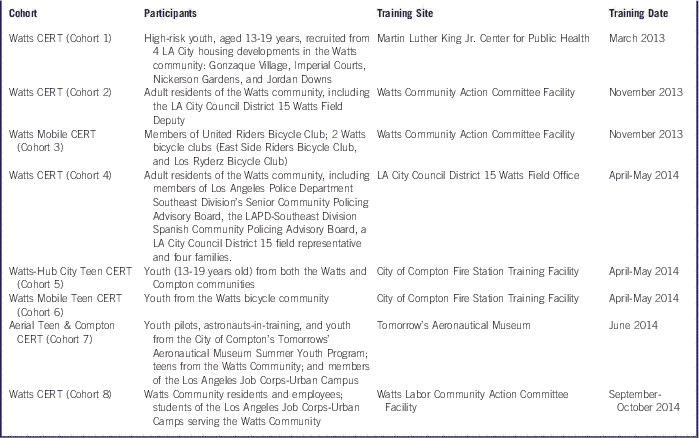
After the success of cohort 1, in which all participants completed training and received certificates in April 2013 (expected outcome 3), 7 more cohorts were recruited for training (November 2013–October 2014). Details about the cohorts are presented in Table 1.
Characteristics of 8 Cohorts Receiving CERT and CPR/First Aid Training: CERT Training in the Community of Watts Study, March 2013–October 2014Footnote a

a Abbreviations: CERT, Community Emergency Response Team; CPR, cardiopulmonary resuscitation.
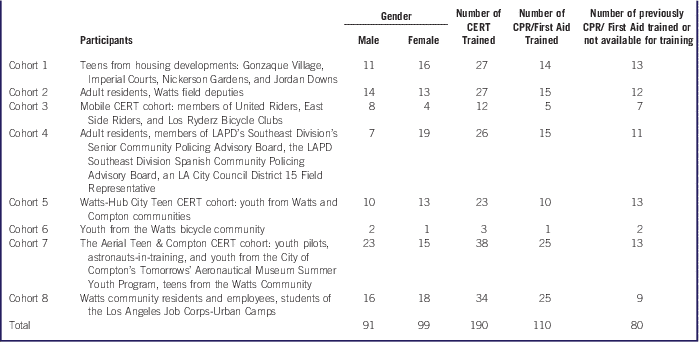
One hundred ninety adults and teens participated in CERT training. A subset of participants received CPR/first aid training. Participants who did not receive this training were either already CPR/first aid-certified or were not available for training at the time. Detailed information is shown in Table 2.
Selected Demographic Characteristics and Number of Participants Receiving CERT and CPR/First Aid Training by Cohort: CERT Training in the Community of Watts Study, March 2013–October 2014Footnote a

a Abbreviations: CERT, Community Emergency Response Team; CPR, cardiopulmonary resuscitation; LAPD, Los Angeles Police Department.
Using Homeland Security Exercise and Evaluation Program Guidelines, 20 the evaluation of participants was performed in the following ways:
-
∙ A verbal quiz at the end of each module with incentives given for correct answers,
-
∙ Return demonstrations for tactical modules such as bandaging and splinting and fire extinguishing,
-
∙ Critical thinking scenarios for triage and medical rescue modules,
-
∙ Simulation exercises at the end of each training module in which students were able to apply learned content,
-
∙ CPR/first aid exams and simulation exercises, and
-
∙ Re-engagement of previous cohorts through current simulation exercises or refresher courses (eg, Mobile CERT participated in all simulation exercises that involved different scenarios).
In addition, on graduation day, participants demonstrated their learned skills, such as team organization, fire suppression, disaster medical operations (assistance to those who are injured, set up of treatment areas, etc), light search and rescue, identification and anticipation of hazards, disaster psychology and survivor stress reduction, and basic first aid during simulation exercises.
The training was well received by participants and by community members, as evidenced by their feedback. Jose, a participant in the first CERT cohort in March 2013 said, “CERT program training means to me a second chance of life, knowledge, teams making difference in time of disaster, planning for disaster and to think before it happens, so you can be ready…to have the ability to help yourself or someone else.” Marvinette, another participant of the first CERT cohort, believed that the CERT training taught her many useful things that could be used in case of a disaster and even during emergency situations at work or at home. Another participant of the training, Raid, stated: “Teen CERT is great. The training helps us learn skills and info that can be useful in many hazardous situations. I like knowing I can help people when disaster happens. People know I am trained and count on me to know what I am doing....I like that.” Another participant, Erik, thought that the training created a fun and educational environment in the community and that every person in California could benefit from learning how to respond and be prepared in the event of emergency. Many community members and leaders shared the thought that in a community where many youth fight the statistical odds just to survive, this program provided them with a vision of hope for them and their community.
LESSONS LEARNED
As a result of this project, 8 cohorts comprising Watts community members were CERT-trained and certified. The novel approach of involving high-risk teens in CERT training was successful: half of the cohorts trained included teen participants. In addition to CERT training, most participants also received CPR and basic first aid training.
The CERT training showed potential not only for disaster response, but also as a tool for building community capacity and self-sufficiency. Governmental and nongovernmental organizations provided support that enabled a diverse group of people to work together in dealing with important challenges affecting their communities.Reference Flint and Brennan 21 This initiative increased CERT visibility in the entire South LA area. New partnerships were developed between governmental, nongovernmental, and community-based organizations, eg, Urban Compass, Residents Advisory Council, and LA Police Department Rampart Division’s Community Relations Department to name a few, thereby creating a more resilient and prepared community that could better respond to minimize the loss or damage to life, property, and the environment when an actual emergency occurs (expected outcome 2).
Several challenges were encountered during the planning, development, organization, implementation, and evaluation of the project. To improve recruitment and increase motivation to participate, several strategies were employed, including organized community partner meetings and outreach events, e-mail mailing lists, network events with community partners, community service fulfillment, and providing material incentives such as emergency preparedness kits and backpacks. Concerns about safe and reliable transportation for participants to and from the sessions were addressed by leveraging the resources of youth-serving organizations (LAPD Southeast Division Cadet Program) to transport youth participants. The financial and economic burden for providing refreshments, meals, emergency preparedness supplies, kits, backpacks, and training materials was remediated by securing commitments from sponsor organizations. Finally, training sessions were scheduled to accommodate the needs of participants, trainers, and supporters by creating a flexible delivery model based on the needs of each cohort population.
Despite the challenges, the CERT training proved to be very successful in Watts; the training added 190 CERT-trained members to the community and strengthened communication and ties between governmental agencies, nongovernmental organizations, community groups, and leaders.
This project received national recognition from the White House and was awarded the Third Annual John D. Solomon Whole Community Preparedness Award, the highest national award given for preparedness.
Future Steps
Several governmental and nongovernmental organizations recommended continuing support and training for CERT in the Watts community and promoting it to other community groups, such as high-risk teens from other housing developments and DPH workforce and nursing staff. To achieve sustainable results, CERT-trained teens and other trainees need continuous assistance and engagement, refresher courses for skills enhancement, CERT competitions and simulation exercises, disaster drills, and exercises. Successfully trained CERT individuals also need to be able to address safety issues at school and work, to provide education and mentor training to their peers and other people in community, and to assist in preparedness outreach.
Acknowledgments
We acknowledge and thank Elizabeth Friedman; Guili Zheng; Nirvi Shah; LA County Department of Public Health, Office of Health Assessment and Epidemiology; LA County Department of Public Health, Community Health Services (CHS); Los Angeles City Council District 15; Watts Labor Community Action Committee; Job Corps; Compton Fire Department; Tomorrow’s Aeronautical Museum; 7-Eleven; and the American Red Cross of Greater Los Angeles for their organizational help, sponsorship, and support with the project.