INTRODUCTION
The Sea of Marmara is connected to the Black Sea and the Aegean Sea through straits, a semi-enclosed basin (surface area 11, 111 km2, maximum depth 1273 m) (Gazioğlu et al., Reference Gazioğlu, Gökaşan, Algan, Yücel, Tok and Doğan2002). The Sea of Marmara has two distinctly different water masses; the upper layer (from the surface to approximately 25 m), has brackish water (22–26 psu) originated from the Black Sea with a mean residence time of about 4–5 months, and the lower layer has subhalocline water (38.5–38.6 psu) originated from the Mediterranean Sea (Ünlüata et al., Reference Ünlüata, Oğuz, Latif, Özsoy and Pratt1990; Beşiktepe et al., Reference Beşiktepe, Sur, Özsoy, Latif, Oğuz and Ünlüata1994). The salinity or temperature of the Mediterranean originated water does not show a seasonal variation but the Black Sea originated water displays seasonal fluctuation (Sur et al., Reference Sur, Okuş, Yüksek, Uysal and Taş2001). The hydrography of the upper layer is strongly associated with the Black Sea inflow, affecting the chemistry of the basin greatly (Polat & Tugrul, Reference Polat and Tugrul1995). Although strong pycnocline inhibits mixing between layers, particularly in winter considerable mixing occurs due to wind stirring (Anderson & Carmack, Reference Anderson and Carmack1974).
There are few detailed studies on the seasonal variability of phytoplankton in this region (Uysal, Reference Uysal1987, Reference Uysal1996; Aubert et al., Reference Aubert, Revillon, Aubert, Leger, Drai, Arnoux and Diana1990; Öktem, Reference Öktem1997; Kaboğlu, Reference Kaboğlu1999; Balkıs, Reference Balkıs2000, Reference Balkıs2003; Şalcıoğlu, Reference Şalcıoğlu2000; Tüfekçi, Reference Tüfekçi2000). Therefore, this study, which is performed at the north-eastern Sea of Marmara where the Bosporus connects to the Sea of Marmara, was designed to figure out the phytoplankton community structure, to monitor the variations in the Sea of Marmara ecosystem, to demonstrate the effects of the Black Sea water on the physico-chemical and biological structure of the Sea of Marmara, and to serve as a database for future studies to determine any change of phytoplankton community and water quality and to report, if any, species that would be new to Turkish waters.
MATERIALS AND METHODS
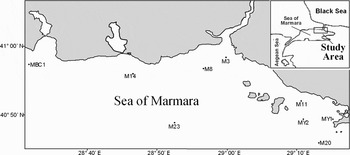
In this study, a total of 280 samples were investigated in 9 stations from January 2000 to December 2000. Samples were collected monthly in the Stations of MY1, MY2 and MBC and seasonally (four times in a year) in the Stations of M20, M11, M3, M8, M23 and M14 (Figure 1). The purpose of the Stations MY1, MY2, MBC, M3, M11 and M14 was to monitor the effects of domestic and industrial discharges on the ecological structure of the environment. The purpose of Station M8, where the Black Sea water enters the Sea of Marmara, was to monitor the properties of that Black Sea water mass. The Stations M23 and M20, located offshore the Sea of Marmara, represented the Sea of Marmara.
Sampling stations in the north-eastern Sea of Marmara.

Water samples for quantitative phytoplankton and chemical analyses were collected by 5 l Niskin bottles from 0.5, 5, 10 and 20 m. The samples were fixed with neutral formaldehyde having a final concentration of 4% (Throndsen, Reference Throndsen and Sournia1978) and examined by a Sedgewick–Rafter cell under a light microscope in duplicates. For qualitative analyses, vertical samples were collected from 15 m depth to water surface by standard plankton net having 55 µm mesh size. The following references were used for the identification of species: Cupp, Reference Cupp1943; Trégouboff & Rose, Reference Trégouboff and Rose1957; Hendey, Reference Hendey1964; Gerhard, Reference Gerhard1974; Rehakova, Reference Rehakova1974; Bernhard, Reference Bernhard1980; Takano, Reference Takano1983; Priddle & Fryxell, Reference Priddle and Fryxell1985; Ricard & Dorst, Reference Ricard and Dorst1987; and Hasle et al., Reference Hasle, Syvertsen, Steidinger, Tangen, Throndsen, Heimdal and Thomas1997. The Sea Bird Electronics (SBE) 9-11 CTD system was used for salinity and temperature measurements and the Winkler method (Greenberg et al., Reference Greenberg, Trussel, Clesceri and Franson1985) was utilized for measuring dissolved oxygen concentration (DO). Nitrate + nitrite, phosphate and silicate values were measured by using a scalar autoanalyser and chlorophyll-a analysis was carried out according to the acetone extraction method (Parsons et al., Reference Parsons, Maita and Lalli1984).
RESULTS
Hydrobiological data
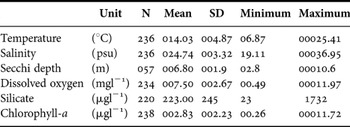
Throughout the study period, the maximum temperature was 25.41°C in Stations MBC and M14 at 0.5 m depth in July and the minimum one was 6.87°C in Station MBC at 0.5 m depth in February. Temperature did not show significant difference between stations. In the 0.5, 5 and 10 m depths, water temperature means were 9.04°C in winter, 11.87°C in spring, 18.87°C in summer and 16.48°C in autumn and temperature significantly varied according to the month of sampling (F3,232 = 133, P < 0.001, ANOVA). On the other hand, in the 20 m depth, the seasonal variation of water temperature decreased (F3,56 = 8.56, P < 0.001, ANOVA). The maximum salinity value was 36.95 psu in January and the minimum one was 19.11 psu in June and July. The means of the salinity values of the 0.5, 5 and 10 m depths were found to be ~20–24 psu. However, in the 20 m depth, salinity values sometimes reached ~37 psu by the effect of the Mediterranean current. The mean of Secchi depth was 6.83 m (maximum 10.6 m in May, minimum 2.8 m in August) (Sur et al., Reference Sur, Okuş, Yüksek, Uysal and Taş2001).
Dissolved oxygen concentration values were low in summer and winter and they were high in spring. The maximum DO concentration was measured as 11.97 mgl−1 in Station MY2 in March at 0.5 m depth and the minimum value was 0.49 mgl−1 in Station MY1 in September at 20 m depth. Throughout the year, the mean of DO values was 8.9 mgl−1 in 0.5 m, 8.6 mgl−1 in 5 m, 7.96 mgl−1 in 10 m and 4.13 mgl−1 in 20 m. Silicate concentrations were high in spring and autumn and they were low in summer and winter. The maximum silicate concentration was 1732 µgl−1 in November in 20 m and the minimum one was 23 µgl−1 in February in 0.5 and 10 m. The mean of silicate values was 159 µgl−1 in 0.5 m, 141 µgl−1 in 5 m, 170 µgl−1 in 10 m and 472 µgl−1 in 20 m. Chlorophyll-a concentrations were high in spring and low in summer (maximum 11.72 µgl−1, minimum 0.26 µgL−1). The mean of chlorophyll-a was 3.32 µgl−1 in 0.5 m, 3.68 µgl−1 in 5 m, 3.11 µgl−1 in 10 m and 1.19 µgl−1 in 20 m. Station M11 had the highest mean of chlorophyll-a (4.45 µgl−1) throughout the year and Station M3 had the lowest one (1.46 µgl−1). The mean of all stations was 2.83 µgl−1 (Table 1).
Sample numbers (N), means, standard deviations (SD), minimum and maximum values for the environmental variables measured or estimated at sampling stations.

Zooplankton abundance and diversity at the upper layer of the Sea of Marmara were higher than the Black Sea. Acartia clausi Giesbrecht 1881, Paracalanus parvus Claus, 1863, Penilia auirostris Dana, 1849 and Pleopis polyphemoides Leuckart, 1859 were the most common species. Zooplankton did not display vertical migration as a consequence of the thermohaline stratification (Yılmaz, Reference Yılmaz2002).
Phytoplankton composition and succession
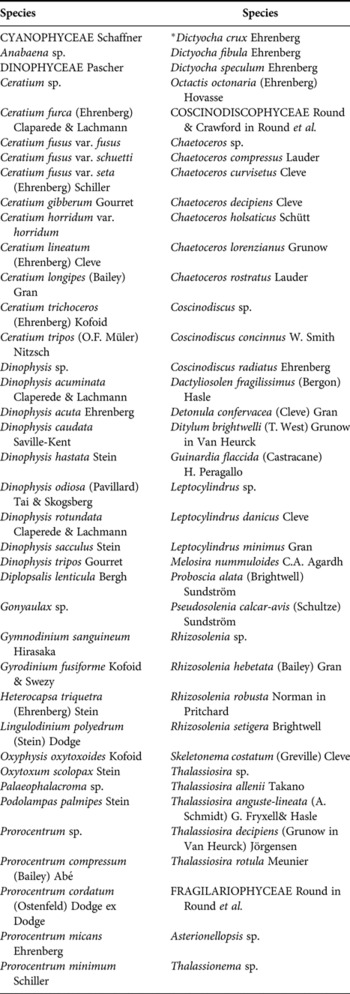
One hundred and fifteen phytoplankton species were recorded (55 dinoflagellates, 42 diatoms, 11 silicoflagellates and 7 other groups). Among these species, Dictyocha antarctica Lohmann 1919, Dictyocha crux Ehrenberg 1840 and Nitzschia rectilonga Takano Reference Takano1983 are new records for the Turkish seas (Table 2).
A list of species found during the study period.

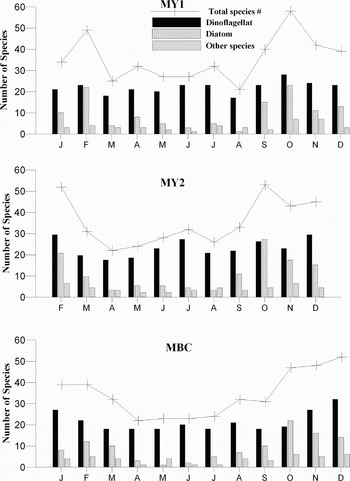
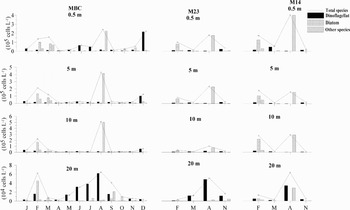
The total number of species was high in winter and autumn and low in summer. Maximum species number was detected at Station MY1 in October (58 species). Dinoflagellates comprised the largest percentage of the phytoplankton community and they did not show a seasonal pattern (except Stations M11 and M14). Diatoms displayed strong seasonal variation. Diatoms were abundant in winter and autumn and low in summer (Figure 2).
Species compositions and total species numbers in stations.

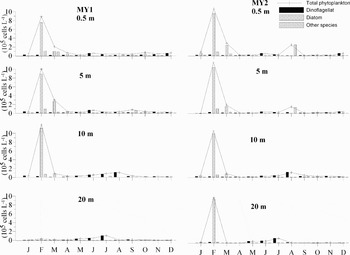
Phytoplankton abundance was generally high and there were algal blooms. Throughout the year, total phytoplankton reached its maximal values at 5 m depth, followed by 0.5 m, 10 m, and 20 m respectively. The maximum abundance has been observed in winter and autumn in the 0.5 and 5 m depths; the abundance of diatoms was higher during the winter and autumn, however the abundance of the dinoflagellates was always high throughout the whole year, they did not display a seasonal variation and some of them are toxic. The phytoplankton density was generally lower at the 20 m depths because of the low light penetration property of the Sea of Marmara (Figures 3 & 4).
Temporal variations of the density of phytoplankton groups.

Temporal variations of the density of phytoplankton groups.

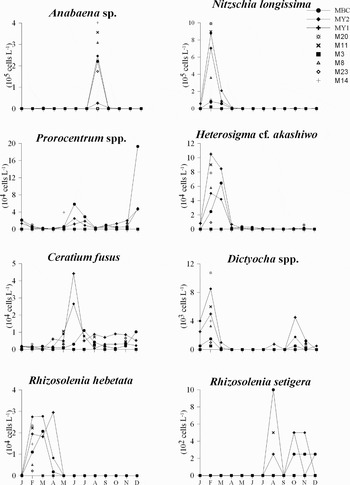
The maximum total phytoplankton abundance was 1.28 × 10⁶ cells l−1 at Station M20 in February at 5 m depth due to a bloom of Nitzschia longissima (Brébisson in Kützing) Ralfs in Pritchard in February. This high abundance was observed at Stations MY2 (1.16 × 10⁶ cells l−1), M20 (1.00 × 10⁶ cells l−1), M11 (0.90 × 10⁶ cells l−1), MY1 (0.75 × 10⁶ cells l−1) and M8 (0.36 × 10⁶ cells l−1) at all studied depths even at 20 m. Another excessive reproduction was in Anabaena sp. in August at Sations MBC (0.51 × 10⁶ cells l−1), M14 (0.40 × 10⁶ cells l−1), M11 (0.36 × 10⁶ cells l−1) and M8 (0.31 × 10⁶ cells l−1). Additionally, C. fusus (Ehrenberg) Claparede & Lachmann 1859 (0.04 × 10⁶ cells l−1), Heterocapsa cf. akashiwo (Ehrenberg) Stein (0.11 × 10⁶ cells L−1) and Prorocentrum triestinum Schiller species sometimes increased their abundance but did not cause any algal bloom (Figures 3 & 4). Dictyocha spp. had its maximum abundance at Station M20 in February (0.01 × 10⁶ cells l−1) and species number of this genus was high in winter and autumn, however, low in summer and spring especially in April. Dinophysis spp. concentrations were high in autumn in the monthly studied stations and they did not show a seasonal variation in the seasonal stations. Maximum abundance of Dinophysis spp. was 2000 cells l−1 at Station MY1 in October. Prorocentrum spp. abundance was high in summer and winter, however, low in spring and autumn but the maximum abundance was detected in May (0.04 × 10⁶ cells l−1) in M14 (Figure 5).
Temporal variations of the density of the most abundant species at 0.5 m depth.

Rhizosolenia hebetata (Bailey) Gran and R. setigera Brightwell species showed a reverse distribution pattern. Rhizosolenia hebetata was found in January, February and March and was not found in other months. On the other hand, R. setigera was found in August, October, November and December and was not found in other months. That means there was no water sample which included both species. Rhizosolenia hebetata showed a reproduction in the first half of the year, however, R. setigera showed a reproduction in the second half of the year (Figure 5).
DISCUSSION
A total of 115 species have been identified during the study period at the Sea of Marmara and three of them were new records for Turkish waters. Phytoplankton abundance was found to be higher than in previous studies. High numbers of toxic species were recorded previously (Şalcıoğlu, Reference Şalcıoğlu2000; Tüfekçi, Reference Tüfekçi2000; Balkıs, Reference Balkıs2003) and the same results were achieved in this study. The dominant phytoplankton classes were Dinophyceae and Bacillariophyceae. Phytoplankton abundance was higher in neritic stations than in offshore ones. The highest abundance was in 5 m depth, and then 0.5 m, 10 and 20 m. The highest abundance was generally in 5 m, not in 0.5 m depth due to the UV and IR radiation of the Sun; continuous high water activity and vertical mixing are slowing down the phytoplankton development in surface water (Levinton, Reference Levinton1995). The reason why there was a low phytoplankton development at 20 m depth is insufficiency of sunlight for photosynthesis. The average Secchi depth was 6.8 m in our study.
Species found in higher abundances have relatively small diameter cells (20–60 µm), therefore higher abundances did not indicate higher biomass. Chlorophyll-a concentrations at Station MY1 in April and August in 0.5 m depth were very high (10–11 µgl−1) but phytoplankton abundance was not high. The reason for this contradiction should be high nanoplankton abundance in this period.
Anabaena sp., living in brackish waters, bloomed in August. During the Anabaena sp. bloom, temperature was about 23.8°C and salinity was 21 psu. Additionally, H. cf. akashiwo, also living in brackish waters, had a bloom in the study period. Determination of these species in the Sea of Marmara indicates that the north-eastern Black Sea oriented low salinity water has a strong impact on the phytoplankton community of the Sea of Marmara.
Another important result is the identification of three new species for Turkish waters (Deniz et al., Reference Deniz, Taş and Koray2006). They are Dictyocha antarctica and D. crux from Dictyochophyceae and Nitzschia rectilonga from Bacillariophyceae. Dictyocha antarctica is living in the Atlantic region in cold waters and even its habitat does not include the Mediterranean Sea (Hasle et al., Reference Hasle, Syvertsen, Steidinger, Tangen, Throndsen, Heimdal and Thomas1997). It may migrate to the Sea of Marmara by ballast waters of ships because there is a dry-dock construction to load/unload international ships near the station where the species was found (Tuzla and Bosporus entrance). Nitzschia rectilonga (Takano, Reference Takano1983) is a recent species therefore its habitat is not well known. Identification of that species in the Sea of Marmara will help to discover its natural habitat. Besides these 3 species, there are 8 species which are not included in the phytoplankton checklist of Turkish waters (Koray, Reference Koray2001), but unfortunately present identification keys and source books are insufficient to identify them. There are not enough studies on the phytoplankton of the Sea of Marmara that might explain the reason for the many new finds reported here.
During the study, so many harmful phytoplankton species were found and many of them were in high abundance. The harmful species are as follows: Anabaena sp., Ceratium furca, Dinophysis acuminata, D. acuta, D. caudata, D. rotundata, D. sacculus, D. tripos, Gonyaulax sp., Gymnodinium sanguineum, Lingulodinium polyedrum, Noctiluca scintillans, Oxytoxum scolopax, Prorocentrum micans, P. minimum, P. scutellum, P. triestinum, Protoperidinium longipes, P. steinii, Scrippsiella trochoidea, Cylindrotheca closterium, Pseudo-nitzschia sp., Thalassiosira allenii, T. anguste-lineata and T. rotula. Koray (Reference Koray, Öztürk and Başusta2002) was used to determine the toxic species. Determination of 25 harmful species along almost all stations indicates that the north-eastern Sea of Marmara is polluted by domestic and industrial discharges and carries risk of harmful algal bloom.
Nitzschia longissima, the most abundant species in the study, is a neritic species (Hasle et al., Reference Hasle, Syvertsen, Steidinger, Tangen, Throndsen, Heimdal and Thomas1997). Its abundance was higher in coastal stations than in offshore ones. The properties of N. longissima could be the reason for this expected result or water current may not allow cell accumulation in offshore stations. The high abundance of N. longissima in February can have a positive effect on marine productivity (Figure 5).
The identified phytoplankton species during this study and the species found by previous studies in the same area are quite different. This variation indicates that the north-eastern Sea of Marmara has an unstable phytoplankton community.
It is known that dinoflagellates reproduce more rapidly than diatoms in warmer environments. Therefore, dinoflagellates generally have higher abundance in summer and diatoms in winter and spring. However, dinoflagellate abundance was high throughout the whole year in our study. The reason for this high abundance could be the eutrophic status of the investigated area and/or sufficient water temperature even in winter for dinoflagellate growth. Chlorophyll-a and nutrient values were high in the studied area throughout the year.
ACKNOWLEDGEMENTS
The authors are grateful to Professor Dr E. Okuş (deceased) from Istanbul University, Institute of Marine Science and Management, for his time and efforts during the course of this study, to Professor Dr T. Koray from Ege University, Faculty of Fisheries, for his valuable assistance in confirming the species and providing related literature and to N. Yılmaz from Istanbul University, Institute of Marine Science and Management.