INTRODUCTION
Identifying which factors affect the diversity of parasite communities across hosts is one of the major quests in parasite ecology. The most common approach to untangle the processes behind the patterns is inferring which factors correlate with what we observe. For example, which host traits correlate with parasite diversity? When we observe different hosts exploring a given habit, how do we expect these hosts to be explored as habitats for the local pool of parasite species? Which host species are the most parasitized, and which traits favour high parasite exploitation? For some hosts groups, such as fishes and mammals, these questions have been studied extensively, and major advances in this field have occurred in the recent years, unveiling some mechanisms underlying long observed patterns (Poulin, Reference Poulin2007).
Body size is the best-studied host trait explaining parasite biodiversity, being positively related to parasite species richness (Kamiya et al. Reference Kamiya, O'Dwyer, Nakagawa and Poulin2014). Large-bodied hosts may be easier to colonize because of the greater amounts of food they ingest, their large surface area, greater mobility, wider niche breadth and longer time of exposure to parasites (Poulin, Reference Poulin2007). Other host features, such as diet, behaviour and habit, might be equally important in determining parasite diversity and composition. Host habit may play an import role in parasite assembly because, all else being the same, variation in habitat used by hosts implies varying exposure to parasite infective stages (Poulin and Morand, Reference Poulin and Morand2004). Nonetheless, few studies have examined the influence of host habit on parasite communities (Aho, Reference Aho, Esch, Bush and Aho1990; Hamann et al. Reference Hamann, Kehr and González2013).
One promising way of studying parasite biodiversity is using the concepts of network theory (Proulx et al. Reference Proulx, Promislow and Phillip2005). Ecological networks are considered the building blocks of biodiversity, and an understanding of their structure is important to the understanding of the functioning of the whole ecosystem (Joppa and Williams, Reference Joppa and Williams2013). Network analysis provides a useful framework to identify, understand and predicting how parasites and hosts interact (Poulin, Reference Poulin2010; Lima et al. Reference Lima, Giacomini, Takemoto, Agostinho and Bini2012; Krasnov et al. Reference Krasnov, Fortuna, Mouillot, Khokhlova, Shenbrot and Poulin2012; Bellay et al. Reference Bellay, De Oliveira, Almeida-Neto, Mello, Takemoto and Luque2015). These interactions are generally not random, and because of the intimacy between hosts and their parasites, a phylogenetic signal in network structure is expected to reflect the relatedness among hosts (Krasnov et al. Reference Krasnov, Fortuna, Mouillot, Khokhlova, Shenbrot and Poulin2012).
Two main patterns emerge when studying host–parasite networks, nestedness and modularity. Nested networks are those where generalist parasite species interact with other generalists as well as with specialists, while specialist parasite species tend to interact with generalists rather than other specialists (Ulrich et al. Reference Ulrich, Almeida-Neto and Gotelli2009). In such networks, the composition of parasite communities in hosts associated with few parasite species is a subset of those associated with many parasite species (Almeida-Neto and Ulrich, Reference Almeida-Neto and Ulrich2011). On the other hand, modular networks are composed of subgroups of hosts and parasites that interact more with each other than with other species within the network (Fortuna et al. Reference Fortuna, Stouffer, Olesen, Jordano, Mouillot, Krasnov, Poulin and Bascompte2010). Both the body size and habit of the hosts may influence network architecture. For instance, if hosts’ habit is related to parasite community structure, we expect that host species of similar habit will form interaction modules with their parasites, resulting in a modular network.
Determinants of parasite species richness and the network patterns are still poorly understood for amphibian hosts. In this study, we investigate how body size and the differences in habitat used by anurans influence parasite community diversity, and how the local pool of parasites exploits sympatric host species. Specifically, we examine how parasite diversity varies across hosts of different size and habit, and test whether similarity among parasite communities correlates with host's phylogeny. We further investigate the interaction proprieties of this anuran–parasite network.
MATERIALS AND METHODS
This study was carried out with anurans collected in the farmland Fazenda Alegria (18°59′Se 56°39′W), Southeastern Pantanal, Brazil. Our field trips to collect the host species were conducted in the rainy seasons of 2011–2013. Anurans were hand-captured and taken to the laboratory, where they were euthanized with an overdose of sodium thiopental solution. We recorded their snout-vent length and examined their body cavity, digestive tract, accessory organs and musculature for helminth parasites. Parasites were collected and processed according to standard procedures (Goater and Goater, Reference Goater and Goater2001), and then identified to the lowest taxonomic category possible. Voucher parasite specimens are deposited in the collection of the Universidade Federal de Mato Grosso do Sul (accession numbers: ZUFMS NEM00001 – ZUFMS NEM00028, ZUFMS PLA00001 – ZUFMS PLA00005, ZUFMS ACA00001).
We examined 229 host specimens, interacting with 32 helminth parasite taxa (one acanthocephalan cystacanth, 24 nematodes, six trematodes and an undetermined helminth cyst). A complete list of helminth taxa is provided in the Supplementary material. All helminth taxa are reported to describe parasite species richness, but only those that could be identified to species or morphospecies were used in the analyses. The term infracommunity refers to the helminth community in a single host (Bush et al. Reference Bush, Lafferty, Lotz and Shostak1997).
We adopted two measures of parasite biodiversity: the number of helminth taxa per host (species richness) and taxonomic diversity. The latter accounts for the variety of parasite taxa, and thus, captures some of the phylogenetic diversity in parasite community composition (Supplementary Table 1). The taxonomic diversity index takes both the abundance and phylogenetic relatedness (based on the distance of a classification tree) amongst species into account. We used parasite phylum, class, superfamily, family and genus to build the classification tree. This analysis was performed in R (R Development Core Team, 2013), with the functions ‘tax2dist’ and ‘taxondive’ of the ‘vegan’ package (Oksanen et al. Reference Oksanen, Blanchet, Kindt, Legendre, Minchin, O'Hara, Simpson, Solymos, Stevens and Wagner2013) to calculate the taxonomic diversity for each infracommunity. We tested the relation of host traits (mean body size and habit) and parasite diversity (species richness and taxonomic diversity) with mixed effect models using the ‘lme4’ package (Bates et al. Reference Bates, Maechler, Bolker and Walker2014).
To test whether closely related hosts had more similar helminth communities, we compared distance matrices of host's phylogeny and parasite communities. We first reconstructed the amphibian's phylogenetic tree from Pyron and Wiens (Reference Pyron and Wiens2011) for our 11 anuran species with the ‘ape’ package, and used the function ‘cophenetic.phylo’ to compute the pairwise distances between the pairs of tips from the phylogenetic tree using branch lengths (Paradis et al. Reference Paradis2004). Pairwise distance measures among hosts based on the dissimilarity of their parasite communities (considering data on parasite presence/absence) were calculated with the Sorensen index. We then tested if the two distance matrices were correlated with a mantel test, with the Pearson coefficient and 1000 permutations in ‘vegan’.
The degree of nestedness of the network was evaluated using the NODF metric (Almeida-Neto et al. Reference Almeida-Neto, Guimarães, Guimarães, Loyola and Ulrich2008). The randomness of matrix nestedness was assessed by the analysis of the row–column null model CE. The calculation of the NODF metric and the simulation of the CE null model (1000 randomizations) were calculated using the program ANINHADO (Guimarães and Guimarães, Reference Guimarães and Guimarães2006). The detection of a modular pattern in network interactions was assessed with the program MODULAR (Marquitti et al. Reference Marquitti, Guimarães, Pires and Bittencourt2014). The program generates a value of modularity (M) for the interaction matrix, and verifies if the degree of modularity differs from those generated by random networks. We randomized 1000 matrices using ‘null model 2’ (see Marquitti et al. Reference Marquitti, Guimarães, Pires and Bittencourt2014). Network graphs were constructed with the packages ‘igraph’ (Csardi and Nepusz, Reference Csardi and Nepusz2006) and ‘RColourBrewer’ (Neuwirth, Reference Neuwirth2011), and the incidence matrix of host–parasite interaction with the packge ‘Bipartite’ (Dormann et al. Reference Dormann, Gruber and Fründ2008), in R.
RESULTS
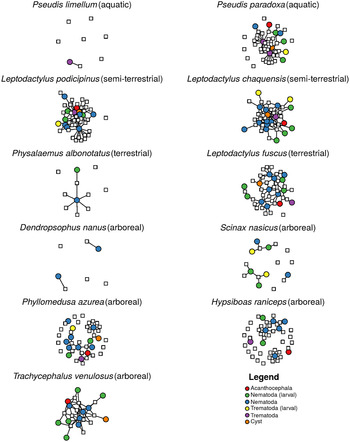
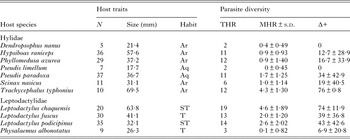
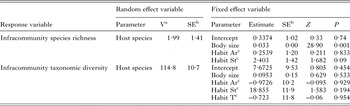
Helminth species richness varied across hosts (Fig. 1). Semi-terrestrial frogs had more complex associations with parasites, being more explored by the local pool of helminth species (Fig. 1). The frog Leptodactylus chaquensis had the highest values of helminth diversity, followed by the treefrog Trachycephalus typhonius. Leptodactylids had higher parasite biodiversity than hylids of similar size. Among the median-sized hylids, the aquatic frog Pseudis platensis had the highest taxonomic diversity. In general, small anurans had low parasite diversity, despite their habit and taxonomy (Table 1). The mixed effect models indicated anuran body size, but not the habit, as a determinant of parasite species richness (Table 2). Variation on taxonomic diversity on the other hand, was not significantly correlated to host size or habit (Table 2). Similarity in parasite communities did not correlate with host phylogeny (Fig. 2) (Mantel statistic r: 0·03 575, P = 0·43 956).
Interaction between host individuals of 11 anuran species (squares) of different habits and their helminth parasites (circles).

A. Phylogeny of 11 anuran species adapted from Pyron and Wiens (Reference Pyron and Wiens2011). B. Dendrogram of the similarity among 11 anuran species based on the Sorensen distance of their helminth communities.

Number of specimens (N), mean body size (mm), habit, total helminth species richness (THR), mean and standard deviation of helminth species richness (MHR ± s.d.), and taxonomic diversity (∆+) of the helminth parasites of eleven anuran species

Habit: Ar, Arboreal; Aq, Aquatic; ST, Semi-terrestrial; T, Terrestrial.
Mixed effect models of host traits on helminth infracommunity diversity

a Variance.
b Standard error.
c Habit: Ar, Arboreal; Aq, Aquatic; ST, Semi-terrestrial; T, Terrestrial.
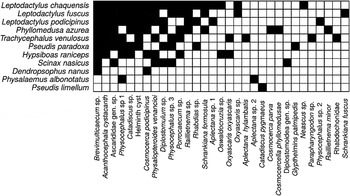
We found a nested (NODF = 44·93, P (CE) = 0·02), but not modular (M = 0·25, P = 0·99) pattern in the host–parasite network (Fig. 3). Among all parasite species, 14 were associated with a single host and 11 were associated with five or more.
Incidence matrix of the network of 11 anuran species (rows) and 32 helminth parasites (columns). A filled square represents interaction, and an empty square indicates that no interaction occurs.

DISCUSSION
The complexity of host–parasite associations varied among hosts of different size and habit. In general, frog species of Leptodactylus had the richest parasite communities, with higher taxonomic diversity. L. chaquensis was the host with greatest parasite biodiversity. Indeed, semi-terrestrial anurans, such as L. chaquensis and Leptodactylus podicipinus, are susceptible to acquiring parasites whose infective stages are both in the water (such as trematodes) and soil (direct life-cycle nematodes). Among the tree frogs, T. typhonius harboured the richest helminth community and had the highest value of taxonomic diversity. The parasite communities of these anurans are composed mostly by parasites transmitted through the ingestion of the infective stages. This is probably due to the arboreal habit of T. typhonius, which might reduce the chances of acquiring trematodes and directly transmitted nematodes, respectively, through water and soil. The high taxonomic diversity may be related to the wide range of prey they consume (including Coleoptera, Diptera, Hemiptera, Hymenoptera, Orthoptera, Pseudoescorpionida and Aranae) (Sabagh et al. Reference Sabagh, Ferreira and Rocha2010), once several invertebrate species act as intermediate hosts for different parasite taxa (Anderson, Reference Anderson2000).
Differences in foraging strategy may also underlie some of the differences we observed among hosts. For example, leptodactilids are active foragers, while most hylids are sit-and-wait predators. Such differences in foraging behaviour may explain why leptodactilids had higher parasite diversity. Among hylids, the aquatic Pseudis paradoxa had more diverse parasite communities than the arboreal anurans of similar size. This is not surprising though, once aquatic hosts generally have more diverse parasite fauna than their terrestrial counterparts (Poulin and Morand, Reference Poulin and Morand2004).
Our results confirmed host size as a determinant of helminth species richness in anuran hosts (Kamiya et al. Reference Kamiya, O'Dwyer, Nakagawa and Poulin2014). Large anuran species always had the most diverse parasite communities, while the small ones had the least diversity. Nonetheless, it is important to consider that the diversity of parasites in small anurans might be higher than observed here if they are targeted with higher sampling effort (Poulin and Morand, Reference Poulin and Morand2004). Despite the differences we observed in parasite diversity across hosts of different life styles, habit was not significantly related to helminth species richness. It is possible that host habit is more influential to parasite community composition, or to the diversity of certain parasite groups (see Hamann et al. Reference Hamann, Kehr and González2013), rather than to overall helminth species richness. Similarly, parasite taxonomic diversity did not correlate to host size or habit. This is different from what we expected, since the taxonomic diversity of parasite assemblages can be more sensitive to the influence of host traits than parasite species richness (Luque and Poulin, Reference Luque and Poulin2008).
Hosts that are closely related phylogenetically may have more similar parasite communities than unrelated hosts (Lima et al. Reference Lima, Giacomini, Takemoto, Agostinho and Bini2012; Krasnov et al. Reference Krasnov, Fortuna, Mouillot, Khokhlova, Shenbrot and Poulin2012; Brito et al. Reference Brito, Corso, Almeida, Ferreira, Almeida, Anjos, Mesquita and Vasconcellos2014). We expect that because host switching is probably more frequent among closely related hosts. Assuming phylogenetic trait conservatism, related hosts probably offer the same set of resources to parasites, and are expected to share physiological and behavioural constraints. Thus, such hosts may have the chances of being exposed to the same parasite infective stages (Poulin, Reference Poulin2007). Notwithstanding, our results showed that closely related anurans did not necessarily have more similar parasite communities. Two processes mainly explain this outcome, one is that parasite network may be strongly influenced by contemporary factors that are not directly related to historical factors. The other is the low specificity observed in most parasite species may play an important role in increasing the similarity in parasite communities.
Low parasite specificity was also important to network structure. The nested pattern of interaction observed between anuran and their helminth parasites indicates that specialist parasites tend to interact more often with generalists than to other specialists (Poulin, Reference Poulin1996, Reference Poulin2010). Thus, specialist helminth species generally occurred in anurans with the richest parasite communities, and species poor parasite communities were subsets of those. This result is consistent with several other studies that investigated nestedness in host–parasite networks (Vázquez et al. Reference Vázquez, Poulin, Krasnov and Shenbrot2005; Graham et al. Reference Graham, Hassan, Burkett-Cadena, Guyer and Unnasch2009; Joppa et al. Reference Joppa, Montoya, Solé, Sanderson and Pimm2010; Bellay et al. Reference Bellay, Lima, Takemoto and Luque2011; Lima et al. Reference Lima, Giacomini, Takemoto, Agostinho and Bini2012). The mechanisms underlying nestedness in interacting networks are not well understood, but are probably related to species abundance and co-evolutionary constrains (McQuaid and Britton, Reference Mcquaid and Britton2013). In the network accessed in this study, all host species are similarly very abundant, but the differences in body size among them might have influenced the interaction pattern, especially because of the effect of body size on parasite species richness.
Different from what we expected, anuran species did not form interacting modules with their parasites. First, we expected modularity because of the general high degree of intimacy and adaptation between species in a host–parasite network (Guimarães et al. Reference Guimarães, Rico-Gray, Oliveira, Izzo, Dos Reis and Thompson2007; Olesen et al. Reference Olesen, Bascompte, Dupont and Jordano2007; Fortuna et al. Reference Fortuna, Stouffer, Olesen, Jordano, Mouillot, Krasnov, Poulin and Bascompte2010). Second, we expected that the different habits amongst host species (aquatic, arboreal, semi-terrestrial and terrestrial) could favour the formation of modules. Ecological and phylogenetic groups of related host species could promote modularity, and the similarity (either phylogenetic, ecological or functional) is higher among species within the same module (Guimarães et al. Reference Guimarães, Rico-Gray, Oliveira, Izzo, Dos Reis and Thompson2007; Olesen et al. Reference Olesen, Bascompte, Dupont and Jordano2007; Bellay et al. Reference Bellay, Lima, Takemoto and Luque2011; Reference Bellay, De Oliveira, Almeida-Neto, Lima Junior, Takemoto and Luque2013; Lima et al. Reference Lima, Giacomini, Takemoto, Agostinho and Bini2012; Krasnov et al. Reference Krasnov, Fortuna, Mouillot, Khokhlova, Shenbrot and Poulin2012), and would be higher among species with the same habit. This has been observed in several host–parasite networks (Fortuna et al. Reference Fortuna, Stouffer, Olesen, Jordano, Mouillot, Krasnov, Poulin and Bascompte2010; Bellay et al. Reference Bellay, Lima, Takemoto and Luque2011, Reference Bellay, De Oliveira, Almeida-Neto, Lima Junior, Takemoto and Luque2013; Lima et al. Reference Lima, Giacomini, Takemoto, Agostinho and Bini2012; Krasnov et al. Reference Krasnov, Fortuna, Mouillot, Khokhlova, Shenbrot and Poulin2012). For instance, Brito et al. (Reference Brito, Corso, Almeida, Ferreira, Almeida, Anjos, Mesquita and Vasconcellos2014) observed that lizard species of similar microhabitat and diet form modules of interaction with their parasites, highlighting the importance of historical and ecological processes to network structure.
The lack of modularity, and the nested pattern of interaction observed in the network of sympatric anurans and their parasites are probably the result of low host specificity observed amongst most helminth taxa. No host species had a unique parasite community, and several parasite species were shared among different hosts. Even some helminth species that were associated to a single host in this study (Aplectona hylambatis, Cosmocerca parva, Cosmocercella cf. phyllomedusae, Glypthelmins palmipedis and Raillietnema minor) are reported as parasites of a wide range of hosts (Campião et al. Reference Campião, Morais, Dias, Aguiar, Toledo, Tavares and da Silva2014). Notwithstanding, parasites may be specialists to a particular resource provided by the host, and not to a particular host taxon. If this resource is either widespread amongst hosts or is a result of hosts convergent evolution, then parasites could track this resource despite host's taxonomic boundaries (Brooks et al. Reference Brooks, León-Règagnon, Mclennan and Zelmer2006). Low host specificity was especially evident among larval nematodes. Indeed, parasites in larval stages may increase the connectivity in host–parasite networks, because they tend to be more generalist (Bellay et al. Reference Bellay, De Oliveira, Almeida-Neto, Lima Junior, Takemoto and Luque2013). Our results agree with that, as we observed parasites in larval stages interacting with host species of different habits and long phylogenetic distances.
Overall, we found that host attributes, such as body size, were important in determining parasite community richness, whereas parasite attributes (specificity) were important to network structure.
SUPPLEMENTARY MATERIAL
To view supplementary material for this article, please visit http://dx.doi.org/10.1017/S0031182015001262.
ACKNOWLEDGEMENTS
We are grateful to Gislaine T. Dalazen and Isabela Carolina O. da Silva for their help in the field and laboratory works. We thank Maria Pil for the English review and an anonymous reviewer for valuable suggestions.
FINANCIAL SUPPORT
K.M.C was supported by CAPES–Coordenação coordenação de aperfeiçoamento de pessoal de nível superior. L.E.R.T. was supported by CNPQ – Conselho Nacional de Desenvolvimento Científico e Tecnológico.