Introduction
This paper aims to provoke discussion concerning optimal management of depression in nursing homes. Questions are posed and new research on screening for depression is presented. It is an opinion piece, not a systematic review of evidence about what works.
Depressive disorders in nursing homes
Summarizing findings from studies around the world, Borson and Fletcher (Reference Borson, Fletcher, Reichman and Katz1996) wrote that in nursing homes the prevalence of major depressive syndromes approximates 15–20%, and minor depression 25–40%. In an overview, Blazer (Reference Blazer, Schneider, Reynolds, Lebowitz and Friedhoff1994) declared that in long-term care (LTC) settings the prevalence rates of major depression and of less severe but clinically significant depression are, respectively, approximately 12% and 30%. In New York, Teresi et al. (Reference Teresi, Abrams, Holmes, Ramirez and Eimicke2001) found that 14.4% of “testable” residents had probable or definite major depression and 16.8% had minor depression. Corresponding figures in the Netherlands were 8.1% and 14.1% (Smalbrugge et al., Reference Smalbrugge, Jongenelis, Pot, Efsting, Ribbe and Beekman2006).
Epidemiologic studies of depression in nursing homes have not provided a complete picture. DSM-IV (American Psychiatric Association, 1994) describes at least ten types of depressive condition or disorder, including bipolar, major, dysthymic, adjustment (with depressed mood), mood disorder due to a general medical condition, substance-induced, dementia (Alzheimer's, vascular) with depressed mood, and “not otherwise specified”. Bereavement is listed as a “relational problem”. The above categories have not all been used in studies allocating diagnostic labels to nursing home subjects. Thus, reports of percentages of residents with major and minor depression do not provide insights regarding relative proportions who have dementia with depression, or a general medical condition with depression, or who are adjusting to circumstances (whether fulfilling criteria for major depression or not). In nursing homes a diagnosis of major depression tends to mean that the depression is more severe than in “minor” cases, but the term is relatively meaningless in relation to causation and management. A history of an episode of major depression (especially if specified as psychotic or melancholic or non-melancholic), prior to the emergence of whatever was thought to precipitate the current episode, may add more meaning, but is commonly not available.
Recognition of depression in nursing homes
There has been widespread under-recognition of depression in nursing homes, especially among residents with dementia (Burrows et al., Reference Burrows, Morris, Simon, Hirdes and Phillips1995; Cohen et al., Reference Cohen, Hyland and Kimhy2003; Gruber-Baldini et al., Reference Gruber-Baldini, Zimmerman, Boustani, Watson, Williams and Reed2005). Bagley et al. (Reference Bagley2000) reported that nursing and other care staff recognized depression in 15–27% of cases (varying according to the definition of depression). Studies in the U.S.A. showed that less than 25% of cases of depression in nursing homes were identified and treated (Cohen et al., Reference Cohen, Hyland and Kimhy2003). Introduction of mandatory screening with the Cornell Scale for Depression in Dementia (CSDD; Alexopoulos et al., Reference Alexopoulos, Abrams, Young and Shamoian1988) resulted in a significantly increased proportion of depressed dementia patients receiving antidepressants (44% versus 20%; Cohen et al., Reference Cohen, Hyland and Kimhy2003). The American Geriatrics Society and American Association for Geriatric Psychiatry (2003) issued a consensus statement recommending that screening for depression should be conducted 2 to 4 weeks following a resident's admission to a nursing home, and then six-monthly or more often. An observer-rated scale (such as the CSDD) is indicated for residents with moderate to severe dementia, while a self-report scale may be preferred in cases of milder or no dementia (Snowdon and Fleming, Reference Snowdon and Fleming2008).
All staff members in nursing homes have opportunities to notice signs that a person may be depressed, such as withdrawal, loss of interest, sadness, weepiness, irritability and behavior disturbance. Best practice in nursing homes is for staff to report, record and discuss such features, as well as depressive statements. They can consider potentially contributory factors and ensure that the primary care doctor is kept informed.
However, residents may hide feelings from others. Staff shortages or disinclination may result in lack of time or encouragement to talk. Gradual changes may not have been noticed. Commonly, care workers have had little or no training about depression and its manifestations. There may be no-one on the staff with mental health expertise, to help others identify those residents who might be depressed. Some features of dementia can also be manifestations of depression. Even for expert diagnosticians there may be difficulty and unreliability in deciding whether a person's presenting features are primarily attributable to dementia, depression, a medical problem that results in similar symptoms, or comorbid depression and brain disease. Provisional criteria for “Depression of Alzheimer's Disease” have been proposed (Olin et al., Reference Olin, Katz, Meyers, Schneider and Lebowitz2002), and these differ from those for DSM-IV major depression. Staff and researchers may differ in what they call “depression”. These points may partly explain why research studies find under-recognition of depression in nursing homes.
To improve the recognition rate, regular use of depression screening questionnaires in LTC homes has been recommended. The International Psychogeriatric Association conducted a survey in 11 member countries concerning use of screening tools, and reported that they are administered in most nursing homes in Hong Kong. The Minimum Data Set (MDS) was being used in U.S. and Finnish nursing homes, though researchers noted the MDS's relatively poor record in identifying cases of depression (Cohen et al., Reference Cohen, Hyland and Kimhy2003). The CSDD has been used routinely in Australian nursing homes as part of an Aged Care Funding Instrument (ACFI) since March 2008.
Improving the utility of the CSDD in Australian nursing homes
Scores on the CSDD and subsequent diagnostic assessments by doctors are taken into account when calculating the funding subsidy to be provided per individual resident in Australian nursing homes. Thus there is an incentive to use the screening tool. Snowdon et al. (Reference Snowdon, Rosengren, Daniel and Suyasa2010) examined the way three nursing homes in Sydney were using the tool during 2008 and 2009. In a previous study of the validity of the CSDD in identifying cases of depression in LTC homes, Snowdon (Reference Snowdon2009) found that in a number of cases, even after reading case-files and assessing participants, a psychiatrist was unable to make a definite diagnosis of depression. These residents had severe dementia. In the New York study by Teresi et al. (Reference Teresi, Abrams, Holmes, Ramirez and Eimicke2001), 15% of participants were untestable.
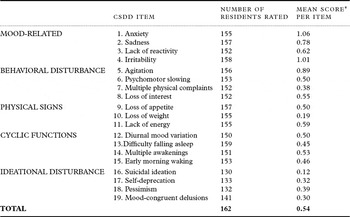
Of the 223 residents in three Sydney nursing homes, Snowdon et al. (Reference Snowdon, Rosengren, Daniel and Suyasa2010) found that 31 (14%) had been found to be too cognitively impaired to assess them meaningfully on the CSDD. In 30 other cases in one nursing home, assessment on a briefer screening instrument indicated to staff that these residents were not depressed, and therefore the more time-consuming CSDD need not be used. CSDD scores were recorded in 162 cases, but in 47 of them, between one and nine items were rated as “unable to score”. As shown in Table 1 (not previously published), some items were rated less commonly than others. In 22 cases either three or four of items 16–19 (on suicidal ideation, self-deprecation, pessimism and mood-congruent delusions) were recorded as “unable to score”. Staff reported that ideational disturbance was too difficult to rate if a participant could not converse intelligibly or convey meaning. As indicated in Table 1, anxiety, irritability, agitation and sadness were commonly rated as present, whereas suicidal ideation and weight loss were given low ratings.
Mean ratings of residents in the 3 nursing homes on 19 CSDD items

*CSDD items are rated as 0 = absent, 1 = mild or intermittent, 2 = severe, a = unable to evaluate (Alexopoulos et al., Reference Alexopoulos, Abrams, Young and Shamoian1988).
Discussion with senior staff of the nursing homes revealed that high scores (>12) on the CSDD did not usually result in changes in medication or therapy orders by doctors, even if the identified residents were not previously known to be depressed. Awareness of CSDD scores may have fostered discussion among staff about need for strategies to reduce depression, but there was little evidence that staff or doctors saw a need for reassessment of those scoring high on the CSDD to detect whether anti-depressive measures had been effective. CSDD scores were not highlighted in case-files. It seemed that depression was commonly viewed as a part of the dementia syndrome rather than being a comorbid and potentially treatable condition. Current research in Melbourne and Sydney is exploring this possibility and aims to provide guidance on how to derive maximum benefit from CSDD testing.
CSDD results are not diagnostic. Review and further assessment are needed if scores are found to be high. Kurlowicz et al. (Reference Kurlowicz, Evans, Strumpf and Maislin2002) conducted a factor analysis of CSDD results and commented that a clear separation of a somatic/vegetative factor from the core depression factor raises questions about the CSDD's validity in populations with high levels of medical illness, functional disability or dementia. Barca et al. (Reference Barca, Selbaek, Laks and Engedal2008) noted that scores on the mood sub-scale of the CSDD did not vary across different levels of dementia severity, but on the other four sub-scales increases were associated with severity of dementia. Apathy is common early in Alzheimer's disease, and some symptoms rated as depressive on the CSDD, including irritability, retardation and agitation, can also be manifestations of dementia. Scores on the CSDD and the Neuropsychiatric Inventory (Cummings et al., Reference Cummings, Mega, Gray, Rosenberg-Thompson, Carusi and Gornbein1994) have been found to correlate highly (r = 0.7; Barca et al., Reference Barca, Selbaek, Laks and Engedal2009).
To optimize utility of the CSDD in nursing homes, managers need to be asked: (1) Who is given access to records of CSDD scores? (2) Are scores recorded in progress notes? (3) Who is expected to respond when scores indicate possible depression? Who does what? (4) Was the person known to be or have been depressed? (5) Are staff discussions of CSDD scores documented? (6) If CSDD scores are high, do staff then monitor changes? (7) Do staff consider the possibility that non-depressive behavioral changes may have contributed to high CSDD scores in cases of dementia?
Of 223 residents, ratings of <8 were made on 29%, 8 to 12 on 21% and 13 or more on 23%, with 27% unrated (Snowdon et al., Reference Snowdon, Rosengren, Daniel and Suyasa2010). In a previous Australian study, 18.4% of testable nursing home residents scored 13+ on the CSDD (Snowdon and Fleming, Reference Snowdon and Fleming2008). In both studies, false positives on the CSDD were deemed to be common, but it did not appear that this applied more often in moderate or severe dementia than in milder dementia.
Causative factors
Questions can be asked about the clinical utility of DSM-IV or ICD-10 diagnostic labels when discussing treatment and prognosis of late life depression. People adjusting to being in an LTC facility, sad about what they have lost, aware of impairments in cognition or physical skills, and feeling demoralized may fulfil criteria for major depression, but is that meaningful in relation to how best to intervene?
Risk factors for depression in nursing homes include the significance to an individual of disability and functional dependence. However, neurobiological effects of (for example) dementing disorders, Parkinson's disease and cerebrovascular changes need to be considered along with psychological influences. The concepts of “depression of dementia” and “vascular depression” are useful in raising questions about whether medication or other physical treatments can be preventive or curative when there are underlying brain changes. Other losses or depressing events, and institutional factors, including staff morale, may also affect or lead to depressive thinking. Pain, loneliness, visual impairment and having had a stroke have been reported as factors associated with depression on admission to nursing homes (Smalbrugge et al., Reference Smalbrugge, Jongenelis, Pot, Efsting, Ribbe and Beekman2006), and functional limitation was a prominent factor six months after admission.
The pattern of types of depression in nursing homes is different from that seen among people of similar age living in their own homes. For a start, most LTC home residents have dementia, and in Australia, half have severe dementia (judging from the ACFI study); proportionally few community-living older people have severe dementia. Dementia with depression is more common in nursing homes than elsewhere. Similarly, depression “due to a general medical condition” is likely to be more common in nursing homes since the severity of disability and debilitating conditions is commonly what necessitated admission. Those who can care for themselves (or be cared for) at home may be depressed, but we can speculate that depression would be more likely to be attributable to factors other than depressing effects of an illness. Those entering nursing homes may be grieving or demoralized about loss of their home and independence. So-called characterological depressions may be more common in nursing homes. Recurrences of major depression with melancholia without significant brain changes seen on neuroimaging are relatively uncommon both at home and in nursing homes. Whether late-onset depression attributable to vascular changes (vascular depression) is more common in nursing homes than among those still at home is unknown.
Optimal management of depression in nursing homes
Effective treatment of depression depends on recognizing that a person is depressed, and then trying to understand what factors may have contributed to the development of his or her depression. Criticisms have been directed at health professionals who are believed to be “ageist”, in that they are perceived as believing that people in nursing homes have good reason to be depressed – being in a nursing home, ill and close to death – so it is wasteful to give them antidepressant medication! Contrastingly, other doctors have been criticized for prescribing antidepressants too liberally, without trying to deal with precipitant causes of depression. Psychiatrists, when asked to assess nursing home residents with depressive features, may well want to foster non-pharmacological approaches in dealing with such depressions, and may make suggestions about what the facility staff can do, but nevertheless are likely to recommend use of an antidepressant. The advice on antidepressants is likely to be followed, even if other ideas are not taken up.
The evidence that antidepressants are efficacious among people with dementia was reported not to be convincing (Bains et al., Reference Bains, Birks and Dening2002; Dening and Bains, Reference Dening and Bains2004), though a meta-analysis (five studies – four being of outpatients and one of women in a nursing home) showed response to be better to antidepressants than to placebo (Thompson et al., Reference Thompson, Herrmann, Rapoport and Lanctôt2007). Pollock (Reference Pollock2008) referred to the evidence base concerning the efficacy of antidepressants when used in nursing homes as minimal. The present author knows of ten trials, mostly with small numbers, in which a total of fewer than 500 participant patients in nursing homes were enrolled. The overall conclusion was that antidepressants showed little advantage over placebo. Trappler and Cohen (Reference Trappler and Cohen1998) reported a good response to selective serotonin response inhibitors (SSRIs) in two out of 29 cases of dementia with depression, 15 out of 16 cases of major depression with no dementia, and five of six cases of depression due to a medical condition. Nelson et al. (Reference Nelson, Holden, Roose, Salzman, Hollander and Betzel2007), in an open label study of mirtazapine given to 119 residents, none with severe dementia, reported that after 12 weeks there had been more than a 50% reduction in scores on a depression rating scale in 47% of the residents. Evidence from random controlled trials of antidepressants given to elderly people, most being physically well and living independently, suggests efficacy in 50–60%, with about 30% response to placebo.
In some depressions in nursing homes, antidepressants may be the major improvement factor, but when depressions are related to loss of health, self-esteem, mastery, or loved ones, it is understandable that antidepressants may not relieve depressed feelings – even if it is believed that stress and steroid output can lead to hippocampal damage and thus depression. There has been little research to compare effectiveness of medication against other anti-depressive measures in nursing homes. Psychotherapeutic interventions in LTC facilities have been understudied and underutilized (Bharucha et al., Reference Bharucha, Dew, Miller, Borson and Reynolds2006). Blanchard et al. (Reference Blanchard, Serfaty, Duckett and Flatley2009) have discussed ‘reintegration’ as a means of reorganizing self-concept, goals and meaning in life. Jang et al. (Reference Jang, Haley, Small and Mortimer2002) commented that enhancement of sense of control may empower functionally challenged older people and help them manage the adversity of disability. Mastery facilitates adaptation in stressful life situations, including after medical events.
The importance of discussion of contributory factors and of a team approach in nursing homes lies in the possibilities for supportive conversation with residents. Keen staff may be willing but lacking confidence, so it needs good leadership to ensure it happens. Bharucha et al. (Reference Bharucha, Dew, Miller, Borson and Reynolds2006) have suggested that “long-term care mental health managers”, with roles similar to those of depression care nurses employed in the PROSPECT and IMPACT collaborative care trials, could prove to be valuable and cost-effective facilitators or therapists in suitable cases. They would be depression experts, either on the staff of nursing homes or asked to visit after screening has identified cases. Nurse practitioners, psychologists, social workers or doctors could provide such services if appropriately trained, but this needs funding, as well as enthusiasm.
Use of antidepressants in U.S. and Scandinavian nursing homes has greatly increased over the last two decades, but the obvious question is this: has the prevalence of depression in those nursing homes come down?
What is needed is research. Of all residents in nursing homes who are depressed, what proportion is likely to respond to antidepressants (accepting that for some it is a placebo effect)? What clinical presentations are predictive of success? Alternatively, what features or factors are predictive of a better outcome with other measures, such as “reintegration” and attempts to restore a sense of mastery? Is there a better way of describing cases of depression in nursing homes in order to better allocate people to potentially curative treatment? And what works best in cases of demoralization?
Outcome and conclusions
Boyle at al. (Reference Boyle, Roychoudbury, Beniak, Cohn, Bayer and Katz2004), in a study of outcomes of treatment of depression in nursing homes, found that only 34% improved over 60 days (8.5 weeks). An Italian study reported increased depression scores among those surviving six months in a nursing home (Scocco et al., Reference Scocco, Rapattoni and Fantoni2006). In contrast, a Dutch study in 14 nursing homes reported a decrease in prevalence of depressive symptoms from 41% to 29% over a 6-month period (Smalbrugge et al., Reference Smalbrugge, Jongenelis, Pot, Efsting, Ribbe and Beekman2006). Payne et al. (Reference Payne2002) reported changes in depression levels among a series of residents newly admitted to a dementia facility in California, U.S.A. Forty (19.9%) scored 13+ on the CSDD soon after admission. Six months later, only six of the 40, plus six other participants (thus a total of 6%), were rated as depressed. At 12 months, a total of 4.5% were depressed, including only four of the original 40. If it can be done in California, it can be done elsewhere. The researchers did not describe what interventions took place. The facility may have been very special in various ways. Such research should be repeated on a bigger scale, exploring what helps, and who is helped.
Above all, what is needed is a keen team of staff, with the time and inclination to get to know and understand their residents properly. Accreditation of nursing homes (in Australia, anyway) should be determined partly by whether staff search for and respond appropriately to evidence of depression among their residents.
Conflict of interest
None.