Introduction
Dementia has a profound effect on the lives of people with dementia and the lives of their family members, especially their informal caregivers. Since there is no cure for dementia, the main task for people with dementia and their caregivers is to maintain a reasonable quality of life (Ettema et al., Reference Ettema, Dröes, De Lange, Ooms, Mellenbergh and Ribbe2005). The aim is to integrate the disease into their life and identity through a complex coping process (Steeman et al., 2005; Bunn et al., Reference Bunn2012). Coping with dementia is considered extremely difficult because of the often unpredictable and incomprehensible changes that accompany the disease (Steeman et al., Reference Steeman, Dierckx de Casterlé Godderis and Grypdonck2005). The progressive nature of dementia makes it even more challenging to adjust to divergent changes, and makes coping with and adjusting to the disease a cyclic and continuing process (Bunn et al., Reference Bunn2012). Although people with dementia try to maintain a normal life as long as possible, they also have to deal with the expected deterioration, and the fear of losing their intellectual and social competencies (Steeman et al., Reference Steeman, Dierckx de Casterlé Godderis and Grypdonck2005; Bunn et al., Reference Bunn2012).
In general, informal caregivers encounter a variety of problems in a range of different areas; however, a greater number and more complex problems are experienced when the person they are caring for is cognitively impaired (such as in dementia) (Chiao et al., Reference Chiao, Wu and Hsiao2015). Informal caregivers refer to the task of taking care of a person with dementia as “stressful and difficult,” especially when behavioral problems are present (Chiao et al., Reference Chiao, Wu and Hsiao2015). Informal caregivers taking care of a person with cognitive impairment experience the most difficult problems in the socio-relational domain; in particular, not being able to engage in social activities together represents a serious problem for these informal caregivers (Van Bruggen et al., Reference Van Bruggen, Gussekloo, Bode, Touwen, Engberts and Blom2016).
Dementia not only affects people with dementia and their informal caregivers directly, but also has an impact on the relationship between a person with dementia and his or her informal caregiver. Particularly, spouses report various changes in the relationship with their partner with dementia. Negative changes are reported in areas like reciprocity, communication, opportunities for shared activities, and happiness in the relationship. However, some positive aspects of the relationship are reported to remain intact, such as closeness and affection (Ablitt et al., Reference Ablitt, Jones and Muers2009). Although spouses report more relationship strain than adult children as a result of their caregiving tasks (Pinquart et al., Reference Pinquart and Sörensen2011), adult children taking care of a parent with dementia also emphasize the impact of the dementia on their parental relationship and report high levels of commitment and emotional attachment in the relationship with their parent with dementia (Day et al., Reference Day, Anderson and Davis2014; McDonnell et al., Reference McDonnell and Ryan2014).
People with dementia describe social relationships as valuable and emphasize the need for social support to be able to cope with their disease (De Boer et al., 2007; Bunn et al., Reference Bunn2012). Furthermore, maintaining a sense of mutuality is reported to be essential for spouses to be able to continue caregiving during the dementia process (Ablitt et al., Reference Ablitt, Jones and Muers2009). Continued closeness in the relationship appears to be crucial to prevent spousal caregivers from feeling frustrated. They experience the caregiving as more fulfilling when they maintain their closeness to their partner with dementia (Motenko, Reference Motenko1989). Couples also refer to the dementia as a “shared experience,” emphasizing the effects on them as a couple. To maintain their connection, couples highlight commitment, mutual support, and doing things together as essential (Wadham et al., Reference Wadham, Simpson, Rust and Murray2015).
These psychological and social aspects of the dementia process are the focus of psychosocial interventions aimed at people with dementia and their informal caregivers (Ruddy and House, 2005 as cited in Forsman et al., Reference Forsman, Nordmyr and Wahlbeck2011). Psychosocial interventions for people with dementia or their informal caregivers are related to positive changes in quality of life and mental health, such as mood, communication, and self-confidence (Forsman et al., Reference Forsman, Nordmyr and Wahlbeck2011; Dugmore et al., Reference Dugmore, Orrell and Spector2015). However, because the effects of these interventions are either small or varying, they are not conclusive (Van‘t Leven et al., Reference Van‘t Leven, Prick, Groenewoud, Roelofs, De Lange and Pot2013; Dugmore et al., Reference Dugmore, Orrell and Spector2015). Moreover, in these latter reviews, no distinction was made between psychosocial interventions that are provided for the person with dementia and the informal caregiver either together or separately. Considering the importance of their relationship and closeness emphasized by people with dementia and their informal caregivers, one might argue against separating them when offering interventions (Ablitt et al., Reference Ablitt, Jones and Muers2009). Therefore, this review explores what kind of psychosocial interventions are provided for people with dementia and their informal caregivers together, and examines the effects on both the person with dementia and the informal caregiver. The relationship between the person with dementia and the informal caregiver (spouses or adult-child) is taken into consideration in the evaluation of interventions.
Methods
Protocol and registration
The search and analysis methods were specified in advance in a protocol. Where relevant, the PRISMA method (Liberati et al., Reference Liberati, Altman, Tetzlaff, Mulrow, Gøtzsche and Moher2009; Moher et al., Reference Moher, Liberati, Tetzlaff and Altman2009) was followed to report this review.
The protocol is registered and published in the PROSPERO database with registration number CRD42015026730.
Eligibility criteria
This review included studies focusing on people with dementia and their informal caregivers. The stage of dementia was not a factor in the selection of studies, but a diagnosis of dementia for the patient was required. The studies describing interventions for people with dementia and their professional caregivers were excluded.
Only clinical trials describing a psychosocial intervention offered to people with dementia and their informal caregivers together were included. The studies in which the person with dementia and the informal caregiver were separated to receive the intervention were excluded.
Psychosocial interventions were defined as focusing primarily on psychological or social factors. Thus, interventions focusing only on biological factors, such as pharmacological or physical interventions, were excluded, whereas interventions with both a psychological or social component and a physical or cognitive component were included (Forsman et al., Reference Forsman, Nordmyr and Wahlbeck2011). However, studies that had a psychological or social component in addition to a physical or cognitive component, but did not evaluate these for both the person with dementia and the informal caregiver in their outcome measures, were excluded, because it was not possible to assess their psychosocial effects.
Searches
The electronic databases PubMed, PsychInfo, and Cinahl were searched for eligible studies. Studies in English, Dutch, French, and German were screened for inclusion. The search strategy included terms related to intervention studies, psychosocial interventions, caregivers, and dementia. No restriction was made regarding the date of publication.
Study selection
Titles and abstracts were screened by the first author (AR). When there was uncertainty about whether an intervention was truly psychosocial or whether the intervention was provided to both the person with dementia and the informal caregiver, the full-text paper was screened. References from the included studies and references of two key reviews were also assessed in this process.
For studies that provided an intervention to both the person with dementia and the informal caregiver, the full-text papers were assessed as to whether the person with dementia and the informal caregiver were together in an intervention. All these papers were assessed by two reviewers (AR, EvdP) separately, and differences were discussed until consensus was reached.
Data-collection process
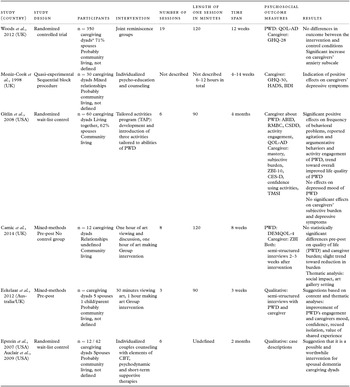
Data from the studies were described in a data extraction sheet (Table 1). The first author (AR) extracted information on the year and country of publication, study design, study population and participant demographic characteristics (i.e. the relationship between the person with dementia and the informal caregiver), setting (community living or institutionalized), intervention and control conditions, outcome measures, and results of all included studies. The second reviewer (EvdP) checked the extracted data. Disagreements were resolved by discussion between the two reviewers (AR, EvdP). A third author (MC) was available if agreement was not reached; however, this was unnecessary in the present study.
Data extraction sheet/study characteristics

aCaregiving dyad = Person with dementia (PWD) and the informal caregiver.
ABID = Agitated Behavior in Dementia Scale, BADLS = Bristol Activities of Daily Living Scale, BDI = Beck Depression Inventory, CAFU = Caregivers Assessment of Functional Dependence and Upset, CBT = Cognitive Behavior Therapy, CDR = Clinical Dementia Rating Scale, CES-D = the Center for Epidemiologic Studies Depression Scale, CSDD = Cornel Scale for Depression in Dementia, DEMQOL-4 = Dementia Quality Of Life-4, DMSS = Dementia Management Strategies Scale, GCS = Geriatric Coping Schedule, GHQ-28 = General Health Questionnaire-28 item version, GHQ-30 = General Health Questionnaire, HADS = Hospital Anxiety and Depression Scale, HAS = Health Assessment Scale, HSCL = Hopkins Symptom Checklist, MBPC = Memory and Behavior Problems Checklist, MNSS = Marital Needs Satisfaction Scale, NPI-C = Neuropsychiatric Inventory Clinician, PWD = person with dementia, QOL-AD = Quality Of Life in Alzheimer's Disease, RBMT = Rivermead Behavioral Memory Test, RMBC = Revised Memory and Behavior Problems Checklist, SSQ = Social Support Questionnaire, TMSI = Task Management Strategies Index, WC-R = Ways of Coping-Revised, ZBI = Zarit Burden Interview, ZBI-10 = 10-item Zarit Burden Interview, ZBI-12 = Zarit Burden Interview Short Version.
Risk of bias in individual studies
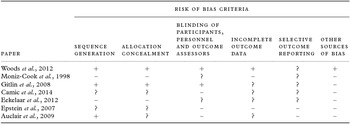
The risk of bias of the included studies was assessed using the “Cochrane Collaboration's tool for assessing risk of bias” (Higgins et al., 2011). Two reviewers (AR, EvdP) independently judged the studies on the stipulated criteria, i.e. sequence generation, allocation concealment, blinding of participants, personnel and outcome assessors, incomplete outcome data, and selective outcome reporting. Other sources of bias recognized by the authors were also listed. A template table (Table 2) with all criteria and studies was designed by the first author (AR) and filled in by both reviewers (AR, EvdP) separately. Disagreements were discussed between both reviewers and checked in the papers if necessary.
Risk of bias criteria in individual studies

– Absent, high risk of bias.
? Not clearly reported, unclear risk of bias.
+ Present, low risk of bias.
Analysis
All the psychosocial outcome measures for people with dementia and their informal caregivers reported in the studies were described. A narrative synthesis of the findings from the included studies was established, structured in terms of the type of intervention, setting, and the relation between the person with dementia and the informal caregiver. Outcome measures are presented as reported in the studies, separately reported for people with dementia and informal caregivers.
Results
Study selection
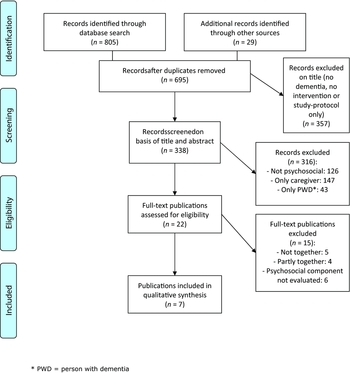
After duplicates were removed, 695 publications remained from the search in the electronic databases (performed on April 13th 2016) and references from key papers. The selection process is shown in Figure 1. Publications not describing an intervention study and publications with only a study protocol were excluded by title before screening, as were twelve publications that did not concern people with dementia (n = 357).
Flow diagram of the study selection.

Finally, 338 publications were screened by title and abstract on the kind of intervention described and whether the intervention was provided to both people with dementia and informal caregivers. The publications that did not describe a psychosocial intervention (n = 126) and studies that provided a psychosocial intervention only for either people with dementia (n = 43) or informal caregivers (n = 147) were excluded.
This left 22 publications for full-text screening (Figure 1). These publications were categorized depending on whether the psychosocial intervention described was provided to people with dementia and their informal caregivers (i) separately, (ii) partly together, or (iii) completely together. Five publications were excluded because they described a psychosocial intervention provided for the person with dementia and a different psychosocial intervention for the informal caregiver. Four publications described a psychosocial intervention for both the person with dementia and the informal caregiver, but they only came together for parts of the intervention; these publications were also excluded because essential aspects of the intervention were provided to the person with dementia and the informal caregiver separately, in different intervention groups.
Five publications were excluded after detailed consideration of the reported outcome measures. These publications all described a cognitive stimulation intervention with a psychosocial component, but had no specific outcome measures to evaluate the psychosocial effects on both the person with dementia and the informal caregiver. One publication described the cost-effectiveness of a combined intervention described in an included publication and was excluded because the outcome measure was not psychosocial.
At the end of the selection process, seven publications were eligible for inclusion in the review. They described psychosocial interventions in which a person with dementia and his or her informal caregiver joined together in the same intervention. One of these publications described and evaluated a psychosocial component of a combined intervention (Gitlin et al., Reference Gitlin, Winter, Burke, Chernett, Dennis and Hauck2008).
Study characteristics
The seven publications included in this review described six different studies. Two publications reported different qualitative results of the same intervention (Epstein et al., Reference Epstein, Auclair and Mittelman2007; Auclair et al., Reference Auclair, Epstein and Mittelman2009). The characteristics of the included studies are listed in Table 1. Four studies took place in the UK, and two were conducted in the USA.
Methods
Two studies did not use a control group (Eekelaar et al., Reference Eekelaar, Camic and Springham2012; Camic et al., Reference Camic, Tischler and Pearman2014). Parallel control groups received either no interventions, regular care interventions, or placebo interventions. All studies used a repeated measures design to evaluate the effects of the intervention. Most studies assessed the effects only directly after the intervention, other studies repeated the evaluative assessment again after 4 weeks (Eekelaar et al., Reference Eekelaar, Camic and Springham2012), 2 months (Epstein et al., Reference Epstein, Auclair and Mittelman2007; Auclair et al., Reference Auclair, Epstein and Mittelman2009), or 18 months (Moniz-Cook et al., Reference Moniz-Cook, Agar, Ginson, Win and Wang1998).
Participants
The number of participants included in the studies ranged from 6 (Eekelaar et al., Reference Eekelaar, Camic and Springham2012) to 350 caregiving dyads (Woods et al., Reference Woods2012). A caregiving dyad refers to a person with dementia and his or her informal caregiver.
Only one study (Epstein et al., Reference Epstein, Auclair and Mittelman2007; Auclair et al., Reference Auclair, Epstein and Mittelman2009) selected dyads beforehand based on their relationship. Their intervention was couples counseling, so they only selected spouses. Four publications explicitly specified the relationships between the person with dementia and the informal caregiver in the results. In these studies, most caregiving dyads were spouses and the other dyads mostly consisted of a person with dementia and a son or daughter. In one study, the relationships were not defined (Camic et al., Reference Camic, Tischler and Pearman2014).
In two studies, the dyads were living in the community (Gitlin et al., Reference Gitlin, Winter, Burke, Chernett, Dennis and Hauck2008; Camic et al., Reference Camic, Tischler and Pearman2014). The setting was not explicitly specified in the other four studies, but based on other descriptions in the publications it appears that these studies also depicted community-living dyads.
Interventions
A wide range of interventions were described in the publications. One study described an intervention in which the person with dementia and the informal caregiver were trained to work together in tailored activities (Gitlin et al., Reference Gitlin, Winter, Burke, Chernett, Dennis and Hauck2008). Other studies described counseling or supportive therapy interventions, such as couples counseling (Epstein et al., Reference Epstein, Auclair and Mittelman2007; Auclair et al., Reference Auclair, Epstein and Mittelman2009) and individualized psychosocial support (Moniz-Cook et al., Reference Moniz-Cook, Agar, Ginson, Win and Wang1998).
More specific interventions were a group reminiscence intervention (Woods et al., Reference Woods2012) and interventions focused on art viewing, discussion, and art making (Eekelaar et al., Reference Eekelaar, Camic and Springham2012; Camic et al., Reference Camic, Tischler and Pearman2014); these were the only interventions provided as group interventions.
Besides the scope of the interventions, there was also a broad diversity in the number of sessions and the total duration of the interventions. The number of sessions ranged from 3 (Eekelaar et al., Reference Eekelaar, Camic and Springham2012) to 19 (Woods et al., Reference Woods2012), and from weekly sessions (Eekelaar et al., Reference Eekelaar, Camic and Springham2012; Woods et al., Reference Woods2012; Camic et al., Reference Camic, Tischler and Pearman2014) to 6 sessions spread across 4 months (Gitlin et al., Reference Gitlin, Winter, Burke, Chernett, Dennis and Hauck2008). There was more homogeneity in the duration of one session, with all studies describing sessions of either 90 minutes (Gitlin et al., Reference Gitlin, Winter, Burke, Chernett, Dennis and Hauck2008; Eekelaar et al., Reference Eekelaar, Camic and Springham2012) or 2 hours (Woods et al., Reference Woods2012; Camic et al., Reference Camic, Tischler and Pearman2014). In one study, the session duration varied during the different phases of the intervention (Moniz-Cook et al., Reference Moniz-Cook, Agar, Ginson, Win and Wang1998). All studies only briefly described the intervention and the background of the intervention; details of the intervention procedures were not given.
Outcome measures
There was a substantial variation in the outcome measures used in the different studies. The measures focused on different psychosocial domains, but mostly on quality of life of the person with dementia, caregiver burden, and symptoms of anxiety and depression in both members of the dyad. There were quantitative, qualitative, and composed measures, which makes it difficult to compare the effectiveness of the different interventions. The outcome measures used in the individual studies are presented in Table 1.
Risk of bias in individual studies
The risk of bias of the individual studies was assessed using the “Cochrane Collaboration's tool for assessing risk of bias” (Higgins et al., Reference Higgins2011). The results and criteria are presented in Table 2. Initially, the two reviewers (AR, EvdP) had many differences in their judgments, mainly because (in most papers) description of the study methods was very concise, making it difficult to evaluate the risk of bias criteria. The differences were discussed and checked in the publications; eventually, a 100% agreement was reached, but with the conclusion that the risk of bias was unclear for most criteria in most of the studies. For all studies except one (Woods et al., Reference Woods2012), the risk of bias from sources other than in the listed criteria was judged as high, mainly because of small sample sizes. The overall risk of bias of the individual studies is considered high in most publications because there were multiple domains with a high or unclear risk of bias. The publication of Woods et al., (Reference Woods2012) was the only one which described the study methods extensively enough to make a judgment regarding the risk of bias on most domains and with a low risk of bias on the majority of the criteria, namely five out of six.
Results of individual studies
The results of the individual studies are summarized in Table 1.
None of the included studies showed clear, indisputable positive effects of any intervention. There was a small amount of significant effects on subdomains and trend toward effects, but also studies showing no effects at all. Especially disappointing was the absence of positive effects in the only study with a high methodological quality (Woods et al., Reference Woods2012).
The joint reminiscence group intervention had no significant effects on the primary and secondary outcome measures of the people with dementia. However, there was an unexpected result on the outcome measure of the caregivers: There was a significant increase in anxiety on a subscale (Woods et al., Reference Woods2012). The authors provided no explanation for this unforeseen result, so one can only speculate regarding its cause.
No significant effects were found for the art viewing, discussion, and art making interventions on any of the quantitative pre–post measures. Nevertheless, qualitative measures suggest positive effects on cognitive functioning, social aspects, and caregivers’ mood and confidence (Eekelaar et al., Reference Eekelaar, Camic and Springham2012; Camic et al., Reference Camic, Tischler and Pearman2014).
Training of specific individualized activities (TAP) had significant positive effects on the frequency of problematic behavior like shadowing, repetitive questioning, and agitation (Gitlin et al., Reference Gitlin, Winter, Burke, Chernett, Dennis and Hauck2008). However, no significant effects were found on depressive symptoms of the person with dementia and subjective burden of the caregiver (Gitlin et al., Reference Gitlin, Winter, Burke, Chernett, Dennis and Hauck2008). However, there was a trend toward an improved overall quality of life of the person with dementia (Gitlin et al., Reference Gitlin, Winter, Burke, Chernett, Dennis and Hauck2008).
Quantitative results of the couples counseling intervention were not reported, but qualitative results suggested it is a suitable and valuable intervention for both the person with dementia and his or her partner (Epstein et al., Reference Epstein, Auclair and Mittelman2007; Auclair et al., Reference Auclair, Epstein and Mittelman2009). The results of an individualized psychosocial support intervention were mixed and inconclusive regarding the effectiveness of this intervention (Moniz-Cook et al., Reference Moniz-Cook, Agar, Ginson, Win and Wang1998).
Discussion
Of the 338 papers screened on title and abstract, 22 papers were assessed for their eligibility and only seven publications were identified as eligible for inclusion in this review. These publications described six studies of psychosocial interventions for people with dementia and their informal caregivers together. One publication studied an intervention in which the person with dementia and his or her partner were trained together in specific individualized activities (Gitlin et al., Reference Gitlin, Winter, Burke, Chernett, Dennis and Hauck2008). This study was included in the review because the training involved psychosocial aspects and these were evaluated with psychosocial outcome measures for both the person with dementia and the informal caregiver. Other interventions described in the included publications concern counseling or supportive therapy (Moniz-Cook et al., Reference Moniz-Cook, Agar, Ginson, Win and Wang1998; Epstein et al., Reference Epstein, Auclair and Mittelman2007; Auclair et al., Reference Auclair, Epstein and Mittelman2009), group reminiscence (Woods et al., Reference Woods2012), and viewing, discussing, and making art (Eekelaar et al., Reference Eekelaar, Camic and Springham2012; Camic et al., Reference Camic, Tischler and Pearman2014).
The results of the included studies were mixed and there was a high risk of bias in most studies. Therefore, based on the review of these studies, it is difficult to draw overall conclusions about the effectiveness of psychosocial interventions for people with dementia and their informal caregivers together. Although qualitative results and small effects on quantitative subdomains indicate positive effects of some interventions, there were no clear positive effects on the majority of the quantitative measures.
Limitations
In most papers, the exact study methods were not clearly described, randomization and blinding were not sufficiently addressed and/or sample sizes were small, leading to an unclear or high risk of bias. Moreover, description of the intervention was generally very brief. Details on the interventions were not reported in most studies, which limits the potentiality of reproduction of the interventions in other studies. Finally, comparison between interventions was difficult due to the use of different outcome measures in the individual studies.
Implications
The lack of convincing results in most included studies might (in part) be due to the study design used. First of all, the outcome measures chosen might not be sufficient to detect changes. This is illustrated by the finding that qualitative results indicated positive effects from an intervention, whereas there were no significant positive effects on the quantitative outcome measures (Camic et al., Reference Camic, Tischler and Pearman2014). For the people with dementia, outcome measures focused mainly on their cognitive functioning and less on psychosocial domains such as mood, relational aspects, interaction and coping, or only the caregiver was asked as a proxy about these psychosocial domains (Moniz-Cook et al., Reference Moniz-Cook, Agar, Ginson, Win and Wang1998; Eekelaar et al., Reference Eekelaar, Camic and Springham2012). The psychosocial aspects an intervention focuses on should be more clearly reflected in the chosen outcome measures. Another, fairly different, possibility is to include time to nursing home admission as an indirect, more concrete outcome measure; this is proposed because psychosocial interventions for community-living people with dementia and their informal caregivers are indicated to delay nursing home admission (Smits et al., Reference Smits, De Lange, Droës, Meiland, Vernooij-Dassen and Pot2007).
Second, in most studies the number of participants was low, resulting in limited statistical power, which makes it difficult, if not impossible, to reach statistical significance (Moniz-Cook et al., Reference Moniz-Cook, Agar, Ginson, Win and Wang1998; Epstein et al., Reference Epstein, Auclair and Mittelman2007; Auclair et al., Reference Auclair, Epstein and Mittelman2009; Eekelaar et al., Reference Eekelaar, Camic and Springham2012; Camic et al., Reference Camic, Tischler and Pearman2014). This underlines the need for studies with more participants in both intervention groups and relevant control groups. Additionally, in most studies there was no specific selection of participating caregiving dyads based on the kind of relationship between the person with dementia and the informal caregiver. The problems and challenges a spouse encounters might be considerably different than those encountered by a caregiving child, considering that caregivers report the most problems in the socio-relational domain (Van Bruggen et al., Reference Van Bruggen, Gussekloo, Bode, Touwen, Engberts and Blom2016). Therefore, the relationship (spousal or parental) should be taken into account in the evaluation of psychosocial interventions and the determination of inclusion criteria.
The rather small number of seven publications describing a psychosocial intervention for people with dementia and their informal caregivers together gives rise to the impression that the relationship between a person with dementia and his or her informal caregiver is also not of primary interest in the development of interventions, with no distinction between spousal and parental relations and their possibly different needs for interventions. Research is needed to give insight in the relationship within the caregiving dyad (both spousal and parental relations), the impact of the dementia on this relationship, and the influence of the relationship on patients’ and caregivers’ quality of life, to further establish suitable psychosocial interventions for these caregiving dyads. Although recruitment for research might be an issue, considering the events already happening in the lives of people with dementia and the informal caregiver after diagnosis, our findings might reflect a clinical need for the development of suitable and effective psychosocial interventions that are in line with the needs of caregiving dyads with either a spousal or parental relationship.
In the search for studies concerning psychosocial interventions for people with dementia and their caregivers together, we came across 147 papers describing a psychosocial intervention for informal caregivers only. In comparison to only 43 studies describing a psychosocial intervention for people with dementia alone, this is a skewed distribution. The question arises as to why there are so many more studies concerning psychosocial interventions for caregivers than for people with dementia, and whether this is illustrative for the interventions provided in clinical practice. One might argue that the cognitive consequences of dementia limit the range of possible interventions for people with dementia.
Similarly, all interventions described in the included studies focused (or seem to be focused) on caregiving dyads living in the community. As far as we could establish, no studies addressed psychosocial interventions for people with dementia living in nursing homes and their informal caregivers. This might be because of perceived limitations in what, as a consequence of their declined cognitive functioning, is considered possible with this group of people with more advanced dementia. The cognitive deficits should be taken into consideration in the development of interventions for people with dementia in all stages of the disease. However, there is evidence for the effectiveness of psychosocial interventions for this group of patients (Testad et al., Reference Testad2014), such as reminiscence therapy (Testad et al., Reference Testad2014), “multisensory stimulation” or “snoezelen” (Lancioni et al., Reference Lancioni, Cuvo and O'Reilly2002), and personalized stimulation and activities (Van der Ploeg et al., Reference Van der Ploeg, Eppingstall, Camp, Runci, Taffe and O'Connor2013). These interventions have positive effects on measures of quality of life, agitated behavior, and engagement of people with advanced dementia (Lancioni et al., Reference Lancioni, Cuvo and O'Reilly2002; Van der Ploeg et al., Reference Van der Ploeg, Eppingstall, Camp, Runci, Taffe and O'Connor2013). Despite the importance of their relationship mentioned by people with dementia and their informal caregivers (De Boer et al., 2007; Ablitt et al., Reference Ablitt, Jones and Muers2009; Bunn et al., Reference Bunn2012), these interventions were provided by professional caregivers and the informal caregiver was not involved in the intervention. One might argue to use these psychosocial interventions as a way to support and possibly strengthen the relationship between a person with dementia and his or her informal caregiver. Involving the informal caregiver in a psychosocial intervention for a person with advanced dementia might stimulate the (nonverbal) communication, contact, and closeness between them; research is needed to evaluate this hypothesis.
In the skills training intervention (TAP), the informal caregiver (mostly spouses in this study) was given the role of trainer of the person with dementia (Gitlin et al., Reference Gitlin, Winter, Burke, Chernett, Dennis and Hauck2008), which might undermine the equality between a person with dementia and his or her partner. Mutuality in the relationship between a person with dementia and his or her partner is emphasized as being important for their relationship and thereby influencing the psychological well-being of both the person with dementia and the partner (Ablitt et al., Reference Ablitt, Jones and Muers2009). As mentioned before, future studies should take into account the relationship between the person with dementia and his or her informal caregiver when designing and evaluating psychosocial interventions for people with dementia and their informal caregiver together.
Conclusion
Psychosocial interventions for people with dementia and their informal caregiver together might have positive effects on the quality of life of caregiving dyads, but good quality research is required for a proper evaluation of these interventions. Most importantly, the relationship between a person with dementia and his or her informal caregiver should receive more attention in both clinical practice and future research on psychosocial interventions. This review underlines the need for well-designed and sufficiently reported studies with adequate sample sizes, suitable outcome measures, and detailed descriptions of the interventions studied. Interventions should target people with dementia living in the community as well as people with dementia living in nursing homes and their informal caregivers.
Conflict of interest
None
Description of authors’ roles
Study concept and design: E. van der Ploeg. Writing the study protocol: A. Rausch and E. van der Ploeg. Database search, analysis, and interpretation of the data: A. Rausch under supervision of E. van der Ploeg. Drafting of the manuscript: A. Rausch. Critical revision of the manuscript: A. Rausch, E. van der Ploeg, M. Caljouw. All the authors read and approved the final version of the manuscript.