Implications
Cereals are a common energy dietary source for exercising horses. Based on these results, using thermo-mechanically processed barley instead of ground barley may lead to a higher dietary fibre digestion. Consequently, feeding horses with thermo-mechanically processed barley may constitute an interesting feeding strategy for exercised horses receiving diets rich in starch.
Introduction
In horses, starch is a major energetic component of the diet as its digestion in the small intestine provides glucose. However, the enzymatic capacity of the small intestine to hydrolyse starch is limited in horses because of low amylase secretion in comparison with other animal species (Alexander and Hickson, Reference Alexander and Hickson1970; Kienzle, Reference Kienzle1994). In this respect, feeding at least 0.35% (Potter et al., Reference Potter, Arnold, Householder, Hansen and Brown1992), 0.3% (Zeyner, Reference Zeyner2008) or even 0.2% (Julliand et al., Reference Julliand, de Vaux, Millet and Fonty2006) BW per meal may lead to a dumping of undigested starch in the hindgut. In this digestive segment, the rapid microbial fermentation of starch produces organic acids, which can lead to a decrease in pH and depress the proportion of cellulolytic bacteria and the cellulolytic activity (Julliand et al., Reference Julliand, de Fombelle and Varloud2001). At times, the energetic supply from forage degradation may decrease and, ultimately, microbial disturbances may occur in the hindgut and be responsible for digestive upsets (Daly et al., Reference Daly, Proudman, Duncan, Flint, Dyer and Shirazi-Beechey2012) such as colic (Hudson et al., Reference Hudson, Cohen, Gibbs and Thompson2001; Archer and Proudman, Reference Archer and Proudman2006).
The range in the recommendation for the upper level of starch per meal reported in the literature probably results from variation in the extent of pre-caecal starch digestibility, which largely depends on starch sources (De Fombelle et al., Reference De Fombelle, Veiga, Drogoul and Julliand2004; Rosenfeld and Austbo, Reference Rosenfeld and Austbo2009; Hymoller et al., Reference Hussein, Vogedes, Fernandez and Frankeny2012) and physicochemical forms of cereal grains (Rosenfeld and Austbo, Reference Rosenfeld and Austbo2009; Hymoller et al., Reference Hussein, Vogedes, Fernandez and Frankeny2012). Using the same batch of barley, a greater mobile bag pre-caecal starch disappearance was found for ground, pelleted or steam-flaked forms than for whole grain (Philippeau et al., Reference Philippeau, Varloud and Julliand2014). Providing processed barley forms to horses could prevent the depression of cellulolytic bacteria in mixed diet, thus enhancing digestibility of dietary fibre in the total digestive tract and limiting the occurrence of microbial ecosystem disturbances in the hindgut. However, these hypotheses have been controversial in the bibliography for diets based on processed forms of barley and sorghum (McLean et al., Reference McLean, Hyslop, Longland, Cuddeford and Holland1999; Al Jassim, Reference Al Jassim2006). The aim of the present study was to determine the impact of the four barley forms we previously studied (Philippeau et al., Reference Philippeau, Varloud and Julliand2014) on fibre total tract apparent digestibility and on the fibrolytic activity and bacteria in the colon of horses.
Material and methods
Experimental design
The experiment was designed as a 4×4 Latin square with four horses and four experimental periods. Each period consisted of 7 days of adaptation to the diet and 11 days of data collection. For the first experimental period, the duration of the adaptation period was longer (17 days) than the three others to allow a gradual increase in starch proportion in the horse ration. The Ethics Committee for Animal Well-Being at the Faculty of Burgundy, Dijon, approved the following experimental procedures (A1309).
Horses
Four cross-bred mature geldings (11.5±3.2 years old; 449±41 kg) each fitted with a polyvinyl chloride cannula in the caecum and in the right ventral colon were included for the study. They were maintained indoors in individual free stalls bedded with wood shavings. They were dewormed (Eraquell®; Virbac SA, Glattbrugg, Switzerland) 25 days before the beginning of the experiment. During the adaptation periods to the diet, they had access to a sand paddock for free exercise for 1 h/day five times per week, and they used an automatic walker for 1.5 h/day five times per week. During the periods of data collection, horses were taken out to a round dry pen three times per week for 30 min, where they walked for 5 min, followed by a steady trot for 20 min and walked again for 5 min.
Feeding management
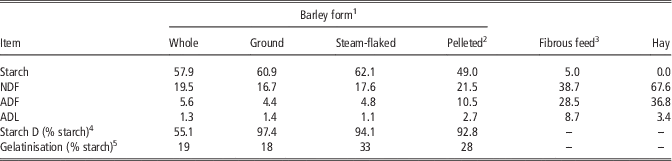
The diets were formulated to meet the recommendations for horses subjected to 1 h very light work as defined by Institut National de la Recherche Agronomique (Martin-Rosset, Reference Martin-Rosset1990) and to supply >1 kg dry matter (DM) hay per 100 kg BW. Horses were fed a meadow hay : concentrate (62 : 38; DM basis) diet at 1.7 kg DM/100 kg BW. The concentrate was composed of an experimental fibrous pelleted feed (20% DM basis) and barley (80% DM basis). Barley came from a single batch of cereal and was fed either as whole grain, 2.5-mm ground, steam-flaked or pelleted (Table 1). Hay was provided in two equal meals at 1000 and 1700 h. The concentrate was fed in two unequal meals (5/6 and 1/6) at 0800 and 1730 h, allowing a starch intake in the morning meal higher than 0.2% BW (Julliand et al., Reference Julliand, de Vaux, Millet and Fonty2006). Salt blocks and water were available ad libitum.
Chemical composition (% of the DM) of the feed samples and starch characteristics of the four barley forms used in the study

DM=dry matter.
1 All barley forms came from the same batch of cereal.
2 Pelleted barley form was composed of barley (80% DM basis) and of the ingredients of the experimental pelleted feed rich in fibre (20% DM basis).
3 Experimental pelleted feed rich in fibre.
4 Mobile bag pre-caecal starch disappearance (Philippeau et al., Reference Philippeau, Varloud and Julliand2014).
5 Starch gelatinisation (Philippeau et al., Reference Philippeau, Varloud and Julliand2014).
To characterise starch sources and to estimate the potential starch dumping in the hindgut, starch gelatinisation and pre-caecal starch digestibility estimated by starch mobile bag disappearance between the oesophagus and the caecum had been measured on these four barley forms in this experiment (Philippeau et al., Reference Philippeau, Varloud and Julliand2014) (Table 1).
Total tract apparent digestibility measurements
Each data collection period began with the measurement of in vivo total tract apparent digestibility using a 3-day total collection of faeces (Goachet et al., Reference Goachet, Philippeau, Martin, Votion, Van Erck and Julliand2009). Faeces samples were collected using a collection harness to which horses had been previously adapted to wearing. They were emptied three times a day. For each horse, the amount of feed offered, refused and faeces were weighed every day. Aliquots of individual faeces samples (10% of total excreted fresh faeces), offered feeds (500 g of fresh matter) and all refusals, if any, were taken daily, dried and ground. At the end of each period, representative samples from each collection of offered feeds, refusals and faeces were pooled for each horse over the 3-day period for subsequent analysis.
Faecal, feed refusals and feed samples were dried in a forced-air oven at 60°C until constant weight was achieved for DM determination. NDF, ADF and ADL were determined according to Van Soest and Wine (Reference Van Soest and Wine1967) as modified by Association Française de Normalisation (AFNOR) (1997). Starch content was determined by an enzymatic method (AFNOR, 2005).
Colonic abiotic and biotic parameters determination
On day 9 of data collection, 4 h after the morning meal, colonic contents were collected using gravity via the cannula, and the pH was immediately measured using an electronic pH-meter (MP 120; Mettler, Toledo, Spain). Subsequently, aliquots of colonic contents were filtered through a 100-µm sieve nylon filter (Bluetex; SAATI, Sailly-Saillisel, France) and frozen (−20°C) for further biochemical measurements. Total volatile fatty acid (VFA) concentrations were determined by GLC (Clarus 500 PPC; PerkinElmer, Courtaboeuf, France), following the procedure described by Jouany (Reference Jouany1982). For microbial analyses, one aliquot of colonic contents was held in CO2-saturated flasks at 38°C before inoculation. Microbial analyses were carried out as described by Julliand et al. (Reference Julliand, de Fombelle, Drogoul and Jacotot1999) and Faubladier et al. (Reference Faubladier, Julliand, Danel and Philippeau2013). Ten-fold dilution series were prepared under O2-free CO2 in an anaerobic mineral solution. Total viable anaerobic bacteria counts were determined using a modified non-selective medium in anaerobic roll tubes. Lactic acid-utilising bacteria counts were determined in a selective medium in anaerobic roll flasks. For these two flora, the number of viable bacteria was determined after 48 h of incubation at 38°C as the average of colony counts from three replicate roll tubes prepared from dilutions representing 10−5, 10−6 and 10−7 ml of diluted colonic effluent. Concentrations of cellulolytic bacteria were determined using a modified broth medium after 15 days of incubation at 38°C as the most probable number on four roll tubes inoculated with dilutions representing 10−5, 10−6 and 10−7 ml of colonic contents. Amylolytic bacteria were deeply inoculated on an adapted medium containing 1% (w/v) of soluble starch as the main energy source. Three replicate Petri plates were inoculated per dilution representing 10−4, 10−5 and 10−6 ml of diluted colonic effluent. For bacterial counts, iodine solution was added to the Petri plates after 48 h incubation at 38°C.
Calculations
Total tract apparent digestibility coefficient of DM was evaluated using ADL as the internal marker as follows:
 $${\rm DMd}\,(\,\%\,){\,=\,}\left( {{\rm 1}{\minus}{A \over B}} \right){\times}{\rm 1}00$$
where DMd was the DM digestibility, A and B were the ADL concentrations in the intake and faeces, respectively.
Total tract apparent digestibilities of DM constituents were calculated as follows:
 $${\rm Constituents}\,{\rm digestibility}\,(\,\%\,){\,=\,}\left[ {{\rm DMd}{\times}\left( {{{{\rm CI}} \over {{\rm CF}}}} \right)} \right]{\times}{\rm 1}00$$
where CI and CF were the DM constituent concentrations in the intake and the faeces, respectively.
Microbial counts were expressed as log10 of colony-forming units (CFU) per millilitre.
Statistical analysis
The variance homogeneity of variables was assessed using the Shapiro–Wilk test in Minitab (Minitab Inc., State College, PA, USA). All the variables were analysed using the MIXED procedure of SAS v9 (SAS Institute Inc., Cary, NC, USA). Daily nutrient intakes, digestibility coefficients, pH values, organic acid concentrations and microbial counts were analysed in a model, including period and barley form as fixed effects and horse as the random effect. Least square means were calculated for each variable and separated using pair-wise t-tests when significant effect due to barley form was found (PDIFF option of SAS). Significance was declared at P⩽0.05 and a trend towards significance at P⩽0.10.
Results
DM and starch intakes averaged 1.7% and 0.32% BW, respectively. The average starch intake in the morning meal amounted to 0.27% BW.
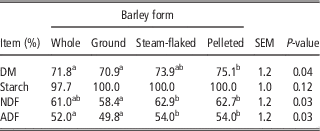
Total tract apparent digestibility of DM depended (P=0.043) on the barley form used in the concentrate (Table 2). It was greater for diets including pelleted than that for whole and ground barley forms and was intermediate for steam-flaked diet. Total tract apparent digestibility of starch was almost complete whatever the barley form and averaged 99%. For insoluble dietary cell wall fraction (NDF), total tract apparent digestibility was (P=0.033) the lowest for the diet including ground barley and the highest for thermo-mechanical barley forms. However, no difference between the whole form and each of the other forms was detected. Total tract apparent digestibility of ADF was greater in diets including thermo-mechanical barley forms compared with whole and ground barley forms (P=0.030).
Effect of barley form on total tract apparent digestibility of DM constituents

DM=dry matter.
a,bLeast square means within the same row lacking a common superscript letter are different (P<0.05).
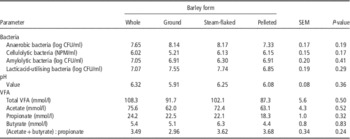
No difference in pH (P=0.360) and VFA concentrations (P=0.502) was reported according to the barley form. The pH and total VFA concentrations averaged 6.1 and 97.4 mmol/l, respectively (Table 3). As it was reported for abiotic parameters, no difference was detected in total anaerobic bacteria concentration and its composition, using the cultural method (Table 3). The concentration averaged 7.8 log CFU/ml, 5.9 NPM/ml, 6.9 and 7.3 CFU/ml for total anaerobic, cellulolytic, amylolytic and lactic acid-utilising bacteria, respectively.
Effect of barley form on biotic and abiotic parameters of colonic content collected 4 h after the morning meal

VFA=volatile fatty acid.
Discussion
In horses, interactions between starch and total tract apparent digestibility of dietary fibre have been studied more extensively in trials assessing variable proportions of starch in the DM intake. Controversial results have been obtained, which may be due to differences between experimental designs. Increasing levels of starchy concentrate in the diet of horses at the expense of the hay proportion led to a decrease in the total tract apparent digestibility of fibre fractions (Vermorel et al., Reference Vermorel, Martin-Rosset and Vernet1997; Palmgren-Karlsson et al., Reference Palmgren-Karlsson, Lindberg and Rundgren2000) or an increase (Vermorel et al., Reference Vermorel, Martin-Rosset and Vernet1997). As the proportion of concentrate remained constant, the increase of starch level in the concentrate at the expense of NDF level led to either a decrease (Jouany et al., Reference Jouany, Gobert, Medina, Bertin and Julliand2008) or an increase in fibre total tract apparent digestibility (Swyers et al., Reference Swyers, Burk, Hartsock, Ungerfeld and Shelton2008). For increasing DM intake, no impact on NDF total tract apparent digestibility was found between a hay-based diet and a hay : barley diet (Hussein et al., Reference Hymoller, Dickow, Brokner, Austbo and Jensen2004). In the present study, interactions between starch and degradation of dietary fibre in the hindgut were studied for different processed barley forms. Horses fed thermo-mechanical barley forms exhibited greater digestibility of ADF compared with horses receiving whole grain or mechanically treated barley forms. This result may suggest that diets including thermo-mechanical cereal forms may lead both to a higher starch digestibility in the pre-caecal digestive tract and a higher fermentation of dietary fibre in the hindgut. Few results are available in the literature regarding the impact of cereal processing on fibre digestibility and controversial data are reported (McLean et al., Reference McLean, Hyslop, Longland, Cuddeford and Holland1999; Al Jassim, Reference Al Jassim2006). In one study, the physical form (rolled, micronised and extruded) of barley-based diets did not affect NDF and ADF total tract apparent digestibility (McLean et al., Reference McLean, Hyslop, Longland, Cuddeford and Holland1999). In another study, a lower total tract apparent digestibility of ADF was found for steam-flaked than for rolled forms of sorghum-based diets (Al Jassim, Reference Al Jassim2006). Based on these two studies, it appears difficult to classify cereal processed forms according to their potential deleterious impact on fibre digestibility.
Al Jassim (Reference Al Jassim2006) reported significant lower total VFA concentration and higher proportion of propionate in faeces of horses, showing the lower total tract digestibility of dietary fibre. However, no clear relationship was established between total tract apparent digestibility and abiotic parameter concentrations in the hindgut content measured at 4 and 5 h after feeding by McLean et al. (Reference McLean, Hyslop, Longland, Cuddeford and Holland1999 and Reference McLean, Hyslop, Longland, Cuddeford and Hollands2000). In the present study, the differences in total tract apparent digestibility of dietary fibre were consistent with numerical variations in pH, VFA concentrations and bacteria counts in colonic content. Thus, horses receiving ground barley showed the lowest in vivo digestibility of dietary fibre and numerically lower values in pH, cellulolytic bacteria count and ((C2+C4)/C3) ratio.
In comparison with other studies dealing with the impact of cereal processing on horse digestibility, the pre-caecal starch digestibility of the four barley forms we tested had been previously determined (Philippeau et al., Reference Philippeau, Varloud and Julliand2014), using the mobile bag technique. In that study, the thermo-mechanical barley forms exhibited a greater pre-caecal starch digestibility compared with whole grain. Based on these in sacco results, starch in whole barley was not entirely digested in the pre-caecal tract and, consequently, may have been flushed in the hindgut. In the caecum, starch fermentation may be limited because fine particles flow quickly through the caecum (de Fombelle et al., Reference De Fombelle, Julliand, Drogoul and Jacotot2001). However, starch may remain longer in the colon where it may be fermented and may interact with degradation of dietary fibre. This hypothesis is in agreement with the data of the present study. Surprisingly, although mobile bag pre-caecal starch disappearance of ground barley was higher compared with whole grain (Philippeau et al., Reference Philippeau, Varloud and Julliand2014), no statistical difference in total tract apparent digestibility of NDF and ADF was detected between these two treatments. For a starch intake in the morning meal higher than 0.2% BW, we would have expected that the large variation in the extent of starch disappearance (almost 40 points) may lead to a significant difference in the amount of starch that entered the hindgut and may affect fibre digestibility as it was suggested by Julliand et al. (Reference Julliand, de Vaux, Millet and Fonty2006). Although conclusions based on the nylon bag technique data should be studied with caution, undigested particulate DM losses through nylon bag pores remained low whatever the barley form (Philippeau et al., Reference Philippeau, Varloud and Julliand2014) and could not insert bias in the mobile bag technique. Consequently, according to us, the discrepancy between in sacco and in vivo results may be related to difference in particle size reduction of barley forms. In contrast to the in sacco technique, barley forms were subjected, in vivo, to chewing activity. Possibly, due to the differential chewing activity according to the physical forms of cereal, mean particle size of the digesta did not differ, and, consequently, in vivo starch accessibility of whole and ground barley forms to microorganisms’ enzymes in the stomach and pancreatic amylase may be similar. If faecal particle length and width were used as the indicator of chewing efficiency, our hypothesis could be corroborated by data from the study by Brokner et al. (Reference Brokner, Norgaard and Hansen2008), who showed no difference between horses receiving whole and ground oats as concentrates.
No data dealing with the impact of cereal form on functional bacteria concentrations are reported in the literature. Irrespective of the barley form (whole v. processed forms), culture-based bacterial measurements in colonic content showed high concentrations of amylolytic and lactic acid-utilising bacteria. This result is in accordance with values for streptococci, lactobacilli and lactic acid-utilizing bacteria reported in horses receiving a high-starch diet (Julliand et al., Reference Julliand, de Fombelle and Varloud2001; Medina et al., Reference Medina, Girard, Jacotot and Julliand2002; de Fombelle et al., Reference De Fombelle, Varloud, Goachet, Jacotot, Philippeau, Drogoul and Julliand2003). Surprisingly, owing to acidic conditions of colonic contents, cellulolytic bacteria counts remained, whatever the barley form, higher than values reported previously in horses receiving a high-starch diet (Julliand et al., Reference Julliand, de Fombelle and Varloud2001; Medina et al., Reference Medina, Girard, Jacotot and Julliand2002; de Fombelle et al., Reference De Fombelle, Varloud, Goachet, Jacotot, Philippeau, Drogoul and Julliand2003). At pH values ranging from 5.9 to 6.3, degradation of fibre may be altered in ruminal content (Erdman, Reference Erdman1988), resulting from an inappropriate bacterial adhesion to the dietary fibre and/or a slower growth of cellulolytic bacteria (Weimer, Reference Weimer1996). Because the deleterious impact of acidic pH on fibre digestion depends on duration and intensity of the pH decrease, further investigations based on repeated measurements should be proposed to assess the effect of barley form on post-prandial pH dynamics in colonic content of horses. In a similar concentrate feeding strategy and proportion of concentrate in the diet, we showed that the pH tended to decrease 4 h after feeding, but it was the lowest from 6 to 7 h post-feeding (Philippeau et al., Reference Philippeau, Faubladier, Goachet and Julliand2009). Moreover, the links between pH and main cellulolytic microorganisms in horses, such as fungi, protozoa and the major bacteria strains Fibrobacter succinogenes, Ruminococcus albus and Ruminococcus flavefaciens, should be investigated using molecular techniques. To explain the high cellulolytic bacteria concentration, irrespective of the barley form, other diet characteristics should be considered in the present study. The high starch inclusion in the morning meal may have been counteracted by the low starch inclusion in the evening meal. Consequently, the starch concentration remained low (in average, 17% of DM intake). On the other hand, the forage DM intake was higher (1.2% BW) than that in previous studies reporting deleterious impact of starch on cellulolytic bacteria (Julliand et al., Reference Julliand, de Fombelle and Varloud2001; de Fombelle et al., Reference De Fombelle, Varloud, Goachet, Jacotot, Philippeau, Drogoul and Julliand2003). Sufficient intake of physical effective fibre may constitute an abundant substrate for cellulolytic microorganisms in the hindgut and stimulate their growth.
In conclusion, using thermo-mechanical cereals in diets rich in starch may limit potential negative impact of starch on fibrolytic activity in horses. Moreover, the fibre-to-starch ratio fed in this trial did not cause any digestive upset, although morning meal starch intake was higher than 0.2% BW. Further studies should be carried out to determine the optimum value of the dietary fibre-to-starch ratio for athletic horses that may limit the risk of hindgut disorders without impairing their exercise performances.
Acknowledgements
This study was supported by In Vivo NSA and Burgundy Council. The authors acknowledge Audrey Fouet and all the staff of AgroSup for the care of the horses and the laboratory analysis.