INTRODUCTION
It has been found that memory complaints are related not only to cognitive decline and incipient dementia but also to depression, anxiety, psychosocial stress, physical health, and personality characteristics (Comijs et al., 2002; Elfgren et al., 2003; Jonker et al., 2000; Jorm et al., 2004; Levy et al., 1994). The concept of subjective memory impairment is often used interchangeably with “memory complaints” and could be defined as a memory failure, perceived by an individual or a proxy, and not necessarily related to a test performance of memory function. Objective memory impairment is often defined as a performance below a specified cut off on test of episodic memory (De Jager & Budge, 2005; Petersen et al., 1999; Purser et al., 2006). Whereas some studies have found an association between subjective memory impairment and poor performance in memory tests (Perrig-Chiello et al., 2000), others have failed to do so (Barker et al., 1995). These differences might partly be attributed to the variation in the conceptualization and measurement of memory complaints. In some population-based studies the participants have been questioned on the subject of memory complaints (Comijs et al., 2002; Jorm et al., 2004) whereas assessment scales of memory complaints have been used in others (Derouesné et al., 1999; Perrig-Chiello et al., 2000). Apart from these methodological differences, “it is likely that the significance of memory complaints depends on who is complaining in which context.” (Jonker et al., 2000, p. 989).
So far, the association between personality characteristics and memory complaints has not been clearly outlined. When studying personality in subjects with memory complaints, similar patterns of personality have been found in community samples and in clinical samples. In a large community survey (Jorm et al., 2004) higher levels of neuroticism and lower extraversion were found among subjects (60–64 years) with memory complaints compared to those without complaints. However, the subjects with memory complaints had significantly lower results on tests of episodic memory as well as on tests of verbal function, reaction time and visual-motor speed. Magnetic resonance imaging did not reveal any significant differences between the groups. Jorm et al. (2004) concluded that “there was no evidence of brain changes indicating early dementia.” (p. 1495). The subjects with complaints were also found to display more symptoms of depression and anxiety as well as poorer physical health. The well-established five-factor model (John & Srivastava, 1999; McCrae & Costa, 2003) was used by Siegler et al. (1991) to assess the personality in patients with dementia or isolated memory disorder. This model consists of five broad dimensions of personality: neuroticism, extraversion, openness, agreeableness and conscientiousness. In the Siegler study caregivers rated current and premorbid personality of the patients in order to detect potential change. Four of the five dimensions were reported to have changed significantly resulting not only in lower extraversion and higher neuroticism but also a lesser degree of conscientiousness and openness. Similar findings, using the same inventory, have also been reported in patients with Alzheimer's disease (AD; Chatterjee et al., 1992).
According to Kliegel et al. (2005) neuroticism is associated with health complaint ratings independent of objective health. Individuals with high levels of neuroticism are more likely to visit physicians, as stated by Costa and McCrae (1987). Furthermore, McCrae & Costa, (2003) propose that people with high levels of anxiety, an aspect of neuroticism, are inclined to worry. High levels of neuroticism could thus be seen to lead to apprehension of memory failure and memory complaints. However, diseases of the brain (e.g., dementing disorders) have also been associated with an increase in neuroticism as well as other personality changes (McCrae & Costa, 2003).
Memory impairment, verified by means of psychometric tests, is a core criterion in Mild Cognitive Impairment (MCI). MCI has clinically been defined as a condition characterized by memory complaints, normal activities of daily living, normal general cognitive function, abnormal memory for age and no dementia (Petersen et al., 1999). This condition has been regarded as an intermediate state between normal aging and dementia, in particular AD, but its heterogeneity is recognized (Winblad et al., 2004). There is a considerable variability in the results of studies concerning the specific diagnostic criteria of MCI (Salmon & Hodges, 2005). Furthermore, the rates of progression of subjects from MCI to AD and differences in the studied population have shown a considerable variation (Ritchie & Touchon, 2000).
It has been reported that memory complaints are related to depressive mood (Tierney et al., 1996). It has also been suggested that the prevalence of depression in patients with isolated memory impairment increases the risk of future dementia (Modrego & Ferrández, 2004) and further that depressed mood is frequently prevalent in the initial stage of AD (Gustafson et al., 1995). A cross-sectional study comparing patients with different degrees of cognitive impairment (patients with not verified memory impairment, patients with MCI and dementia patients) showed no significant group differences in the total score according to a depression scale (Elfgren et al., 2003).
Whereas the existence of gender differences in depressive symptoms is well established (Nolan-Hoeksema et al., 1999), most studies from medical settings have failed to reveal significant gender differences regarding depressive symptoms according to the Hospital Anxiety and Depression Scale (Herrmann, 1997). So far, gender perspectives on memory complaint have received modest attention. Derouesné et al. (1999) studied the relationship between memory complaints, memory performance, psycho-affective status, gender, and age in patients at a Memory Clinic. Anxious symptomatology was the main relative risk factor for memory complaints independent of age. For patients below the age of 50, the second risk factor was gender with female patients having more memory complaints than male patients. However, in the community survey by Jorm et al. (2004) the majority of the subjects with memory complaints were male patients. It has been proposed that women report lower level of performance than men despite the fact that they performed as well as, or even better than men on memory tests (Herzog & Rodgers, 1989; West et al., 2002). These findings are, however, not conclusive (Perrig-Chiello et al., 2000).
One of the aims of the present study was to explore the personality characteristics of patients with memory complaints and to evaluate whether their personality characteristics differed from a Swedish normative sample (Psykologiförlaget, 2003). Based on previous studies, we hypothesized that the patients, compared to the reference group, would show higher neuroticism and lower extraversion and conscientiousness (Chatterjee et al., 1992; Comijs et al., 2002; Jonker et al., 2000; Jorm et al., 2004; Pearman & Storandt, 2004; Siegler et al., 1991). A second aim was to find out if our clinical sample showed any gender differences with regard to personality characteristics, symptoms of anxiety and depression. A third aim was to ascertain whether patients with subjective and objective memory impairment respectively differed regarding personality characteristics, symptoms of anxiety, and depression. Finally, we explored the five personality factors, symptoms of anxiety, and depression and their potential interaction with gender and memory performance. This is, to our knowledge, the first study exploring personality characteristics of patients with memory complaints and then comparing those patients with memory complaints, not verified by test, with patients with memory complaints, verified by test.
METHOD
Patients
We invited consecutive patients, referred or self-referred to the Memory Clinic at the University Hospital of Lund, Sweden, to participate if they fulfilled the following criteria: age 35 to 70 years, first visit or a follow up visit after one year, subjective memory dysfunction with or without verification on tests of memory. Exclusion criteria were a former diagnosis of dementia, other neurodegenerative diseases, known abuse of alcohol or drugs, post-traumatic stress disorder, psychosis, bipolar disorder, major depressive disorder, traumatic brain injury, a history of cerebrovascular disorder, and non substituted metabolic disturbances. The patients were assessed by means of a neuropsychiatric examination. A letter of invitation was sent to those patients who fulfilled the inclusion criteria. This was followed-up with a phone-call giving the patients the opportunity to ask questions about the study. All patients who agreed to participate were examined neuropsychologically and completed a personality inventory as well as a self-assessment scale of affective status. The two latter were completed at home and sent back by mail. Biological markers of stress (the cortisol level in saliva and glycosolated hemoglobin) were measured. These data will be reported in a forthcoming paper.
Eighty-seven patients fulfilled the criteria and were invited to participate. Out of these, 67 patients accepted the invitation. However, two of the patients received a diagnosis of dementia and were excluded. Another eight patients were excluded because of missing/invalid data resulting in a final sample of 57 patients: 38 women and 19 men; age range 38 to 70; mean 56.9 ± 7.4 years (Table 1). The patients were interviewed with regard to their education and thereafter classified as follows: 1) preG, 14%; 2) G (high school), 47% or 3) postG, 39%. All patients came from a university town and its surroundings. The study was approved by the Research Ethical Committee, and written consent was received from all patients.
Demographic characteristics and MMSE scores

Neuropsychiatric Examination
All patients were examined by a psychiatrist who reviewed their personal medical history using a semi-structured interview. Each patient underwent a general physical and neurological examination, including the Mini Mental State Examination (MMSE; Folstein et al., 1975).
Neuropsychological Test-Battery
All patients were assessed by means of a comprehensive test-battery. Most of the tests were chosen from the Betula study, Sweden, a prospective cohort study on memory, health, and aging (Nilsson et al., 1997). Verbal functions were examined through a multiple-choice vocabulary test and tests of verbal fluency (the Betula study), Boston Naming test (Kaplan et al., 1983) and Token test (Lezak et al., 2004). Four tests of verbal episodic memory from the Betula study were used. Free immediate recall of (1) 16 imperative sentences that were read aloud for the patients to follow and to memorize, (2) 16 similar sentences, also read aloud but with visible text, which then had to be memorized. Delayed cued recall of nouns from the previously learned and performed sentences (Test 3 & 4) was tested after 30 to 40 minutes (Nilsson et al., 1997). Visual episodic memory was examined using the immediate recall of Rey Complex figure test (RCFT; Meyers & Meyers, 1995). Visuospatial construction ability was examined using Block design (the Betula study; Wechsler, 1992) and the copy trial of RCFT, while attention functions were tested by means of the Trail Making Test A+B (Bergman et al., 1988; Reitan, 1958), Digit Span and Digit Symbol (Wechsler, 1992). The results from the Betula tests were compared with the age scaled normative data from the Betula study (Nilsson et al., 1997). The data used was from the first wave of 1000 subjects of the study. It consisted of 100 individuals from each of 10 cohorts (35, 40, 45 etc., to 80 years of age). The gender distribution in the study was approximately even, it varied slightly between the age-cohorts (50% to 60% females). The education of the participants in the Betula study was of a higher standard than that of the whole of Sweden (preG: 36%, G: 38%, and postG: 25%). This difference was expected given the fact that the participants came from a university town and its surroundings. The results of the other tests in our study were compared with the normative standard groups given in the respective manuals.
Classification Procedure
Two experienced neuropsychologists independently classified the patients into two groups on the basis of the neuropsychological test results: (1) “Subjective memory impairment” (SMI) with no significant deficit in any test of episodic memory and (2) “Objective memory impairment” (OMI) with performance on at least one test of episodic memory ≥1.5 SD below age and estimated premorbid level of intellectual function. The patient's result on the test of vocabulary compared with the age scaled normative data from the Betula study was used as an estimate of premorbid level. The neuropsychologist considered whether the test result was in accordance with education and job experience. In a few cases, the patient's result on the test of vocabulary was lower than expected. In those cases the premorbid level was approximated and based on education and job experience rather than on the test result. Both groups included patients with deviations in other tests. However, these deviating results were not regarded as significant when considered in the relevant context according to the recommended procedure in psychological assessment (Meyer et al., 2001). None of the patients fulfilled criteria for dementia. Twenty-seven patients had no significant memory impairment on the tests and are reported as SMI whereas thirty patients, who were found to have verified memory impairment on the tests, are reported as OMI.
Personality Inventory
The Swedish version of the revised NEO Personality Inventory (NEO PI-R), an inventory based on the five-factor model of personality, was used (Psykologiförlaget, 2003; Costa & McCrae, 1992). This model covers five broad dimensions of personality: neuroticism, extraversion, openness to experience, agreeableness and conscientiousness. The inventory is a 240-item questionnaire asking for agreement or disagreement on five-point Likert scales measuring the five factors. The Swedish version is a translation of NEO PI-R from Costa & McCrae, (1992) and authorized by Costa and McCrae. This version of NEO PI-R is standardized in a normal Swedish population consisting of a random selection of 1250 persons aged 16 to 75 years. The sample is stratified by sex and consists of 437 woman and 329 men. The mean age of women in the normative sample is 44.9 years (±16.5) whereas that of male patients is 46.1 years (±16.6). The manual recommends the use of normative values based on sex.
Affective Status
To assess symptoms of depression and anxiety the patients fulfilled the Hospital Anxiety and Depression Scale (HADS; Zigmond & Snaith, 1983). This scale was initially developed to assess emotional disorders in the setting of a hospital medical outpatient clinic. For both subscales, anxiety (HADS-A) and depression (HADS-D), a score of 7 or less was found for non cases, scores of 8 to 10 for possible cases and scores of 11 or more for definite cases of disorder. A cut off score of ≥8 points was applied in our study. In a recent study the HADS-D identified ICD-10 depressive episodes with a sensitivity of 87% and a specificity of 70% when the cut off score of ≥8 p was applied (Löwe et al., 2004).
Statistical Analysis
All statistical analyses were conducted using the SPSS version 14.0 except for the comparisons with the Swedish normative sample of NEO PI-R where Microsoft Office, Excel 2003 was used. Non-parametric methods (Mann-Whitney Test and Fisher's Exact Test) were used in the analyses of categorical data and in the analyses of the results on MMSE because the data was not normally distributed. Two-sample t-test for independent groups was used to test group differences regarding the personality factors and symptoms of depression and anxiety. Equal variance was assumed unless otherwise stated. The response variables were generally approximately symmetrically distributed. The effects of outliers were investigated by repeating the analysis with the outliers excluded and by using a non-parametric method (Mann-Whitney). Data used for the Swedish normative sample of NEO PI-R were mean values and standard deviations published in the Swedish manual (NEO PI-R, 2003). T-scores based on sex were used when it was necessary to reduce the general effect of gender that is well recognized for NEO PI-R. Ordinary linear regression analysis was used in a General Linear Model (GLM) to explore potential interaction effects. The five personality factors, HADS-A and HADS-D were dependent variables. Gender and memory performance (SMI/OMI) were independent variables and the cross-products between those two variables were explored. Age was accounted for in the regression analyses. A continuous variable was used when the personality variables were analyzed. Because there is a nonlinear association between the HADS score and age, age was considered in a continuous and a dichotomized variable in these analyses: (1) the age groups reported to have the highest levels of symptoms or (2) younger or older respectively than the age groups in 1 above (Herrmann, 1997).
RESULTS
The female patients were in the majority (67%) and significantly younger than the male patients. There were no differences regarding education or results on MMSE (Table 1).
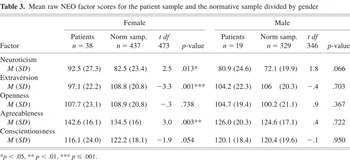
In the personality factors the patients differed significantly from the Swedish normative sample with higher scores on neuroticism and lower scores on extraversion (Table 2). Furthermore, agreeableness was found to be significantly higher among the patients. No differences were found regarding either the openness or the conscientiousness factors. The female patients, compared to the females in the normative sample, scored higher regarding neuroticism (p = .013) and agreeableness (p = .003) as well as lower regarding extraversion (p = .001; Table 3). The male patients did not differ from those in the normative sample on any of the personality factors (Table 3).
Comparison between the patient sample and the normative sample regarding mean raw scores of NEO factors

Mean raw NEO factor scores for the patient sample and the normative sample divided by gender

No significant differences were revealed regarding the five personality factors when we compared the male patients and female patients, using T-scores based on sex.
The female patients scored significantly higher than the male patients on HADS-A (female patients: mean = 10.1 ± 4.5 vs. male patients: mean = 6.9 ± 4.2, t = 2.6, p = .012) and HADS-D (female patients: mean = 9.3 ± 4.4 vs. male patients: mean = 5.9 ± 3.7, t = 2.8, p = .007). The mean levels of the females were above the proposed cut off score (≥8 points, see Methods) indicating the presence of a possible emotional disorder. Whereas 25 of the female patients (66%) scored ≥8 points on HADS-A only 6 male patients (32%) did so. Regarding HADS-D, 28 of the female patients (74%) scored ≥8 points whereas 6 of the males did (32%).
Fifty-eight percent of the female patients had OMI compared to 42% for the men. This difference was, however, not significant (Table 4).
Mean NEO factor T-scores and HADS raw-scores of patients with (OMI) and without (SMI) objectively verified memory impairment

As shown in Table 4, no significant differences were revealed regarding the five personality factors or the HADS scores when the two patient groups (OMI vs. SMI) were compared. Furthermore, there were no differences regarding age (p = .26), educational level (p = .951), or results on MMSE (p = .79).
The OMI and SMI groups were divided by gender in order to explore potential gender differences regarding the five personality factors and symptoms of anxiety and depression. Despite the small numbers in these groups (male OMI n = 8, male SMI n = 11) significant differences were found with the male OMI group having a significantly higher mean level than the male SMI group on the neuroticism factor (OMI: mean = 62.5 ± 11.8 vs. SMI: mean = 47.45 ± 6.3, t = 3.27, p = .009 equal variance not assumed) and a significantly lower mean level on the conscientiousness factor (OMI: mean = 43.5 ± 9.3 vs. SMI: mean = 54.55 ± 6.3, t = −3.1, p = .007). No significant differences were found for any of these seven explored variables in the female sub samples of OMI (n = 22) and SMI (n = 16). Corresponding p-values for female patient groups (OMI vs. SMI) were p = .870 (neuroticism) and p = .876 (conscientiousness). Comparisons with nonparametric tests yielded similar results.
The revealed gender differences led to a further exploration of the five personality factors, HADS-A and HADS-D and their potential interaction with gender and memory performance (OMI or SMI) when age was considered. A significant interaction was found regarding the neuroticism factor (β = −15.7, p < .015, 95% CI −28.3 − −3.1). The male OMI group had the highest level of neuroticism and the male SMI group the lowest (Fig. 1). The female patients had an intermediate level of neuroticism and did not differ regardless of whether they had OMI or SMI. Except for the neuroticism factor, no significant interaction effects were found for the other four personality factors. Furthermore, for HADS-D a significant interaction of gender and memory was found (β = −4.9, p < .038, 95% CI −9.59 − −.27). Female patients with SMI had the highest level of depressive symptoms and male patients with SMI the lowest (Fig. 2). Male and female patients with OMI had an equal and intermediate level. A similar pattern, although not significant (p = .143), was also found for HADS-A.

Memory performance by gender interaction with neuroticism.

Memory performance by gender interaction with depressive symptoms.
DISCUSSION
Personality Characteristics
In the present study of patients with memory complaints only half of them had test verified memory impairment (OMI). The lack of objective memory impairment in the remaining patients may reflect other possible causes of the experienced memory failure such as psychosocial stress or personality characteristics as described in other studies (Jonker et al., 2000).
The patients differed significantly from a normative group on three of the five personality factors; they were lower on extraversion, higher on neuroticism and agreeableness. Our results are in line with earlier studies showing memory complaints to be significantly associated with low extraversion (Jorm et al., 2004) and high neuroticism (Comijs et al., 2002; Jorm et al., 2004; Pearman & Storandt, 2004). However, personality profiles with low extraversion and high neuroticism have not only been found in patients with memory complaints—similar personality characteristics, in combination with reduced conscientiousness, agreeableness, and openness, have also been described in patients with dementia and even in patients with isolated memory disorder (Chatterjee et al., 1992; Siegler et al., 1991). Our hypothesis that the conscientiousness factor would be lower in this patient sample than in the normative group was not confirmed.
Gender Differences
Gender differences regarding memory complaints (Derouesné et al., 1999; Jonker et al., 2000) and memory self-evaluation (Herzog & Rodgers, 1989; West et al., 2002) have been reported. In our clinical sample the female patients were in the majority and significantly younger than the male patients. Gender differences in health care seeking behavior have been described. Men, as a group, have been found to seek professional help less frequently than women, despite findings indicating that men suffer from poorer health than women (Addis & Mahalik, 2003). These findings seem to be consistent in men of various age groups, nationalities, ethnical and racial backgrounds as well as in different medical or mental health settings (Addis & Mahalik, 2003). In our study no difference was found regarding the proportion of patients with OMI in the male group compared to the female group. Instead, other interesting differences were detected when the sample was divided by gender. The significant differences regarding personality characteristics between the patients in our sample and the normative group were principally because of the characteristics of the female patients. They differed significantly from the females in the normative group on three of the five factors whereas male patients did not differ from the males in the normative group. There was a greater degree of agreeableness in the female patients than in the female normative group. Previous studies have reported a reduction of agreeableness among patients with manifest dementia (Chatterjee et al., 1992; Siegler et al., 1991) and a slight decrease in patients with depression (McCrae & Costa, 2003) but our findings point to the contrary. The agreeableness factor refers to an interpersonal dimension of personality and represents a positive attitude towards others. It might be safe to assume that this positive attitude of the female patients in our study leads to medical advice being sought when difficulties are experienced. Support for this assumption is found in a study by Cox et al. (2005) showing that patients, men and women, seeking hearing aid in the private practice system scored higher on agreeableness than the general population. No significant differences were found regarding the personality factors between the male and female patients (using scores adjusted for sex). This lack of differences might partly be attributed to our small male sample.
The female patients scored significantly higher than the male patients on symptoms of depression and anxiety on the HADS. Several studies using the HADS in medical settings have shown that female patients scored higher on the HADS-A but, in most studies, not on the HADS-D. Furthermore, these studies have shown age effects on both subscales (Herrmann, 1997). In our study, the female patients' higher level of anxiety corresponds to what might be expected when the gender effect and the relevant age spans were taken into account. However, the differences regarding symptoms of depression cannot be generalized with regard to age or gender.
Comparisons Between the SMI and the OMI Groups
Different clinical concepts have been suggested to describe memory impairment such as age-associated memory impairment (Crook et al., 1986), cognitive impairment no dementia (Graham et al., 1997) and MCI (Petersen et al., 1999). In this study we used the concepts SMI and OMI to denote the difference between the conditions. Our findings have revealed similarities between personality characteristics and affective status among patients with memory complaint, irrespective of objective verification. To our knowledge, this has not been reported previously.
Our study is cross-sectional and no changes or causal relationships could be established. Similar personality characteristics could reflect different aetiologies. The findings might correspond to the premorbid personality of these patients and thus, to some extent, be an effect of help seeking bias. That explanation might be valid for both SMI and OMI patients. A recent study revealed that in both the participants with objective memory impairment on test and in the age-stratified controls, neuroticism was positively and significantly associated with subjective cognitive complaints (Kliegel et al., 2005). Neuroticism, followed by gender, had the strongest effect on subjective cognitive complaints in the former group. In the latter group, depressive affect had the strongest effect followed by neuroticism, age and gender. For some patients in our study, it could be assumed that the results reflect a change of personality.
Interaction Effects
Neuroticism and symptoms of depression interacted with memory performance and gender. The female patients had a moderately increased level of neuroticism, which remained approximately the same whether they had OMI or SMI. The male patients with OMI had a more pronounced increase of neuroticism than the female patients, whereas the males with SMI had a low level of neuroticism. Could it be that men with increased levels of neuroticism are more likely to seek help when they experience memory problems than men with lower levels of neuroticism? Women tend to seek help even with moderately increased levels of neuroticism. Help-seeking bias could be an explanation as to why gender interacted with memory performance in the prediction of neuroticism. The high level of neuroticism and the low level of conscientiousness found in the male patients with OMI may reflect a change of personality as a result of the same process that renders impaired memory (Chatterjee et al., 1992; Siegler et al., 1991). It has been found that lower neuroticism is associated with higher levels of health promoting behavior in young adults (Kikuchi et al., 1999). If seeking medical advice when difficulties are experienced could be regarded as health promoting behavior, the low level of neuroticism might partly explain why male patients with SMI sought help at the Memory Clinic. Regarding HADS-D, male and female patients with OMI reported equal levels indicating a possible depressive episode. This finding is in line with previous results with the absence of significant gender differences regarding depressive symptoms in clinical groups (Herrmann, 1997). Male patients with SMI scored low on HADS-D, which was in line with their low level of neuroticism. Female patients with SMI, on the other hand, scored even higher on HADS-D than female patients with OMI. Based on previous findings, it could be proposed that women tend to experience a lower memory function than men (Herzog & Rodgers, 1989; West et al., 2002). Women report more rumination, lower mastery, and more chronic strain than men (Nolan-Hoeksema et al., 1999). Furthermore, low mastery and chronic strain, mediated through rumination, were positively correlated with depressive symptoms. The enhanced level of depressive symptoms and neuroticism among the female patients in our sample, possibly in combination with rumination over experiences of memory failure, might have contributed to the decision to seek health care. This suggested explanation does not, however, apply to the males with SMI. Their reasons for seeking health care remain obscure.
Methodological Considerations
Parametric statistical methods were applied since the distributions were approximately normal despite the existence of outliers. However, the results were found to be essentially the same when applying non-parametric methods as well as when the outliers were excluded from the analyses. Several analyses have been performed at the risk of committing a Type I error. However, the differences regarding personality factors between patients and the normative group were in keeping with our hypothesis regarding neuroticism and extraversion. Although the sample in this study is thoroughly assessed, the results need to be reproduced in various settings and in bigger samples in order to be generalized.
This approach does not provide the information required to ascertain whether this patient group differs from other patient groups seeking medical aid. However, according to McCrae & Costa (2003), deterioration in physical health was unrelated to personality changes in a sample of volunteers, divided into three groups (healthy, having a minor disease or a major disease).
CONCLUSION
The diagnostic validity of subjective memory complaints is questionable. The subjective memory complaints were not associated with objective memory performance in nearly half of the patients. The clinical pictures differ between male and female patients regarding affective symptoms despite the lack of difference regarding the proportion of objective memory impairment. This could result in a failure to observe objective memory impairment in patients with anxiety and depressed mood as well as in those with high levels of neuroticism. Our findings demonstrate the importance of applying an objective assessment of memory function and a gender perspective when studying patients with memory complaints.
ACKNOWLEDGMENTS
This research was financially supported by the University Hospital in Lund, Sweden and by grants from the Alzheimer Foundation, Sweden, the Sjöbring Foundation, the Stohne Foundation, and the Siegvald Foundation. The authors thank the staff at the Memory Clinic at the University Hospital of Lund, Sweden, for their contribution to the research. They also thank Jonas Björk and Martin Bäckström for statistical advice and Siv Börjesson, Ulla Ängquist and Helena Andersson for technical assistance.