1. Understanding Zambia's growth
As Zambia celebrates 50 years of independence, a surprising feature of its history is just how unsuccessfully three consecutive democratically-elected, post-colonial governments have converted the country's abundant natural resources and relatively stable past into sustainable economic growth. At Independence in 1964, Zambia was widely regarded as one of the wealthiest independent states to have emerged from colonial Africa, its economy buoyed by substantial copper and cobalt endowments, mining infrastructure, and foreign reserves.Footnote 1 However, after 27 years of leadership by President Kenneth Kaunda and his United National Independence Party (UNIP), Zambia had, by 1991, been transformed into one of Africa's poorest.Footnote 2 Despite dramatic political and economic reform towards a market economy in the 1990s, the consequences of these first 27 years are still evident today.Footnote 3
Early analysis of this dismal performance had assigned direct causality to either the ‘policy’ argument, i.e. specific political and economic decisions taken by the UNIP government, or the ‘non-policy’ argument, i.e. the effects of exogenous features including Zambia's colonial legacy, resource curse and the country's geography.Footnote 4 However, while contributing a great deal to our understanding of the effects of specific factors, neither the ‘policy’ nor the ‘non-policy’ argument on its own has satisfactorily explained why Zambia underperformed so many states that followed similar socialist policies or inherited comparable colonial histories and/or geographies. To move this analysis forward, proponents of New Institutional Economics (NIE) have sought to re-approach the problem by bringing together both these lines of argument to uncover the institutional framework that may have helped compound several individual factors, for example how a policy of political exclusivity (the One-Party State in Zambia, for example) may have altered the economy's access to mineral wealth, or how economic exclusivity (for example, by placing all land under the legal ownership of President Kaunda) may have distorted agricultural production.
2. The institutional approach
In their popular book ‘Why Nations Fail’, Daron Acemoglu and James Robinson have recently argued that a history of poor political institutions frequently leads to weak economic performance.Footnote 5 Their approach is not new but builds on Douglass North and Barry Weingast's seminal 1989 argument that the institutions maintained in England after its Glorious Revolution in 1688 gave its Government the ‘credible commitment’ to property rights that later facilitated its access to crucial funds. In developing this argument, Acemoglu and Robinson have differentiated between two types of institutions – what they term ‘inclusive’ and ‘extractive’ – loosely defined as those institutions that empower and distribute wealth to a broad section of society, and those that do not. Under their analysis, ‘inclusive’ institutions have actively encouraged improvements in economic development in countries like the United States and Australia, while more ‘extractive’ institutions have achieved exactly the opposite in Mexico and North Korea.
Applying a similar argument to Zambia, Sophia and Stan du Plessis have convincingly shown an econometric link between one measure of institutional quality (Clague et al.'s Reference Clague, Keefer, Knack and Olson1999 concept of ‘contract-intensive money’) and the underperformance of the Zambian economy (measured as its gross domestic product per person). To date their work stands as the best application of the NIE framework to the Zambian case, and they convincingly show that one measure of institutional weakening in Zambia between 1968 and 1975 can be statistically related to Zambia's economic decline. However, while observing that two proxies – ‘contract-intensive money’ and ‘gross domestic product per capita’ – are related in Zambia, they fail to explain how this may be so, or indeed propose any mechanism through which their chosen measure of falling institutional quality may have actually translated into slow economic growth. In North and Weingast's historically based example, they explained this as the result of England's improved funding terms following their ‘credible commitment’ to the institutions understood to be important to investors – particularly the enforcement of property rights through the rule of law. The du Plessis’ omission of this important explanatory step – the how institutional change affected economic outcomes – is not uncommon in the still theoretically biased field of NIE, but puts their argument at risk of omitting alternative explanatory factors. For example, might there be a third factor to which both of their chosen proxies are related, such as the growth of the informal cash economy as a factor in reducing both the contract intensity of transactions, and their measurement of the formal economy?
3. Method and hypothesis
This study tests, therefore, whether there is sufficient evidence in Zambia's history to support du Plessis and du Plessis’ argument that poor institutional quality contributed to the county's slow economic growth since independence. The study begins by posing the hypothesis that du Plessis and du Plessis’ econometric analysis is not sufficiently supported by historical evidence, but instead is the result of an alternative, and yet unrecognized factor. Alternatively, if this cannot be shown, and sufficient historical evidence can be found to support this link, then the hypotheses will not be rejected, and the historical evidence will serve as support for du Plessis and du Plessis’ study and the NIE analysis of Zambia's economic history more generally.
The paper presents historical evidence from the first 10 years of Zambian independence, and highlights four important institutional changes that Asiedu (Reference Asiedu2003: 620) has shown to be important to economic development, namely: constitutional supremacy, the state's commitment to the independence of the judiciary, the independence of the press, and the independence of the legislature. The paper discusses the potential link between changes in these important institutions and a pivotal decision by President Kaunda to hastily refinance two large loans that the Zambian government held with the county's largest investors. The paper goes on to present the deeper economic impact of this action, including how investors reacted to it, and how their response may have choked the Zambian economy after 1973.
Henisz (Reference Henisz2004) and Easterly (Reference Easterly2005) have both argued for the importance of policy stability to foreign investment, and Asiedu (Reference Asiedu2003) has explained how more ‘inclusive’, less centralised political decision-making can make policy more considered and predictable by improving checks and balances. Like in North and Weingast's (Reference North and Weingast1989: 808) argument that ‘credible restrictions on the state's ability to manipulate economic rules to the advantage of itself and its constituents’ secured England's access to critical funds in the 17th and 18th century, dwindling institutional constraint on Kaunda and his subsequent actions may have had the opposite effect on the Zambian economy in the 20th century. This paper, therefore, focuses on recorded events from Zambia's recent past to try and establish if sufficient historical evidence exists to show how institutional change following Zambia's independence may have been, or perceived as being, destabilising and discouraging of foreign investment.
4. Change in Zambia 1964–1974
In 1968, just four years after independence under the country's new Republican Constitution, President Kaunda announced the first of Zambia's economic reforms aimed at achieving ‘economic independence’. The reforms included the compulsory acquisition by the Zambian State of a 51 percent share of privately owned businesses and the restriction of dividend distributions outside of Zambia.Footnote 6 Kaunda initially excluded Zambia's Copper mines from this reform, but a year later announced the second tranche of reforms which outlined the new terms under which Zambia's two largest mining companies – ZamAnglo (a subsidiary of the South African-owned Anglo American Corporation) and Roan Selection Trust (RST, an American-owned company) – would be allowed to continue operations, including the compulsory sale to the State of 51 percent of their companies at ‘book value’.Footnote 7 Surprising to some, management and owners of the foreign-controlled mines initially welcomed the reforms, recognizing the potential long-term value of a partnership with the State and the promised stability it brought.Footnote 8 At least on the face of it, the synergistic effect to the Zambian economy of foreign capital and know-how, coupled with agreeable government policy, facilitated opportunities to extract mineral rents that neither the foreign companies nor the Zambian government could have accessed alone.
Withdrawing constitutional supremacy
However, while the economic reforms of 1968–69 were widely seen as beneficial to both the mining companies and the country, deeper institutional change after 1969 was seen quite differently and had a far more profound impact on Zambia's economy. In June 1969 the ruling UNIP (holding 55 of the 75 parliamentary seats, 73 percent) announced plans to hold a referendum giving a simple two-thirds majority in Parliament the power to alter the entrenched clauses of the National Constitution, including its Bill of Rights. UNIP leaders argued that because independence negotiations with Britain had been rushed, the Constitution included clauses that many Zambians could do without.Footnote 9 In a national television broadcast on the eve of the referendum, Kaunda ominously explained to the Zambian people that constitutions would not ‘. . .prevent a dictator in this country from rising and plunging the nation into misery and bloodshed’.Footnote 10 Despite considerable criticism from both opposition parties and the press, Kaunda succeeded in convincing an astonishing 85 percent of those who voted in what the press dubbed the ‘referendum to end all referendums’.Footnote 11
UNIP's success in subverting constitutional supremacy, coupled with its overwhelming majority in Parliament, submitted the Republic's laws to the will of a far less ‘inclusive’ group of UNIP-controlled policy-makers. Furthermore, the landslide victory in the referendum showed both a public confidence in the Government and a willingness to simplify responsibility – in other words, if the Government claimed confidence in performing without constitutional constraint, then the people seemed willing to bestow that responsibility upon them.
Threatening judicial independence
The political exclusivity that the referendum facilitated soon began to affect other important institutions as well. Less than a month after the referendum, two of Zambia's most senior judges (who happened to be white) were forced to leave the country after Zambian police failed to defend the High Court from violent UNIP supporters carrying placards declaring ‘The only good white man is a dead one’ and ‘A white man will never be a Zambian’.Footnote 12 Chief Justice James Skinner immediately fled the country, followed days later by a second senior judge.Footnote 13
Their decision to leave was not exclusively motivated by the Government's failure to defend the courts from petty politics. Two weeks earlier, after successfully defending two Asian businessmen and opposition parliamentarians, the State had declared another senior judge a prohibited immigrant and deported him.Footnote 14 Skinner never returned to his position in Zambia, instead accepting the same role in neighboring Malawi in 1970.Footnote 15
The loss of three highly qualified judges made the Judiciary a far less ‘inclusive’ institution and raised the focus on UNIP to deliver acceptable judicial outcomes. While not obviously ‘extractive’, the growing perception of UNIP as the central body of control to the exclusion of independent institutions amplified a political feedback loop; it did so by removing important filters (the law in this case) that the Government had previously relied on to help manage public expectations.
Ending press freedom
While UNIP policies appeared to enjoy widespread support in the capital Lusaka and in national referendums, media reports by 1971 were becoming increasingly critical. In reaction to one disapproving report in the most widely-read daily newspaper the Times of Zambia, Kaunda requested in an informal letter to the owners of the paper that ‘anti-government fellows’ be removed and replaced with what he called more ‘progressive chaps’.Footnote 16 When nothing came of his request, and after the Times printed statements critical of UNIP's detention of opposition members, Kaunda took things into his own hands and personally ordered the removal of the Editor, replacing him with a UNIP-faithful diplomat with no journalistic experience.Footnote 17 In the months that followed, a series of senior members of the newspaper were declared ‘prohibited immigrants’ and given 48 hours to leave the country.Footnote 18 By late 1972 the resulting UNIP-dominated press formally accepted a perverse proposal to pursue a policy to ‘counteract malicious propaganda aimed at Zambia both within and outside the country’.Footnote 19
The removal of independent voices from the policy debate further raised the dissonance between political expectations and economic reality, and in doing so amplified potential reaction to economic delivery, thereby threatening the consistency (or stability) of future policy.
Loss of independent legislature – the One-Party State
A fourth significant institutional shift came in February 1972, when in an early example of inconsistent policy-making Kaunda reversed his earlier policy and announced plans to draw up an entirely new Constitution and endow Zambia with the apparatus of a One-Party State.Footnote 20 By August 1972, without the protection of constitutional entrenchment and following an unsuccessful legal appeal by the leading opposition party to a now UNIP-controlled judiciary, a Bill was passed making it illegal ‘belonging to, expressing opinion, or doing anything in sympathy with’ any opposition party.Footnote 21
Zambia was, thus, placed under the exclusive and seemingly permanent legal control of UNIP. At a National Council meeting that December, the Council recorded its belief that Zambia had no further need for a ‘Bill of Rights’ as long as President Kaunda remained its Executive.Footnote 22 One doting telegram congratulating UNIP on its new position called for Kaunda to be endowed with the Presidency for life, while another requested UNIP be made ‘supreme over anything under the sun except God’.Footnote 23
In August 1973, a new and less ‘inclusive’ Constitution was presented to Parliament, reordering power by submitting Parliament to the decisions of the UNIP Central Committee and placing this Committee under the control of the President. Despite some debate over the potential merits of this far less ‘inclusive’ form of government and the risks of centralizing power in a small elite, the Bill unsurprisingly received the requisite two-thirds majority in the now purely UNIP Parliament and was passed into law.Footnote 24
Some months later Kaunda issued new and even more exclusive ‘Guidelines for the Central Committee’, reinforcing the ‘supremacy’ of the small UNIP Committee over Parliament and, thus, over policy.Footnote 25 In his words, ‘Members of the Central Committee are policy-makers . . . it is your duty to initiate policy, suggest concrete action. This must be done by your offices in your offices’ . . . ‘you cannot appeal to Cabinet Ministers. Your duty as a Central Committee is to direct other institutions to take appropriate measures’.Footnote 26 As President of UNIP and head of the Central Committee, Kaunda was effectively reminding the UNIP elite of his personal control of Parliament. The Cabinet was to act as the administrative branch of the Central Committee, rubber-stamping laws at the direction (and discretion) of the policy-making Central Committee. The implementation of the One-Party State was perhaps the pinnacle of political centralization and de-institutionalization in Zambia. With all other political voices silenced, all focus fell on UNIP to deliver on its political promises.
For foreign investors, the growing centralization of UNIP's political and economic control had important implications; records suggest that from ZamAnglo and RST's perspective, UNIP was a valued partner in their mining activities, and as long as property rights were respected, the mines could feel confident that their joint interests would be protected, because UNIP's revenue objective was closely aligned to their own. However, even in a present environment of conducive policy, the mines were aware of the risks associated with a potential increase in policy volatility that the removal of restraining ‘inclusive’ institutions brought, and the investment of new capital would have to account for this change. In the end, it appears to have been the second of these important implications that played the dominant role in shaping capital investment in Zambia's mining industry for the next 20 years.
An immediate outcome
Just six days after announcing Zambia's new Constitution in August 1973, and without consultation with the Ministry of Finance, the Bank of Zambia, or mine managers, Kaunda announced the immediate abrogation of the management contracts that the Government held with its international mining partners.Footnote 27 The contracts had been entrenched in the terms of the original nationalization agreements in 1969 to ensure present and future investors of continued professional management of investments in Zambia, and if abrogated by the Government would trigger the full redemption of its outstanding debt to investors.Footnote 28 In order to force ZamAnglo and RST to accept local management, the Government would refinance the debt it had issued to purchase its 51 percent stake in the mines.Footnote 29
With three years of interest and principal payments already made, the total outstanding on the bonds amounted to USD 177 million.Footnote 30 Owing to the relatively low coupon rate initially agreed by the mines of just 6 percent, and the growing perception of risk that the Government might default, by August 1973 the bonds were trading on the London and Paris exchanges at just 48 percent of their face value (Sardanis, Reference Sardanis2007: 17). By failing to take advice and by canceling the management contracts, the Government triggered a bond redemption instead of implementing a bond buy-back, thereby announcing the settlement of the bonds at 100 percent, rather than repurchasing them for less than half that amount. Once announced, there was no going back. The market reacted immediately and the bonds converged on 100 percent of their face value, representing a substantial windfall for the bond-holders, who were mainly the foreign mining companies.Footnote 31
While it is unlikely that the Government could have purchased the greater share of its bonds back at 48 percent, it is likely that with some negotiation it could have agreed a repurchase at far less than face value. In foreign exchange terms, this first mistake therefore cost the Government anything up to the 52 percent, or USD 92 million, more than it needed to. Also, because of Kaunda's growing exclusive control of policy, the Ministry of Finance and the Bank of Zambia had not been consulted on the decision and as a consequence had no choice but to hurriedly find new funding to cover the redemptions Kaunda had announced.Footnote 32
After rushed investigations into potential sources of funds revealed the potentially crippling borrowing cost of raising nearly USD 150 million on the long-term fixed rate bond market, the UNIP-controlled Ministry of Finance hastily settled on an initially cheaper – but highly risky – floating rate loan, tied to a spread over the floating ‘Interbank’ Offer Rate.Footnote 33 The Times of Zambia's Business Review reported the terms of the first USD 100 million leg of this enormous Eurobond loan at the end of September 1973 as: ‘Interbank’ +1.25% for 5 years, ‘Interbank’ +1.5% for the following 3 years, and ‘Interbank’ +1.75% for the last 2 years.Footnote 34 With ‘Interbank’ rates around 7 percent, interest began at around 8.2 percent, already 2.25 percent higher than what had been paid to the mines (on the full USD 150 million this would cost USD 3.38 million extra per year). However, years later as USD ‘Interbank’ rates rose to exceed 20 percent by 1980, interest on the bonds grew to almost 22 percent, or 16 percent (USD 24 million per year) more than the Government had been previously paying the mines.Footnote 35 Hidden within Zambia's growing debt numbers after 1973 was interest on this transaction of more than USD 200 million, more than three times what the Government had originally committed to pay the mines and 10 times its education budget.Footnote 36
To add insult to injury, unilateral cancellation of the management contracts (Kaunda's stated objective of the refinancing) later cost the Government a further ZMK 55 million (USD 66 million), after it was forced to pay ZMK 22 million to RST and ZMK 33 million to ZamAnglo in compensation for the residual value of the management contracts themselves, bringing the total cost of the decision to far in excess of USD 250 million or more than a third of Zambia's annual GDP (Larmer, Reference Larmer2010: 117). (It is important to note that USD 250 million in 1973 equates to almost USD 1.5 billion in 2014 terms). This added to the more than USD 1 billion which some estimate by 1981 to have been the cost to the Government of appointing inexperienced local mine management. Kaunda's decision proved very expensive indeed (Stoever, Reference Stoever1985).
Andrew Sardanis, the previous head of Zambia's parastatal Industrial Development Corporation (INDECO), and the official who had negotiated the original nationalization of the mines and the management contracts, later described the transaction as ‘either wholly political or partly corrupt, but had no economic merit at all’. Valentine Musakanya, previous Minister of State, Bank Governor, and head of the Civil Service was equally appalled; in an analysis written some years later Musakanya asserted that the real tragedy of the whole affair was that through UNIP's exclusive political hierarchy, Kaunda had been able to commit the State to more than USD 150 million of debt without even informing Parliament, the Ministry of Finance or the Bank of Zambia (Larmer, Reference Larmer2010: 116–117).
On the face of it, the redemption appeared profitable to the mining companies; both would receive repayment of their loans in full as well as the present value of the remaining management contracts they held. However, in reaction to Kaunda's surprise decision, both ZamAnglo and RST immediately disinvested the capital freed up by the redemption. ZamAnglo announced the disinvestment of USD 81 million from Zambia for reinvestment in the less risky Engelhard Minerals & Chemical Corp in the United States.Footnote 37 ZamAnglo, Zambia's largest investor before 1973, would not invest again until 1999, only returning after a change in government, institutional reform, and eight years of policy stability.Footnote 38 RST repatriated its cash and declared a substantial dividend to its mainly American shareholders. RST would never invest in Zambia again.
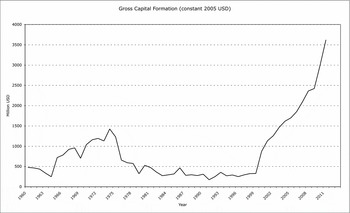
The effect of throttling capital investment to Zambia's resource-based economy should not be underemphasized; at Independence in 1964, copper sales accounted for 47 per cent of the country's GDP and 92 per cent of its export earnings, and investment by ZamAnglo and RST made possible much of this highly capital intensive economy.Footnote 39 In fact, Kaunda's 1973 announcement coincides with an important turning point in Zambia's relationship with foreign capital. According to the World Bank, gross capital formation in Zambia fell dramatically from its peak in 1974, to just 25 per cent in real terms over the following 10 years, not recovering again until 2003, as can be clearly seen in Figure 1.Footnote 40
Gross capital formation in Zambia 1960–2012. Source: World bank, World development indicators.

The decision by the mining companies in 1973 to stop, or reverse, investment can be seen as a response to the growing volatility in Zambia's policy environment, particularly evident in surprise announcements by Kaunda. Four important institutional events – the discharge of constitutional supremacy, reduced judicial independence, the muffling of the press, and the loss of independence of the legislature – had systematically unraveled institutional constraint on Zambia's executive and government. However, degraded institutions by themselves do not explain how by 1980 Zambia had transitioned from its relatively wealthy position at Independence to one of the poorest countries in the world. In fact, while the Government's nationalizations in 1968–69 and their cancellation of foreign management contracts in 1973 had the effect of exposing the Government to new expensive debt, Libby and Woakes (Reference Libby and Woakes1980: 33) and Faber and Potter (Reference Faber and Potter1971: 125–126) have each pointed out that the terms under which the Government acquired ownership should have more than made up for the increased financial cost. The perverse economic consequences brought about by degraded institutions must, therefore, be more fully explained.
5. Discussion – a mechanism
At the heart of the Government's economic development plan in 1964 was the conversion of its natural resource endowment into economic and social development. In a highly influential 1964 Economic Survey, Dudley Seers (Reference Seers1964) expressed confidence that the Zambian Government could convert the country's vast natural capital into economic development, as long as it could attract and maintain sufficient economic and human capital to do so. Indeed, at Independence the Government found itself well positioned to access this natural capital; during 41 years of colonial rule the Zambian economy had developed the fixed capital and infrastructure capable of extracting more than USD 700 million copper per year, almost 15 percent of world production (Bostock, Reference Bostock1972: 4, Hill and McPherson, Reference Hill and McPherson2004: 30, Meller and Simpasa, Reference Meller and Simpasa2011). However, while being resource-rich and endowed with considerable fixed capital, the economy had quite limited access to domestic financial capital, partly due to its relatively small domestic formal economy and its exceptionally low domestic savings rate (Melzer, Reference Melzer2007). As Seers (Reference Seers1964: 121) pointed out, Zambia relied heavily on foreign investment and loans to develop its mines.
To access this foreign capital the Zambian economy had to compete in the international market for financial investment. As in North and Weingast's example of 17th century England, Zambia's success (or failure) to access these capital markets arguably held the key to its economic success; if it failed to attract capital at the right price, it would fail to unlock and profit from its mineral wealth, and thereby fail to develop its economy more broadly.
Theories of investor decision-making offer a useful way to approach the challenge of understanding reactions by investors to the Zambian Government's actions in the 1970s, and may help explain the financial consequences of institutional change in Zambia. Within the broad field of financial decision-making theory, rational investors are seen to judge competing investment opportunities on their probability of delivering competitive returns, and investments perceived as higher risk tend to attract higher returns to compensate investors for the increased probability of losing some or all of their investment.Footnote 41 Perhaps unsurprisingly, policy stability has been shown to be a leading determinant of foreign investment to Sub-Saharan Africa (Asiedu, Reference Asiedu2006, Guisinger et al., Reference Guisinger, Mason, Hood and Young1985), and a significant body of work including Ramey and Ramey (Reference Ramey and Ramey1995) and Imbs (Reference Imbs2003) has demonstrated that countries with a history of greater policy volatility – i.e. sudden and frequent policy changes – have in the long run achieved only modest growth.
However, even if a government has recognized the need for stable policy, under a dynamic political backdrop, maintaining time-independent policy is fraught with challenges; as reactions to policies evolve, so does political motivation to adjust them. A good example of this occurred in Zambia. In 1969 the UNIP Government's decision to allow foreign management of the mines in exchange for a commitment to ‘Zambianise’ the work force (the preferential promotion of Zambian nationals) was met with popular support. But by 1973 the perception that the Government had not gone far enough in wresting control from foreign influences brought sufficient political pressure to reverse its agreements – an unfortunate economic but arguably rational political reaction to the evolving realities.
Kydland and Prescott (Reference Kydland and Prescott1977) explain how just such discretionary policy can result in sub-optimal outcomes through seemingly optimal decisions later becoming less optimal under cycles of reaction and feedback from rational agents. In their view, in order to mitigate the time-inconsistent policy such feedback may produce, it may be preferable to follow a set of guidelines. For example, while UNIP's growing control of the economy through a policy of partnership with the mines was initially considered optimal, it raised the electorate's expectations of the Government's ability to deliver, elevating the threshold of what was considered acceptable, and ultimately inducing UNIP to significantly modify its policy and take further control. Indeed, as Persson and Tabellini (Reference Persson and Tabellini1994) point out, politically appointed policy-makers are colored by their own political ambition, an observation quite fitting to the growing centrality of UNIP to Zambia's Government. As UNIP's control grew, so did the potential for economic-political feedback, creating a vicious circle that translated political pressure into evermore short-term and less ‘inclusive’ economic decisions. This may explain how the loss of one or two ‘inclusive’ institutions in Zambia quickly precipitated the loss of others, nucleating a broad slide in institutional quality. It may also more broadly explain how institutional quality can quickly decline.
In contrast, delegating some control away from the President and UNIP's Central Committee to independent, non-politicized institutions might have dampened this feedback loop and added policy stability. Elsewhere Henisz (Reference Henisz2004: 1) has found empirical evidence of this relationship between institutional quality and policy stability; specifically that ‘checks and balances that limit the discretion of policy-makers reduce the volatility of government expenditure and revenue’. On this point both Acemoglu et al. (Reference Acemoglu, Johnson, Robinson and Thaicharoen2003) and Easterly (Reference Easterly2005) agree, with the latter going so far as to argue that in explaining economic growth, policy serves as little more than a proxy for the institutions that constrain them.
Following this argument, institutional degradation in Zambia may have manifested itself in reduced policy constraint, which in turn was interpreted by observers – including ZamAnglo and RST – as a likelihood of increased future policy volatility. If this was true, it would have been considered when seeking future investment opportunities in Zambia. In a statement to shareholders in December 1969, six months after the withdrawal of constitutional supremacy, Chairman of Anglo-American Harry Oppenheimer made his view quite clear, stating that changes in Zambia were ‘not encouraging to new enterprise’ and ominously concluding that it would make it ‘easier than it was to assess the viability of new projects’.Footnote 42
Oppenheimer's reaction is perhaps unsurprising. An increase in policy volatility had increased the risk of foreign investment in Zambia, making opportunities less competitive with those available elsewhere. In the same letter to shareholders Oppenheimer explained that: ‘Since 94 percent of our shareholders are resident outside Zambia it will obviously be inappropriate, in the new circumstances, for us to remain registered in Zambia and we also are in the process of moving to Bermuda’.Footnote 43 While not explicitly announcing a full disinvestment from Zambia, Oppenheimer's comments can be seen as a cautious move to ‘wait and see’, while his investment advisors in his words ‘. . .actively look for new business both in Zambia and elsewhere’.Footnote 44
This analysis of ZamAnglo's actions as the option to ‘wait and see’, i.e. delaying further investment until additional information or alternative opportunities appear, fits well with the work of Fisher (Reference Fisher1930) and later Myers (Reference Myers1981) on how businesses make capital investment decisions under uncertainty. Under their analysis, the higher the expected volatility of the investment environment, the higher the value of the option to invest; if this option value exceeds the probable return on committing to an investment, their theory predicts that rational investors retain their option and wait, maximizing their opportunity while minimizing their obligation.
Following this early work by Fisher, Black and Scholes (Reference Black and Scholes1973) devised a widely accepted analytical model describing the relationship between investors’ subjective interpretation of future volatility and the value they place on an option. Known as the Black-Scholes model, it has since the 1970s become recognized as the industry standard for valuing simple options and shows how as perceptions of future volatility increases (for example, when constraints on policy formation are weakening) so does the value of the option to invest. When applied to the Zambian case, as institutional constraint on President Kaunda began to decline after 1969, investors’ perception of potential policy volatility began to rise – a perception later proved fair by Kaunda's 1973 surprise decision to reverse the important agreements the Government held with its two largest investors.
Following this policy U-turn, Oppenheimer made a further announcement to shareholders explaining that Kaunda's shift would ‘greatly enhance the chances of successfully implementing ZamAnglo's policy of seeking new business opportunities on a worldwide basis’.Footnote 45 Seemingly valuing its option to ‘wait and see’ on Zambian investment higher than the expected rents available from mining copper there, Anglo American quickly repatriated the proceeds of the bond settlement following Oppenheimer's statement and did not reinvest in Zambia until fundamental institutional reform had been implemented in 1999.
6. Conclusion
This paper has presented historical evidence of one mechanism through which the previously established econometric relationship between institutional quality and economic growth in Zambia may have manifested itself. The paper has shown how UNIP's purposeful and systematic reduction of institutional constraint on President Kaunda appears to have been interpreted by foreign investors as the increased potential for policy volatility, and as such discouraged investment. In the most direct and observable outcome of this, Zambia's two largest investors, ZamAnglo and RST, both disinvested assets in 1974 after UNIP allowed Kaunda to unilaterally, and without cause, cancel partnership agreements made only four years earlier with the Zambian government. This reaction by Zambia's largest foreign investors has been explained using the financial decision-making theory of Real Options (Leslie and Michaels, Reference Leslie and Michaels1997), and attributes the investors’ reactions to an increase in the value of their option to ‘wait and see’ while they withheld investment. This may help explain why foreign investment reversed after Kaunda's actions, and why Zambia's already capital-constrained economy stalled, halting the transfer of associated externalities including technology and human capital.
Furthermore, the paper has shown how a broad shift of power away from Zambia's more ‘inclusive’ institutions evident at independence, towards those more exclusive and central to Kaunda, made the President the pivotal source of policy and thereby amplified political feedback. This feedback appears to have intensified the exclusive nature of Kaunda's centralize control, and made the government an even less ‘inclusive’ institution by more directly exposing Kaunda, and hence policy making, to the short-term political demands of Zambian’s. If Kaunda and UNIP had maintained the institutional constraints embedded in the original 1964 Constitution, these popular expectations may have remained more politically manageable, and perceptions of policy volatility reduced.
The hypothesis that an econometric link between institutional quality and economic growth in Zambia is not sufficiently supported by historical evidence is, therefore, rejected, and the details presented here are seen to support the NIE analysis of Zambia's slow growth.
7. Theoretical implications
While the paper has shown how UNIP's decision to shift away from politically ‘inclusive’ institutions adversely affected Zambia's economic growth, UNIP's shift can perhaps be described more as one towards institutional ‘exclusivity’ than Acemoglu et al.'s concept of ‘extraction’. That is to say, UNIP's shift away from the terms of the country's original Republican constitution towards the One-Party State, for example, certainly made the political process in Zambia more ‘exclusive’ after 1972, but did not make it inherently ‘extractive’. For example, despite Kaunda holding substantial exclusive control of Zambia's political and economic machinery, there is little if any evidence of his personal corruption, and he eventually retired with only modest wealth. This exclusive rather than ‘extractive’ nature is evident throughout the institutional evolution presented here, including in the reduction of judicial and press independence. In some cases, UNIP's less ‘inclusive’ policies could even be described as an attempt to restrict ‘extractive’ and ‘rent seeking’ opportunities, for instance by shrinking the breadth of government influence, and by throttling the supply of working capital to that part of the economy most focused on extracting rents, i.e. the mining sector.
This differentiation between exclusive and ‘extractive’ is important because, at least in the Zambian case, the institutional change that most probably impeded the country's growth seems not to have been the result of active ‘extraction’, but instead the failure to remain ‘inclusive’. While in other cases there may be clear evidence of ‘extractive’ behavior, it is possible that this is the result of exclusive institutions failing to defend against ‘extractive’ practices, rather than being an institutional metric in itself. This paper proposes, therefore, that an ‘inclusive-exclusive’ dichotomy be adopted as a more explanatory metric of institutional quality (or type), instead of Acemoglu et al.'s ‘inclusive-extractive’ model.