Heat stress, particularly the combined effects of temperature and humidity as represented by the temperature-humidity index (THI), reduces dry matter intake (DMI) and milk yield in lactating cows (West et al. Reference West, Mullini and Bernar2003) and also influences the dairy cow's time budget (Cook et al. Reference Cook, Mentink, Bennet and Burgi2007). A strong negative relationship exists between THI and the duration of lying time during the day (Zähner et al. Reference Zähner, Schrader, Hauser, Keck, Langhans and Wechsler2004), and generally cattle spend less time lying down in warmer conditions (Overton et al. Reference Overton, Sischo, Temple and Moore2002; Brown-Brandl et al. Reference Brown-Brandl, Nienaber, Eigenberg, Mader, Morrow and Dailey2006; Cook et al. Reference Cook, Mentink, Bennet and Burgi2007). To prevent the negative effects of heat stress, some authors recommend, among other solutions, increasing the number of daily feed deliveries during the hot season to assure the availability of total mixed ration (TMR) and motivate cows to eat. Bava et al. (Reference Bava, Tamburini, Penati, Riva, Mattachini, Provolo and Sandrucci2012) found that increasing feeding frequency can be a helpful strategy to reduce the negative effects of moderate heat stress on milk production.
During the past few years, there has been increased interest in determining the effects that feeding frequency has on the performance and behaviour of lactating dairy cows. Dairy cows spend 3 to 5 h/d eating (Grant & Albright, Reference Grant, Albright and Mello2000). Furthermore, dairy cows spend approximately 11 h/d lying down (Cook et al. Reference Cook, Bennett and Nordlund2005; Ito et al. Reference Ito, Weary and von Keyserlingk2009). Typically, group-housed dairy cows are provided with fresh feed twice per day, or only once per day to reduce labour costs. Research on feeding management in more competitive free-stall settings indicates that the frequency with which fresh feed is delivered influences feed bunk attendance (DeVries et al. Reference DeVries, von Keyserlingk, Weary and Beauchemin2003) and can affect other aspects of cows’ time budgets such as time spent standing and ruminating while standing, vs. lying down (Phillips & Rind, Reference Phillips and Rind2001). Oostra et al. (Reference Oostra, Stefanowska and Sallvik2005) reported that the daily number of visits to the automatic milking unit was not affected by the feeding frequency; however, an increased frequency positively affected the utilization of the cowshed facilities, such as the occupation of the feeding fence, cubicles, and feed alley. DeVries et al. (Reference DeVries, von Keyserlingk and Beauchemin2005) showed that increasing the frequency of feed delivery prompted cows to increase their daily feeding time and increase the distribution of feeding time over the course of the day.
The objective of this study was to examine the influence of feed delivery frequency and environmental conditions, characterized by different THI, on the daily time budget of lactating dairy cows milked in two commercial farms. The selected farms, one equipped with automatic milking units (AMS farm) and the other with a conventional milking parlour (conventional farm), were representative of two different management systems both current in Lombardy (northern Italy).
Materials and methods
Housing system and animals
The study was carried out between April and November in two dairy farms with Holstein herds located in Lombardy (northern Italy) where animals were kept in a loose-housing condition with cubicles.
AMS farm
In the AMS farm 95 cows, divided in two groups, were milked in two milking units (DeLaval VMS, DeLaval International AB, Tumba, Sweden). The monitored group of approximately 50 primiparous and multiparous cows (average no. parity 1·83 ± 0·03, milk yield 30·0 ± 3·05 kg/d, days in milk 193 ± 17·8) was housed in the north side barn, equipped with 61 cubicles (mattress covered with sawdust). The manger had 39 feeding spaces and there were 2 fans to enhance summer ventilation. All cows were fed the same TMR (DMI 19·8 kg/d per cow), which consisted of 51·7% maize silage, 10·4% maize grain, 3·9% lucerne hay, 2·8% grass hay, 2·3% dried beet pulp, 12·9% protein concentrate feed, and 16·0% energy concentrate feed on a DM basis. A forced traffic milking first system was applied so that the animals were forced to pass through the milking units before they could reach the feed troughs. Cows from both groups had access, by a close waiting area behind the unit entrance, to both milking units 24 h/d except at the time of system cleaning (once per day from 5·30 to 6·00). The minimum time interval between two consecutive milkings was 6 h. Cows exceeding 12 h since their last milking were manually fetched and forced to visit the milking units.
Conventional farm
In the farm with the conventional milking parlour, animals were milked twice daily (at 5·00 and 17·00) and were divided into two groups (primiparous and multiparous cows). The barn considered in this study, equipped with 100 cubicles (mattress covered with chopped straw), housed a group of 96 primiparous cows. At the beginning of the data collection period, cows were 214 ± 9·37 (mean ± sd) days in milk (DIM) and the average milk yield was 27·1 ± 0·66 kg/d. The manger had 90 feeding spaces and there were 8 fans to enhance summer ventilation. Cows were fed a TMR (DMI 22·0 kg/d per cow), which consisted of 59·4% maize silage, 15·3% maize grain, 9·4% lucerne hay, 0·6% straw, and 15·3% concentrate feed on a DM basis.
Environmental conditions and feeding frequency
The observational study on both farms consisted of two different frequencies of feed delivery replicated in two different periods of the year, which were characterized by different THI. Each 15-d experimental period (replicated 4×, 2× for different feeding frequencies and 2× for the period effect) consisted of a 7-d adaptation period (to allow dairy cows to adapt to the treatment), followed by an 8-d data collection period, on both farms. The two data sets of observations (AMS and conventional farms) cannot be regarded as a comparison between different farm systems and each farm was considered separately for analysis (Allen et al. Reference Allen, Hall, Collier and Smith2015).
AMS farm
Feed delivery frequencies: 1× (at 9·00, standard practice) and 2× (at 9·00 and 18·00), each administered in mild (April) and warm (July) periods. All cows received a TMR at the feed bunk and a different amount of concentrate at the automatic milking unit during milking depending on milk yield.
Conventional farm
Feed delivery frequencies: 2× (at 7·00 and 17·00, standard practice) and 3× (at 8·00, 11·00, and 17·00), each administered in warm (June) and mild (October) periods.
For both farms, the experimental feeding timetables (2× and 3×) were defined to create uniform intervals and amount of feed between feedings and to distribute the fresh feed more evenly during the day, motivating the cows to eat more times. In both farms feed was offered ad libitum and some orts always remained in the manger before the new administration. Dry matter intake of the whole group of monitored cows for each farm was recorded every day during the 8 measurement days of each experimental period by subtracting the DM weight of the orts from the DM weight of the TMR.
Behavioural recording
All behaviours of the cows were monitored using a video recording system throughout the study. The video surveillance system consisted of four infrared (IR) day/night weather-proof varifocal cameras with 42 IR LED for night vision (420SS-EC5, Vigital Technology Ltd., Sheung Wan, Hong Kong) connected to a recording personal computer. The cameras (four for each farm) were placed about 5 m above the pen floor. The cameras were connected to a four-channel video capture card (DVR4200, Huper Laboratories Co., Ltd., Taipei, Taiwan) that was integrated into the PC.
The analysis of the video recordings involved the evaluation of the number of dairy cows engaged in different behavioural activities (i.e., feeding, lying, and standing). Video recordings were continuous, except at the times when the cows were milked on the conventional farm. Daily time budget were analysed at scan intervals of 60 min (Mattachini et al. Reference Mattachini, Riva and Provolo2011; Porto et al. Reference Porto, Arcidiacono, Anguzza and Cascone2015) for each farm to create two databases. For each database and for each hour, specific indices were calculated for the analysis of the behavioural data. The cow lying index was defined as the proportion of cows touching a stall that are lying down. The free-stall use index describes the proportion of eligible cows lying in stalls and was defined as the total number of cows lying in free stalls divided by the total number of cows that were not eating during that time period (Overton et al. Reference Overton, Sischo, Temple and Moore2002). The cow standing index was defined as the proportion of cows observed standing (not lying and eating). The stall perching index was defined as the proportion of cows touching a stall that were standing with only the front 2 feet in the stall and the rear feet in the alley (Cook et al. Reference Cook, Bennett and Nordlund2005). The cow feeding index was defined as the proportion of cows eating (Overton et al. Reference Overton, Sischo, Temple and Moore2002). In the AMS farm the status of the automatic milking unit (cow being milked) and number of cows in the waiting area were amalgamated into a waiting and milking index. All video analyses were performed by the same trained observer having a within-observer reliability of 98·5% agreement. Reliability was expressed as a Pearson correlation coefficient for a subset of the data set (24 h for 2 periods, for both farms). The entire behavioural observation period covered 8 d for each treatment in each period for a total of 32 d for each farm (1536 observations).
Environmental monitoring
Two data loggers were used on each farm to measure the air temperature and relative humidity (HOBO U12 Temp/RH/Light/External Data Logger, Onset Computer Corporation, Bourne, MA, USA). The data loggers were located in the two opposite sides of each barn at a height of about 2 m above the floor. The recording interval for microclimatic data was set at 15 min. The THI (Yousef, Reference Yousef1985) was used to consider the combined effect of temperature and humidity. For the environmental conditions effect the THI was evaluated daily and separately for the day (10·00–22·00) and night (22·00–10·00).
Statistical analysis
Descriptive statistics were used to characterize the distribution of the variables in the study, and before analyses all data were screened for normality. For the analysis, each farm was considered separately, with measures from multiple days and cows averaged to create one observation (value) per hour (n = 24), per day (n = 8), per feed frequency delivery (n = 2) and per environmental condition (n = 2). In the conventional farm milking hours were excluded. Statistical analyses, conducted using the software package SPSS®, version 21 (International Business Machines Corp., Armonk, NY, USA), were performed separately for each farm using ANCOVA considering the following as fixed factors: environmental condition (mild and warm); feed frequency delivery (1× and 2×; 2× and 3×); hour; and the interaction between environmental conditions and feeding frequency. In the statistical analyses, ‘significance’ was declared when P < 0·05.
Results
Environmental condition effect
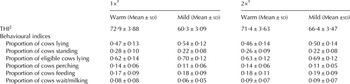
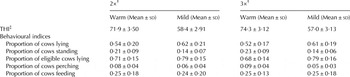
The THI on both farms was significantly higher during the warm period compared with the mild period (P < 0·001). The daily average THI on AMS farm was 72·1 and 63·4 in the warm and mild periods (Table 1), respectively (P < 0·001); comparable values on conventional farm were 73·1 and 57·7 in the warm and mild periods (Table 2), respectively (P < 0·001). The average THI values during the day (10·00–22·00) on AMS farm were 74·8 and 65·7, while the night (22·00–10·00) average THI were 69·5 and 61·1 in the warm and mild periods, respectively; comparable values on conventional farm were 75·2 and 58·9 for day THI and 70·7 and 56·5 for night THI in the warm and mild periods, respectively.
Mean and standard deviation (sd) values of temperature humidity index (THI) and behavioural indices for the two frequencies of feed delivery (1× and 2×) and for the two periods (warm and mild) in the automatic milking systems (AMS) farm

† 1×, feed delivery once a day; 2×, feed delivery twice a day
‡ THI, temperature humidity index
Mean and standard deviation (sd) values of temperature humidity index (THI) and behavioural indices for the two frequencies of feed delivery (2× and 3×) and for the two periods (warm and mild) in the conventional farm

† 2×, feed delivery twice a day; 3×, feed delivery 3 times a day
‡ THI, temperature humidity index
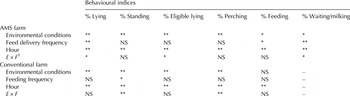
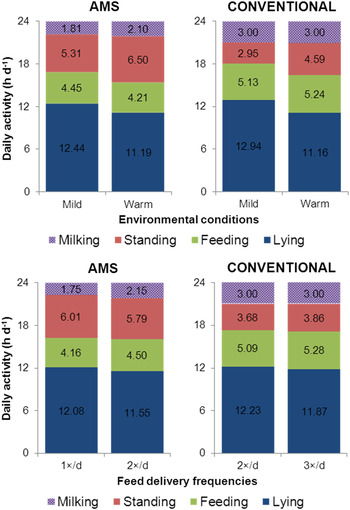
In the AMS farm (Table 1) the percentage of lying decreased significantly during the warm period compared to the mild one (P < 0·01, Table 3), while cows were standing longer (P < 0·01, Table 3). Thus, the proportions of stall use decreased in warm conditions (P < 0·01, Table 3). In warm conditions, the cows increased perching behaviour (P < 0·01, Table 3). Also the proportion of cows feeding was affected by environmental conditions (P < 0·05, Table 3), showing a significant (on average by 5%) decrease in the warm period compared to the mild one. Warm conditions also determined a significant increase of the number of cows in the waiting/milking area, in comparison to the mild conditions (P < 0·05, Table 3).
Environmental conditions and feeding frequency effects on behavioural indices (significance level) in the automatic milking systems (AMS) and conventional farm

† E × F, environmental conditions × feeding frequency interaction
**P < 0·01; *P < 0·05
NS, Not significant
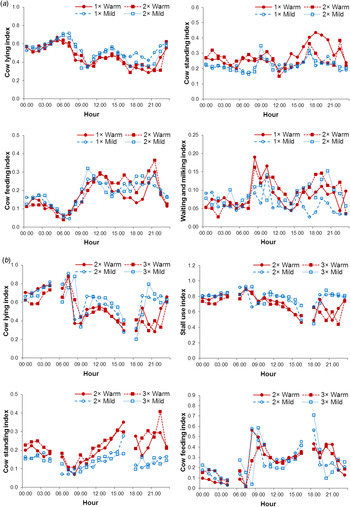
Environmental conditions affected also the behavioural patterns throughout the day (Fig. 1a); an effect that was especially evident in the % of lying and standing. Differences were found mainly during late morning and afternoon, in correspondence with the higher hourly average values of THI.
Hourly means of the behavioural indices for the AMS (a) and conventional farm (b) in the four test conditions: two environmental conditions (warm and mild) and two feed delivery frequencies (1× and 2×; 2× and 3×). Data are averaged for 8 d for each treatment and period

In the conventional farm (Table 2), as on the AMS farm, the proportions of cows lying decreased significantly (P < 0·01, Table 3), while % of standing increased (P < 0·01, Table 3) during the warm period compared to the mild one. In warm conditions, the cows increased the perching behaviour (P < 0·01, Table 3). Also for the conventional farm, the behavioural pattern throughout the day was affected by environmental conditions especially in terms of lying, stall use and standing behaviours. The main differences in the pattern occurred in the middle part of the day, before and after the second milking (Fig. 1b).
Feed delivery frequency effect
In the AMS farm significant effects of feed delivery frequency on the proportion of cows lying, feeding and in the waiting/milking area (Table 3) were found. Proportion of lying decreased when the number of feed distributions per day increased (P < 0·01), but the effect was significantly higher (environmental conditions × feeding frequency interaction, P < 0·05) in the mild period than in the warm period. Because the cow traffic was forced through the automated milking system (milking first), a significant increase (P < 0·01, Table 3) in the proportion of cows in milking and waiting area was observed when cows were fed 2× instead of 1×. Proportion of feeding cows was slightly but significantly higher (P < 0·05, Table 3) as number of feed administrations increased.
The effect of feed delivery frequency on the behavioural patterns throughout the day was rather limited compared to the effect of the periods (Fig. 1a). When cows were provided feed twice a day, instead of once, cows increased their feeding and waiting/milking time and decreased their standing time compared with once a day delivery, especially around the second feed delivery, when cows were stimulated by the fresh feed.
The increase of feed delivery frequency in the conventional farm determined a significant increase in time spent standing (P < 0·05), which occurred mainly in the warm period, as shown by the significant interaction between environmental conditions and feeding frequency (P < 0·01). The limited effect of feeding frequency on cow activities in the conventional farm was highlighted also on the behavioural patterns throughout the day (Fig. 1b).
Daily time budget
Feed delivery frequency and environmental conditions affected the daily time budgets of the cows (Fig. 2), and the effects were similar in both farms. In particular when the number of feed distributions increased, the feeding time increased and the lying time decreased. In the AMS farm cows significantly increased the time spent in the waiting and milking area of the automatic milking unit, while in conventional farm they increased the standing time.
Comparison of the daily time budget for the AMS and conventional farm considered in relation to the environmental conditions (mild and warm) and feed delivery frequency (AMS, 1× and 2×; conventional, 2× and 3×). Data are averaged for 16 d for each feeding frequencies and periods

Discussion
Environmental condition effect
Temperature-humidity index is a good predictor for heat stress in dairy cows (Dikmen & Hansen, Reference Dikmen and Hansen2009). During the warm period, daily average THI was slightly above 72, while during the day was 75, in both farms. Mild heat stress in high producing cows occurs when THI exceeds 72 (Armstrong, Reference Armstrong1994). Almost all behavioural indices were significantly affected by environmental conditions, both in the AMS and conventional farm. Although the daily average THI values were not particularly high (<75), even in the warm period, the differences in the daily time budget in the two periods were marked. This interaction between heat stress and lying and feeding behaviour, can be explained by the average THI during the day (10·00–22·00) recorded in both farms.
On both farms, environmental conditions significantly affected the lying, standing and perching behaviours. Cows spend more time standing without feeding and less time lying as heat load increased (Legrand et al. Reference Legrand, Schütz and Tucker2011). Cook et al. (Reference Cook, Mentink, Bennet and Burgi2007) found significant changes in behaviour at a THI of 68, with a reduction in lying time of 3 h/d over a range of THI from 56·2 to 73·8. Endres & Barberg (Reference Endres and Barberg2007) described an inverse relationship between lying behaviour and THI. In the present study lying behaviour was affected because standing time increased significantly during the warm period compared with the mild period on both farms. Provolo & Riva (Reference Provolo and Riva2009) reported increased standing durations as THI increased. Likewise, Cook et al. (Reference Cook, Mentink, Bennet and Burgi2007) found that the time spent standing in the alley increased from 2·6 to 4·5 h/d from the coolest to the hottest periods. This significant increase is comparable to the results from the present study, in which standing time increased by 1·2 and 1·6 h/d (on the AMS and conventional farm, respectively) in analogous environmental conditions (represented by THI). These changes in standing behaviour could be an indication of restlessness or stress during warmer periods (Endres & Barberg, Reference Endres and Barberg2007). As with standing, the proportion of cows perching showed a significant increment in both farms (>30%) revealing cows were less comfortable at higher THI, as indicated in previous researches (Overton et al. Reference Overton, Sischo, Temple and Moore2002; Zähner et al. Reference Zähner, Schrader, Hauser, Keck, Langhans and Wechsler2004). Environmental conditions affected also the lying and standing patterns throughout the day. Allen et al. (Reference Allen, Hall, Collier and Smith2015) found that standing durations peaked and lying durations decreased during the hours 12·00 to 18·00, suggesting that the hottest times throughout the day should be targeted for improving cow comfort.
Feed delivery frequency effect
The increase in feed delivery frequency caused different effects in the two farms. In particular, in the AMS farm, increasing feeding frequency decreased the time spent lying especially during mild period. On the contrary, DeVries & von Keyserlingk (Reference DeVries and von Keyserlingk2005) and DeVries et al. (Reference DeVries, von Keyserlingk and Beauchemin2005) showed that an increased frequency of feed delivery did not affect the total daily lying time. Moreover, the increase of feed delivery frequency from 1× to 2× caused an increase of feeding behaviour by 8% in both periods. Similar results were obtained by DeVries & von Keyserlingk (Reference DeVries and von Keyserlingk2005) and DeVries et al. (Reference DeVries, von Keyserlingk and Beauchemin2005). On the contrary, Hart et al. (Reference Hart, McBride, Duffield and DeVries2014) reported that feed delivery frequency had little effect on feeding behaviour.
Oostra et al. (Reference Oostra, Stefanowska and Sallvik2005) found that the waiting time for milking in AMS was reduced when the feeding frequency was increased under conditions of free cow traffic. In our AMS farm with forced traffic, milking first, the effect of more frequent feed deliveries was the opposite of that reported by Oostra et al. (Reference Oostra, Stefanowska and Sallvik2005). In fact, our results showed an increment in the proportion of cows in milking and waiting area with the increase of feeding frequency, confirmed by an increase of feeding behaviour and a decrease of lying time. This could be explained by the type of forced traffic (milking first system) which forces the cow to pass through the milking robot to access the manger.
Despite the increment of feeding behavior the increase of feed delivery did not significantly modify the DMI of cows, as reported in the companion paper (Bava et al. Reference Bava, Tamburini, Penati, Riva, Mattachini, Provolo and Sandrucci2012). The lack of response in terms of dry matter intake could be partially explained by the ad libitum feed administration and is in agreement with results reported by DeVries et al. Reference DeVries, von Keyserlingk and Beauchemin2005. Conversely the higher feeding frequency showed a positive significant effect on milk production (Bava et al. Reference Bava, Tamburini, Penati, Riva, Mattachini, Provolo and Sandrucci2012).
In the conventional farm the increased frequency of feed delivery induced a significant increase of standing behaviour mainly in the warm period. In contrast, DeVries et al. (Reference DeVries, von Keyserlingk and Beauchemin2005) found that an increased frequency of feed delivery reduced the amount of time that cows spend idly waiting for feed or to access the feed bunk. As happened on the AMS farm, cows fed at higher frequency (3×) on the conventional farm changed their feeding and lying time, especially around the hour between the first and second feed deliveries, when cows were more motivated to feed. Also in this farm no modification of DMI was observed as a consequence of the increase of feed deliveries but a significant increase of milk production was registered (Bava et al. Reference Bava, Tamburini, Penati, Riva, Mattachini, Provolo and Sandrucci2012).
The behavioural patterns throughout the day were not dramatically affected by the frequency of feed delivery on either farm. The fact that feeding and lying patterns were the behaviours more affected by increased feed delivery frequency agrees with results of DeVries & von Keyserlingk (Reference DeVries and von Keyserlingk2005) and DeVries et al. (Reference DeVries, von Keyserlingk and Beauchemin2005), who reported that the frequency of feed delivery altered feeding and lying patterns. The free-stall environment, management strategies (e.g. pushing feed in the manger) and milking systems introduce greater constraints on the amount of time cows can allocate to different activities (feeding, lying, standing). These influences may explain the differences in behavioural patterns observed on the two farms in this study.
In the AMS, cows are more able to determine individual patterns of lying, feeding and milking, but still remain influenced by the automatic milking management and complete barn setup consisting of milking units setting, cow traffic system, resting area and feeding area. Compared to conventional farms, where synchronization of behaviour does still occur (particularly around times of milking and feed delivery), in AMS farm behavioural activity is evenly distributed over a 24-h period. This may explain the different effects of feed delivery frequency found in this study with conventional feeding systems in combination with AMS or parlour-milking systems.
Conclusions
The most significant effect on daily cow time budget was related to THI, and this effect was observed also when daily THI values were in the range where heat stress should not yet occur.
The increased feed delivery frequency modified only slightly the daily time spent in different activities. Standing time of cows on the conventional farm and the time spent by cows in the waiting/milking area on the AMS farm both increased in response to increased feeding frequency. Although feed delivery frequency showed limited influence on cow's time budget, the effect on standing time should be considered carefully, especially on farms equipped with automatic milking units where the type of cow traffic system (e.g., milking first) might amplify the negative consequences of more frequent feed delivery.
Further investigations are required to evaluate the effect of environmental conditions and feed delivery frequency on other cow behaviours, such as the number of lying bouts and the duration of each lying period. Of course, in farms where feeding operations are not automated, a farmer should carefully evaluate if the higher cost of additional feed deliveries would be compensated by a mitigation of the negative effects of heat stress on behaviour and performance of dairy cows during warm conditions. The results could be helpful for farmers to improve their feeding management, through a proper use of feed delivery frequency as a management tool for helping cows to cope with heat stress, taking into consideration the specific farm milking and management system.
This research was financially supported by the Ministry of Education, University and Research (MIUR, Italy) within the PRIN 2007 project on Innovative Technical Solutions for Improving the Production Efficiency and the Animal Welfare in Dairy Cow Housing.